

You've poured a whiskey that looks familiar, read the label twice, and still aren't sure whether you're tasting the spirit or the story wrapped around it. The bottle may suggest a remote farm, a family recipe, or a carefully guarded barrel, yet the test begins when the label disappears and the glass has to speak for itself.
That's the pleasure of an American craft distillery. Across the country, small and independently minded producers are making bourbon, rye, and other American whiskies with regional grains, different maturation climates, and distinctive ideas about time. A blind tasting turns that variety into a personal discovery. You notice the pepper before you know the mash bill, the oak before you see the age statement, and the texture before a famous name tells you what to expect.
What Makes a Distillery Truly Craft
At a tasting bar, two glasses can fool you in opposite ways. One smells rich and polished, the kind of whiskey you expect from a big-name label. The other comes off younger, grainier, a little raw at first. Then you taste blind, and the question changes. You stop asking which bottle looks impressive and start asking who made the spirit in the glass, and what choices gave it that texture, spice, or weight.
That shift gets to the heart of craft. The American Craft Spirits Association's definition of craft spirits describes a U.S. craft spirits producer as a licensed American producer that is independently controlled, markets itself as craft, follows the association's ethical standards, and removes no more than 750,000 proof gallons, approximately 394,317 nine-liter cases, from bond annually. That gives drinkers a real frame for the term, but it does not settle every bottle on the shelf.
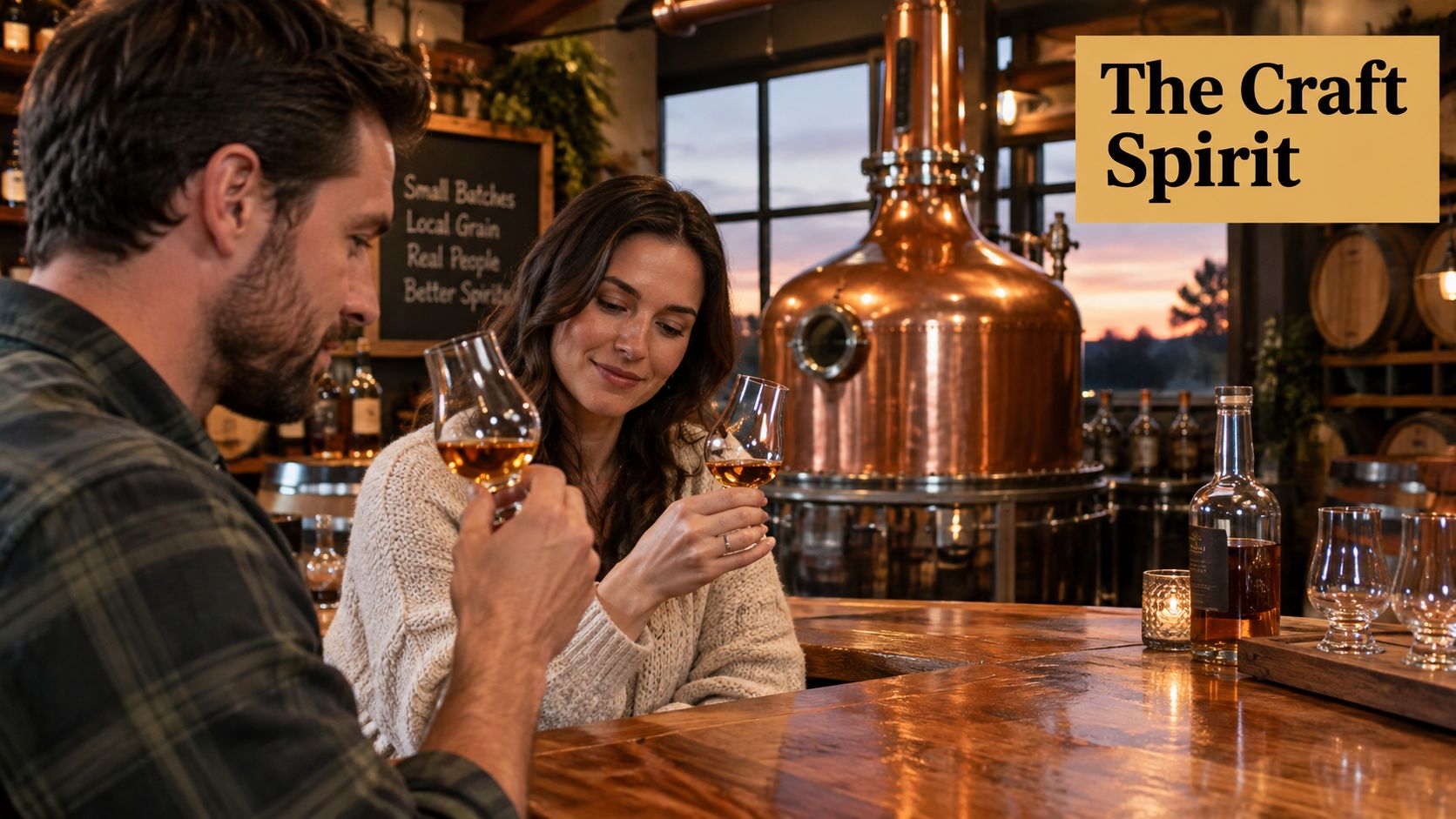
Independence matters more than romance
Some distilleries do the whole job in-house. They mill grain, ferment on-site, run small distillation batches, fill barrels, and watch those barrels mature in warehouses shaped by local weather. Visit a place like that and you can often smell the mash before you ever reach the tasting room. The whiskey tends to carry those decisions with it.
Other producers build their identity differently. They source whiskey, blend it with care, finish it in a distinctive cask, and bottle it with honesty about what they did. That can still lead to a memorable pour. What matters is clarity. A bottle should tell you whether the distillery made the whiskey, matured it, finished it, or curated it.
Blind tasting makes that distinction easier to feel before you read the back label. You notice whether the oak seems integrated or laid on top, whether the grain still speaks, whether the finish feels stitched together or naturally grown from the spirit. Brand image falls away. Process comes forward.
If you want a grounded explanation of what craft whiskey means, start there, then return to the glass. Ask who distilled it, where it aged, what grains shaped it, and how plainly the producer describes the work. That is usually where true craft begins.
Legal Standards and Production Methods
A bottle can carry an intimate backstory and still require careful technical reading. The American Craft Spirits Association sets its upper craft threshold at 750,000 proof gallons removed from bond annually, while the American Distilling Institute uses a narrower ceiling of 100,000 proof gallons, roughly 52,575 nine-liter cases. Those different standards show why “craft” isn't a single, universally measured production category. The Congressional Research Service overview of craft distiller definitions explains why output, ownership, sourcing, and in-house distillation all matter when comparing producers.
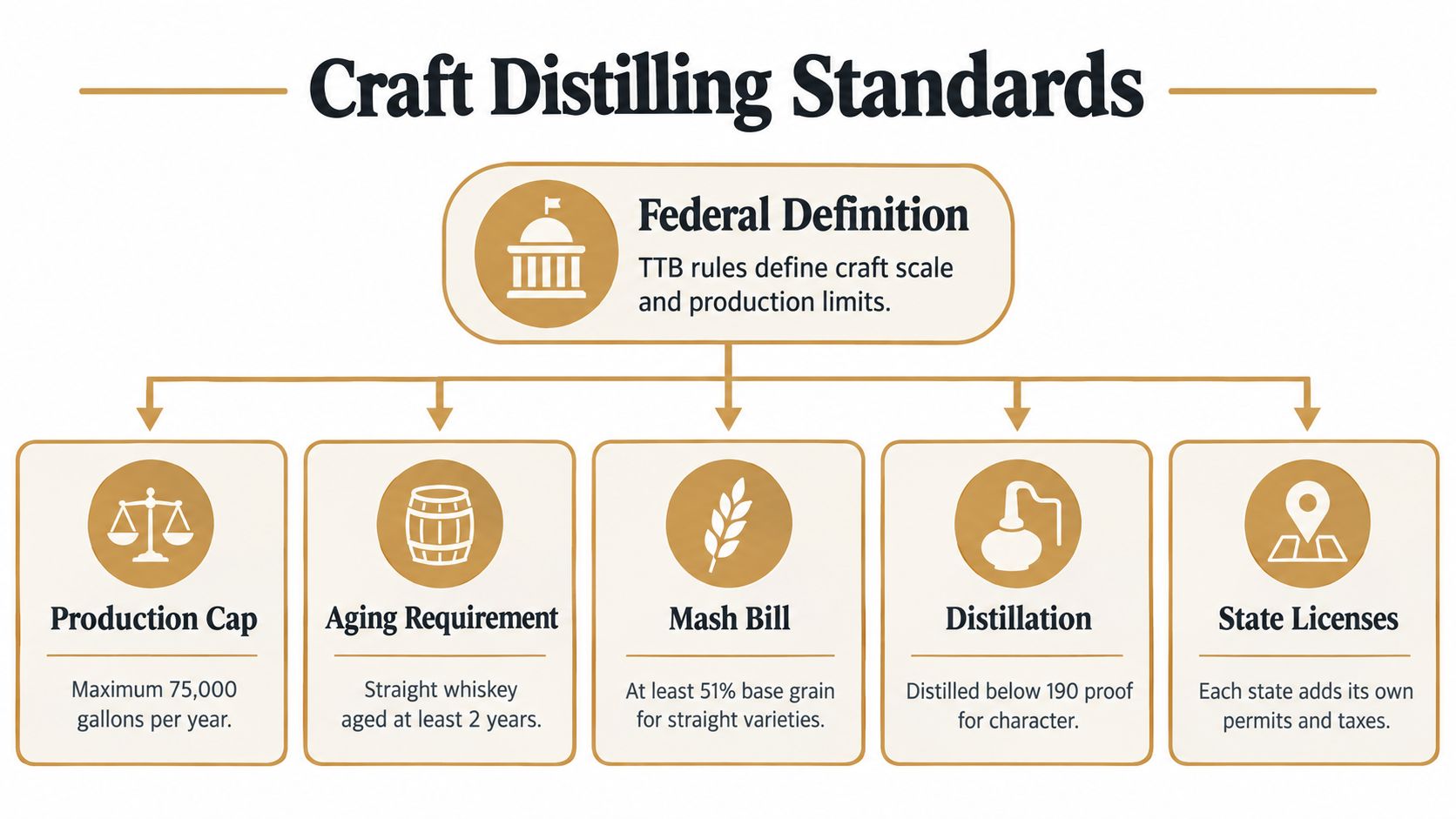
From grain to spirit
Production choices begin before the still. A mash bill determines whether the whiskey leans toward corn sweetness, rye spice, wheat softness, or malted-grain richness. Fermentation adds another layer through yeast selection, temperature, and the time the distiller allows the wash to develop.
Distillation then concentrates the spirit while shaping its texture and aroma. Pot stills can support a rich, weighty character, while column stills allow continuous operation and precise control. The copper still, the cut points, and the distiller's treatment of the heads, hearts, and tails all influence what eventually enters the barrel. A clear overview of these differences appears in this exploration of pot stills and column stills.
Label-reading rule: Treat “craft” as an invitation to investigate, not as a shortcut to a quality judgment.
The barrel changes the conversation
Maturation isn't passive storage. In controlled American whiskey research, bourbon and rye distillates entered identical new, charred 25-gallon, or 94.6-liter, oak barrels at 62.5% alcohol by volume, while ambient temperatures ranged from -2°C to 42°C. During maturation, compounds from the wood increased, including acids, esters, aldehydes, furfural, tannins, solids, and phenolic compounds. The research on bourbon and rye maturation chemistry helps explain why color, aroma, and flavor develop together.
Barrel size matters because a smaller barrel exposes more liquid to oak surface area. Extraction and, to some extent, oxidation can accelerate, but a young whiskey in a small cask hasn't automatically become the sensory equivalent of a much older whiskey in a full-size barrel. When you compare bottles, record the barrel volume, warehouse conditions, entry proof, char level, finishing regimen, and stated age. Those details explain why two whiskeys with the same age statement can taste dramatically different.
How to Taste Whiskey Like a Pro
Start with a small pour and resist the urge to add ice immediately. A beginner-friendly tasting method recommends choosing a familiar style, pouring about 1 ounce, and assessing aroma, sweetness, spice, texture, and finish before changing the whiskey. For bourbon, 80 to 90 proof, equivalent to 40% to 45% alcohol by volume, can provide an approachable starting range, according to this beginner's guide to drinking bourbon.
Build a repeatable first impression
Hold the glass below your nose and inhale gently with your mouth slightly open. That small adjustment softens the alcohol rush. Look at the color, then tilt the glass and watch how slowly the whiskey moves down the sides. These observations don't prove age or quality, but they give you a visual and tactile beginning.
Take a small sip and let it coat your tongue for 3 to 5 seconds. The first sip may register heat more than flavor, so compare the second and third sips before writing anything definitive. Use plain notes rather than trying to sound like a professional: “baked apple,” “dry pepper,” “toasted cereal,” “thin texture,” or “long oak finish” will tell you more than an elaborate tasting paragraph.
If you enjoy methodical sensory comparison, a coffee cupping guide offers a useful parallel. Coffee tasters separate aroma, flavor, body, acidity, and aftertaste rather than collapsing the whole experience into a single verdict. Whiskey rewards the same discipline.
Add water as an experiment
Taste neat first. Then add a small amount of room-temperature water, especially to a higher-proof pour, and compare the same glass again. Guidance for cask-strength bourbon above 115 proof suggests approximately 3 to 5 drops per ounce as a starting point, not a universal rule. The bourbon tasting guide on water and dilution explains the purpose clearly: gradual dilution can reduce ethanol's dominance and allow fruit, spice, or oak aromas to emerge.
Write down what changes. Does the nose become more open? Does the palate become softer, or thinner? Does the finish shorten? A blind tasting table, such as the one in this whiskey tasting guide, helps you compare samples without relying on memory.
Understanding Different Distillery Scales
Set three blind glasses in front of a few whiskey friends and scale starts to show itself fast. One pour feels raw and vivid, full of a single barrel's odd little edges. Another lands with a steadier rhythm, the kind of whiskey that suggests careful blending rather than one cask speaking alone. A third might still count as craft, yet it arrives polished, familiar, and easy to find again.
That spread exists because the craft category covers very different kinds of producers. Some distilleries work with only a small run of barrels, so each release carries the personality of a specific batch. Others have built enough inventory to shape a recognizable house style from multiple barrels while still playing with grain, proof, or local aging conditions.
The category also became more concentrated in August 2025. 2,282 active U.S. craft distillers were reported, down 25.6% from 3,069 a year earlier, and 39 large craft distillers, less than 2% of producers, accounted for 54.9% of total craft volume. Those figures show why the word craft can point to a tiny farm distillery or a much larger independent producer with broad distribution.
A useful comparison
| Distillery scale | What you may notice in the glass | What to check before buying |
|---|---|---|
| Very small | Distinctive batch character and greater variation between barrels | Batch number, barrel number, proof, and distillation source |
| Growing regional producer | More repeatable flavor with room for local experimentation | Mash bill, maturation location, and blending approach |
| Large craft producer | Consistent releases and wider availability | Ownership, actual production site, and whether the whiskey is distilled in-house |
None of those scales guarantees a better whiskey. Scale changes the producer's choices. A larger operation can smooth rough edges through blending and keep a core release tasting familiar from bottle to bottle. A very small distillery may have less room to correct variation, but that same limitation can leave you with a bottle that feels singular and alive.
That difference matters most in a blind tasting. Without the label nudging your expectations, consistency stops being a marketing virtue and becomes a sensory fact. You notice whether a whiskey carries a clean through-line from nose to finish, or whether its charm comes from a crooked, memorable twist.
Availability complicates the picture too. A bottle may be scarce because production is tiny, because state distribution rules get in the way, or because a distributor sees little reason to carry it. In a blind flight, scarcity loses its glamour for a moment. The glass gets the final word.
Spotlight on Notable Craft Distilleries
A map of American craft whiskey doesn't end at Kentucky. Coverage from PUNCH's look at American craft whiskey identifies producers such as Catoctin Creek in Virginia, Kings County in New York, Wyoming Whiskey in Wyoming, and Smooth Ambler in West Virginia. Their locations matter because grain, climate, warehouse conditions, and local drinking culture give each producer a different set of choices.
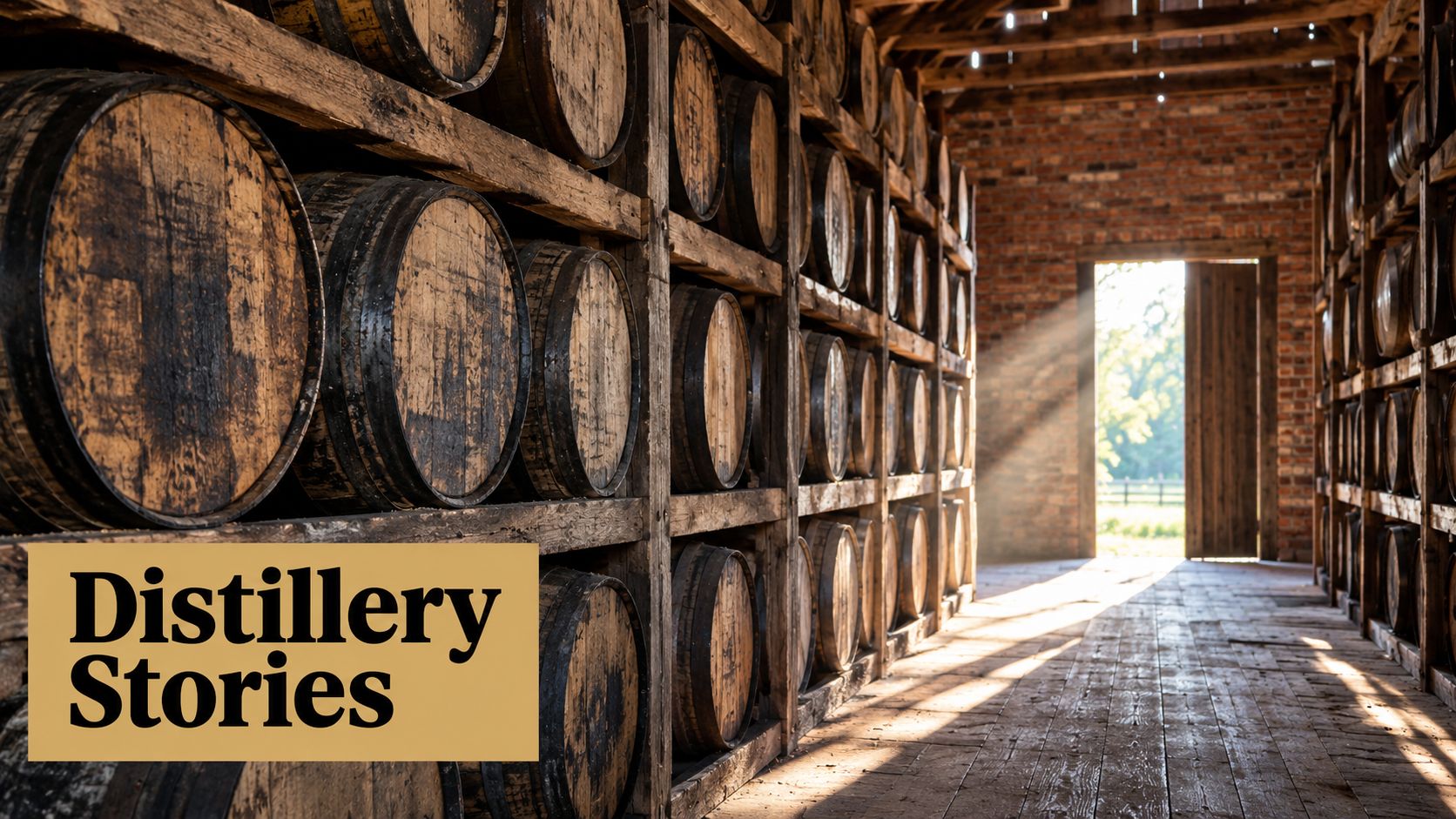
Regional character in the glass
Catoctin Creek offers a Virginia point of view, while Kings County brings an urban New York identity to American whiskey. Wyoming Whiskey suggests how a western environment can become part of a producer's personality, and Smooth Ambler gives West Virginia a place in the broader craft conversation. The point isn't to assign each state a single flavor. It's to recognize that American whiskey now comes from a much wider range of regions and production cultures.
A blind flight makes those contrasts easier to hear. One sample may show a grain-forward profile, another a firmer rye edge, and another a softer, sweeter structure. Only after you've formed an opinion should you reveal the producer and compare your notes with the stated mash bill, proof, and maturation details.
Distillery visits add a human dimension. You see whether the team works with a compact still, rows of resting barrels, or a grain-to-glass process. You also learn which details the producer explains freely. That transparency often tells you as much about the operation as the tasting notes.
For travelers planning a wider drinks itinerary, a guide to the best craft breweries near me can help build a regional route around independent producers. A distillery visit doesn't have to be a formal tour. Sometimes the most valuable moment is a conversation beside the tasting bar, with the person pouring the whiskey explaining why one barrel was kept separate from the next.
Why Blind Tasting Changes Everything
A brand name can create expectations before the whiskey reaches your lips. Packaging can suggest luxury, a familiar state can suggest tradition, and a high price can make you search for complexity that isn't there. Blind tasting removes those signals long enough for your senses to establish a first opinion.
The method works because it separates two decisions. First, you decide what you enjoy. Later, you decide whether the producer, price, production model, and availability make the bottle worth pursuing. That order protects the tasting from becoming a hunt for confirmation.
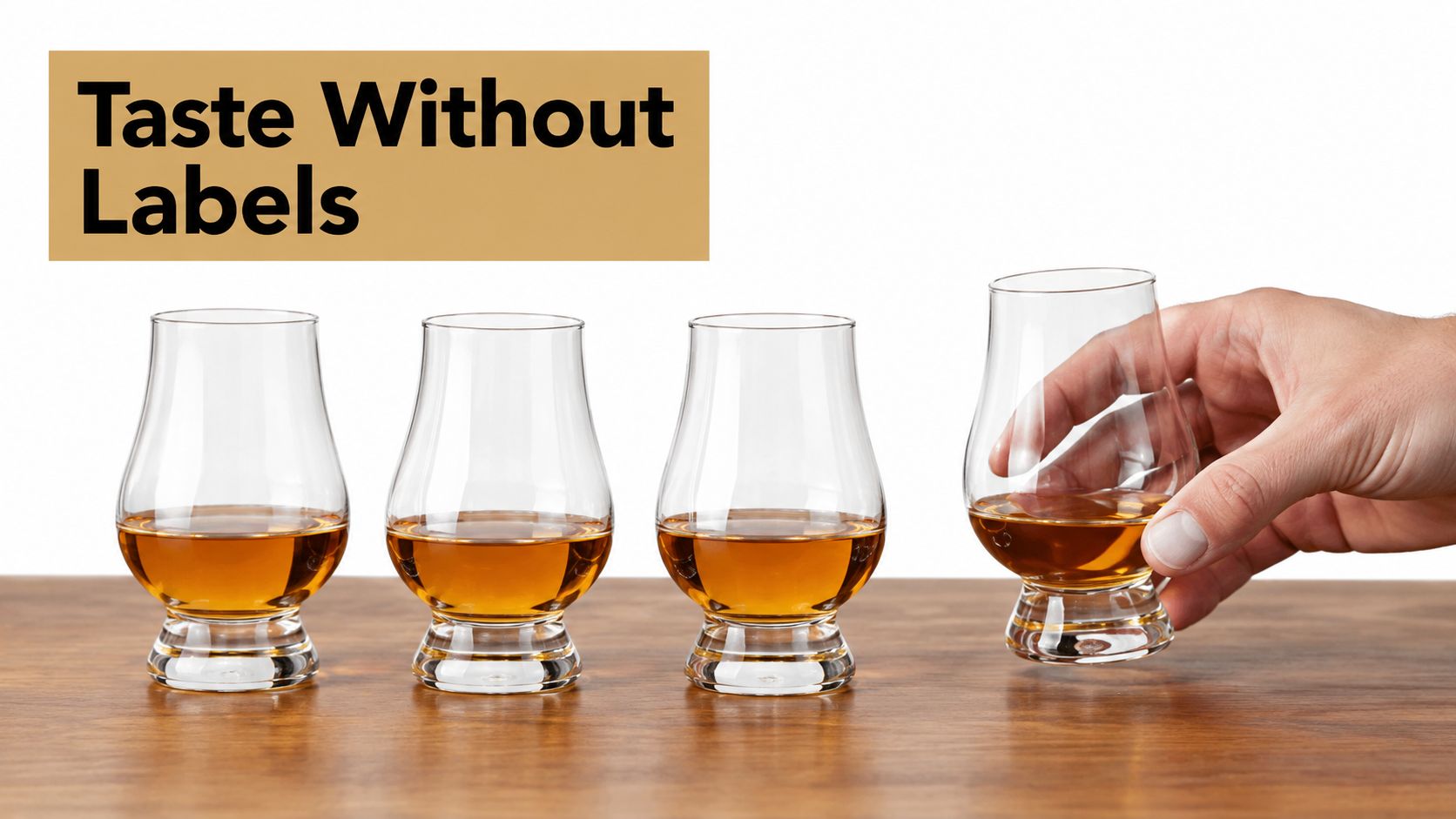
Flavor before biography
Consider a four-sample flight. You might rank sample three first because it has the richest texture, place sample one second for its bright spice, and leave sample four behind because the oak overwhelms the finish. Only after recording those impressions do you learn that one came from a producer you already admire, another from an unfamiliar regional distillery, and another from a sourced whiskey with a transparent production story.
That reveal doesn't invalidate your palate. It gives you better questions. Did the higher-proof sample need water? Did the smaller barrel produce a more assertive oak note? Did a rye-heavy mash bill create the pepper you noticed? Blind tasting turns those questions into a practical investigation rather than a theoretical debate.
A useful habit: Write your ranking before you reveal the labels. Your first preference is information, even when it surprises you.
Blind tasting also makes craft whiskey communal. Couples can compare scores, friends can argue over fruit and spice, and beginners can participate without needing a vocabulary built over years. The game matters less than the conversation it creates. Everyone starts with the same unknown glasses and discovers that preference doesn't always follow reputation.
That discovery can influence what you buy and whom you support. Once you know you prefer grain-forward rye, soft wheated bourbon, or a dry oak finish, you can look for producers whose methods create those traits. The bottle becomes the next step in an informed exploration, not a purchase based only on a story.
How to Find and Support Craft Distilleries
Start close to home, but don't assume local availability tells the whole story. Search for distilleries that publish their production location, distillation source, mash bill, maturation details, and ownership structure. A producer that explains what it does gives you more useful information than a brand that relies on broad words such as “handcrafted” without describing the liquid.
Plan the visit around questions
Before you go, check whether the tasting room offers tours, bottle sales, or access to limited releases. Ask whether the whiskey is distilled in-house, where it ages, and how the team handles sourced spirit if it uses any. None of those questions is an accusation. They help you understand what you're tasting.
Bring a notebook and record the details that can disappear once the visit becomes social:
- Production: Note the still type, mash bill, fermentation approach, and whether the distillery makes or sources its whiskey.
- Maturation: Ask about barrel size, warehouse conditions, entry proof, char level, and finishing.
- Bottling: Record proof, batch, barrel number, age statement, and whether the whiskey is chill-filtered.
- People: Remember the names of the distiller or guide, especially if they explain a choice that changes how you understand the bottle.
The American craft category has real national reach, but it has also experienced correction. In 2024, craft-spirit volume declined 6.1% to 12.7 million nine-liter cases and value declined 3.3% to $7.58 billion, while exports fell to 142,000 nine-liter cases, according to the 2024 Craft Spirits Data Project. Those figures help explain why direct visits, transparent purchasing, and thoughtful recommendations matter to small producers.
Understand the distribution problem
State rules differ substantially in what distillers can sell on-site and how bottles travel across state lines. In 2024, 48.5% of craft-spirit sales occurred within producers' home states and 51.5% outside them, showing that craft whiskey moves well beyond tasting rooms, even while access remains uneven. The reporting on distribution challenges for craft distillers also notes that large craft producers obtained 68.6% of their volume sales outside their home state, compared with 39.3% for medium-sized producers.
So, a missing bottle isn't automatically a superior bottle. It may be constrained by licensing, distributor priorities, allocation, or limited production. If you find a whiskey you love, buy from the distillery when permitted, recommend it accurately, and return for another release. A blind tasting can guide that process by showing you which producers and styles deserve your attention before you commit to a full bottle.
Blind Barrels sends members quarterly blind tasting kits with four samples from small American craft distilleries, a tasting table, a guessing game, and QR-code access to each whiskey's details and bottle purchasing options. If you want to put your palate first and discover unfamiliar producers without brand bias, visit Blind Barrels and explore the next tasting experience.