

You've invited a few friends over, bought a bottle that looked interesting, and placed several glasses on the kitchen table. Then someone asks the question that changes the evening: “What are we tasting?” Without a plan, the night can become a sequence of pours, guesses, and half-remembered labels. With an at home whiskey tasting kit, the same table becomes a small sensory classroom, where everyone can compare, score, and learn together.
Whiskey already has the audience to support that kind of experience. One market summary estimated global whiskey consumption at about 3.0 billion litres in 2024, with China, India, and the United States among the largest consumption centers by volume. The same source placed world-average per-capita consumption near 0.4 litres, while the UAE reached 5.4 litres per person, illustrating how whiskey culture spans both mass markets and premium occasions (global whiskey consumption and market data).
What an At Home Whiskey Tasting Kit Is
At the kitchen table, a bottle of bourbon usually points you toward drinking. A tasting kit gives the evening a different purpose: slow down, compare pours, and describe what you sense before anyone identifies the whiskey.
An at home whiskey tasting kit is a curated package organized around that process. It typically combines small-format whiskey samples, tasting glassware, blind-tasting materials, scoring cards, and host guidance. Its purpose is to make tasting repeatable, social, and educational, rather than provide a selection of miniatures.
A generic sampler reveals its contents immediately. The label can trigger expectations before the first sip, much like seeing the answer before taking a quiz. A structured kit removes that shortcut with numbered or letter-coded samples, matching glasses, and a reveal key. Attention moves toward aroma, flavor, texture, and finish.
Blind comparison is the central feature
Blind tasting is the method that makes comparison useful. If one guest knows a sample is expensive, another recognizes a famous distillery, and a third has already decided that rye is not for them, the group is responding to reputation as well as liquid.
A blind setup gives every sample the same visual treatment. Guests can record whether a whiskey seems sweet, spicy, fruity, or smoky before learning its identity. They can also guess its type, age, or proof, then compare those guesses with the answer key during the reveal.
The useful question isn't “Which label do I prefer?” It's “What did I perceive before the label influenced me?”
The result is a palate-training tool. A score is feedback, not a verdict on your taste. If you repeatedly mistake a high-proof bourbon for a softer pour, or notice fruit while missing oak, you have a specific skill to practice.
Craft-focused subscriptions such as Blind Barrels use this format to make each delivery a deliberate comparison instead of a random collection of miniatures. The approach works across bourbon, rye, single malt, and other American styles, while keeping craft distillers at the center of the story. It also suits home tasting, where 48% of spirits in the United States are consumed at home, according to U.S. spirits consumption locations and whisky market context.
Inside the Box and What Each Piece Does
Open a well-designed kit and start with the samples, not the glassware. The liquid is the lesson, while every other component helps you observe it more consistently.
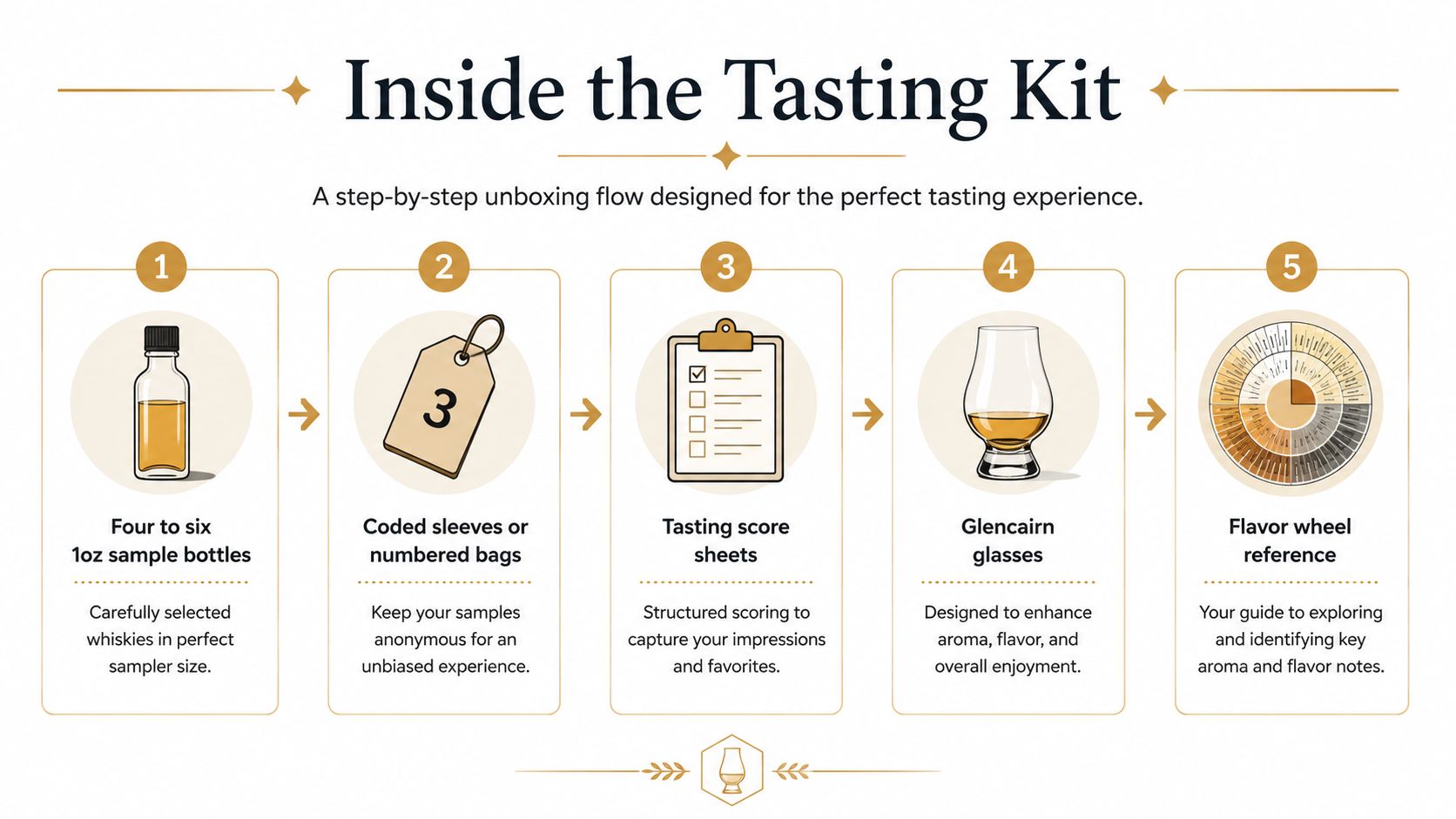
Samples and blind coding
Most kits center on four to six small bottles, often holding 50 ml or 1 oz. That gives each guest enough liquid to nose, taste, revisit, and compare without opening several full bottles.
The bottles may arrive inside coded sleeves or numbered bags. Keep the original labels hidden and place the samples in a sequence such as A, B, C, and D. The code should appear on the glass and the score sheet, but not reveal the distillery, style, age, or proof.
A Glencairn-style tulip glass or copita is useful because its bowl gives the whiskey room to move while the narrower rim directs aromas toward the nose. Sensory guidance commonly treats about 20 mL as sufficient for evaluation, and recommends covering the vessel between sniffs for a brief 5 to 10 second aroma equilibration (spirits glassware and sample-handling guidance).
The tasting mat and score sheet
A printed mat should create a clear path through the glass:
- Appearance: Note color, clarity, and viscosity without treating color as proof of age or quality.
- Nose: Record the first aroma, then look for families such as vanilla, fruit, cereal, spice, oak, or smoke.
- Palate: Describe sweetness, heat, texture, grain character, and barrel influence.
- Finish: Decide whether the flavor disappears quickly or lingers with changing notes.
- Score: Use the kit's scale consistently, then explain the reason behind the number.
The score sheet should also include a guess-the-whiskey field. Depending on the kit, you may guess type, age, proof, or distillery. A reveal window or answer key lets the host keep the information concealed until everyone has written down an impression.
Water and palate cleansers
Place neutral water beside every setting. Guests can take a sip between samples, and a few measured drops can help them explore how dilution changes aroma and mouthfeel.
Plain water crackers, unseasoned bread, and unflavored sparkling water are safer than strongly flavored snacks. A flavor wheel, spit cup, and printed distillery backstories are useful extras. The backstories work especially well during the reveal, when a question about a grain bill or barrel finish can turn a score comparison into a conversation about production.
Why Blind Tasting Changes the Experience
A label carries more than information. It can suggest price, status, age, region, and expected flavor before the whiskey reaches your lips. Those expectations can make the same liquid seem more impressive, more refined, or more disappointing than it feels when the identity stays hidden.
Blind comparison doesn't eliminate every personal preference, but it removes several obvious cues. Identical glasses and equal pours prevent presentation from becoming part of the score. Keeping bottles out of sight also stops guests from reading the kit insert and unconsciously searching for its tasting notes.
The chemistry of a better pour
Dilution matters because ethanol can dominate the vapor above the glass. Sensory and volatile-analysis research found that diluting beyond about 80% whiskey and 20% water can reduce the ability to distinguish aromas within the same style, while broader style differences may become more noticeable with further dilution. Industry-facing sensory guidance also commonly standardizes aromatic evaluation near 20% ABV, because lower ethanol can reduce burn and improve odor detection sensitivity (whisky dilution and aroma research).
That doesn't mean every pour needs the same water addition. It means water should be available as a controlled variable. Taste the sample neat first, add a small amount, and record whether the aroma becomes clearer or flatter.
Practical rule: Keep the bottle hidden, keep the glass consistent, and change only one variable at a time.
For a fuller explanation of the format, the guide to blind whiskey tasting is a useful companion for hosts who want to turn guesses into a repeatable exercise.
What the host should prevent
Avoid announcing the category before the first round. Don't tell guests which sample is young, smoky, expensive, or from a familiar distillery. Remove scented candles, powerful food aromas, and freshly sprayed cleaners from the room.
A calm environment helps guests notice small differences. Professional judging panels and organized competitions use standardized conditions for the same reason, although a home tasting should stay relaxed rather than pretending to be a formal examination.
The most valuable result is not a perfect score. It's a clearer sense of your own palate. Across several kits, you can compare your guesses with the reveals and see whether your recognition of proof, grain, barrel, fruit, spice, or smoke becomes more consistent.
How to Host a Tasting Night Step by Step
Set the room before guests arrive. Clear the table, remove strong scents, and use comfortable lighting that lets everyone see the score sheet without turning the evening into a laboratory session.
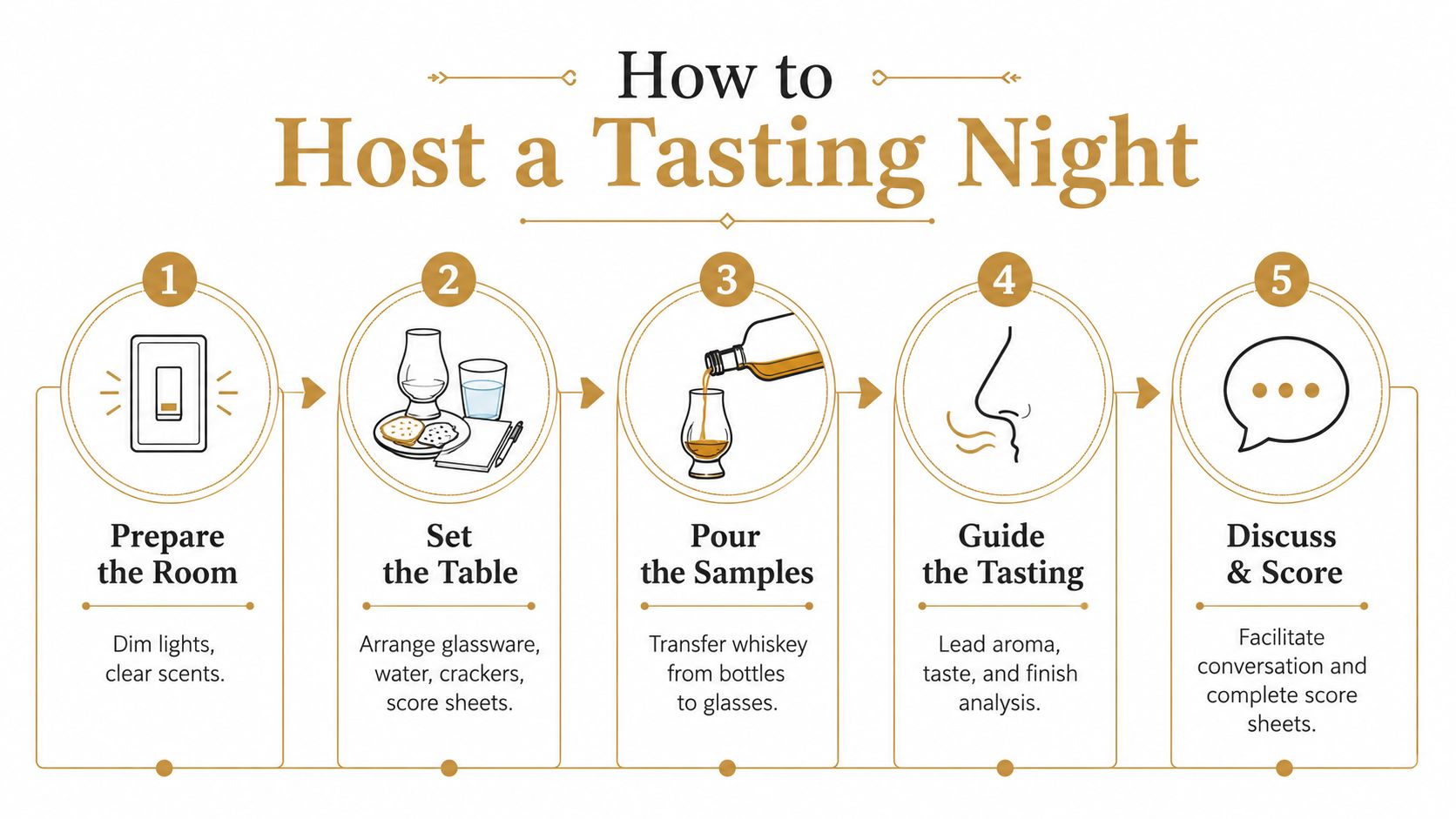
Prepare the table
Place the glasses, water, plain crackers, and score sheets where guests can reach them. Pour the samples into identical glasses labeled A, B, C, and D, then cover them or use opaque sleeves. Keep the source bottles and answer key in another room until the reveal.
Start with a short primer. Explain that guests will look, smell, sip, and savor, then introduce four broad flavor families: sweet, spicy, fruity, and smoky. These categories aren't a limitation. They give a newcomer somewhere to begin before more precise descriptors arrive.
Guide each sample
Give guests about one minute for nosing. Ask them to smell gently rather than forcing a deep inhale, then write the first impression before discussing it with the group.
Next, take a small sip and hold it for ten seconds. Notice heat, sweetness, texture, and the way the flavor spreads. A second sip after a water rinse can reveal a different balance, especially when the first impression was dominated by alcohol or oak.
Use prompts that don't lead the answer:
- Nose: What arrives first, grain, fruit, spice, vanilla, or smoke?
- Palate: Does the whiskey feel light, oily, dry, sweet, or hot?
- Finish: What remains after swallowing, and does it change?
- Guess: Which style or proof range seems plausible, and why?
Discuss without contaminating the score
Give the group a fifteen-minute discussion window between rounds so palates can reset. Ask everyone to write privately before inviting comments. That prevents the most confident voice from becoming the group's official opinion.
For hosts who enjoy guided hospitality, the principles behind exclusive tastings at Girard Winery offer a useful reminder: the host's job is to create structure while leaving room for personal discovery. The same balance works with whiskey.
Finish with the reveal. Compare each guess with the answer key, discuss the largest surprises, and crown a winner based on the kit's scoring system or the most accurate set of predictions. The evening doesn't need to stop immediately afterward. Leave twenty minutes for conversation, optional refills, and questions about the distilleries.
The at-home whiskey tasting guide can help you shape the event if you'd rather follow a prepared format than improvise.
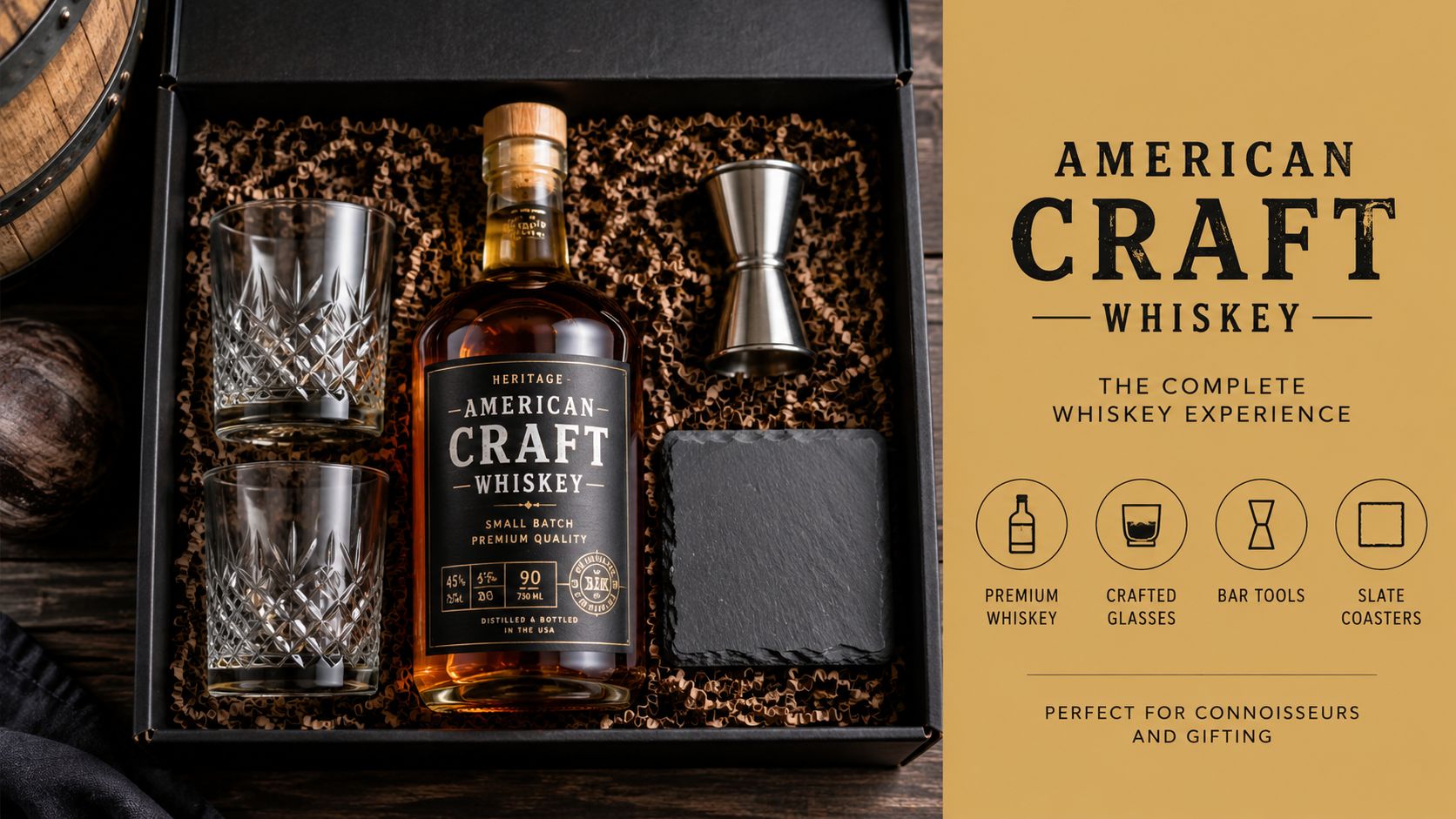
American Craft Whiskey at the Center of the Kit
The first pour may come from an anonymous vial, but the lesson begins with its origin. A craft-focused kit selects each sample to show how American distillers shape flavor through grain bills, yeast, barrels, and finishing techniques. The box becomes a palate-training tool, not just a collection of small servings.
A well-built flight might place a high-rye bourbon from Kentucky beside a Pacific Northwest single malt, a young corn whiskey from the Midwest, and a whiskey finished in wine or maple casks. Guests can score their guesses before the reveal, then compare those predictions with the production choices behind each pour. The goal is not to name one region as superior. It is to connect a sensory impression with a practical decision made in the distillery.
A high-rye bourbon may show pepper and dry spice. A single malt can emphasize malt, fruit, or toasted grain. A corn whiskey may feel softer or more direct, while a finishing cask can add a layer absent from the original spirit. Blind comparison makes those differences easier to notice because the label cannot supply the expected answer.
Why smaller producers make strong teaching material
Small distilleries often build a clearer production identity. Unusual grain choices, limited barrel experiments, and variation between expressions give guests stronger contrasts than a lineup made only from widely distributed bottles.
The American craft segment includes 3,069 craft distillers in the United States as of 2025, according to American craft distiller coverage. Earlier industry analysis described growth from 75 distillers in 2006 to more than 2,000, with reported sales of $7.6 billion and 12.7 million 9-liter cases (American whiskey craft segment analysis).
Craft-only curation gives the distillery card a teaching role. Guests first record what they smell and taste, then learn about the place, materials, and choices behind the liquid. One commonly used craft-distillery definition sets a ceiling of fewer than 750,000 proof gallons annually, roughly 1.6 million liters, to distinguish smaller producers from industrial-scale operations.
The result is a tasting map of American whiskey innovation. Each reveal links a scored guess to a real production choice, helping the palate become more precise over repeated sessions.
Choosing a High End Subscription Worth Paying For
A worthwhile subscription functions like a palate-training course. Each delivery should give you a focused question to answer, a method for recording the result, and enough context to understand what your senses noticed after the reveal.
Blind Barrels, for example, delivers four blind craft whiskey samples quarterly with a tasting table, QR-based reveal, and a guessing game covering characteristics such as age, proof, and whiskey type. Other subscriptions may change the schedule or sample format. Compare how well each one teaches comparison, rather than judging the box by its appearance.
Compare the important features
| Criterion | Premium Kit, for example Blind Barrels | Generic Sampler Box |
|---|---|---|
| Curation | A coherent flight with a clear regional, stylistic, or craft focus | A scattered mix chosen mainly for variety |
| Education | Origin cards, aroma prompts, tasting notes, and structured scoring | Basic labels or short product descriptions |
| Glassware and tools | Suitable nosing glasses, water guidance, and useful tasting materials | Decorative extras that may not improve evaluation |
| Blind integrity | Numbered sleeves, opaque presentation, and a controlled reveal | Visible brands or easily identifiable packaging |
| Palate development | Repeated comparison, scored guessing, and reflection | One-time sampling with little feedback |
| Value | Price assessed against the quality and educational use of each pour | Price driven by quantity, presentation, or novelty |
For more detail on subscription criteria, see this guide to monthly whiskey subscriptions.
Sample count affects the quality of the lesson. Independent home whiskey tasting kit guidance often recommends three to five whiskies for a home tasting, which helps limit palate fatigue. Too many miniatures can make each pour blur into the next, particularly during a first session.
Check the provenance information before subscribing. A serious kit should disclose mash bill details when available, aging information, bottling date, and ABV. It should offer neutral water guidance and explain why the samples are arranged in their chosen order. Those details connect a sensory impression to a production decision.
Skip expensive accessories when the whiskey arrives without useful context. A high-end subscription earns its price by helping you compare, score, and recognize patterns over repeated tastings, not by looking impressive before the first bottle is opened.
Building Your Palate and Pairing Beyond the Kit
Your first tasting night creates a baseline. Two weeks later, revisit one of the samples and write a short note before checking your original score. You may notice fruit where you first recorded sweetness, or recognize oak as the source of a dry finish.
Keep the habit simple enough to continue. Record the date, bottle code or name, one aroma, one flavor, and one change from your earlier note. Beginner guidance also recommends modest pours, water nearby, avoiding strong foods or coffee beforehand, and comparing notes with friends (practical whisky tasting guidance).
Use food as a calibration tool
Pairings aren't about finding one officially correct combination. They're a way to push the whiskey in different directions and observe what becomes easier to smell or taste.
- High-rye bourbon: Try smoked almonds or sharp cheddar. Salt and fat can make peppery spice and barrel char feel more pronounced.
- Port-finished rye: Dark chocolate can echo dried fruit and deepen the impression of richness.
- Wheated bourbon: Dried apricots can highlight soft sweetness and fruit.
- Light, grain-forward whiskey: Oysters or ceviche can create a clean contrast that makes cereal and freshness easier to notice.
Taste the whiskey alone, take a bite, and return to the glass. Ask whether the food makes the finish sweeter, drier, spicier, or less noticeable. Salty, fatty, bitter, and sweet foods each shift attention toward different parts of the sensory profile.
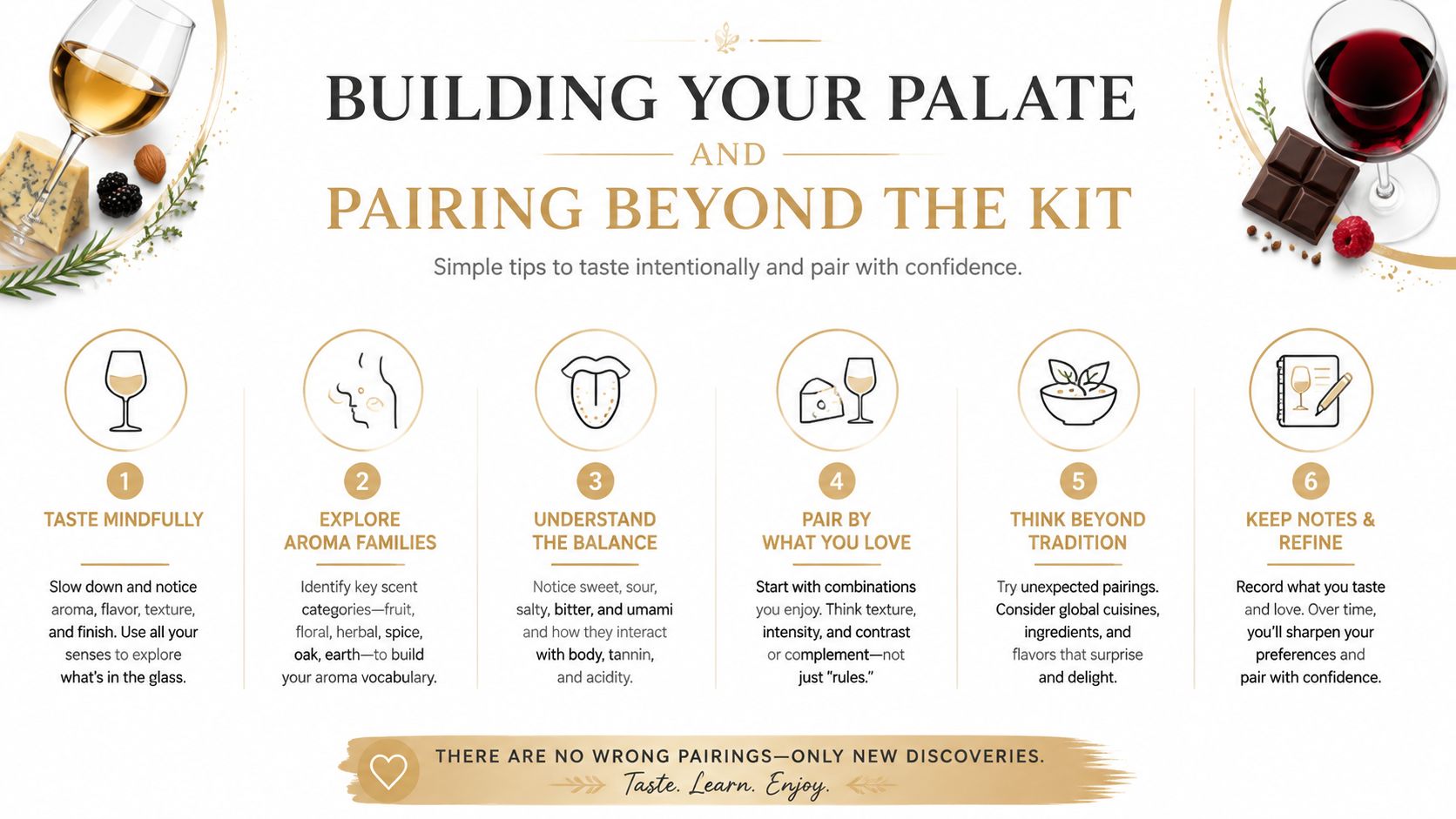
A useful journal doesn't need elaborate tasting language. Write one new descriptor per session and explain what led you there. Over time, your notes become a record of how your palate recognizes proof, grain, barrel, fruit, spice, and smoke.
Your palate improves through attention, not performance. You don't need to identify every aroma. You need to notice one more thing than you noticed last time.
Blind Barrels offers a quarterly blind whiskey tasting subscription with four samples from small American craft distilleries, tasting guidance, a QR reveal, and a scoring game for testing your guesses. Visit Blind Barrels to explore a kit that turns an evening of sampling into an ongoing palate-training ritual.