

If you're looking for the best glasses for scotch whiskey, let's cut to the chase. The Glencairn is the undisputed king for a serious tasting, while a classic Tumbler (you might know it as a Rocks glass) is your go-to for just kicking back and enjoying a dram. Your glass isn't just a cup; it's a critical tool designed to channel aromas and elevate every single sip, transforming a simple drink into a full-on sensory journey.
Why Your Glass Is As Important As Your Scotch
Ever wonder why wine lovers get so particular about using different glasses for a Merlot versus a Chardonnay? Well, the exact same logic applies to scotch whiskey. The shape, size, and even the material of your glass have a direct impact on how the aromas hit your nose and how the spirit lands on your palate. It’s the difference between just drinking whiskey and truly tasting it.
Think of it like this: a fantastic scotch is a complex piece of music. Pouring it into any old cup is like trying to listen to a symphony through cheap, crackly earbuds. Sure, you'll catch the main tune, but all the subtle harmonies and rich details that make it truly special will be lost. A proper scotch glass, on the other hand, acts like a high-fidelity speaker, gathering all those aromatic compounds and pointing them right where you can appreciate them.
Finding The Right Tool For The Job
For anyone new to whiskey, the sheer variety of glassware can feel a bit much, but it really just boils down to two main purposes: serious tasting or casual enjoyment.
A glass built for tasting, like the famous Glencairn, features a wide bowl that allows the whiskey to breathe and open up, paired with a narrow rim that funnels those delicate scents upward. This specific design is what helps you pick up on those subtle notes of oak, fruit, and smoke that might otherwise completely pass you by.
On the other side of the spectrum, a Tumbler is built for comfort and pure versatility. It’s got plenty of room for a large ice cube or for mixing a simple cocktail. It's less about deep analysis and more about the simple pleasure of a good drink. Many enthusiasts keep both types on hand, especially those exploring the bold flavors from American craft distilleries. And while you're upgrading your bar, you might want to discover more kitchenware essentials to round out your home entertaining setup.
To help you choose, we’ve put together a quick look at the most popular styles and what they do best.
Scotch Glass Styles At A Glance
This table breaks down the key players in the scotch glassware game, helping you match the right glass to your drinking style.
| Glass Type | Primary Use | Aroma Concentration | Best For Drinker Type |
|---|---|---|---|
| Glencairn | Analytical Tasting & Nosing | High | The Enthusiast & New Drinker |
| Tumbler (Rocks) | Casual Sipping & Cocktails | Low | The Casual Drinker |
| Copita (Nosing) | Professional Nosing | Very High | The Connoisseur & Blender |
| NEAT Glass | Diffusing Alcohol Burn | Medium | The Professional Taster |
Whether you're a seasoned connoisseur or just starting your whiskey journey, having the right glass in hand makes all the difference. It's a small investment that pays huge dividends in flavor and enjoyment.
Why Your Scotch Glass Shape Matters So Much
Don't mistake your scotch glass for a simple container. It's a highly functional piece of engineering, designed from the ground up to completely transform your tasting experience. Think of it like the cone of a speaker—its specific shape is what gathers all the subtle, complex aromatic compounds from the whisky and channels them directly to your nose. Without it, you'd miss half the show.
It all starts with a wide bowl. That larger surface area is crucial because it lets the scotch breathe. This gentle encouragement of evaporation is what releases the volatile compounds that carry the spirit’s unique personality. Whether it’s the briny, smoky peat of an Islay scotch or the sweet vanilla from an American single malt aged in new oak, these aromas are the first chapter of your whisky's story.
From there, the rim takes over. A narrow, tapered opening acts like a funnel, concentrating every last one of those released aromas. This focused delivery is what allows you to pick up on layers of complexity that would simply float away in a wide-mouthed tumbler. For anyone new to whisky, this is the secret to learning how to identify specific tasting notes.
How Shape Unlocks Flavor
The link between aroma and taste is immediate and powerful. A huge portion of what we register as "flavor" actually comes from our sense of smell. By concentrating the aromas, a well-designed glass essentially primes your palate for what’s to come, making the flavors seem richer, deeper, and more distinct.
"A proper glass doesn’t just hold your whisky; it presents it. The shape is a tool that separates the amateur from the enthusiast by unlocking the full aromatic potential locked inside the spirit."
This isn't just theory; it plays out in the real world. A sensory study in 2022 found that a staggering 68% of drinkers reported a better tasting experience with tulip-shaped glasses over standard tumblers. This preference has a real business impact, too. Bars often see a 15-20% bump in premium scotch sales just by switching to proper glassware, proving that presentation directly shapes perception and enjoyment. You can get a better sense of how global tastes are evolving and discover more insights about scotch consumption worldwide.
This infographic gives you a fantastic visual breakdown of how different glass styles are built for different purposes.
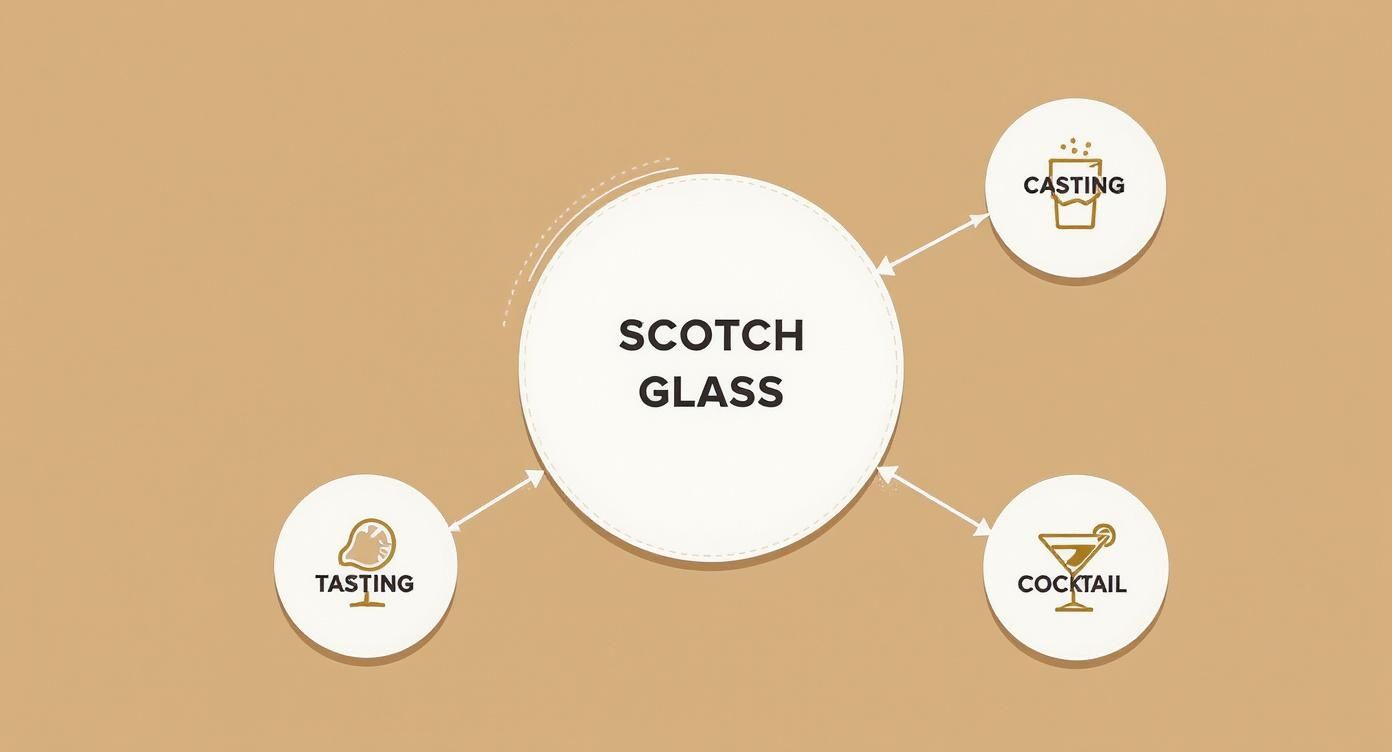
As you can see, your choice of glass should really match your goal for the evening, whether it’s a deep, analytical tasting, a casual weeknight dram, or mixing up a cocktail.
Putting It All Together
Once you understand the science, you can choose the best glasses for scotch whiskey based on function, not just looks. When you know why a Glencairn works so well, you start to appreciate the brilliant, yet subtle, design choices that made it the industry standard. This is the foundation for moving beyond simply drinking whisky to truly appreciating its craft, its history, and its incredible complexity.
Alright, we've established why the shape of your glass is so crucial. Now, let's get into the fun part—exploring the specific styles that you'll find in the hands of whisky lovers everywhere.
Each of these contenders for the "best" scotch glass brings something different to the table. They all have their own history, design quirks, and ideal use case. The right one for you really just depends on how you want to enjoy your drink.
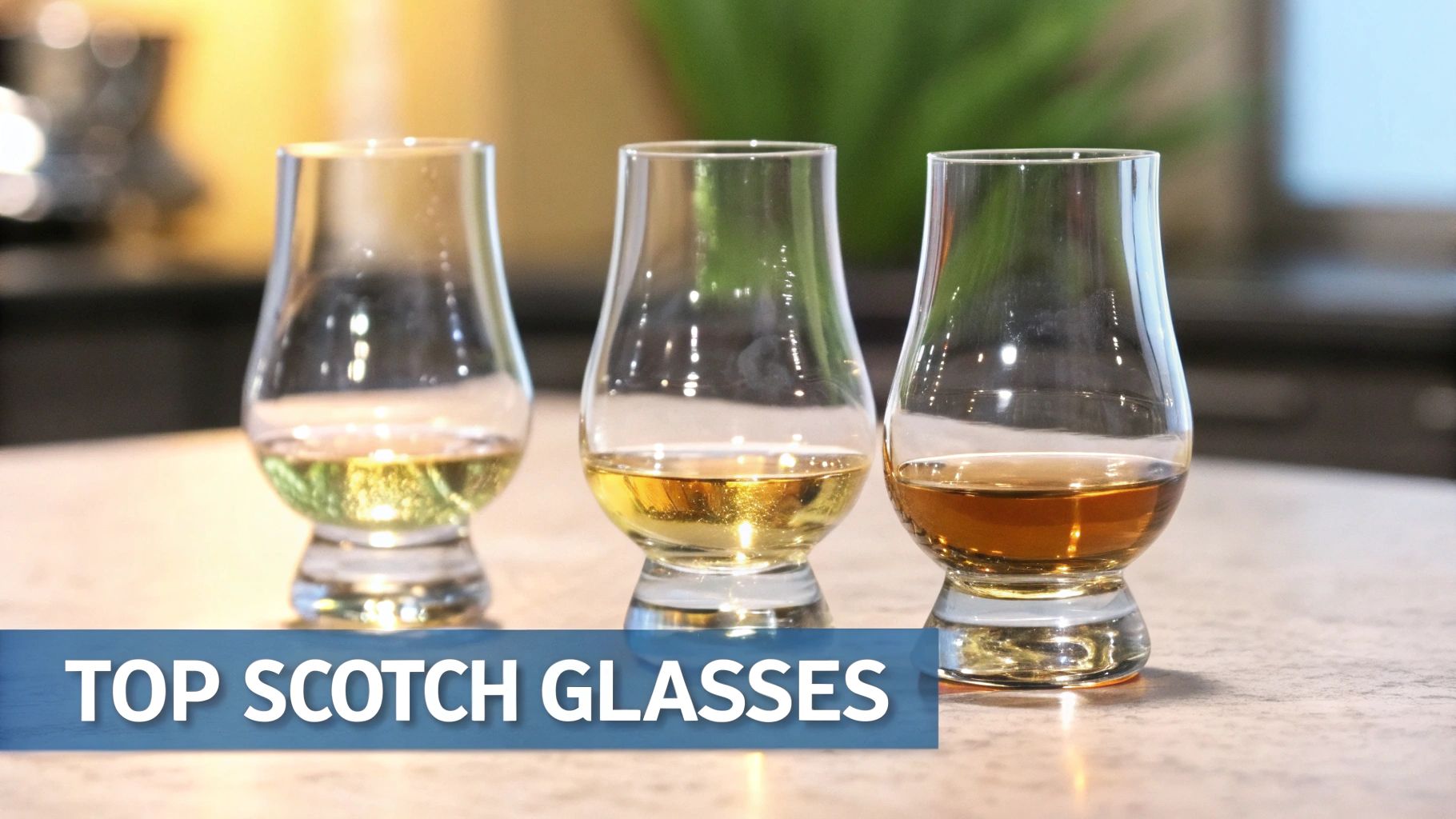
We'll break down the pros and cons of the big three, from the modern industry standard to the classic bar staple. This will help you find the perfect match for whatever you're pouring, whether it's a peat-smoked Islay monster or a complex American single malt.
The Glencairn: The Modern Standard
If there's one glass every whisky aficionado needs, it's the Glencairn. It only hit the scene in 2001, but its iconic tulip shape was designed in collaboration with master blenders to be the definitive tasting glass.
Its wide bowl gives you plenty of room for a good swirl, releasing all those volatile compounds. Then, the narrow, tapered mouth funnels those aromas right where you want them, making it much easier to pick out individual notes. It’s a game-changer, especially for newcomers.
The Glencairn has become so dominant that it’s now the official glass used at distilleries around the globe. Its rise has been nothing short of meteoric; by 2024, Glencairn Crystal was shipping over two million glasses a year. For a deeper dive, you can explore more fascinating statistics from the world of Scotch whisky.
- Best For: Analytical tasting, learning to nose, and truly appreciating complex single malts like a delicate Speyside or a nuanced American craft whiskey from a distillery like Westland.
- Holding Tip: Pinch the short, solid base between your thumb and forefinger. This simple trick keeps the heat from your hand from messing with the whisky's temperature.
The Copita: The Traditional Nosing Glass
Long before the Glencairn came along, the Copita was the tool of choice for the pros. It was originally used for nosing sherry in Spain, and its design—a long, elegant stem and a small, tulip-shaped bowl—makes it the ultimate instrument for aroma detection. The stem is key, ensuring your hand stays far away from the spirit, preserving its true character.
The Copita's design delivers an even more intense concentration of aroma than the Glencairn, which can honestly be a bit much if you're just starting out. But for a seasoned connoisseur trying to dissect every last layer of a cask-strength beast, it’s unbeatable. It’s a phenomenal choice for any serious tasting, but if you're hunting for the ultimate evaluation tool, check out this excellent whiskey tasting glass designed specifically for that purpose.
The Tumbler: The Versatile Workhorse
Also known as the Rocks glass or Old Fashioned, the Tumbler is what most people imagine when they hear "whiskey glass." With its wide brim and thick, heavy base, it's the go-to for casual sipping, adding big ice cubes, or building classic cocktails.
While it's not built for analytical tasting—that wide opening lets all the good smells escape—the Tumbler is king when it comes to comfort and versatility. It just feels solid in your hand and is the perfect home for a robust American high-rye bourbon that won’t be intimidated by a little ice or dilution.
Ultimately, choosing between these glasses is all about your intention. Are you trying to study the spirit, or just kick back and enjoy it? My advice? Get a set of Glencairns for those focused tasting sessions and keep a few sturdy Tumblers on hand for more casual evenings. That way, you’ve got the best of both worlds.
How To Choose Your Perfect Glass
Alright, you've met the key players. Now it’s time to move from knowing the names to actually picking your go-to glass. This is where it gets personal. The best scotch glass for you is the one that fits how you actually drink and enjoy whiskey.
There’s no single right answer here. Your ideal glass comes down to your habits, your budget, and even your personal style. Are you just starting out and need a solid, all-around workhorse? Maybe you're a seasoned enthusiast looking to build out a collection for every occasion. Or perhaps your main relationship with whiskey involves a mixing tin and a big ice cube.
Let's walk through how to find your perfect match.
Define Your Drinking Style
First things first, be honest with yourself about how you enjoy your whiskey most of the time. This is easily the most critical part of the equation—it ensures you buy a glass you'll actually reach for again and again.
-
For the New Drinker: If you’re just getting into scotch, your main goal is learning. You need a glass that makes it easy to pick out different aromas and flavors without being complicated. The Glencairn is your best friend. It’s affordable, incredibly effective, and became the industry standard for a reason. Think of it as the perfect training tool.
-
For the Enthusiast: If you're looking to build out a proper collection, variety is key. You'll want a set of Glencairns for serious tasting, a couple of heavy-bottomed Tumblers for casual weeknight pours, and maybe a Copita for those special, high-proof drams that really deserve a closer look.
-
For the Cocktail Maker: If an Old Fashioned or a Whiskey Sour is your jam, then a sturdy Tumbler or Rocks glass is non-negotiable. Its wide mouth and solid base are built for muddling ingredients and handling those big, beautiful ice spheres that make a cocktail sing.
Consider The Material And Durability
Beyond just the shape, what the glass is made of really matters. Most good glassware is either standard glass or crystal. While old-school lead crystal has that amazing clarity and satisfying heft, modern lead-free crystal gives you all the same brilliance and toughness without any health worries.
And don't forget about practicality. Are you cool with hand-washing a delicate, stemmed glass after every use, or do you need something that can take a trip through the dishwasher? A durable, machine-washable glass might be a much better fit for daily life. While finding the perfect scotch glass is a great start, many discerning drinkers eventually explore other quality drinkware options to round out their collection.
Tip for New Drinkers: Don’t feel pressured to spend a fortune on your first glass. A single, well-made Glencairn is a small investment that will absolutely transform how you experience whiskey. Master the fundamentals with this versatile workhorse before you start chasing more specialized or expensive options.
Match The Glass To The Whiskey
As you become more familiar with different whiskey styles, you can have a little fun pairing your glass to the spirit. This isn't about rigid rules, but about experimentation. For example, the bold, corn-forward sweetness of a big American bourbon like Frey Ranch Straight Bourbon just feels right in a classic Tumbler, especially over a large cube of ice.
On the other hand, a complex and smoky American single malt—like something from Westland Distillery in Seattle—really comes alive in a Glencairn. That focused rim helps you unpack all the intricate layers of peat, fruit, and oak that make it so special. Seeing how the glass directs the tasting experience is part of the journey.
Which Scotch Glass Is Right For You?
Still weighing your options? This table breaks it down to help you pinpoint the perfect glass based on what you're looking for.
| Your Primary Goal | Recommended Glass | Key Benefit | American Craft Whiskey Pairing |
|---|---|---|---|
| Learning aromas and flavors (neat pours) | Glencairn | Concentrates aromas perfectly for analysis | Westland Distillery American Single Malt |
| Casual sipping and classic cocktails | Tumbler (Rocks) | Durable, versatile, and ideal for ice or muddling | Frey Ranch Straight Bourbon |
| In-depth analysis of high-proof spirits | Copita (Nosing) | Excellent aroma concentration with a stem to hold | Stranahan’s Single Malt |
| Appreciating the color and gentle sipping (neat) | NEAT Glass | Wide surface area aerates the spirit | High West Campfire Whiskey |
Ultimately, the goal is to find a glass that makes you enjoy your whiskey more. Whether that's one perfect Glencairn or a full cabinet of options, the right choice is the one that brings you closer to the spirit in the bottle.
Elevating Your Whiskey Tasting Experience
You've picked out the perfect glass, and now the real fun begins. The tasting ritual is where you truly connect with the spirit, and getting a handle on a few simple steps will completely change how you appreciate whiskey. Think of it less like a set of rigid rules and more like a process for unlocking the full story of what's in your bottle.

First things first, let's talk about the pour. For a proper tasting, you only need about 1 to 1.5 ounces. This gives the whiskey just enough surface area to open up and breathe without blasting your senses with alcohol vapor. Once it's in the glass, give it a minute to just sit and acclimate.
How To Properly Nose Your Whiskey
Nosing is, without a doubt, the most important part of tasting. Your sense of smell accounts for the vast majority of what you perceive as flavor, so you really want to get this right. The secret is to be gentle.
New Drinker Tip: Instead of jamming your nose into the glass and taking a huge sniff (which will only singe your nostrils with ethanol), bring the glass up slowly. Keep your mouth slightly open and take short, gentle sniffs. This simple trick lets all those delicate aroma compounds reach your olfactory senses without the harsh alcohol burn.
Try nosing from different points around the rim. You’ll be surprised at what new scents you can uncover. This is where a great tasting glass truly shines. For a deeper dive, our complete guide on tasting Scotch whisky breaks down even more techniques to fine-tune your approach.
The Great Debate: Water And Ice
Adding a few drops of water is a time-honored tradition that can "open up" a whiskey, especially one with a higher proof. It can knock back the alcohol burn and coax out some of the more subtle, underlying notes of fruit or spice. There’s no right or wrong answer here; play around with it and see what you like.
Ice, on the other hand, is a bit more controversial among enthusiasts. While it’s fantastic for a casual drink in a tumbler, it chills the whiskey down so much that it can mute its complex aromas and flavors. For a serious tasting session, it’s usually best to skip the ice.
A fantastic way to practice these newfound skills is with an approachable, flavorful whiskey. See if you can find an American craft wheated bourbon. Its naturally softer, sweeter profile is forgiving for newcomers and makes it easier to pick out distinct notes as you start building your palate.
Common Myths About Whiskey Glassware Debunked
Step into the world of scotch, and you'll quickly find yourself swimming in a sea of opinions, especially when it comes to the "right" glass. A lot of myths and half-truths get passed around, making it tough for newcomers to figure out what really matters. Let’s cut through the noise and clear up a few of the biggest misconceptions.
One of the most persistent myths is that all whiskey glasses are basically the same. As we've already seen, nothing could be further from the truth. A wide-mouthed Tumbler is perfect for a casual drink on the rocks, but it lets all those delicate, complex aromas vanish into thin air.
On the other hand, a tulip-shaped glass is specifically engineered to do the exact opposite. It captures and concentrates those aromas, funneling them right to your nose and completely transforming the tasting experience.
Crystal Is Always The Superior Choice
Another idea you'll hear a lot is that you must use crystal. While it’s true that traditional lead crystal has a brilliant sparkle and a satisfying heft, the notion that it's inherently better is a bit dated. Today, modern lead-free crystal gives you that same stunning clarity and premium feel without any of the health concerns tied to lead.
Besides, a well-designed glass made from high-quality standard glass will always outperform a poorly shaped crystal one. The shape is the real hero here, not the material it's made from.
The most important factor is function over form. A glass that helps you appreciate the whiskey is always the right choice, regardless of what it's made of.
You Must Use A Specific Glass For A Specific Region
You might run into staunch traditionalists who swear you need one glass for an Islay scotch and a totally different one for a Speyside. While certain glasses might highlight specific characteristics—and that can be a fun thing to explore down the road—it’s more of an advanced refinement, not a hard-and-fast rule.
For most drinkers, a versatile tasting glass like the Glencairn works beautifully for just about any whiskey you can pour into it, from a peaty single malt to a complex American bourbon. The myth that there's only one "correct" way to enjoy your drink can really get in the way of your own personal enjoyment. If you want to dive deeper into this, check out our guide on whether there is a wrong way to drink whiskey.
At the end of the day, personal preference is king. This is beautifully highlighted by how glassware is used around the world. In 2024, with over 1.4 billion bottles of Scotch whisky exported globally, tasting traditions vary wildly. Here in the US, the Glencairn has become the go-to for serious tastings, but in many emerging markets, the classic Tumbler is still the standard for a casual pour. It just goes to show how much local customs shape the experience.
So, what's the ultimate takeaway? Trust your own palate. Don't let myths and gatekeepers stop you from experimenting to find what you enjoy most.
Still Have Questions About Scotch Glasses?
We've gone through a lot, but you might still be mulling over a few things. Let's tackle some of the most common questions that pop up for folks just getting into whiskey.
What Is The One Best Glass For A Beginner Whiskey Drinker?
If you're just starting your journey, the Glencairn glass is the hands-down winner. It's not just affordable and tough, but its entire design is built to funnel aromas right to your nose. This makes it so much easier to start picking out the subtle notes that make each whiskey unique. Think of it as the perfect, reliable all-rounder before you decide to branch out into more specialized glassware.
Does A Thicker Glass Base Really Make A Difference?
Oh, absolutely. It's not just for show. A solid, heavy base gives the glass stability and a satisfying heft in your hand. But more importantly, it acts as an insulator. That thick glass keeps the warmth from your hand from creeping into the spirit, which could raise the whiskey's temperature and mess with its carefully balanced aroma profile.
How Should I Clean My Whiskey Glasses?
You'll want to be gentle here. Always hand-wash your good whiskey glasses. Use warm water and just a tiny drop of unscented soap. Why unscented? Because scented detergents can leave behind a chemical residue that will absolutely clash with the aromas of your next pour. After a thorough rinse, just let them air-dry to avoid getting any lint on them from a towel.
Ready to put your palate to the test without any brand bias getting in the way? Blind Barrels sends out quarterly kits with four unique samples from some of America's best craft distilleries. It's the best way to discover your next favorite whiskey—by letting your taste buds do the talking. Explore our blind tasting experience at https://www.blindbarrels.com.