

You've poured a small measure of barrel-proof bourbon, taken a cautious sniff, and already feel the alcohol rising from the glass. The label looks impressive, but one question matters more than the proof number: will this whiskey taste balanced enough to enjoy?
The best high proof bourbon isn't automatically the strongest bottle on the shelf. It's the pour that gives you concentrated aroma, satisfying texture, and enough heat to stay interesting without erasing the flavors underneath. A good blind tasting makes that distinction clear because the label, price, and reputation can't influence your first impression.
This guide will help you understand proof, connect it to flavor and mouthfeel, and choose between a neat pour, a little water, or a cocktail. You'll also see why American craft whiskey deserves attention, how to compare proof bands, and how to find your own preference instead of chasing someone else's definition of “best.”
Introduction to High Proof Bourbon Without the Burn Fear
A first high-proof pour can feel like a test of toughness. You raise the glass, catch a rush of ethanol, take a sip, and wonder whether bourbon is supposed to burn this much. That reaction doesn't mean you dislike whiskey. It usually means the pour needs time, water, or a more deliberate approach.
High proof carries more than alcohol intensity. It can lift aromas, thicken texture, and make oak, caramel, vanilla, fruit, or baking spice feel more concentrated. The same strength can also create a sharp sensation in the nose and throat, especially when you drink quickly or take too large a sip.
Blind-tasting rule: Judge the whiskey's flavor after the first impression of heat passes, not during the first instant of alcohol shock.
A useful comparison comes from wine. Higher alcohol doesn't automatically make a bottle bad, and the same principle applies to bourbon. This resource on why high alcohol wine isn't automatically bad offers helpful context for separating alcohol level from overall balance. In both drinks, structure, aroma, sweetness, texture, and finish determine whether strength feels integrated.
A practical proof-to-flavor framework
Think of proof as one part of a tasting profile, not a quality score. A lower high-proof pour may feel round and approachable, while a stronger one may deliver more spice, oak, and viscosity but require dilution. Neither automatically wins.
The most useful questions are simple:
- What do you smell after the alcohol settles? Look for caramel, vanilla, toasted oak, fruit, mint, pepper, or baking spice.
- What happens across the sip? Notice whether sweetness arrives before heat, or whether heat dominates immediately.
- What remains afterward? A long finish can be flavorful, drying, spicy, hot, or some combination of all four.
New drinkers often assume they must enjoy bourbon neat to be taken seriously. You don't. A few drops of water can make a high-proof bourbon easier to understand, and a strong pour can work beautifully in a cocktail when its flavors have enough structure to remain present.
The Blind Barrels mindset is useful here. Taste first, identify later, and let your palate decide whether a bottle is balanced for your preferences. Once you compare proof bands side by side, “high proof” stops sounding like a dare and starts becoming a drinking-style decision.
What High Proof Really Means for Bourbon
Start with the label. Proof is twice the alcohol by volume, or ABV, on the U.S. scale. A bourbon at 57.5% ABV is 115 proof, as explained in this guide to what proof means in whiskey. That conversion helps you understand both the alcohol strength and the likely intensity of the pour.
“Barrel proof” and “cask strength” generally indicate that the whiskey was bottled with little or no water added after aging. The exact production approach can vary, so the bottle's proof remains the practical clue. If the whiskey lost water during aging, its final strength can differ from its original barrel-entry strength.
Federal bourbon rules create important boundaries. Bourbon can leave the still at no more than 160 proof, enter the barrel at no more than 125 proof, or 62.5% ABV, and must be bottled at a minimum of 80 proof, or 40% ABV. There's no legal maximum for the final bottle strength, which means a barrel-proof bourbon can reach a very high proof if enough water evaporates during aging. These bourbon proof regulations and their implications explain why bottles above 140 proof, or 70% ABV, are unusual enough to receive “hazmat” discussion in the whiskey market.
Why the historical context matters
Barrel entry proof also changed bourbon's modern. The ceiling rose from 110 proof to 125 proof in 1962, according to the regulatory summary cited in the bourbon proof reference above. A separate historical account places the change in 1964, so readers may encounter both years in whiskey history discussions.
Stitzel-Weller had already released an “Original Proof Bourbon” in the late 1940s, with a 110-proof barrel entry cited in the historical coverage. A broadly recognized modern barrel-proof wave didn't emerge until the mid-1990s, when Jim Beam released Booker's Bourbon at barrel proof. That release helped establish barrel-proof bourbon as a recognizable category rather than a rare curiosity.
The result is a shelf where high proof usually occupies a practical middle range, while extreme proof remains an outlier. Reading the number tells you how much alcohol is present. Tasting the whiskey tells you whether the producer managed that strength well.
How Proof Changes Flavor Mouthfeel and Heat
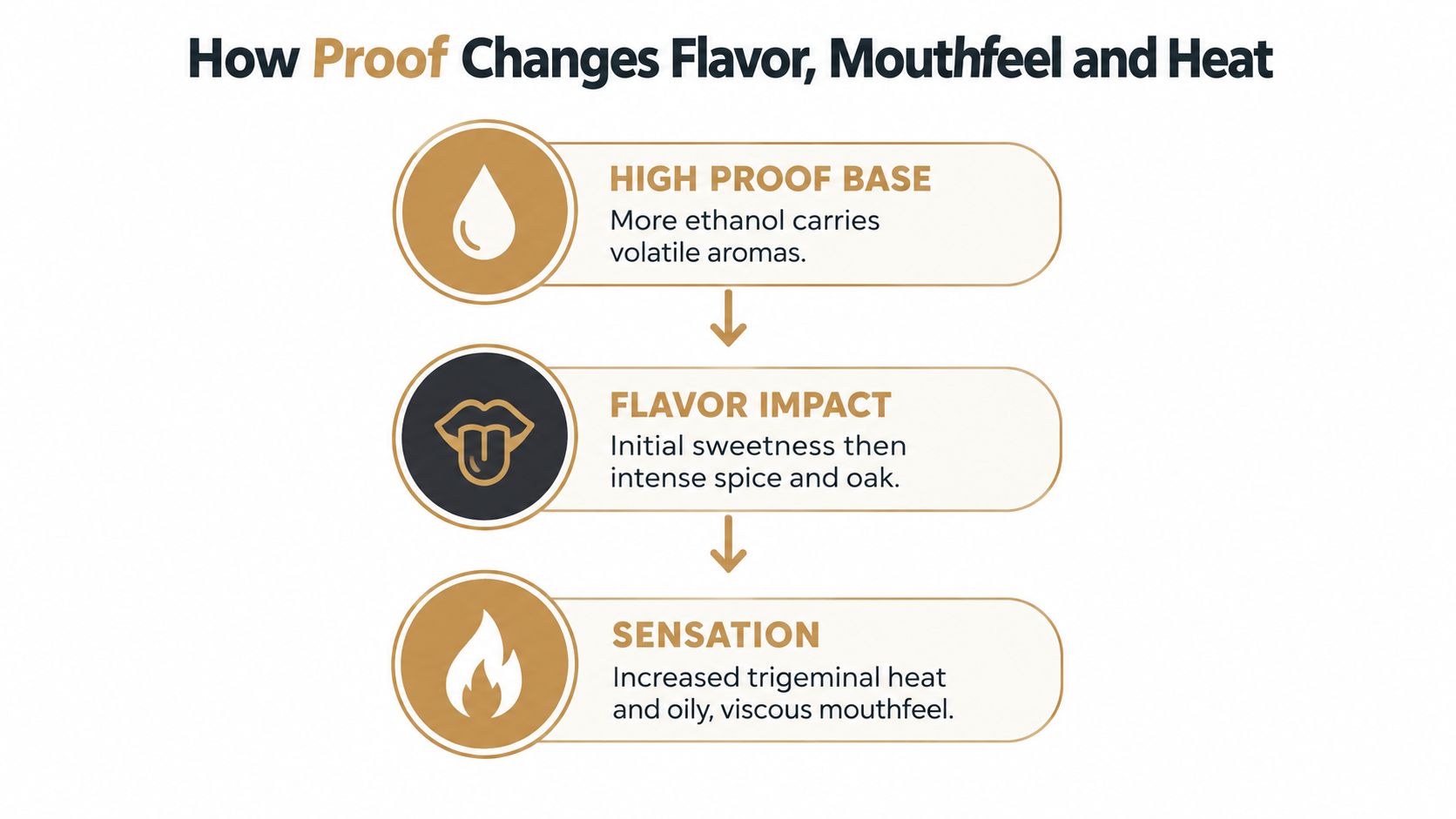
Proof changes the way bourbon reaches your senses. Ethanol helps carry volatile aroma compounds from the glass toward your nose, so a higher-proof bourbon may project more strongly. That doesn't mean every aroma becomes better. It means the whiskey can feel more aromatic, more forceful, and less forgiving if you smell too aggressively.
On the palate, high proof can create an interesting sequence. A sip may begin with sweetness, such as caramel or vanilla, then move into pepper, oak, cinnamon, or baking spice. If the alcohol sensation arrives too quickly, it can cover those flavors and make the bourbon seem simpler than it is.
Separating flavor intensity from alcohol burn
Heat isn't the same as flavor. The burning sensation involves the trigeminal system, the sensory pathway that responds to irritation and temperature-like sensations. A bourbon can be intense because it has concentrated spice and oak, or it can be intense because ethanol dominates the sip. Those experiences overlap, but they aren't identical.
Above roughly 55% ABV, heavier fusel oils become more soluble and can contribute to a thicker, oilier mouthfeel and sharper spice expression, according to the sensory explanation in this discussion of proof and texture. That oily texture can be a strength when the bourbon has enough sweetness and oak integration to support it. Without balance, the same texture may feel heavy or numbing.
Resting the pour helps because the first aroma isn't always the most useful one. After a short pause, try smelling from slightly above the rim rather than plunging your nose into the glass. Take a small sip, let it move across your tongue, and notice whether the finish develops flavor after the heat fades.
Proofing method can matter too. Published sensory work found that proofing method affected unaged spirits more than aged spirits. Slow-proofed unaged samples were perceived as sweeter at the start and less burning across the full evaluation period, while aged whiskey showed a smaller difference. That finding supports a practical habit: don't judge a new pour from one quick sip, especially when comparing undiluted samples.
Water changes the balance rather than making bourbon weaker. A little dilution can soften ethanol, open aromas, and make caramel, vanilla, or oak easier to identify. Add it slowly so you can recognize the point where the whiskey becomes clearer without losing its texture.
High Proof Bourbon Comparison by Proof Band and Style
Proof bands make high-proof bourbon easier to compare than a simple ranking from strongest to weakest. A bottle near the lower end of the category may offer a more reliable neat pour, while a stronger release may reward water, patience, or cocktail use.
| Proof Band | Flavor and Texture | Heat and Balance | Best For |
|---|---|---|---|
| 107 to 114 proof | Concentrated caramel, oak, spice, and a fuller texture without requiring heavy dilution | Noticeable heat that can remain integrated | Neat sipping, first high-proof bottles, blind tasting |
| 115 to 125 proof | Bolder oak, baking spice, ethanol lift, and a more viscous body | More assertive heat, often improved by a few drops of water | Experienced neat drinkers, water-assisted pours, robust cocktails |
| Above 125 proof | Powerful aroma and texture, with oak, spice, and alcohol competing for attention | Heat can dominate unless the whiskey is carefully opened or diluted | Collectors, experienced tasters, novelty pours, dilution experiments |
The balanced intensity band
A useful benchmark sits between 107 and 114 proof. Maker's Mark Cask Strength is bottled at 107 to 114 proof, while another cask-strength rye example reaches 112.2 proof, showing how premium high-proof expressions often cluster just above 110 proof rather than at the legal maximum. The range can preserve enough ethanol to lift oak, spice, and caramel aromas while remaining manageable for neat tasting.
Best starting point: If you want intensity without turning the pour into an endurance exercise, begin around the 107-to-114-proof band.
The bold classic band
At 115 to 125 proof, bourbon often feels more forceful. You may find deeper oak, sharper spice, and a thicker body, but the whiskey may need a rest or a small amount of water before it shows its full profile. This band suits drinkers who already know they enjoy a warm, concentrated finish.
The upper band deserves more skepticism. Coverage from Food & Wine on ultra-high-proof whiskey pushes back on the assumption that being above 140 proof automatically signals quality. Strength can be interesting, but it can't replace balance, texture, or drinkability.
The outlier tier
Bottles above 125 proof can be exciting, but they're better treated as specific tasting experiences than universal recommendations. Some may open dramatically with water. Others may remain dominated by heat, oak, or alcohol even after dilution.
The strongest bottle isn't necessarily the most expressive bottle.
Choose this tier when you enjoy experimentation, collect unusual releases, or want to study how dilution changes a whiskey. Skip it if you're looking for an easy daily sipper or a bottle that welcomes every guest immediately.
How to Taste and Serve High Proof Bourbon Safely
A comfortable tasting starts with restraint. Pour about 0.5 to 1 ounce, let the bourbon rest for 2 to 5 minutes, then add 2 to 5 drops of water before tasting again, following this beginner-friendly guide to drinking bourbon. Those small adjustments reduce the first rush of ethanol without stripping away the whiskey's character.
Use a tulip-shaped glass if you have one, but any clean glass with enough room to swirl gently will work. Don't swirl aggressively at the beginning. High-proof bourbon already releases plenty of aroma, and a calm pour gives you a clearer first impression.
A six-part tasting routine
- Look at the color. Note whether the bourbon appears pale gold, amber, or deep brown, but don't treat color as proof of age or quality.
- Smell from a distance. Begin above the rim and move closer gradually. Identify broad families such as sweet, fruity, woody, spicy, or minty.
- Take a tiny first sip. Let the alcohol pass before deciding whether the bourbon is harsh.
- Rest and dilute. Revisit the whiskey after the recommended rest period, then add water drop by drop. The practical guide to water for bourbon gives additional context for this technique.
- Compare the finish. Ask whether the ending tastes sweet, dry, smoky, spicy, woody, or hot.
- Choose the serving style. Drink neat if the flavors stay clear, use water if the heat hides detail, or mix it when the bourbon's structure can support other ingredients.
For a tasting flight, move from the lowest proof to the highest. A structured bourbon tasting is often limited to 4 to 6 pours, with water or unsalted crackers between samples, because sensory discrimination drops sharply after the sixth sample, according to this bourbon tasting guide.
Drink slowly, keep water nearby, and don't treat tasting as a race. High proof deserves smaller sips and longer pauses, not forced endurance.
Recommended High Proof Bourbons by Drinking Situation
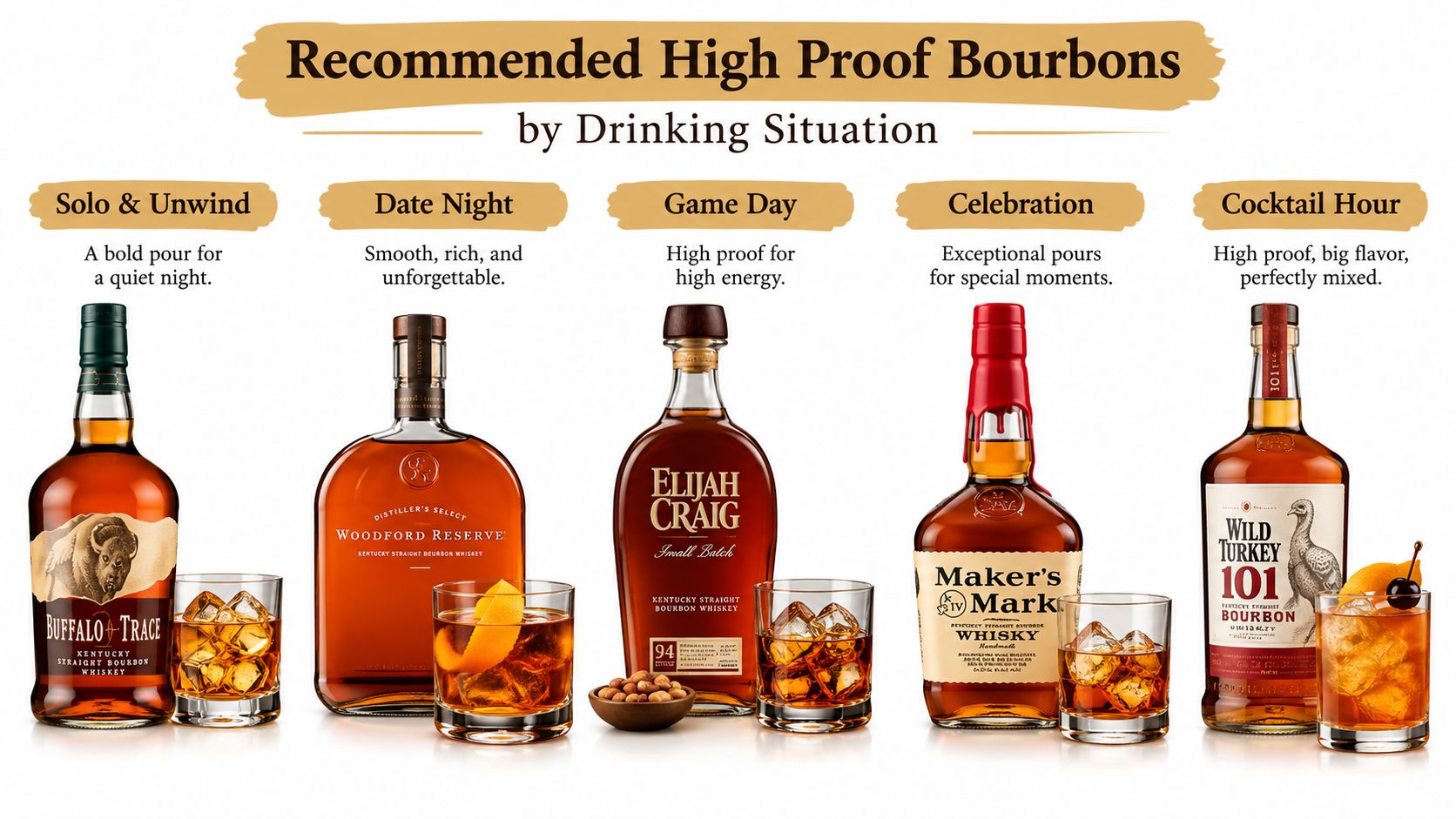
A useful recommendation begins with the occasion, not the proof number. The right bottle for a quiet neat pour may not be the right bottle for a cocktail, a group tasting, or a search for American craft whiskey.
For a balanced daily sipper
Maker's Mark Cask Strength is a strong place to begin if you want barrel-proof character without automatically jumping to the most extreme releases. Its cited bottling range of 107 to 114 proof gives you a useful target for concentrated flavor, and the bottle can be approached neat or opened with a few drops of water.
Choose it when you want caramel, oak, spice, and texture in a pour that remains adaptable. Skip it if your preference is for a lighter, lower-proof bourbon with less heat.
For a bold neat pour
The 115-to-125-proof range suits experienced drinkers who enjoy a larger flavor frame. These bourbons can show more forceful oak, baking spice, and viscosity, but they're worth tasting both neat and diluted before you make a judgment.
Choose this band for slow sipping and side-by-side comparison. Skip it for casual guests who are new to bourbon, unless you're prepared to add water and guide the tasting.
For an American craft discovery
Craft whiskey can sit comfortably in the high-proof category. Nelson Brothers Reserve Bourbon is cited at 107.8 proof, while another referenced American craft whiskey reaches 125.5 proof, or 62.75% ABV, in coverage of American craft whiskey. These examples show why small-distillery bottles shouldn't be treated as automatically delicate or experimental in a narrow sense.
Choose craft bottles when you want to explore different mash bills, warehouse approaches, and regional identities. Skip a bottle if you're buying only because the proof looks impressive and you have no interest in tasting the whiskey's individual style.
For cocktails and finishing styles
A high-proof bourbon can work well in cocktails because its aroma and texture have enough presence to remain noticeable after dilution and mixing. Cask finishes and double-oaked approaches can add another layer, but extra wood isn't automatically better. Look for harmony between sweetness, oak, spice, and alcohol.
Choose a stronger bottle for an Old Fashioned-style drink when you want the whiskey to remain central. Use water instead when the bourbon already has plenty of flavor and you want to explore it without additional ingredients.
Finding Your Personal Best Through Blind Tasting
Brand recognition can make you expect a certain flavor before the whiskey touches your tongue. Blind tasting removes that shortcut. Pour a small flight, cover the bottles, and assess each sample by aroma, sweetness, spice, oak, texture, heat, and finish before revealing anything.
A simple four-pour flight works well at home. Arrange the samples from lower to higher proof, use the same glassware, and give each pour equal rest time. Record your guesses for proof, age, and whiskey type, then score how closely your impressions matched the revealed details.
The blind bourbon tasting approach turns preference into something you can test rather than assume. You may discover that you prefer a balanced pour near 110 proof, or that a stronger bourbon becomes your favorite after water opens it. You may also learn that a bottle you expected to love feels too oak-driven or hot.
Keep notes on the serving style that worked best:
- Neat: The whiskey stayed expressive without excessive burn.
- With water: Dilution revealed sweeter aromas or a longer finish.
- In a cocktail: The bourbon retained enough structure to remain noticeable.
Blind Barrels offers quarterly kits with four blind samples from small American craft distilleries, a tasting table for aroma, palate, and finish notes, plus a QR reveal that provides sample details and access to full bottles at a discounted price. Visit Blind Barrels to compare high-proof whiskey without letting the label decide your favorite. Use your tasting notes to build a collection around balance, texture, and drinkability rather than the biggest number on the bottle.