

The most popular advice about the best tasting whiskey for the money is usually wrong. “Buy the cheapest bottle that gets decent reviews” confuses a low sticker price with genuine value. A whiskey that tastes thin, burns harshly, and sits untouched in the cabinet isn't a bargain. It's an expensive mistake spread across several disappointing pours.
The better question is simple: how much flavor, balance, texture, and finish do you get for every dollar spent? That answer often lives in an entry-premium or mid-tier bottle, not at the bottom of the shelf. In the United States, retail sales value at premium-and-above price points has outpaced standard-and-below by roughly 3:1, and 2021 was the first year in 50 years of IWSR tracking when U.S. whiskey volumes at premium-and-above surpassed standard-and-below volumes (IWSR).
Here are the bottles and categories I'd start with, along with the trade-offs that matter more than packaging, hype, or a prestigious age statement.
| Category | My value benchmark | What you're buying | Main trade-off |
|---|---|---|---|
| Bourbon | Wild Turkey 101 | High proof, sweetness, oak, mixing strength | More heat than a softer bourbon |
| Rye | Stellum Spirits Rye Whiskey | Powerful spice and concentration | Higher proof can need water |
| Bourbon upgrade | Four Roses Single Barrel | Rich texture and concentrated flavor | Bottle variation matters |
| Tennessee whiskey | Uncle Nearest 1856 Premium Aged Whiskey | Full flavor at strong proof | It isn't the cheapest pour |
| Irish whiskey | Redbreast 15 | Fruit, texture, and mature character | Premium pricing |
| Japanese whisky | Nikka From The Barrel | Dense, layered flavor | Potent and less beginner-friendly |
| American craft | A reputable cask-strength local release | Distinctive grain and barrel character | Availability and consistency vary |
Why Cheap Whiskey Is Not the Same as Good Value
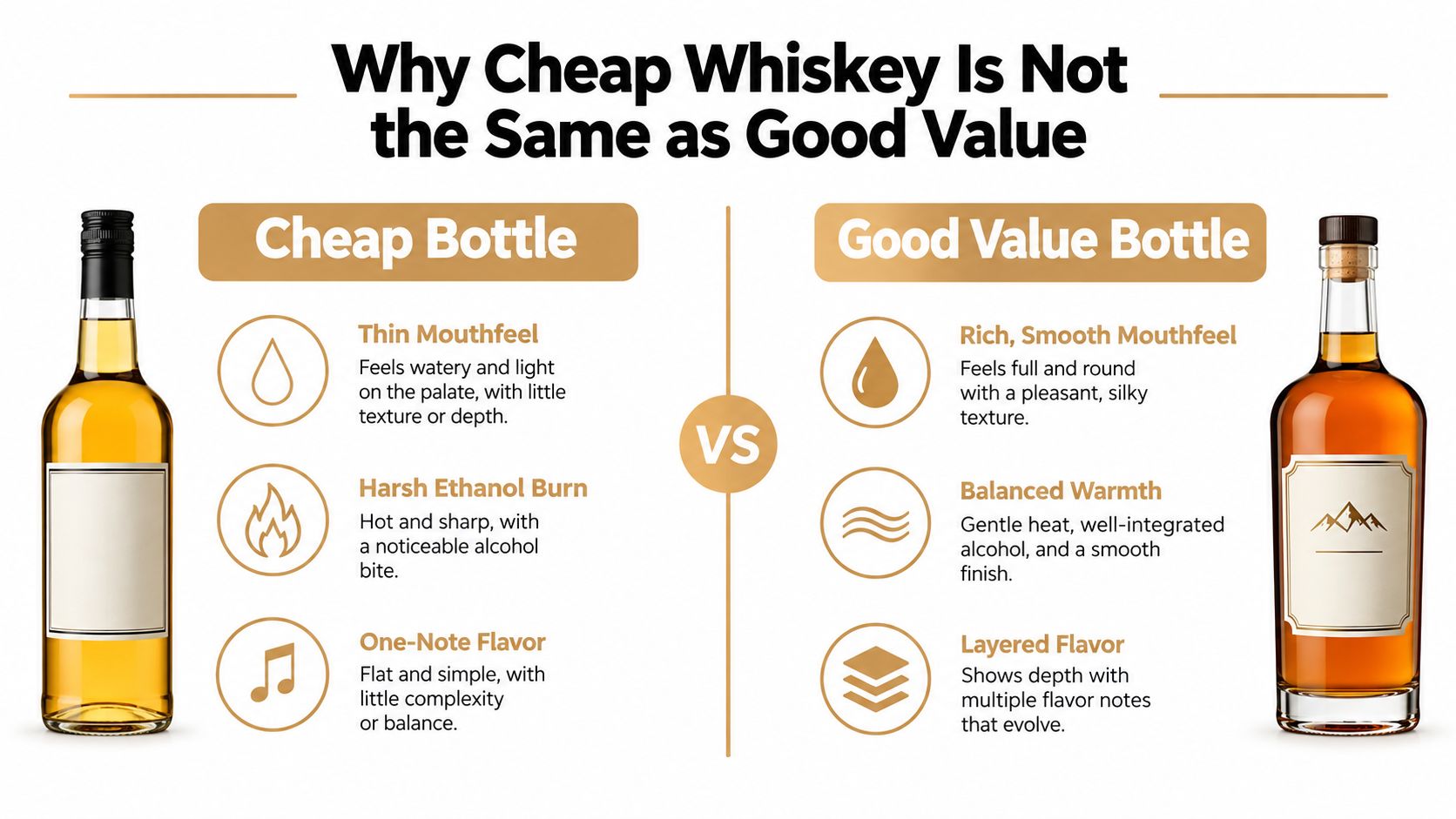
The cheapest whiskey is rarely the smartest buy. It can work in a high-volume cocktail, but a low shelf price often comes with a thin flavor profile, harsh alcohol, or a finish that vanishes immediately. Low price only answers what you pay at checkout. It doesn't answer what you enjoy in the glass.
Good value measures taste per dollar. Judge flavor depth, balance, mouthfeel, finish, proof, and versatility alongside the price. A moderately priced bourbon with vanilla, caramel, baking spice, and a warming finish can deliver far more than a cheaper bottle built around sweetness and alcohol. Saving money matters only if you want to pour the bottle again.
The shelf price is only one part of value
The best bargains usually come from distillers that spend enough on production to build structure without charging for luxury packaging, scarcity, or collector appeal. Better grain character, thoughtful barrel management, a useful bottling proof, and sufficient maturation can make the difference between a merely cheap pour and a satisfying one.
American craft distilleries deserve particular attention here. A reputable local release can show distinctive grain and barrel character, although availability and consistency vary. That trade-off is often worthwhile for drinkers who want flavor rather than a famous label.
Category and purpose matter. A bold rye may be excellent in a Manhattan but too aggressive for a new drinker sipping neat. A softer Irish whiskey can suit a beginner while leaving an experienced bourbon drinker wanting more intensity. Proof also changes the equation. Higher proof can bring concentration and a longer finish, but it may need water.
Practical rule: Buy the bottle you'll happily pour again, not the bottle with the lowest price tag.
Where the value equation improves
The middle of the shelf often offers the strongest compromise. You are paying for more than basic mixability, while avoiding prices driven mainly by presentation, scarcity, or collector demand. American bourbon, rye, and craft whiskey frequently deliver the most flavor per dollar.
Use taste, price, proof, and age as your starting checks. A bottle does not need to win on all four. A younger whiskey can be compelling when vivid flavor and an appealing price compensate for limited maturity. A higher-priced bottle needs enough complexity, texture, and finish to justify the jump. For newer drinkers, compare aroma before tasting, note the finish after swallowing, and add a little water to see whether the proof reveals flavor or only heat.
The Four Criteria That Define Value in Whiskey
Value starts in the glass, not on the cheapest shelf. I judge a bottle by four questions: Does it taste balanced? Is the price sensible for its role? Does the proof provide flavor without burying it in heat? Has the age added character rather than only oak? These tests favor mid-tier and entry-premium bottles, including releases from American craft distilleries, where distinctive flavor often matters more than label prestige.
Taste comes before intensity
A powerful whiskey is not automatically a rewarding one. Look for harmony among sweetness, spice, oak, fruit, grain, and finish. Bourbon may bring vanilla and caramel, rye pepper and mint, Scotch smoke or dried fruit, and Irish whiskey honey, cereal, and citrus. Strong value comes from integration. The flavors should develop together instead of arriving as disconnected bursts.
Use a whiskey flavor profile guide to build vocabulary, but do not turn tasting into a quiz. Identify the aroma that stands out, take a small sip, and pay attention to what remains after swallowing. A good bottle gives you more to notice on the second sip.
Price should match the job
Price only makes sense beside the way you plan to drink. A regular pour needs balance and repeatability. A weekend bottle can justify greater concentration, unusual distillery character, or a longer finish.
| Criterion | Sweet spot | Value signal | Warning sign |
|---|---|---|---|
| Taste | Balanced sweetness, spice, oak, and finish | Layers remain clear after dilution | Heat dominates the palate |
| Price | $25–$40 for daily drinking, $40–$70 for weekend sipping | You'd repurchase at the same price | Packaging costs more than flavor |
| Proof | 90–110 proof | Flavor stays present neat or with a little water | Alcohol overwhelms the whiskey |
| Age | Often 6–12 years | Maturation adds texture and integration | Oak tastes dry, bitter, or dusty |
The $25–$40 range works for a dependable everyday pour, while $40–$70 can buy a more distinctive bottle for slower sipping. Above $70, demand a clear reason for the premium, such as unusual cask work, a recognizable distillery style, or an especially satisfying finish. Price is not a tasting note.
Proof and age need context
Proof determines intensity and flexibility. Bottles around 90–110 proof often carry enough concentration for flavor while remaining approachable neat. Higher-proof whiskey can deliver better value for drinkers who enjoy adding water, especially when one bottle must work as both a concentrated sipper and a mixer.
Age needs the same scrutiny. Maturation can soften spirit and add fruit, vanilla, spice, or oak, but excessive wood can bury the distillery character. A younger whiskey with lively flavor and a clean finish can outperform an older release that tastes dry, bitter, or over-oaked. For newer drinkers, compare the aroma first, assess the finish after swallowing, then add a little water. That simple routine shows whether proof reveals flavor or only heat.
How the Whiskey Market Prices Value
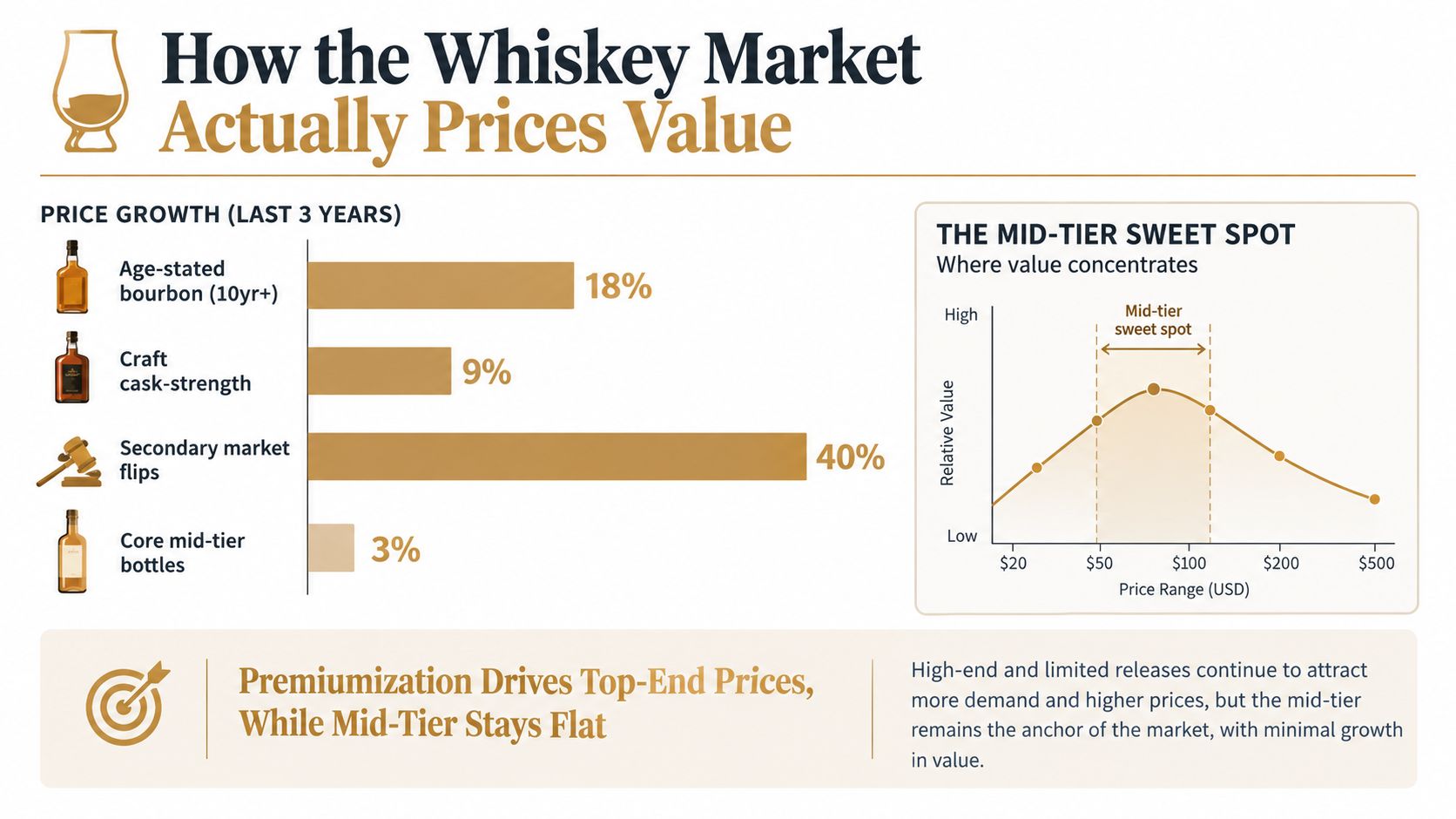
Whiskey pricing reflects perceived quality, scarcity, and brand credibility, not just what appears in the glass. That explains why the strongest value often sits in the mid-tier and entry-premium range, where better production choices add flavor without making rarity the main product.
Grand View Research projects the global whiskey market at USD 92.89 billion in 2025, reaching USD 180.20 billion by 2034, with a 7.68% compound annual growth rate (Grand View Research). A separate estimate places the market at USD 77.27 billion in 2025, rising to USD 145.17 billion by 2035, at about 6.44% CAGR (Market.us).
Those figures differ because research firms define and measure the category in different ways. The useful takeaway is consistent demand for quality, distinctive flavor, and trusted producers across major whiskey markets, including the United States, the United Kingdom, Europe, and Japan. Premiumization helps explain why careful buyers increasingly compare complete, flavorful bottles rather than just choosing the cheapest option (IWSR).
Awards can reveal value, but prestige can distort it
Competition results show that strong whiskey does not belong exclusively to luxury bottles. At the 2021 Los Angeles Spirits Awards, Stellum Spirits Rye Whiskey won both Best Whiskey and Best Rye Whiskey at 58.1% ABV and a listed price of $54. Uncle Nearest 1856 Premium Aged Whiskey won Best Tennessee Whiskey at 50% ABV and $59 (2021 Los Angeles Spirits Awards results).
Moderate pricing can therefore coexist with serious quality. The 2026 USA Spirits Ratings separates Quality, Value, and Packaging scores, and Winn-Dixie Gin received a 99-point Value score. That framework reinforces a useful buying rule: judge value separately from prestige and presentation (Los Angeles Spirits Awards competition framework).
Awards can also raise prices sharply after recognition. Industry commentary cites one whiskey moving from GBP 200 to GBP 7,500 after a major World Whisky of the Year award, while another rose from GBP 7,600 to GBP 20,200 after a category win (Los Angeles Spirits Awards industry commentary). A medal can signal quality, but it cannot guarantee that the bottle remains a sensible purchase afterward.
The mid-tier remains the smart hunting ground
Buyers need more discipline at the top of the market. IWSR reported that super-premium-and-above spirits fell 15% in value in 2025, compared with a 7% decline for standard-priced products (The Spirits Business). The figures do not make standard whiskey better. They show why paying extra should produce a clear improvement in the glass.
My target is a bottle with enough production care to taste complete, enough proof to stay expressive, and a price that does not depend mainly on scarcity. American craft whiskey belongs in that search, especially when independent distilleries offer dense flavor and a recognizable house style. Value-focused coverage has featured 15 craft whiskeys under $60, giving newer drinkers a practical starting point for exploring smaller producers (VinePair's craft whiskey roundup).
Standout Value Picks Across the Major Categories
The cheapest bottle rarely delivers the best value. Flavor-per-dollar improves once you move into mid-tier bourbon, rye, single malt Scotch, Irish whiskey, and American craft releases. Each category rewards a different kind of drinker, so choose by flavor and proof rather than shelf position.
| Category | Proof range | Typical age | Price band | Signature tasting notes |
|---|---|---|---|---|
| Bourbon | 90–110 proof | 6–12 years | $25–$35 | Vanilla, caramel, sweet oak |
| Rye | 100–115 proof | 4–8 years | $30–$40 | Rye grain, pepper, mint, baking spice |
| Entry-level single malt Scotch | 86 proof, 43% ABV | 10–12 years | $40–$55 | Sherry fruit, malt, oak, gentle smoke |
| Irish whiskey | 80–86 proof | 4–12 years | $25–$35 | Honey, citrus, cereal, soft vanilla |
| American craft | Often cask strength | Varies by release | $35–$55 | Dense grain, toasted oak, fruit, spice |
Bourbon and rye
Wild Turkey 101 is my bourbon benchmark for value. It combines 101 proof, or 50.5% ABV, an estimated 6–8 years of age, and a sub-$20 retail price in some markets, according to The Whiskey Wash. The proof gives cocktails enough backbone, while the neat pour offers caramel, oak, and spice. A few drops of water open it further. Its trade-off is direct: the flavor is assertive, not delicate.
Choose Four Roses Single Barrel for a more polished bourbon upgrade. Its appeal rests on the balance of proof, flavor, and cost, with a full mouthfeel that works well for slow sipping, as Liquor.com notes. I reach for it when I want richer texture without paying for a luxury label. Barrel variation matters, though. One bottle may become a favorite while another tastes less expressive.
Rye should start with Stellum Spirits Rye Whiskey if you enjoy intensity. At 58.1% ABV and a $54 listed price, it offers concentrated spice and fruit for a serious neat pour or a powerful Manhattan. Its recognition at the Los Angeles Spirits Awards reinforces its value, but the proof remains the practical issue. Add water when alcohol heat hides the rye character.
Scotch, Irish whiskey, and American craft
Entry-level single malt Scotch earns its place through balance rather than prestige. Look for clear malt, fruit from sherry or bourbon casks, and enough oak to give the finish shape. Redbreast 15 suits drinkers who want mature fruit and texture. Nikka From The Barrel fits those who prefer concentrated, layered Japanese whisky character. Neither is a low-intensity beginner pour, but both show how a mid-tier bottle can offer premium character without trophy-bottle pricing.
Irish whiskey generally provides the easiest introduction. Honey, citrus, cereal, and soft vanilla make the category approachable, while a fuller bottle such as Redbreast 15 adds texture for drinkers ready to explore beyond light, simple pours.
American craft whiskey deserves a dedicated place on any value shortlist. Small distilleries often bring cask strength, non-chill filtration, unusual grain bills, or a clear regional identity. Those features can produce more character than a standardized entry-level bottle, but availability and release-to-release consistency are less predictable. Taste a sample first when possible, then judge aroma, finish, and proof for yourself.
For a category-by-category starting point, use this guide to best whiskeys for the price, then compare its recommendations with the flavors you actually enjoy.
A Practical Tasting Routine for New Whiskey Drinkers
The cheapest bottle is rarely the best place to learn. New drinkers need a repeatable method for separating aroma, palate, finish, and value from label reputation. Taste the same whiskey more than once, and treat unfamiliar notes as information rather than mistakes.
Set up the pour
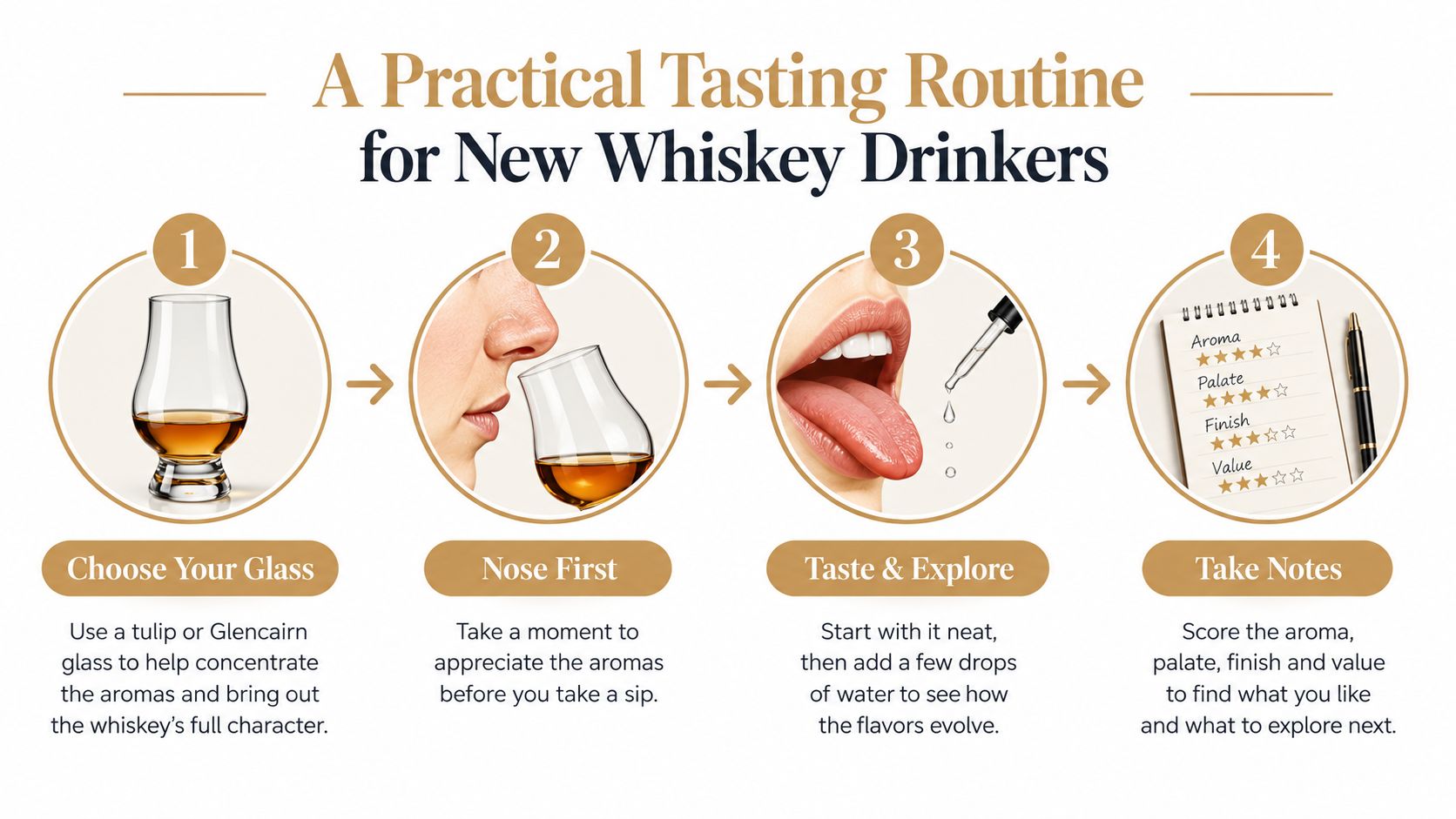
Use a Glencairn or tulip-shaped glass if available. Its narrower opening concentrates aromas more effectively than a wide tumbler. Pour about 1.5 ounces. If you are new to whiskey, start under 100 proof, or 50% ABV, so the flavor stays clear without overwhelming burn, following beginner-focused guidance from Blind Barrels (Blind Barrels tasting guidance).
Taste it neat first. Hold the glass below your nose and take a distant sniff, then move closer for a second pass. Swirl gently and smell again. This sequence helps prevent alcohol heat from dominating your first impression.
Taste in controlled stages
Take a small sip and let it coat your tongue. Check the front of the palate for sweetness or citrus, the middle for grain, oak, spice, or fruit, and the finish for warmth, dryness, smoke, or lingering sweetness.
Add only a few drops of water, then taste again. Water can soften alcohol heat and reveal aromas, especially in higher-proof whiskey. Keep the neat and diluted versions separate in your notes. The better result is the one that exposes more flavor, not merely the one that feels thinner.
Record four observations:
- Aroma: What appears before the sip?
- Palate: Is the texture thin, creamy, oily, dry, or hot?
- Finish: Does the flavor fade quickly or develop?
- Value: Would you buy it again at the price you paid?
Use this guide to how to taste whiskey to keep the routine consistent. Your notes will show whether a mid-tier or entry-premium bottle delivers genuine flavor for its price, instead of merely carrying a more impressive label.
Matching Bottles to Real Drinking Moments
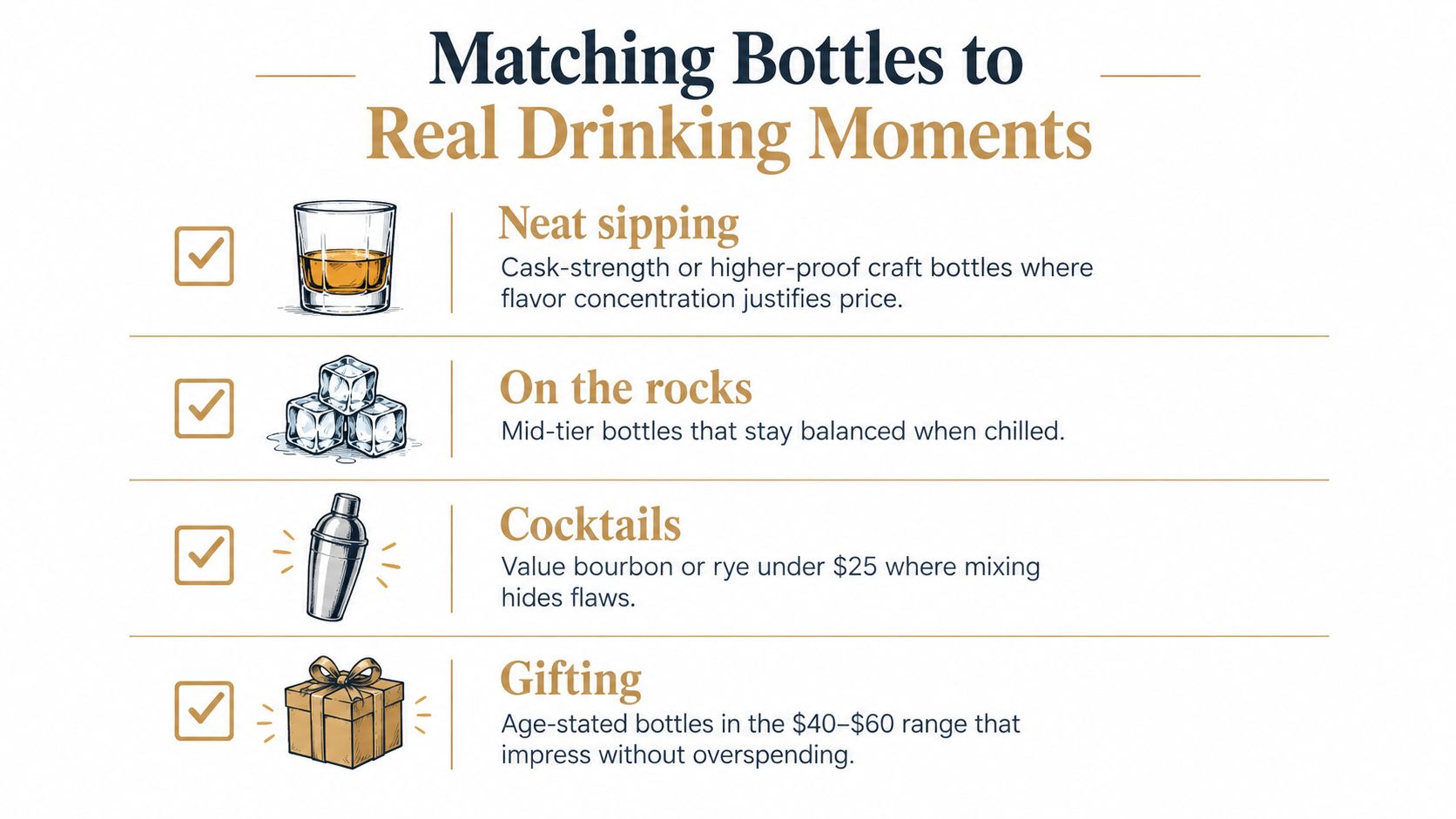
Value depends on the pour you plan to make. A whiskey that rewards neat sipping may vanish in a cocktail, while a direct, mid-tier bourbon can become a smarter buy once it meets ice, bitters, sugar, or vermouth.
Neat sipping
Choose higher-proof craft whiskey when you want concentrated flavor and a longer finish. Water lets you adjust the intensity, while an unusual mash bill or barrel profile gives the bottle more to reveal across several pours. Stellum Spirits Rye Whiskey fits this role. Its proof brings plenty of spice and intensity, provided you enjoy that profile and are comfortable adding water.
For rocks pours, choose balance rather than sheer strength. Ice reduces aroma and cools the palate, so a mid-tier bourbon with clear vanilla, caramel, and oak often delivers more pleasure than a delicate whisky whose finer notes disappear.
Cocktails and food
An Old Fashioned or Manhattan needs bourbon or rye with enough body to withstand dilution and sugar. Wild Turkey 101 is a practical benchmark because its proof and flavor remain present beside the other ingredients. Spend on structure, not rarity, when the bottle is mainly for mixing.
Whiskey also has a place at the table. Pair a bold pour with smoky, sweet, and spicy food, such as these spicy whisky BBQ wings. Heat, char, and glaze give a full-flavored whiskey enough contrast to stay interesting.
Gifting and exploration
A gift bottle with an age statement around 12 years and a price in the $50–$70 range shows care without pushing the recipient toward collector pricing. Match the style to the person when you can. Bourbon favors sweetness, rye brings spice, Irish whiskey offers softness, and single malt Scotch suits drinkers drawn to malt, fruit, or smoke.
For exploration, a craft whiskey subscription or tasting flight reduces the risk of buying a full bottle you may dislike. It also lets you compare proof, grain, age, and distillery style directly. Blind Barrels samples can support that kind of comparison, especially for drinkers exploring American craft distilleries before committing to a complete bottle.
Building Your Own Best-for-the-Money Shortlist
Stop searching for one universal winner. The best value bottle is the one that delivers flavors you enjoy often enough to justify buying it again. Build a shortlist around three to five bottles under $60, then compare them blind. Score aroma intensity, palate balance, finish length, and perceived value. Remove the labels, use identical glassware, and pour similar amounts. This setup exposes whether you prefer a famous name or a less-hyped bourbon, rye, Scotch, Irish whiskey, or American craft release.
Keep a simple tasting log:
- Date: Record when you tasted.
- Pour size: Use the same serving size each time.
- Price paid: Write down the actual shelf price.
- Aroma: Note one or two specific impressions.
- Palate: Describe texture, sweetness, spice, and heat.
- Finish: Record its length and whether the flavor holds together.
- Repurchase decision: Choose yes, no, or only at a lower price.
Small samples make comparisons affordable and practical. 50ml splits, distillery tour flights, and curated craft subscriptions let newer drinkers explore different grains, ages, and proofs without buying every bottle in full size. Blind Barrels sends members four blind samples each quarter from small American craft distilleries. Its tasting table covers aroma, palate, and finish, while the reveal provides details such as distillery, mashbill, ABV, age statement, and tasting notes.
Update the list as your palate develops. A bottle that impresses you at first may lose its appeal beside a better-balanced pour, while an affordable craft whiskey may become a reliable favorite. Organize the results by style, occasion, and the people drinking them, much as you would when learning how to make a wine list.
Sample broadly, take honest notes, and judge value by price per pour. That approach favors mid-tier and entry-premium bottles, where taste-per-dollar often peaks, while giving American craft distilleries a fair test beside established brands.
Blind Barrels offers quarterly blind tastings featuring four samples from small American craft distilleries, tasting notes, reveal information, and a palate-scoring game. Visit Blind Barrels to compare whiskey by flavor before deciding which bottles belong in your cabinet.