

You're standing in a liquor store with several bottles in front of you. One has a familiar name, another has an impressive-looking label, and a third promises a long age statement at a price that makes you hesitate. The bottles on the highest shelf seem to carry an unspoken message: this must be the best top shelf liquor. But the shelf itself can't tell you whether the spirit will suit your palate.
A better approach is to learn what premium quality looks like. Age, cask treatment, proof, production scale, finish, and provenance can reveal more than packaging or reputation. A blind tasting can reveal even more, because it asks what you enjoy before a label tells you what you're supposed to enjoy.
What Top Shelf Liquor Really Means When You're Standing in the Store
“Top shelf” began as a practical retail description, but shoppers often treat it as a formal quality grade. It isn't. A bottle's position may reflect price, packaging, brand strategy, or store layout rather than a verified difference in liquid quality.
In everyday use, top shelf liquor means a spirit positioned as premium. That positioning may come from higher-quality ingredients, extended maturation, a distinctive cask program, smaller production runs, unusual provenance, or a higher bottling strength. None of those signals guarantees that you'll like the result. They give you clues about how the producer made the spirit and what kind of experience it may offer.
A useful store rule: Treat “top shelf” as an invitation to investigate, not as a final verdict.
The premium spirits category is already substantial rather than niche. The global premium spirits market was estimated at USD 223.90 billion in 2025 and is projected to reach USD 388.48 billion by 2034, with a projected compound annual growth rate of 6.37% over that period, according to Fortune Business Insights' premium spirits market analysis. North America accounted for 36.39% of the market in 2025, while the premium segment alone was valued at USD 110.53 billion that year, which helps explain why shoppers encounter premium whiskey, tequila, rum, gin, and vodka in nearly every major market.
The store also reflects a category shaped heavily by whiskey. Whiskies held 22.89% of the global premium spirits market in 2025, according to Mordor Intelligence's premium spirits market report. That's why whiskey often anchors top-shelf conversations, though the right premium bottle depends on the occasion and your taste.
The pages ahead focus on practical evaluation. You'll learn how premium quality differs by category, what aging and proof do to flavor, why price can mislead, and how blind tasting helps you choose with more confidence. For a concise companion definition, see what top shelf liquor means.
How Premium Quality Shows Up Across Whiskey, Tequila, Rum, Gin, and Vodka
Premium quality doesn't wear the same uniform in every category. A characteristic that matters in whiskey may matter less in vodka, while a production choice that defines high-end tequila can be irrelevant to gin.
Whiskey rewards patience and structure
With whiskey, look first at maturation, mash composition, cask selection, and bottling strength. A longer stay in oak can bring deeper color and more developed vanilla, spice, fruit, and wood notes, but age alone doesn't determine quality. Single-barrel releases can offer distinctive character, while higher rye or malted barley content can shift the texture and flavor profile.
The analogy I use with new tasters is bread. The grain provides the basic flavor, the fermentation creates the structure, and the barrel acts like a finishing environment that changes the whole loaf over time.
Tequila starts with the agave
For tequila, check whether the bottle is made from 100 percent agave. Traditional production methods, careful cooking, fermentation, and maturation can matter more than a flashy label. Blanco tequila often preserves bright agave and peppery notes, while extra añejo expressions bring oak and dessert-like flavors through extended aging.
Rum can be defined by fermentation and still type
Premium rum may come from pot-still production, expressive fermentation, higher ester content, or meaningful tropical aging. Pot stills can produce a heavier, more aromatic spirit than a lighter column-still style. Tropical maturation can also accelerate interaction with the barrel, creating bold flavors that don't resemble a gently aged whiskey.
Gin depends on botanical clarity
In gin, premium quality often appears in the botanicals, base spirit, and distillation method. A well-made London Dry gin should let juniper lead while supporting citrus, spice, floral, or herbal notes. Copper pot distillation and carefully selected botanicals can create definition rather than a flat, purely alcoholic profile.
Vodka is judged by texture and restraint
Vodka presents a different challenge because producers often aim for neutrality. Multiple distillations, clean water, and filtration can produce a smooth, polished texture. But excessive filtration may strip away the small amount of grain, fruit, or mineral character that gives a premium vodka personality.
A useful comparison is music. Whiskey may ask you to listen for layers, while vodka may ask whether the sound is clean, balanced, and free from distortion. Premium is category-specific, so don't use one universal checklist for every bottle.
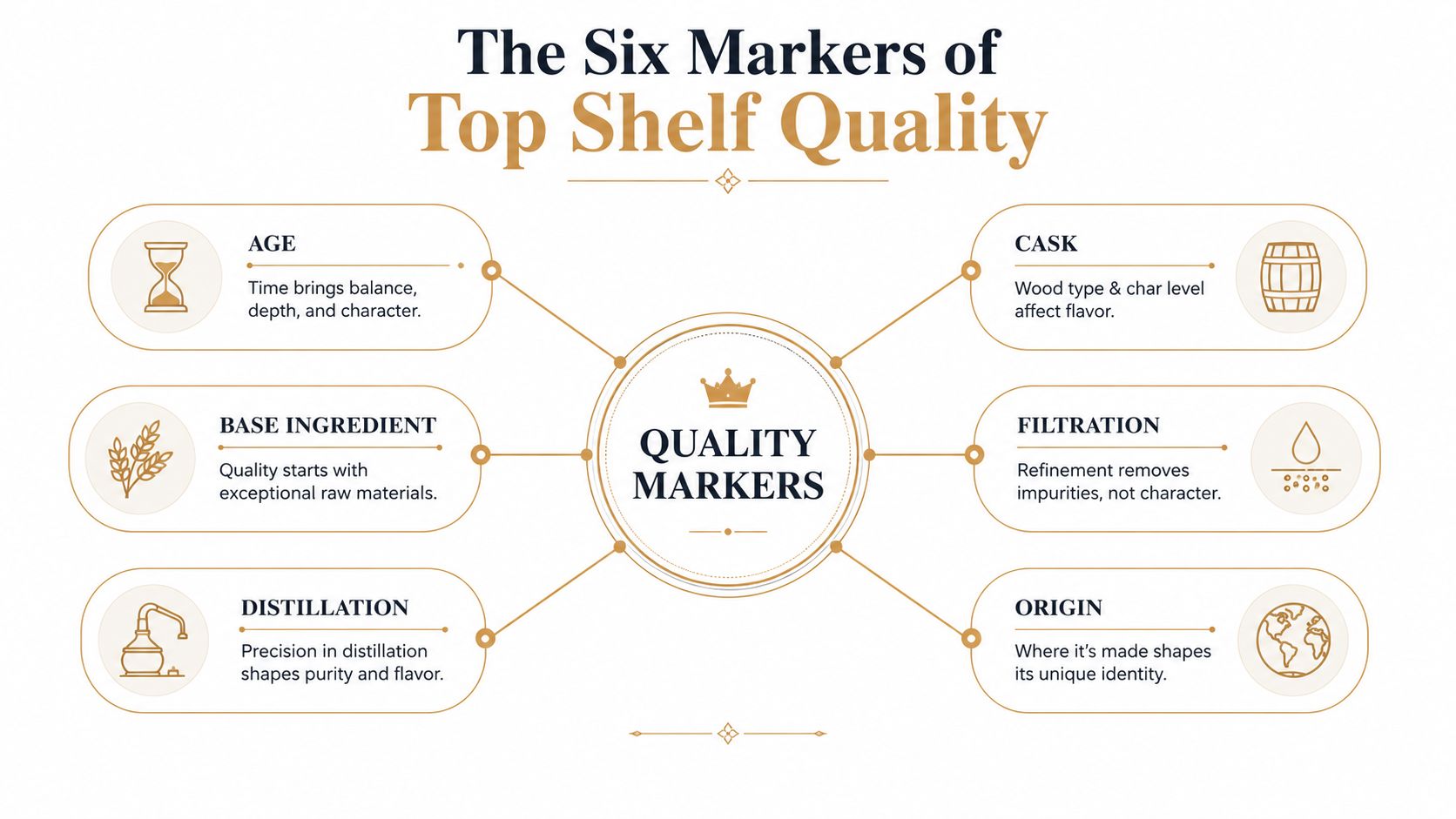
The Six Markers That Separate Top Shelf From the Rest of the Shelf
A premium label becomes more useful when you translate its claims into production mechanics. The six markers below won't predict your personal favorite every time, but they'll help you separate meaningful information from decorative language.
1. Age changes flavor through barrel chemistry
Aging is not just time passing. In new charred oak, maturation increases color, acids, esters, aldehydes, furfural, solids, and tannins, while sensory panels detect stronger vanilla, cinnamon, alcohol, and woody aromas as aging progresses, as detailed in this study of whiskey maturation and oak chemistry.
Oak pyrolysis and extraction release compounds such as vanillin, oak lactones, and eugenol. Micro-oxygenation, evaporation, and oxidative reactions then help shape aroma complexity and soften rougher notes. A bottle needs balance, though. More barrel influence can eventually overwhelm the underlying spirit.
2. Cask selection gives the spirit its accent
New charred oak, used bourbon barrels, wine casks, sherry-seasoned wood, and other finishing vessels each contribute different flavors. Char level affects extraction, while previous contents leave behind their own compounds. American craft whiskey can become especially interesting. Distilleries such as Stranahan's in Colorado, McCarthy's in Oregon, and Wasmund's in Virginia show how regional producers can build identity around grain, wood, and local production decisions, as discussed by The Whiskey Wash in its comparison of craft and major whiskey producers.
3. Proof affects aroma and texture
Proof isn't a synonym for quality. Alcohol concentration changes volatility, mouthfeel, and flavor release, so a higher-proof whiskey may feel more intense and structured. Barrel-proof whiskey can preserve more of the barrel's ester, phenolic, and oak-derived character, although the final result still depends on aging, extraction, evaporation, blending, and bottling strength, as explained in this technical discussion of whiskey as a chemical solution.
4. Small-batch production can support consistency
“Small-batch” isn't a universal legal guarantee of quality. It can indicate that a distillery works with a more limited amount of spirit, which may allow closer attention to blending, barrel selection, and release decisions. The label deserves context. Look for information about the producer, source, mash bill, and maturation rather than treating the phrase alone as proof of excellence.
5. Finish reveals balance
The finish is what remains after the swallow. Does fruit fade into spice? Does oak stay pleasant, or does tannin dominate? Does alcohol heat disappear quickly, or does it cover the flavor?
A long finish isn't automatically better. A shorter, clean finish may suit a delicate whiskey, while a layered evolving finish can make a powerful bourbon compelling.
6. Provenance adds context, not automatic superiority
Water source, grain, agave, climate, distillery equipment, and production location can all shape a spirit. Provenance tells you where the character may come from, but it can't replace tasting. American craft distilleries often make provenance visible because their scale and regional identity are part of the story.
For a closer look at how wood choices create distinct American whiskey profiles, explore whiskey barrel finishes in American craft whiskey.
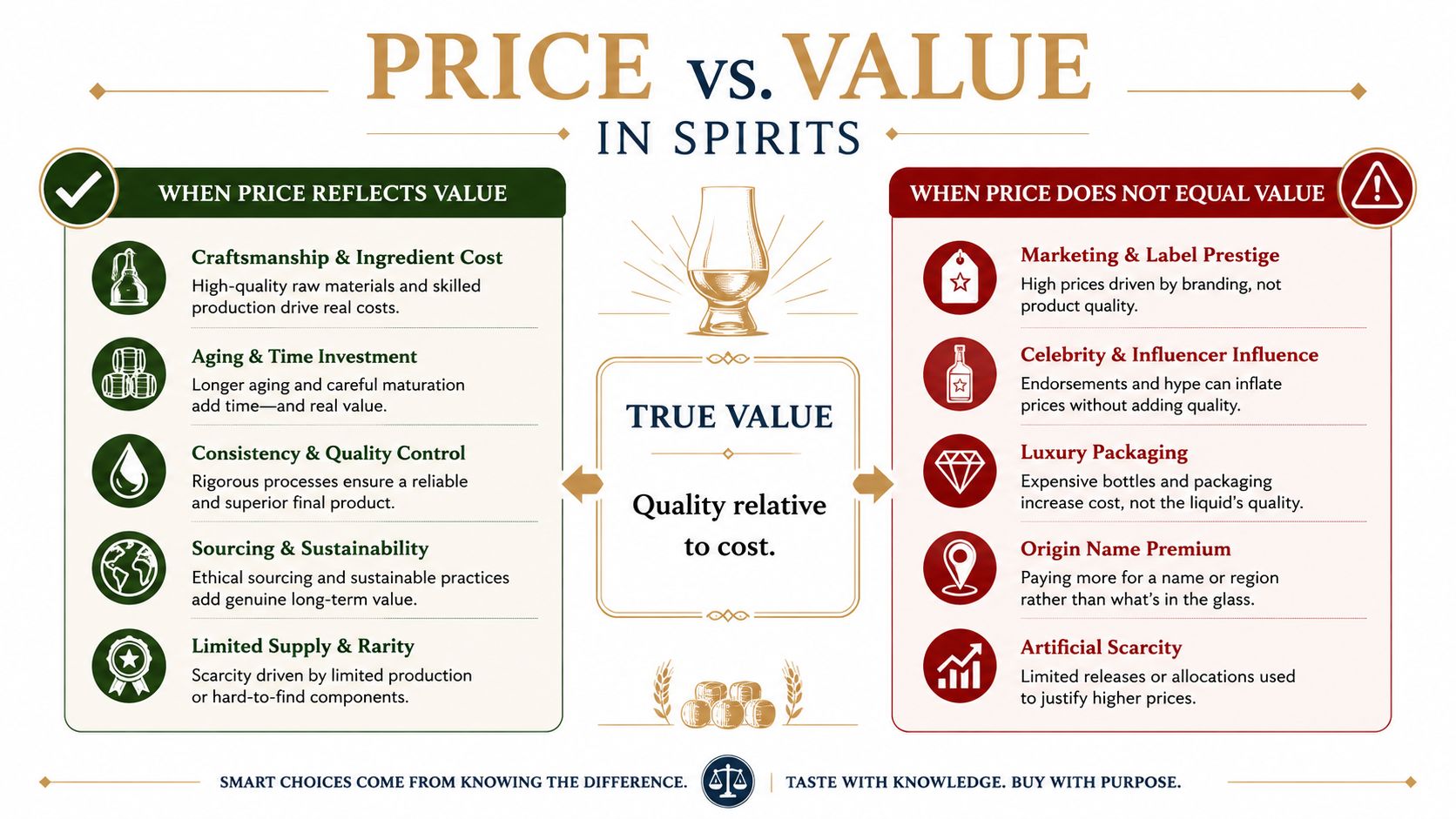
Why Price and Value Are Not the Same Thing in Premium Spirits
A high price can reflect real production expense, but it can also reflect reputation, packaging, distribution limits, or scarcity. True value means quality relative to cost, not just the largest number on the shelf.
A distillery may charge more because it holds whiskey in barrels for longer, uses expensive casks, accepts lower yields, or blends carefully across a limited release. Those choices can create real costs. Another bottle may cost more because consumers recognize the name and retailers know they'll pay for it.
Recent market reporting supports a more selective approach. Super-premium-plus spirits fell 15% in 2025, while broader premium tiers declined 5% or less, according to The Spirits Business' coverage of premium spirits performance. The figures don't prove that expensive bottles lack merit, but they do suggest that shoppers are questioning whether prestige alone justifies the price.
Three bottles, three different value stories
| Bottle situation | What may justify the price | What to investigate |
|---|---|---|
| A moderately priced craft bourbon | Dense flavor, careful blending, distinctive casks | Proof, age, source, and tasting balance |
| A famous-label release | Established production and reliable availability | Whether the liquid delivers more than the reputation |
| A rare allocation | Limited access and collector interest | Whether scarcity adds flavor or only exclusivity |
Read the label before reading the price tag. Look for an age statement, proof, mash bill or agave information, distillery or bottler details, and any explanation of cask treatment. A celebrity endorsement or elaborate bottle can tell you about marketing, but it can't tell you whether the spirit suits your palate.
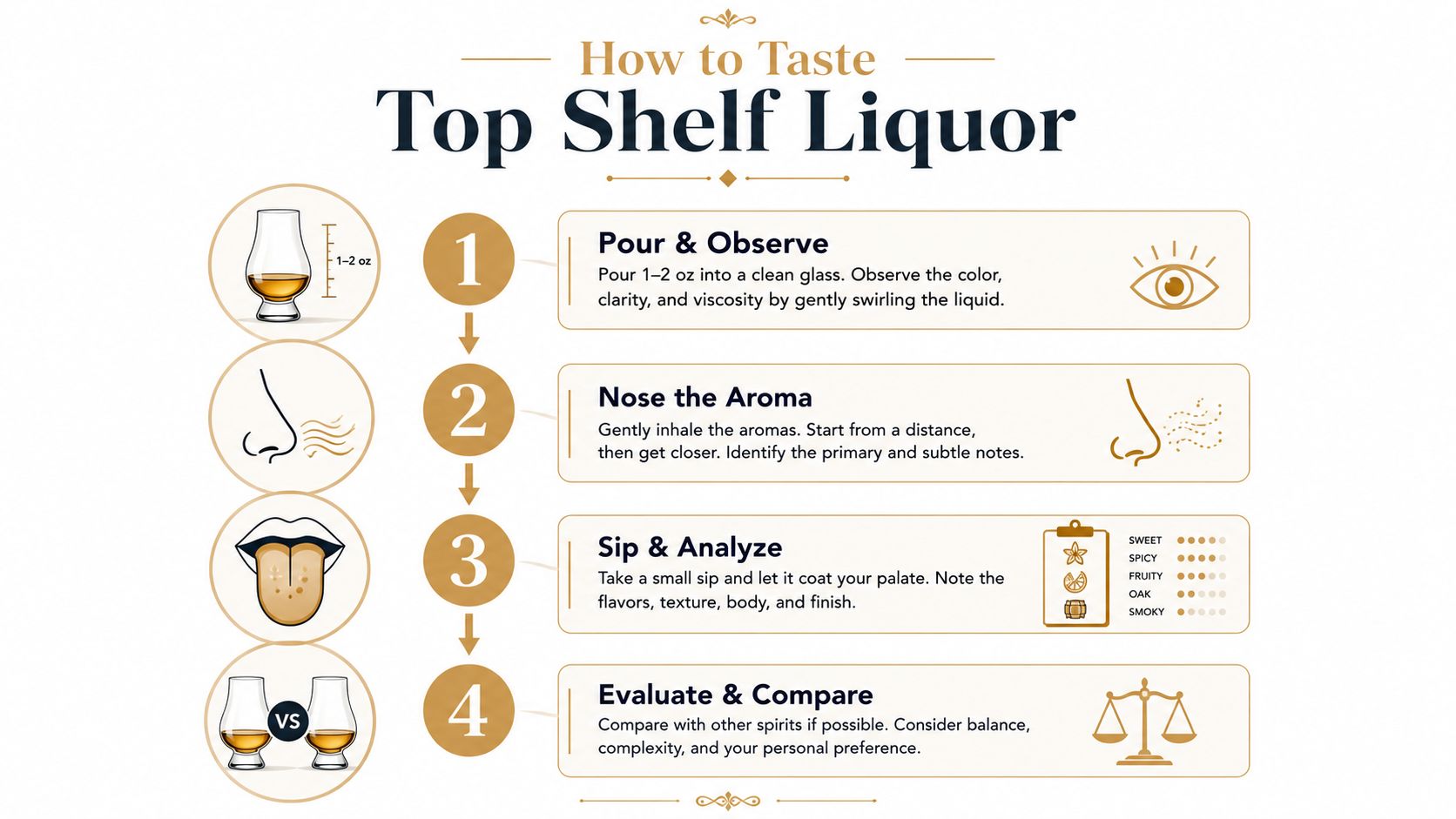
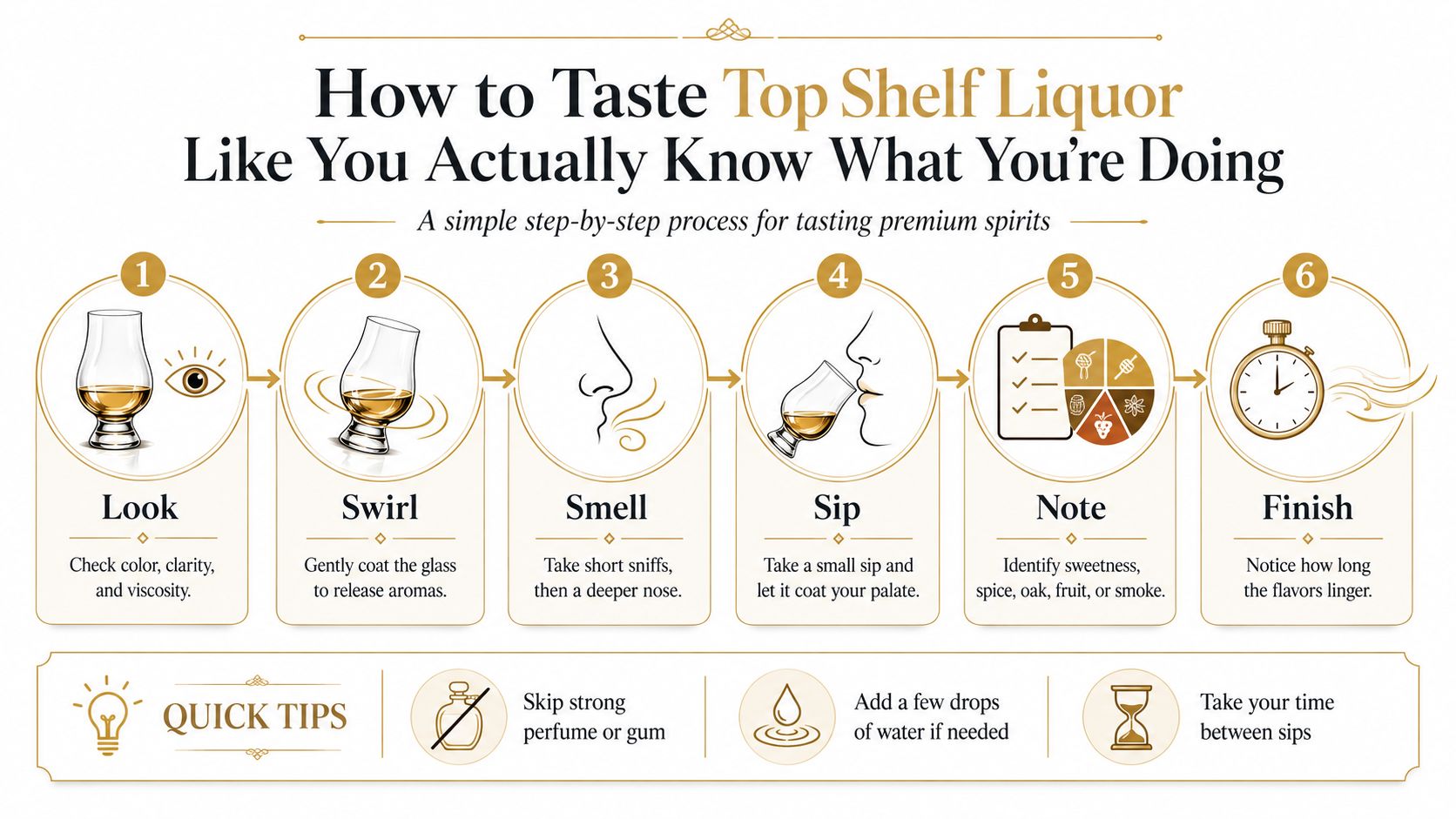
How to Taste Top Shelf Liquor Like You Actually Know What You're Doing
You don't need a professional vocabulary to taste well. You need a repeatable process and enough patience to separate aroma, texture, flavor, and finish.
Start with about one ounce, following the practical guidance in this beginner's whiskey tasting guide. Use a tulip-shaped glass if you have one, because its narrower opening helps gather aromas. Let the pour rest briefly before tasting. The same guide recommends letting whiskey sit for thirty seconds, giving the spirit a moment to settle.
Begin with observation, then move to aroma
Look at the color, but don't treat darkness as a guaranteed age statement. One tasting resource says a whiskey that appears quite dark is probably at least four years old and possibly high proof, though color can also reflect cask type, char, and blending, as noted in Spirits & Distilling's tasting guidance.
Swirl gently, then take short sniffs. Keep your mouth slightly open while nosing, which can make the aroma easier to assess. Start with broad impressions such as grain, fruit, caramel, or citrus. Then look for secondary notes such as oak, cinnamon, vanilla, pepper, or herbs.
Beginner practice: Write down your first impression before checking the bottle. Your initial reaction is useful, even if your vocabulary is still developing.
Taste in stages
Take a small sip and let it move across your tongue. Notice the entry, the mid-palate, and the finish rather than judging the whiskey from the first flash of alcohol. Ask whether the texture feels creamy, oily, light, dry, or hot. Then identify the flavors that remain after swallowing.
If the whiskey feels harsh, add a few drops of water and taste again. Cask-strength pours can run north of 60% alcohol, so dilute them gradually rather than adding a large amount at once, according to the same tasting resource for evaluating strong whiskey.
Proof is easy to misread. In the United States, proof is exactly twice the alcohol-by-volume percentage, so 122.4 proof equals 61.2% ABV, as explained in this guide to reading a bourbon proof label. Age and proof are independent variables. A younger whiskey can be stronger than an older one.
Between samples, drink water and give your palate time to recover. In a blind tasting, compare samples with one another, but don't force yourself to prefer the one with the longest finish or highest proof. Your preference is the final evidence.
What a Blind Tasting Subscription Teaches You That Brand Labels Cannot
A bottle label creates expectations before the spirit reaches your glass. You may anticipate sweetness from a familiar brand, assume a high price signals complexity, or dismiss an unfamiliar craft distillery before tasting it. Blind tasting removes that early instruction.
A subscription format such as Blind Barrels sends members four blind whiskey samples each quarter, featuring small American craft distilleries. The samples arrive in identical unmarked bottles, accompanied by a tasting table for aroma, flavor, and finish notes. QR codes connect to reveal pages after scoring, so you can learn the producer and bottle details only after forming an opinion.
The reveal comes after the judgment
The game adds structure without turning tasting into an exam. You estimate details such as age, proof, and whiskey type, record your impressions, and receive a score indicating how closely your palate identified the samples. The point isn't to prove that you can guess every technical detail. It's to make you slow down and notice what you're experiencing.
The comparison also changes the question. Instead of asking whether a sample is objectively perfect, you ask which one you prefer and why. One whiskey may offer dark oak and baking spice, another may show bright fruit and a lighter body, and a third may deliver heat that overwhelms its flavor. Ranking them side by side exposes your preferences more clearly than tasting a single bottle with its label visible.
Familiarity can influence judgment before the first sip. Blind tasting gives the liquid a chance to speak first.
The educational payoff is practical. You may discover that you prefer craft bourbon with a softer texture, rye-forward whiskey with peppery lift, or higher-proof pours that open with water. You also build a vocabulary tied to actual sensory experience instead of repeating the language printed on a bottle.
For a deeper explanation of the format and its value, read about blind whiskey tasting. The same method works with samples poured by friends, a local tasting group, or bottles covered and numbered at home. The essential step is simple: taste before you identify.
Building Your Own Framework for Choosing the Best Top Shelf Liquor
The most reliable buying framework starts with the occasion, not the bottle. Decide what you want the spirit to do, then choose the category and evaluate the production details that matter for that category.
Start with the moment
A high-proof bourbon may suit quiet sipping because its concentration gives you room to explore it with or without water. A blanco tequila can bring bright agave and citrus energy to a cocktail. A mature rum may add depth to a tiki drink, while a London Dry gin can provide juniper structure in a martini. Filtered vodka may be the right choice when the goal is a clean texture in a simple build.
These aren't rigid rules. They're starting points that connect flavor structure with the way you plan to drink.
Read the label as a set of expectations
Scan for the information that helps you predict the pour:
- Spirit identity: Whiskey, tequila, rum, gin, and vodka each have different quality markers.
- Raw material: Look for mash bill details, grain information, or agave labeling when provided.
- Distillation: Still type and production method can suggest whether the spirit will feel light, rich, clean, or expressive.
- Maturation: Check the age statement, cask type, and whether the bottle contains a finish.
- Strength: Proof tells you about alcohol intensity, not age or guaranteed quality.
- Source: Distillery location, bottler, and producer information can clarify provenance.
American craft whiskey deserves a place in this process because producers such as Stranahan's, McCarthy's, and Wasmund's illustrate how regional identity and production choices can create different styles. Craft doesn't automatically mean better, but it gives you another field of bottles to explore beyond the most familiar major brands.
Finish your decision with a blind comparison whenever possible. If the bottle wins with the label hidden, its quality and your preference are working together. If it loses, that's useful information too. Credentials guide your search. Your palate makes the decision.
Misconceptions About Top Shelf Liquor Worth Leaving Behind
Older doesn't automatically mean better. Barrel maturation can deepen whiskey, but too much oak can push a spirit toward tannin, dryness, or flatness. Delicate tequila and rum can also lose their defining character when wood dominates the liquid.
Higher price doesn't guarantee higher quality. Price may reflect careful production, but it may also reflect packaging, scarcity, distribution, or brand prestige. A moderately priced craft whiskey can deliver more balance and flavor density than a more expensive bottle chosen mainly for its reputation.
Top shelf doesn't mean neat only. A distinctive premium spirit can improve a cocktail when its character remains visible in the finished drink. Use a bright tequila in a citrus-forward build, a botanical gin in a martini, or an aged rum when you want deeper molasses and spice notes.
The strongest definition is simpler: top shelf liquor is premium positioning supported by meaningful production markers and confirmed by your own palate. Shelf height, age statements, and labels can guide your attention, but blind tasting can test whether the liquid earns your preference.
Blind Barrels offers quarterly blind whiskey tasting kits with four samples from small American craft distilleries, a tasting table, reveal QR codes, and a scoring game for age, proof, and whiskey type. Visit Blind Barrels to explore a structured way to taste premium whiskey without brand or price bias.