

Most “best whiskey subscription” guides start with the wrong question. They ask which box contains the rarest bottle, the highest retail value, or the most impressive label. That approach turns discovery into expensive guesswork. If you haven't tasted the whiskey, a full bottle is a commitment, not a recommendation.
The better question is simpler: which subscription format helps you identify what you actually enjoy, without brand reputation or price influencing your palate? For most drinkers, that means sample-led tasting, clear education, and a practical route to buy a full bottle only after a whiskey earns its place in your glass.
The market supports this kind of experience. The global whiskey market was estimated at USD 77.92 billion in 2025 and is projected to reach USD 116.01 billion by 2033, with a projected 5.1% CAGR from 2026 to 2033, according to Grand View Research's whiskey market analysis. There's no shortage of whiskey. The challenge is finding the bottles that suit your palate.
Rethinking How We Discover New Whiskey
A full-bottle club sounds generous until the whiskey misses your taste. You've paid for liquid you may not finish, and the bottle occupies shelf space while you search for a mixer, a guest, or a charitable recipient. Retail value matters, but it doesn't tell you whether the subscription improves your judgment.
That's why I use palate ROI as the first test. A subscription should help you answer useful questions: Do you prefer a sweet bourbon or a peppery rye? Does oak appeal to you, or does it overwhelm the fruit? Do you enjoy higher-proof whiskey, or does the alcohol cover the flavors you want to find?
The label is often the loudest voice
A famous distillery, an expensive age statement, or a striking bottle can shape your expectations before you taste anything. You may search for the flavors you think should be present instead of noticing what's in the glass. Blind tasting removes much of that pressure, leaving aroma, texture, sweetness, spice, smoke, and finish to make the case.
That doesn't mean brand information is useless. It means you should receive it after forming your first impression. The ideal sequence is taste, record, compare, reveal, then decide whether the whiskey deserves a full-bottle purchase.
Sample-based clubs also solve a basic household problem. A small pour lets you test a style without filling the cabinet with bottles that seemed exciting in a recommendation list but don't work for you neat. This is particularly useful with American craft whiskey, where distilleries can offer distinct mash bills, barrel approaches, and regional character.
Palate rule: Don't pay for a large bottle when what you really need is a trustworthy first taste.
Curated can beat abundant
Consumer survey data found that alcohol subscription boxes averaged $43 in monthly spend and recorded an 81% usage rate, suggesting that drinkers can stay engaged with a subscription when the experience feels curated and experiential rather than purely transactional. The figures come from CouponFollow's subscription-box research.
That distinction matters. A box that ships alcohol may create a delivery habit. A box that gives you a structured tasting, useful notes, and a way to compare samples can build a repeatable learning habit. For genuine discovery, I'd choose fewer, better-explained samples over a larger shipment with no tasting framework.
The Three Main Whiskey Subscription Models
Before comparing services, decide what you want delivered. Whiskey subscriptions generally fall into three formats: full-bottle clubs, curated sample boxes, and blind tasting experiences. They overlap, but they create very different drinking habits.
| Model Type | Primary Goal | Best For |
|---|---|---|
| Full-bottle club | Build a home bar with regular bottle deliveries | Drinkers who already understand their preferences |
| Curated sample box | Explore styles, distilleries, and flavor profiles | Curious drinkers who want variety without committing to bottles |
| Blind tasting experience | Improve palate awareness through unbiased comparison and guided play | Couples, friends, and learners who value discovery over bottle volume |
Full-bottle clubs
The full-bottle model is closest to a retail delivery service. You receive larger formats and can add meaningful bottles to your shelf, but the discovery risk is higher. If the curator's taste differs from yours, the box may feel costly even when the selection is objectively respectable.
This format suits a drinker who already knows their preferred profile. Someone who consistently chooses wheated bourbon, for example, may appreciate regular access to similar releases. A beginner who's still distinguishing bourbon from rye may get more value from smaller samples first.
Curated sample boxes
Sample boxes widen the tasting field. You can compare American craft whiskey, bourbon, rye, Tennessee whiskey, and other styles without treating every experiment as a full-bottle purchase. The drawback is volume. If your main goal is to stock a home bar, samples alone won't satisfy you.
The important question is whether the box gives you more than pre-portioned liquid. Does it provide tasting notes, production context, structured comparisons, or a route to purchase the bottle afterward? The broader subscription-box market shows strong interest in curated at-home experiences, but the key whiskey question remains unresolved: are you paying for education, exclusivity, or samples? Blind Barrels' analysis of liquor subscription boxes makes that value question central.
For comparison, readers interested in how curation, member benefits, and discovery work in another drinks category can explore Napa wine club advantages. The same principle applies to whiskey: benefits matter only when they improve what you drink and how confidently you choose it.
Blind tasting experiences
Blind subscriptions prioritize method over bottle size. The service hides the identity of each sample, gives you a tasting framework, and reveals the details after you've recorded your impressions. This is the strongest format for reducing brand bias and turning a casual pour into an experiment.
If you're unsure how fulfilment, billing, and shipment timing work, this guide to how subscription boxes work provides useful background. For a whiskey buyer, the practical test is whether the subscription creates a complete loop: sample, assess, reveal, and purchase if the bottle earns it.
Evaluating the Top Whiskey Subscription Services
Flaviar is a sensible choice for drinkers who want a broad spirits discovery platform and access to a large catalogue. Its appeal is variety and exploration across categories. The trade-off is that a broad catalogue doesn't automatically create a focused whiskey education programme, especially if you want to compare samples without knowing the brand first.
Whiskey Club options vary considerably, so inspect the exact offer rather than relying on the category name. Some clubs emphasize full bottles or rare releases, while others provide tasting-led access. Ask whether the service explains why each whiskey was selected, whether the samples are substantial enough for repeated tasting, and whether you can buy a full bottle after finding a favorite.
Blind Barrels takes the most focused approach for drinkers who want American craft whiskey and a blind comparison. Each quarterly kit contains four blind samples from small American craft distilleries, a tasting table covering aroma, tasting, and finish notes, and a QR code that reveals the whiskey details and connects the member with full-bottle purchasing options. The experience also includes a guessing game involving age, proof, and whiskey type, followed by a score that shows how closely your assumptions matched the revealed information.
Compare the purchase path, not just the package
The best discovery service doesn't leave you with a sample you love and no obvious way to find the bottle. QR-linked purchasing is valuable because it shortens the gap between recognition and action. You taste first, reveal the details, then decide whether that expression belongs in your cabinet.
Recent trend coverage describes growing interest in sample clubs that partner with independent small-batch distilleries, including approachable formats that explore one distillery at a time or use unbiased comparison and shared tasting. TrendHunter's coverage of The Slow Whisky Club reflects the appeal of smaller, more intimate discovery models.
For gifts, a bottle-heavy service may feel more substantial. For a tasting night or a couple exploring whiskey together, blind samples create more interaction. Blind Barrels' guide to monthly clubs for gifts is useful when the recipient's preferences and drinking routine matter more than the size of the parcel.
How to Taste and Evaluate Your Subscription Samples
A subscription can't improve your palate if you drink every sample without paying attention. You don't need formal certification or an expensive room. You need a proper glass, a calm pace, and notes that capture what your senses detect before someone else's description takes over.
Independent whiskey education guidance recommends a proper tasting glass, avoiding large mouthfuls, and recording appearance, aroma, and finish. It also recommends taking a small sip and letting the initial burn fade before swallowing, as explained in this beginner's whiskey tasting guide.
Use the same sequence every time
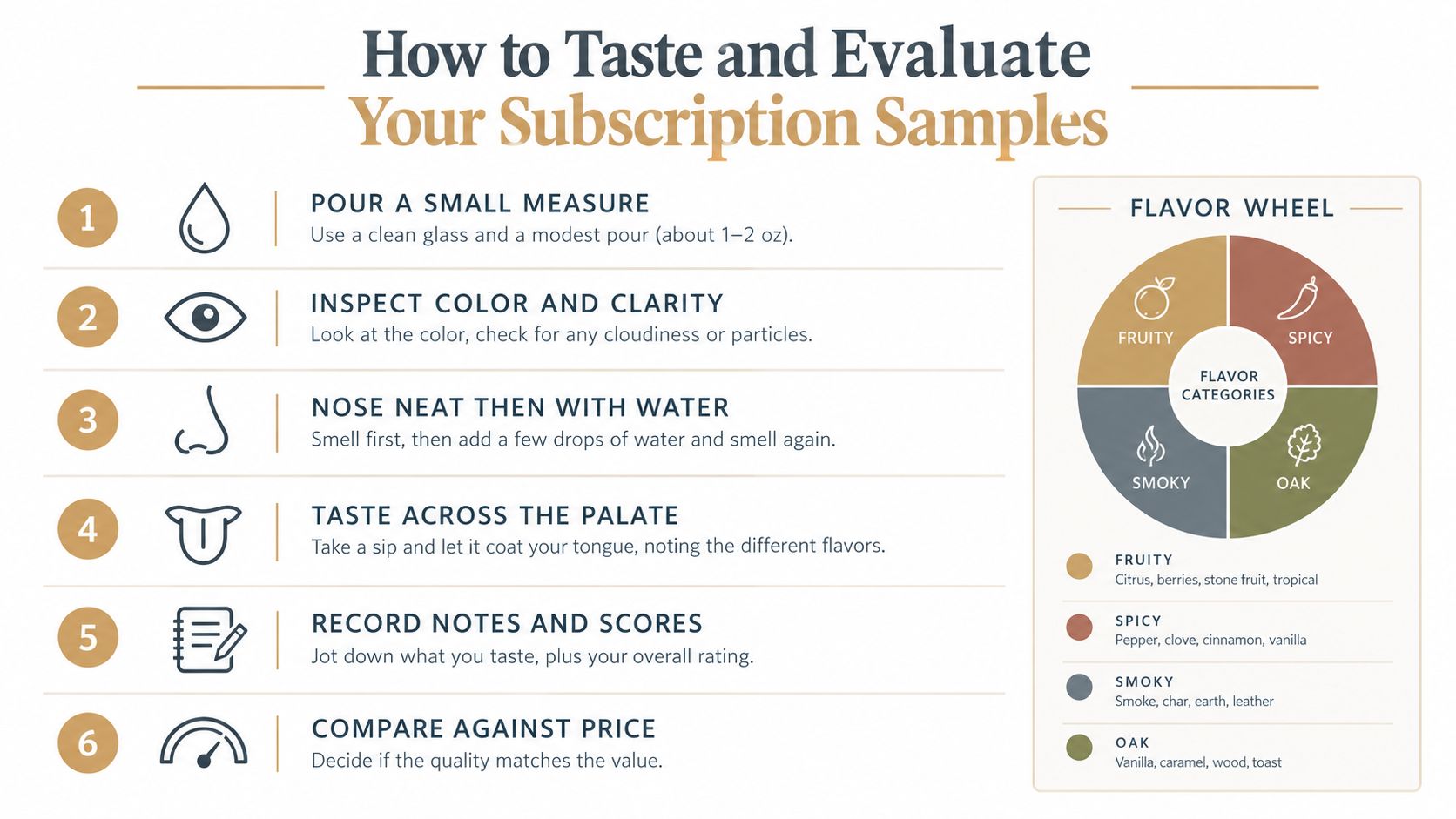
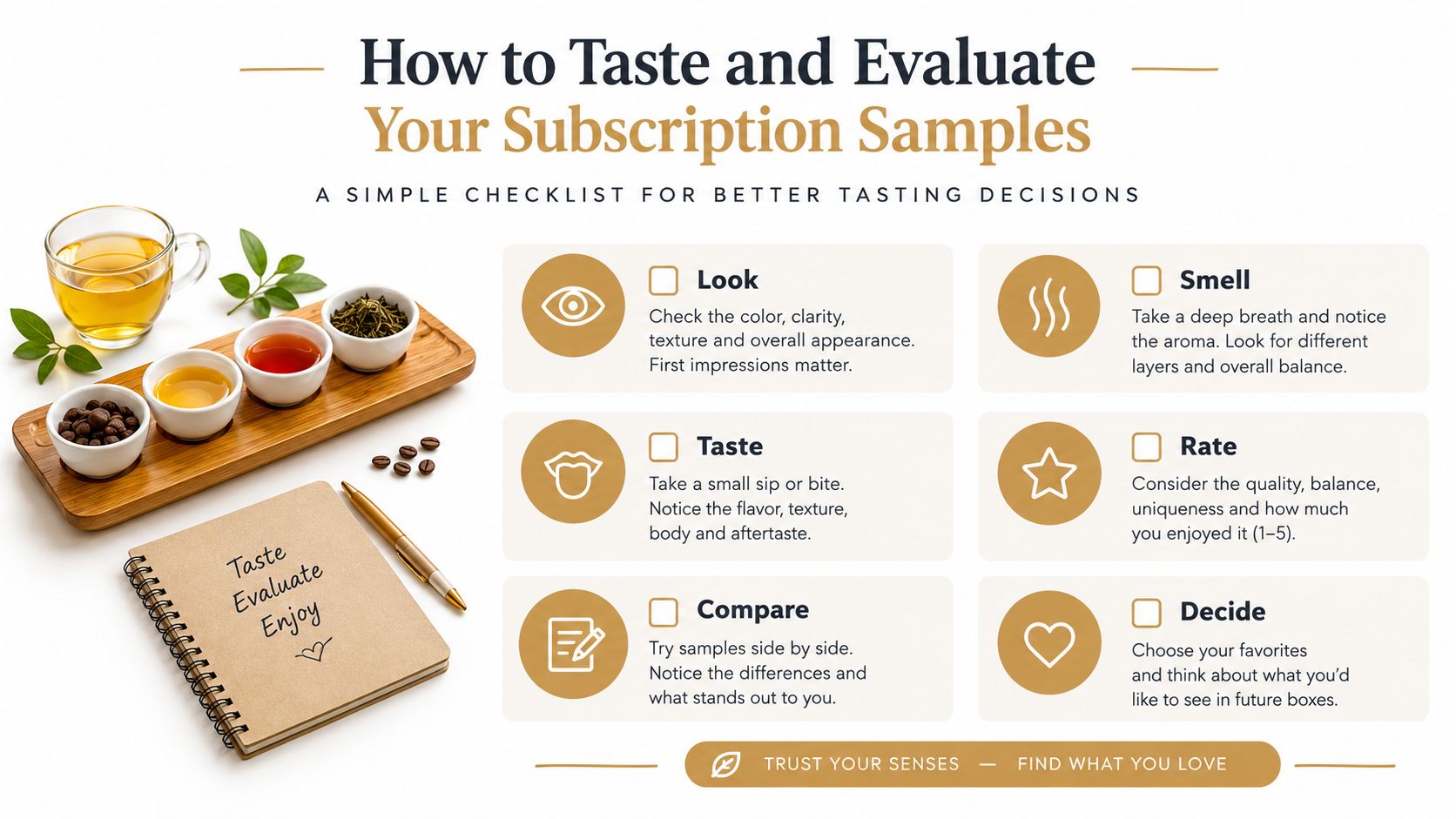
Pour a small measure into a tulip-shaped tasting glass if you have one. Look at the color and clarity, but don't treat a darker appearance as proof of superior quality. Color can suggest barrel influence, yet the aroma and taste have to justify your conclusion.
Bring the glass to your nose gently. Smell the whiskey neat, then add a little water if the alcohol dominates. Take a small sip, move it across your palate, and let the initial burn settle before judging the flavors. Water isn't a failure. It can make aromas easier to identify and may reveal a different texture.
Record notes before checking the label. A useful tasting sheet should include:
- Appearance: Note color, clarity, and how the liquid moves in the glass.
- Aroma: Record the first impression, then look for fruit, grain, spice, smoke, oak, or sweetness.
- Palate: Describe texture, warmth, sweetness, bitterness, spice, and balance.
- Finish: Write down what remains after swallowing and whether the ending feels short, dry, sweet, hot, or lingering.
- Preference: State whether you'd drink it again, regardless of its reputation or price.
A structured whiskey tasting notes template makes comparisons easier because every sample gets judged against the same prompts. Don't chase fashionable tasting notes. If you smell cereal, caramel, black pepper, or very little at all, write that down. Honest notes train your palate more effectively than borrowed vocabulary.
Practical rule: Taste the whiskey before you read what it is supposed to taste like.
Matching the Right Subscription to Your Drinker Persona
The right subscription depends less on whiskey knowledge than on how you want to drink. A person exploring alone needs clarity and repetition. A couple may want a shared game. A collector may care most about access to bottles that don't appear in ordinary retail channels.
The curious beginner
Choose a curated sample box or guided blind format if you're still learning the difference between bourbon, rye, Tennessee whiskey, and other American styles. You need explanations that make the liquid approachable, not a parade of technical terms or prestige labels.
American whiskey has a specific U.S. legal definition when it is produced in a single state or territory and that jurisdiction permits the name. It must be distilled from a fermented grain mash, stored in oak containers, and bottled at no more than 80 proof, according to this beginner's guide to drinking whiskey. Common American styles include bourbon, rye, Tennessee whiskey, and single malt, giving a craft-focused subscription plenty of room to teach through contrast.
Look for approachable tasting notes, a proper reveal process, and samples that encourage comparison. The beginner doesn't need maximum rarity. They need a reliable way to connect sensory impressions with a style they can recognize later.
The social couple
Choose blind tasting. It gives both people a role, even when one person knows more about whiskey. You can pour samples, keep the identities hidden, compare aroma notes, guess the style, and reveal the answers together.
This format also prevents one person's confidence from dominating the evening. A partner who rarely drinks whiskey can participate through smell, texture, and preference without needing to identify a distillery. The conversation becomes “Which one do we like?” rather than “Which one is the expensive bottle?”
The seasoned collector
Choose a full-bottle or rare-release club if your primary goal is to expand a home bar. You already know what you like, so the risk of receiving an unsuitable bottle is lower. You may also value allocation access, independent bottlings, or small-batch American releases more than tasting instruction.
Still, collectors shouldn't dismiss samples. A blind sample can challenge a strong brand preference and expose a bottle that would otherwise be overlooked. If the collector wants both access and better judgment, a hybrid approach works best: use bottle clubs for acquisition and blind tastings for palate calibration.
The collector buys bottles. The learner buys better decisions.
The Economics of Whiskey Discovery and Retention
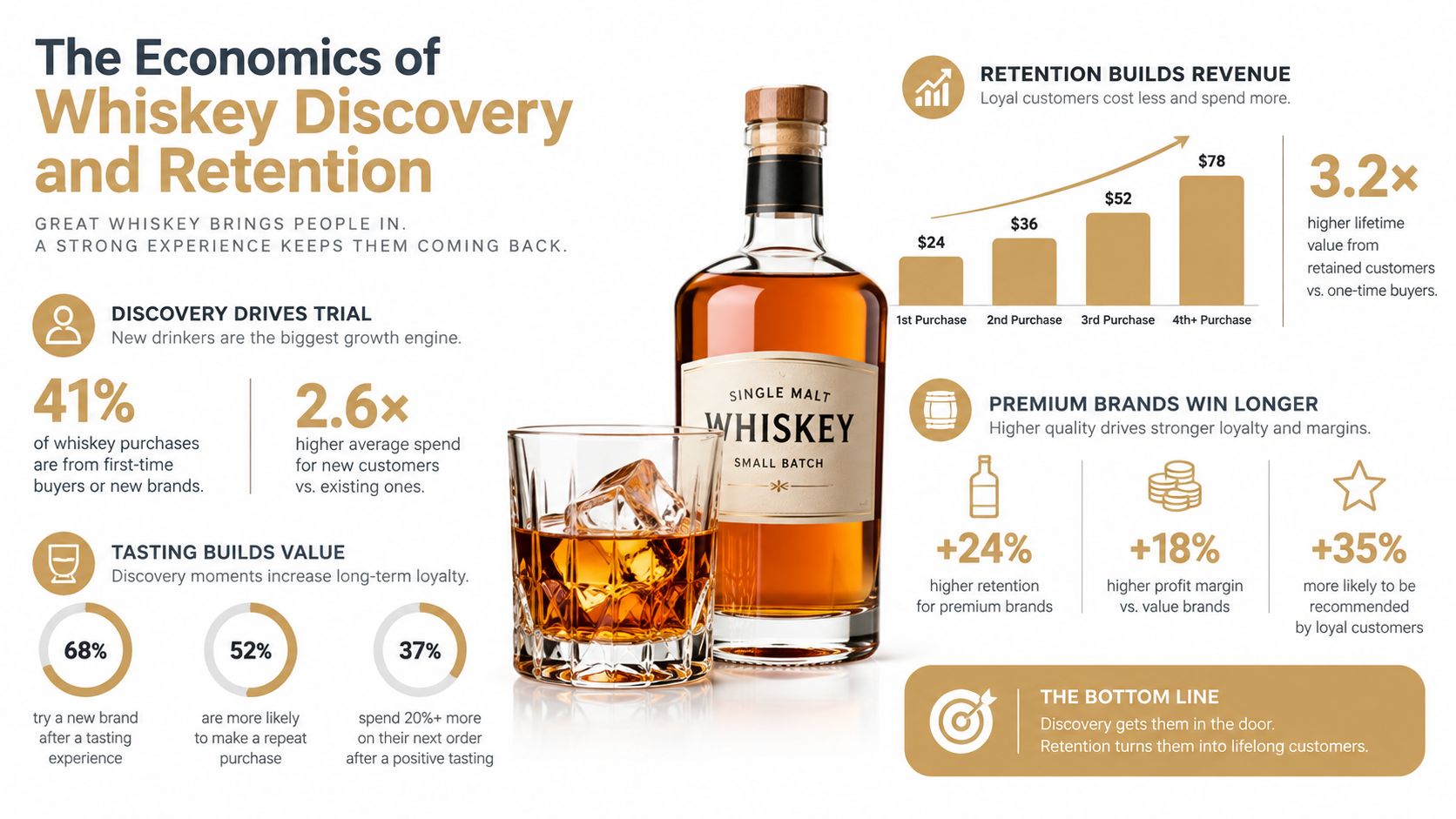
A whiskey subscription earns its place through the drinking decisions it improves, not the unboxing it stages. The strongest format helps you identify a style, understand your preference, and find a full bottle without restarting the search. Blind tasting earns particular value because it removes brand reputation from the first judgment.
Premium interest gives the category room for paid discovery, but market growth does not guarantee subscriber value. The economic test is whether each shipment improves palate decisions and makes a worthwhile bottle easier to choose.
Retention follows relevance
A subscription becomes forgettable when every shipment feels interchangeable. It becomes habitual when each delivery answers a question raised by the previous one. If a tasting shows that you prefer rye spice to heavy oak, the next selection should examine that preference rather than introduce unrelated bottles.
Guided education strengthens retention because it turns a shipment into progress. Tasting notes, comparison prompts, and a useful reveal process help subscribers remember what they learned. Blind formats add another benefit: they can expose a preference that a familiar label would have concealed.
Subscription economics still require discipline. A commonly used benchmark for subscription businesses is an LTV-to-CAC ratio of 3:1, meaning each dollar spent acquiring a customer should ideally produce about three dollars in lifetime value. Distiller Magazine's discussion of spirits by subscription explains why retention and gross margin matter in a premium spirits box.
For the customer, the test is practical:
- Discovery value: Does each shipment teach you something about your palate?
- Usage value: Do you open, compare, and discuss the samples?
- Purchase value: Can you find the full bottle when one earns a place at home?
- Relationship value: Does the format give you a reason to return to whiskey with someone else?
Use broader guidance on subscription churn for ecommerce carefully. Cancellations often signal poor fit, not rejection of subscriptions as a concept. A drinker seeking rare bottles needs access and allocation opportunities, while a beginner gains more from guided samples and blind comparison. The right service retains customers by matching its format to the decision they want to make.
Planning Your First Whiskey Tasting Night
Start with the experience, not the shipping box. Choose a clean table, neutral glasses if possible, water, a notebook, and a few simple snacks that won't dominate the whiskey. Keep the bottles or identifying materials out of sight until everyone has recorded an initial impression.
Set out the samples in an order that moves from lighter and gentler expressions toward richer or more forceful ones. You don't need to announce what that order means. The point is to give each whiskey a fair chance and avoid letting a powerful pour flatten your ability to notice the next one.
A practical tasting sequence
- Pour and label privately. Give each sample a number or letter so nobody can use the name as a clue.
- Taste before researching. Everyone writes an aroma, palate, finish, and preference note before the reveal.
- Compare impressions. Read the notes aloud and notice where people agree or disagree.
- Play the guessing game. Estimate the whiskey type, age, or proof if the subscription provides those prompts.
- Reveal the details. Scan the QR code or use the supplied tasting table to learn about the distillery and expression.
- Choose the bottle. Buy only the whiskey that earned a clear “I'd drink this again,” not the one with the most impressive story.
The U.S. online alcohol channel became more structurally important after pandemic-era growth, making it easier for drinkers to purchase premium bottles after tasting samples, according to Global Market Insights' whiskey market coverage. That makes the post-tasting purchase path part of the subscription's value, not an afterthought.
If you're evaluating subscription logistics or designing a recurring tasting experience, the RecurX guide for Shopify brands offers useful context on how subscription boxes are structured. As a buyer, use the same practical lens: clear delivery expectations, useful contents, and a reason to continue.
The best first tasting night should leave you with more than an empty sample. You should know which flavors drew you in, which styles didn't work, and which bottle deserves further attention. That's the standard I'd use before calling any service the best whiskey subscription for your palate.
Blind Barrels delivers four blind samples from small American craft distilleries each quarter, supported by a tasting table, a reveal QR code, bottle-purchase access, and a guessing game that makes palate development social. Visit Blind Barrels to choose a tasting-led subscription and turn your next whiskey delivery into a more informed buying decision.