

You've bought a few interesting bottles for dinner, covered the labels with foil, and handed everyone a glass. Within minutes, someone recognizes the region by the color, another person reads the bottle shape, and the tasting turns into a guessing game based on reputation rather than what's in the glass.
A well-designed blind wine tasting kit can do much more. It can turn a casual evening into repeatable palate practice, provided the wines, masking system, tasting sheet, and reveal are designed to work together. By the end of a properly run flight, you should know not only which wine you preferred, but also why you preferred it and whether your first impressions held up after the labels came off.
What a Blind Wine Tasting Kit Actually Is
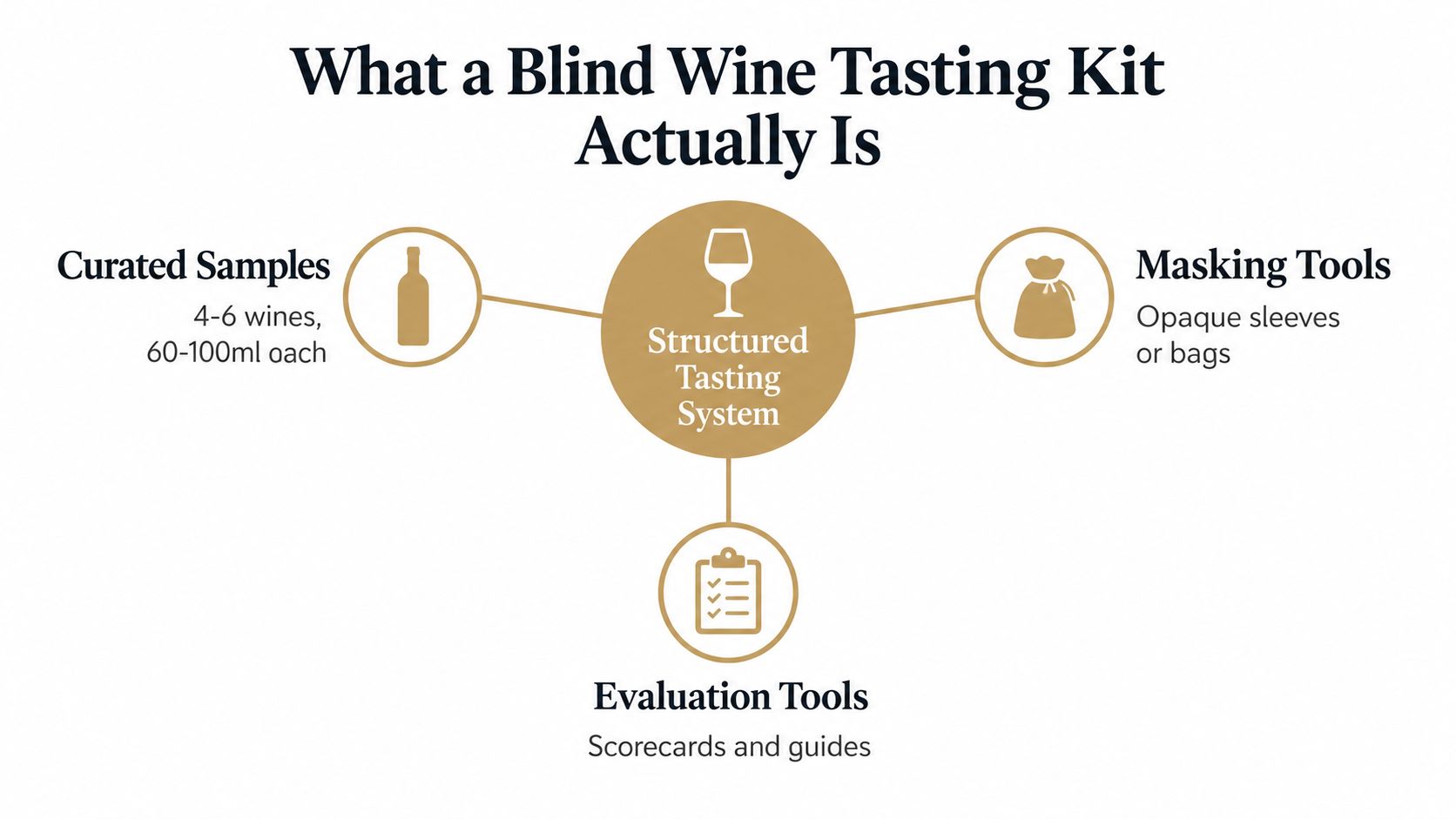
A blind wine tasting kit is best understood as a structured tasting system, not merely a box of unidentified bottles. The bottles are hidden, but the useful part of the experience comes from everything around them: the selection of wines, the order of service, the tasting prompts, and the reveal process.
At home, the setup might include a flight of four to six small samples, each marked with a number rather than a name. The sample sizes should be consistent, so a larger pour doesn't make one wine seem more important or give it an unfair advantage. A printed or digital guide then gives tasters the same questions for each glass, such as what they notice on the nose, how the wine feels on the palate, and what remains in the finish.
The final element is the reveal mechanism. Numbered foil capsules, coded sleeves, opaque bags, or sealed envelopes keep the identity hidden until everyone has recorded an opinion. The sequence matters. You taste first, write down your response, and only then discover the producer, grape, region, or vintage.
The three parts that create the learning loop
Curated samples give the flight a purpose. A lineup might compare grapes from different regions, similar wines at different price points, or contrasting styles within the same broad category. Random bottles can be entertaining, but they make it difficult to understand what your palate is responding to.
Evaluation guides stop the tasting from becoming a string of vague reactions. A useful scorecard separates aroma, acidity, tannin, body, flavor, balance, and finish, while still leaving room for a simple personal preference score.
Masking tools remove the label before it can influence the result. You can also personalize the experience by using a stemless glass or tumbler, and a resource such as add your logo to a stemless tumbler can help couples or clubs create reusable tasting vessels without printing the wine names on them.
The distinction between a kit and a mystery-bottle grab bag is educational scaffolding. A mystery box hides the answer. A serious kit creates a fair comparison, gives you a consistent way to describe each wine, and preserves your notes for later review. A useful companion example is this whiskey tasting kit guide, which treats tasting materials and scoring as part of the experience rather than as decoration.
Why Blind Tasting Changes What You Taste
Labels influence judgment before the wine reaches your tongue. A famous region can make a wine seem more refined, a high price can make flaws feel intentional, and an attractive producer story can encourage you to search for qualities you expect to find. Blind tasting removes those prompts long enough for your sensory response to arrive first.
The historical case is the 1976 Judgment of Paris, held on May 24, 1976. Nine French judges evaluated 20 wines without seeing the labels, and California wines won both the white and red categories. A 1973 Chateau Montelena Chardonnay took the white category, while a 1973 Stag's Leap Wine Cellars Cabernet Sauvignon took the red category over leading French competitors, an outcome reported by NPR's account of the Judgment of Paris.
The importance of that event wasn't only that California won. It showed how hiding prestige cues could overturn an established ranking. Blind tasting later became a serious tool for evaluation, education, and comparison because it gave tasters a way to examine the liquid before the story attached to it.
Controlled research points in the same direction. One widely cited experiment involving 400 participants found that members of the public couldn't reliably distinguish expensive wines from inexpensive wines when the labels were removed. A separate dataset containing 6,175 observations from 17 blind tastings found a small negative correlation between price and overall rating, meaning participants slightly preferred lower-priced wines on average. These findings are summarized in the wine tasting research overview.
| Bias Triggered | Taster Told | Typical Score Shift | Blind Result |
|---|---|---|---|
| Price expectation | The wine is expensive | Can raise expectations before tasting | The taster evaluates aroma, structure, and balance without the price prompt |
| Regional prestige | The wine comes from a celebrated area | Can encourage a more generous interpretation | The taster responds to the sensory profile first |
| Producer reputation | The bottle comes from a respected house | Can make familiar qualities easier to “find” | The wine must establish its own identity |
| Label design and bottle shape | The presentation suggests a style or quality level | Can influence assumptions before the first sip | Visual branding is unavailable during the initial judgment |
A blind wine tasting kit therefore works as a calibration tool, not just a guessing game. It helps you notice where your preferences are stable and where your assumptions change after the reveal. Research on blind consumer hedonic testing also explains why wine panels control the environment and avoid giving tasters brand or price information before they judge liking, since those non-sensory cues can distort interpretation. The research on blind consumer hedonic testing provides the technical background.
The practical lesson: record your preference before you learn what the bottle is. Your first response is the useful training data.
Setting Up a Blind Flight the Right Way
Good results depend on preparation more than theatrical presentation. If one person sees the bottle, receives a larger pour, or tastes a wine after a strongly flavored dish, the reveal won't tell you much about your palate.
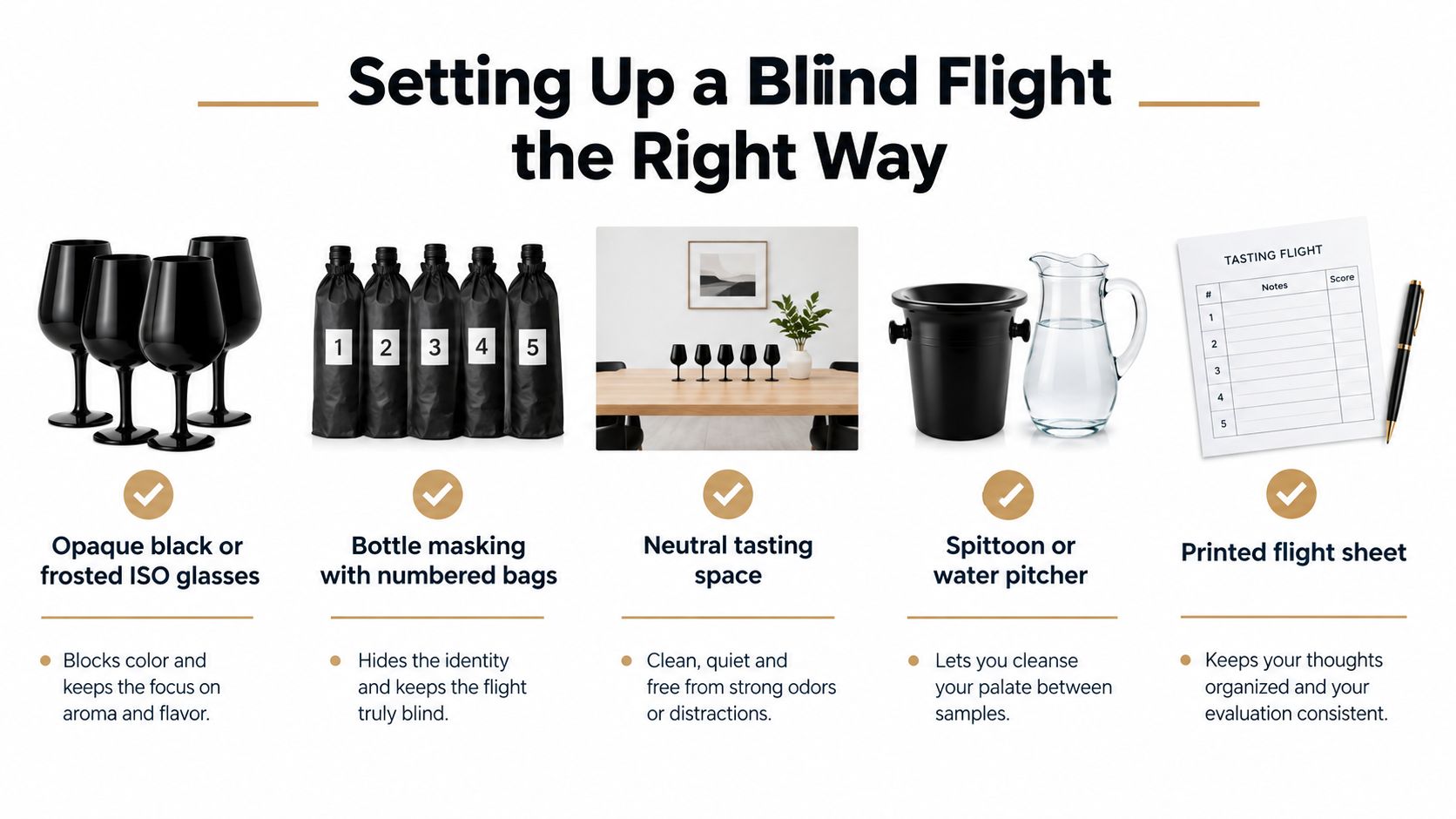
Start by choosing glasses that limit visual information. Opaque black or frosted tasting glasses prevent color from signaling grape, age, or winemaking style. If your kit uses bottle masking instead, place every bottle in an identical numbered bag, sleeve, or covering before anyone enters the room. Don't let bottle weight, foil shape, or capsule design reveal the answer.
Pour the same modest amount into each numbered vessel. A consistent 60 to 100 ml range works well for small flight samples, as represented in the kit component guide, but consistency matters more than chasing an exact volume. A larger pour isn't automatically better. It can encourage over-drinking and make tasters spend less time comparing specific sensations.
Build a fair order of service
Serve wines in an order that protects the palate:
- Begin with lighter whites or delicate styles. Strong acidity, sweetness, oak, or alcohol can dominate everything that follows.
- Move toward fuller whites, rosé, or richer textures. This gives the palate time to adjust instead of forcing a heavy wine into the first position.
- Finish with fuller reds or more tannic examples. Tannin and intense fruit can overwhelm lighter wines served afterward.
- Keep comparison groups coherent. If you're testing regions or grape varieties, compare similar colors and styles before moving to a different category.
Research on technical blind-tasting design describes the use of masked bottles, poured samples, and randomized order to remove bottle-weight, position, primary, and recency effects. It also reports that experts judged a color-masked white wine more accurately in opaque glasses than in clear glasses, showing that appearance can affect aroma judgments. The study on controlled wine tasting conditions explains why these details matter.
Keep the room calm and neutral. Use plain water, plain crackers, neutral lighting, and a clean table free from scented candles or strongly aromatic food. A flight sheet should already be printed, with spaces for each numbered wine. You can find another useful framework in this whiskey flight tasting set guide, then adapt the same discipline to wine.
The reveal is meaningful only when the setup was fair. If the conditions change from glass to glass, the labels aren't the only variables affecting the score.
Running a Tasting Like a Pro
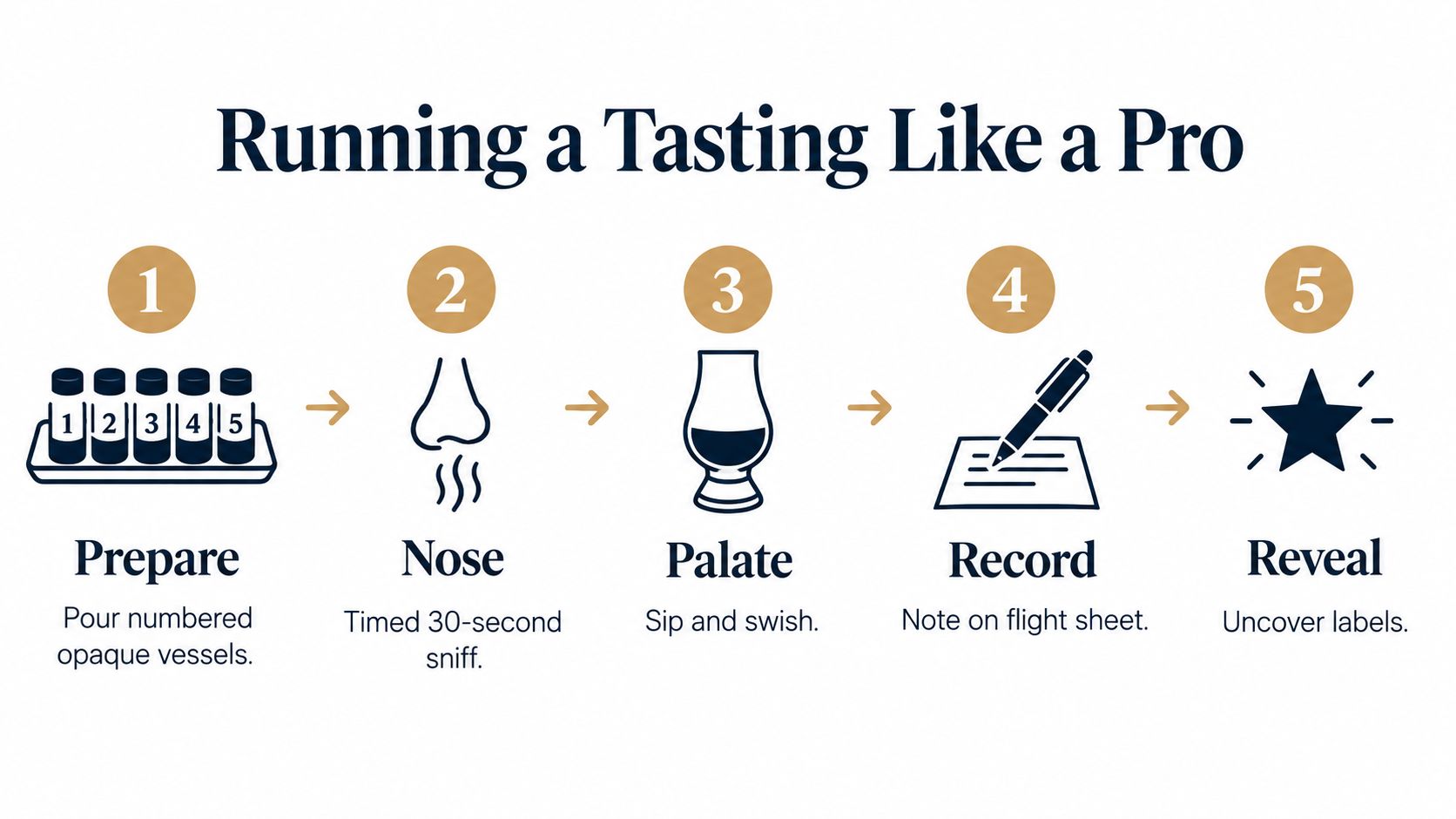
Four friends sit around a kitchen table with a row of numbered glasses. One person has prepared the pours while the others were out of the room, and every bottle is hidden in an identical sleeve. The flight sheet lists Wine 1 through Wine 4, but no grape, region, producer, or price appears anywhere.
The host starts with the nose. Each person gets a quiet interval to smell the first glass, then writes one confident descriptor before conversation begins. The point isn't to produce a poetic tasting note. “Lemon,” “black cherry,” or “vanilla” gives the group something concrete to compare.
Next comes the palate. Tasters take a small sip, move it across the tongue, and consider acidity, texture, fruit, oak, tannin, and balance. They can spit or swallow according to their preference, but everyone should pause before moving to the next glass. Water and a plain cracker provide a reset when a wine leaves a strong impression.
Lock the score before the story appears
The group then records a blind score. You can use a simple scale, but the important rule is that everyone uses the same criteria for every glass. Ask each taster to write:
- Aroma: one clear descriptor and an intensity impression.
- Palate: one flavor or texture descriptor.
- Finish: what remains after the sip.
- Preference: how much the taster enjoyed the wine.
- Prediction: grape, region, style, or other category relevant to the flight.
The host collects or covers the scores before revealing anything. This prevents a confident speaker from influencing the rest of the table. A quiet taster may have noticed the most useful detail, but that observation can disappear if the group starts debating labels too early.
A craft-whiskey-style reveal-and-score mechanic transfers naturally to wine. In a whiskey tasting, participants may guess details such as age, proof, and whiskey type before a QR reveal displays the sample information and calculates how close their palate came. For wine, substitute grape variety, country or region, vintage category, and style. The reveal can show the producer and bottle details only after the preference and prediction are locked.
Use the reveal as a teaching conversation rather than a verdict. If Wine 2 was your favorite and turned out to be an unfamiliar grape, write down what attracted you. If Wine 4 seemed expensive but was a simple, fruit-forward style, note which cues led you there. The guide to conducting a blind wine tasting offers a useful model for keeping the sequence organized.
A good reveal doesn't tell you that you were right or wrong. It tells you which sensory clues deserve another look.
What Separates a Good Kit from a Gimmick
A DIY setup can hide bottles. That doesn't make it equivalent to a well-designed tasting kit. The comparison to make is not packaging versus no packaging. It's concealment alone versus a complete learning loop.
A genuine kit should make it clear why the wines belong together. The selection might emphasize grape diversity, regional comparison, food pairing, or a shared style. It should also explain what the taster is meant to notice. Without a comparison principle, four mystery wines become four unrelated opinions.
Education is the second layer. A useful guide doesn't need to sound like a certification textbook. It should define unfamiliar terms, separate aroma from flavor, and give beginners a way to describe texture and finish. An aroma wheel can help, but a short list of accessible prompts is often more useful than a large vocabulary chart that makes a new drinker feel tested.
The third layer is the reveal. Numbered sleeves, coded bags, sealed cards, or a digital mechanism can all work. The method matters less than whether it keeps the identity hidden until scores are complete and presents the answer in a way that supports discussion.
| Feature | Genuine Blind Kit | DIY Setup |
|---|---|---|
| Wine selection | Chosen around a comparison or theme | Depends on the buyer's knowledge and intentions |
| Pour consistency | Usually planned as part of the flight | Easy to vary without noticing |
| Tasting guide | Gives common prompts and scoring criteria | May be improvised or omitted |
| Concealment | Designed to hide labels and visual clues | Foil, paper, or bags can work but may reveal differences |
| Reveal | Timed to follow note-taking and scoring | Often happens as soon as someone gets curious |
| Replay value | Notes and themes can support future comparisons | Usually depends on the host creating a new structure |
| Educational depth | Links the reveal to what the taster noticed | Often ends with “guess what it was” |
What are you actually paying for?
A premium kit earns its place when it saves preparation and adds curation, instruction, and repeatability. It may also create a smoother social experience, especially when nobody wants to act as the permanent host.
A DIY setup is smarter when the goal is a single low-stakes party game. You can conceal bottles with materials already at home, print a basic scorecard, and choose a simple theme from bottles you already own. The result won't be inferior because it's homemade. It will require more judgment from the organizer.
The warning sign is a product that treats the hidden label as the entire experience. If the kit doesn't explain how the wines relate, what to record, or when to reveal the answers, you're mostly paying for surprise.
Tasting Techniques New Drinkers Can Borrow
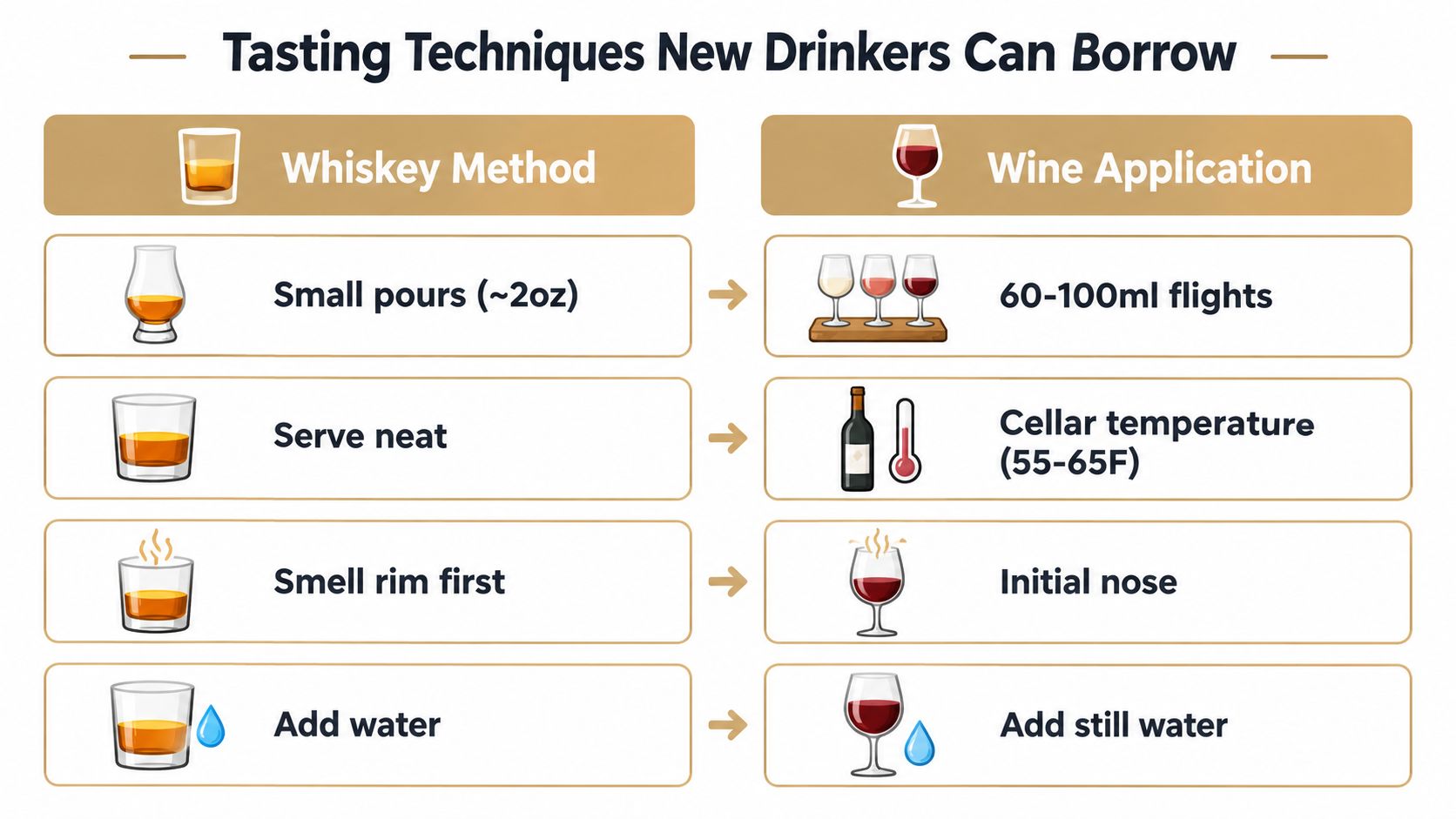
Whiskey tasting offers a helpful model for beginners because it treats sensory attention as a sequence of small actions. Start with a modest pour, taste it neat before changing it, and write down what you notice before deciding whether the drink suits you. Wine drinkers can use the same discipline without copying whiskey's stronger alcohol profile.
For whiskey, one beginner guide recommends a pour of about 0.5 to 1 ounce, resting it for 5 to 10 minutes, then nosing from a few inches away with the mouth slightly open and taking small sips. Those mechanics are described in this beginner guide to reading whiskey notes. For wine, pour the same amount into every glass and allow the wine to settle briefly while you prepare the sheet.
Serve the wine at an appropriate cellar temperature rather than allowing a warm room or an icy refrigerator to decide how it tastes. Smell gently and repeatedly. A few short sniffs are more useful than burying your nose in the glass and exhausting your sense of smell.
Use a three-word tasting record
New drinkers often freeze because they think every note must sound polished. It doesn't. A reliable record can be as simple as one word for each stage:
- Nose: lemon, rose, black cherry, apple, smoke.
- Palate: crisp, creamy, dry, spicy, soft tannin.
- Finish: short, herbal, warm, fresh, lingering.
A whiskey tasting guide recommends writing three words per whiskey, one for the nose, one for the palate, and one for the finish, so the drinker builds a consistent record instead of relying on price or reputation. The method appears in this whiskey tasting notes guide. The same format works well for wine because it keeps the exercise manageable.
Take a sip, aerate it gently across the mouth, and notice the sequence rather than hunting for a perfect answer. First ask what flavor arrives. Then consider weight, acidity, tannin, sweetness, and texture. Finally, wait to see what remains.
Use ordinary words precisely. “Sour cherry with drying tannin” teaches you more than an elaborate note you can't reproduce later.
Between wines, drink still water and use a plain cracker if the previous sample leaves a strong coating. Don't add ice, flavored water, cheese, or heavily seasoned food during the comparison. Those additions change the sensory conditions and make it harder to tell whether the next wine is different or your palate is just tired.
American craft whiskey brands often introduce new drinkers by moving one step away from a familiar style. A bourbon drinker might try a sweeter-profile rye, while someone who prefers lighter Scotch might explore Highland or Speyside malt before moving toward heavier peat. That progression, described in expert whiskey ordering advice, maps neatly onto wine. Start with a familiar grape or style, then compare one variable at a time rather than making every glass unfamiliar.
Picking the Right Kit for Your Group
The right kit depends on what you want the evening to accomplish. A group that wants laughter and a reveal needs a different level of structure from a solo learner building a vocabulary. Price matters, but it should be judged against the amount of preparation the kit removes and the quality of the learning it creates.
A casual dinner party
Four friends at a dinner party usually need a smooth, forgiving format. Choose a flight with clear contrasts, readable instructions, and a reveal that doesn't require one guest to manage complicated technology. A smaller sample size keeps the focus on comparison, while numbered sleeves and a printed scorecard create enough ceremony to make the activity feel distinct from ordinary drinking.
For this group, social rhythm beats technical depth. A guide should provide short prompts that guests can answer without prior wine knowledge. The best flight is one that supports conversation without requiring a lecture about soil, appellation law, or winemaking chemistry.
A monthly book-and-bottle club
A recurring club needs replay value. Members should be able to compare notes from one gathering with the next, so look for consistent score categories, thematic curation, and enough information after the reveal to explain why the wines differed. A club may value regional or varietal themes more than decorative packaging because each session becomes part of a longer learning record.
A digital reveal can be useful here if it stores information or links the group to further producer details. The core requirement remains the same: everyone must taste and score before the answer appears.
A serious solo learner
A solo taster should prioritize curation depth and note quality. Look for flights that isolate a question, such as how two grapes differ, how a region expresses a style, or how acidity and tannin affect preference. The guide should encourage predictions and provide enough post-reveal context to explain missed clues.
Solo tasting also makes it easier to repeat a method. Use the same glassware, pour approach, note categories, and palate reset each time. Over time, your notes can show whether a descriptor keeps appearing alongside wines you enjoy.
A premium kit makes sense when its structure changes how you taste. If it only provides concealed bottles, a DIY setup may deliver similar utility at lower cost. Before checkout, ask:
- What comparison does the wine selection make possible?
- Are the sample sizes and pours consistent?
- Does the guide teach me what to notice, not just what to guess?
- Will the reveal wait until scores and predictions are recorded?
- Will I use the notes again after this tasting ends?
The strongest choice is the one that matches your goal. Choose a guided kit when you want curated wines, a clear tasting table, and a repeatable reveal. Choose DIY when the evening is primarily a playful experiment and you're comfortable doing the planning yourself.
Blind Barrels offers quarterly blind whiskey tastings featuring four samples from small American craft distilleries, with tasting materials, aroma, tasting and finish notes, a QR reveal, and a score-based guessing game. Visit Blind Barrels to explore how that reveal-and-score format can inspire a more structured tasting experience at home.