

You've probably heard the shortcut. Pick bourbon if you like sweet, pick rye if you like spicy, and you'll know which glass is which every time. That advice sounds tidy, but it's also the fastest way to fool yourself.
The legal line between bourbon and rye is clear. Flavor isn't. A bourbon can taste dry and peppery, a rye can taste round and soft, and proof, age, and the producer's choices often matter more than the name on the label.
That's not a reason to give up. It's a reason to learn the rules first, then test them with the labels hidden, especially when you're exploring American craft whiskey from small distilleries that don't always follow the stereotype.
The Legal Rules That Separate Bourbon and Rye
Start with one decision. Which grain makes up the majority of the mash?
The TTB chart of distilled spirits products and label options sets bourbon at a fermented mash containing at least 51% corn, distilled at no more than 160 proof, and entered into charred new oak containers at no more than 125 proof. Rye whiskey follows the parallel rule with at least 51% rye in the mash.
Everything else flows from that grain majority. Corn points you toward a sweeter foundation, while rye points you toward a spicier, more grain-forward one, but the law only guarantees the majority, not a specific taste.
The rules both whiskeys share
Both categories must be produced in the United States. Both face the same proof limits for distillation and barrel entry, which preserve grain character instead of stripping it away at very high strength.
The word straight adds an age floor. A straight bourbon or straight rye must generally mature in charred new oak containers for at least 2 years. Without that word, the basic bourbon and rye categories don't impose a universal minimum aging period.
| Rule | Bourbon | Rye whiskey |
|---|---|---|
| Minimum grain in the mash | 51% corn | 51% rye |
| Maximum distillation proof | 160 proof (80% ABV) | 160 proof (80% ABV) |
| Maximum entry proof into new charred oak | 125 proof (62.5% ABV) | 125 proof (62.5% ABV) |
| Minimum age for a straight label | 2 years | 2 years |
| Minimum age for the basic category | No minimum | No minimum |
| Coloring, flavoring or blending | Not permitted | Not permitted |
| Where it must be made | United States | United States |
New drinker's check: Find the category name first, look for the word straight second, then read the proof. Those three items tell you the grain majority, whether the age floor applies, and how intense the pour is likely to feel.
Read a bottle in that order and confusion drops. If you see bourbon, you know corn leads the mash even if rye is the next grain. If you see rye whiskey, you know rye leads even if corn softens it.
Don't stop at the front label. Distillers sometimes print a fuller mash bill, age statement, or barrel note on the back, and those details explain why two legal bourbons can taste nothing alike.
How Mash Bill Shapes Flavor in Your Glass
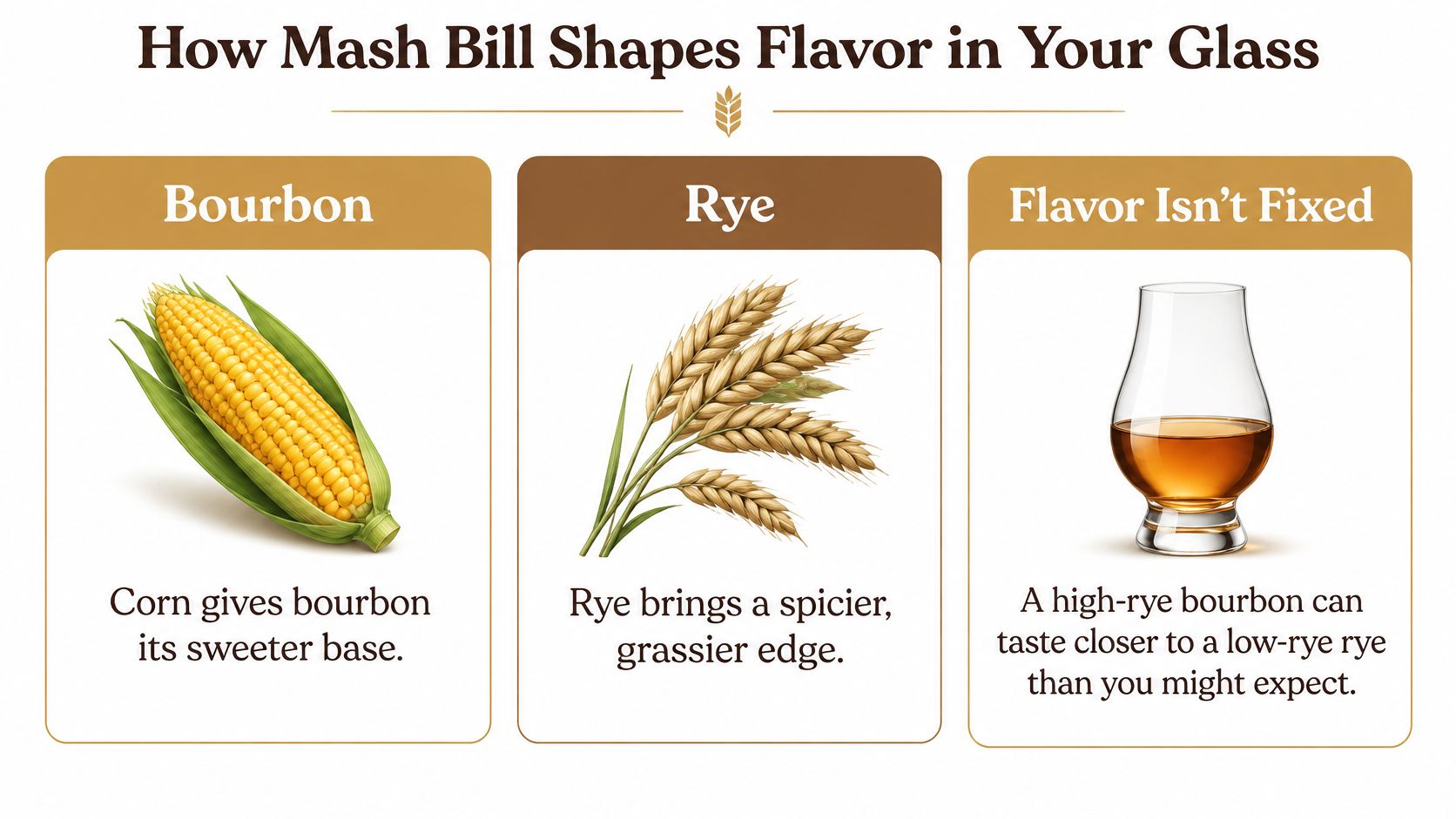
Corn and rye push flavor in different directions, but they don't write the whole story. Corn gives you a sweeter base to build on, and rye gives you a spicier, grassier edge that you notice earlier on the palate.
Say you're comparing a soft, low-rye bourbon with a rye made only just past the legal minimum. You might expect a wide gap, yet the bourbon's rye portion and the rye's corn portion can pull them toward each other.
Where the stereotype breaks down
A high-rye bourbon can taste closer to a low-rye rye than to a wheated bourbon. Yeast, fermentation, distillation cuts, and barrel entry proof all reshape what the grain started, so treat the mash bill as a hypothesis you test in the glass.
Maturation complicates the picture further. A study in the Journal of the Institute of Brewing reports that aging increases acids, esters, aldehydes, furfural, dissolved solids, and tannins, and sensory panels associated longer aging with stronger vanilla, cinnamon, alcohol, and woody aromas.
That same research found a clear contrast between a 20% rye bourbon, associated with apple, vanilla, and red-wine aromas, and a 70% rye whiskey, associated with hay-like, grassy, vegetal, and yeasty aromas. Use that contrast carefully, because cinnamon and vanilla can come from oak, while mint, grass, and pepper point more strongly toward rye grain.
Reading a fuller breakdown of the whiskey grain bill helps you separate the leading grain from the supporting grains before you taste. You'll then know whether you're expecting grain spice, oak spice, or both.
| Flavor cue | Typical bourbon | Typical rye |
|---|---|---|
| Sweetness | Caramel, vanilla, brown sugar | Lower, drier sweetness |
| Spice | Baking spice from oak, cinnamon | Pepper, clove, rye spice |
| Grain and herbal notes | Light corn sweetness | Mint, grass, dill-like herbs |
| Oak influence | Vanilla, toffee, coconut | Vanilla and tannin from maturation |
| Body and finish | Rounder, longer sweet finish | Crisper, drier finish |
A fair way to compare
- Match the proof first: Add a little water to the stronger pour so alcohol heat doesn't hide delicate aromas.
- Match the temperature: Taste both at room temperature before you add ice to either glass.
- Name the source: Ask whether vanilla and tannin feel like oak, and whether mint or pepper feels like grain.
That last question matters most for beginners. If you call every cinnamon note rye spice, you'll misread a well-aged bourbon, and if you call every sweet note corn, you'll miss sweetness the barrel contributed.
How Bourbon and Rye Grew Into Separate Traditions
Rye came first in much of early American distilling. Farmers in Pennsylvania and Maryland turned a hardy local grain into whiskey long before bourbon became the national shorthand for American whiskey.
Bourbon grew around Kentucky, where corn thrived and distillers built a style around it. The eastern rye tradition stayed tied to a drier, more assertive grain, while Kentucky producers leaned into corn's abundance and sweetness.
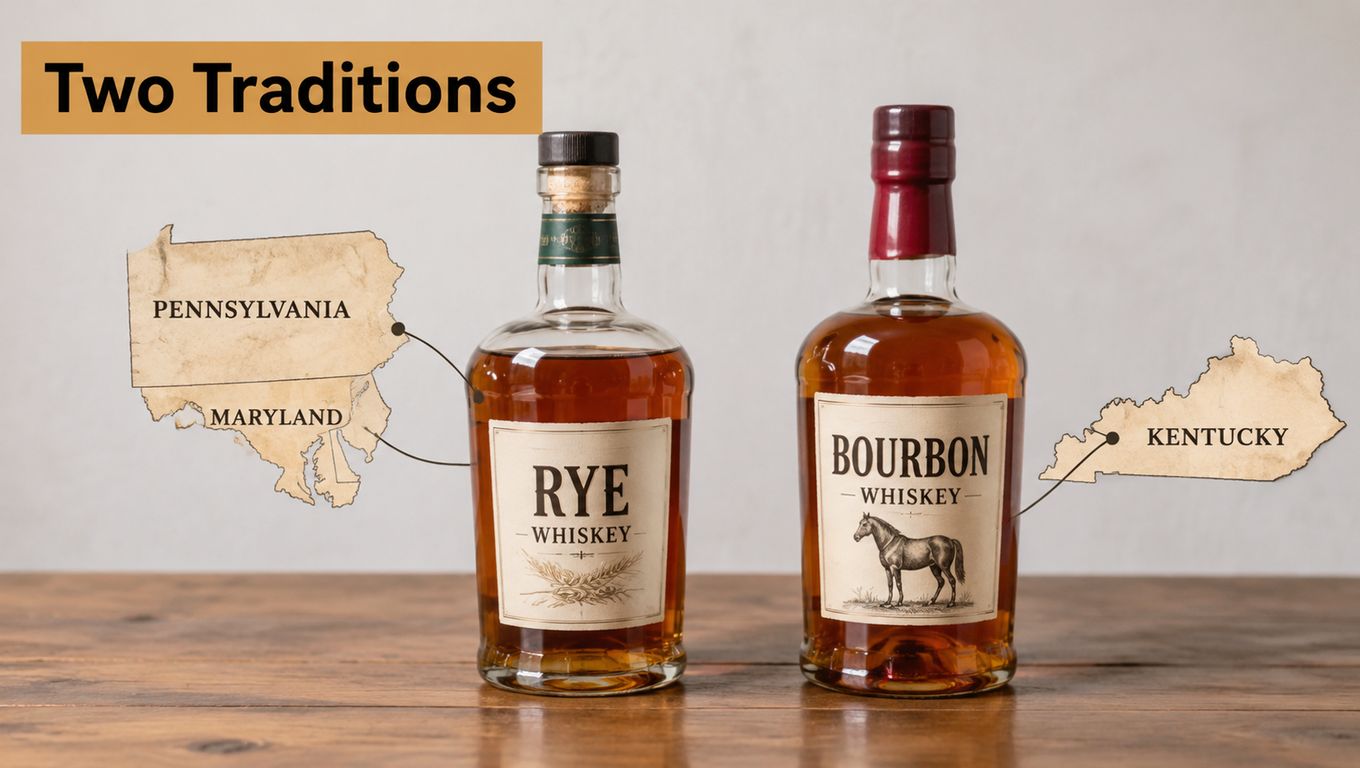
That regional split still shapes names you'll see on shelves. A Maryland or Pennsylvania rye signals an older eastern lineage, and tracing the history of rye as America's true native spirit shows why rye held that ground before bourbon's modern surge.
The modern scale behind the shelf
Kentucky's recent output shows how large bourbon has become. The Kentucky Distillers' Association economic impact report says Kentucky distillers filled approximately 3.03 million bourbon barrels in 2024, compared with about 3.2 million in 2023. Even with that dip, 2024 production remained 135% above the level recorded a decade earlier.
Scale has practical consequences you can taste. Every bourbon barrel needs new charred oak, so producers must plan cooperage, grain supply, and warehouse space years ahead, and small distilleries make different choices within those constraints.
History gives you a useful hint, not a final answer. A regional name tells you where a tradition started, but the grain, proof, and barrel decisions on the label tell you more about the next sip.
Which Cocktails and Foods Suit Each Whiskey
Use one rule in the kitchen and at the bar. Bourbon's corn sweetness softens bitter, sweet, and fresh ingredients, while rye's spice stands up to them and keeps the drink or dish from turning flat.
That doesn't mean bourbon is only for sweet drinks or that rye can't work with dessert. It means you should decide whether you want the whiskey to round the edges or sharpen them.
| Cocktail | Usual base | Why it works |
|---|---|---|
| Old Fashioned | Bourbon | Corn sweetness rounds bitters and sugar |
| Mint Julep | Bourbon | Sweet base balances fresh mint and sugar |
| Manhattan | Rye | Spice cuts through sweet vermouth |
| Sazerac | Rye | Rye spice holds up to absinthe and bitters |
An Old Fashioned made with bourbon tastes rounder because there's little in the glass to hide the base spirit. Make the same drink with rye and the finish turns drier, which some drinkers prefer after a rich meal.
A Manhattan flips the logic. Sweet vermouth can overwhelm a soft bourbon, so rye's pepper and herbal bite restore balance, and a Sazerac needs that same firmness against absinthe and bitters.
If you're building a small home bar for guests, recipes for entertaining with bourbon from Jolitee give you a practical starting set to adapt with either base. Make one version, taste it, then swap the whiskey before you change anything else.
Pairings that match weight to weight
- Bourbon with sweet and smoky food: Try pecan pie, caramel desserts, or smoky barbecue, where brown sugar and vanilla echo the dish without fighting it.
- Rye with bold and salty food: Try dark chocolate, aged cheddar, or spiced dishes, where a drier finish cleans up fat and heat.
- Both with caution around delicate food: A strong, high-proof pour can bury mild fish, soft cheese, or light fruit, so add water or serve a smaller pour.
If a bourbon cocktail tastes too sweet, rebuild it with rye before you cut the sugar. You'll often fix the balance by changing the grain, not the recipe.
That swap is the best first experiment for a new drinker. You learn what the base whiskey contributes because every other ingredient stays exactly the same.
Choose Your First Bottle of Each
Don't shop by the prettiest label. Shop by the information the law requires and the details a producer chooses to add, then pick two bottles you can compare fairly at home.
The TTB guide to bourbon standards confirms bourbon must contain at least 51% corn, be distilled at no more than 160 proof, enter newly charred oak at no more than 125 proof, and contain no coloring, flavoring, or blending materials. Those numbers draw the legal line cleanly. What they cannot tell you is how a bottle will taste, because proof, age, and barrel treatment often shape flavor more than the grain split does. Keep that in mind as you shop.
A checklist you can use in the shop
- Confirm the category first. Bourbon means corn leads the mash, and rye whiskey means rye leads it, no matter what the brand story emphasizes.
- Look for straight. That word signals the two-year floor in new charred oak and rules out the youngest, least integrated options.
- Compare proof before price. Proof works like a volume knob. Turn it up and every flavor gets louder, including a heat that drinkers often misread as rye spice.
- Buy a matched pair. Choose one bourbon and one rye at a similar proof so grain, not alcohol strength, drives your first comparison.
- Read the barrel note. Toasted, finishing, or single-barrel language tells you the wood may play a larger role than usual.
- Start small when you can. A smaller bottle, sampler, or bar pour lets you learn your preference before you commit shelf space and money.
Questions that reveal how a craft producer works
American craft whiskey rewards a closer look because small producers control different parts of the process. The USA Today 10Best craft whiskey guide notes Jeptha Creed operates a Kentucky distillery alongside a 64-acre farm supplying grains and other ingredients, while Wigle Whiskey mills regional organic corn, wheat, and malted barley on-site.
Some small producers run the whole chain under one roof, milling, cooking, fermenting, distilling, and barreling on a single site. What matters is what that setup tells you: one team controlled every decision from grain to glass.
- Who grows or sources the grain: Farm or regional sourcing can shape the mash and the producer's seasonal choices.
- Who distills on site: On-site milling and distillation give the producer direct control over cuts and proof.
- How barrels are selected: Single-barrel and finishing programs can move flavor farther from the category stereotype.
Those answers tell you more than a famous name will. A whiskey can be grain-led, oak-led, or shaped by a producer's particular house style, and the front label rarely admits which. When you know which lever did the work, your first side-by-side pour teaches you something instead of confirming a guess.
Test Your Pick Blind and Keep Score
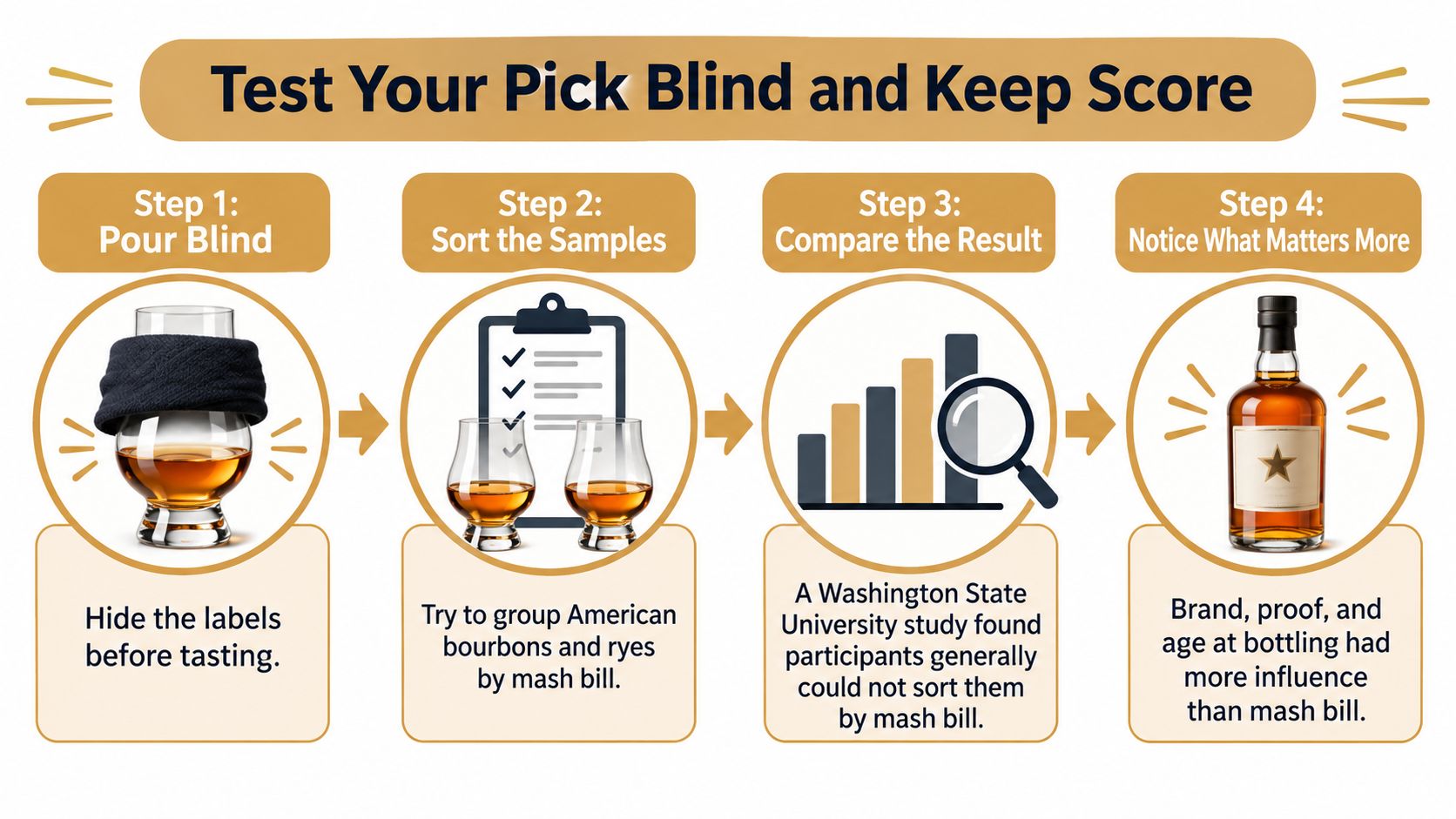
Now remove the labels. That's where the sweet bourbon, spicy rye rule has to prove itself, and the evidence says it often won't.
A Washington State University study on bourbon and rye sorting found participants generally could not distinguish American bourbons from ryes by mash-bill category in blind sorting. They were more influenced by brand, alcohol content, and age at bottling.
Don't treat that result as discouraging. It tells you what to control, because a high-rye bourbon can land closer to a barely legal rye than to a wheated bourbon once branding and expectations disappear.
Consider two bourbons you might meet blind. Bull Run Distilling Company's Cask Strength Straight Bourbon Whiskey has a mashbill of 75% corn, 21% rye, and 4% malted barley, while 13th Century Whiskey Company Toasted Barrel Straight Bourbon Whiskey has a mashbill of 88% corn, 7% rye and 5% malted barley. Both are bourbon, yet the first carries far more rye influence before wood and proof enter the decision.
Run the test with your matched pair
Use the two bottles you selected at similar proof, and follow a method like the one in this guide to a whiskey blind taste test so your notes stay consistent.
- Pour both blind. Have someone else pour, or mark the glass bottoms yourself and shuffle them, keeping both at room temperature.
- Write before you guess. Score sweetness, spice, oak, body, and finish in plain words before you name a category.
- Separate grain from oak. Circle mint, grass, and pepper as possible grain cues, and circle vanilla, cinnamon, and tannin as possible barrel cues.
- Make your call. Group each glass as bourbon or rye and write one sentence explaining the strongest evidence.
- Reveal and score. Compare your guess with the label and mash bill, then note which cue helped and which cue misled you.
A wrong guess isn't a failed palate. It's useful evidence that proof, age, or producer style spoke louder than grain in that glass.
Repeat the test with the next bottle rather than defending your first result. If pepper keeps pointing you to rye but the reveal shows high-rye bourbon, you've learned how that bourbon is built, and you'll read the next label with better questions.
Over a few rounds, you'll discover whether you prefer rye grain, higher proof, heavier oak, or a particular distillery's style. That's a more honest answer than the shortcut you started with, and it's the skill that lets you choose the next bottle with confidence.
Put that skill to work with Blind Barrels, where each quarterly kit brings you four blind samples from small American craft distilleries, a tasting table for aroma, palate, and finish notes, and a reveal that lets you score your guesses on age, proof, and whiskey type before buying full bottles at a member discount. Visit Blind Barrels to start your next bourbon and rye comparison with the labels hidden and your own taste buds in charge.