

You can open a bourbon box on a weeknight and still end up in a serious tasting. One sample smells like caramel and toasted oak, another leans spicy and dry, and suddenly you're not just sipping, you're comparing, guessing, and noticing what your own palate prefers. That's the appeal of bourbon in a box, it turns a casual pour into a small, repeatable experiment.
What Bourbon in a Box Really Means
The first time a box lands on the table, the ritual matters as much as the liquid. Four sealed samples, a tasting card, and a few names you may not recognize create a little uncertainty, and that uncertainty is useful. It forces the drinker to focus on what's in the glass instead of what the label promises.
That's why bourbon in a box works best as a learning format, not just a novelty. It can be a subscription kit, a one-time tasting set, or a gift box, but the strong versions all do the same thing, they create a structured comparison of styles, distilleries, and production choices. If you want a savory pair with the pour, try the Bourbon BBQ flavor from Louisville Jerky Co., which fits nicely alongside a tasting night without distracting from the whiskey itself.
Why people reach for it
For newcomers, the box removes the pressure of choosing a full bottle blind. For enthusiasts, it creates a cleaner way to compare distilleries and proofs side by side. For couples or small groups, it gives the night a shared task, which makes the conversation better and the tasting more memorable.
The best boxes don't ask, “Do you like bourbon?” They ask, “Which bourbon do you like, and why?”
That distinction matters because the category has grown up around curiosity. A curated box can make sense of a crowded shelf, especially when the goal is discovery rather than stocking a bar. The result is less about collecting tiny bottles and more about learning how your palate responds to different whiskeys under the same roof.
The Legal Foundation Behind Every Bourbon Sample
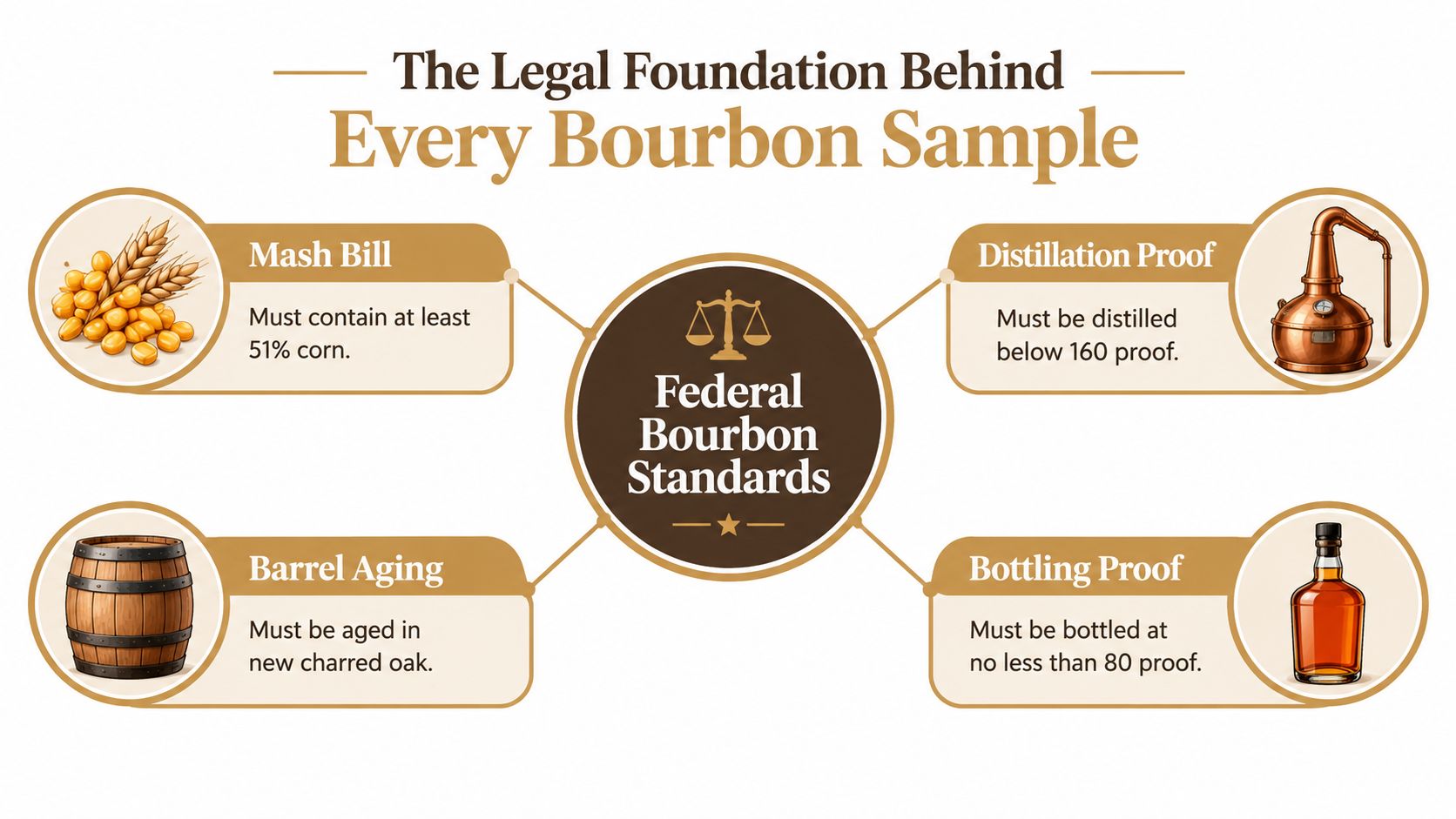
A tasting kit only works if the whiskey inside already qualifies as bourbon. Federal standards require bourbon to be made from a mash containing at least 51% corn, distilled to no more than 160 proof, entered into new charred-oak containers at no more than 125 proof, and bottled at a minimum of 80 proof. Straight bourbon also needs at least two years of aging, and bourbon aged under four years must carry an age statement. Those rules are laid out clearly in the bourbon standards overview from Distiller, which is useful reading if you want the legal baseline before comparing samples at this bourbon rules guide.
What a box can and can't claim
A box can preserve bourbon, but it can't create maturation after bottling. That's a common point of confusion for newer drinkers. The age of the spirit comes from what happened in the barrel, not from how long it sits in a package later.
That's why sample integrity matters. Small containers have more headspace relative to liquid volume, so oxygen can influence the spirit more quickly than it would in a full bottle. A serious kit uses tightly sealed, spirit-compatible containers, keeps them upright, and protects them from heat and light.
Practical rule: if the label or QR reveal doesn't separate barrel age from time in the box, you're missing part of the story.
What to look for on the reveal card
A good tasting card should tell you the proof, mash bill where available, distillery, barrel treatment, bottling date, and sample volume. It should also be clear about whether the whiskey is straight bourbon, finished bourbon, or something else that belongs in the broader whiskey family. If you want a plain-language explanation of whether buying alcohol online is even allowed, this internal guide is a helpful companion: https://blindbarrels.com/blogs/whiskey-insights/is-it-legal-to-buy-alcohol-online
The big idea is simple. The rules define what bourbon is before it ever reaches your glass, and a box should help you compare those legal and production details without blurring them together.
Why Craft Distilleries Power the Best Boxes
American craft whiskey gives bourbon boxes their range. The American Craft Spirits Association reported 3,069 active U.S. craft distillers as of August 2024, up 11.5% from 2,753 in August 2023, and said craft spirits generated $7.8 billion in U.S. sales in 2023 while representing 7.5% of the spirits market by value in its 2024 Craft Spirits Data Project. Whisky Advocate also notes that craft distilling is defined as producing fewer than 750,000 proof gallons, which helps explain why the category is so often associated with smaller, more experimental producers in its 2024 craft whiskey overview.
Why small producers fit the format
A boxed tasting is a natural home for smaller distilleries because it lowers the commitment. Most drinkers won't drive to dozens of tasting rooms, and even a curious shopper can't efficiently explore every release on a shelf. A kit turns that wide market into four focused pours.
That matters because craft producers often lean into distinction. They may highlight grain character, unusual barrel choices, or a more transparent production story. Those differences are easier to notice when the samples are side by side instead of scattered across different nights.
One useful internal primer on this broader category is the publisher's own craft whiskey overview, which frames why small distilleries matter even when they don't dominate volume. A separate industry angle on oversupply and shifting producer strategy is covered in this supplier perspective on whiskey glut, which helps explain why discovery-based formats can be attractive to drinkers even when producers are under pressure.
What usually makes a craft sample interesting
- Distinct mash bills: Different grain recipes change sweetness, spice, and body.
- Visible barrel choices: New oak, finishing, and toast level can push the whiskey in different directions.
- Smaller allocations: Limited releases can show a distillery's style without repeating the same profile every time.
- Clear provenance: Drinkers can trace where the whiskey came from and how it was made.
The point isn't that small automatically means better. It's that smaller producers often give a tasting box more texture, more contrast, and more room for the drinker to discover what really stands out.
Anatomy of a Curated Bourbon Tasting Kit
A serious kit should behave like a learning system, not a bundle of mini bottles. The best versions include four controlled samples, a tasting table, a reveal mechanism, and some kind of scoring loop. That design matters because each part pushes the drinker to compare, record, and then verify.
What belongs in the box
The tasting table is the anchor. It should give you space to note aroma, palate, finish, proof guesses, and any reaction to water. The QR code is the second anchor, because it reveals the sample details after you've already formed your opinion. The bottle path, if included, should be direct and transparent so the tasting doesn't end in mystery.
A passive gift box of miniatures does one thing well, it gives someone small bottles. A curated kit does something more useful, it gives feedback. That feedback loop is what teaches you whether you're sensitive to proof, drawn to certain mash bills, or more responsive to texture than to sweetness.
| Feature | Curated Kit | Gift Box Miniatures |
|---|---|---|
| Sample structure | Controlled, side-by-side pours | Loose mix of minis |
| Learning tool | Tasting table and scoring | Often none |
| Reveal method | QR code or notes after tasting | Usually labels visible upfront |
| Comparison value | High, because pours are standardized | Lower, because context varies |
| Follow-up | Often includes bottle access | Usually ends after gifting |
A box teaches faster when every sample is poured the same way and judged on the same sheet.
Why the interactive parts matter
The game element is not just for fun. Guessing age, proof, and whiskey type makes you pay attention to details you'd otherwise skip. A high-quality kit doesn't reward lucky guessing alone, it rewards careful observation and honest scoring.
If a box only looks premium, that's decoration. If it helps you learn how bourbon behaves across different producers, it's doing real work.
How Blind Barrels Approaches Bourbon in a Box
Blind Barrels sits on the more disciplined end of the tasting-box spectrum. Its model centers on quarterly delivery, four blind samples, a tasting table, a QR reveal, and a scoring game that asks drinkers to judge the liquid before the label ever enters the conversation. That structure is especially appealing if you want a communal ritual instead of a one-off novelty.
What changes when the labels disappear
Blind tasting strips away brand memory, shelf reputation, and price bias. That matters because people often think they're tasting prestige when they're really reacting to packaging cues or a familiar distillery name. Removing those signals forces the drinker to answer a simpler question: what do I like in the glass?
The format also works well for pairs and small gatherings. One person may lean toward proof and spice, another toward sweetness and texture, and a blind format makes those differences obvious without turning the night into a brand contest. That's a better setup for honest conversation than a table full of labels everyone has already Googled.
How the experience is organized
- Four blind samples: Each kit gives you a controlled comparison set.
- Tasting table: You write down aroma, taste, and finish while the memory is fresh.
- QR reveal: The sample details appear after you've made your own judgment.
- Bottle access: The path to a full bottle stays tied to the liquid, not the packaging story.
- Scoring game: You can check how close your guesses were on age, proof, and whiskey type.
The result is a format that feels like an experience, but still behaves like a method. If you want to compare it with broader tasting-box ideas, the key difference is discipline. The kit isn't asking you to admire the box. It's asking you to listen to your palate first.
A Beginner's Method for Tasting Four Samples
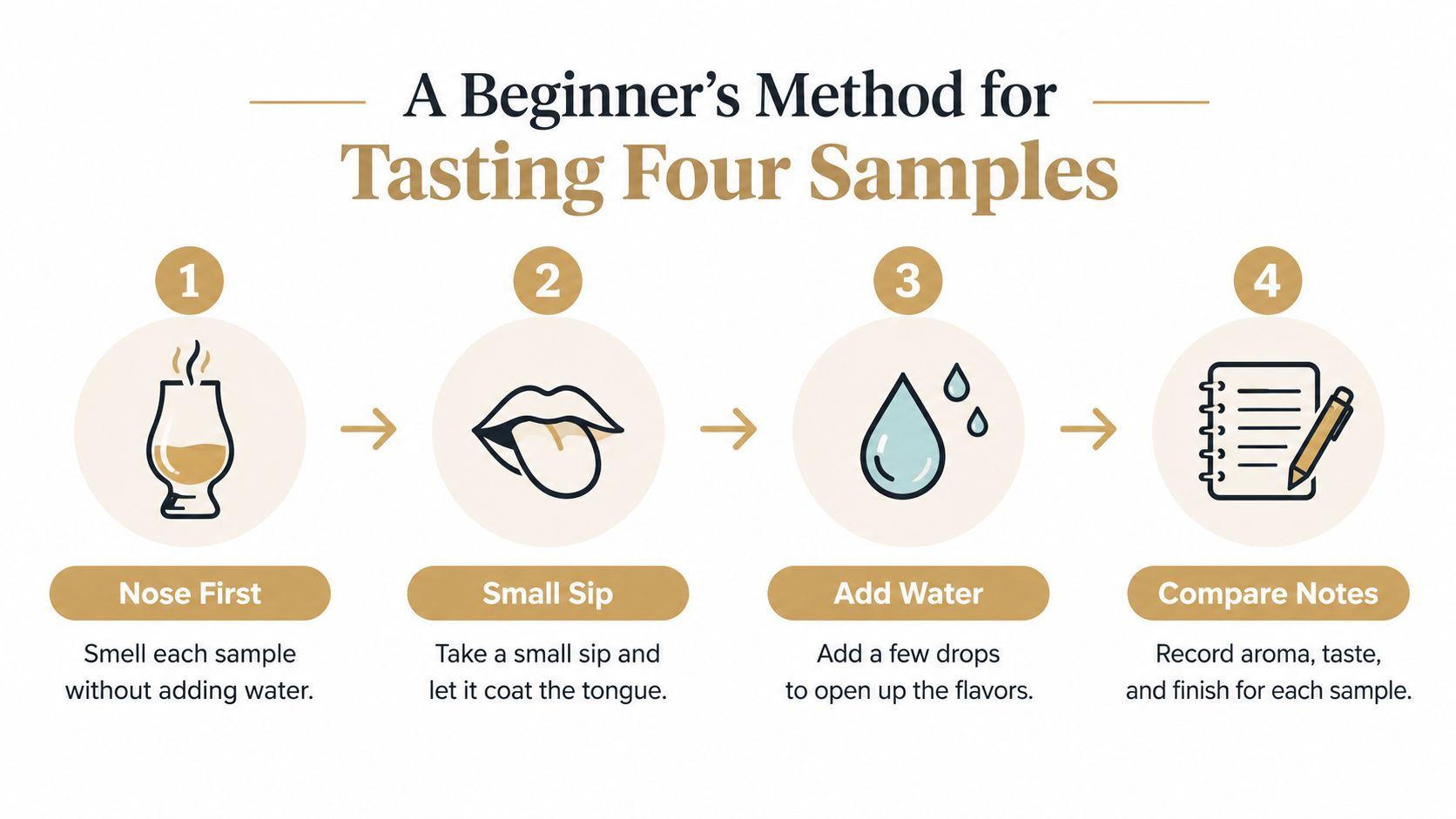
A first tasting goes better when it follows a repeatable routine. Start with a clear glass, hold it roughly one inch below your nose, and keep your lips slightly open while smelling the bourbon. That nose-first approach keeps the alcohol from overwhelming everything else, which is exactly what newer drinkers need in this beginner bourbon guide.
A simple four-sample rhythm
- Nose first. Smell each sample before tasting, and don't bury your nose in the glass.
- Take a small sip. Let it coat the tongue instead of swallowing immediately.
- Use water if needed. A few drops can open up flavor and soften the alcohol edge.
- Write it down. Record aroma, palate, finish, heat, and your guess before the reveal.
Wild Turkey's tasting guidance adds a few practical habits that help in a multi-sample setting. It recommends cleansing the palate with water or a plain cracker between pours, using room-temperature water for dilution, starting with a small pour of about one-quarter ounce, and exhaling through the nose after swallowing in its bourbon tasting tips guide. That combination keeps the session from turning into a blur.
Useful habit: if the second sip tastes different from the first, that's not a problem. It's information.
The beginner mistake is to rush. The better move is to compare successive sips and notice what changes. A whiskey can feel sweeter on one pass, hotter on another, and more expressive after a few drops of water. That's the kind of detail a blind tasting is built to catch.
Judging Value When the Label Is Hidden
A premium-looking box can flatter weak whiskey, and a modest-looking bottle can hide a great pour. That's why blind tasting is so useful in a market where appearance and story often crowd out the liquid itself. If you want a broader consumer lens on price and quality, this internal guide offers a useful companion: best whiskeys for the price.
What to audit before you reveal the label
The first checkpoint is proof. Higher proof can bring more intensity, but intensity isn't the same as balance. Age statement matters too, though older isn't automatically better because oak can add desirable vanilla and spice while also pushing tannic or woody notes if it goes too far.
Mash bill and barrel treatment matter for the same reason. They shape the core profile before marketing ever enters the picture. Source transparency helps too, because a drinker should know whether the liquid comes from a known distillery, a sourced blend, or a small-batch release with a limited run.
A value check that stays honest
- Proof: Does the whiskey drink hotter, softer, or more balanced than you expected?
- Age statement: Did the maturity line up with the flavor in your glass?
- Mash bill: Did the grain mix create the sweetness or spice you noticed?
- Barrel treatment: Did finishing or barrel char alter the profile in a meaningful way?
- Price context: Would you still want it if you didn't know the brand?
Recent coverage of the whiskey market describes 2025 as a tougher year for producers but a friendlier one for consumers, with broader choice and better premium value, even as some craft distillers face slower growth. That context matters because scarcity can reflect distribution limits or production scale, not just quality. A great sample is still a great sample, but it shouldn't get credit for being hard to find.
The smartest move is to score the whiskey before you know the label, then compare your notes with the specs. If your favorite blind sample turns out to be the cheapest bottle in the flight, that's useful information. If the priciest one wins cleanly, that's useful too.
Making Your Next Bourbon in a Box Count
The best use of a bourbon box is to treat it like a standing habit, not a one-time stunt. Keep the notes, compare quarters, and pay attention to the patterns that keep showing up. Over time, you'll learn whether you like higher proof, a certain grain profile, or a style that opens up with a little water.
The bigger lesson is that blind tasting gives you a cleaner relationship with whiskey. It strips away the guesswork that comes from branding and lets you build your own map of preference, sample by sample. That's why the format works so well for couples, gift recipients, and curious drinkers who want the experience to mean something after the cork is off.
A simple checklist helps:
- Write first, reveal later.
- Compare every sample against the same standards.
- Track which mash bills and proofs keep winning.
- Use the bottle option only when the blind score really earns it.
That's the value of bourbon in a box when it's done well. It's not just a package. It's a repeatable way to audit your palate, enjoy the company around you, and decide for yourself which whiskey is worth coming back to.
If you want that kind of blind tasting built around small American craft distilleries, Blind Barrels ships four-sample whiskey kits with a tasting table, QR reveal, and a scoring game that turns each delivery into a guided comparison. It's a straightforward way to test your preferences against the craft whiskey world, one blind pour at a time.