

You're standing in a liquor store comparing gift sets, or scrolling through bourbon subscriptions while wondering whether the recipient wants a bottle, a tasting adventure, or something they can enjoy with friends. The label box of bourbon sounds specific, but it describes several different formats with very different contents, learning value, and ongoing cost.
The right choice depends less on the box itself than on the experience you want to create. A polished gift set can make an occasion feel special, while a sample kit limits the risk of buying a full bottle that doesn't suit your palate. A subscription adds discovery over time, and a guided blind box turns each pour into a small experiment.
What a Box of Bourbon Can Mean
A shopper searching for a bourbon gift might find a wooden case holding a full bottle and glasses, a mailer filled with tiny samples, or a recurring delivery that arrives every quarter. All of them may be marketed as a box of bourbon, yet they solve different problems.
The phrase has no legal definition. It doesn't tell you the bottle size, proof, age, distillery, shipping schedule, or whether the package contains bourbon at all beyond the seller's description. You have to inspect the product details rather than rely on the name.
Four different experiences
A curated gift box usually centers on one or two full-size bottles. The seller may add glassware, snacks, cocktail ingredients, or branded accessories. This format works when presentation matters as much as the whiskey, such as a birthday, housewarming, holiday, or thank-you gift.
A one-off tasting kit contains small pours from several bottles. It gives a curious drinker a chance to compare styles without committing to a full bottle. Sample sizes and selection quality vary, so check whether the seller states the exact volume and proof of each pour.
A subscription box delivers whiskey on a recurring schedule. Some clubs send samples, others send full bottles, and some let members choose between formats. The attraction is continuity, but the recurring charge can become a poor fit if the recipient drinks slowly or prefers choosing every bottle personally.
An educational discovery box puts the tasting lesson at the center. It may include aroma prompts, tasting notes, a map, a palate guide, or a reveal system that keeps the brand hidden until after evaluation.
Practical rule: Decide whether you're buying a present, a sampling opportunity, a recurring hobby, or a lesson. The same phrase can describe all four.
Bourbon also has a useful historical reason to reward careful comparison. The Bottled-in-Bond history of bourbon shows how packaging and consumer protection helped shape modern whiskey buying, but today's box formats still vary widely in transparency. A practical framework should therefore separate what you receive, what you can learn, and what you'll keep paying for.
Understanding the Main Bourbon Box Formats
Start with a simple definition. A bourbon box is packaging around a bourbon experience, not necessarily a single bottle or a standardized quantity. Once you understand that, the four common formats become easier to distinguish.
Gift sets prioritize presentation
A gift set typically includes one or two full bottles, sometimes accompanied by tumblers, snacks, cocktail tools, or branded materials. It suits a host, colleague, parent, or whiskey fan who enjoys opening an attractive package on a special occasion.
The trade-off is limited comparison. If the recipient already likes the selected bottle, the gift succeeds immediately. If they don't, the accessories may remain useful, but the whiskey itself may become an expensive experiment.
Tasting kits reduce the commitment
A one-time kit normally groups several small samples around a theme. The theme might involve proof, flavor profile, regional identity, or American craft producers. A beginner can taste several styles in one sitting and make a more informed full-bottle purchase afterward.
This format serves curious newcomers especially well because the commitment ends with one purchase. It also gives experienced drinkers a focused way to compare bottles they might not otherwise open side by side.
Subscriptions create continuity
A subscription sends samples or bottles on a repeating schedule, often monthly or quarterly. Some programs focus on recognizable national brands, while others seek small-batch or craft distillery releases.
The recurring structure can help enthusiasts build a personal reference library. It can also create budget pressure, particularly when the recipient prefers fewer, carefully chosen bottles.
Discovery boxes teach through comparison
A discovery box resembles a tasting kit but adds interpretation. Tasting cards, maps, aroma prompts, and delayed reveals give the drinker a method rather than just liquid in small containers.
That difference matters. A sample can tell you whether you like a whiskey, but a guided comparison can help you identify why. A beginner might notice vanilla, spice, oak, or heat more clearly when a prompt directs attention without dictating the answer.
| Format | Typical contents | Typical size | Main purpose | Best suited to |
|---|---|---|---|---|
| Gift set | Full bottle or bottles, glassware, accessories | Full-size bottles | Celebration and presentation | Gift buyers |
| Tasting kit | Several themed samples | Small pours | Low-commitment exploration | Curious beginners |
| Subscription | Repeating samples or bottles | Varies by club | Ongoing variety | Committed enthusiasts |
| Discovery box | Samples plus guides and tasting aids | Small pours | Structured education | Learners and social tasters |
A box makes the most sense when its format matches the recipient's behavior. Someone who wants an impressive package may value a gift set. Someone asking, “What kind of bourbon do I like?” will usually learn more from samples arranged for comparison.
Comparing Contents, Prices, and Trade-Offs
Price alone doesn't reveal value. A full bottle may provide more liquid, but a tasting kit may prevent an unsuitable purchase. A subscription may cost more over time, yet offer a steady ritual that a one-off gift can't provide.
| Format | Contents | Typical size | Purpose | Price range | Strengths | Drawbacks | Best-fit shopper |
|---|---|---|---|---|---|---|---|
| Gift sets | One or two bottles, glasses, snacks, or accessories | Full-size bottles | Gifting and celebration | Varies from accessible sets to premium presentations | Strong visual appeal, immediately giftable | Less comparison, accessories may inflate value | Shopper buying for an occasion |
| Tasting kits | Themed bourbon samples | Small samples | Try before committing | About $30 for a basic kit | Affordable exploration, low bottle risk | Samples are consumed quickly, selection may be uneven | Beginner or curious drinker |
| Subscriptions | Recurring samples or bottles | Samples or full bottles | Ongoing discovery | From recurring entry plans to $250 or more for premium subscription quarters | Builds a tasting habit and reference library | Ongoing cost, less control over selections | Enthusiast who wants regular variety |
| Discovery boxes | Samples, tasting notes, maps, or palate guides | Small educational pours | Guided learning | Mid-range to premium, depending on contents | Highest instructional value when well designed | Quality and guidance vary widely | Learner, couple, or small tasting group |
The table makes the central trade-off visible. Gift sets carry celebratory value but offer limited learning, while tasting kits are usually easier to justify for a first exploration because the commitment ends after the session. Subscriptions can build a long-term record of preferences, but they tie up part of the drinker's recurring budget.
Discovery boxes often teach the most because they add structure, although a pretty card isn't automatically useful guidance. Look for exact bottle information, clear tasting prompts, and enough sample volume to compare aroma, palate, and finish.
Before buying, compare the box against advice on finding bourbon that fits the price. The cheapest package isn't always the best value, and the most expensive package may devote too much of its price to presentation.
A practical question helps: would the recipient rather receive one bottle they may love, or several small pours that help them choose the next bottle? That answer often matters more than the package design.
What a Tasting Box Can Teach You
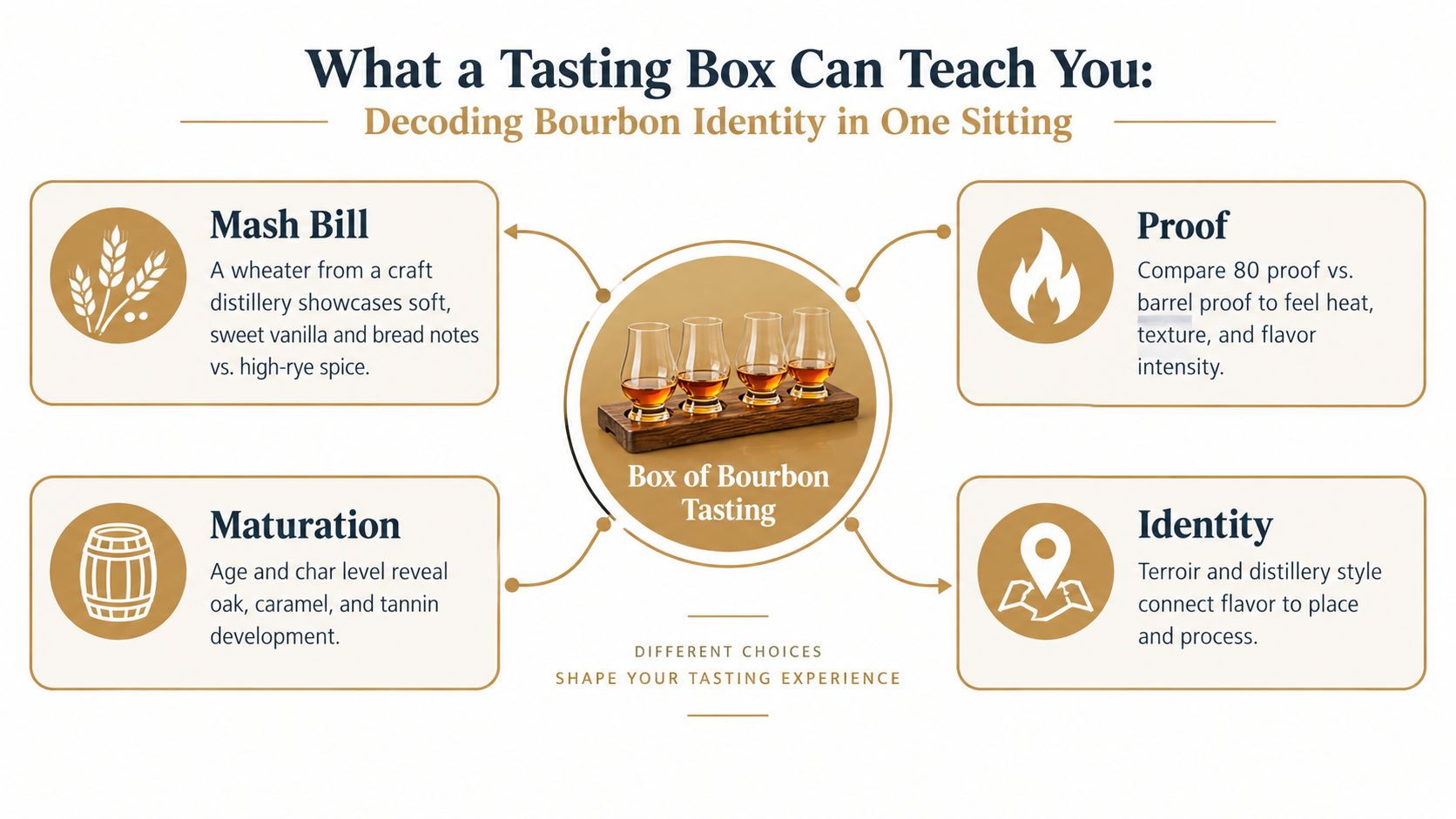
A well-designed tasting box turns abstract bourbon vocabulary into direct comparisons. Instead of hearing that mash bill, proof, and maturation affect flavor, you can taste those differences close together and record your own response.
Begin with the grain profile
A wheated bourbon from a craft distillery can showcase a softer grain impression, with notes that may read as sweet, bready, or rounded. A high-rye bourbon can put spice and dryness closer to the foreground. These are not rigid tasting rules, but they provide useful hypotheses to test.
Proof gives you another immediate comparison. A lower-proof pour may feel lighter and easier to approach, while a cask-strength pour can show more aroma intensity, heat, texture, and concentration. Bourbon can be distilled to no more than 160 proof, enter a new charred-oak barrel at no more than 125 proof, and be bottled at 80 proof or higher, according to the chemistry of bourbon explained by AIChE.
Let maturation become tangible
Taste a younger bourbon beside a more mature one and pay attention to oak, caramel, vanilla, spice, and tannin. The comparison doesn't turn age into a guarantee of quality. It shows how time and barrel interaction can alter texture and flavor.
Barrel-entry proof also affects what the wood contributes. Research on 12-year-matured bourbon found that color intensity and congener concentration decreased as entry proof rose from 109 to 155, while fusel oil remained approximately constant, as reported in the Journal of AOAC International study. That gives tasters a concrete reason to treat entry proof as part of bourbon identity, not just a technical production detail.
Two bourbons with the same age can still taste very different because distillery choices shape the final profile. Compare aroma first, then palate, then finish. Your notes become a personal palate map, which is the main educational return of paying for samples instead of guessing with a full bottle.
How to Run a Fair Blind Bourbon Tasting
Blind tasting removes information before it can influence your judgment. A familiar label can make you expect sweetness, oak, smoothness, or prestige before the whiskey reaches your mouth. Hiding the bottle doesn't eliminate personal preference, but it helps you identify that preference more clearly.
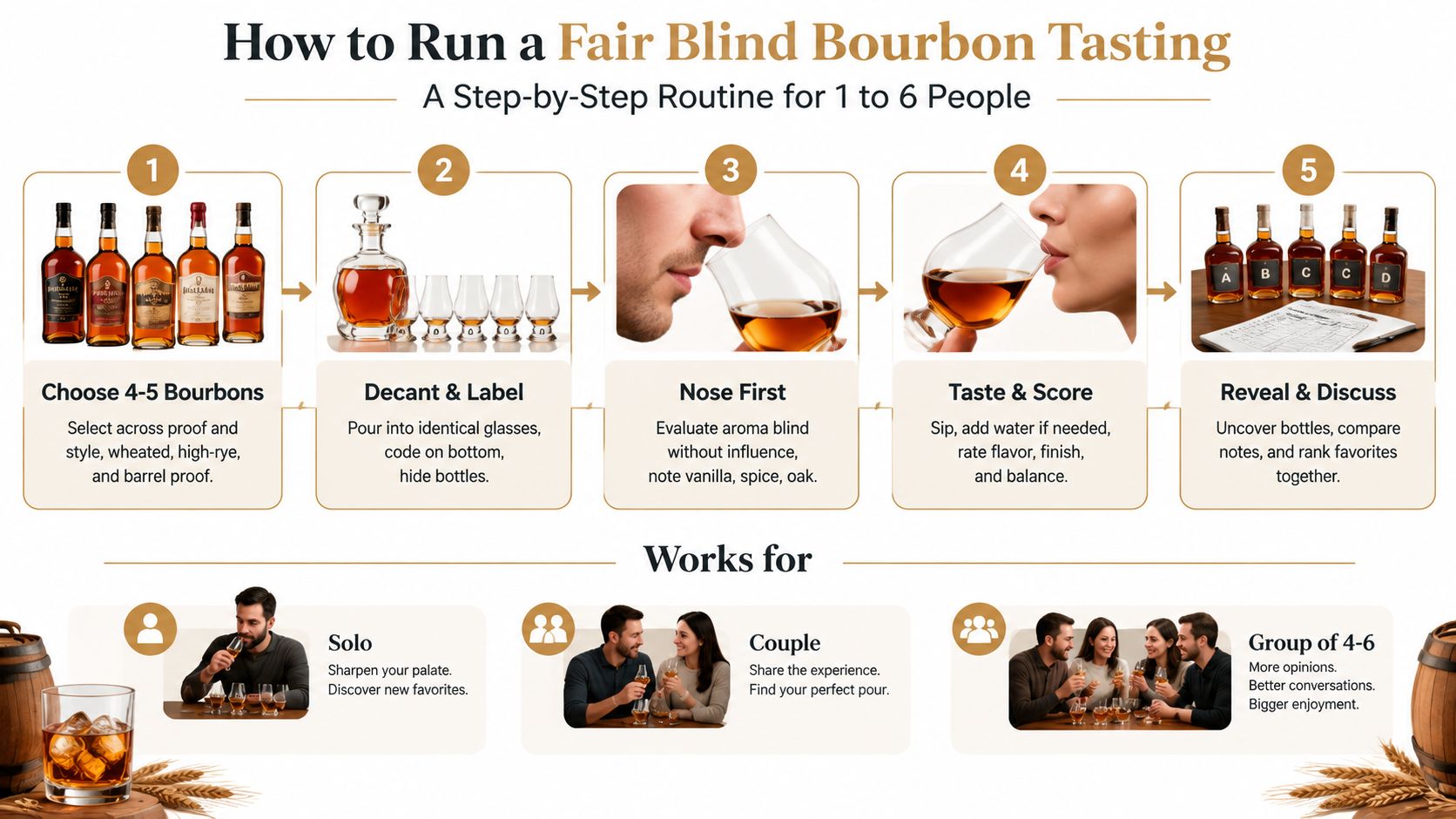
The routine works for one person, a couple, or a small group of four to six friends.
- Choose a balanced flight. Select four to five bourbons across proof and style. Include contrasts such as wheated, high-rye, and barrel-proof expressions, but avoid making the pours so different that the result becomes obvious from alcohol intensity alone.
- Decant and code the samples. Pour each whiskey into identical glasses or small decanters. Number them, cover the bottles, and keep the key with the organizer. If you're tasting alone, ask someone else to prepare the glasses or use opaque covers.
- Set up a neutral table. Use plain water and unsalted crackers. Remove decorative labels, colored glassware, strong fragrances, and food with aggressive flavors. The sensory evaluation method for whiskey is most useful when tasters encounter the same conditions.
Write before you reveal
For each sample, score aroma, palate, and finish on a simple 1 to 5 scale. Add short descriptions such as vanilla, baking spice, dry oak, fruit, caramel, grain, or heat. Don't worry about finding the “correct” note. The useful record is what you notice first and how the whiskey changes after a sip.
Taste in the same order for every glass. Smell first, take a small sip, let the whiskey move across your palate, and then wait through the finish. Add water only if the proof feels difficult, and record that change rather than treating it as a mistake.
Write your impressions before the reveal. Once you know the brand, your memory may reshape what you thought you tasted.
Reveal the bottles only after everyone has scored and ranked favorites. Compare guesses with the actual proof, age, and style. You may discover that a bottle you expected to love performed less well without its label, or that a modestly packaged craft whiskey suited your palate better than a famous name.
Keep the social side light. Offer a small prize for the closest guess, the best tasting note, or the most accurate ranking. Blind tasting isn't an exam. It's a way to turn uncertainty into conversation.
How Blind Tasting Subscriptions Compare
A box of bourbon is a format, not one fixed product. A labeled subscription may send a bottle or samples with the brand visible, while a blind subscription delays that information until after tasting. The better choice depends on whether the recipient wants an easy pour, a gift with immediate recognition, or structured palate practice.
A labeled subscription works well for hosts and gift buyers. The recipient can discuss the producer at once and serve the whiskey without organizing a reveal. A blind format serves a different purpose. It keeps the label from influencing first impressions, so tasters can compare aroma, flavor, finish, proof, and age impressions before seeing outside cues.
| Format | Samples per shipment | Distillery focus | Tasting guidance | Reveal process | Bottle upgrade option |
|---|---|---|---|---|---|
| Blind Barrels | Four quarterly samples | Small American craft distilleries | Guided tasting table and game | QR-based delayed reveal | Full bottles available at member pricing |
| Single-bottle monthly club | Usually one bottle | Often rotating or established brands | Basic or optional | Bottle is labeled | Depends on the club |
| Budget sample box | Varies | May rely on common national brands | Often limited | May be immediate | Usually limited |
| Sampler pack without reveal guidance | Several samples | Depends on the curator | Product descriptions or tasting notes | No structured reveal | Depends on the seller |
A monthly whiskey subscription can be useful when regular discovery matters more than choosing one bottle. The recurring cost pays for continued selection and tasting opportunities, not more whiskey. If the recipient rarely records impressions or compares samples, a one-time gift box may offer better value.
Blind Barrels offers four blind samples each quarter, along with guided tasting notes, a pairing game, and a reveal system. Tasters can record aroma, palate, and finish before scanning the QR code to view the distillery, mash bill, ABV, age statement, and related details. Members can access full bottles at member pricing when a sample stands out.
That structure makes the box a learning tool rather than a package of anonymous pours. It also opens a window onto the American craft field. The U.S. craft spirits market reached 3,069 craft distillers by August 2025, while volume fell 3.6% to 13.5 million cases and value was reported at $7.8 billion, according to coverage of U.S. craft spirits sales. A box featuring smaller producers can expose drinkers to distillery styles they may not encounter at a typical store.
The craft whiskey scene has expanded beyond a few familiar names. Industry coverage recorded more than 1,589 U.S. craft distilleries by 2017 and about 2,753 active craft distillers by 2022, as described in the American whiskey boom. For shoppers seeking palate training and American craft discovery, blind tasting gives the recurring format a clear purpose. Someone who only needs an easy bottle for a party may prefer a labeled club instead.
How to Choose a Bourbon Box Wisely
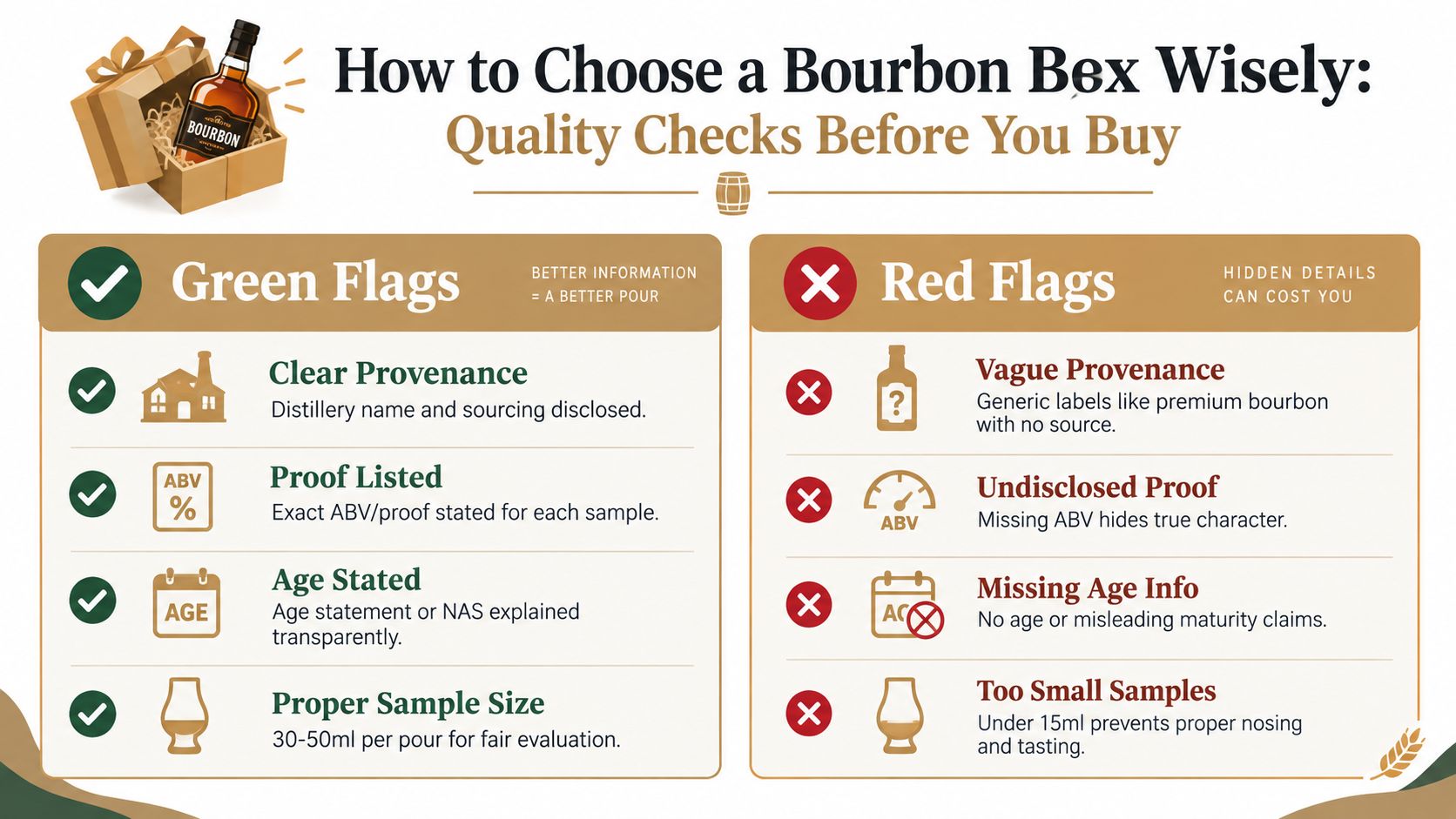
A glossy package can hide weak information. Before purchasing, check whether the seller identifies the distillery, states the proof, explains the age, and gives you enough liquid to evaluate the whiskey fairly.
A useful quality check looks like this:
- Clear provenance: The seller names the distillery or explains sourcing.
- Exact proof: Every sample has its ABV or proof listed.
- Transparent age information: The box provides an age statement or explains that the whiskey is NAS.
- Fair sample size: A 30 to 50 ml pour gives you room to nose, taste, revisit, and add water.
- Useful tasting aids: Notes, a scoring card, or a reveal method adds learning value.
- Clear subscription terms: The renewal schedule, cancellation process, and shipping charges appear before checkout.
- Legal delivery details: Confirm that spirits can ship to the recipient's state and that the recipient meets the legal drinking age.
Be cautious with vague phrases such as “premium bourbon” when the producer, proof, and age remain hidden. Also confirm that the contents are bourbon rather than flavored whiskey or a whiskey-based cocktail product if bourbon is the promised experience.
Match the price to the learning opportunity
A curated four-bottle kit priced around $40 can be sensible when it supplies 50 ml pours and clear bottle information. A quarterly subscription priced around $120 may make sense when it includes guided notes, a reveal system, and a consistent experience rather than only small containers. Those examples describe pricing logic, not a universal value standard.
New drinkers should also examine proof before opening the box. Beginner guidance recommends starting with lower-proof whiskey rather than cask-strength pours, and suggests adding a few drops of water when needed, as explained in this beginner bourbon tasting guide. A premium box filled with high-proof samples may frustrate someone who is still learning how to nose and sip whiskey.
Mid-range packages from established retailers can outperform flashy premium sets when the seller provides honest provenance, useful sample sizes, and practical guidance. Presentation matters, but information determines whether the box teaches you anything.
Finding the Right Bourbon Experience
Choose the format by the job you need it to do.
A gift set suits someone who needs a polished present for a host, colleague, or whiskey fan. It creates an immediate unboxing moment, especially when the bottle and accessories feel intentional.
A one-time tasting kit fits a curious beginner who wants a structured first session without signing up for future deliveries. It also works for a couple planning a relaxed evening around comparison rather than cocktails.
A recurring subscription is better for an enthusiast who wants variety and a regular palate-building ritual. If the box includes blind samples, tasting notes, and a reveal game, the recipient receives an activity as well as whiskey.
For genuine evaluation, look for at least 90 ml per bottle when the format presents a single bottle as the central tasting subject. Smaller exploration samples can still be useful, particularly when several pours form a deliberate flight, but they leave less room for repeat tasting.
Before checkout, ask:
- What occasion or goal drives this purchase?
- How often will it be used?
- What proof range matches the drinker's experience?
Those answers usually identify the right format quickly. Buy the gift set for presentation, the tasting kit for low-risk discovery, and the subscription for an ongoing learning habit.
Blind Barrels offers four blind 50 ml whiskey samples each quarter, with guided tasting materials, a pairing game, and a QR reveal that connects standout pours with full-bottle purchasing options. Visit Blind Barrels to explore a structured box of bourbon experience built around tasting without brand and price bias.