

Ever wondered what the big deal is with "cask strength" bourbon? Think of it like this: you can have orange juice from a concentrate, or you can have it fresh-squeezed. One is diluted and standardized, the other is bold, intense, and exactly as nature intended. Cask strength bourbon is the fresh-squeezed juice of the whiskey world.
What Is Cask Strength Bourbon?
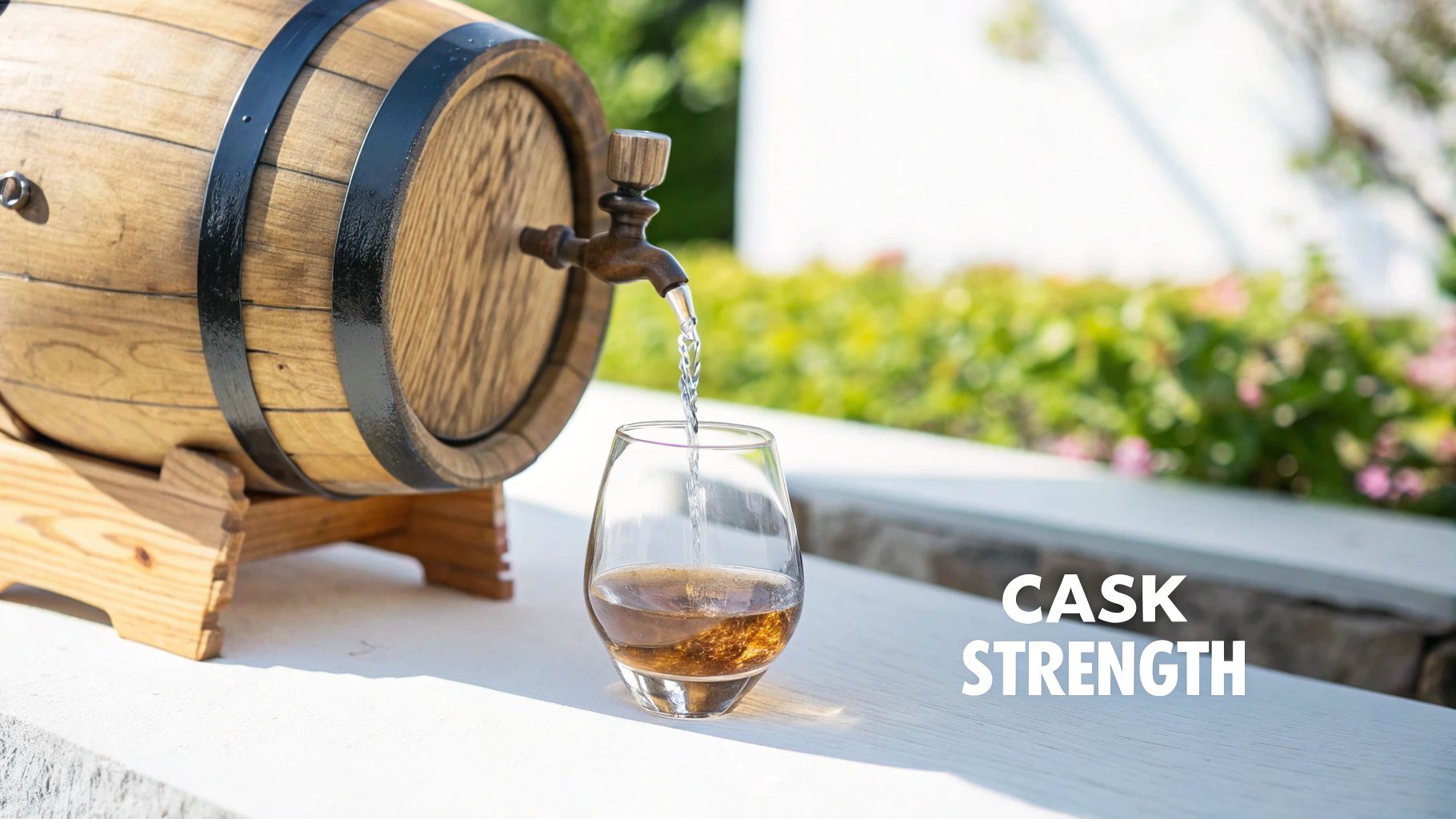
When you see cask strength, barrel proof, or barrel strength on a label, it all means the same thing: the whiskey inside is bottled at the exact proof it came out of the barrel. No water is added before it hits the bottle. This is a huge departure from the norm.
Most bourbons you find on the shelf are “proofed down.” After aging, distilleries add water to bring the alcohol by volume (ABV) to a consistent, more approachable level, usually between 80 and 100 proof. Cask strength expressions skip that step entirely.
What you get is an unfiltered, untamed whiskey experience—about as close as you can get to sticking a thief directly into a barrel in a Kentucky rickhouse.
Why Enthusiasts Seek High Proof
For someone new to bourbon, a proof of 120 or higher can sound pretty intimidating, and frankly, it can be. It’s a significant jump from your standard 80-proof bottle. But that raw intensity is exactly what gets seasoned enthusiasts and craft whiskey fans excited.
Cask strength bourbon represents the pinnacle of authenticity. By bottling directly from the barrel, distillers offer a pure, untamed expression of their craft, allowing the whiskey’s true character—shaped by grain, wood, and time—to shine through without compromise.
This demand for authenticity has exploded right alongside the modern bourbon boom. In 2022 alone, Kentucky distillers filled a record-breaking 2.7 million barrels. This incredible growth isn't just about making more bourbon; it's about meeting a surging demand for more powerful and genuine whiskey experiences. You can read more about the incredible expansion of the bourbon industry and its rising barrel inventory on The Bourbon Culture.
An Opportunity for Exploration
Instead of seeing high proof as a challenge, think of it as an invitation. A cask strength bourbon gives you a richer, more vibrant canvas of flavors and aromas that are often muted in lower-proof versions. It puts you in the driver's seat, letting you add water drop by drop to find the perfect balance for your own palate.
Here’s why connoisseurs love it and why it’s a fantastic way for newcomers to deepen their appreciation:
- Unfiltered Flavor: You’re tasting the bourbon in its purest form. Every complex note of caramel, spice, oak, and vanilla is right there, front and center.
- Customizable Experience: Don't like the heat? A few drops of water can tame the alcohol burn, opening up a whole new world of aromas and flavors that were hiding underneath.
- A Story in a Bottle: The final proof tells a story. It’s a direct reflection of its time in the barrel, influenced by where it sat in the warehouse, the climate, and its unique interaction with the wood.
Many incredible American craft whiskey brands, like Leiper’s Fork or Old Dominick, proudly release cask strength expressions. It’s a bold move that shows confidence in their spirit, letting the quality of their grain and distillation process speak for itself.
Why Proof Varies in Cask Strength Bourbon
If you’ve ever browsed a shelf of cask strength bourbons, you've probably noticed something curious—the proofs are all over the place. One bottle might sit at a friendly 118 proof, while its neighbor blasts past 135. This isn't just random chance. It’s the direct result of each barrel's unique journey, shaped by everything from federal regulations to the weather in Kentucky.
The story starts with something called barrel entry proof, which is exactly what it sounds like: the proof of the new-make spirit when it first splashes into a charred oak barrel. By law, bourbon must enter the barrel at no higher than 125 proof (62.5% ABV). That number is the starting line, but the finish line is almost always somewhere else.
This is where the real magic—and a bit of science—of aging kicks in.
The Angel's Share and Warehouse Location
As bourbon matures inside a rickhouse, the oak barrel breathes. And as it breathes, a little bit of the spirit evaporates right through the wood. Distillers call this lost portion the "angel's share." But what exactly the angels take—more water or more alcohol—depends entirely on where the barrel is resting.
Picture a classic Kentucky rickhouse, a towering wooden structure that can be nine stories tall. The environment inside changes dramatically from the very top to the very bottom.
- Top Floors: Up near the roof, it gets hot and dry. In this climate, water molecules are smaller and more eager to escape the barrel than the larger alcohol molecules. As more water evaporates, the alcohol becomes more concentrated, and the proof climbs higher and higher. This is where you find the fire-breathing, high-octane bourbons.
- Bottom Floors: Down on the cooler, more humid lower levels, the dynamic flips. Alcohol can evaporate at a rate closer to, or sometimes even faster than, water. The result? The proof often drops or stays much closer to its original entry proof.
The impact of location is staggering. You could fill two barrels with the exact same distillate on the exact same day, and they could end up with wildly different proofs just because one sat on the top floor and the other on the bottom. You can dive deeper into how distillers navigate the economics of evaporation in craft whiskey in our detailed guide.
How Proof Tells a Story
That final proof on the label is more than just a number; it’s a condensed story of that whiskey's life in the barrel. Even federal regulations have played a part. The maximum entry proof was raised from 110 to 125 back in 1962, a shift that allowed for higher yields and has shaped the character of modern high-proof bourbons. On the other hand, some craft distillers are intentionally using lower entry proofs, believing it helps pull out more flavorful compounds that are more soluble in water. You can explore more about how entry proof and maturation influence the final spirit in this fascinating article on Paste Magazine.
At the end of the day, a cask strength bourbon's proof is its fingerprint. It's a reflection of its unique aging conditions—the summer heat, the cellar cool, and its specific spot in the rickhouse—giving you a pure, unfiltered taste of its history.
How to Properly Taste High Proof Bourbon
Tasting a cask strength bourbon for the first time can feel like stepping up to the plate against a major league pitcher—it’s intense, powerful, and honestly, a little intimidating. But just like a seasoned batter, you can learn to read the pitch and connect. The secret isn't about bracing for the heat, but about coaxing out the complex flavors hiding behind it.
Your best friend in this process is a proper nosing glass, like a Glencairn. Its tulip shape is masterfully designed to concentrate the bourbon's aromas, funneling them straight to your nose. This simple switch lets you pick up those subtle notes of vanilla, oak, or dark cherry that would get lost in the alcoholic haze of a standard rocks glass.
The First Sip and the Kentucky Chew
Before you even think about adding water, you need to give your palate a gentle introduction. Pour a small amount and just let it sit for a few minutes. Now, take a tiny initial sip—barely enough to coat your tongue.
Instead of swallowing right away, gently swish the bourbon around your mouth. This move, affectionately known as the "Kentucky Chew," is crucial for preparing your taste buds for the high proof. It might still pack a punch, but it prevents your palate from getting completely blown out, setting you up for a much more nuanced experience on the next sip.
The Art of Strategic Dilution
Now we get to the most important part: adding water. This is where you take control of the tasting. Adding just a few drops of water can dramatically dial back the alcohol burn, allowing the whiskey's more delicate flavors and aromas to step forward. Think of it like adjusting the focus on a camera lens; suddenly, blurry background notes snap into sharp, vivid detail.
The goal is to find your own personal "sweet spot." Here’s a simple, step-by-step way to do it:
- Start Neat: Take another sip after your initial "chew" and make a mental note of the flavors. Is it spicy? Sweet? Oaky?
- Add a Single Drop: Using a pipette, straw, or even a spoon, add just one drop of water. Give the glass a gentle swirl.
- Taste Again: Take another small sip. How have the aroma and taste shifted? Has that hot cinnamon spice mellowed out? Is a new caramel note making an appearance?
- Repeat as Needed: Keep adding water one drop at a time, tasting after each addition. The transformation can be astounding; a bourbon that first hits like hot cinnamon and leather might blossom into honey, dark fruit, and buttercream with just a few drops.
This patient method allows you to experience the full spectrum of what a single cask strength bourbon can offer. These principles of sensory evaluation are surprisingly universal. In fact, you can sharpen your palate by exploring other complex beverages; for instance, guides on how to learn how to taste coffee like a professional use similar techniques for identifying aroma, flavor, and body.
The image below gives you a great visual of how different factors come together to create the final proof you'll be taming.
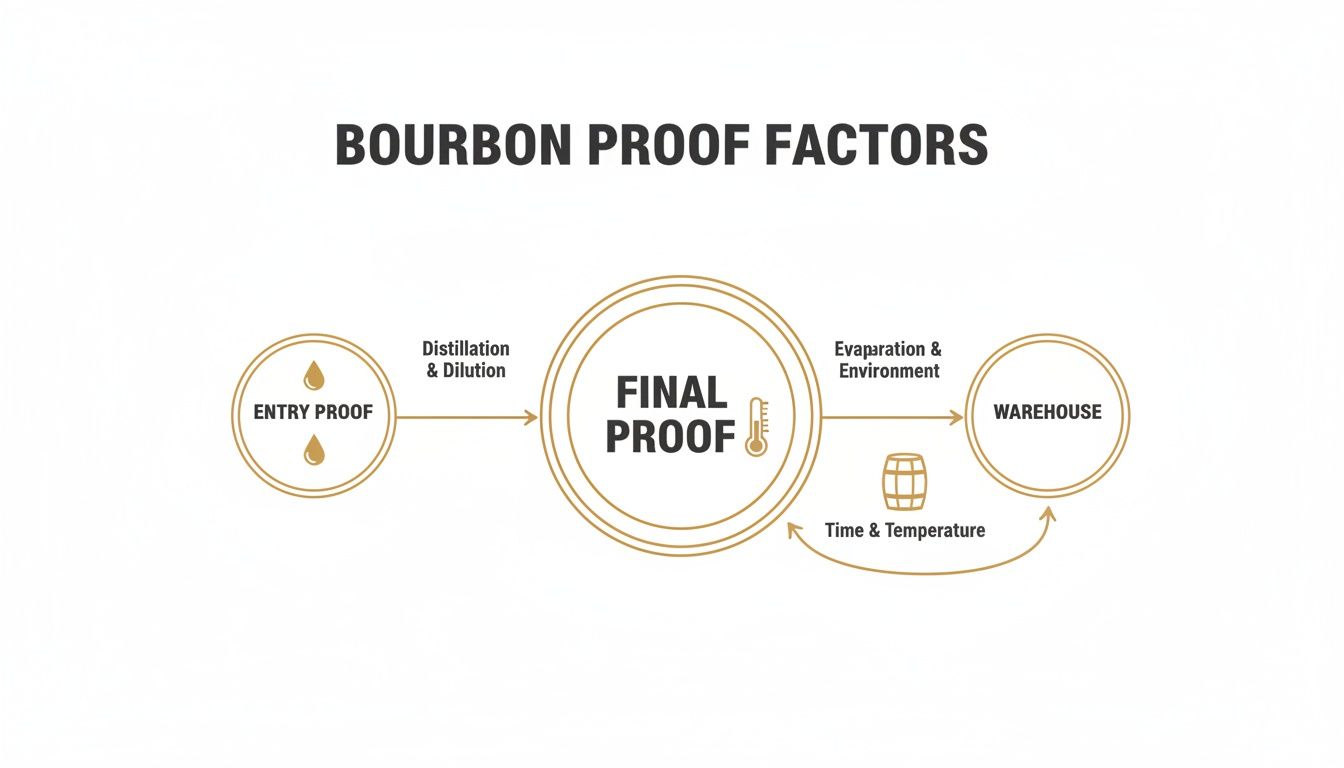
As you can see, the final proof is a direct result of where it started and the specific environment where it aged. For a closer look at the science, you can check out our deep dive on adding water for bourbon tasting.
Your Cask Strength Bourbon Tasting Guide
Think of this as your roadmap for dilution. Use this simple guide to see how adding water can gradually unlock new layers of flavor and aroma in your whiskey.
| Dilution Level | What You Will Experience | Perfect For Discovering |
|---|---|---|
| Neat (0 Drops) | The bourbon's raw, untamed character. Intense heat, powerful aroma, and concentrated flavors. | The distiller's original intent and the pure impact of the barrel. |
| A Few Drops | The alcohol "burn" softens, allowing sweeter, fruitier notes to emerge. Aromas become more distinct. | Hidden notes of vanilla, caramel, and dark fruit that were masked by the high proof. |
| More Diluted | The palate becomes much softer and rounder. More delicate floral and spice notes can appear. | Subtle complexities, herbaceous qualities, and the underlying grain character. |
This process is all about personal discovery. There's no right or wrong amount of water—only what tastes best to you. Have fun with it and enjoy the journey
Exploring Cask Strength American Craft Whiskeys
While the legacy distillers in Kentucky rightfully command respect, there's a powerful movement brewing across the country. A new wave of American craft producers is creating some of today's most thrilling cask strength bourbons. These smaller, passionate distilleries are pushing boundaries, playing with unique grain recipes, and offering a true taste of grain-to-glass whiskey.
Venturing into the world of craft whiskey means discovering stories as rich and potent as the spirits themselves. It’s about meeting artisans who are deeply connected to their local agriculture, producing bourbons that genuinely reflect a specific time and place. This is where the real innovation is happening.
Spotlighting Craft Innovators
Many American craft whiskey brands are building stellar reputations with their high-proof offerings. They bottle their spirits straight from the barrel, a bold move that shows pure confidence in their product. This unfiltered approach lets the quality of their grain, fermentation, and aging process shine through without any dilution.
Here's a glimpse of what makes craft cask strength bourbon so compelling:
- Unique Mash Bills: Craft distillers aren't afraid to experiment with non-traditional recipes. Take Old Dominick in Memphis, for instance. They use a high-rye mash bill (44% rye) in their cask strength bourbon, delivering an intense wave of cinnamon and spice that evolves with every sip.
- A Focus on Terroir: Distilleries like Leiper’s Fork, just south of Nashville, live by a "grain to glass" philosophy. Their detailed process, from sourcing local grains to using unique pot stills, creates a whiskey that is a true expression of its Tennessee roots.
- Transparent Storytelling: When you buy from a craft producer, you often get incredible detail about your bottle—from the exact age to the specific barrel number. It forges a personal connection that you just don't get with mass-market brands.
Exploring craft whiskey is about more than just taste; it's about appreciating the artistry and dedication behind each bottle. These producers are writing the next chapter of American whiskey, one barrel at a time.
This spirit of exploration is built on a solid foundation. Kentucky's deep bourbon heritage—powering an incredible 95% of global production—laid the groundwork for the entire industry. The state’s history, from the first commercial distillery in 1783 to the sour mash process, created the traditions that modern innovators now build upon. Today, a new wave of producers continues this legacy of constant improvement. You can dive deeper into the rich history that shaped modern bourbon on Wikipedia.
Why Blind Tasting Levels the Playing Field
So, how do you find these hidden gems without getting swayed by a fancy label or a sky-high price tag? The answer is simple: blind tasting.
By removing all the marketing and preconceived notions, you allow your palate to be the only judge. This is where craft whiskeys truly get a chance to compete head-to-head with the giants. A blind tasting forces you to focus solely on what’s in the glass: the aroma, the flavor, and the finish.
You might just discover that your new favorite cask strength bourbon comes from a small, up-and-coming distillery you’ve never even heard of. It’s the ultimate way to appreciate a whiskey for its intrinsic quality, not its hype. For anyone interested in starting this journey, our guide on phenomenal American craft whiskeys beyond Kentucky is the perfect place to begin.
Discover Your Palate Through Blind Tasting
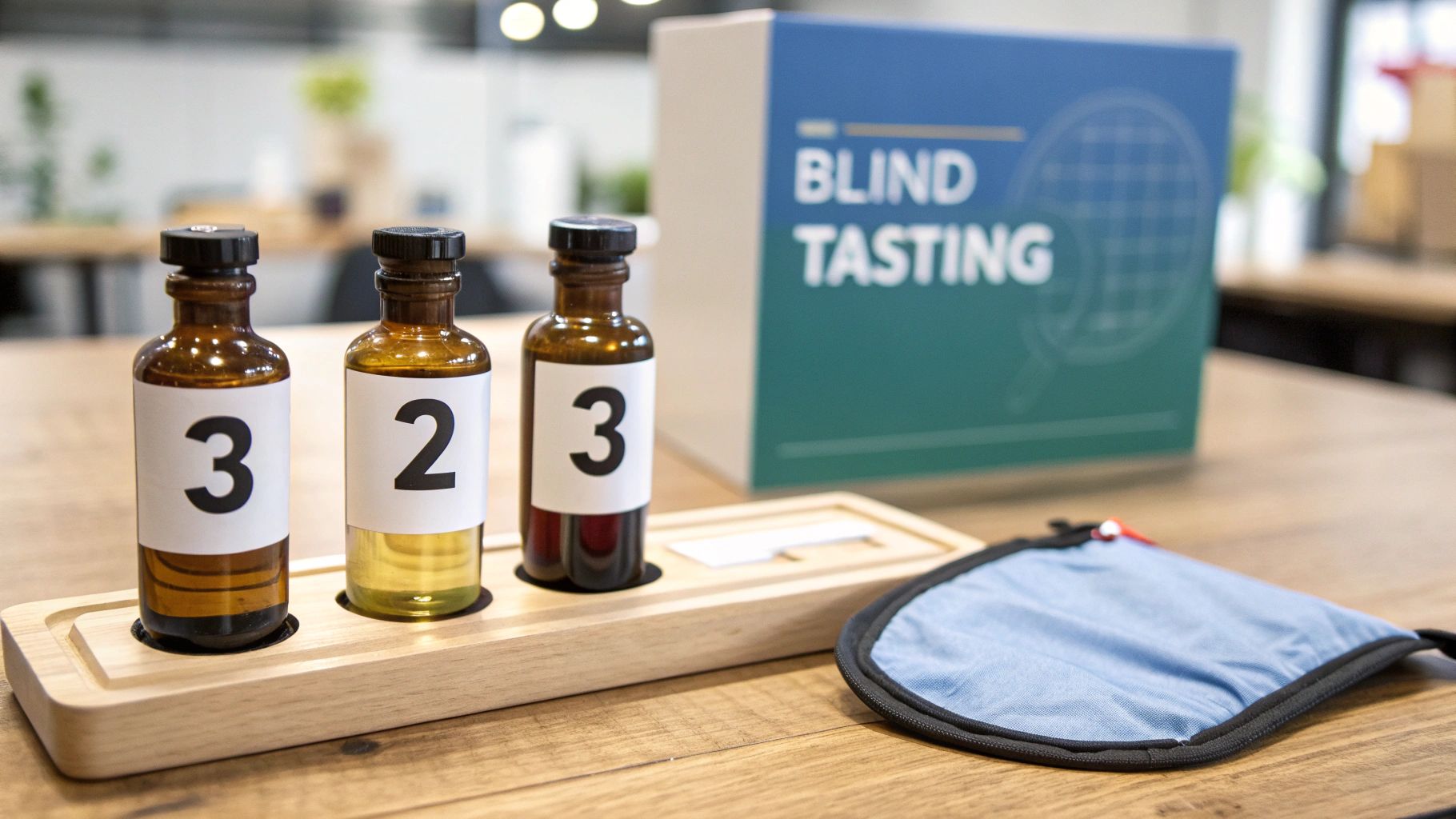
The single best way to figure out what you truly love is to let your taste buds do the talking—without any outside noise. The moment you see a bottle, your brain is already processing the label, the price tag, and the distillery’s reputation. Blind tasting cuts through all that, leaving you alone with what’s actually in the glass.
It’s a powerful tool for genuine discovery. When you taste "blind," you’re forced to make an honest call based only on the whiskey's aroma, flavor, and finish. The results are often surprising, and you might just find that a lesser-known craft bourbon completely blows away a bottle that costs twice as much.
More Than Just a Guessing Game
Blind tasting is so much more than just pouring whiskey into unmarked glasses. It's an incredible, hands-on way to sharpen your senses. A curated experience, like a Blind Barrels tasting kit, transforms the whole process into a journey that's as educational as it is fun.
Picture this: a box arrives with a set of numbered samples from some of America's most exciting craft distilleries. You get to jot down your own notes on a tasting mat, tracking everything from the first whiff to the last lingering taste. This interactive approach is what makes the lessons stick.
Blind tasting is the great equalizer in the world of whiskey. It strips away brand bias and marketing hype, allowing the quality of the spirit in the glass to speak for itself. It’s here that a well-made cask strength bourbon from a small distillery can prove it belongs with the best.
This method is especially effective for unpacking the layers of cask strength bourbon. When you taste several high-proof spirits side-by-side, you start to pick up on the subtle nuances—the unique fingerprints—that make each one special.
What You'll Actually Discover
You don't need to be an expert to get something out of blind tasting; you just have to be curious. By simply paying attention to what you're smelling and tasting, you'll start building a mental library of flavors and aromas. The whole point is to connect what's in the glass to what you actually enjoy.
A guided tasting often throws in a few friendly challenges to make the experience even more memorable:
- Guess the Proof: Can you feel the difference between a 115-proof bourbon and a 130-proof one without peeking at the label?
- Estimate the Age: Does the whiskey taste young and feisty, or does it have the deep, oaky wisdom of a more mature spirit?
- Identify the Mash Bill: Can you pick out the peppery spice of a high-rye mash bill versus the soft sweetness of a wheated one?
After you’ve made your calls, the "big reveal" shows you exactly what you’ve been drinking. It’s that final, rewarding step where everything clicks, connecting your sensory experience to the whiskey's real story. You'll not only discover your next favorite bottle but also become a more knowledgeable and confident whiskey drinker, one blind sample at a time.
Common Questions About Cask Strength Bourbon
Even after you've gotten your feet wet in the world of high-proof whiskey, a few questions tend to pop up. Let's tackle some of the most common ones people have about cask strength bourbon. Think of this as a final run-through to make sure you can walk into any bottle shop or tasting with complete confidence.
Is Cask Strength Bourbon Better Than Regular Bourbon?
Honestly, "better" is all in the eye of the beholder. It really just depends on what you're after. Cask strength bourbon is the purest expression you can get—it's an intense, complex, and unfiltered look at what was happening inside that barrel. But that same high proof can be a bit much for some people.
On the other hand, a standard, proofed-down bourbon is blended and diluted to be approachable and consistent right out of the bottle. Neither one is technically superior; they're just different roads to the same destination. If you're the kind of whiskey drinker who loves to tinker with a splash of water and explore the raw, untamed character of a spirit, cask strength will probably be your jam.
Does "Barrel Proof" Mean the Same Thing?
Yep, you nailed it. In the whiskey world, the terms cask strength, barrel proof, and barrel strength are all used interchangeably. All three mean the same thing: the bourbon was bottled at the exact proof it was when it came out of the aging barrel, with zero water added. If you see any of those phrases on a label, you can be sure you're getting the undiluted, full-flavored good stuff.
Can I Use Cask Strength Bourbon in Cocktails?
Absolutely! In fact, a high-proof bourbon can really make a classic cocktail sing. Think about an Old Fashioned or a Manhattan—a cask strength expression provides a muscular backbone that refuses to get bullied by sugar, bitters, or vermouth. The bold flavors just won't get lost in the mix.
The only thing to keep in mind is the proof. A cocktail made with a 125-proof bourbon will pack a much bigger punch than one made with a standard 80-proof bottle. You might want to tweak your recipe a bit, maybe pulling back on the bourbon pour just a tad to keep everything in balance. You’ll find that many American craft whiskey brands create cask strength expressions that are phenomenal for mixing.
Why Is Cask Strength Bourbon More Expensive?
It boils down to a couple of key factors. First, you're literally buying more whiskey and less water. Since the bourbon isn't diluted, a distiller gets far fewer bottles from a single barrel of cask strength whiskey than they would from a standard-proof release.
The higher price also signals that it’s a premium product. Distillers almost always save their best, most interesting barrels for these releases. At full proof, there's nowhere for flaws to hide, so they're putting their best foot forward. You're often paying for a hand-selected, top-tier expression that represents the pinnacle of their craft.
What Is a Good Cask Strength Bourbon for Beginners?
Dipping your toes into the high-proof end of the pool is a ton of fun. A great starting point for newcomers is to look for bourbons on the lower end of the cask strength spectrum—somewhere in the 110 to 120 proof range. This gives you that full-flavor experience without the fire-breathing intensity of the really high-octane stuff.
Another great strategy is to check out what respected American craft whiskey brands are doing. A small-batch release from a distillery with a reputation for quality can be a perfect introduction. Brands like Leiper's Fork or Old Dominick are known for crafting complex, high-quality cask strength bourbons that really show off what makes this category so special.
Ultimately, though, the best way to figure out what you like is to taste without knowing what you're drinking. An approachable, fun method is to try several different styles blind.
The best way to discover your personal preferences is by tasting without bias. At Blind Barrels, we send you curated blind tasting kits featuring exceptional American craft whiskeys, allowing you to focus purely on flavor. Let your palate be your guide and find your next favorite cask strength bourbon by exploring our tasting experiences at https://www.blindbarrels.com.