

Most advice about Colorado whiskey starts in the wrong place. It tells you to look for altitude, as if a mountain address automatically makes the glass more interesting. That's too easy, and it misses the key question: what changes in the whiskey, and what part of the story is just branding?
Colorado deserves a harder look because the category grew from almost nothing into a real craft scene. In 2004, one account says the state had no distillery at all, while Stranahan's opened that same year as the first legal distillery in Colorado since Prohibition and bottled its first batch in 2006, a revival that helped push the state to 102 distilleries by 2019 according to the American Craft Spirits Association, with more than 40 producers now represented by the Colorado Distillers Guild Real Food Traveler Whiskey Mappers. That growth matters because Colorado whiskey isn't just bourbon with a mountain backdrop. It's a craft-first category shaped by place, experimentation, and a lot of consumer curiosity.
If you're planning a trip, even a non-whiskey resource can help set the scene. I like pointing travelers to find Colorado park shirts at HikeTee because so much of this category's identity is tied to the state's outdoor culture, but the bottle in your hand still has to earn attention on taste alone. Blind tasting is the cleanest way to separate the mountain myth from the actual pour, and it's where the smartest whiskey education starts.
What Makes Colorado Whiskey Different
Colorado whiskey stands out because the state turned whiskey into a craft practice after the modern industry was already established. Geography matters, but it does not do all the work by itself. The difference is the mix of post-Prohibition revival, craft-scale production, and makers who treat whiskey like something to test, adjust, and learn from rather than follow as a fixed formula.
A category built from a restart, not a legacy
Colorado's modern whiskey identity started with a restart. Stranahan's opened in 2004 as the first legal distillery in the state since Prohibition, and that early revival helped create a producer base where there had been almost none. That matters because Colorado did not inherit a long industrial whiskey tradition the way some states did. It had to build one from scratch, which is why many Colorado bottles feel closer to American craft whiskey than to legacy corporate brands.
That fresh start also helps explain the state's habit of experimentation. Colorado producers are often comfortable with single malt, barrel experimentation, and small-batch releases because the category grew in a setting where there was room to try things. The label often tells you more than it does in larger, older whiskey markets. Grain choice, barrel type, proof, and finishing method are usually part of the story, and those details give beginners a better way to learn what they like.
Colorado also sits inside an outdoor culture that shapes how people talk about place and provenance. Even a casual travel search, like find Colorado park shirts at HikeTee, shows how often the state is framed through its natural scenery. Whiskey makers borrow that same language, but the bottle still has to earn attention through aroma, texture, and finish.
Practical rule: If a Colorado whiskey story leans only on altitude and never on grain, barrel, fermentation, or proofing, treat it as marketing until the tasting says otherwise.
What the label can and can't promise
There is no single legal style called “Colorado whiskey.” The state produces bourbon, rye, American single malt, and experimental blends. The label tells you the whiskey's rules, while the Colorado part points to how the maker approaches place, climate, and production choices.
For a closer look at how location can shape flavor, Blind Barrels has a useful discussion in this piece on location and flavor influence. That is the right frame here. Colorado whiskey is distinct because geography becomes one variable in a deliberate craft process, not because elevation overrides everything else.
The simplest way to say it is this. Colorado whiskey is defined by craft intent, not just elevation. Its bottle culture reflects a modern revival, not a borrowed tradition, and that gives the category its own voice.
The Origin Story Behind Colorado's Whiskey Renaissance
Colorado whiskey's modern rise did not begin with a slogan about altitude. It began with a market opening that gave drinkers a local bottle worth noticing. Stranahan's launched in 2004, and one account notes that it bottled its first batch in 2006, at a time when another source describes Colorado as having no distillery at all Real Food Traveler. That kind of starting point matters because a category usually needs a first label people can point to before it becomes part of everyday conversation.
From Gold Rush drinking culture to modern craft revival
Colorado's drinking culture predates the modern whiskey boom by a long stretch. Park Street points back to the 1858 Gold Rush and the opening of the Rocky Mountain Brewery in 1859 as part of the state's earlier alcohol history Park Street. That context helps explain why spirits found an audience once craft distilling returned. The modern bottles were new, but the appetite for local drinking culture was already familiar.
The market growth is easier to see in category data than in storytelling. Park Street reports a spirits CAGR of 8.78% over the previous five years, while beer grew 0.76%, which shows that spirits have been expanding much faster than beer in Colorado Park Street. In 2023, Park Street's state data show straight whiskey volume sales of 696 9-liter cases, with 306 for Canadian whisky, 123 for Scotch whisky, and 136 for Irish whiskey Park Street. Those numbers do not make whiskey the dominant category, but they do show that it has a visible place in the state's spirits mix.
For beginners, that matters because market growth changes what you can taste and compare. More local labels mean more styles, more barrel programs, and more chances for a drinker to notice differences in grain, proof, and cask influence instead of just reading about them. Blind Barrels' look at rapid maturation in American craft whiskey gives a useful frame for that kind of discovery, since Colorado's rise is part of a broader craft pattern where distillers test how climate, barrel choice, and process shape the glass.
Why one brand changed the map
Stranahan's gave Colorado a reference point. One account describes it as the first legal distillery in the state since Prohibition, and another notes that the brand helped define modern Colorado whiskey as a craft-first movement Whiskey Mappers. Once one producer made a serious whiskey in Colorado, other makers had a model to answer, copy, or push against.
That is how a category starts to feel real. One distillery opens, then drinkers, distributors, and competitors begin treating the state as a whiskey region instead of a novelty. By the time Colorado reached 102 distilleries in 2019 Real Food Traveler, the early revival had already become a broader market story.
High-Altitude Maturation and the Flavor Question
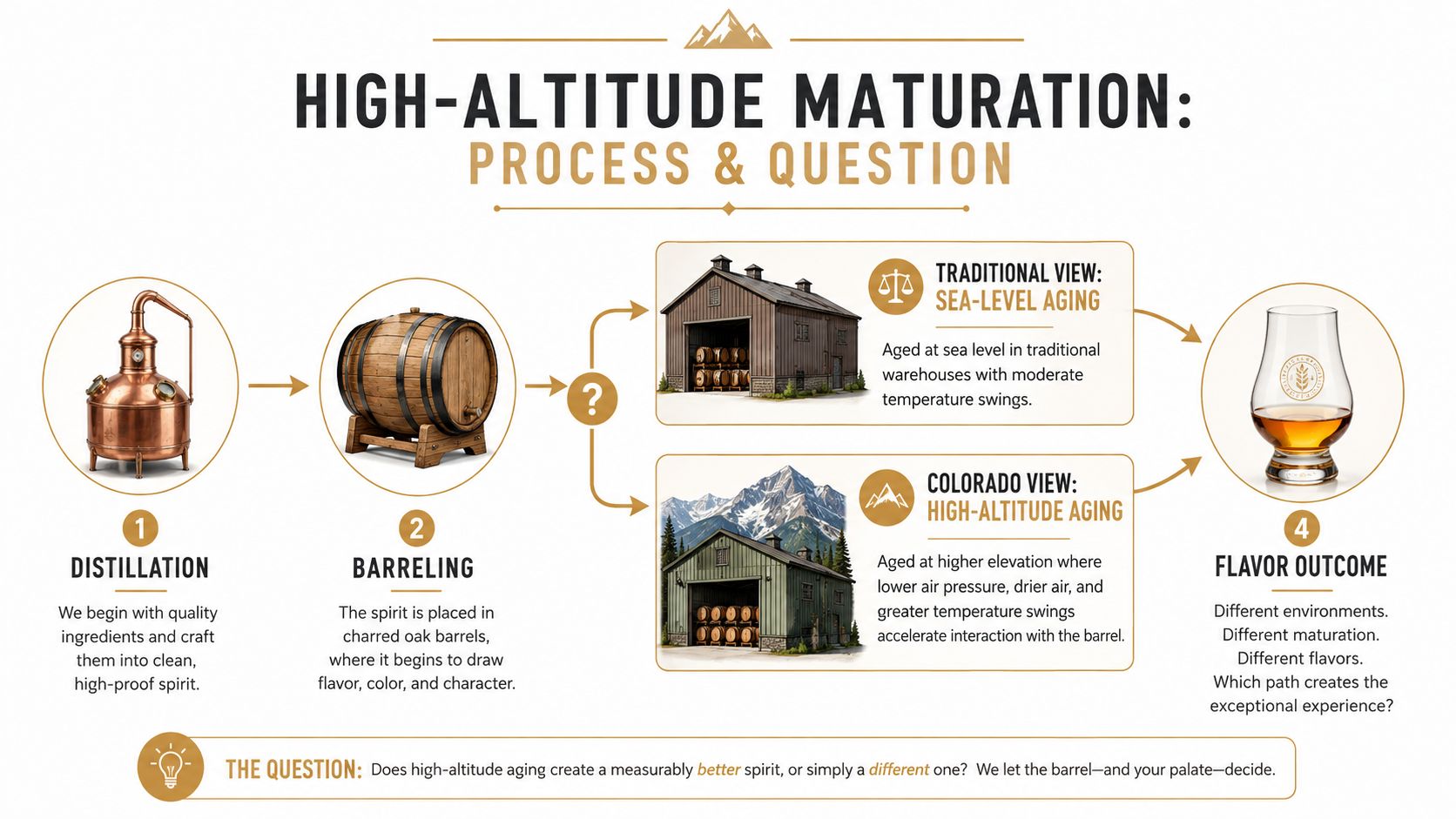
Altitude is the part of Colorado whiskey that gets repeated most often, and it is also the part most likely to be stretched by marketing. Distillers do have a physical case to make. One Colorado distillery points to elevations from roughly 5,000 feet in Denver to over 9,500 feet in mountain communities, along with sharp swings in heat and cold, as part of how aging develops in the state Marble Distilling. The core question is how that shows up in the glass.
What altitude can reasonably change
The basic logic is straightforward. Big temperature swings move whiskey in and out of the barrel more aggressively, which can speed interaction between spirit and oak. That can affect evaporation and the pace of flavor extraction, especially when distillers are using 53-gallon American oak casks and all-copper pot stills to shape character over throughput.
Climate can influence maturation, and it can do so in a way that matters. Barrel size, char level, distillation cuts, fermentation, and raw materials still shape the final result too. A whiskey aged in a mountain warehouse can still taste dull if the distillate is weak.
Altitude influences maturation pace, while recipe quality remains the primary driver of flavor.
What still needs skeptical listening
A drinker's palate matters more than the marketing copy. One of the most common blind spots in whiskey coverage is the habit of repeating “high altitude” without asking what that tastes like. Some differences are plausible, and some are still mostly anecdotal. Colorado producers have clearly embraced altitude-influenced aging, clean water, and experimentation, but the consumer still has to decide whether those choices produce a profile they enjoy.
Blind Barrels' discussion of rapid maturation and craft whiskey experiments offers a useful frame for that check. If a whiskey tastes more integrated, oak-forward, or concentrated, that gives the claim some weight. If it mainly tastes like oak and bragging rights, the label is doing more work than the spirit.
The most reliable way to judge Colorado's altitude claim is to taste it blind against whiskeys from other climates. That removes the story and leaves the structure, the aroma, and the finish.
Signature Colorado Styles and How to Spot Them
Colorado whiskey makes more sense once you stop treating it as a single category. The state's stronger bottles usually fall into a few recognizable lanes, and the label often tells you more than the marketing copy if you know how to read it. Single malt, rye, bourbon-style whiskey, and wheat-forward releases each point to a different set of priorities in the distillery.
Start with the grain and the barrel
A representative Colorado single malt uses a 100% Colorado barley mash bill, El Dorado Rocky Mountain spring water, and a 6-day fermentation in closed-top stainless fermenters. It is then double-distilled to 70% ABV (140 proof), cut to 55% ABV (110 proof) before barreling, and aged a minimum of 2 years in #3-char new American oak The Spirits Educator. Some bottlings blend 2-, 3-, 4-, and 5-year whiskey or finish in a 620-gallon toasted oak foeder under a Solera-style system. Those production choices matter because they shape the whiskey before the first sip ever reaches the glass.
Single malt usually signals barley-forward flavor, a softer grain texture, and more room for fruit, malt, and oak to share the stage. Rye usually reads drier and spicier. Bourbon-style bottles tend to feel richer, sweeter, and more oak-driven, especially when the distiller is relying on char and new wood.
How to read the bottle fast
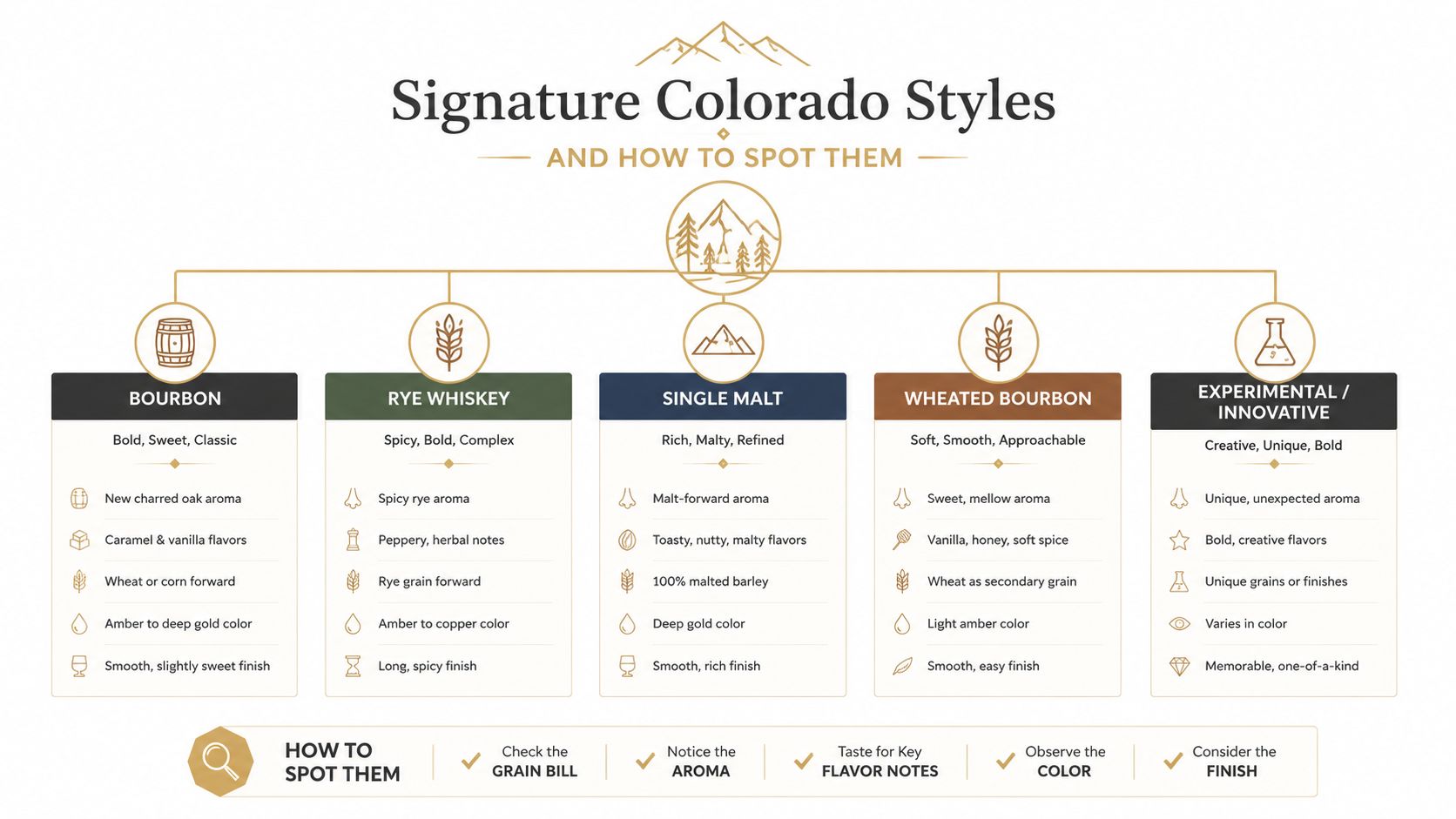
- Single Malt: Look for malted barley language, finished wood, or a distillery that emphasizes fermentation and barrel selection.
- High-Rye: Expect a firmer, drier spice profile and a more assertive finish.
- Bold Bourbon: Check for new charred oak, corn-led sweetness, and a rounder palate.
What those styles usually mean in the glass
The goal is not to memorize a neat taxonomy. The goal is to set expectations before you pour. If a Colorado bottle says single malt and you are expecting classic Kentucky sweetness, you may read the whiskey wrong before it even touches your tongue. If it is rye, the first thing you should look for is more snap. If it is bourbon-style, oak may show up earlier and take more space.
The state's style range is part of its appeal. Colorado producers are not locked into one house style, and that is why the bottles can feel so different from one another. Once you know the style, you can taste the intent.
Notable Colorado Distilleries and What They Stand For
Stranahan's still matters, but the more useful question is why it matters. Its early whiskey gave Colorado a reference point for what a state-made spirit could taste like, and its 100% malted barley approach shows that Colorado whiskey was never forced to copy a bourbon script. For beginners, that makes it a helpful starting bottle because it teaches you to separate grain character from the assumptions people often bring to American whiskey Whiskey Mappers.
What to look for beyond the headline name
A better way to read Colorado distilleries is to ask what each producer is trying to demonstrate. Some focus on copper pot stills, some on Colorado-grown grain, some on experimental cask finishes, and some on limited collaborative releases. Those choices tell you more about the maker's priorities than any polished label copy can.
Colorado now has enough producers that no single bottle can speak for the whole state. As noted earlier, the field is broad, and the important point is the range of approaches rather than a single count. That variety is what makes Colorado whiskey worth studying. You are looking at a working category, not a novelty shelf.
Here's the simplest way to sort the field:
- Producers focused on single malt: Often emphasize barley, fermentation, and how the barrel shapes a softer grain core.
- Producers leaning toward rye or bourbon: Usually foreground spice, sweetness, or structure, which tells you where the maker wants the whiskey to land.
- Collaborative or limited-release makers: Often use cask finishes or blended expressions to test how far Colorado whiskey can stretch without losing balance.
Practical rule: Do not ask which distillery is “the best.” Ask which philosophy matches the flavors and textures you already enjoy.
How to use Stranahan's as a template
Stranahan's is also useful because it gives beginners a concrete tasting model, not just a bottle. Its guided tastings are short, focused, and comparative, which is the same method that helps people learn any whiskey category without getting lost in labels. A side-by-side pour teaches faster than a solo sip because your palate has something to measure against.
That approach pairs well with a simple tasting routine at home. A helpful guide like Blind Barrels' whiskey tasting walkthrough shows why structure matters, because beginners learn more from repeatable comparisons than from trying to name every note at once.
The broader lesson applies across Colorado. One distillery's style can train your eye for another distillery's label, and one glass can teach you more when you know what to compare it against. Once you know what you like, the state's range stops feeling noisy and starts feeling useful.
How to Taste Colorado Whiskey Like a Beginner Should
Most first-time whiskey drinkers make the same mistake. They sip from a fresh bottle, try to name the flavors too quickly, and end up repeating whatever the label or bartender suggested. A better approach is slower, more structured, and much more forgiving of inexperience.
Use a guided tasting shape
Visit Denver describes Stranahan's Original Guided Whiskey Tasting as an intimate 45-minute session, and its Distiller's Experimental Guided Whiskey Tasting is also 45 minutes and focuses on comparing unique whiskeys with the Original Single Malt Visit Denver. That setup works because it narrows the field. You're not trying to solve the whole category at once.
A simple home version looks like this:
- Pour a small taste of one Colorado whiskey and one non-Colorado whiskey in similar styles.
- Smell first, then take a tiny sip.
- Add a few drops of water only after your first impression.
- Write down texture, sweetness, spice, and finish.
- Compare notes before you compare brands.
If you want a more detailed sensory routine, Blind Barrels has a straightforward guide in its whiskey tasting walkthrough. That kind of method matters because beginners don't need jargon, they need repeatability.
Focus on what your palate can actually tell you
Don't worry about sounding educated. Worry about noticing texture. Is the whiskey oily or lean? Does it open fruity, grainy, spicy, or woody? Does the finish fade fast or stay with you? Those are the clues that matter.
Start with comparison, not judgment. Two whiskeys tasted side by side teach you more than ten labels tasted weeks apart.
A tasting flight works especially well with Colorado whiskey because the category spans such different styles. A single malt can show you malt sweetness and oak structure. A rye can show you spice. A bourbon-style bottle can show you how much barrel influence the distiller wanted. You're building a vocabulary out of real sensations, not marketing terms.
The drinker who takes notes becomes harder to fool by hype. That's a good thing.
Blind Tasting and the Case for Letting Your Palate Lead
Blind tasting is the cleanest way to learn Colorado whiskey because it strips out the loudest bias in the room, the label. Price, brand reputation, and altitude stories all shape expectation before the glass even gets lifted. Once you cover the bottle, the whiskey has to speak for itself.
Why blind tasting matters here
Colorado whiskey carries a lot of story weight. Some bottles are tied to craft history, some to mountain identity, and some to the idea that place makes flavor. Blind tasting doesn't reject those stories, but it does postpone them until after the first honest impression.
That's where a model like Blind Barrels fits naturally. It offers a quarterly blind whiskey tasting subscription with four samples from small American craft distilleries, plus a tasting table for aroma, tasting, and finish notes, a QR code that reveals the samples, direct access to purchase full bottles at a discounted price, and a game that lets you guess the age, proof, and whiskey type before scoring your accuracy. For Colorado whiskey specifically, that kind of setup removes the mountain myth and makes the comparison visible.
What blind tasting teaches faster than labels do
When you taste blind, you learn which styles you prefer, not which stories you're supposed to like. A drinker who thinks they love bold oak may discover they prefer barley sweetness. Someone chasing proof may find they enjoy balance more than heat. That's the point of the exercise.
Blind tasting is also communal in a way that helps beginners relax. People can compare notes without needing to defend a favorite brand. They can disagree on aroma, then agree on finish. That conversation builds confidence quickly.
If you want to keep exploring, keep the rule simple. Taste first, read later, buy only when the whiskey earns the purchase. Colorado whiskey rewards that approach because the category is broad enough to surprise you, but specific enough to teach you something every time.
If you want a structured way to keep exploring Colorado whiskey without brand bias, visit Blind Barrels and use its blind tasting format to compare craft bottles on aroma, taste, and finish instead of marketing copy. It's a practical way to keep learning what you like, especially when Colorado's whiskey scene has so many styles competing for your attention.