

The United States had approximately 100 distilleries around 2008, compared with more than 3,000 active craft distillers reported in 2024, according to the 2025 Craft Spirits Data Project. That growth is why craft whiskey brands now fill shelves with local grains, unusual mash bills, and limited barrels. It also creates a problem. A label can set your expectation before you taste anything. The fix is simple. Check what's verifiable, then taste blind and let your palate vote.
Why Small American Craft Whiskey Is Growing Fast
A single whiskey aisle now offers far more than a handful of familiar national labels. Bottles from Texas, Colorado, and the Pacific Northwest sit alongside them, each shaped by different grains, mash bills, and maturation choices.
A Crowd, Not a Handful
The American Craft Spirits Association reported 2,753 active craft distillers by August 2023 and 3,069 by August 2024, a one-year increase of 11.5%, in its 2024 Craft Spirits Data Project. The report puts the starting point at about 100 distilleries around 2008. That growth gives whiskey drinkers a wider range of producers and approaches to explore.
Regional grains, distinctive mash bills, local water, unusual maturation, and limited releases can all shape a whiskey's flavor. Blue corn can bring a different grain character; cask choice can alter the aromas and finish. These details matter most when the glass confirms them.
Why Craft Bottles Cost More
Craft spirits account for a larger share of market value than of volume. That gap suggests a higher average value per case, but it does not tell you whether a particular bottle will taste better to you.
What that means for you: Price reflects more than flavor. A higher price is not proof that you'll prefer the whiskey.
Craft distilleries operate across the country, making American whiskey a geographically varied category. For more background, read about the rebirth of American craft whiskey. Provenance can help you understand how a whiskey was made, but small-batch or local stories are not tasting notes. Compare pours blind, and let the flavors, not the label, shape your judgment.
Craft Whiskey Brands to Try First, Style by Style
Think of this table as a starting map, not a ranking. Nobody can rank these for your palate, and anyone who tries is guessing. What you can do is pick clear examples of different styles, so the differences are easy to notice.
| Brand | Home state | Signature style | Start with |
|---|---|---|---|
| Balcones Distilling | Texas | Single malt and blue corn whiskey | Baby Blue |
| Stranahan's | Colorado | Single malt aged at high altitude | Original Colorado Whiskey |
| Westward | Oregon | American single malt shaped by a cool, damp climate | Westward American Single Malt |
| Koval | Illinois | Rye and millet whiskey from organic grain | Koval Rye |
| Garrison Brothers | Texas | Straight bourbon matured in Hill Country heat | Straight Bourbon Whiskey |
| Corsair | Tennessee | Experimental grain and smoke-finished bottlings | Triple Smoke |
Three Families to Learn
Corn-forward bourbon is your anchor. Garrison Brothers makes a straight bourbon matured in Texas Hill Country heat, which pushes spirit in and out of the wood hard. Start here if you like sweetness first, then oak. Balcones Baby Blue, made from blue corn, belongs near this family too, and it'll show you how changing the corn itself changes the glass.
Rye and malt split in two useful directions. Koval Rye, from Illinois organic grain, gives you rye spice in a clean form, and the distillery also works with millet if you want something softer and grain driven. Stranahan's Original Colorado Whiskey and Westward American Single Malt are both single malts, but they age in very different air. Stranahan's sits at high altitude in Colorado. Westward matures in Oregon's cool, damp climate. Put those two side by side and you're tasting warehouse climate, not just barley.
Experimental grain is where craft gets weird, sometimes in a good way. Corsair in Tennessee experiments with unusual grains and smoke, and Triple Smoke is the obvious starting bottle if you want to see how far smoke can go in American whiskey. Balcones also earns a second look here, since its Texas single malt work doesn't follow the Kentucky template at all.
How to Build Your First Flight
- Pick one bottle from each family: one corn-forward bourbon, one rye or malt, and one experimental bottle gives you three clear reference points.
- Don't buy three similar bottles: three sweet bourbons teach you less than one bourbon next to a rye and a malt.
- Check availability before you drive anywhere: release lineups change, so confirm a named bottle is still being sold.
Keep this shortlist handy. The blind tasting steps in section six will let you test whether these style labels match what you taste.
How to Tell a True Craft Whiskey From a Sourced One
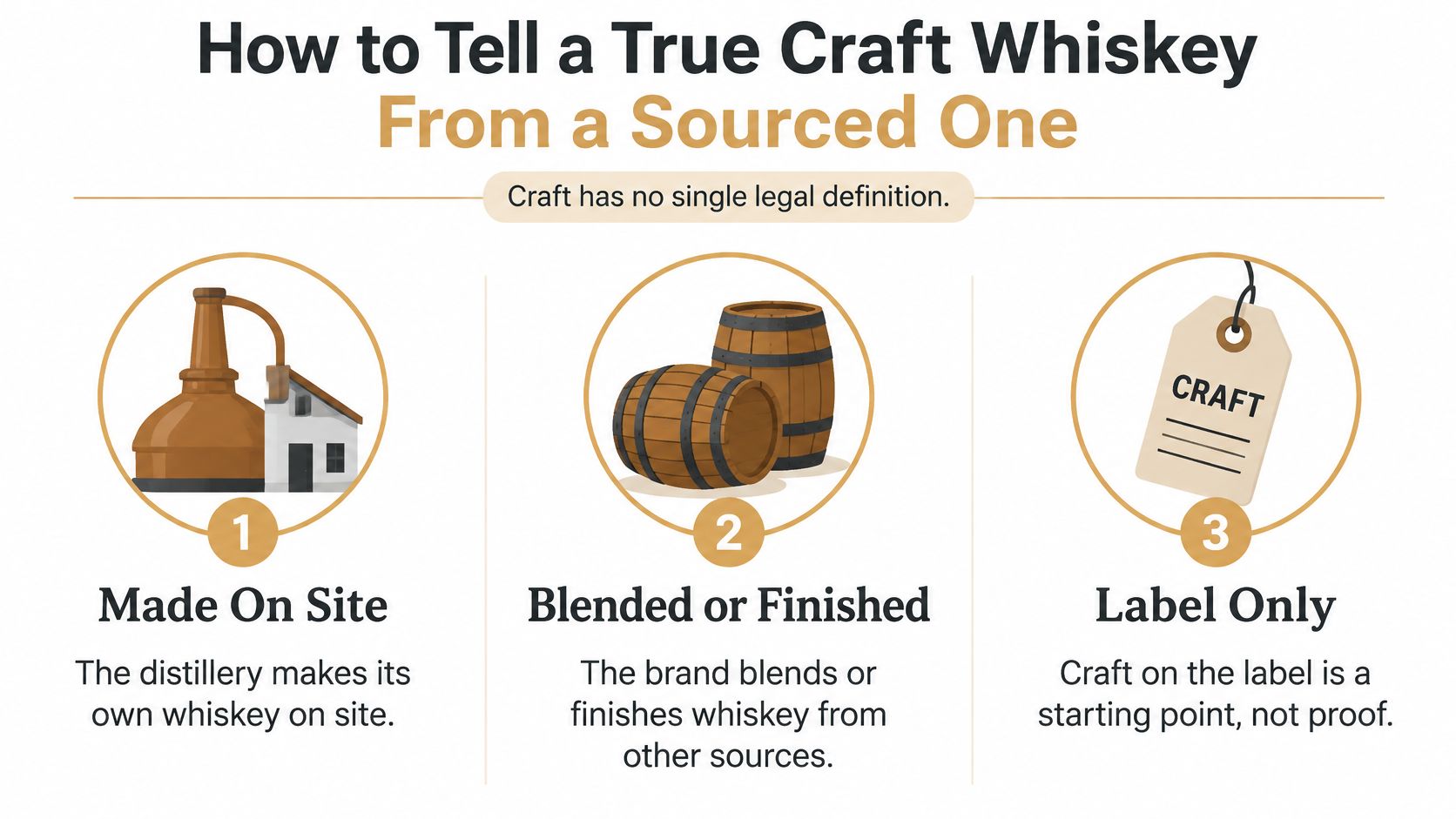
Here's the uncomfortable part. Craft has no single legal definition. A rustic label, a founder story, and the words small batch don't prove who made the whiskey. Transparent provenance is a stronger trust signal than small or local storytelling, and it's the thing you can check.
Three Different Situations Behind One Word
Some distilleries make their own whiskey on site, from grain to barrel. Others buy whiskey from a larger producer, then blend, finish, or bottle it under their own name. A third group mixes sourced stock with whiskey they distilled themselves, often while their own barrels are still aging. None of these automatically means bad whiskey. A skilled blender working with sourced barrels can make something excellent, and a tiny on-site distillery can make something rough. Small doesn't mean distinctive. Local doesn't mean better.
What matters is whether the brand tells you which situation you're in. The Mordor Intelligence United States spirits market report notes that consumers are asking more detailed questions about mash bills, barrel programs, production practices, and inputs rather than relying only on brand stories. That shift is healthy, because authenticity claims are hard to test by taste, while provenance details can be verified.
Five Checks to Run on Any Bottle
- Look for the distiller's own name: check whether the label names the distillery that made the whiskey, not just the brand that bottled it.
- Ask who distilled it and where: distillery location, distillation dates, and maturation site should be findable on the label or the producer's site.
- Find the grain story in numbers: a stated mash bill and barrel type beat farm-to-bottle language every time.
- Check blending and sourcing disclosures: look for what share was sourced, whether it was blended, plus bottling proof and batch size.
- Compare the claims with your glass: taste it blind if you can, then see whether the production facts explain what you noticed.
A brand that openly discloses sourcing has given you something testable. A brand that only gives you a story has given you nothing to verify.
How Mash Bill, Barrels and Age Change What You Taste
A whiskey's age is only one clue to its flavor. Grain, barrel treatment, and time each shape the glass, so comparing age alone can obscure the differences you're trying to understand.
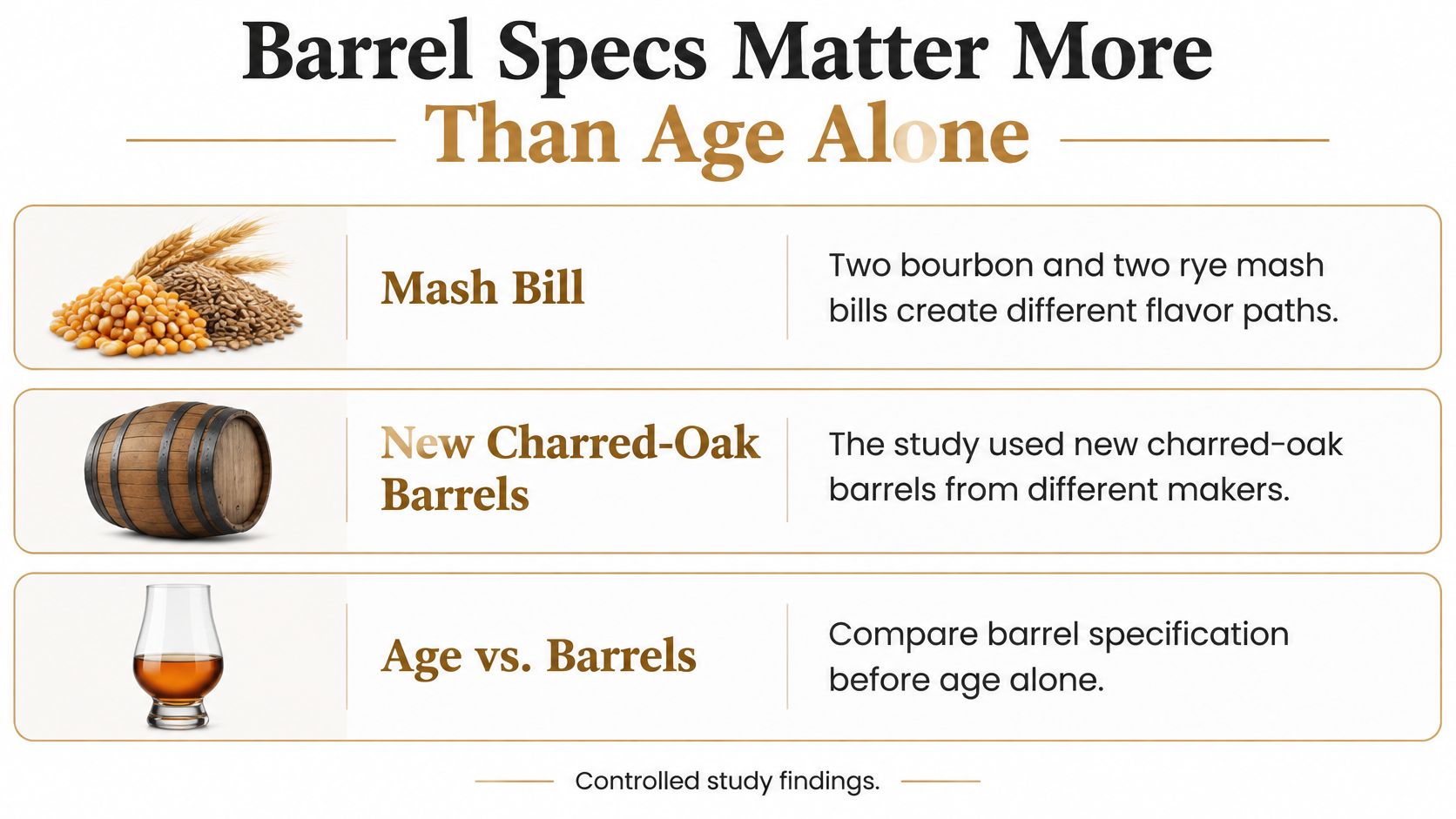
A controlled study of American whiskeys made from two bourbon and two rye mash bills, using new charred-oak barrels from the same cooperage and stave lot, found that mash bill and bottling age significantly changed multivariate chemical profiles and 18 of 35 sensory attributes, according to the Journal of the Institute of Brewing study. The researchers found significant effects from both factors, without a significant interaction. In short, grain and age each influence what you taste. A younger high-rye whiskey and an older high-corn whiskey can't be judged by the age number alone.
| Production choice | Typical flavor effect | How to test it |
|---|---|---|
| High-rye mash bill | Spice, pepper and a drier finish | Compare with a high-corn bottle of similar age |
| High-corn mash bill | Sweeter, rounder body with caramel and vanilla | Compare with a high-rye bottle of similar age |
| Heavier char on new oak | Caramel, vanilla and toasted-wood notes with some smoke | Compare two bottles of the same mash bill and age |
| Longer barrel time | More compounds, with the largest change in the first two years | Compare a young and an older bottle of the same mash bill |
| Higher barrel entry or bottling proof | Stronger aroma, more heat and more grip | Taste neat, then with a few drops of water |
| Secondary finish in a different cask | Added wood sugar and fruit, often a rounder finish | Check the label for a finishing statement |
Reading the Table Like a Taster
Mash bill is a starting point, not a flavor guarantee. A high-rye recipe tends toward spice, pepper, and a drier finish; a high-corn recipe tends toward sweetness, caramel, and a rounder body. Barrel char adds another influence: heat changes the wood, contributing flavors associated with caramel, vanilla, and toast.
Time works alongside those factors. Much of the change in a barrel happens early, roughly in the first two years, while longer aging adds complexity and more oak-derived compounds. That is why a young, heavily charred, high-proof whiskey can taste more intense than an older, lighter one. Intensity alone doesn't establish maturity.
Compare One Variable at a Time
For a useful comparison, change one factor and hold the others as steady as possible. Try high-rye and high-corn bottles of similar age to focus on grain, or the same mash bill at two ages to focus on time. Record whiskey type, mash-bill emphasis, barrel type and char, age or minimum age, proof, and finishing treatment. Then taste blind before considering the producer's story: transparent production details give you something to check against the glass, while reputation can't determine what you'll perceive.
For a separate example of a whiskey-oak treatment outside a whiskey bottle, you can browse 12 oz Caturra coffee bags.
Reading Bourbon, Age and Bottled-in-Bond Labels
Labels confuse new drinkers because some words are law and some are decoration. Your job is knowing which is which. The regulated terms tell you how a whiskey was made. They don't tell you whether you'll like it.
What an Age Statement Really Says
Federal rules require an age statement for whiskey aged less than four years, including blends containing whiskey younger than four years, unless the product qualifies for the bottled-in-bond labeling exception, according to the TTB distilled spirits FAQs. For bourbon and other covered American whiskeys, age means the time stored in charred new oak after distillation and before bottling. Time spent in a steel tank or any other container doesn't count. Once a whiskey is at least four years old, an age statement is generally optional unless the label makes an age or maturity claim.
So a missing number on an older bottle isn't a warning sign. The distillery may prefer to talk about mash bill, barrel character, proof, or finishing instead. A stated age is a concrete comparison tool, nothing more.
The Bourbon Thresholds
Bourbon is a regulated identity, and small distilleries meet the same rules as large ones. The TTB standards of identity define bourbon as whiskey from a fermented grain mash of at least 51% corn, distilled at no more than 160 proof, entered into charred new oak barrels at no more than 125 proof, and bottled at a minimum of 80 proof, with no added coloring, flavoring, or blending materials. Everything outside those lines, including the other grains, yeast, fermentation, barrel selection, climate, and proofing, is where brands differ.
Bottled-in-bond is stricter still. It signals one distiller, one distillery, one season, at least four years of aging, and bottling at 100 proof. For a fuller walk-through, see this guide to how bourbon whiskey labels work.
What Each Term Leaves to You
- Bourbon: guarantees the production method above, not sweetness level or quality.
- Age statement: guarantees time in charred new oak, not balance or complexity.
- Bottled-in-bond: guarantees a single source and set proof, not that you'll enjoy the heat.
- Small batch and craft: guarantee nothing specific, so treat them as claims to check.
How to Run a Blind Tasting of Craft Bottles
Blind tasting sounds like a party trick. It's the fastest way to learn your own palate, because it removes the two loudest influences on your opinion, the brand name and the price. Run it slowly and write things down.
Six Steps, in Order
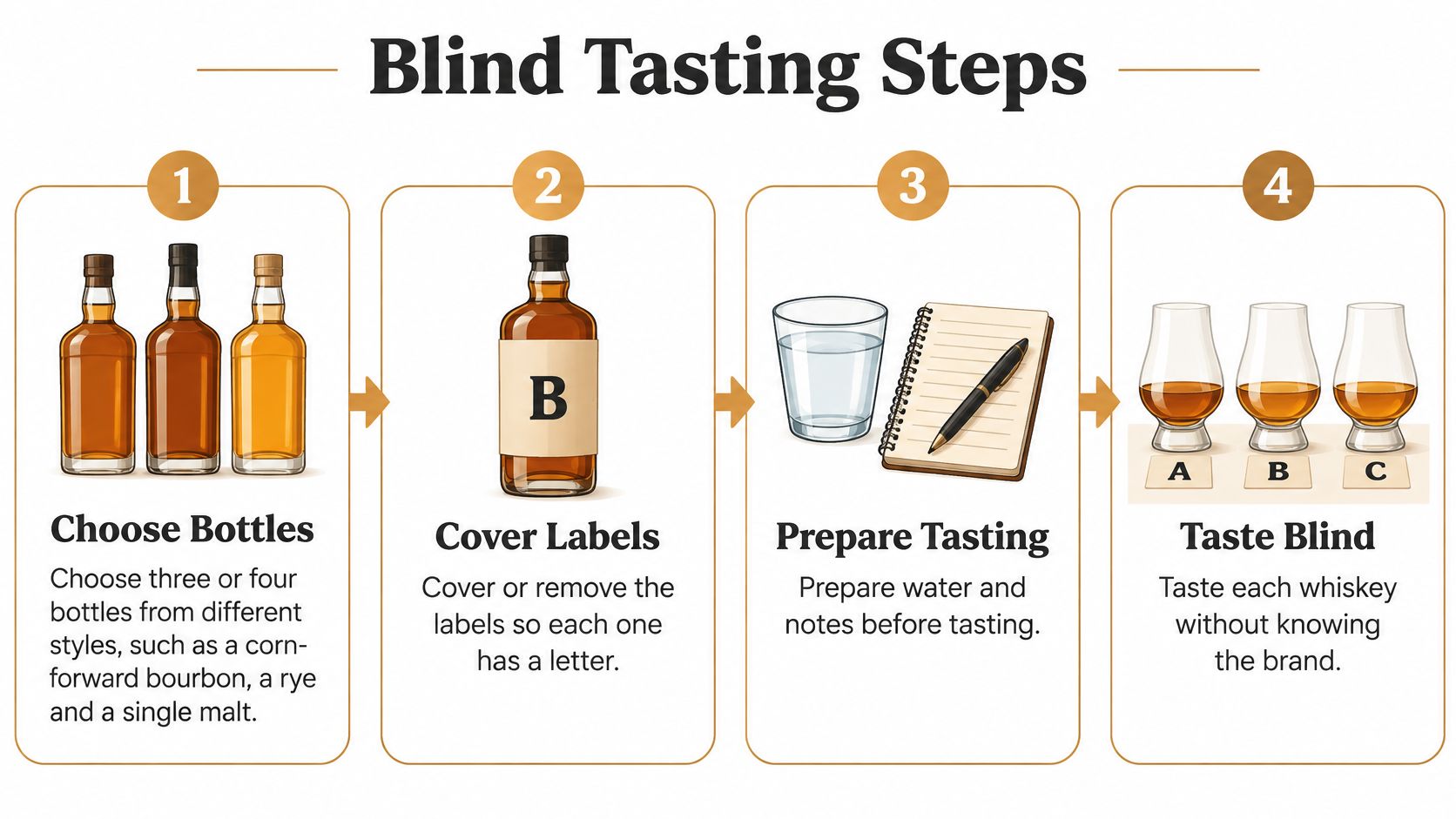
- Choose three or four different styles: pick a corn-forward bourbon, a rye, and a single malt from your shortlist. Cover or remove the labels and mark each bottle with a letter, so nobody can anchor on a name.
- Build a blank card for each sample: leave fields for whiskey type, mash-bill emphasis, barrel char, stated age, proof, and finishing treatment, plus scores for aroma, palate, and finish. The card forces you to look for causes, not just impressions.
- Pour a measured one ounce of each: smell each glass first without tasting, because aroma is easier to judge before alcohol hits your palate. Then taste neat and write down aroma, palate weight, and finish for each letter.
- Add a few drops of water and taste again: water changes how a whiskey presents, especially at higher proof. Note whether the aroma opens, the alcohol sensation softens, or the finish becomes easier to identify.
- Guess age and proof before the reveal: proof is a concentration measure, not a quality rank. U.S. labeling rules in 27 CFR Part 5 define proof as twice the alcohol-by-volume percentage at 60°F, so 80 proof is 40% ABV, 100 proof is 50% ABV, and 120 proof is 60% ABV.
- Reveal, compare, and rank by preference: check your guesses against the labels, then rank the samples by what you enjoyed, not by price or reputation.
If you want a ready-made format, this overview of how a blind whiskey tasting works lays out the same basic structure.
Mistakes That Ruin the Test
Tasting too quickly is the big one. Your palate needs a pause and plain water between samples. Skipping the water step is the second, because you'll misread a high-proof whiskey as harsh when it only needed dilution. Judging only by the finish is the third. A long finish on a whiskey you didn't enjoy isn't a win.
A useful result: you can name one concrete difference between two samples and explain it with a field on your card, such as rye content or proof.
Matching Craft Whiskey to Your Situation
The right craft bottle depends on what you plan to do with it. Proof and style help narrow the choice, while transparent production details offer a stronger trust signal than small-batch or local storytelling. Use the table as a starting point, then judge the glass rather than the reputation.
| Situation | Bottle profile to choose | Why it fits |
|---|---|---|
| First craft bourbon | Straight bourbon around 90 to 100 proof | Familiar sweetness with moderate heat |
| Cocktail | Bottle at or above 100 proof | Flavor holds up when mixed |
| Rye lover | High-rye craft bottle | Spice that cuts through sweetness |
| Shared tasting for two | Blind set of three or four bottles | Both tasters start with equal information |
| Collector | Limited release with full barrel details | Production details give you more to evaluate than scarcity alone |
Using the Table Well
For a first craft bourbon, stay near 90 to 100 proof. That range can leave room to notice corn sweetness and oak without alcohol heat crowding out the other flavors. For cocktails, a bottle at or above 100 proof can retain more of its grain and barrel character after citrus, sugar, and ice are added. If you enjoy rye, a high-rye bottle offers more spice and dryness.
A shared tasting for two works well blind: neither person sees the label first, so both can focus on what they taste. It's a good cold-weather plan at home, before a cabin trip where a small flight beats one expensive bottle. For a little atmosphere, browse winter lodge looks from California Cowboy.
Collectors can look beyond a limited-release label to the production details. Information such as char, entry proof, and maturation site gives you something concrete to consider; scarcity alone tells you little about the whiskey in the glass.
The First-Bottle Mistake
A high-proof, heavily finished bottle can make a difficult first introduction. Strong alcohol heat and assertive finishing flavors may obscure the grain character, making it harder to tell what you enjoy. Start with a profile suited to the occasion, and let blind tasting, not reputation, guide your judgment.
Confirm Your Palate Before Buying Full Bottles
A blind tasting gives you a preference. Before buying a full bottle, check whether its production details fit what you liked.
- Start with your highest-rated sample. Review its card and compare the style, mash-bill emphasis, char, and proof with the traits you enjoyed.
- Check the label. Confirm the bourbon designation, any age statement, and whether it is bottled-in-bond.
- Check its provenance. Look into the distillery, grain source, maturation site, blending, and any sourced whiskey.
- Compare your notes with the reveal. If the production details align with the profile you keep choosing, your preference has a clearer basis for a full-bottle purchase.
If you'd rather not buy several bottles to run this test, Blind Barrels offers a blind-tasting experience of rare craft whiskey in every box, featuring whiskey from hard-to-find distilleries. Every quarter, members get a new distillery and can order member-discounted full bottles of the whiskey they discovered. The same four checks work with bottles bought elsewhere. For ideas on matching rich flavors, you can explore Amsterdam's food and drink pairings. Run one blind tasting, then choose a full bottle based on what you liked.
Blind Barrels sends four blind samples each quarter from small American craft distilleries. Each kit includes a tasting table for aroma, tasting, and finish notes, plus a QR code to reveal the samples and access discounted full bottles. It lets you judge craft whiskey brands by taste rather than reputation. Visit Blind Barrels to start a blind tasting.