

It all boils down to one simple thing: geography. The fundamental difference between whiskey and whisky is where it’s made. If the spirit comes from the United States or Ireland, it’s spelled whiskey. If it’s from Scotland, Canada, or Japan, you’ll see it spelled whisky. This isn't just a quirk of grammar; it's a deeply rooted marker of national identity and centuries of distinct tradition.
Whiskey or Whisky More Than Just a Vowel
That extra "e" might seem small, but it carries some serious historical weight. The divide really opened up in the 19th century when Irish distillers, whose spirit was considered the gold standard at the time, wanted to set their product apart from their Scottish competition. Adding the "e" was a brilliant marketing move to signal a premium, unique spirit.
As many Irish immigrants made their way to America, they brought their distilling traditions—and their spelling—with them. American distillers adopted the "whiskey" spelling, cementing a separation that still exists today. That one little vowel became a signpost for a bottle’s origin and the style of spirit you'll find inside.
Spelling Conventions at a Glance
For anyone new to the world of whiskey, this simple rule is your first step to navigating the spirits aisle like a pro. It gives you an immediate clue about where the bottle came from and what kind of flavors you might expect.
Here’s a quick reference to keep in your back pocket.
| Spelling | Primary Countries | Common Styles |
|---|---|---|
| Whiskey | United States, Ireland | Bourbon, Rye, Tennessee, Irish Pot Still |
| Whisky | Scotland, Canada, Japan | Single Malt Scotch, Blended Scotch, Canadian Rye |
This geographical split is tied to fierce national pride and production scale. Scotland, the world’s largest producer, fiercely defends the whisky spelling. With over 130 distilleries pumping out more than 700 million litres a year, they dominate the global scene.
In contrast, the USA produces around 55 million cases of whiskey annually, focusing on its own iconic styles like bourbon and rye that lean heavily on corn and rye grains. For a deeper dive into these production differences, Whisky Invest Direct offers some great insights.
Now that we’ve got the foundational difference down, we can move past the label. It's time to explore how location, ingredients, and tradition come together to create the wonderfully diverse flavors that make each style so unique.
Sure, the spelling difference between "whiskey" and "whisky" is a neat party trick, but the real story is in the liquid itself. The nuances that make a Scotch taste nothing like a Bourbon are baked into legally protected production methods, unique to each region.
These aren't just arbitrary rules; they're the architectural blueprints that dictate the final flavor, color, and character of what ends up in your glass. Understanding them is the first step to truly appreciating the global family of whisk(e)y.
Take Scotch whisky. To earn that name, it has to be made in Scotland from malted barley (though other grains can be included), aged in oak casks for at least three years, and distilled below 94.8% ABV. The common practice of double distillation in those classic copper pot stills is what helps create the rich, complex spirit Scotland is famous for.
Fly over to Ireland, and you'll find Irish whiskey. It also requires a minimum of three years in wooden casks and must be produced on the Emerald Isle. The game-changer here is often the triple-distillation process. That third run through the still strips out heavier compounds, resulting in an exceptionally smooth and lighter-bodied spirit—a big reason why Irish whiskey is so approachable and a fantastic starting point for newcomers.
American Whiskey Regulations
Across the Atlantic, American whiskey proudly carves out its own identity with a whole different rulebook. The undisputed king is Bourbon whiskey, which is legally protected as a “distinctive product of the United States.”
To wear the Bourbon crown, a whiskey must hit several key benchmarks:
- Mash Bill: The grain recipe has to be at least 51% corn. This is non-negotiable and it's where Bourbon gets its signature sweetness.
- Aging: It has to be matured in new, charred oak containers. No used barrels allowed. Scotch and Irish producers often reuse barrels, but for Bourbon, it’s one and done.
- Proof Levels: The spirit can't be distilled higher than 160 proof (80% ABV) and must go into the barrel at no more than 125 proof (62.5% ABV).
That mandate for new, charred oak is arguably the single most important factor in Bourbon's flavor. It’s what infuses the spirit with those deep notes of vanilla, caramel, and toasted spice that are the hallmarks of the style.
Of course, the American story doesn't stop with Bourbon. Craft distilleries all over the country are honoring these traditions while pushing the creative envelope. Brands like Balcones in Texas and Westland Distillery in Washington are perfect examples, showing how regional grains and unique climates can add incredible new dimensions to familiar styles. They play by the rules but experiment with everything from unique grain combinations to innovative aging techniques, showcasing the incredible diversity living under the "whiskey" spelling.
This is exactly why a blind tasting is so powerful. It strips away the label and forces you to focus on what’s actually in the glass, training your palate to recognize the results of these fascinatingly different production styles. It's the purest way to learn the language of whiskey.
How Ingredients and Distillation Shape Flavor
While geography and legal definitions draw the battle lines, the real soul of any whisk(e)y comes from two places: the grains in its recipe (the mash bill) and the distillation method used to concentrate the spirit.
It's here, in the interplay between grain and copper, that the vast spectrum of flavor is born. This is what separates a sweet, mellow American Bourbon from a spicy Rye or a biscuity Single Malt Scotch. It’s where art and science collide to define what ends up in your glass.
The Foundation: Grains and the Mash Bill
Think of the mash bill as the spirit's DNA. It's the absolute foundation of flavor. For American Bourbon, a mash bill of at least 51% corn is the law, and it's the primary reason for Bourbon's signature sweetness. That high corn content delivers those classic notes of vanilla, caramel, and a buttery richness that makes it so approachable.
Scotch single malts, on the other hand, are built from a different blueprint: 100% malted barley. This grain provides a completely different profile, full of nutty, biscuity, and often fruity notes. Then you have American Rye whiskey, which flips the script again. Requiring at least 51% rye grain, it delivers a punch of peppery spice, distinct herbal notes, and a characteristically drier finish.
The high corn content in a bourbon mash bill is the primary source of its signature sweetness and vanilla notes.
Shaping the Spirit: The Role of the Still
Once the grains have done their part, the still takes over. Distillation is all about purifying and shaping that raw spirit, and the type of still used has a massive impact on the final whiskey's body and complexity.
In Scotland, the iconic copper pot stills are practically sacred. Most Scotch is double-distilled, a process that intentionally leaves in more of the original grain character and heavier flavor compounds. The result is a richer, more robust, and often oily spirit. It’s a method designed to preserve depth and character.
Just across the water in Ireland, triple distillation is far more common. That extra trip through the still strips out more of the heavier oils and impurities, creating an exceptionally smooth, clean, and lighter-bodied whiskey. It’s no wonder Irish whiskey is so often described as delicate and soft on the palate.
American distilleries, true to form, use a mix of everything. The workhorse of the industry is the column still, which operates continuously to produce a purer, higher-proof spirit with incredible efficiency. This is the go-to for most large-scale Bourbon and Tennessee whiskey production. If you want to dive deeper into how these different pieces of equipment function, you can explore the art of whiskey distillation and see exactly how each still shapes the final taste.
But many American craft distillers are taking a hybrid approach. It's not uncommon for a distillery to use a column still for the first run to get a clean base, then switch to a pot still for the final run to add back that body and complexity they’re looking for. This lets them blend industrial efficiency with artisanal character, giving them pinpoint control over the flavor. It’s this kind of experimentation that makes the American craft scene so thrilling and continues to widen the incredible difference between whiskey and whisky styles.
Mapping the Flavor Profiles of Major Styles
Knowing the rules is one thing, but tasting the results is where the real magic happens. The difference between whiskey and whisky truly comes alive in the glass, where the unique combination of grains, distillation methods, and aging casks creates something special.
Each major style takes you on a different sensory journey. For newcomers, learning to spot these core characteristics is the best way to figure out what you like and start exploring the vast world of whisk(e)y with a bit of confidence.
American Whiskey Sweetness and Spice
American whiskey, particularly Bourbon, is often one of the most welcoming styles for anyone starting out. The legal requirement of at least 51% corn in the mash bill, plus aging in brand-new charred oak barrels, sets the stage for a consistently sweet and full-bodied profile.
You can almost always count on finding a few key notes:
- Caramel and Vanilla: These are the signatures of Bourbon, pulled directly from the caramelized sugars in the charred oak.
- Toasted Oak and Baking Spices: Flavors like cinnamon and nutmeg create a warm, comforting foundation that balances the sweetness.
On the flip side, Rye whiskey brings the spice. With rye as the dominant grain, the profile shifts from sweet to peppery, often with herbal or faint fruity notes underneath. It's a bolder, drier experience that really shines in classic cocktails. To get a better handle on all these nuances, you can explore a detailed bourbon flavor wheel and see how different notes connect.
Scotch and Irish Whisky Traditions
Once you cross the Atlantic, the flavors take a sharp turn. Irish whiskey is often triple-distilled, a process that gives it an incredibly smooth and light character. The profile is usually clean, crisp, and fruit-forward, with hints of green apple, honey, and floral notes that make it exceptionally easy to sip.
Scotch whisky is probably the most diverse category on the planet. One of the biggest factors here is the use of peat—that smoky, earthy flavor comes from burning decomposed vegetation to dry the malted barley.
Islay Scotches are legendary for their intense peat smoke, which can taste anything from medicinal to briny. But plenty of Scotches, especially from regions like Speyside, have no smoke at all. They focus instead on elegant notes of orchard fruit, vanilla, and rich malt.
The primary grain in the mash bill is the starting point for all these flavors. This graphic does a great job of showing how the three most common grains—corn, barley, and rye—bring their own signature character to the table.
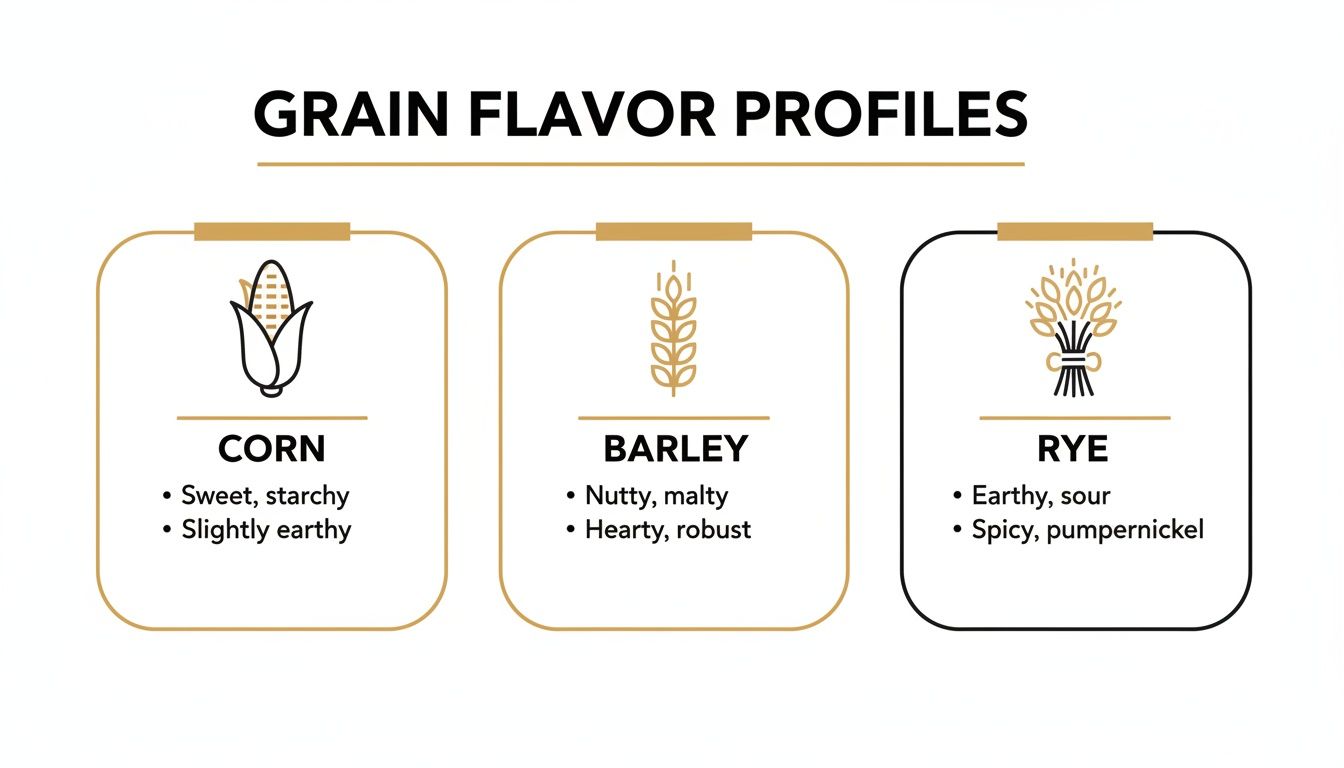
You can see how corn lays down a sweet foundation, barley offers those malty, biscuity notes, and rye delivers that unmistakable spicy kick. From there, the distillation and aging processes unique to each region take over, shaping these base flavors into the finished spirit.
To make things a bit clearer, here's a quick breakdown of what you can generally expect from each major style.
Typical Flavor Profiles by Style
| Style | Country | Key Ingredients | Common Tasting Notes |
|---|---|---|---|
| Bourbon | USA | At least 51% corn | Caramel, vanilla, oak, baking spice, cherry |
| Rye | USA | At least 51% rye | Black pepper, mint, dill, cinnamon, dried fruit |
| Scotch (Unpeated) | Scotland | 100% malted barley | Honey, apple, pear, floral, nutty, malt |
| Scotch (Peated) | Scotland | 100% malted barley (peated) | Campfire smoke, brine, iodine, leather, dark fruit |
| Irish Whiskey | Ireland | Malted & unmalted barley | Green apple, honey, floral, light citrus, biscuit |
| Canadian Whisky | Canada | Often rye, corn, barley | Light, smooth, vanilla, caramel, subtle spice |
| Japanese Whisky | Japan | Often 100% malted barley | Balanced, floral, honey, sandalwood, light smoke |
Keep in mind, these are just the classic profiles. Distillers love to experiment, so you'll find plenty of exceptions, but this table gives you a solid starting point for what to look for when you're exploring the shelf.
How to Read a Label and Choose Your Bottle
Standing in the whiskey aisle can feel like staring down a wall of secrets. All those terms, styles, and unfamiliar names can be intimidating, but the label on every bottle is actually a roadmap. It tells you exactly what’s inside, you just need to learn the language. A few key phrases are all it takes to go from confused to confident, and start zeroing in on what you truly love.
First things first, identify the core style. You'll see terms like Single Malt, Blended, Straight Bourbon, and Rye. These aren't just clever marketing; they're legal classifications that guarantee a specific production process. A "Single Malt" Scotch, for example, has to come from one distillery and be made from 100% malted barley. A "Blended" Scotch, on the other hand, is a combination of whiskies from multiple distilleries, crafted for a consistent and often smoother profile.
Decoding American Whiskey Labels
Here in the States, labels get even more specific, which is great for the consumer. "Straight Bourbon Whiskey" tells you it was aged at least two years in new, charred oak barrels, with no funny business like added colorings or flavorings. If it’s been aged less than four years, the label has to say so. It’s a level of transparency that defines American whiskey.
The American craft scene is especially good at putting its story right on the bottle. A brand like FEW Spirits out of Illinois might highlight the local grain they use, while a distillery like Stranahan’s in Colorado proudly calls its product an "American Single Malt," a clear signal that they’re breaking from the traditional Bourbon mold to do something new.
Cask Strength (or Barrel Proof) is another term you’ll spot, usually on more premium bottles. It simply means the whiskey is bottled at the same alcohol level it was at when it came out of the barrel, with no water added to dilute it. This gives you a much more intense, pure expression of the spirit.
If you’re just getting started, the best way forward is to try accessible, classic examples of each major style. This helps you build a foundational palate and really understand the core differences between the major whiskey and whisky flavor profiles.
- Start with a classic Bourbon: Grab a bottle of "Kentucky Straight Bourbon." This is your chance to experience the sweet vanilla and caramel notes that come from its high-corn mash bill and aging in brand-new oak barrels.
- Try an approachable Irish Whiskey: The characteristic smoothness from its triple distillation makes it a fantastic and easy entry point.
- Explore an unpeated Scotch: A Speyside Single Malt will introduce you to the fruity, malty side of Scottish whisky without any of the intense smoke that can be a bit much for newcomers.
Of course, beyond the technical details of distillation and aging, how we perceive a whiskey is heavily shaped by how it's presented and sold. For a deeper dive into how bottles are positioned on the shelf and how that sways our choices, you can find some fascinating insights by exploring wine and spirits marketing strategies. It adds a whole other layer to how you select a bottle.
This educated approach is more important than ever when you look at how the market is growing. The overall whiskey/whisky market, which hit USD 84.06 billion, is on track to reach USD 114.26 billion by 2030. But the real story is in the details—different styles are exploding at different rates. Irish whiskey, for instance, saw its popularity skyrocket by 123% in just five years, making it the fastest-growing major style on the planet.
Discovering Your Palate With Blind Tasting

After digging through all the rules, regions, and grains, the single best way to really get the difference between whiskey and whisky is to just taste them. The catch? Our brains are easily tricked. We're all swayed by a cool label, a steep price tag, or the legendary reputation of a distillery.
That’s where blind tasting comes in. It’s the ultimate equalizer.
When you strip away all those preconceived notions, your palate becomes the only judge. It's hands-down the most honest way to figure out what you genuinely enjoy, completely free from brand bias. And this isn't some stuffy activity just for experts; it's an incredibly fun tool for any newcomer looking to build confidence and map out their own preferences.
Putting together a tasting at home is simple, and it can reveal a ton about your own taste. You can learn how to set one up properly with a blind whiskey tasting kit that makes the whole experience seamless.
How to Host a Simple Blind Tasting
You really don't need much to get started. Just grab a few different bottles—maybe a great American craft whiskey like Laws Whiskey House Four Grain Bourbon, a classic unpeated Scotch, and a smooth Irish whiskey.
- Prep the Pours: Have a friend pour about one ounce of each spirit into identical glasses. They can label the bottom of each glass to keep track, but make sure the labels are hidden from the tasters.
- Nose Around: Before you even take a sip, check out the color of each one. Give the glass a gentle swirl and take in the aromas. Does one smell sweet like caramel? Does another hit you with notes of fruit or spice?
- Taste and Think: Take a small sip. Let it sit on your tongue for a moment before swallowing. Really focus on the flavors you’re picking up and how it finishes—is it long and warming, or short and clean?
A blind tasting isn't about getting the "right" answer. It's about paying attention to what you're actually experiencing and discovering which profiles you naturally lean toward, without any outside noise.
This simple exercise is a complete game-changer. You might be shocked to find that your favorite of the bunch is an affordable American craft bottle you’ve never even heard of. It’s the purest way to let your taste buds take the lead on your whiskey journey.
Answering a Few Common Questions
If you’re just getting into this world, you’ve probably wondered how much that one little letter—the 'e' in whiskey—really matters. Let's tackle some of the questions we hear all the time.
Does the Spelling Actually Change the Taste?
Nope, not one bit. The spelling—whiskey vs. whisky—has zero effect on what you taste in the glass. It’s simply a historical signpost pointing to where the spirit was made.
The real flavor drivers are the legally mandated production rules for each region. Things like the grain used (corn, barley, rye, wheat), the specific distillation process, and of course, the type of barrels used for aging are what create the incredible diversity of flavors we all love.
Is One Style Better for Making Cocktails?
This is where things get fun. Certain styles are practically made for specific cocktails. American whiskeys, like a bold Bourbon or a spicy Rye, are the backbone of classics like the Old Fashioned and the Whiskey Sour for a reason—they stand up beautifully to mixers.
On the other hand, the famously smooth, often lighter character of many Irish whiskeys makes them a perfect match for an Irish Coffee. And while many of us prefer our Scotch neat, a good blended Scotch is absolutely killer in a Penicillin or Rob Roy.
If you're looking for a starting point, you can't go wrong with an approachable Irish whiskey or a wheated American Bourbon. Irish whiskeys are known for their easy-sipping smoothness. Wheated Bourbons, like those from craft distillers such as Wyoming Whiskey, offer a softer, sweeter introduction than their rye-heavy cousins. The best way to learn is to try both and see what you like!
Ready to figure out your own preferences without being swayed by a fancy label? The Blind Barrels tasting kit sends you curated samples from some of America's best craft distilleries, letting your own palate be the judge. Start your blind tasting journey today!