

Walk down any whiskey aisle, and you'll see a lot of numbers on the labels. But two of the most important are ABV and proof. At its core, nearly every whiskey you'll find starts at a legal minimum of 40% Alcohol by Volume (ABV), which is the same as saying it's 80 proof.
Think of them as two sides of the same coin, both measuring the spirit's strength. Getting a handle on these numbers is the first step to really understanding what's in your glass and finding the whiskeys you'll love. For new whiskey drinkers, this is the most important skill to learn.
Your Guide to Whiskey Alcohol Content
The alcohol content is your roadmap to a whiskey's character. It’s what separates the smooth, easy-going nature of a standard bourbon from the fiery, intense kick of a barrel-proof rye from an American craft distillery. The amount of alcohol fundamentally shapes the entire tasting experience.
That 40% benchmark isn't just a random number. It's the legal minimum in most major whiskey-producing countries, including the US, Scotland, and Ireland. These regulations exist to guarantee a certain level of quality and ensure the whiskey has the robust character we all expect.
So, what does this mean for you, the whiskey drinker?
- A Solid Starting Point: When you see "whiskey" on a label, you know it has at least this much punch, giving you a consistent baseline. If you're new, starting with a bottle in the 40-45% ABV range is a great way to ease into the spirit.
- The Flavor Engine: Alcohol is the vehicle that carries all those complex flavors and aromas—caramel, oak, spice, and smoke—from the barrel to your nose and palate.
- Smarter Choices: Knowing the typical alcohol ranges helps you zero in on a bottle that fits your mood, whether you’re after something mellow and approachable or big and bold.
This guide will break down the numbers and pull back the curtain, giving you the confidence to navigate the world of whiskey like a pro.
Decoding the Language of Proof and ABV
When you pick up a bottle of whiskey, the numbers on the label are telling you a crucial story. Two of the most important figures you'll see are Alcohol by Volume (ABV) and Proof. Getting a handle on these terms is the first step to really understanding what's in your glass.
ABV is the most straightforward measurement of the bunch. It’s simply the percentage of pure alcohol in the total liquid. So, if a bottle reads 40% ABV, it means that 40% of what's inside is pure alcohol, while the other 60% is water and all the flavorful compounds picked up during distillation and aging.
Proof: The American Standard
Here in the United States, you’ll almost always see a "proof" number right alongside the ABV. Thankfully, the math is simple: proof is always exactly double the ABV. That same 40% ABV bottle will be labeled as 80 proof. It's a bit like Celsius and Fahrenheit—just two different scales measuring the exact same thing.
A simple way to remember the conversion:
- ABV x 2 = Proof
- Proof / 2 = ABV
For anyone new to whiskey, getting this relationship down is foundational. If you're curious about the old-school origins of this system (it involves gunpowder!), you can take a deeper dive into what proof means in whiskey and why we use it.
Grab a bottle from an innovative American craft distillery, like Balcones out of Texas, and you'll see both the ABV and proof stated clearly. This gives you an instant picture of its strength and intensity. Knowing this empowers you to explore with confidence, whether you're in the mood for a smooth 80-proof sipper or something with a bit more of a kick.
Exploring Alcohol Levels in Different Whiskey Styles
While the legal floor for most whiskeys is set at 40% ABV (80 proof), the actual alcohol content you'll find on the shelf varies wildly from one bottle to the next. How much alcohol is in a whiskey really depends on its style, where it comes from, and what the distiller was aiming for in the final product. Each category has its own unique character, and proof is a huge part of that identity.
For example, many mainstream Bourbons, Ryes, and Irish Whiskeys are bottled right at that 40% to 43% ABV (80-86 proof) mark. This makes them incredibly approachable and perfect for newcomers, offering a smooth sipping experience without overwhelming the palate.
American Craft and Cask Strength Expressions
Dig a little deeper, though, and you’ll find that many of today’s American craft distilleries are pushing those boundaries. It’s becoming common to see their flagship bourbons and ryes bottled between 45% and 55% ABV (90-110 proof). This isn’t just for show; a higher proof often means more of the concentrated, robust flavors from the barrel are preserved in the bottle. A great example is the Westward American Single Malt, often bottled around 90 proof.
This infographic helps visualize that simple relationship between ABV and its corresponding proof.
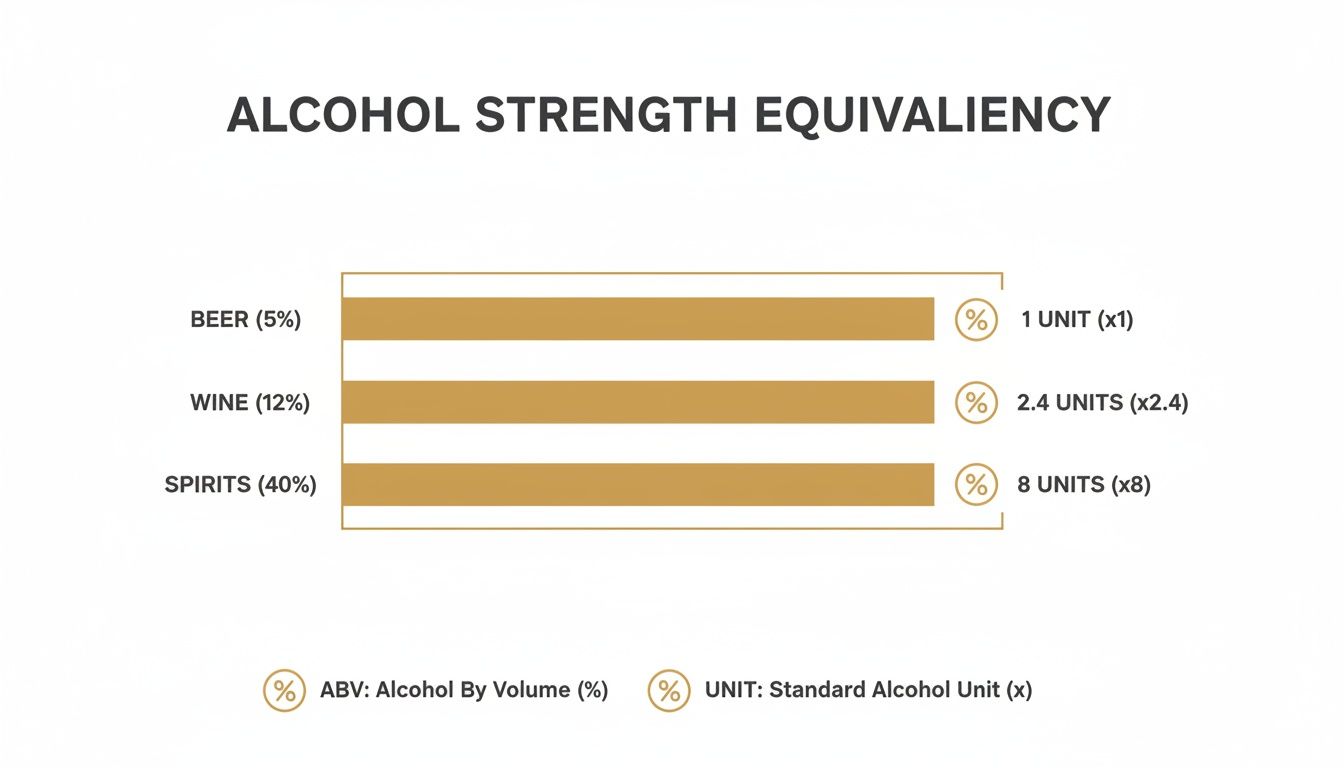
As the chart shows, in the U.S., proof is just a direct doubling of the ABV—a straightforward conversion to remember when you're reading labels.
At the very top of the intensity scale, you'll find cask strength or barrel proof whiskeys. These are the boldest of the bold, bottled straight from the barrel without any water added to dilute them.
Cask strength expressions are whiskey in its purest form. The proof can soar anywhere from 55% to over 65% ABV (110-130+ proof), delivering an intense, undiluted, and incredibly complex tasting experience that enthusiasts cherish.
This potent style is where you often find the most unique and powerful flavor profiles. To get a better sense of these powerhouse spirits, you can learn more about what defines cask strength whiskey and why it's so celebrated.
Global Standards and Scotch Whisky
This global appreciation for whiskey has led to massive international demand. Scotch whiskeys, which are typically bottled at a standard 40% ABV, saw exports reach a staggering 1.35 billion bottles in 2023. This volume, shipped to over 160 markets, underscores whiskey's role as a worldwide spirits leader. For a deeper look into these figures, you can explore more fascinating Scotch whisky statistics on Casktrade.com.
Understanding these different styles and strengths is your key to unlocking a world of flavor and finding the perfect pour for any occasion.
How Alcohol Content Shapes Your Tasting Experience
So, why should you care about ABV beyond its raw power? Because the amount of alcohol in a whiskey fundamentally shapes its flavor, aroma, and even how it feels in your mouth. Think of alcohol as the delivery truck for all those delicate flavor compounds, carrying them from the glass to your nose and palate.
It's a lot like listening to music. A standard 80-proof whiskey is like a beautiful acoustic melody—clear, crisp, and easy to enjoy. But a high-proof, cask-strength whiskey? That’s a full orchestra playing at full blast—powerful, layered, and incredibly intense. Both are fantastic, but they offer completely different experiences.
This dynamic helps explain why whiskey has become a heavyweight champion in bars. In recent on-premise sales across the US, whiskey actually overtook vodka in popularity, with American, Canadian, and Irish styles grabbing a massive 94% share of the market. Their typical 40-50% ABV is the sweet spot for crafting cocktails that are balanced and full of character. You can read more about the global impact of whiskey on Straits Research.
Tips for New Whiskey Drinkers
If you’re just getting into whiskey, a high-proof bottle can seem a little intimidating. The alcoholic “heat” can sometimes steamroll the more subtle flavors hiding underneath. Luckily, there's an easy trick to unlock all that hidden potential.
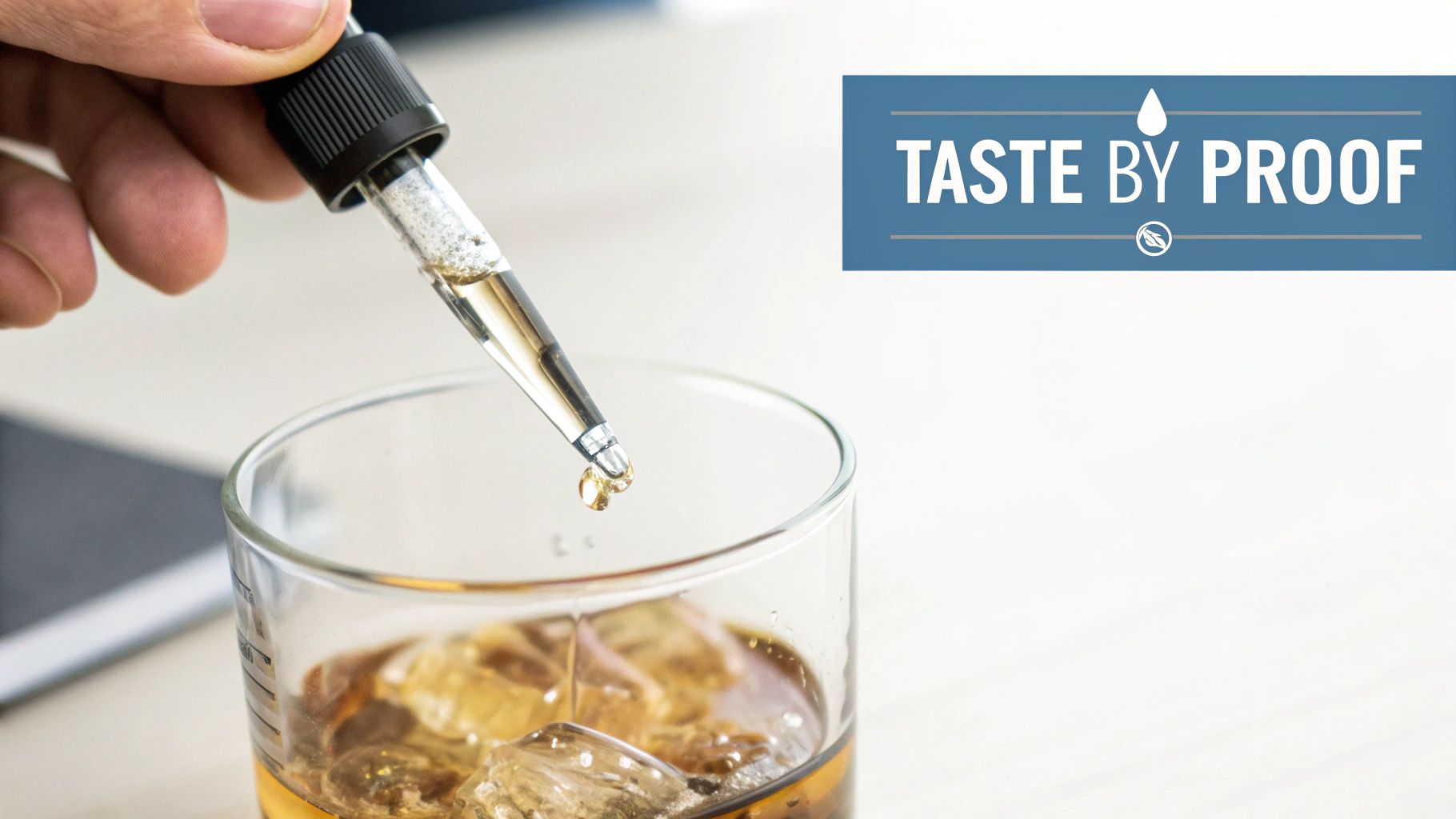
The secret weapon of just about every seasoned whiskey lover is a simple dropper of water. Adding just a few drops to a high-proof spirit can tame the alcoholic burn and gently "open up" the whiskey, revealing nuanced layers of flavor and aroma you would have otherwise missed.
Give this a try: pour a dram and taste it neat to get a baseline. Then, add a single drop of cool water, give the glass a swirl, and taste it again. Repeat the process, one drop at a time, until you hit that perfect balance where the flavors are singing and the heat is just a pleasant warmth. Another tip is to start with whiskey in a simple cocktail, like a Whiskey Highball (whiskey and soda water), to get accustomed to the flavor profile before diving into neat pours.
This small step transforms a simple tasting into a hands-on exploration, letting you customize each pour to exactly what you enjoy.
Discovering Your Ideal Proof with Blind Tastings
So, what's the best way to figure out which proof is your proof? Simple: taste without bias. A fancy label or a legendary distillery name can easily sway your opinion before the whiskey even hits your lips.
Blind tasting cuts through all that noise. It strips away the marketing and the hype, leaving you with nothing but the liquid in the glass. It’s the single best tool for figuring out what you genuinely enjoy. This approach turns learning into a hands-on, interactive challenge—no more guessing what you might like. You get to experience a whole range of spirits firsthand.
Find Your Perfect Pour
A curated tasting is a fantastic way to navigate the world of American craft whiskey. Many of these smaller distilleries, like Stranahan's from Colorado or Westland from Washington, are putting out incredible, higher-proof expressions that you might walk right past on a crowded store shelf. A blind tasting puts them on a level playing field with the big guys.
Blind tasting is about so much more than just sipping whiskey. It’s about sharpening your palate and building a real understanding of what makes a pour perfect for you. You might just discover that a 115-proof rye you've never heard of is your new go-to.
This method takes brand loyalty and price tags completely out of the equation, letting your taste buds be the one and only judge. To make this discovery process even easier, you can explore the benefits of a blind whiskey tasting kit designed to guide you on your journey. It’s a fun, engaging way to build confidence and truly understand your preferences when it comes to a whiskey’s strength.
Answering Your Whiskey Proof Questions
As you dive deeper into the world of whiskey, you'll find a few questions pop up time and time again. Getting these sorted out helps build a solid foundation, giving you the confidence to grab a new bottle off the shelf and know exactly what you’re getting into. Let's tackle a few of the most common queries about whiskey's strength.
One of the first things people ask is whether an open bottle of whiskey loses its proof. The short answer is no, not really. Once it's in the bottle, the alcohol content is locked in. It’s not like wine that will spoil, but if you leave a bottle half-empty for months or years, the air inside can cause a bit of oxidation. This might soften the flavors slightly, but the proof itself isn't going anywhere.
What’s the Big Deal with Cask Strength?
You’ll hear whiskey lovers rave about “cask strength,” and for good reason. It’s the most authentic, undiluted expression of what a distillery can do. Cask strength simply means the whiskey is bottled straight from the barrel, with no water added to bring the proof down. Distillers, especially in the American craft scene, love it because it preserves every ounce of concentrated flavor and texture developed during aging.
For many enthusiasts, cask strength is whiskey in its purest form. It’s a powerful, unfiltered experience that lets you taste the spirit exactly as the master distiller does in the rickhouse.
This raw intensity also puts you in the driver's seat. You can sip it at its full, roaring strength or add a few drops of water to dial back the proof yourself. This little trick can unlock entirely new layers of aroma and flavor, letting you customize each pour. For newcomers, however, it's best to work your way up to cask strength rather than starting with it.
How Does Whiskey Compare to Other Spirits?
When you line them all up, you’ll find that whiskey’s starting proof is right in step with most other major spirits.
- Vodka and Rum: Just like whiskey, these are almost always bottled at a minimum of 40% ABV (80 proof).
- Gin: Gin also typically clocks in at 40% ABV or higher, with many craft and premium expressions pushing that number up.
- Flavored Whiskey: Here's where you need to be careful. Many "whiskey liqueurs" or heavily flavored products don't meet the legal definition of whiskey. For example, Skrewball Peanut Butter Whiskey is bottled at 35% ABV, below the 40% ABV legal minimum for American whiskey. It also contains additives, which technically makes it a liqueur.
So, while a standard bottle of whiskey, vodka, or rum might share the same proof, whiskey's unique barrel-aging process and the rising popularity of high-proof expressions give it a much more dynamic and interesting range.
Ready to discover your perfect proof without bias? The Blind Barrels tasting experience lets your palate be the guide. Explore unique American craft whiskeys and find what you truly love, one blind sample at a time. Start your tasting journey with us today!