

You're probably holding a glass of whiskey, or standing in a store aisle, wondering why one bottle smells like vanilla and caramel while another leans dry, spicy, and woody. The answer usually starts with the barrel.
New drinkers often hear romantic lines about “time in oak,” but that phrase hides the whole story. Oak doesn't just store whiskey. It changes it. It gives raw spirit color, aroma, texture, and structure, and it can push a whiskey toward sweetness, spice, smoke, or dryness depending on how the distiller uses it.
That matters even more if you're exploring American craft whiskey. Craft producers often use barrel choices as one of their clearest style signals, because they can shape a whiskey's personality long before the label starts talking about heritage or warehouse lore.
Why Oak Barrel Aging Shapes Every Sip
Clear spirit off the still can be sharp, grainy, and simple. Once it enters oak, the transformation begins. The barrel becomes an active ingredient.
A long industry history notes that barrels were already the preeminent vessel for spirits by the early 1900s after serving as the dominant container technology for roughly 2,000 years, and that the 1935 Federal Alcohol Administration Act required bourbon to be aged in new oak, a rule that still shapes American whiskey today. The same source says close to 3 million American oak barrels were made in one recent year, compared with fewer than 800,000 in 1986, which shows how barrel production expanded by nearly fourfold as whiskey and wine demand grew (industry history of oak barrels and bourbon regulation).
That history matters because it explains why so many flavor notes people associate with whiskey are really barrel notes. Vanilla, caramel, baking spice, toast, smoke, tannin, drying grip on the finish, even much of the color in the glass. Those don't arrive by accident.
What the barrel actually changes
When whiskey sits in oak, four parts of the drinking experience move together:
- Color develops because the spirit pulls compounds from the wood.
- Aroma expands as oak contributes notes like vanilla, spice, and toast.
- Mouthfeel shifts because tannins and oxidation can make the whiskey feel silkier or firmer.
- Finish lengthens as wood compounds and concentration shape what stays after you swallow.
Practical rule: If you taste vanilla, coconut, clove, smoke, or dry oak in whiskey, ask what the barrel was doing. That question usually gets you closer to the truth than the marketing copy does.
Why newcomers get confused
People often talk about aging as if time alone improves whiskey. Time helps, but time without the right cask, warehouse conditions, and spirit character won't guarantee balance.
Oak barrel whiskey is really a collaboration among the distiller, the cooperage, the warehouse climate, and patience. Species selection matters. Toast and char matter. Barrel size matters. Finishing casks matter. Once you see the barrel as a tool rather than a prop, a lot of whiskey starts making more sense.
Oak Species, Char Levels, and Toast Explained
Distillers have a few major knobs they can turn, and three of the most important are oak species, char level, and toast. If you can separate those in your mind, labels become easier to read and tasting notes become less mysterious.
Oak species changes the flavor direction
American white oak is the wood many drinkers learn first because it sits at the heart of bourbon. It often points whiskey toward vanilla, caramel, coconut-like oak sweetness, and a rounded profile.
European oak often reads drier and spicier. Drinkers commonly find more grip, more clove-like spice, more nutty or dried-fruit structure, and a firmer finish. If American oak feels plush, European oak often feels stricter.
That's why the same distillate can taste very different depending on the cask program.
Char and toast are not the same thing
Think of a slice of bread. Warm it slowly and you get toast. Hit it with too much direct heat and you get blackened edges. Barrels work the same way.
Toast is the gentler heating phase. It coaxes out sweetness and opens up wood compounds without creating a heavy carbon layer.
Char comes from direct flame. It blackens the inside of the barrel and changes the wood surface more aggressively. That can deepen caramelized, smoky, and darker oak notes.
Many drinkers hear char numbers such as #1 through #4. Those numbers refer to how intense the char treatment is. A lighter char keeps things gentler. A heavier char pushes the barrel toward deeper caramelization and more pronounced dark-oak effects.
| Comparing Oak Choices for Whiskey | |||
|---|---|---|---|
| Variable | American White Oak | European Oak | Char vs. Toast Effect |
| Typical impression | Vanilla, caramel, coconut-like sweetness | Drier spice, firmer tannin, nutty depth | Toast leans sweet and woody. Char leans darker, smokier, more caramelized |
| Texture | Often rounder | Often grippier | Toast can feel softer. Char can add edge and structure |
| Best beginner cue | Smell for vanilla and sweet oak | Smell for clove, dry spice, toasted nuts | Ask whether the whiskey tastes baked and sweet, or darker and more charred |
If you want a useful backgrounder on how cooperage decisions shape small-batch spirits, Blind Barrels has a solid piece on the cooperage legacy in crafting small-batch spirits.
A good beginner habit is to stop saying “oaky” as a catch-all. Try replacing it with sweeter, spicier, smokier, or drier. That one change sharpens your palate fast.
The Chemistry Behind Oak Barrel Whiskey
Romance fades quickly when you look inside the cask. That's a good thing. The science is more interesting than the myth.
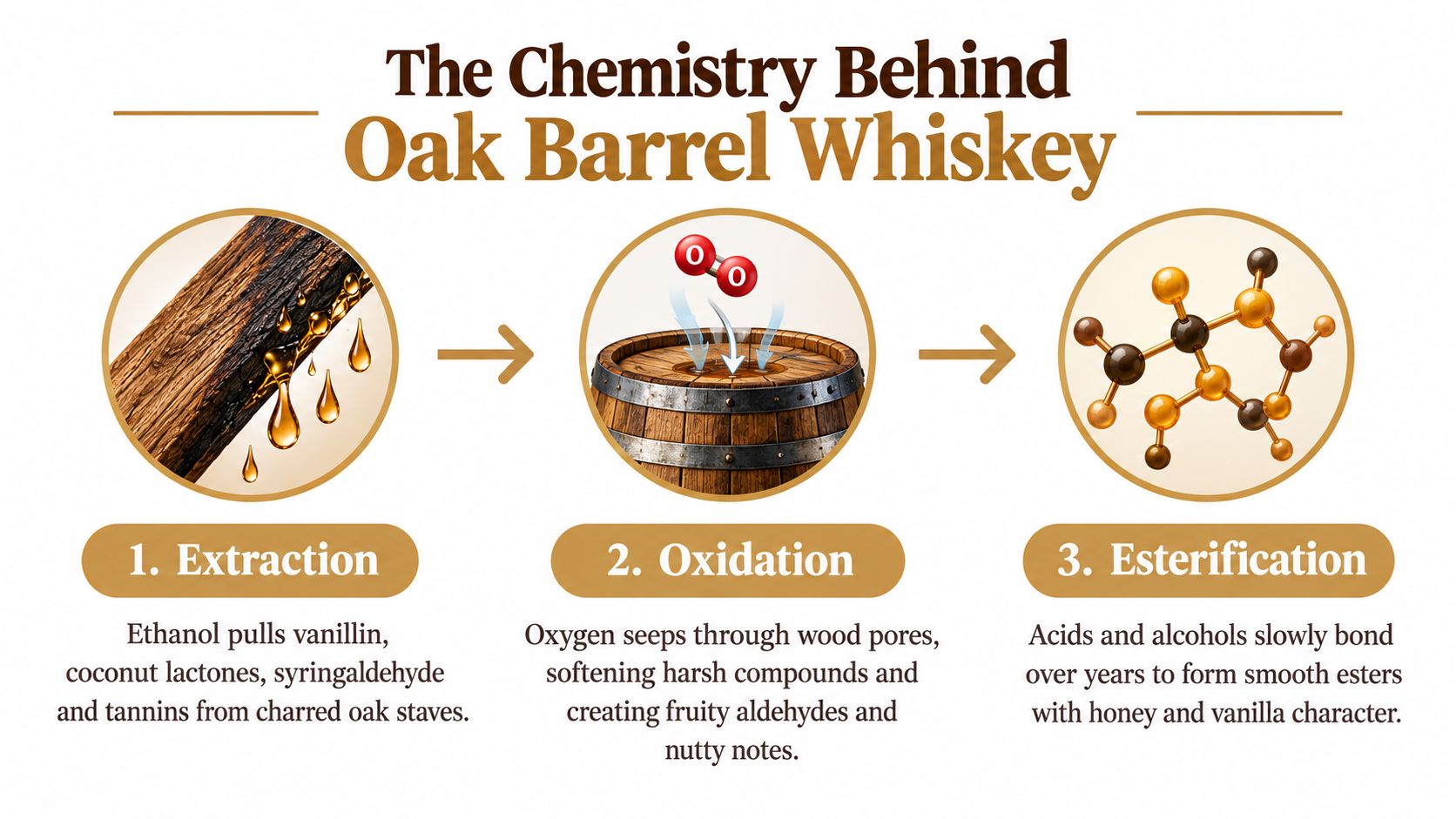
A detailed review of spirit maturation in oak describes three coupled mechanisms behind barrel aging: extraction of wood compounds, reactions between wood compounds and ethanol or distillate, and evaporation of volatile components. It also explains that toasted or charred oak doesn't just add flavor. Heat treatment breaks down lignin, hemicellulose, and cellulose into compounds that reshape the whiskey's chemical profile, while oxidation and esterification help convert harsher spirit notes into a softer, more integrated profile (review of the chemistry of spirits matured in oak barrels).
Extraction gives whiskey its first oak signature
Spirit pulls compounds from the staves. That's where many familiar notes begin. Vanilla-like aromas, smoky hints, spice, wood sugars, and tannic structure all trace back to what the oak releases.
For a new drinker, extraction shows up first as obvious flavor. “I get vanilla.” “I get char.” “This tastes dry.” Those are extraction clues.
Oxidation and esterification smooth the edges
Barrels aren't sealed like stainless steel tanks. Oxygen moves slowly through wood and helps change the spirit during storage. Reactions continue in the cask, and the profile can move from sharp and disjointed toward rounder and more connected.
That's why an aged whiskey often feels more integrated than a fresh spirit. The sweetness, spice, and wood don't just sit beside one another. They start to knit together.
Evaporation changes concentration and balance
Some volatile compounds leave the barrel over time. As that happens, the whiskey's balance shifts. Certain rougher notes can diminish, while the remaining flavors may feel more concentrated.
What to notice in the glass: Extraction often shows up as flavor intensity, oxidation as softness and cohesion, and evaporation as concentration and length.
One more useful point for beginners. Charred oak can act a bit like a selective filter while toast exposes compounds that support sweetness and aromatic complexity. So if a whiskey tastes both rich and polished, the barrel likely did more than one job at once.
Barrel Size, Age, and How Flavor Builds Over Time
A common beginner mistake is assuming age tells you everything. It doesn't. Barrel size can change the pace of maturation, and pace matters almost as much as time.
Research on extraction from barrels used small casks in the 2 to 10 gallon range to show faster transfer of compounds such as guaiacol, eugenol, and vanillin over 200 days, illustrating how higher surface-area-to-volume ratio speeds wood impact. The same body of work notes that aging in charred oak increases color, acids, esters, aldehydes, furfural, solids, and tannins, and one report says as much as a fifth of the whiskey in a barrel can be lost to evaporation depending on aging time (study on barrel extraction kinetics and maturation effects).
Why smaller barrels taste oakier sooner
More wood contact relative to the amount of liquid means the spirit reaches into the cask faster. That can build color and wood-derived flavor quickly. It can also push a whiskey into over-oaked territory if the distiller isn't careful.
Larger casks usually move more slowly. The reward is often subtler integration. The tradeoff is patience.
| Barrel Size vs. Flavor Development | |||
|---|---|---|---|
| Cask Type | Size (gallons) | Relative Oak Intensity | Typical Aging Implication |
| Small experimental cask | 2 to 10 | High | Faster extraction, quicker color and oak pickup, greater over-oaking risk |
| Standard bourbon barrel | Standard size | Moderate | Balanced extraction pace with room for integration |
| Large cask or puncheon-style format | Larger than standard | Lower at first | Slower wood pickup, gentler maturation arc |
A practical guide to this topic appears in Blind Barrels' article on the impact of barrel types and sizes on American craft whiskey.
How to read labels without overvaluing age
A younger whiskey from a more active barrel can taste more wood-driven than an older whiskey from a gentler cask. So when you compare bottles, ask two questions instead of one: how long was it aged, and how active was the barrel likely to be?
Older doesn't always mean bigger flavor. Sometimes it means quieter flavor, better integration, or a drier, calmer finish.
Finishing Techniques and Cask Variations
Primary aging gives a whiskey its foundation. Finishing changes the accent.
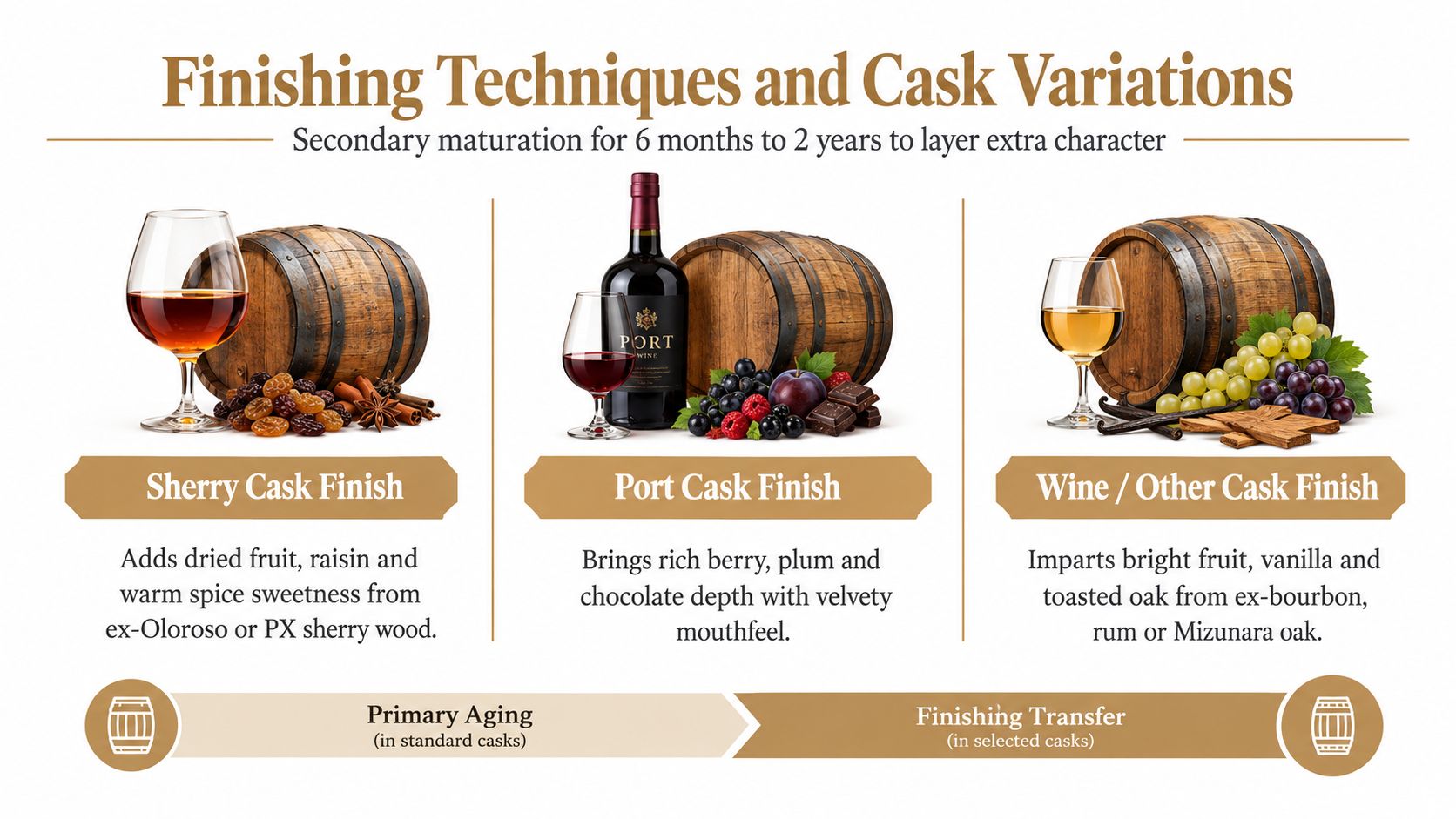
A finishing program usually means the whiskey spends most of its life in one cask, then moves into another barrel type for a shorter secondary maturation. In practice, producers often talk about this final stage as lasting 6 months to 2 years, using the second cask to layer on a distinct set of aromas and textures.
Three cask families worth knowing
Sherry casks often bring dried fruit, raisin, nutty oxidation, and warm spice. If you taste a whiskey and think of figs, walnuts, or dark fruitcake, sherry is a good suspect.
Wine casks vary more. Port can read plush and dark-fruited. Madeira can feel rich and lifted at once. Red wine casks may add berry skin, tannin, or a subtle jam note.
Rum casks often bring molasses, brown sugar, tropical fruit, and a sweeter edge that sits differently from bourbon oak sweetness.
How to separate finish from base spirit
Try a simple comparison. Taste a straight bourbon or unembellished malt first, then taste the finished version. Ask what's new.
- If dried fruit appears, the finish may be doing most of the talking.
- If berry or grape-like tannin shows up, wine casks may be steering the profile.
- If the sweetness turns syrupy or tropical, rum influence is a likely factor.
The barrel market itself is also shaping these choices. A 2025 market analysis says American oak held 67.51% of wine and whiskey barrel market revenue, and it notes that revised U.S. tariffs on imported oak staves and assembled barrels pushed distillers toward domestic sourcing and shorter maturation or blended programs to protect margins (wine and whiskey barrels market analysis).
That matters in 2026 because finishing isn't only a creative decision. It can also reflect what casks are available, affordable, and practical to source. For more on that side of the category, see Blind Barrels' piece on the world of whiskey barrel finishes in American craft whiskey.
American Craft Whiskey and Barrel Creativity
If you want to see barrel choices in motion, American craft whiskey is one of the best places to look. Small producers often use cooperage as a style tool, not just a compliance step.
The American Craft Spirits Association's craft spirits data project reported 2,753 active craft distilleries in the United States, using a definition of fewer than 750,000 proof gallons per year. Those distilleries accounted for nearly 8% of the value of the U.S. spirits market and more than 14 million cases of volume (Whisky Advocate coverage of craft spirits market data).
What barrel creativity looks like in practice
One craft bourbon may use toasted heads with charred staves to lift custard-like vanilla while keeping smoke in the background. Another rye may go into a re-coopered wine cask and come out with a more tannic, jammy edge. A Texas whiskey might lean hard into heavy char and produce cocoa, espresso, and dark-crust notes.
None of that guarantees quality. It does tell you where to look on the palate.
How to spot a house style
Ask yourself three simple questions when you taste craft whiskey:
- Is the distillery chasing sweetness or structure? Some producers want dessert-like bourbon oak. Others want spice and grip.
- Does the wood support the grain or dominate it? Good barrel work can still leave room for corn, rye, or malt to speak.
- Is the finish additive or integrated? Layered doesn't always mean harmonious.
Barrel choice is often a better clue to distillery identity than the back-label story.
Craft distillers also work within real constraints. Cooperage cost, humidity management, barrel reuse, and cask availability all affect what reaches the shelf. So when a bottle tastes unusual, the reason may be creative intent, supply pressure, or both.
Tasting Cues Every New Whiskey Drinker Should Know
If you're new to whiskey, start simple. Don't try to identify twenty notes. Try to identify the barrel's fingerprints.
Begin neat. A beginner guide to whiskey drinking recommends tasting neat before adding water or ice, then observing color, smelling before sipping, and only after that trying small additions of water or a large ice cube to see how the profile changes (beginner guide to drinking whisky).
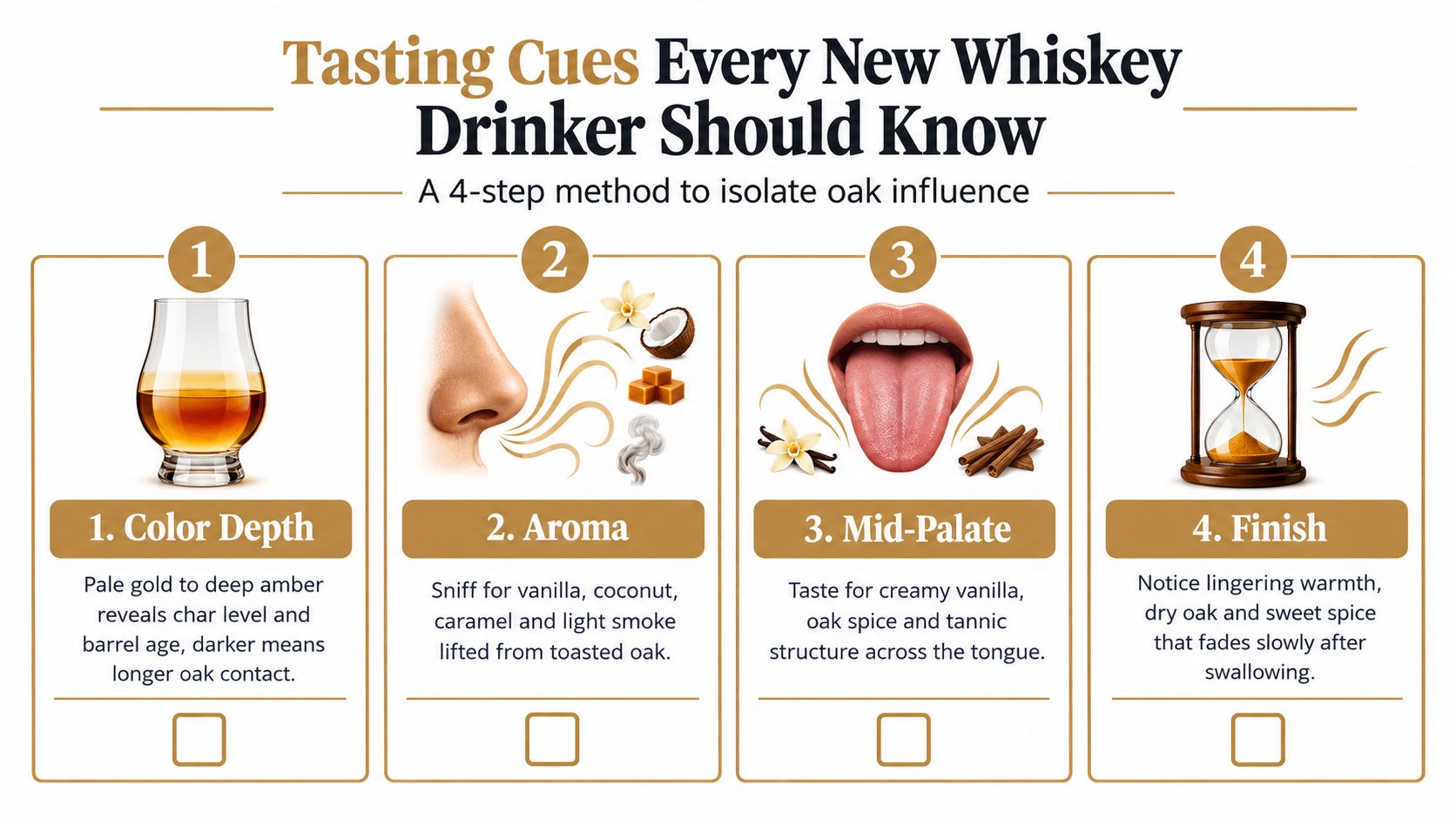
Use four checkpoints
-
Color depth
Pale gold can suggest gentler oak influence. Deeper amber or mahogany can point toward heavier barrel influence or finishing. Color isn't proof of quality, but it's your first clue. -
Aroma
Hold the glass below your nose and take short sniffs. American oak often points toward vanilla, coconut, caramel, and dill-like herbal edges. European oak and finishing casks can lean toward toasted nuts, clove, dried fruit, or wine-like richness. -
Mid-palate
You separate sweetness from wood. Grain sweetness can feel like caramel corn, bread, or cereal. Oak tannin feels drier and more structural, often like tea grip or pencil-shaving dryness. -
Finish
Ask what stays behind. Sweet spice? Dry oak? Smoke? A long drying finish usually tells you the barrel had a strong hand in the final profile.
Common mistakes that blur oak notes
- Nosing too long can numb your senses with alcohol.
- Swirling too aggressively can over-aerate the pour and throw balance off.
- Judging only on sweetness makes it easy to miss spice, tannin, and char.
- Adding ice too early can mute the very aromas you're trying to learn.
Try this short scent checklist: vanilla, coconut, toast, clove, nuts, dried fruit, smoke, dry wood. You won't find all of them in every pour, but the list helps train recall.
If you want a structured way to practice, tasting kits, bar flights, and blind pours all help because they force your attention back to the glass.
Finding Your Own Oak Barrel Whiskey Style
The fastest way to get better at whiskey isn't buying older bottles. It's learning what kind of oak profile you enjoy.
Some drinkers love the sweeter side of American oak. Others prefer the drier spice of European oak or the fruitier lift of a finishing cask. Some want heavy char and dark caramel. Others want gentler toast and a cleaner grain voice. Once you know your lane, shopping gets easier.
Build a simple comparison flight
Pour two to four whiskeys side by side and give each one a role.
- One baseline bottle with straightforward new-oak aging
- One spicier or drier bottle that shows more tannin or European-oak character
- One finished whiskey that clearly carries sherry, wine, or rum influence
- One wildcard craft bottle with a distinct barrel program
Write down only four things for each glass: color, first aroma, mid-palate, and finish. Don't chase perfect language. “Vanilla frosting,” “dry tea tannin,” and “charred orange peel” are all useful notes if they're honest.
Shop with better questions
When you're in a tasting room or talking to a bartender, skip “What's your best bottle?” Ask these instead:
- What kind of oak was used?
- Was it heavily charred, lightly charred, or toasted?
- Was there a finishing cask involved?
- Does the barrel lead the flavor, or does the grain stay front and center?
Those questions tell you far more than a dramatic brand story does.
One practical option for training that skill is Blind Barrels. It sends quarterly blind whiskey samples from small American craft distilleries with a tasting table, aroma and finish prompts, and a reveal that lets you compare your notes against the actual bottles without label bias.
Why this matters in 2026
As barrel sourcing, cask substitutions, and release allocations keep shaping the market, drinkers who understand oak will make better choices than drinkers who only chase age or hype. If a producer changes oak origin, toast level, or finishing strategy to manage supply pressure, your palate can still tell you whether the result works.
That's the payoff. Oak barrel whiskey stops being mysterious once you know what to look for. Then the barrel stops being a romantic backdrop and becomes what it has always been. One of the most powerful flavor tools in whiskey.
If you want to practice these ideas instead of just reading about them, Blind Barrels gives you blind whiskey tastings built around small American craft distilleries, complete with guided note-taking and bottle reveals. It's a practical way to test how oak species, char, and finishing show up in the glass, and to find out what you like before label hype gets in the way.