

A memorable whiskey line can do more than decorate a social post. It can give a tasting invitation a mood, help a wedding toast sound personal, or turn a quiet pour into a moment of reflection. That may explain why whisky editorial pages attract such focused attention. One large whisky publisher reported more than 825,000 page views across its guides, with mean time-on-page exceeding five minutes, and described an audience of 516,000 adults aged 18-54 interested in whisky content. Those audience figures suggest that people don't just collect one-liners. They want language that helps them understand what they're drinking.
This collection groups quotes about whisky by their practical role, including sensory discovery, mindful savoring, social celebration, humor, and craft history. Use each line as a tasting prompt. Notice the aroma, flavor, finish, or the people sharing the glass.
The spelling matters, too. Whisky usually appears in Scottish, Canadian, and Japanese contexts, while whiskey is generally used for American and Irish spirits. Here, American craft whiskey takes its place alongside Scotch tradition, without assuming that a brand, age statement, or price determines what you'll enjoy. For more inspiration about why short sayings work well in everyday spaces, explore this guide to wall sticker quotes from Quote My Wall.
1. Whiskey is liquid sunshine, Mark Twain
“Whiskey is liquid sunshine.”
This familiar line, commonly attributed to Mark Twain, turns a pour into an image of warmth. Golden color, gentle heat, and the lift of a shared drink all sit inside the phrase. It doesn't tell you what the whiskey tastes like, but it encourages an open-minded first encounter.
That makes it useful for a blind tasting. Before you search for oak, caramel, fruit, or spice, look for the feeling the whiskey creates in the glass. Hold it under good light, then bring it toward your nose without forcing an answer. You might find baked grain, orange peel, vanilla, toasted wood, or something entirely different.
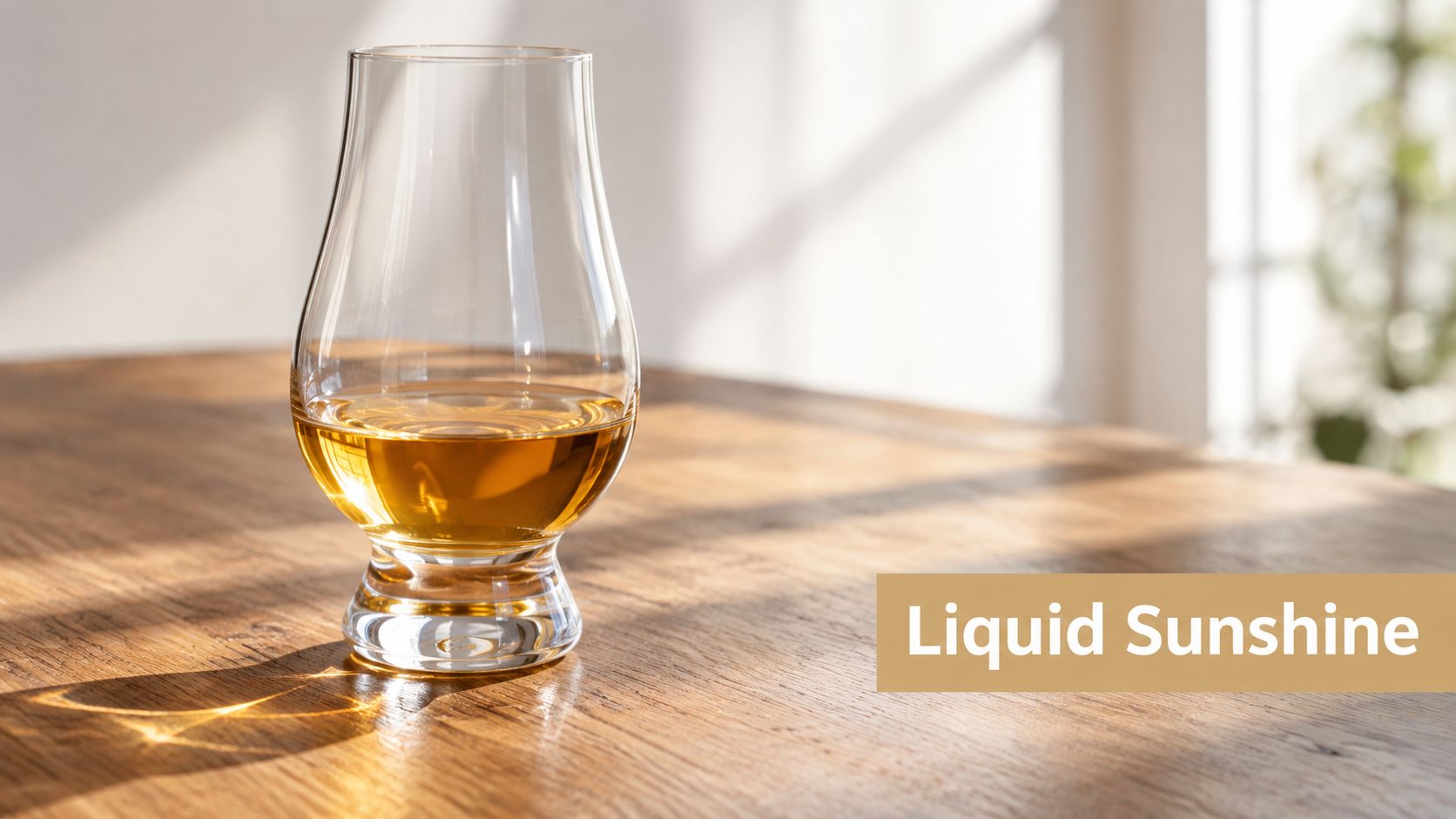
Let warmth guide attention
For a new drinker, “sunshine” shouldn't mean ignoring alcohol heat. Start with a smaller pour in a tulip-shaped or Glencairn-style glass, and let the whiskey rest for 5-10 minutes before nosing. Beam Distilling's guidance explains that resting can allow the sharpest alcohol vapors to dissipate.
Try this prompt with an American craft whiskey from a producer such as Frey Ranch: Where does the warmth appear first, and what flavor follows it? Share the question with a tasting partner, not as a test but as an invitation. One person may find honey while another notices roasted grain. Both observations can be useful.
The best “sunshine moment” isn't universal. It may be a soft, sweet bourbon, a grain-forward whiskey, or a lively rye. Let the glass establish its own weather.
2. Too much of anything is bad, but too much good whiskey is barely enough, Mark Twain
Twain's second line turns excess into a joke about discernment. Its real lesson is that quality can make a modest pour more rewarding than a crowded shelf of ordinary choices. The aim is not to drink more, but to notice more in what is already in the glass.
That principle suits American craft whiskey, where different grains, barrels, and distilling choices can produce very different personalities. Blind Barrels' quarterly kits give members four blind samples to compare character rather than chase quantity. Treat each sample like a short story: give it room to show its aroma, texture, and finish before moving on.
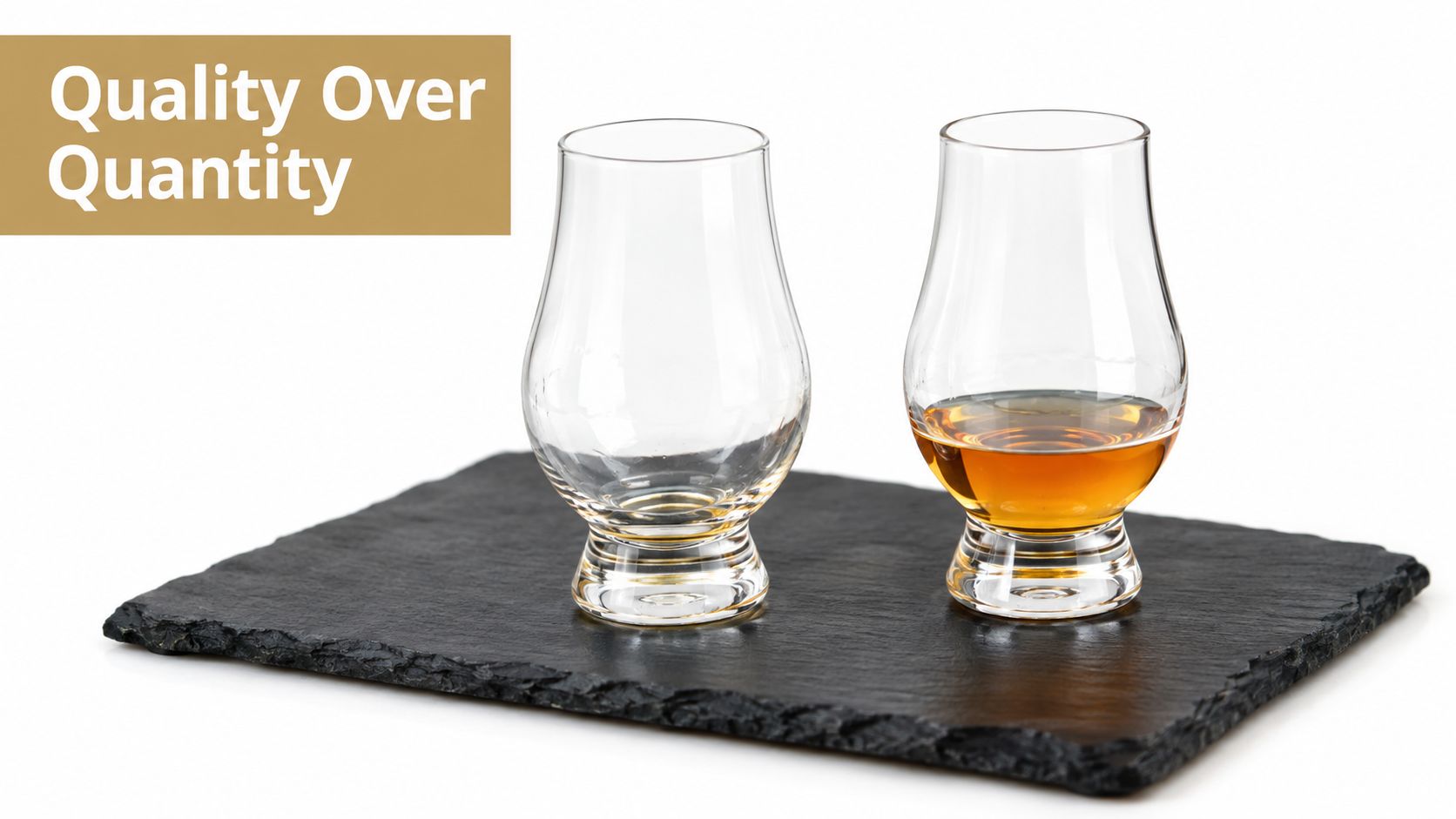
Taste excellence as a question
Pour small samples side by side and ask what “good” means to your palate. One whiskey may feel rich and dessert-like, another dry and peppery, while a third stays light but highly aromatic. A familiar name does not have to decide your favorite.
- Slow the sequence: Give each sample a first sip, a second sip, and a pause before comparing it.
- Record the contrast: Write one aroma, one palate impression, and one finish note for each whiskey.
- Check your preference: Compare your favorite with its production story after the reveal, rather than letting that story decide whether you should like it.
Beginner guidance often places comfortable neat-sipping around 90-100 proof. Bourbons aged 6-12 years can balance freshness with oak, while whiskeys aged 12+ years often show stronger wood influence. Beam Distilling's bourbon guide presents these ranges as starting points, not rules.
A focused comparison can teach more than hurried sampling. Twain's humor becomes a tasting prompt: find the pour that gives you the most to notice, then share what you found.
3. Whiskey is for drinking, not talking about, W.H. Auden
Whiskey earns its meaning in the glass, not in a vocabulary list. W.H. Auden's line is a useful reminder for beginners: tasting notes can guide attention, but they cannot replace aroma, texture, or finish.
Begin with the pour itself. Hold the glass to the light, smell gently, then take a small sip without checking the brand or expected profile. Describe what appears in plain language: sweet, dry, peppery, warm, or nutty. These words work like signposts, helping you locate an experience before you try to name every detail.
Let the conversation follow the evidence. A friend might notice dried fruit, while you find toasted cereal or oak. Neither observation needs to win. The difference sends both tasters back to the whiskey, much like comparing two sketches of the same scene can reveal details one drawing missed.
Use this sequence as a beginner-friendly tasting prompt:
- Taste before interpretation: Take a tiny first sip, then allow a second sip to coat the palate.
- Describe before revealing: Share one aroma and one flavor without consulting the tasting table or QR code.
- Return to the glass: Check which notes match, then notice how the whiskey changes as it rests.
Rolling Stone's beginner guide offers similar practical advice, including keeping the mouth slightly open while nosing and using small sips.
Auden puts drinking first, and shared notes make that drinking more attentive. Conversation becomes part of the tasting, giving friends a reason to linger over the pour.
4. In life, there are a few things worth savoring, a fine cigar, a glass of great whiskey, and the company of good friends, Unknown
This unnamed quotation places whiskey inside a larger ritual of pleasure. The drink matters, but so do the pace of the evening and the people around it. That makes the line especially suitable for a tasting night, where the goal is not merely to consume a spirit but to create a shared memory.
Blind Barrels' format supports that kind of gathering. A quarterly kit can become a date night, a small party, or a relaxed comparison among friends. Samples from craft distilleries such as Frey Ranch and Southern Star give the group something specific to investigate, while the blind format removes brand and price expectations from the first impression.

Give the gathering a gentle structure
Set out the samples, tasting table, water, and suitable glasses. Ask everyone to write notes before revealing the identities. The game adds a light competitive element, but nobody needs to perform expertise. A palate score can start a conversation about why one person identified a whiskey's type or proof while another focused on its finish.
For a little more atmosphere, pair the occasion with this reflection on whiskey and cigars, while keeping the focus on responsible, legal-age enjoyment.
Shared discovery: The most memorable tasting may be the one where everyone describes the same sample differently.
Invite a partner, including someone who doesn't usually follow whiskey culture, to choose a favorite without pressure. A sweet, soft profile may appeal to one guest, while a bold rye or oak-led bourbon appeals to another. The quote's real subject is not status. It's attention, companionship, and time well spent.
5. A man should always have a good whiskey, a good cigar, and a good woman, in that order, Unknown
This unverified saying turns whiskey into part of a shared ritual, though its ranking of people and possessions feels dated. Read today, the line works better as a playful prompt about companionship, preference, and the pleasure of giving a good drink your attention.
A couple can test that idea with a blind tasting. Each person meets the whiskey without a label, price cue, or familiar brand reputation. That clean first impression often reveals different sensory priorities. One taster may notice floral grain and honey, while the other follows baking spice, toasted oak, or a long, warming finish.
Make the quote a tasting conversation
Pour the samples together, then write separate notes before discussing them. Ask each person to describe the aroma, texture, and finish in ordinary language. A whiskey that smells like toasted bread or tastes peppery gives a beginner plenty to say without requiring distillery history.
Keep the reveal until both sets of notes are finished. You can then compare guesses about the whiskey's type, age, or proof, while remembering that tasting is observation rather than an exam.
Use these prompts to give the evening a clear rhythm:
- Choose a shared favorite: Pick the sample you would pour again, even if your reasons are different.
- Compare sensory focus: Notice whether one palate follows aroma while the other responds to texture, sweetness, spice, or oak.
- Allow for surprise: An unexpected favorite or inaccurate guess can reveal how strongly expectations shape perception.
- Describe the finish: Say whether the flavor fades softly, stays spicy, turns dry, or leaves gentle warmth.
The format also gives wives and partners who feel excluded by whiskey jargon an easy entry point. Everyone begins with the glass, not a vocabulary test.
The quote's lasting value is social. A good American craft whiskey can become the center of a relaxed exchange, where two people discover both the drink and the differences between their palates.
6. Scotch whisky is a complex spirit that rewards curiosity and patience, Charles MacLean
Complexity reveals itself in layers, like a terrain that comes into focus as your eyes adjust. Charles MacLean's quote describes why a first sip rarely tells the whole story. A whiskey might begin with grain sweetness, develop notes of fruit or spice, and finish with oak, smoke, or drying warmth. Patience gives each stage time to speak.
The idea applies beyond Scotch whisky. American craft whiskey from Frey Ranch or Southern Star may reflect different grains, production choices, barrels, and places. Blind tasting keeps curiosity open because the bottle name cannot supply an answer before your senses do.
This guide to tasting Scotch whisky offers a useful way to approach a dram as an exploration, not a checklist. Start by asking one simple question: what changed between the first sip and the last?
A difficult sample deserves a second reading. Some glasses seem closed, hot, or confusing at first. Taste an easier whiskey, drink water, and revisit the challenging pour once your palate has adjusted. New aromas may appear, much as a quiet instrument becomes audible after louder sounds fade.
For higher-proof whiskey, a few drops of water can provide another useful comparison. Beam Distilling's tasting advice explains that water may open aromas and soften the initial alcohol impact. Add it gradually, then compare the glass before and after.
Record the whiskey's movement in three short lines:
- First impression: What reaches your nose immediately?
- Mid-palate: Does the flavor become sweeter, drier, fruitier, or spicier?
- Finish: Does the final impression fade quickly or remain with oak and heat?
Research the distillery after the QR-code reveal. Context can explain production styles without replacing your own observations. Over time, these notes turn uncertainty into a useful guide to both whiskey and personal taste.
7. A single barrel of whiskey is a biography, Unknown
A single barrel records a whiskey's life in flavor. Grain, water, fermentation, distillation, oak, warehouse conditions, and the distiller's decisions leave marks that can appear in the glass. Age is only one chapter. The finished whiskey reflects a chain of choices, like a biography shaped by both events and character.
Start with the sensory clues, then connect them to American craft whiskey. A sample from Frey Ranch might suggest an agricultural setting through grain sweetness or earthy notes. A release from Southern Star could raise questions about barrel selection or maturation. Taste before reading the label, so the story begins with your own observations.
This explanation of single-barrel whiskey links the poetic idea to releases whose character can vary from barrel to barrel.
Use the quote as a tasting prompt:
- Nose: Find the clearest aroma. Is it fruity, grainy, spicy, woody, or earthy?
- Palate: Notice the texture, then name the first flavor that takes control.
- Finish: Follow what remains after swallowing. Look for sweetness, dryness, spice, or heat.
Once you have written your impressions, explore the distillery's origin and barrel philosophy. Ask which parts of the whiskey's biography reached your senses and which stayed hidden. Production details can clarify a flavor, while your response remains the final reader's interpretation.
Blind Barrels kits can support comparisons over time. As you revisit samples, record which styles appeal to you, even when the brand is hidden. The barrel supplies the story. Your palate supplies the reading.
8. Whiskey warms the stomach and opens the mind, Traditional saying
This traditional saying joins physical comfort with intellectual curiosity. A pour can bring gentle warmth, while the act of identifying aroma, texture, and finish asks the drinker to stay alert. That combination explains why whiskey appreciation can feel both relaxing and absorbing.
New drinkers don't need a formal setting to experience it. Choose a comfortable room, good lighting, and a glass that concentrates aroma. A fireplace can add atmosphere, but it isn't essential. What matters is creating enough calm to notice how the whiskey changes from the first smell to the last impression.
Make the mind part of the pour
Blind tasting gives the saying a practical shape. The tasting table turns impressions into language, and the QR-code reveal turns curiosity into information about the distillery and sample. The palate game adds another layer by asking you to estimate age, proof, and whiskey type before you see the answer.
That structure keeps learning playful. You might identify a grain note accurately but misjudge the proof. You might recognize a familiar oak character without knowing where it came from. Each result gives you a reason to taste again, not a reason to feel inadequate.
Take the first sip for pleasure. Take the next one for understanding.
For a beginner, the process can remain simple. Start with tiny sips, keep notes on appearance, aroma, palate, and finish, and compare your impressions with others. Malts' beginner tasting guidance recommends written observations, while another approach is to record just three words per whiskey, one for the nose, palate, and finish.
The stomach may feel the warmth, but the mind opens through attention. That's the lasting value of a tasting quote when it becomes a practice.
Comparison of 8 Whisky Quotes
| Quote | Ease of adoption (implementation complexity) | Required engagement / resources | Expected outcome | Ideal use cases | Key advantages |
|---|---|---|---|---|---|
| Whiskey is liquid sunshine - Mark Twain | Very easy | Low, short mindful sessions | Increased enjoyment and positive mood | Introductory tastings, setting tone for events | Emotional appeal; encourages mindful appreciation |
| Too much of anything is bad, but too much good whiskey is barely enough - Mark Twain | Easy | Moderate, time to savor curated samples | Preference for quality over quantity | Curated subscription tastings, comparative sessions | Justifies premium selection; promotes slow savoring |
| Whiskey is for drinking, not talking about - W.H. Auden | Very easy | Minimal, focus on direct sensory experience | Pure, unanalysed tasting enjoyment | Purist or first-sip experiences | Reduces pretension; emphasizes intuition |
| In life, there are a few things worth savoring... - Unknown | Easy | Moderate, social coordination (guests, setting) | Stronger social bonding and ritualized enjoyment | Group tastings, special occasions | Holistic: combines quality, community, mindfulness |
| A man should always have a good whiskey... - Unknown | Easy | Moderate, social/paired participation | Shared discovery and bonding | Couples' tasting nights, informal gatherings | Promotes shared experiences; familiar, traditional framing (may feel dated) |
| Scotch whisky is a complex spirit... - Charles MacLean | Moderate | Higher, patience, repeated tastings, study | Deeper palate development and understanding | Educational tastings, progressive palate training | Encourages learning; frames complexity as rewarding |
| A single barrel of whiskey is a biography - Unknown | Moderate | Moderate, follow-up research, tracking releases | Stronger connection to provenance and distinctiveness | Single-barrel tastings, distillery-focused sessions | Highlights uniqueness and storytelling of barrels |
| Whiskey warms the stomach and opens the mind - Traditional Saying | Easy | Low–moderate, comfortable setting, light study | Balanced sensory comfort and intellectual engagement | Introductory tastings that combine relaxation and learning | Inclusive approach; bridges casual enjoyment and education |
Turn a Memorable Line Into a Tasting Ritual
The best quotes about whisky don't end as captions. They give a tasting a purpose. Use the “liquid sunshine” line when you want guests to approach a new sample with warmth and no pressure. Choose the “good whiskey and good friends” saying for a gathering where conversation matters as much as the pour. A humorous line suits a social post or date night, while the barrel biography and MacLean's reflection can lead into a deeper discussion about craft, patience, and place.
Beginners can keep the ritual uncomplicated. Pour a small amount into a tulip-shaped or Glencairn-style glass, allow it to rest, and approach the aroma before taking a tiny sip. Notice whether the whiskey feels sweet, dry, spicy, fruity, grainy, smoky, or oak-led. Then pay attention to the finish. Does it disappear quickly, or does it leave warmth and flavor behind?
Write those observations on the tasting table before looking at the sample identity. Recording aroma, palate, and finish gives vague impressions somewhere to land. The practice also helps you compare different whiskeys without relying on brand reputation. Your notes may be brief, and they may be imperfect, but they become more useful each time you return to them.
The QR-code reveal can come later. First, let your senses form an opinion. Then compare your notes with the sample's distillery details and tasting information. The contrast between your expectations and the revealed story often creates the most interesting conversation.
The palate game adds a playful challenge. Guess the age, proof, and whiskey type, then use the score as feedback rather than a verdict. A wrong answer can still reveal that you recognized texture, spice, or oak correctly. Tasting improves when curiosity feels more important than being right.
Blind Barrels makes that discovery communal through quarterly kits featuring four blind samples from small American craft distilleries, a tasting table, a QR-code reveal, bottle access, and the palate game. The format gives the group a shared starting point while leaving the final decision with each drinker. The whiskey that belongs in your glass is the one your senses and your experience lead you back to.
Blind Barrels sends four blind samples each quarter from small American craft distilleries, with a tasting table, QR-code reveals, and a palate game to make discovery practical and social. Visit Blind Barrels to turn these quotes into a guided tasting with friends or a partner.