

You're holding a glass of scotch, someone asks what you think, and your mind goes blank. You can smell something, perhaps fruit, smoke, vanilla, or wood, but you're not sure whether “apple” is a useful tasting note or whether you're supposed to identify something more unusual.
You aren't taking an exam. Scotch tasting notes are a record of your own observation, not a performance. With a repeatable method, you can describe what's in the glass, notice how it changes, and discover which styles you enjoy.
Why Tasting Notes Make Every Glass Better
A useful note doesn't need to sound like a professional review. It only needs to answer three questions: What do I smell? What do I taste? What remains after I swallow? That simple structure turns uncertainty into a routine.
Begin with three lines:
- Nose: Write the first aroma that comes to mind, such as apple, vanilla, smoke, or cereal.
- Palate: Describe the texture and the main flavor, perhaps oily with dried fruit or light with lemon.
- Finish: Record what lingers and whether it fades cleanly or shifts toward spice, oak, or peat.
This approach fits naturally into the broader beginner sequence of appearance, aroma, palate, and finish. Beginner guides also encourage recording what you notice in each stage, rather than relying on memory later. A beginner's Scotch tasting guide recommends structured observation and suggests retasting after adding a small amount of water.
Make the first pour uncomplicated
For your first note, don't chase rare comparisons. “Definitely citrus, maybe lemon zest” tells your future self more than “tropical fruit” when you aren't sure what you mean. Your vocabulary will expand as you compare pours, but honest uncertainty is already useful information.
Write down the bottle, date, and whether you tasted it neat or with water. If the dram changes later, add a second line instead of replacing the first. You'll begin to see whether you consistently prefer sherry influence, bourbon-cask freshness, gentle malt, or pronounced smoke.
Practical rule: Describe what you can recognize first. Precision grows from repeated comparisons, not from impressive-sounding words.
Keep a record for your future self
A notebook helps you remember which bottles you reach for and which profiles lose your interest after a few sips. It can also reveal patterns across pours, such as a preference for dried fruit and walnut in sherry-cask Speyside or fresh grass and shortbread in lighter Lowland whisky.
That habit resembles the value of keeping tasting records in other drinks. If you enjoy comparing aroma, texture, and finish across wines as well as whisky, a structured resource such as the Viansa Sonoma wine club can provide another setting for practicing observation without treating tasting as a test.
The payoff is practical. You may recognize a sherry-cask Speyside more quickly, finally put a name to the level of peat you enjoy, or understand why one bottle feels more inviting at the end of a long evening. Your note is a conversation with the person you'll be after the next pour.
The Look, Smell, Taste, and Finish Sequence
A consistent order keeps one strong sensation from taking over the entire tasting. Use a tulip-shaped glass or Glencairn, pour about 50 ml, and place the glass against a white surface so you can observe the whisky without guessing what the color means.
Appearance
Look for intensity, clarity, and movement. A pour may range from pale straw to deep mahogany, but color alone can't tell you the whisky's age. Cask type, maturation conditions, and coloring practices can all affect appearance, so write “pale gold” or “rich amber” rather than turning color into a claim about maturity.
Tilt the glass and watch the legs form, but don't treat them as a reliable quality score. They can suggest body, yet the palate will tell you more about texture.
Aroma
After pouring, let the whisky rest for 5 to 10 minutes, a timing recommended in a beginner tasting guide from Beam Distilling's whiskey notes guide. Start with short, gentle sniffs from roughly two inches above the rim. This first pass helps you avoid the shock of concentrated alcohol.
Then bring the glass closer and take deeper inhalations, with your nose near or just inside the rim. Look for broad families before specific details: fruit, grain, sweet aromas, flowers, wood, spice, or smoke. The second and third sips often reveal more than the first, so give your senses time to adjust rather than judging the dram immediately.
Palate
Take a small sip and let it move across your mouth. Coat the tongue and cheeks, hold it for about 5 seconds, then swallow. Notice three separate things:
- Texture: watery, silky, creamy, or oily.
- Flavor: fruit, malt, vanilla, oak, spice, smoke, or another clear impression.
- Balance: whether sweetness, alcohol, oak, and peat work together or compete.
The Scotch tasting guide from Blind Barrels also treats aroma, palate, and finish as distinct parts of the tasting process.
Finish
The finish is what remains after swallowing. Track both length and direction. A finish under 15 seconds is short, while one over 45 seconds is long. These thresholds are useful shorthand, not rigid judgments.
Ask whether the finish repeats the palate or changes. A light fruit note may become dry oak, a smoky palate may leave seaweed and ash, or dark fruit may turn toward walnut and baking spice. Write the final sensation while it's still present. That last impression often distinguishes two whiskies that seemed similar at the first sip.
Descriptor Families Every Beginner Can Detect
Experts often use many precise terms, but casual drinkers usually begin with a smaller group of recognizable aroma families. One analysis of everyday drinkers found recurring checkboxes such as peat, vanilla, oak, smoke, and bacon, while consumer language can differ from prestige-oriented tasting language. For expensive American whiskey, consumers in one analysis favored chocolate and caramel more than terms such as tobacco, leather, and grass. A whiskey tasting guide from Sipsy provides useful context for that gap between expert vocabulary and familiar sensory language.
The point isn't to reduce whisky to a short list. It's to start with words you can connect to a smell or flavor.
A practical comparison
| Flavor Family | Beginner Descriptor | Expert Descriptor |
|---|---|---|
| Fruity | Apple or pear | Overripe banana with a hint of acetone |
| Sweet and honeyed | Vanilla or brown sugar | Toffee, praline, or honeycomb |
| Floral | Fresh flowers | Heather, honeysuckle, or orange blossom |
| Cereal and malty | Bread or porridge oats | Malted biscuit, barley sugar, or cereal sweetness |
| Woody and spicy | Oak or cinnamon | Cedar, sandalwood, nutmeg, or tannic oak |
| Smoky | Campfire | TCP, seaweed, medicinal peat, or coastal smoke |
| Off-notes | Rubber or nail polish | Sulfur, struck match, solvent, or rubber sap |
A sherry-cask Speyside may offer an easy entry through dried fig, raisin, walnut, and brown sugar. A bourbon-cask Highland or Lowland dram may make vanilla, pear, fresh grass, and shortbread easier to notice. An Islay pour can announce itself with campfire, seaweed, ash, or medicinal smoke, though the exact balance depends on the spirit and cask.
Let familiar words lead
Suppose you smell banana. Write banana. On a later tasting, you may decide the aroma is closer to overripe banana with a faint solvent edge. That added detail matters because it tells you how the note evolved, not because the expert term is automatically better.
The same progression works with smoke. “Campfire” may become “dry ash,” “wood smoke,” or “medicinal peat” after comparison. If you aren't sure, keep the broad term and add a question mark.
A notebook filled with “definitely citrus, maybe lemon zest” is more useful than one filled with guesses chosen to sound sophisticated.
Off-notes deserve neutral treatment. Sulfur, rubber, and nail polish can be noticeable characteristics, but you don't need to decide immediately whether they make the whisky good or bad. First identify them, then decide whether they distract you.
How to Read the Scotch Tasting Wheel
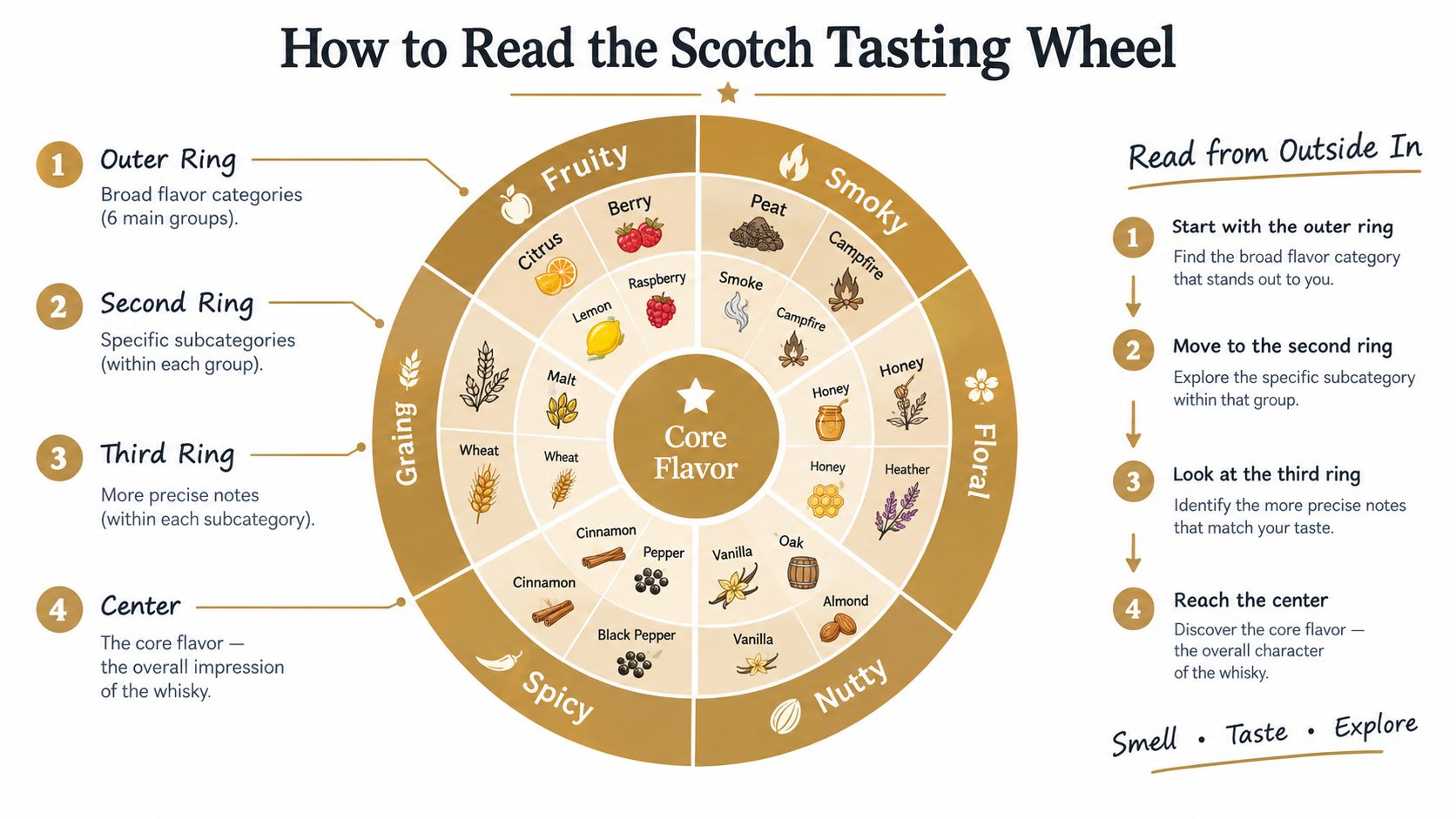
A tasting wheel works like a map. You begin with a broad region of flavor, then move inward only when the aroma gives you enough evidence.
The outer ring contains wide families such as fruity, smoky, floral, nutty, spicy, and grainy. Use it before you reach for a specific term. If the whisky smells like toasted oak, start with woody. If it reminds you of burnt caramel, start with sweet. If you smell struck match or a damp fire pit, smoky is a reasonable first destination.
The next ring narrows the category. Fruity may become citrus or berry. Smoky may become peat. Sweet may become honey or vanilla. Oak may lead toward cedar. These words are still accessible because they connect to familiar objects and foods.
Move inward gradually
The inner rings offer more precise notes. Citrus can become lemon, berry can become raspberry, smoke can become campfire, floral can become heather, nutty can become almond, and spicy can become cinnamon.
Follow this sequence:
- Choose the broad family. Ask what dominates the nose.
- Select a subcategory. Decide whether the fruit feels citrus-like, orchard-like, or berry-like.
- Test a specific note. Check whether lemon, apple, raspberry, or another detail fits.
- Stop when the description feels accurate. You don't need to reach the center every time.
The most common mistake is jumping straight to an unusual descriptor. A drinker may write “candied kumquat, antique cedar, and maritime medicinal phenols” before confirming whether the whisky is primarily fruity or smoky. That creates ornate notes with no stable foundation.
Use the wheel as a question
Don't scan the entire wheel looking for a word that sounds right. Ask one question at a time:
- Is this fruit fresh or dried?
- Is the sweetness vanilla-like, honeyed, or caramelized?
- Does the smoke resemble a barbecue, fireplace, or medicinal cabinet?
- Is the wood fresh, toasted, polished, or drying?
This method keeps your attention on sensory evidence. The wheel isn't a vocabulary test. Honest observation beats impressive language, and a simple note that you can reproduce is more valuable than a dramatic description you can't explain later.
Example Tasting Notes for Each Scotch Style
The examples below use the four-part format in a way a drinker could write it. They aren't universal regional rules. Region gives you a starting expectation, while still type, cask, age, proof, and blending determine what appears in the glass.
Five styles side by side
| Style | Nose | Finish | Dominant Cues |
|---|---|---|---|
| Speyside | Baked apple, raisin, walnut, orange peel | Coffee, ginger, toffee, gentle oak | Dried fruit, nuts, soft spice |
| Highland | Orange marmalade, malted biscuit, clove, honey | Baking spice, orange, dry oak | Citrus preserve, spice, rounded malt |
| Islay | Seaweed, wood smoke, ash, lemon oil | Smoke, salt, coastal earth | Peat, brine, citrus lift |
| Lowland | Fresh grass, barley, lemon, shortbread | Malty, herbal, lightly drying | Cereal, green notes, gentle sweetness |
| Blended Scotch | Grain sweetness, vanilla, light fruit, faint smoke | Soft oak, cereal, mild spice | Balance, grain, approachable smoke |
A sherry-cask Speyside can open with dried fig, raisin, walnut, and baked apple. On the palate, brown sugar and malt may sit beside orange peel and cinnamon. The finish often shifts toward coffee, ginger, or gently drying oak. This is a useful style for learning how fortified-wine cask influence adds darker fruit and nutty tones without erasing the underlying malt.
A sherry-forward Highland dram may feel brighter. Try describing orange marmalade, pear, honey, malted biscuit, and clove on the nose. The palate can bring caramel, orange preserve, and baking spice, while the finish dries toward oak and nutmeg.
An Islay whisky makes smoke easier to identify, but smoke isn't one single flavor. You may find seaweed, damp ash, wood smoke, medicinal notes, lemon oil, or charcoal. A heavily peated pour can leave a long, saline finish that moves from campfire to coastal earth.
Lowland Scotch often gives beginners a gentler place to notice cereal and green aromas. Fresh grass, barley, lemon, and shortbread can lead to a palate of apples, herbal tea, and malt. The finish may be lighter and more immediate than that of a peated or heavily sherried dram.
A blend can show how components work together. Look for grain sweetness, vanilla, light fruit, and a small amount of smoke. The palate may feel smooth and balanced rather than dominated by one note, with cereal sweetness lingering beside soft oak.
These contrasts help you identify what's in your own glass. Write the four stages first, then compare the dominant cues. If your whisky doesn't match the expected profile, that isn't a mistake. It may be the cask or blending strategy doing something interesting.
How Dilution and Rest Time Change the Notes
A tasting note describes a whisky under particular conditions. Change those conditions, and the aroma can change with them.
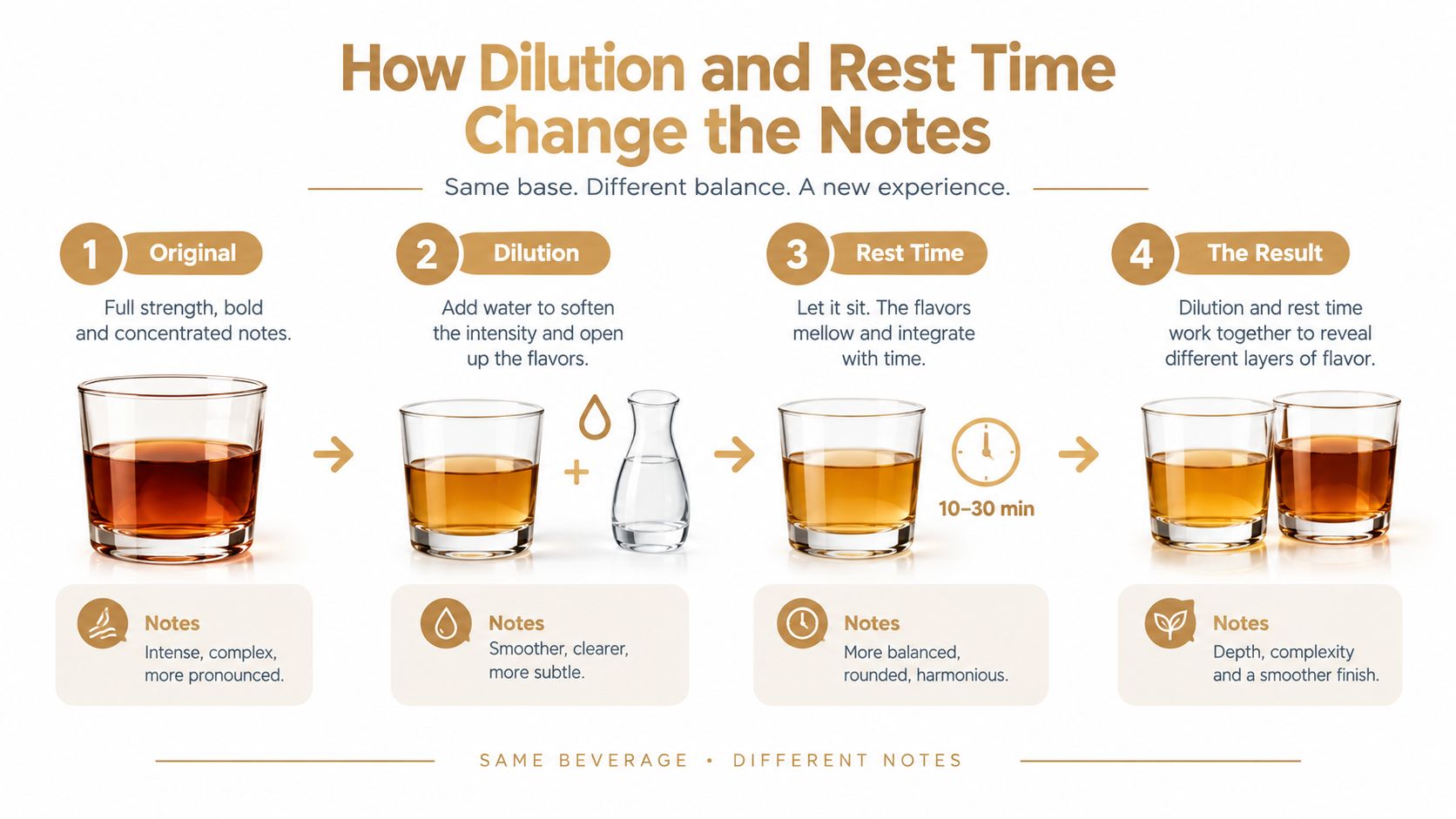
Experimental work summarized in the 2025 Scotch Whisky Report found that undiluted whisky can lean more toward chemical or solvent notes, vanilla, oak, and bacon, while diluted whisky can move toward pome fruit and cedar. Smoke-related attributes also strongly predict peated Scotch. That helps explain why the same bottle may seem fruitier, softer, or more smoky after water is added.
Ethanol volatility can dominate the first impression at full strength. A small amount of water may reduce that immediate alcohol heat and make esters, fruit, floral notes, or softer wood easier to notice. The change isn't always positive or dramatic, so treat dilution as a comparison rather than a correction.
Test one pour three ways
Use the same whisky and separate your observations:
- Neat: Note the first aroma, alcohol heat, texture, and strongest flavor.
- With water: Add a few drops, swirl gently, and retaste. For a 30 ml pour, a noticeable shift often begins between one and five drops, but the right amount depends on the whisky and your preference.
- After resting: Give the glass another 10 to 15 minutes and check whether the nose has softened or opened.
A sherry-cask dram might move from hot alcohol toward raisin, orange peel, walnut, or toffee. A peated Islay may reveal citrus oil beneath the smoke after resting. Record the change as a sequence, such as “neat: solvent and oak; water: apple and cedar; rested: softer smoke and lemon.”
Water isn't a rule, and neat isn't a badge of expertise. The useful question is: Which version lets you notice more? A practical discussion of this comparison appears in Blind Barrels' guide to water with Scotch.
What Moves the Notes in a Glass
Three accessible variables explain many differences between bottles: age statement, cask type, and proof. Treat them as clues rather than guarantees.
A younger Scotch, especially one under 10 years, may show more grain, cereal, fresh wood, and lively spirit character. Longer maturation can bring rounder texture, dried fruit, polished oak, and deeper development. That doesn't mean older always means better. A well-balanced younger whisky can be more vivid than an older bottle whose oak has taken over.
Compare the cask first
Ex-bourbon casks commonly point you toward vanilla, coconut, honey, and golden fruit. Ex-sherry casks may bring raisin, fig, dark chocolate, and walnut. Wine and rum finishes can add red berries, brown sugar, or baking spice, though their influence varies considerably.
Imagine two Speyside pours. A 12-year bourbon-cask whisky might smell of pear, vanilla, honey, and fresh oak, with a bright, clean palate. A 15-year oloroso sherry-cask Speyside may show raisin, walnut, orange peel, dark chocolate, and a more rounded texture. Those are tendencies, not promises, but they give you a useful starting question: is the cask supporting the spirit or dominating it?
Read proof through texture
Cask-strength whisky is often bottled around 50% to 60% ABV, and it can deliver dense texture with pronounced alcohol heat. Bottlings at 40% to 46% ABV generally feel softer, although some aromatic intensity may be less apparent.
| Factor | Typical Effect on Nose | Typical Effect on Palate |
|---|---|---|
| Age statement | More developed fruit, oak, and dried aromas | Rounder texture and deeper wood influence |
| Ex-bourbon cask | Vanilla, coconut, honey, golden fruit | Sweet oak and bright fruit |
| Ex-sherry cask | Raisin, fig, walnut, dark chocolate | Richer dried fruit, nuts, and spice |
| Higher proof | Concentrated aroma and alcohol heat | Fuller body, warmth, stronger texture |
| Lower proof | Softer aromatic entry | Easier sipping and gentler finish |
Use the label to form a hypothesis, then let the glass answer it.
Sharpening Your Palate With Blind Tasting
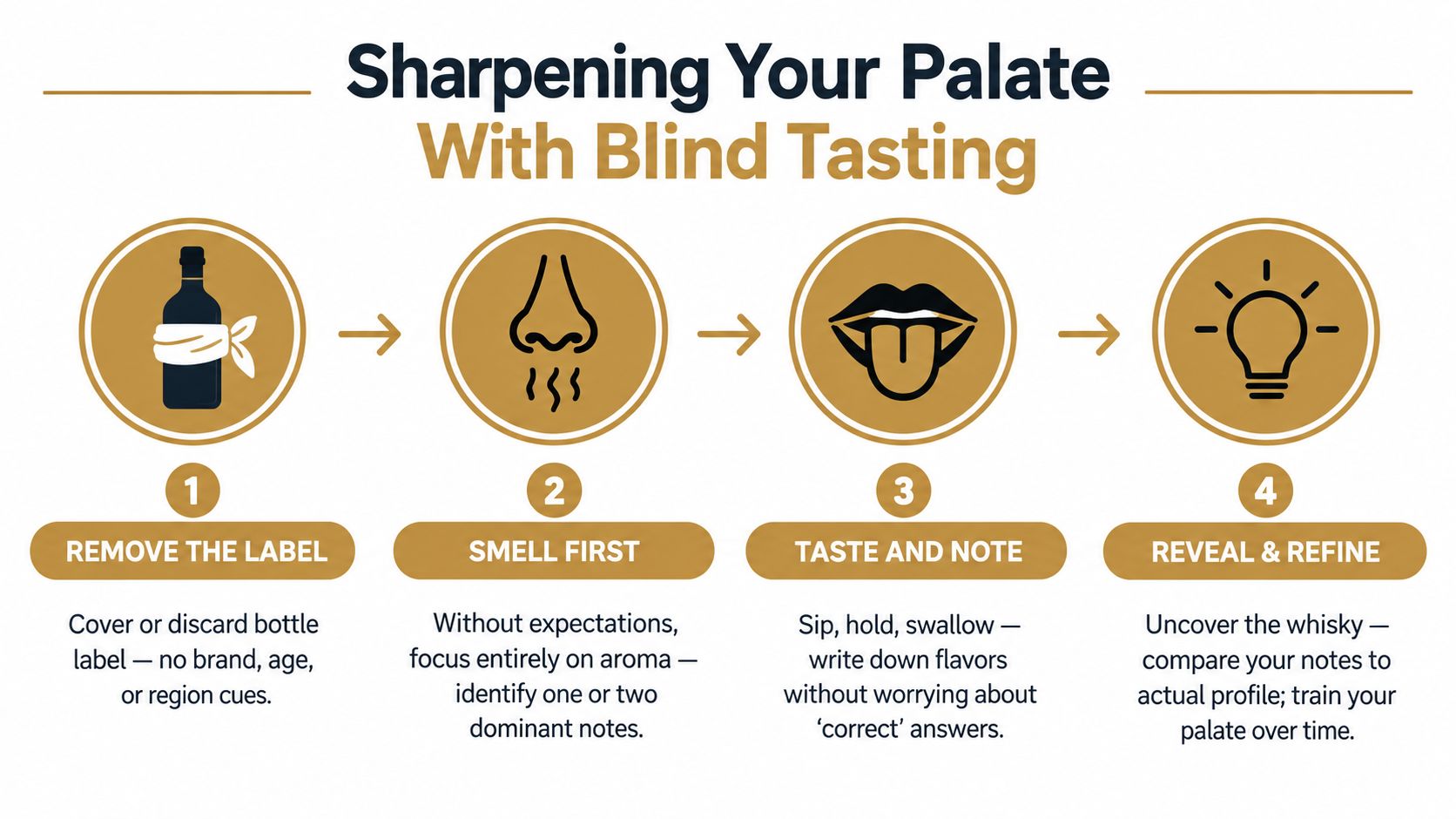
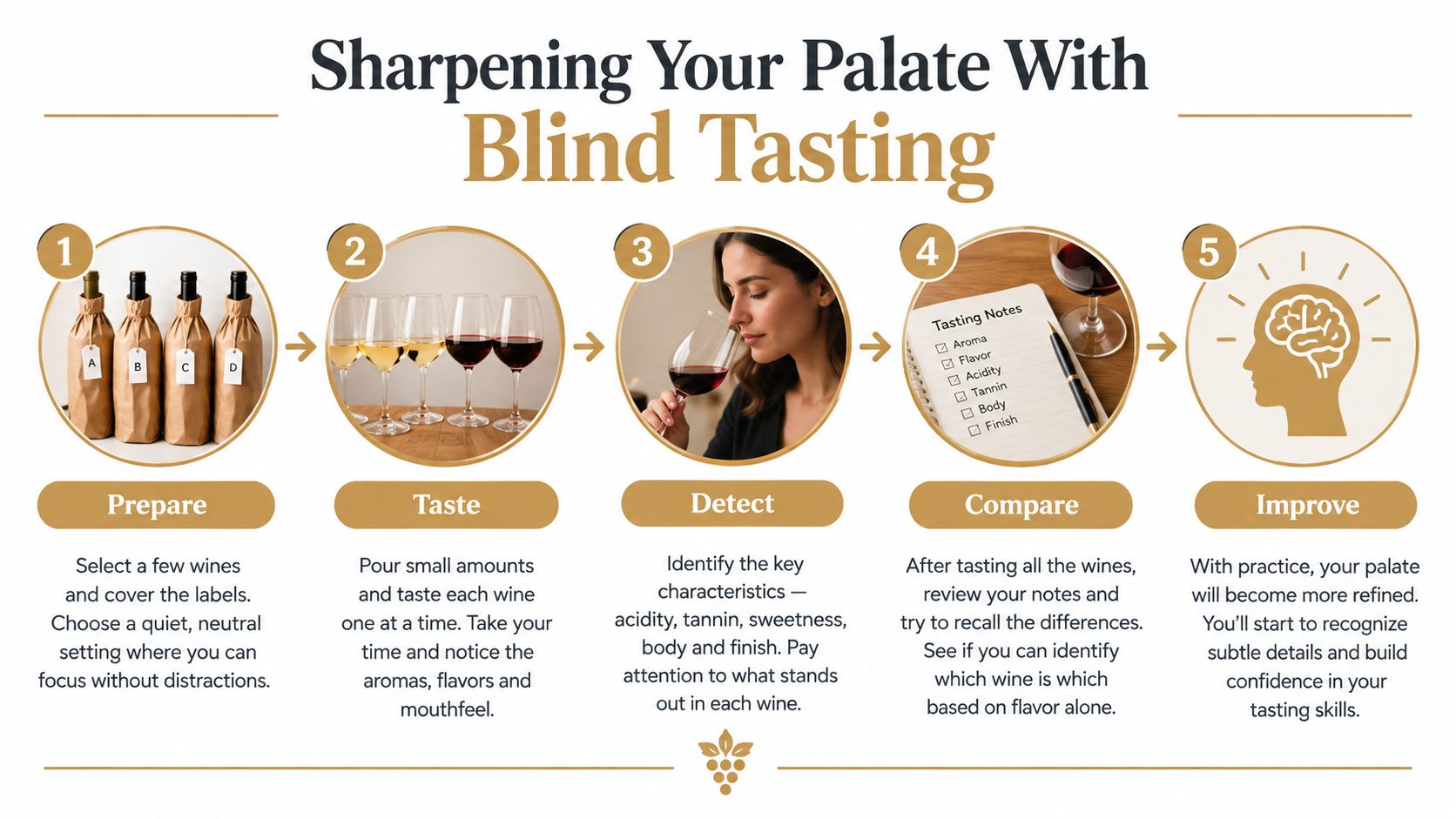
A label tells your brain what to expect before you smell anything. The distillery name, age statement, region, price, and reputation can all pull your attention toward familiar descriptions. Covering that information removes the prediction and leaves you with aroma, flavor, texture, and finish.
Blind tasting doesn't require elaborate equipment. At home, pour three whiskies into separate glasses and cover the labels with numbered foil. A useful flight could include a peated Islay, a sherry-cask Speyside, and a bourbon-cask Highland. Taste them in the same order, using the same glass style, and write your notes before revealing the bottles.
A simple blind drill
For each numbered glass, record:
- Appearance and color intensity.
- Two broad aroma families.
- One specific aroma, if you can find it.
- Texture, heat, and main palate flavor.
- Finish length and final direction.
- Your guess about style, age, proof, and cask.
Don't worry about getting every guess right. The reveal shows where your senses and assumptions diverge. You may discover that you call oak “vanilla,” mistake cereal sweetness for honey, or underestimate how much smoke you enjoy when it arrives with citrus and salt.
Keep a dedicated notebook. A useful record includes the dram, date, rest time, proof or ABV, glassware, and any water added. A whiskey tasting-notes primer from Drinkist recommends separating appearance, nose, palate, and finish while recording those conditions so later comparisons remain meaningful.
Blind tasting also works well socially. A flight of American craft whiskey from distilleries such as Frey Ranch or Southern Star can introduce new drinkers to bourbon and rye while keeping brand expectations out of the first conversation. The same method applies whether you're comparing Scotch regions or learning what styles your group prefers.
Quick Reference Card You Can Keep Next to the Glass
Copy this structure into a notebook or keep it beside the bottle. The blanks are intentionally short. A tasting card should help you notice more, not make writing feel like homework.
Appearance
- Color: pale straw / gold / amber / mahogany
- Clarity: clear / hazy / bright
- Movement: light / slow / coating
Nose
- First impression: ____________________
- Main family: fruit / floral / grain / wood
- Second note: spice / smoke / sweetness / earth
- Specific possibility: ____________________
Palate
- Texture: watery / silky / creamy / oily
- Main flavor: ____________________
- Supporting flavor: fruit / malt / vanilla / oak / spice / smoke
- Balance: sweet / dry / hot / bitter / balanced
Finish
- Length: short / medium / long / very long
- Texture: watery / silky / oily / drying
- First aftertaste: ____________________
- Final shift: oak / smoke / dark fruit / citrus / spice
- Overall impression: ____________________
Use the checklist as a prompt, not a menu you must complete. If you smell apple immediately, write apple. If the aroma feels smoky but you can't separate ash from campfire, leave it at smoky. The whiskey tasting-notes template from Blind Barrels offers another format for keeping these observations organized.
At the bottom of every entry, add:
Bottle: ____________________
Age statement: ____________________
ABV or proof: ____________________
Cask information: ____________________
Glassware: ____________________
Rest time: ____________________
Water added: ____________________
Date and time: ____________________
That final line of context makes your notes reproducible. When the bottle tastes different later, you can check whether the whisky changed or whether the tasting conditions did.
Blind Barrels offers quarterly blind whiskey kits with four samples from small American craft distilleries, a tasting table for aroma, palate, and finish notes, and a reveal system that includes bottle details and a palate-scoring game. Visit Blind Barrels to turn your next tasting into a structured comparison with friends, a partner, or fellow whiskey drinkers.