

Buy the oldest Scotch you can afford is common advice, but it's a poor way to choose a bottle you'll enjoy. An age statement tells you something precise about maturation. It doesn't tell you whether you'll like the smoke, how drying the oak will feel, or whether a less expensive whisky would suit you better.
When you're comparing Scotch whisky, 18 year expressions deserve attention, not automatic preference. Start by understanding the label, then taste for balance, and finally hide the bottle to find out how much the number influenced your expectations.
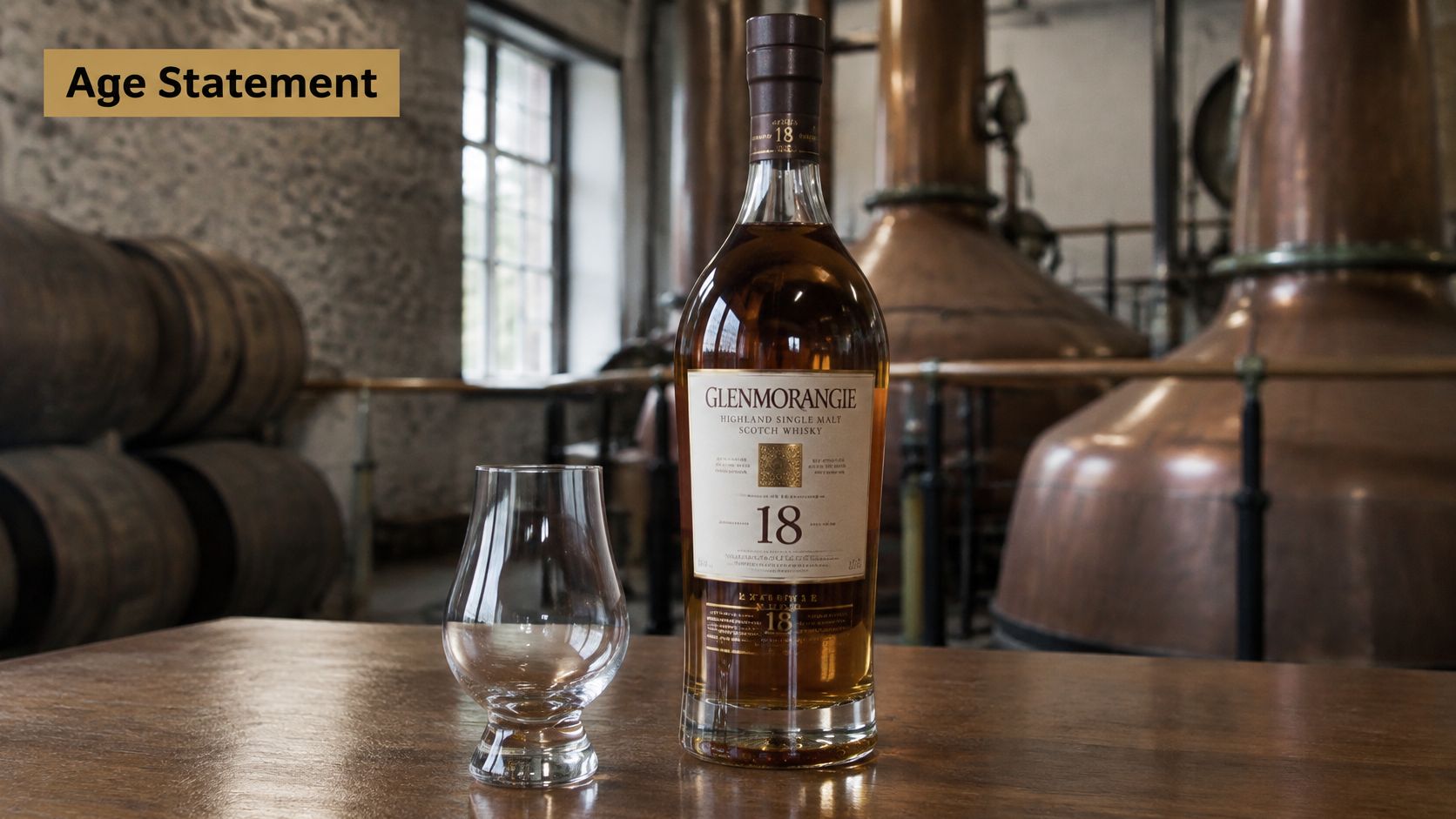
What an 18 Year Age Statement Guarantees
An age statement is a minimum, not an average. Under the Scotch Whisky Regulations, the youngest whisky component determines the stated age, so every component in an 18-year Scotch must have matured for at least that long, as the UK government's Scotch Whisky technical guidance explains. That guidance also sets the minimum oak maturation for Scotch at three years, making an 18-year expression six times the legal minimum, and identifies eighteen years among established longer maturation periods.
Consider a blend containing whiskies aged 18, 25, and 30 years. Applying that youngest-component rule, the producer can label it 18 Years Old, but can't claim either older age for the finished whisky. The older components don't cancel out the younger one.
What the number leaves unanswered
The label doesn't disclose the proportions of those components. Nor does the age alone identify the cask history, finishing method, bottling strength, or character of the spirit before it entered wood.
Those omissions matter when you're buying for flavor. A smoky whisky and a fruit-led whisky don't become interchangeable just because their age statements match. Likewise, a producer can emphasize fresh oak influence in one expression and preserve delicate spirit character in another.
Label-reading rule: Treat the age as a verified maturation floor, not a tasting score.
For a newer drinker, separating these ideas prevents an expensive misunderstanding. You aren't buying a guaranteed improvement over every younger whisky. You're buying a bottle that meets a specific maturation claim, with its own particular style.
If you're moving up from a younger expression, our guide to 12-year Scotch provides a useful comparison point. Look for a similar flavor family rather than assuming that every older bottle represents the next step on the same ladder.
Before paying, check that an actual age statement appears on the bottle or packaging. Then look separately for the information that helps predict enjoyment: cask type, strength, smoke level, and producer description. The number answers the age question. It doesn't answer all the buying questions.
How Eighteen Years in Oak Changes the Flavor
Typical 18 year character by Scotch region
| Region | Typical 18 year character | What the oak adds | Watch for |
|---|---|---|---|
| Speyside | Dried fruit, honey, baked apple, vanilla | Sherry casks add raisin and dark chocolate | Oak can dull the fruit after eighteen years |
| Highland | Honey, malt, citrus peel | Ex-bourbon casks add vanilla and light coconut | Styles vary widely between distilleries |
| Islay | Peat smoke, sea salt, iodine | Long aging softens smoke into leather and tobacco | Peat character can fade with time |
| Lowland | Light floral, cereal, citrus | Oak becomes more visible in a lighter spirit | Can turn dry or woody quickly |
Use these regional descriptions as starting expectations, not guarantees. A distiller's spirit style, the previous contents of the cask, and warehouse conditions can produce different outcomes within the same region.
With Speyside, begin by looking for fruit. Does the baked-apple character remain clear, or does the whisky taste mostly of dry wood? In a sherry-cask expression, raisin and dark chocolate may deepen the profile, but the most enjoyable result still needs definition rather than a blur of sweetness and oak.
Highland is a broad signpost. Honey, malt, and citrus peel give you useful things to search for, while ex-bourbon wood can contribute vanilla and light coconut. Don't reject a Highland whisky because it doesn't match every descriptor in the table. Judge whether its individual flavors work together.
Smoke and delicacy need different judgments
In Islay whisky, distinguish the intensity of smoke from its character. Peat can suggest medicinal iodine, coastal impressions, or a softer leather-and-tobacco register. A less forceful smoky aroma doesn't necessarily mean a less interesting whisky.
For Lowland styles, pay particular attention to the relationship between light spirit and drying wood. Floral, cereal, and citrus notes can become difficult to find when oak dominates. The useful question isn't whether you can detect wood, but whether you can still taste anything clearly alongside it.
Our explanation of aging barrels for whiskey helps unpack why cask choices matter so much. Think of maturation as a relationship between wood and spirit, not a countdown that always ends in greater richness.
More oak is a flavor outcome. Better balance is a judgment.
To test the regional description, write down what you expect before pouring. Then record what you smell and taste without forcing a match. If you expected fruit but mostly find drying wood, that disagreement is useful information about the bottle and your preferences.
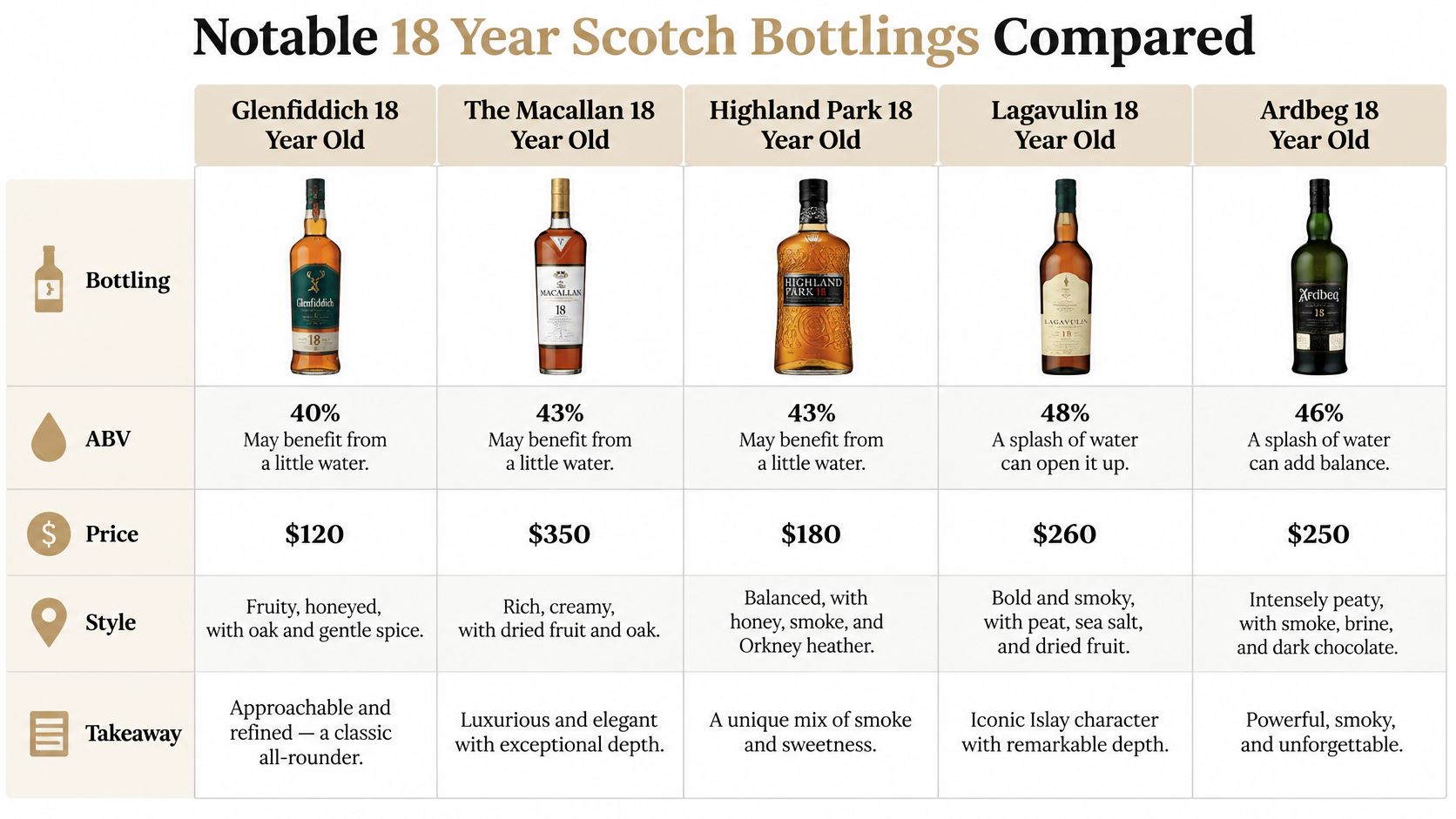
Notable 18 Year Scotch Bottlings Compared
The age statement gives these bottles a shared starting point, not a shared flavor or value. Compare them by style, strength, and the question each one helps answer.
| Bottling | ABV | Price | Why it stands out |
|---|---|---|---|
| Glenlivet 18 Year Old | 43% | About $150 | First place among eighteen-year single malts, with 92.6 points, in the 2024 International Whisky Competition |
| Bruichladdich Port Charlotte 18 Year Old | 54.3% | $199.99 suggested retail | Heavily peated Islay style at high strength, reported by The Daily Pour |
| Deanston 18 Year Old | 46.3% | $154 suggested retail | Mid-priced Highland example, listed by Whisky Advocate |
| Lagavulin Iain's Farewell Dram 18 Year Old | 58.7% | About $390 suggested retail | Limited run of 212 bottles, according to The Daily Pour |
| Chivas Regal 18 Year Old | 40% | About $70 | Widely available blended reference point |
ABV, or alcohol by volume, measures the proportion of alcohol in the whisky. It can affect how intense a pour feels, but it does not measure quality. The listed prices describe reported release pricing, not a promise of what a shop will charge.
Choose a reference, not a winner
Glenlivet offers a fruit-led Speyside reference. Its competition result is a useful point of comparison, not a guarantee that its profile will suit your palate.
Port Charlotte shifts the focus to heavily peated whisky at substantial strength. A small splash of water can help if alcohol heat obscures the smoke and texture.
Deanston gives you a Highland example at a more moderate strength than the boldest entries here. Compare what you find in the glass with your own expectations, rather than treating regional labels as a flavor checklist.
Keep scarce releases in perspective
Lagavulin Iain's Farewell Dram is notable for its limited release, but rarity does not make it a required choice for a first flight. An accessible smoky whisky can serve the same tasting purpose.
Chivas Regal adds a blended Scotch to a list otherwise centered on single malts. That contrast helps separate whisky style from category: assess the blend by its aroma, texture, and finish, just as you would any other pour.
Use this list to select contrasting styles, not to rank bottles by age or price. The premium attached to an eighteen-year label is a question to test in the glass.
What an 18 Year Scotch Costs and Why
Selected eighteen-year bottles can sell for roughly $75 to $180 in the United States, while recognizable luxury bottlings can cost several times more, as illustrated by The Whiskey Wash's retail roundup. That spread is wide enough to make the age statement alone a poor budgeting tool.
You may be paying for careful cask selection, limited stock, elaborate packaging, brand prestige, or some combination of them. Only some of those expenses directly concern the flavor you'll taste. An impressive presentation can make a satisfying gift without making its contents your favorite whisky.
Ask what the premium buys
Before purchasing, use these questions:
- What does the price per year tell me? Dividing price by stated age can expose a large prestige premium between same-age bottles. It isn't a measure of flavor or production cost.
- What useful detail does the producer disclose? Look for cask information, bottling strength, and a clear explanation of the expression. Specific information is more useful than an elaborate story about excellence.
- Am I buying drinking value or rarity? A limited release may appeal to a collector even when an accessible bottle better suits someone who wants to open and share it.
Availability also needs context. Producers have moved away from explicit age statements during supply pressure and reintroduced them as stock conditions changed. That doesn't establish that today's bottle is automatically better value than one purchased earlier. Compare actual local offers rather than relying on memories of an earlier market.
Buying advice: Pay extra for something you can identify and want, not simply for a more expensive label.
The useful contrarian test is straightforward: let a moderately priced bottle compete against a prestige bottle without revealing their identities. The less expensive whisky might be your preference, or it might provide almost as much enjoyment for substantially less money.
Set your budget before tasting. Then compare your preferred bottle with an alternative at a similar price, considering whether you'd happily buy it again. A whisky can be excellent and still be the wrong purchase for your household.
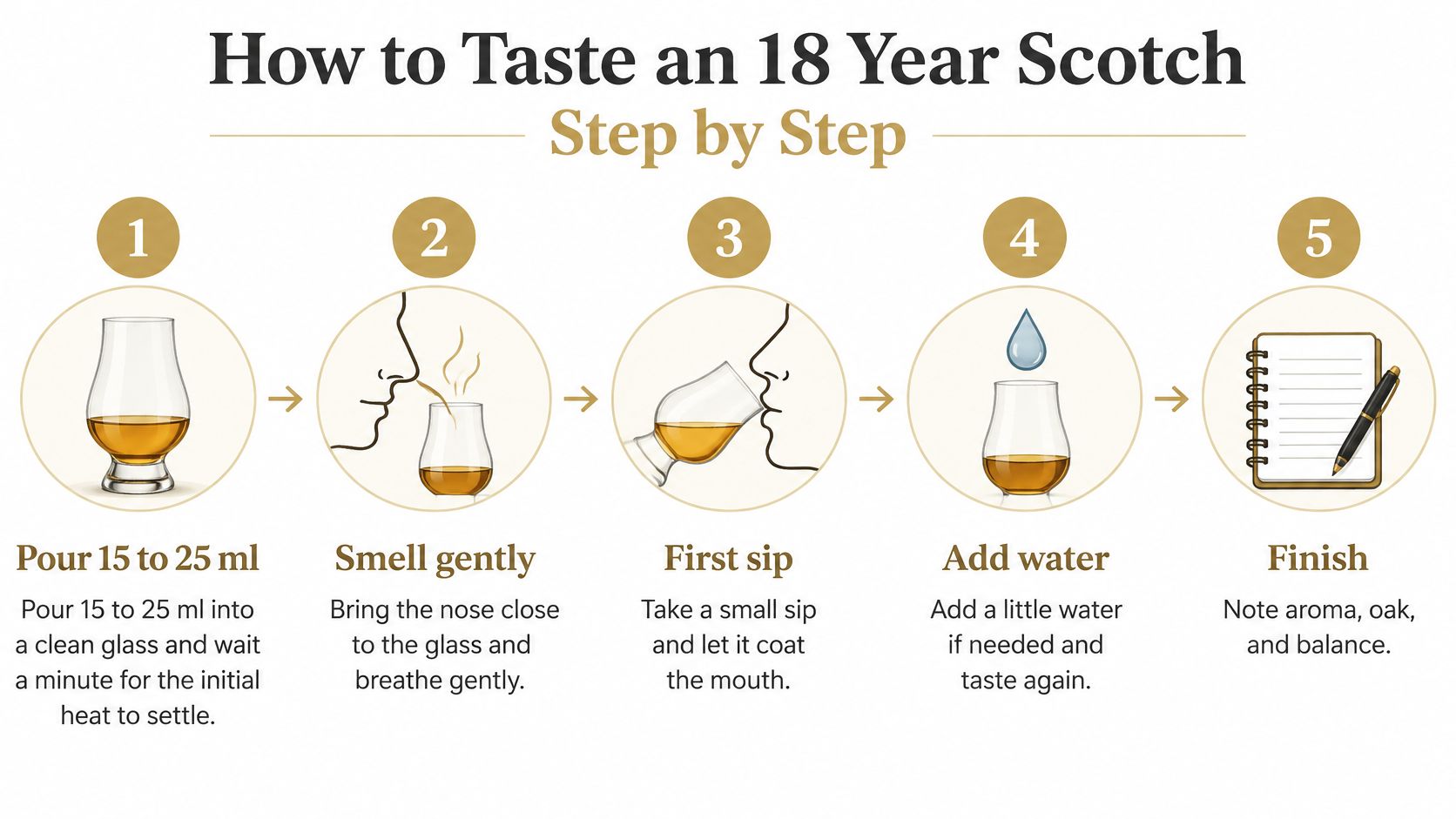
How to Taste an 18 Year Scotch Step by Step
An age statement can set expectations, but your glass gives you the evidence. A clean glass, a modest pour, still water, and a little patience are enough to follow how an 18 year Scotch smells and tastes. Keep food aromas, scented candles, and perfume away from the tasting area.
Build a repeatable routine
- Pour a modest sample. For a practical home exercise, pour 15 to 25 ml into a clean glass and wait about a minute. The pause lets the first impression of alcohol settle before you begin.
- Smell gently. Bring your nose toward the glass, breathe lightly, and keep your mouth slightly open, following Michelin's whisky-tasting guidance. Start with broad impressions, such as fruit, smoke, wood, or sweetness, rather than hunting for a specific fruit.
- Take a controlled sip. Let a small amount coat your tongue briefly before swallowing. Notice texture as well as flavor: oily, light, rounded, or drying are useful descriptions.
- Follow the flavor after swallowing. Separate the middle of the sip from the finish. Sweetness may give way to spice, or fruit may fade into dry wood. Lingering alcohol burn alone does not make a flavorful finish.
- Add water gradually. Taste neat first, then add a few drops of room-temperature still water and compare, following the Scotch Whisky Association's tasting toolkit. Water can change how aromas and flavors come across; add it in small amounts so you can notice the difference.
- Record the change. Note whether the aroma became clearer, the texture thinned, or the finish improved. Stop when you prefer the result.
Avoid the beginner traps
A forceful sniff can overwhelm your nose with alcohol vapor. Move the glass away, breathe normally, then return with a gentler inhale.
Ice changes both temperature and dilution, making it harder to tell which affected your impression. Start without it when learning a bottle, and leave a pause between sips rather than rushing to name every flavor.
For more guidance on organizing your impressions, see our guide to tasting Scotch whisky. The same habit of separating a drink's identity from its serving method can help across categories. Draft beer explained offers a companion introduction to beer terminology.
Your description may become clearer after the opening sips as your palate adjusts. Taste patiently, and let the whisky in the glass guide what you notice.
Judging an 18 Year Scotch in a Blind Tasting
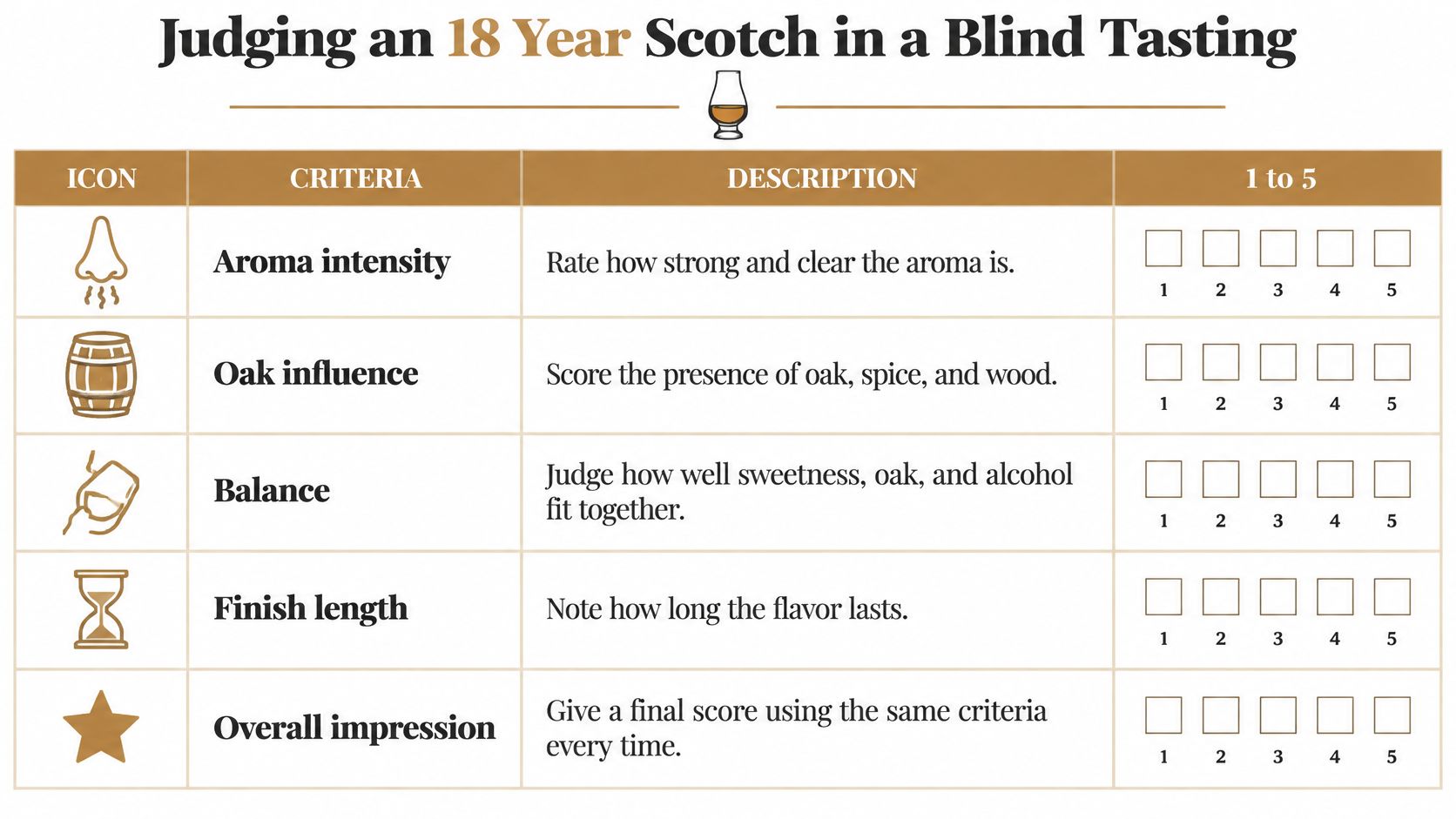
Score these criteria on a one-to-five scale for a home exercise. Keep intensity and enjoyment separate: a powerful flavor isn't necessarily a pleasing one.
- Aroma intensity: How strong and clearly defined are the aromas?
- Oak influence: How prominent are vanilla, spice, tannin, and dried-fruit impressions?
- Spirit character: Can you distinguish fruit, grain, or smoke beneath the wood?
- Balance: Do the spirit, oak, sweetness, and alcohol fit together?
- Finish length: How long do recognizable flavors remain?
For the oak column, a higher score means more influence, not better quality. Mark your favorite separately so a wood-heavy whisky doesn't win automatically through arithmetic.
Hide the information that creates expectations
For example, arrange a 12-, 15-, and 18-year comparison using similar styles and matching labeled strength where practical. Have a friend pour coded glasses while keeping bottles, packaging, and prices out of sight. If strengths differ, record that limitation rather than pretending alcohol concentration can't affect your judgment.
A useful question raised by Lochs of Whisky's discussion of eighteen-year whisky is whether drinkers can recognize maturity and whether they prefer it. Those are different questions. Guess the oldest sample, then choose your favorite before revealing either answer.
Hypothetical completed score sheet
| Sample | Aroma | Oak | Spirit | Balance | Finish | Total |
|---|---|---|---|---|---|---|
| A | 4 | 3 | 4 | 5 | 4 | 20 |
| B | 4 | 5 | 2 | 2 | 4 | 17 |
| C | 3 | 2 | 4 | 4 | 3 | 16 |
In this illustrative result, sample B has the strongest oak but doesn't provide the best balance. Sample A would be a more persuasive favorite if its flavors also suited the drinker.
Interpret the result cautiously
If the older whisky wins on balance and finish, maturation may be contributing something you value. If it wins only on oak intensity, consider whether wood has displaced more interesting spirit character.
That doesn't prove the underlying spirit was weak. A home flight can reveal your preference, but it can't isolate every production decision or establish that you can identify age reliably.
Repeat the exercise on another occasion with different codes if you want to test recognition. Keep the first result as an observation, not a permanent verdict about a brand or age category.
Choose a First 18 Year Flight
Build this month's flight around Glenlivet 18, a younger Scotch with a similar fruit-led style, and an American craft whiskey as the contrast. For that final glass, consider a bourbon from Frey Ranch or Southern Star rather than searching for an American bottle that imitates Scotch.
Craft doesn't mean amateur, and it doesn't specify a flavor. A University of Kentucky publication counts fewer than 100 U.S. craft operations in 2005 and more than 3,000 by 2024, with most producing under 100,000 proof gallons annually.
Using a different definition, ACSA research cited by Whisky Advocate identifies 2,753 distilleries below a 750,000-proof-gallon threshold, representing nearly 8% of U.S. spirits market value and more than 14 million cases. These aren't interchangeable counts. They illustrate why the category includes producers operating at different scales.
Make the contrast useful
An American craft bourbon isn't another rung on a Scotch age ladder. Its purpose is to reveal whether you prefer a different whiskey style altogether, even when you expected the mature Scotch to win.
- Hide the bottles. Ask a friend to pour equal samples and cover the labels.
- Commit your guesses. Record age, proof, and whiskey type before looking.
- Use the score sheet. Choose your favorite without adding points for brand recognition.
- Reveal and price-check. Compare the preferred Scotch with current local alternatives and decide whether rarity matters to you.
At Blind Barrels, members make those age, proof, and whiskey-type guesses before the reveal in our Whiskey Game, then receive an accuracy score. Each quarter, members discover a new whiskey distillery and can order member-discounted full bottles for their cabinet.
If you're turning the tasting into a gathering, BeeHive Mobile Bar's guide to sparkling wine and spirits for celebrations can help you plan drinks for guests who don't want whiskey. For readers 21 and over, keep samples modest, sip slowly, and let the scores guide the next bottle purchase.
Blind Barrels offers quarterly blind tasting kits featuring small American craft distilleries, with tasting guidance and a reveal that lets you compare expectations with what you enjoyed. Visit Blind Barrels to practice choosing whiskey by flavor rather than age, price, or label.