

Finding the small batch bourbon best suited to your palate is a personal quest, not a race to a finish line. Think of it less like crowning a single champion and more like discovering your favorite band—the "best" one is simply the one that speaks to you. This guide is your roadmap for that journey into the exciting world of American craft whiskey.
Your Guide to Navigating the World of Small Batch Bourbon
Stepping into a good whiskey shop can feel a little overwhelming. The shelves are packed with bottles, and the labels are a whirlwind of heritage claims, unique grains, and special aging techniques. But don't worry. This guide is here to cut through the noise, turning that potential confusion into a confident exploration, especially for new whiskey drinkers.
Our goal is simple: demystify the term ‘small batch’ and show you how to zero in on a bourbon that hits all the right notes for you.
Think of this as your compass for understanding the real artistry behind American craft whiskey. Unlike the big, mass-produced spirits, these bourbons are the passion projects of distillers who are chasing unique, character-rich flavors. It’s all about quality over quantity, a philosophy that always leads to a more memorable pour.
What You Will Discover
As you read on, you’ll pick up practical knowledge that makes the process of discovery just as enjoyable as the bourbon itself. We want you to feel empowered to walk into any store and choose your next bottle with excitement, not anxiety.
Here’s a taste of what we'll cover:
- Decoding the Label: You'll learn how to read a bourbon label like a pro, finally understanding what terms like "mash bill," "proof," and "age statement" actually mean for the liquid inside.
- Tasting with Confidence: We'll walk you through interpreting aromas and flavors, helping you pinpoint the subtle notes that make each small batch bourbon its own thing.
- Exploring Modern Distilleries: Get introduced to the innovative American craft distilleries that are pushing the boundaries and redefining what modern bourbon can be.
The search for the "best" small batch bourbon is really about education and exploration. It’s about learning what you value in a whiskey—whether that’s a spicy rye kick, a smooth wheated profile, or a deep, oaky finish.
This guide will give you the tools you need for the adventure ahead. We'll build from basic concepts to practical tips, making sure you have a solid foundation for your tasting journey. By the end, you won’t just understand what makes a small batch bourbon special—you'll have the confidence to find your own personal favorite.
What Defines a Small Batch Bourbon?
Walk down any whiskey aisle, and you’ll see "small batch" proudly displayed on plenty of labels. It feels special, like you're getting something high-quality, but what does it really mean? Here's the catch: unlike legally protected terms like "straight bourbon" or "bottled-in-bond," there is no official, government-mandated definition for what makes a bourbon "small batch."
This can be a bit confusing if you're new to the world of whiskey. It’s not about hitting an exact number, though the general industry consensus often lands somewhere between 10 to 150 barrels. The term is really more about an artisanal philosophy than a hard-and-fast rule.
Think of it this way: a master chef isn't just going to dump every vegetable from the pantry into one giant stockpot to make soup. They carefully select the best, most flavorful ingredients, combining them in just the right amounts to create a perfect, consistent dish. A small batch bourbon is born from that very same intention.
The Art of the Blend
At its heart, the small batch concept is all about curation and consistency. A master distiller is aiming to create a specific, repeatable flavor profile that truly represents the best their distillery can produce. They get there by hand-selecting a limited number of aged barrels and blending their contents together.
This process is a delicate art form. Every single barrel of bourbon matures differently, developing its own unique personality based on where it sat in the rickhouse, the particular piece of oak it was made from, and even the weather during its years of aging. One barrel might come out bursting with vanilla and caramel, while its neighbor is spicier, full of cinnamon and clove.
By blending these barrels, distillers can smooth out the quirks of any one barrel. They can amplify the flavors they want and tone down the ones they don't, creating a final product that is complex, balanced, and reliably excellent from one bottle to the next.
The term 'small batch' signifies a hands-on approach where the distiller meticulously crafts a bourbon's final flavor. It's a promise of quality control and a distinct point of view, not just a measure of quantity.
This is a totally different game from a single barrel bourbon, which is bottled from—you guessed it—one individual barrel. A single barrel is a unique snapshot in time, offering a one-of-a-kind taste that can never be perfectly recreated. A small batch, on the other hand, is the distiller's signature work of art, designed to be dependably delicious every time.
Why American Craft Distillers Embrace It
Many of today's best American craft whiskey producers have built their entire reputation on the small batch philosophy. For these smaller operations, this method is their ace in the hole. It allows them to go toe-to-toe with the industry giants by focusing on exceptional quality rather than sheer volume. It’s a way for them to put their unique grains, yeast strains, and aging techniques on full display.
For anyone new to whiskey, this creates a fantastic entry point. Grabbing a small batch bourbon from a reputable American craft whiskey brand is a surefire way to experience a well-made, balanced spirit and get a clear sense of that distillery's style. To dig a little deeper, you can check out our full guide to understand what is craft whiskey and see how these producers are shaking up the industry.
So, what does this all mean for the person holding the glass?
- Consistency: You can buy a bottle of Four Roses Small Batch or Elijah Craig Small Batch today and another a year from now, and you can trust you're getting a very similar, high-quality experience.
- Complexity: Blending multiple barrels adds layers of flavor. You might get sweet notes from one barrel, oak from another, and a kick of spice from a third, all harmonizing perfectly in your glass.
- Accessibility: Small batch bourbons offer a curated taste that is often more balanced and approachable than the wild, unpredictable variations of a single barrel, making them an ideal starting point for your journey.
Ultimately, finding the small batch bourbon best for you is about understanding this philosophy. You're not just buying bourbon; you're buying a distiller's specific vision for what great bourbon should taste like.
How To Taste Bourbon Like A Seasoned Pro
To find the best small batch bourbon for you, it all starts with one simple thing: learning how to actually taste it. This isn't about being stuffy or pretentious; it's about unlocking the complex story each bottle wants to tell. Distillers and die-hard enthusiasts use a straightforward, three-step process to break down the experience, and you can, too.
Forget about complicated rituals. All you really need is a decent glass (a Glencairn is perfect for focusing the aromas) and an open mind. This approach will train your senses to pick up on the subtle differences that make American craft whiskey so compelling.
This flowchart shows the journey from mass-produced whiskey to the carefully curated experience of small batch and single barrel bourbons.
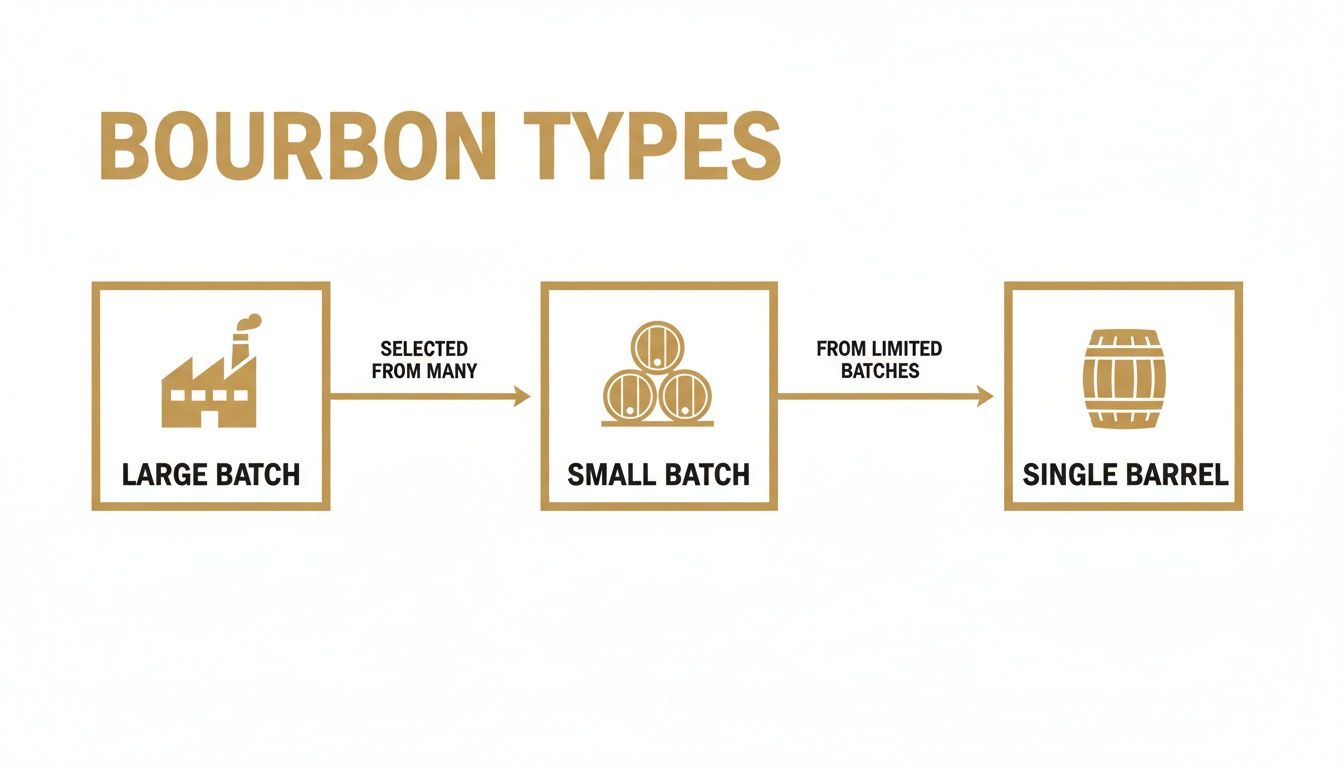
As you can see, moving from Large Batch to Small Batch involves a much greater focus on selection and quality control.
Step 1: The Nose
Believe it or not, before you even take a sip, your nose is doing most of the heavy lifting. A staggering 80% of what we perceive as "taste" is actually driven by aroma. Give the bourbon a gentle swirl in the glass—this coats the sides and releases its aromatic compounds, letting you get a clear sense of its profile.
Bring the glass toward your nose, but keep your mouth slightly open. This simple trick prevents the alcohol vapor from overwhelming your senses. Take short, light sniffs and just think about what you’re smelling.
Common Aromas to Look For:
- Sweet: Caramel, vanilla, brown sugar, honey, or toasted marshmallow.
- Fruity: Dried cherries, raspberry, baked apple, or a pop of citrus zest.
- Spicy: Cinnamon, clove, black pepper, nutmeg, or other baking spices.
- Earthy: Toasted oak, old leather, pipe tobacco, or even a hint of dark chocolate.
Don't sweat it if you can't name everything right away. Training your nose takes a little practice. The more you do it, the more distinct aromas you'll start to recognize.
Step 2: The Palate
Alright, it’s time for that first sip. Take a small amount into your mouth and let it roll over your entire tongue. This initial taste, sometimes called the "Kentucky Chew," gets your palate used to the alcohol and starts to unveil the bourbon's true character and mouthfeel.
What flavors hit you first? Is it sweet and caramel-forward like a classic bourbon, or does a peppery rye spice jump out? This is the moment where all the distiller's choices—from the grain recipe to the barrel char—really come to life.
The 'palate' is where the mash bill truly reveals itself. A high-corn bourbon will lean sweet, a high-rye will bring the spice, and a wheated bourbon will offer a softer, smoother experience.
This is also where you'll notice the bourbon's texture. Does it feel oily and thick, or is it light and crisp? A richer, more viscous mouthfeel often points to a non-chill-filtered bourbon, a technique many American craft whiskey brands use to keep more of the flavorful oils and fatty acids from the barrel.
Step 3: The Finish
The finish is all about the lingering sensation after you've swallowed. A high-quality small batch bourbon won’t just disappear; it will have a finish that evolves, leaving behind warm, pleasant notes that can last for a minute or more.
A long, warming finish is almost always a sign of a well-made, well-aged spirit. On the flip side, a finish that’s short, harsh, or unpleasantly sharp can be a sign of a younger or less balanced whiskey.
Ask yourself a few questions about the finish:
- How long does it last? Does the flavor vanish instantly, or does it stick around?
- Is it warming? That gentle warmth spreading through your chest is what's affectionately known as a "Kentucky Hug."
- What flavors remain? Often, the finish brings out different notes than the initial taste, like more oak, leather, or dark chocolate.
By breaking down the tasting experience into these three stages—Nose, Palate, and Finish—you can go from just "liking" a bourbon to truly understanding why you like it. For a deeper dive with some more advanced techniques, you can learn how to taste whiskey like a professional in our dedicated guide. This methodical approach is your key to confidently exploring the incredible world of American craft bourbon and finding what you love.
Alright, you've got the theory down. You know what makes a small batch, well, a small batch, and you've got the tasting fundamentals in your back pocket. Now for the fun part: putting that knowledge to the test.
The real joy of bourbon isn’t just in the drinking; it’s in the discovery. To get you started on your own journey, we’re shining a spotlight on a few exceptional American craft whiskey brands. This is more than a list—it's a look inside the stories and unique processes that make these bottles stand out in a very crowded field.
We'll connect the dots from what we've already covered, looking at the mash bill, age, and flavor profile for each. Think of this as a reliable starting point for finding the small batch bourbon best suited to your own palate, with a mix of beloved craft icons and some exciting new faces.
Four Roses Small Batch: The Art of the Blend
Four Roses is a legendary name in Kentucky, and their take on small batch bourbon is a masterclass in the art of blending. While many distilleries work with just one or two recipes, Four Roses famously juggles ten distinct bourbon recipes. They get this variety from two different mash bills and five proprietary yeast strains.
For their standard Small Batch expression, they meticulously select and combine four of these recipes to hit that signature flavor profile. This gives their master distiller an incredible palette to work with. It's like a painter mixing colors—they can add a touch of fruity yeast here, a bit of spicy rye there, and the result is a bourbon that is perfectly balanced, smooth, and consistently delicious.
- Mash Bill: A blend of four distinct recipes. Two are high-rye (75% corn, 20% rye, 5% malted barley) and two are lower-rye (60% corn, 35% rye, 5% malted barley).
- Age: The bourbons in this blend typically rest for 6 to 7 years.
- Tasting Notes: Expect a mellow and creamy pour. The nose offers gentle spice and sweet fruit, while the palate brings hints of ripe red berries, vanilla, and caramel. It all wraps up with a soft, smooth finish that’s just remarkably balanced.
If you're new to whiskey, Four Roses Small Batch is an absolutely fantastic introduction. It’s approachable, complex without being intimidating, and a beautiful showcase of how expert blending can create something truly special.
Wilderness Trail Small Batch Bottled in Bond: A Grain-to-Glass Pioneer
Hailing from Danville, Kentucky, Wilderness Trail Distillery is an American craft whiskey brand that has built a stellar reputation on its scientific, transparent approach to making whiskey. These guys are true "grain-to-glass" producers, which means they control every single step, from sourcing local grains right through to bottling the final product. Their Small Batch Bottled-in-Bond bourbon is a perfect example of their meticulous craft.
One of the things that makes them special is their use of a sweet mash process instead of the more common sour mash. This means every batch starts completely fresh, without using any leftover mash from a previous run. It's a tougher technique that demands absolute precision, but the payoff is a softer, cleaner, and distinctly flavorful bourbon.
"A Bottled-in-Bond bourbon must be the product of one distillation season, by one distiller at one distillery. It must be aged in a federally bonded warehouse for at least four years and bottled at exactly 100 proof (50% ABV)."
This designation has been a mark of quality for over a century, and Wilderness Trail's expression is a modern classic. Their choice to go with a high-rye mash bill adds a wonderful layer of complexity and spice.
- Mash Bill: 64% Corn, 24% Rye, 12% Malted Barley. That rye content is higher than average for a Kentucky bourbon and delivers a delightful spice kick.
- Age: At least 4 years, as required by the Bottled-in-Bond regulations.
- Tasting Notes: On the nose, look for caramel, vanilla, and cinnamon. The palate is rich and buttery with flavors of baked apple, cloves, and black pepper, which flows into a long, warm finish of oak and spice.
Frey Ranch Straight Bourbon: A Taste of the Terroir
Now let's head west to Fallon, Nevada, where American craft whiskey brand Frey Ranch is proving that incredible bourbon isn't just a Kentucky thing. What makes Frey Ranch so unique is their estate-grown philosophy. A full 100% of the grains in their bourbon are grown, harvested, and malted right there on their 1,500-acre farm.
This gives them an unparalleled level of control over their ingredients and creates a bourbon with a true sense of place, or "terroir." Their flagship Straight Bourbon is a "four-grain" whiskey, using corn, rye, wheat, and barley. This complex mash bill results in a spirit with incredible depth—it's both robust and beautifully nuanced.
- Mash Bill: 66.6% Corn, 11.4% Winter Rye, 10% Winter Wheat, 12% Two-Row Malted Barley.
- Age: Usually aged for about 5 years.
- Tasting Notes: The nose is complex, with notes of vanilla, citrus, and dried herbs. On the palate, you’ll find a creamy mix of caramel, banana bread, and cedar. It all transitions into a long, satisfying finish of black pepper spice and lingering oak.
Frey Ranch is a testament to the passion and innovation driving the craft spirits boom across the entire country. For even more recommendations, you can explore our guide to other must-try small batch bourbon brands that are making waves in the industry.
The Craft Revolution Shaking Up the Bourbon Industry
If you've found yourself increasingly drawn to small-batch bourbon, you're not alone. It's a key part of a huge global shift in how we drink—a trend often called "premiumization." Put simply, we're all starting to value artisanal quality and unique experiences more than mass-produced quantity.
This movement is really about a search for something more authentic. We want to know the story behind what’s in our glass, feel a genuine connection to the makers, and explore flavors that are truly distinctive. And American craft whiskey brands have become the heroes of this story, stepping up to meet that demand with real passion and creativity.
A Growing Thirst for Quality and Authenticity
The numbers tell the story loud and clear. While the entire bourbon market has seen incredible growth, the real action is happening at the top. Super-premium categories have absolutely surged, driven by demand for the limited-run, age-stated, and single-barrel releases that American craft whiskey brands specialize in.
Premiumization has pushed small-batch bourbon straight into the spotlight. Super-premium categories recently jumped by 18%, part of a total U.S. bourbon market worth $5.3 billion. Of that, over 2,500 U.S. craft distilleries contributed $1.4 billion, carving out their niche with an artisanal edge. You can find more insights about the bourbon industry outlook and this exciting trend.
This groundswell of consumer interest has given small, independent distilleries the breathing room to challenge the industry giants—not on volume, but on pure character and innovation. They're the ones pushing the boundaries, creating one of the most dynamic eras in the history of American whiskey.
Innovation Born from Passion
This craft revolution has kicked off an incredible wave of creativity. Because small-batch producers aren't chained to massive production quotas, they have the freedom to experiment. This is where the magic happens, leading to exciting new expressions that bring fresh character to the world of bourbon.
Some of the key areas these American craft whiskey brands are innovating include:
- Experimental Grains: Distillers are playing with everything from heirloom corn varieties and different types of rye to unconventional grains like quinoa or blue corn to create entirely new flavor profiles.
- Unique Barrel Finishes: The practice of finishing bourbon in a second cask—like one that previously held port, sherry, or even craft beer—is adding incredible layers of complexity and nuance.
- Yeast Strain Exploration: Just like in craft beer, distillers are treating yeast as a crucial flavor ingredient. They're cultivating their own proprietary strains to produce specific fruity, spicy, or floral notes in the final spirit.
The rise of craft distilling isn't just about making bourbon on a smaller scale; it's a fundamental shift in philosophy. It’s a commitment to transparency, terroir, and the belief that a great whiskey should tell the story of where it came from.
For anyone new to whiskey, there's never been a better time to start exploring. The sheer variety available today means there's a perfect small-batch bourbon out there for every palate, from sweet and traditional to bold and experimental. The key is to just embrace the journey of discovery. Start with a style you think you’ll enjoy, and don't be afraid to ask for recommendations at your local shop. Every bottle from an American craft whiskey brand is an invitation to taste something new and support a maker's unique vision.
Actionable Tips for Buying and Savoring Your Bourbon
Alright, you’ve got the knowledge. Now comes the fun part: heading out to find your next favorite bottle and bringing it home. The real key is to shop smart and set yourself up to savor every single pour.
This is the practical advice that will help you make a great purchase and create the perfect tasting right in your own home.
Making a Smart Purchase
If you're just getting into whiskey, your best asset is the knowledgeable staff at a good specialty liquor store. Don't be shy. Tell them what you’ve liked before—even if it isn't whiskey—and what you're curious about. They can point you toward American craft whiskey brands that align with your tastes.
As you wander the aisles, keep a few things in mind:
- Start Small: Not sure if you'll love a certain distillery's profile? Look for a 375ml bottle. It's a fantastic, low-commitment way to explore something new without dropping cash on a full-sized bottle.
- Seek Distillery Exclusives: If you find yourself near a craft distillery, pop into their gift shop. They almost always have distillery-only releases that give you a unique taste of their more experimental work.
- Look Beyond the Hype: This is a big one. The small batch bourbon best suited for you is all about your own palate, not a hefty price tag or a flashy label. You'd be surprised how many award-winning craft bourbons are incredibly affordable.
Setting Up the Perfect Tasting Experience
Once you've got your bottle, a few simple touches can completely transform your tasting. This isn't about being fancy; it's about letting the bourbon's true character come through.
Tip for New Drinkers: The right glass does more than just hold your whiskey—it actively shapes your perception of its aroma and flavor. It's the single most important tool for a great tasting.
A Glencairn glass, with its signature tulip shape, is purpose-built to concentrate the bourbon's aromas. It makes it much easier to pick out all those distinct notes of caramel, spice, and oak.
After you’ve smelled and sipped the bourbon neat, add a single drop of water. Just one. It can lower the proof just enough to unlock entirely new layers of flavor and aroma. It's a little trick that professional tasters use all the time, and a great way for newcomers to temper the alcohol "burn."
Finally, think about some simple food pairings. A piece of high-quality dark chocolate or a sharp, aged cheddar can beautifully complement the rich notes in your bourbon. These pairings create a conversation between the food and the spirit, bringing out the best in both and turning every sip into a memorable moment.
A Few Common Questions About Small Batch Bourbon
Diving into the world of American craft whiskey always stirs up a few questions. Let's tackle some of the most common ones to clear things up as you start your search for the perfect small-batch bourbon.
Is Small Batch Better Than Single Barrel?
One isn’t better than the other—they’re just different beasts, offering totally unique tasting experiences.
Think of a single barrel bourbon like a solo artist's live concert. It’s a raw, unfiltered snapshot of one specific cask, giving you a distinct, one-of-a-kind profile that can never be exactly duplicated. It's all about that singular, unrepeatable moment.
A small batch bourbon, on the other hand, is more like a band’s finely-tuned studio album. It’s the master distiller playing producer, carefully blending multiple barrels to achieve a specific vision of balance, complexity, and consistent quality.
So, what’s your jam? The unique character of a single barrel, or the crafted harmony of a small batch? Your preference is all that matters.
Tip for New Drinkers: If you're just starting out, small batch is a fantastic entry point. The consistency helps you get a real feel for a distillery's signature style, making it easier to figure out which flavors you truly enjoy.
Does a Higher Price Tag Mean Better Bourbon?
Not necessarily. While things like premium ingredients and extra years in the barrel will drive up costs, a high price can just as easily reflect a massive marketing budget or manufactured scarcity rather than what's actually in the bottle.
Don't let the price tag fool you; there are tons of exceptional American craft whiskey brands out there offering incredible value.
The best way to find true quality is to trust your own senses. Use the tasting principles we’ve talked about to discover what you genuinely enjoy, instead of letting a price sticker dictate your choice. At the end of the day, your palate is the only judge that matters when it comes to finding the small batch bourbon best for you.
What Is the Best Way to Store My Bourbon?
Good news: proper storage is simple, but it's absolutely crucial for protecting your whiskey.
- Store it upright. That high-proof alcohol can eat away at the cork over time if the bottle is on its side, which could ruin the seal and your whiskey.
- Keep it cool and dark. Find a spot for your bottles away from direct sunlight and big temperature swings. A closet or a cabinet works perfectly.
An opened bottle, as long as you seal it up tight, can keep its character for years. You might notice some subtle changes over a long period, but it won’t go bad.
Ready to stop guessing and start discovering your next favorite American craft whiskey? At Blind Barrels, we send you curated blind tasting kits featuring top-shelf bourbons from incredible small distilleries. It's time to let your taste buds lead the way and find what you truly love, without any brand bias getting in the way. Explore our whiskey tasting kits today!