

The most common advice for a first smooth pour is to grab a famous bottle and stop worrying. That advice is lazy. A household name can still burn, and a small distillery can drink softer than a national label if the mash bill, proof, and barrel work line up. Smooth whiskey brands are not a hall of fame. They are bottles whose heat, texture, and sweetness you can assess.
Start with American craft whiskey, then run a short blind tasting so your palate, not the label, picks the winner.
Smooth Whiskey Brands to Try First
Five American craft bottles belong on a first shortlist because of grain, proof, age, or barrel work. Order them by the job you want the whiskey to do, then confirm the ranking in a blind pour. Where a producer has not published an age statement, the table says so.
| Expression | Style | Age statement | Why it made the list |
|---|---|---|---|
| 13th Century Whiskey Company Toasted Barrel Straight Bourbon | Straight bourbon with toasted-barrel finish | 6 years | Extra year in a heavily toasted Char 1 cask rounds out the oak |
| Bull Run Distilling Company Cask Strength Straight Bourbon | Cask strength straight bourbon | 4 years | Medium-long finish with cedar and licorice notes |
| Middle West Spirits Cask Strength Straight Wheat Whiskey | Straight wheat whiskey, cask strength | No age statement | Ranked #14 on the Whisky Advocate Top 20 List for 2025 |
| McKenzie Bottled-in-Bond Wheated Bourbon | Wheated bourbon, bottled in bond | No age statement | Wheat in the mash bill points to a softer, rounder style |
| Doc Holliday 10 Year Straight Bourbon | Straight bourbon | 10 years | Long barrel aging for vanilla and oak depth |
Pour 13th Century first if you want the clearest barrel lesson on the list. It spends five years in 30-gallon casks at Char 2, 3, 4, and 5, then one year in a 53-gallon heavily toasted Char 1 cask. That finishing year pushes dessert sweetness forward and is the reason it leads. Bull Run is the useful contrast: a 4-year cask-strength bourbon whose cedar and licorice finish stays lively instead of turning soft. Middle West is wheat whiskey at barrel proof. The Whisky Advocate #14 ranking for 2025 is a quality signal, not proof the whiskey will feel gentle. McKenzie is the beginner grain choice. Wheat in the mash bill usually reads rounder than a rye-heavy bourbon. Doc Holliday is the long-aged pick, and its 10-year statement is easy to explain in one sentence to anyone you pour for.
What craft actually means
Craft is a size and ownership test. The American Craft Spirits Association defines an active U.S. craft distiller as a licensed producer that removes no more than 750,000 proof gallons, about 394,317 nine-liter cases, from bond a year, markets itself as craft, is not openly controlled by a large supplier, and has no proven ethics-code violation. Apply that threshold when an unfamiliar bottle claims small-batch status. Scale and ownership decide it, not the font on the label.
What Makes a Whiskey Feel Smooth
Smooth is partly a body response and partly a preference. Ethanol activates TRPV1 receptors tied to heat and irritation, so a higher alcohol level usually means more burn. Aroma, sweetness, oak, texture, and finish still change whether that burn feels harsh or welcome. The Whiskey Wash is right that low burn is not the same thing as low flavor. A whiskey can carry plenty of taste and a long finish and still bite.
Split the word into five checkable dimensions:
- Alcohol heat: the prickle in the nose and the burn on the tongue.
- Mouthfeel: thin, oily, creamy, or drying.
- Sweetness: grain sugar, caramel, or dessert notes, not added sugar.
- Oak intensity: vanilla and toast versus bitter wood and tannin.
- Finish length: how long flavor stays after you swallow, and whether heat outlasts it.
A 90-proof wheated bourbon can feel round because wheat softens the edges even when the proof is not especially low. An 80-proof rye-heavy bottle can taste sharper, because rye brings pepper and structure that a few points of alcohol do not erase. If you only chase the gentlest first sip, you will miss bottles with real flavor.
Four label variables, plus one warning
Beam Distilling treats proof as a first pass, not a quality score. Standard bourbon is bottled at a minimum of 80 proof, and many mainstream expressions sit around 80–90 proof. Lower ethanol generally cuts perceived heat. Mash bill is the next lever: wheated bourbon tends toward a softer, rounder profile, while rye-heavy bourbon adds pepper, spice, and more structure. Aging in new charred oak adds vanillin, caramel, and wood compounds and can take the sharpest edges off. Cask type changes the picture again. Mizunara oak, for instance, throws a different aromatic set than American oak.
Cask strength is the warning. Undiluted barrel proof can hide alcohol behind sweetness and oak. The first impression feels rich. The third sip shows the heat. That is why Bull Run and Middle West belong on a shortlist and still need water before you call them easy.
| Variable | Effect on smoothness | What to record |
|---|---|---|
| Proof | Lower ethanol reduces heat; standard bourbon is at least 80 proof, many at 80–90 | Bottling proof from the label |
| Mash bill | Wheat gives a softer, rounder profile; high rye adds pepper and spice | Secondary grain (wheat, rye, or both) |
| Age statement | Longer aging adds vanilla, caramel, and wood notes and softens sharp edges | Stated age, or no age statement if none is given |
| Barrel and char | New charred oak adds vanillin and caramel; cask type changes the profile | New or used oak, char level, any finishing barrel |
| Cask strength | Undiluted barrel proof can hide alcohol behind sweetness | Whether the bottle is cask strength |
Before you taste, write down proof, secondary grain, stated age, and barrel type. Then answer one question in your own words: do you want less burn, a creamier mouthfeel, more sweetness, quieter oak, or a finish that does not sting? That answer is the only ranking that matters.
Tasting Profiles of Smooth Expressions Compared
Published notes beat a one-word "smooth" claim. Two bottles from the shortlist have enough producer detail to compare. The gaps matter as much as the flavors.
| Expression | Aroma | Palate and finish |
|---|---|---|
| 13th Century Toasted Barrel Straight Bourbon | Wine-soaked oak, roasted cinnamon almonds, pecan pie with vanilla ice cream, toasted herbs | Mahogany, cigar box, leather, candied ginger; finish of drying tannins, dark roast coffee, and buckwheat honey |
| Bull Run Cask Strength Straight Bourbon | Not published | Spicy, French roast, Raisin Bran, soft vanilla, cinnamon almond; medium-long finish with cedar and licorice |
13th Century reads soft because the oak is sweet
The aroma is dessert-led: wine-soaked oak staves, roasted cinnamon almonds, warm pecan pie with vanilla ice cream, and toasted herbs. On the palate you get rich mahogany, cigar box, leather, walnut skins, sarsaparilla, and candied ginger, with s'mores and strawberry marshmallow in the mix. The finish dries into tannins, dark roast coffee beans, and buckwheat honey. Those tannins could read bitter. They don't dominate, because the toasted Char 1 year keeps a sugary oak frame around them. Heat is not the story here. Texture and sweet wood are.
Bull Run needs a pause
The palate is spicy, with French roast, Raisin Bran, soft vanilla, and cinnamon almond. The finish is medium-long, cedar and licorice lingering. No aroma note has been published for this bottle, so don't invent one from the palate. Smell it yourself and write what you get before the first sip. Spice plus cask strength means the first hit will feel hotter than 13th Century. A few drops of water, or a sip you hold instead of swallowing immediately, lets the vanilla and almond come forward. If you judge it on the opening burn alone, you will misread it.
Practical rule: sweetness can make tannin feel polished, and water can make spice feel round. Neither trick removes alcohol. It only changes which dimension you notice first.
If you want a shared vocabulary for those notes, the bourbon flavor wheel keeps "smooth" from swallowing every descriptor. Use it to name oak, grain, and spice separately, then decide which of the five dimensions won.
Matching Smooth Styles to the Occasion
The bottle that fits Tuesday night is not the bottle you hand someone as a gift. Match the style to how the whiskey will be drunk.
First sip, neat. Pick a wheated or long-aged bourbon at 80–90 proof. McKenzie is the grain answer. Doc Holliday 10 Year is the age answer. Lower heat lets a new drinker hear the flavor instead of flinching. New drinkers almost always score the first sip and stop. The second and third sips show balance. Wait for them.
Cocktails and highballs. You want a clear vanilla or caramel core that survives soda or a simple syrup. A cask-strength bottle can work, but only after you dilute it more than you would for a neat pour. Bull Run and Middle West are poor "splash of mixer" bottles until that extra water is in the glass. An 80–90 proof wheated bourbon is the easier highball base.
A gift. Stated age plus a profile you can say out loud beats a cult label the recipient has never seen. "It's a 10-year bourbon, more vanilla than pepper" is a complete sentence. Doc Holliday does that job. So does 13th Century if you mention the toasted-barrel finish rather than the distillery name.
After dinner. A barrel-finished bourbon with dessert notes belongs in a small glass, sipped slowly. 13th Century's pecan, ginger, and honey finish sits next to a last bite of something sweet without fighting it. Don't pour it tall.
The best smooth whiskey for a situation is the one the drinker will pour again, not the one with the highest score on someone else's list.
Pairing makes those flavors obvious. A vanilla-forward wheated bourbon next to a vanilla dessert shows the sweetness you already tasted. A rye-heavier pour next to something salty shows the pepper. The food and whiskey pairing guide is the longer map if you want more than those two matches. If the pour is for guests, host a smoother evening gathering the same way you would any dinner: small serves, water on the table, and no speech about the bottle before people have tasted it.
How to Run a Blind Smoothness Tasting
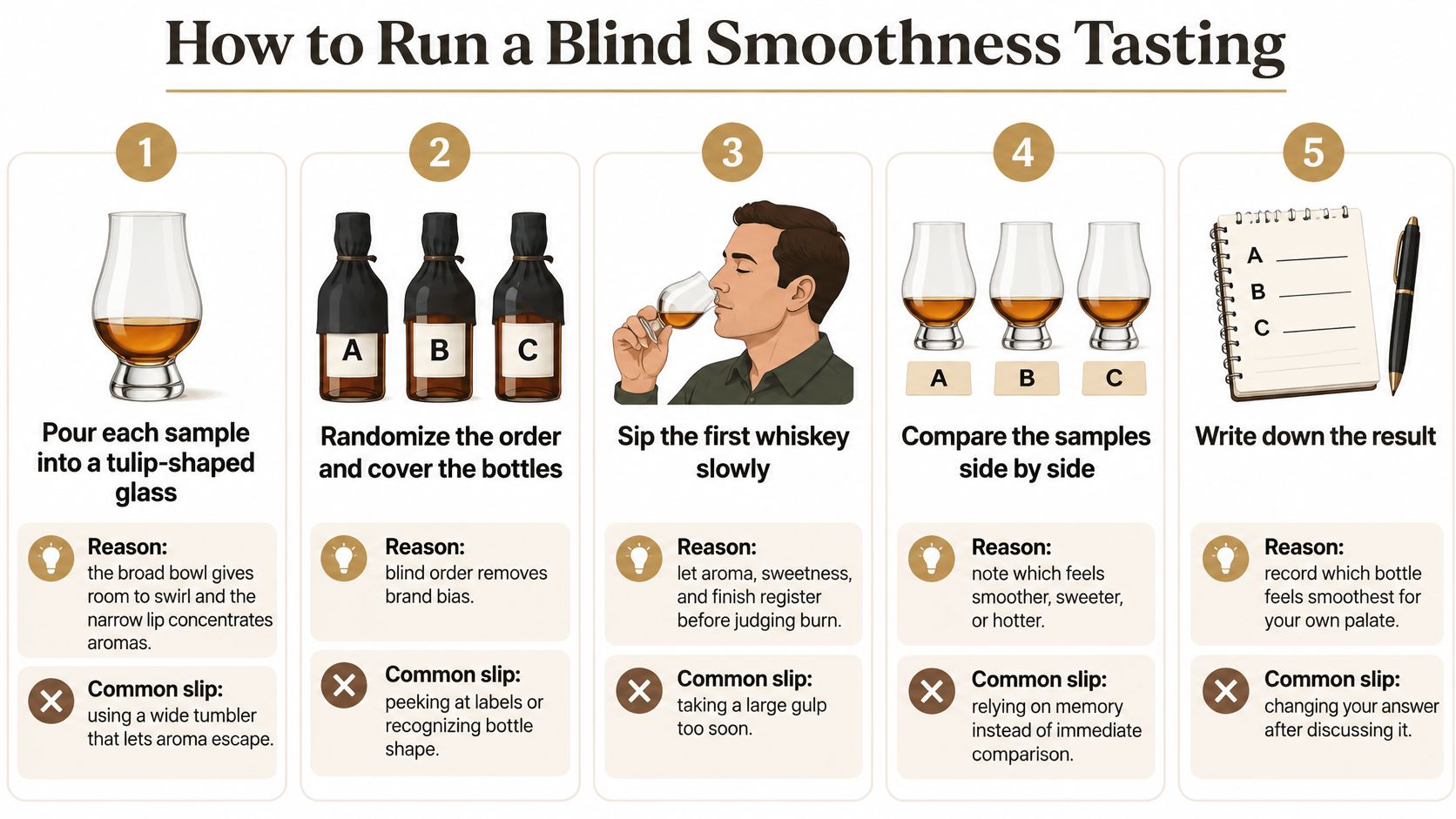
Use the same eight moves on every glass. Same glass, same pour, same order. Cover the labels until the scores are written, or brand and price will do the tasting for you.
Color first. Nose only after the vapor lifts. Then a small sip, moved around the mouth. That order is the spine of a smoothness test. Change it mid-flight and the scores stop meaning anything.
Whisky Magazine adds the water step: dilute toward about 30% alcohol by volume with cool water, around 15°C, a little at a time, and stop when the sharp prickle on the nose drops away. Very cold water flattens aroma.
- Pour into a tulip-shaped glass. The broad bowl gives you room to swirl, and the narrower lip holds aroma at the rim. A wide tumbler lets the smell escape before you can name it.
- Note the color, then ignore it as an age clue. Proof, barrel char, and the weather during aging all shift the hue. A dark glass is not "older, therefore smoother."
- Swirl, wait, then smell above the rim. Coating the glass releases aroma. A short wait lets alcohol vapor lift so you are not smelling only ethanol. Burying your nose in the glass on the first second scores the burn, not the whiskey.
- Take a small sip and move it across the tongue. Flavors change from tip to sides to swallow. Scoring the first alcoholic hit and calling that the whole whiskey is the usual miss. A full method for setting this up at home is in this blind taste test walkthrough.
- Rate heat from 1 to 5. One is barely there. Five is a burn that crowds out flavor. Write the number before anyone talks.
- Add a few drops of cool water and smell again. Start toward that 30% ABV idea, and stop when the nose prickle fades. Ice-cold water, or a big splash, washes the sample out.
- Score the finish. Note length, and whether sweetness, oak, or mouthfeel is what remains. A long finish with heat still counts as heat.
- Reveal the labels last. Set your scores next to proof, mash bill, age, and barrel. One scorecard per sample. Memory of the label is not a score.
Keep the cards. On the next unfamiliar craft bottle, you already know whether you wanted low heat, a softer grain, or a toasted finish.
Pick Your First Smooth Bottle to Blind Taste
Buy two bottles from the shortlist and taste them blind before you decide you "like craft" or don't. One should be wheated or long-aged: McKenzie or Doc Holliday. The other should be barrel-finished or cask strength: 13th Century or Bull Run. Cover the bottles, pour in the tulip glasses, and run the eight steps. Blind order strips brand and price, so the palate has to pick.
If you don't want to hunt two full bottles yet, we built the same test into a quarterly kit. Blind Barrels features whiskey from hard-to-find distilleries. Each quarter you get a new distillery, four blind samples, a tasting table for aroma, taste, and finish, and a QR code that reveals the labels only after you've scored them. A short game asks you to guess age, proof, and whiskey type, then tells you how close your palate was. After the reveal, members can order discounted full bottles for the cabinet. Ironclad The Old Kernel Straight Bourbon is one example, at a member price of $49.99 against a regular price of $74.99.
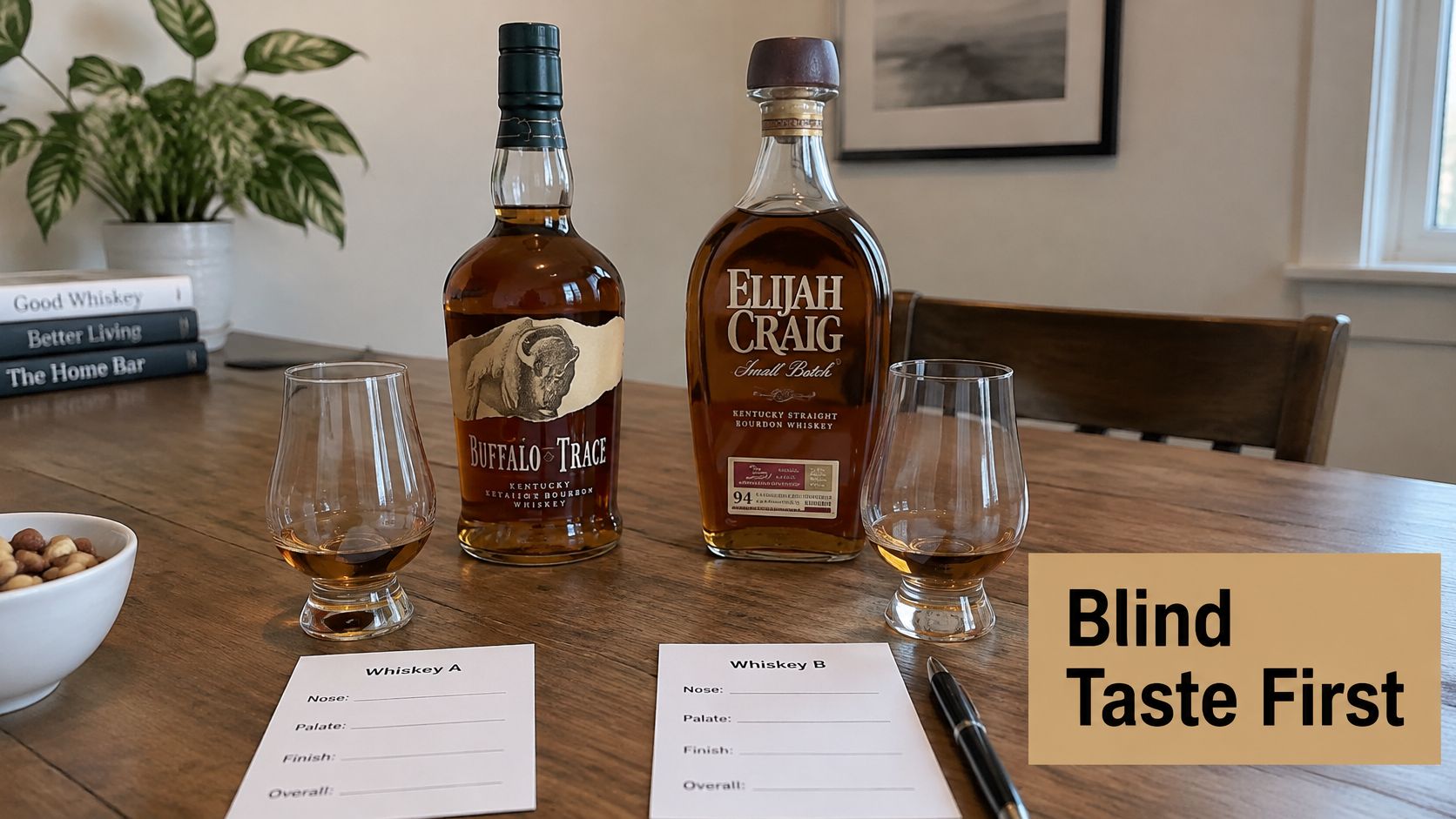
The path is short. Taste blind. Score heat, mouthfeel, sweetness, oak, and finish. Reveal the label. Buy the bottle that matched what you liked, not the one a list told you was smooth.
Blind Barrels sends four blind samples from small American craft distilleries each quarter, with a tasting table and a label reveal so you can judge smoothness before you see the brand. It's a direct way to practice the same heat, texture, and finish scoring on bottles you won't find in every shop. Visit Blind Barrels and start with the next kit.