

You've probably had this moment: a bottle catches your eye, the label looks promising, and you still don't know if it'll be your next favorite pour or just another shelf mistake. A spirits subscription box turns that gamble into a guided tasting, which is exactly why it feels different from a random unboxing. It gives you small pours, a blind comparison, and a reason to slow down enough to notice aroma, palate, and finish.
Discovering Your Next Favorite Whiskey
A good first box feels a little like opening four doors at once. Each sample can lead you toward a different style, and because the labels stay hidden at first, you judge the whiskey by what's in the glass rather than by brand recognition. That's a big part of the appeal for anyone who's ever stood in front of a wall of bottles and wished for a clearer path.
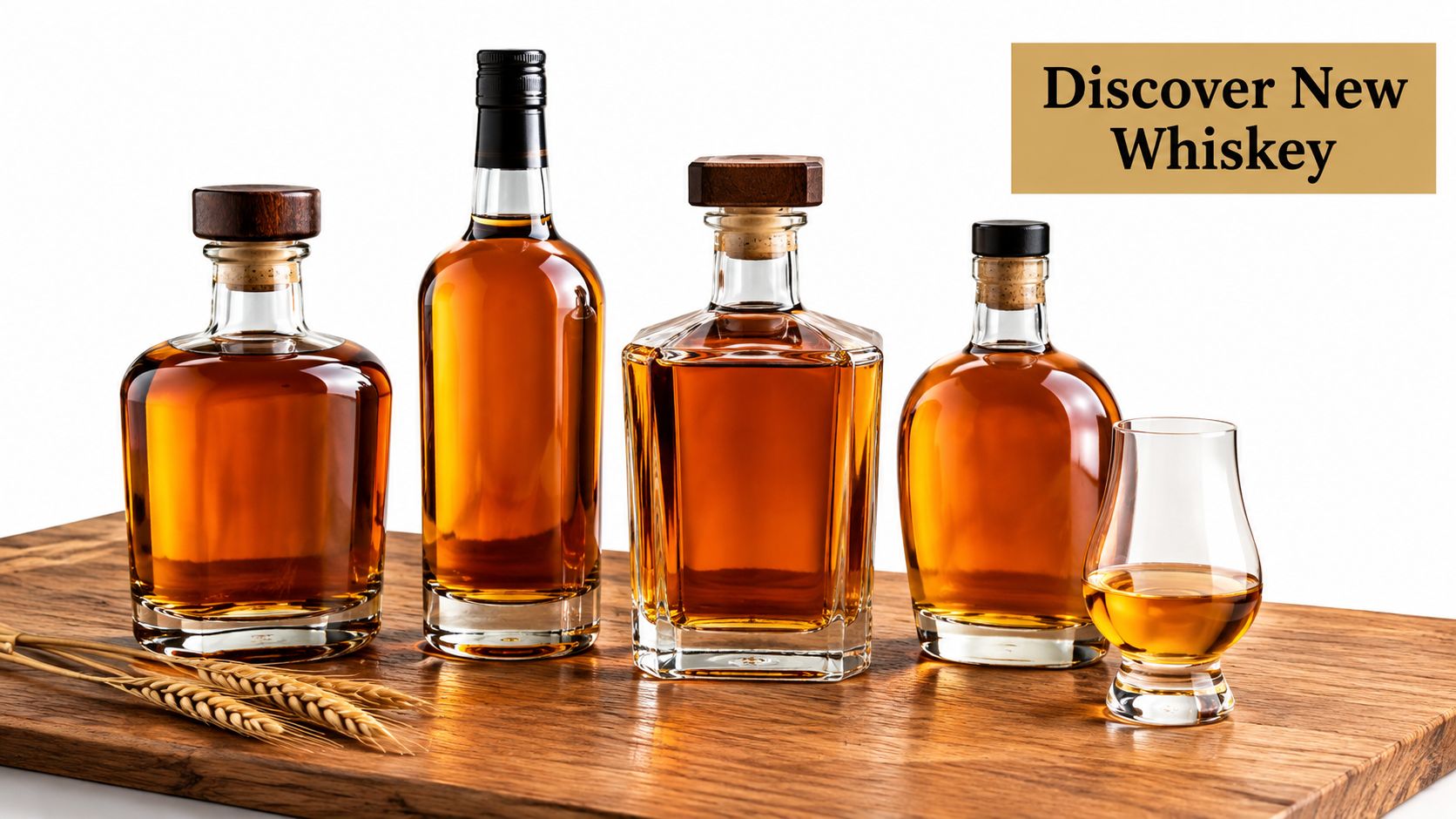
A spirits subscription box often works best when it introduces you to small American distilleries that don't have national shelf space. The modern craft-spirits market helps explain why, with 3,069 active U.S. craft distillers reported in August 2024, up from 2,753 the year before, even as the category sold 13.5 million 9-liter cases in 2023 and accounted for an estimated 4.6% of U.S. spirits volume but 7.5% of value (American Craft Spirits Association 2024 data). That mismatch between volume and value says a lot, craft spirits are fewer units, more premium positioning, and a lot of room for discovery.
Why blind tasting changes the experience
Blind tasting removes the most common shortcut, brand memory. That matters because unfamiliar distilleries can be easy to overlook even when the whiskey is excellent. When the bottle stays hidden, your palate gets first vote, and the reveal becomes a lesson instead of a sales pitch.
Practical rule: if you can describe the whiskey before you identify it, you're tasting with more honesty than if you start with the label.
The best subscriptions lean into that idea. They make each quarter feel less like shopping and more like learning how your own palate works.
How Spirits Subscription Boxes Work
The mechanics are simple, but the structure is what gives the format value. You choose a plan, receive a curated set of samples on a regular schedule, and taste them in a sequence that helps you compare one whiskey against the next. If the service is doing its job well, the box doesn't just arrive with bottles, it arrives with context.
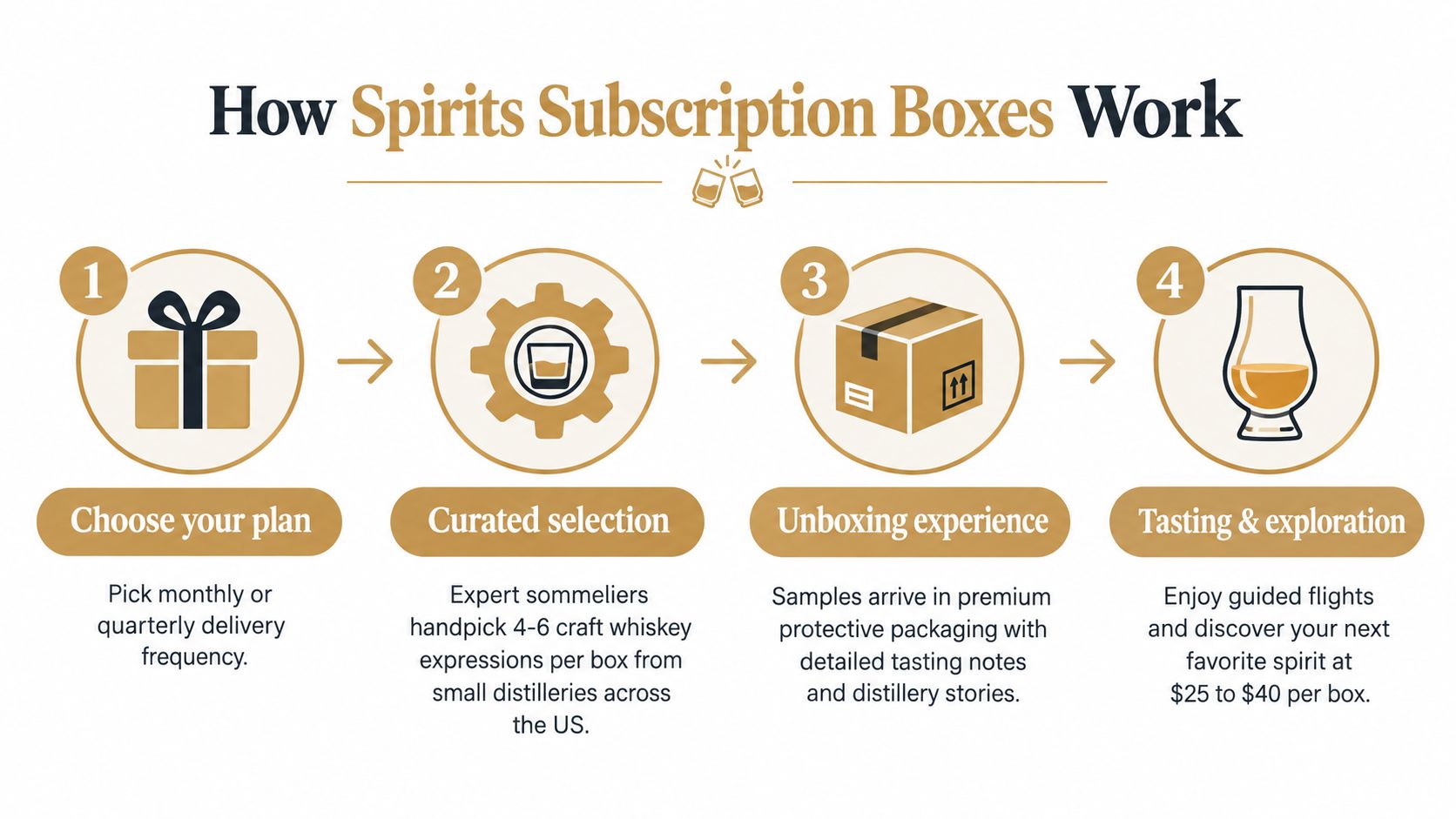
A useful way to think about the model is as a guided tasting path. Some services focus on monthly cadence, others on quarterly drops, but genuine value comes from curation, tasting notes, and a repeatable process that helps you compare expressions without committing to full bottles first. If you're thinking about build a subscription box brand, the hard part isn't only logistics, it's designing the experience so the sample, story, and reveal all feel connected.
For a deeper look at the product side, the way Blind Barrels explains how subscription boxes work is a helpful reference point. The logic is consistent across strong tasting boxes, the samples arrive in a protected kit, and the member gets enough guidance to compare aromas, palate notes, and finish with confidence.
The typical flow
- Choose a plan. Decide whether you want a recurring tasting schedule or a one-time experience.
- Receive curated samples. Four to six small pours is common for a structured flight.
- Use the notes. Aroma guidance, tasting prompts, and reveal details turn the box into a learning tool.
- Taste, score, and compare. The best boxes leave room for reflection before the brand names come out.
If you're comparing product formats, compare boxes for bottles is a useful reminder that protection matters too. Good packaging keeps the samples intact, which is a boring detail until the shipping box fails and the whole tasting night falls apart.
What You Will Find Inside the Box
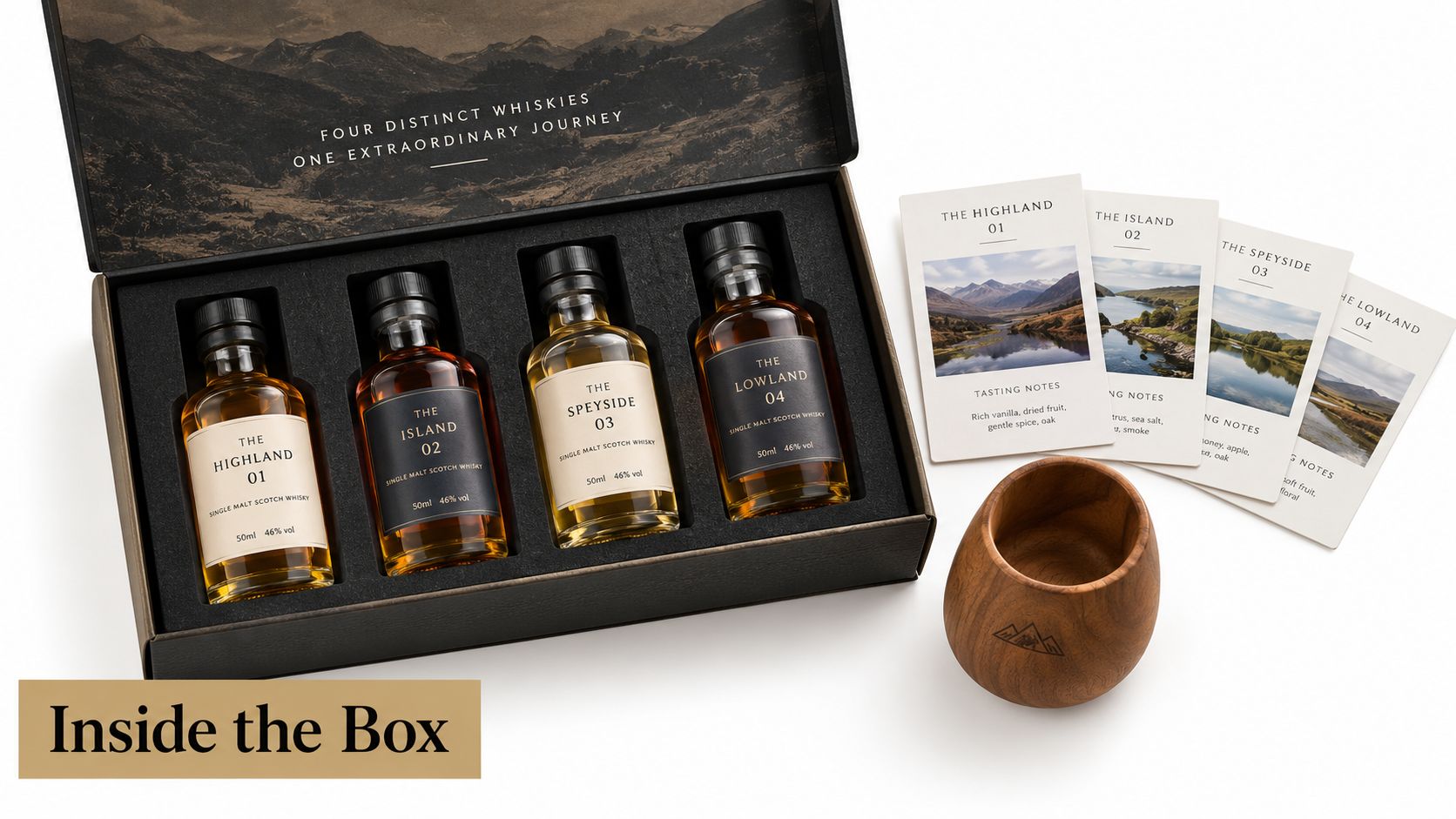
A good tasting box gives you more than small pours. It gives you a method for paying attention. In practice, that usually means a set of samples, tasting notes, and a scoring tool that helps you separate aroma, palate, and finish.
Many premium kits organize the tasting table around aroma families, because that mirrors how sensory analysis works. In one study of Scotch and American whiskies, researchers used the Rate-All-That-Apply method and identified eight significant aroma categories, including caramel/toffee, vanilla, peach, phenolic, smoky, fruity, floral, and fermented apple/cider (Fraunhofer publication). The same research reported 97.86% accuracy for sensory classification between the two whiskey groups, which shows why structured tasting is more than guesswork.
A tasting box turns that idea into something practical. One card may ask you to rate aroma intensity, while another separates palate from finish so you can notice how a whiskey changes after the sip. Some kits also add an age or proof guess, which keeps the session engaging without distracting from the learning.
The useful parts are easy to spot.
- Small-format samples, enough for side-by-side comparison without opening full bottles.
- Tasting notes, so you have a guide for vocabulary and focus.
- Scorecards or prompts, which help you remember what stood out in each pour.
- Reveal tools, often a QR code or similar feature that links the blind sample to the distillery story after tasting.
For a closer look at how a structured kit is put together, Blind Barrels' whiskey taster kit shows how aroma, finish, and provenance can be grouped into one learning flow. That format is especially useful for anyone who wants to understand whiskey through blind tasting first, then connect the glass to the producer's story. For shipping protection details, compare boxes for bottles is a useful reference, because a broken sample tray can end the tasting before it starts.
Craft Whiskeys vs. Mainstream Brands
The biggest difference between a craft-focused box and a mainstream one is not just rarity. It's perspective. Mainstream bottles often reward familiarity, while craft-focused subscriptions reward curiosity and regional exploration. If you want the same reliable label every time, a retailer works fine. If you want a guided surprise, craft is the better fit.
The American craft-whiskey world also has clear production boundaries. Whisky Advocate reported that the American Craft Spirits Association defines a craft distillery as one producing fewer than 750,000 proof gallons (Whisky Advocate). That threshold matters because it helps separate independent producers from mass-market scale. The same source noted 2,753 U.S. craft-spirits distilleries in the cited study, which shows how broad the category already is.
The category isn't tiny, it's fragmented. That fragmentation is exactly why a subscription format works so well. Many strong bottles never become household names outside their home region, and a blind tasting lets you meet them without needing prior brand loyalty.
For a closer look at how the category is framed, Blind Barrels' explanation of what craft whiskey is is useful context. Craft doesn't mean handmade in some romantic sense, it means a producer small enough to feel local, but established enough to be part of a national sector.
Simple takeaway: mainstream boxes help you buy what you already know, craft boxes help you discover what you'd otherwise miss.
That distinction is why the best craft subscriptions feel educational, not just exclusive.
The Responsible Tasting Approach
A spirits subscription box works best as a tasting lesson, not a race to empty the glass. One pour can teach more than three rushed ones. Drink less, learn more gives the category its clearest purpose.
A tasting flight also needs a steady method. Research on whisky dilution found that aroma discrimination drops when dilution goes beyond about 20% water by volume (PMC study). That does not mean water is off-limits. It means the first sip should establish the whiskey's baseline, then a small, measured splash can show how the aroma changes.
A simple rhythm keeps the comparison fair.
- Start neat. Sample each whiskey before anything changes the proof.
- Use the same glassware. Consistent shape and size help you compare like with like.
- Add water slowly. A drop or two can reveal new notes without washing them out.
- Pause between pours. Your palate needs a reset, just like a lens needs refocusing after a close shot.
That process turns a box into a small classroom. Proof, aroma, and personal preference start to separate into clearer parts, the way a distiller watches spirit move from raw edge to settled character. If one whiskey shines at full strength and another opens up with water, both answers matter.
Responsibility matters here too. Taste a little, write down what you notice, and save the full bottle for the whiskey that earns it. That keeps curiosity active without turning the hobby into overconsumption.
Choosing the Right Subscription Provider
A strong provider does the work before the first bottle arrives. Start with the curation philosophy. A brand that cannot say whether it focuses on American craft distilleries, blind evaluation, or educational material has not clearly defined the experience.
What to check before you subscribe
- Craft focus. Look for clear sourcing from small distilleries rather than generic mixed assortments.
- Education. Tasting notes, aroma prompts, and reveal details should be part of the package, not an afterthought.
- Interactive features. Scorecards, guessing games, or QR-based reveals can make the learning stick.
- Shipping clarity. A serious provider will explain where it can and can't ship, along with adult-signature rules.
Legal clarity matters more in alcohol than in most subscription categories. U.S. spirits shipping depends on destination state rules, carrier policies, age verification, and whether the order goes through a producer or a licensed retailer. Some states are far more restrictive for spirits than for wine, and some require pickup through a state-controlled system rather than home delivery (GetTips alcohol delivery laws). A transparent provider will say where you are eligible before you buy.
Practical rule: if a subscription is vague about shipping, it is usually vague about operations too.
The tasting experience should also lead somewhere useful after the samples are gone. A solid provider makes it easy to buy a full bottle later if one pour stands out. That turns discovery into a clear next step instead of a dead end.
Is a Spirits Subscription Right for You
This format works best for people who like a little ceremony with their whiskey. If you enjoy guessing what's in the glass, comparing notes with someone else, or learning why two similar pours taste different, a spirits subscription box will probably feel natural. It's also a good fit for couples or small groups who want an activity that's social without being loud.
If you already know exactly what you like and you only want to restock favorites, a standard retailer may be simpler. The subscription model asks for patience, because the value comes from discovery, not speed. Some people want the box to behave like a wine club, while others want it to behave like a tasting class. Knowing which one you want saves disappointment later.
The strongest sign that it's a fit is curiosity. If you want the bottle to teach you something, not just taste good for a night, you're in the right lane.
Blind Barrels gives whiskey drinkers a quarterly blind tasting built around four samples from small American craft distilleries, with tasting notes, a reveal step, and a built-in scoring game. If that kind of guided discovery sounds like your style, visit Blind Barrels and see how a blind tasting box can make your next pour more educational, more social, and a lot more memorable.