

Is Tennessee whiskey just bourbon with a Tennessee address, or does one production choice change what reaches your glass? The short answer is that it shares much of bourbon's foundation, but its legal identity, charcoal mellowing, history, and modern experimentation give it a character of its own.
A good first tasting doesn't require a rare bottle or specialized training. With one glass, a little water, and a few quiet minutes, you can learn to separate grain sweetness, oak influence, charcoal mellowing, proof, and finish. You can also see why American craft whiskey brands are pushing the category beyond its most familiar profile.
What Tennessee Whiskey Actually Means
The easiest place to begin is with the question most newcomers ask: is Tennessee whiskey just bourbon from a different state?
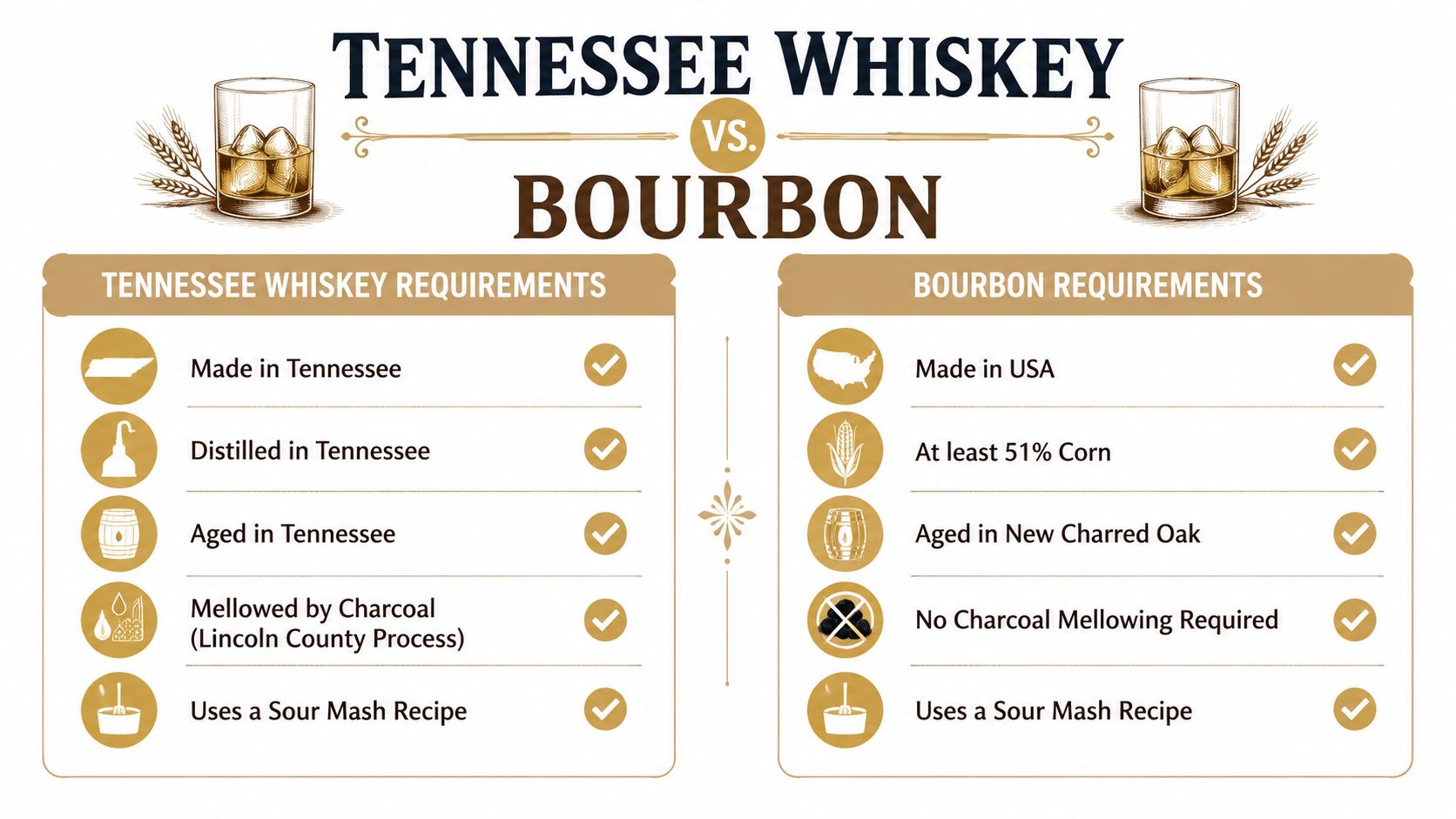
Not quite. Tennessee whiskey belongs to the broader American whiskey family and shares several bourbon-style requirements, but Tennessee law gives it a distinct identity. It must be made in Tennessee, distilled from a fermented mash containing at least 51% corn, distilled at no more than 160 proof, placed into new charred oak at no more than 125 proof, and bottled at at least 80 proof, or 40% ABV. It must also pass through sugar maple charcoal before aging, a step known as the Lincoln County Process. The Tennessee whiskey legal definition lays out those production conditions.
Think of bourbon and Tennessee whiskey as two bread recipes that share flour, water, yeast, and most of the basic method. One recipe includes an extra shaping step before the loaf enters the oven. That step doesn't make the ingredients unrelated, but it changes the texture and the final eating experience. For Tennessee whiskey, charcoal mellowing is that extra step.
The label also creates common confusion. Tennessee whiskey must be produced in Tennessee, but the legal requirements don't mean every bottle tastes identical. Distillers can vary grain bills, distillation choices, barrel management, proof, blending, and finishing methods while still meeting the category's rules.
What the rules don't tell you
The definition doesn't promise a single flavor, and it doesn't mean every bottle has the same proof. It also doesn't establish one universal minimum aging period for all Tennessee whiskey. New charred oak aging is required, but the length of maturation can differ, which affects oak, fruit, spice, and texture.
A separate legal point matters too. The Lincoln County Process is required for a spirit labeled Tennessee whiskey under Tennessee Code Annotated § 57-2-106, passed in 2013, according to the Tennessee charcoal-mellowing explanation.
Practical rule: Read the label as a production map, not a flavor guarantee. The category tells you where and how the spirit was made, while the bottle's mash bill, age, proof, and barrel choices shape the details.
For a wider map of American styles and regional differences, explore this guide to American whiskey regions.
The Lincoln County Process and Why It Changes the Spirit
The Lincoln County Process happens before the whiskey enters the barrel. New-make spirit, the clear liquid fresh from distillation, is reduced to a filtration proof commonly in the 115 to 125 proof range, then passed slowly through a bed of sugar maple charcoal. The charcoal bed can be about 10 feet deep, and filtration may take 3 to 7 days, according to the charcoal-mellowing process guide.
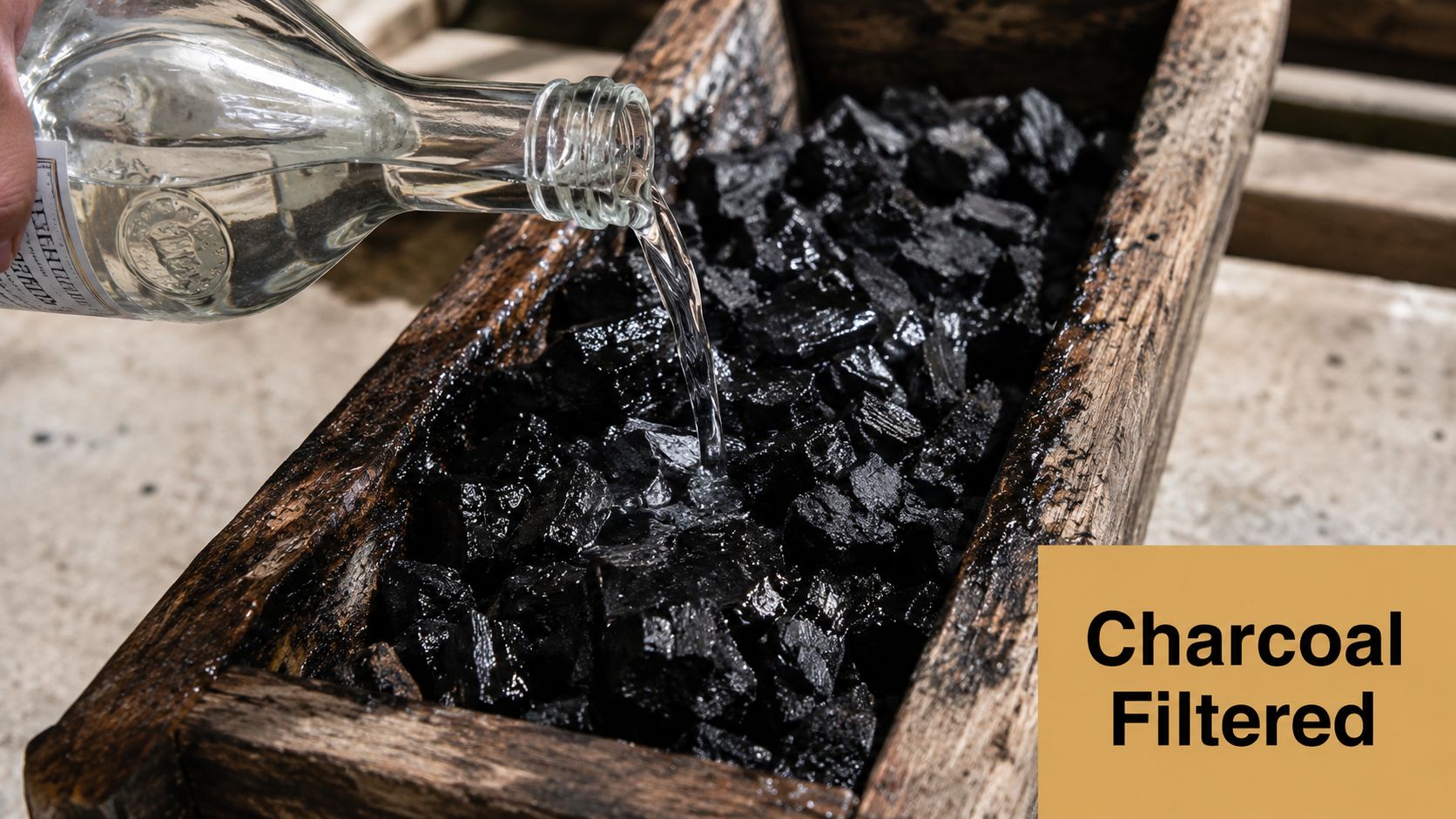
The useful analogy is a water filter. A filter doesn't add fruit, vanilla, or caramel to water. It removes selected material that makes the water taste harsh or unpleasant. Charcoal mellowing works in a similar subtractive way. It adsorbs some congeners, fusel alcohols, and sulfur compounds from the distillate before oak maturation begins.
That removal can reduce young spirit's rough edges. The result is often a softer mouthfeel, less obvious alcohol burn, and a cleaner aroma. Once the whiskey enters new charred oak, the barrel contributes familiar notes such as vanilla, caramel, toasted wood, and gentle spice. Charcoal mellowing doesn't create those barrel flavors, but it can make them easier to notice by reducing competing harshness.
Filtration isn't a magic button
The process doesn't turn every Tennessee whiskey into a delicate spirit. Proof, distillation cuts, fermentation, mash bill, barrel location, climate, and maturation time still matter. A higher-proof bottle can feel intense even when its distillate has been mellowed, while a younger whiskey may retain more grain and oak brightness.
The most useful way to think about the process is as style control. Distillers use it to shape the starting spirit before oak has a chance to add its own influence. That can help a producer deliver a recognizable profile across batches, though individual bottles can still show meaningful variation.
Taste the difference as a sequence rather than a slogan. First notice the spirit's grain and alcohol. Then look for the barrel's sweetness and wood. Finally, ask whether the finish feels clean, dry, hot, soft, or lingering. Those observations turn “smooth” from a vague marketing word into a set of sensations you can identify.
How Tennessee Whiskey Became a Global Category
Tennessee whiskey's roots reach back much further than modern tasting rooms and gift shops. By 1810, Tennessee had 14,191 registered distilleries producing 25.5 million gallons of whiskey, a scale that shows how distilling had entered the state's economy long before global branding made the style widely recognizable. Those historical figures are documented in the history of Jack Daniel's and Tennessee whiskey.
The category later gained a powerful brand anchor. Jack Daniel's was established as a brand in 1875, statewide prohibition took effect in Tennessee in 1910, and after U.S. repeal in 1933, Jack Daniel's became the first distillery to reopen in Lynchburg. That reopening matters because it connects Tennessee whiskey's modern identity to both survival and revival.
Legal history shaped the category as much as commercial history did. Producers preserved charcoal mellowing as a practical method and as a visible marker of regional identity. The process helped tell consumers that Tennessee whiskey was distinct from a generic American spirit bottled in the state.
From regional tradition to export category
The style now operates on a global scale. The Distilled Spirits Council reported that by 2013, the U.S. market for bourbon and Tennessee whiskey had reached $2.4 billion, while exports of bourbon and Tennessee whiskey exceeded $1 billion, as summarized in the Tennessee whiskey overview.
Jack Daniel's illustrates the size of that international presence. In 2017, the Jack Daniel's family sold 12.9 million nine-liter cases of Black Label Tennessee whiskey and more than 16.1 million adjusted cases across the brand family, according to the same historical reference.
That scale doesn't erase craft distilling. New Tennessee producers continue to test different mash bills, barrel approaches, and finishing ideas, while established brands explore premium releases. The result is a category with one foot in inherited practice and the other in active reinvention.
Tennessee Whiskey vs Bourbon and Other American Whiskeys
Tennessee whiskey and bourbon share the same broad American foundation. Both use a mash bill with at least 51% corn, mature in new charred oak, and must be bottled at no less than 80 proof. Tennessee whiskey adds a geographic requirement and charcoal mellowing before aging, which bourbon law doesn't require.
| Feature | Tennessee whiskey | Bourbon |
|---|---|---|
| Production location | Must be made in Tennessee | Must be made in the United States |
| Corn content | At least 51% | At least 51% |
| Barrel | New charred oak | New charred oak |
| Charcoal mellowing | Required for the Tennessee label | Not required |
| Typical impression | Soft sweetness and a clean, mellow texture | Fuller caramel, oak, and spice presence |
These are tendencies, not guarantees. A Tennessee whiskey can be rich, powerful, or heavily oaked, while a bourbon can be gentle and easygoing. The charcoal step often gives Tennessee whiskey a softer entry and lighter-feeling finish, but the glass still reflects the distiller's grain recipe and barrel decisions.
Three styles that confuse new shoppers
Rye whiskey must contain at least 51% rye, which usually brings a drier, spicier grain character. Think pepper, baking spice, and a sharper finish rather than corn's round sweetness.
American single malt uses at least 51% malted barley and has no corn requirement. It can show malt, toast, fruit, and roasted grain in ways that sit outside the usual bourbon and Tennessee whiskey comparison.
Bourbon remains the useful reference point for Tennessee whiskey because the two categories share so many structural rules. If you enjoy caramel, vanilla, and a broad sweetness, either can work. If you prefer a cleaner, more rounded texture, Tennessee whiskey may feel more approachable. If you want grain-led spice, rye is the better direction.
The label is your shortcut. Start with the grain requirement, then check the production state, charcoal statement, proof, and age information. Those details give you more useful guidance than a front-label adjective such as “smooth.”
Typical Flavor and Aroma Profiles
Tennessee whiskey often rewards a structured tasting vocabulary. Instead of searching for an elaborate description, sort what you notice into four practical groups: sweet, fruity, woody, and finishing sensations.
| Stage | Common descriptors | What to ask yourself |
|---|---|---|
| Aroma | Caramel, vanilla, brown sugar, honey, banana bread, ripe apple, cherry | Does the glass smell sweet, fruity, grainy, or woody? |
| Palate | Corn sweetness, caramel, vanilla, toasted coconut, fruit, gentle spice | Does the whiskey feel round, dry, oily, light, or hot? |
| Wood character | Oak char, toasted nut, leather | Is the barrel leading, supporting, or overwhelming the grain? |
| Finish | Soft tannin, gentle warmth, medium-long finish | Does the flavor disappear quickly or stay with you? |
The first impression often leans sweet because corn provides a broad foundation and new charred oak contributes vanilla and caramel. Fruit notes can resemble banana bread, ripe apple, or cherry, particularly when the spirit's grain and fermentation character remain visible.
Read the finish separately
The finish tells you how the whiskey behaves after the sip. Soft tannin can feel drying without becoming rough. Gentle warmth describes alcohol presence that remains noticeable but doesn't dominate. A medium-long finish gives the flavors time to shift from sweetness toward oak, spice, or fruit.
The Lincoln County Process tends to soften the spirit's sharper edges, so the aroma may feel cleaner and the palate less aggressive. That doesn't mean “smooth” equals flavorless. A mellow whiskey can still carry char, fruit, proof, and spice.
Mash bills create another useful point of difference. Higher-rye recipes may bring more pepper and dryness, while wheated recipes can feel rounder and less spicy. Those variations are why two bottles that both say Tennessee whiskey can taste noticeably different.
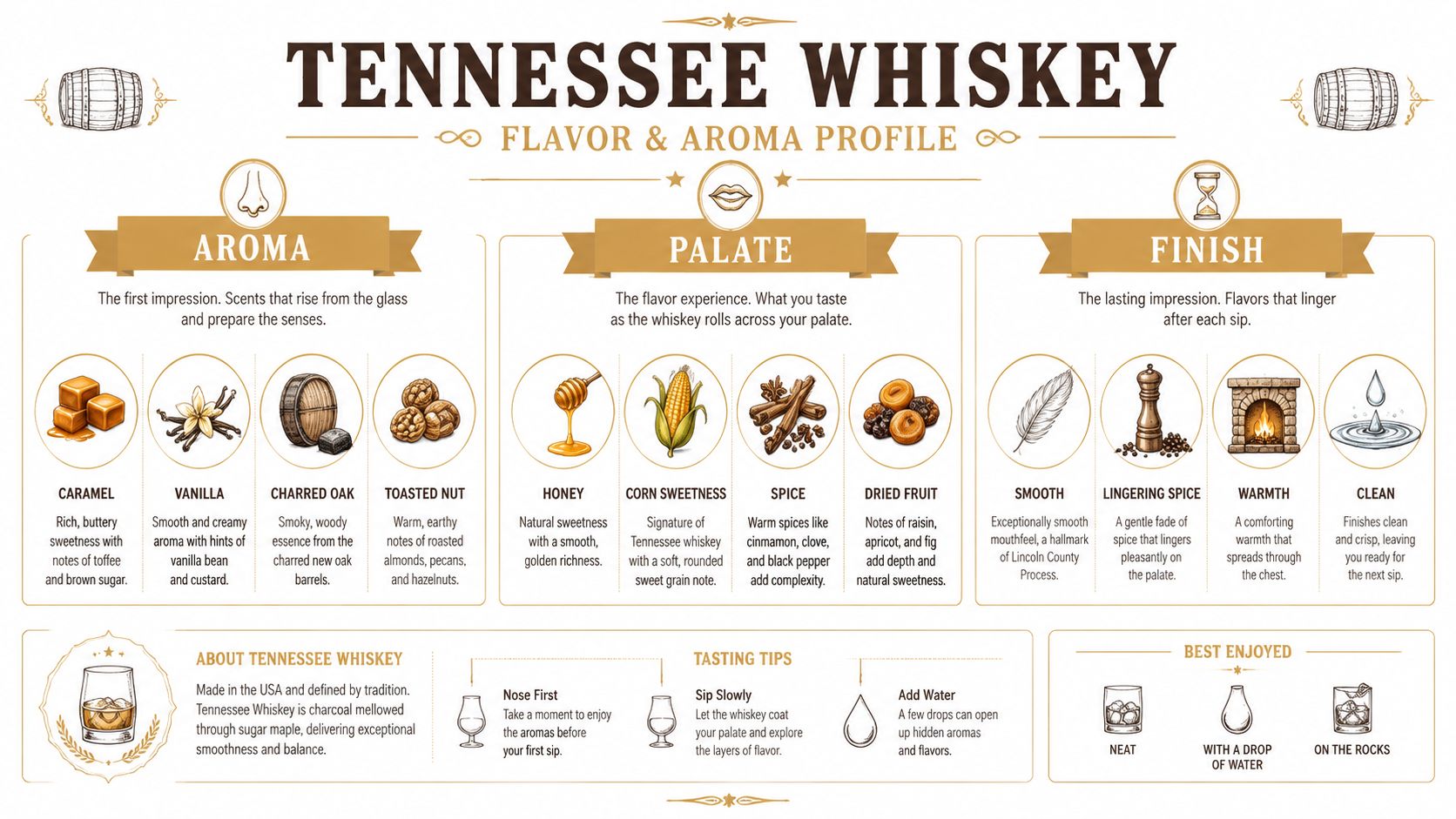
Keep the chart nearby during your next tasting. You're not trying to guess a secret answer. You're building a personal reference library, one aroma and finish at a time.
How to Taste Tennessee Whiskey as a Beginner
You can run a useful tasting at a kitchen counter tonight. You don't need a crystal glass, a special decanter, or a trained palate. You need a small pour, a neutral setting, and enough time to notice what changes from the first smell to the last swallow.
Set up the glass
Choose a tulip-shaped glass or Glencairn glass if you have one because the narrow opening concentrates aromas. A white wine glass works well too. A rocks tumbler is fine for drinking, but its wide opening makes nosing more difficult, as described in this beginner's whiskey tasting guide.
Pour about one ounce, then let the whiskey sit briefly. Some tasting guidance recommends serving whiskey around room temperature or approximately 60 to 65°F, and avoiding ice when you want to preserve flavor intensity, according to this whiskey tasting method.
Smell, sip, and adjust
Use three short inhales instead of one deep breath. The first may reveal alcohol and grain. The second can uncover vanilla, caramel, fruit, or oak. The third often gives you the clearest overall impression because your nose has adjusted.
Take a small first sip and let it coat your tongue. Use a second sip to assess the middle of the palate, where sweetness, spice, and texture become clearer. Take a longer final sip, then wait through the finish before deciding whether the whiskey feels dry, warm, soft, woody, or lingering.
Water is a tool, not a test. Add only a few drops, swirl gently, and smell again. If the whiskey becomes more aromatic or less fiery, keep tasting it that way. If it turns flat, return to the undiluted pour.
Between samples, use plain water and an unseasoned cracker to reset your palate. Avoid strong food, scented candles, and heavily perfumed surroundings. If you'd like a bottle-specific example, this George Dickel Tennessee whiskey guide offers useful context for comparing an established Tennessee producer.
Where the Category Is Heading Beyond the Classic Profile
The most interesting change in Tennessee whiskey isn't another explanation of charcoal mellowing. That process defines the category, but diversification will determine how people encounter it next.
Craft producers are widening the flavor map. They can work with different grain bills, barrel finishes, and aging environments while retaining the required charcoal-mellowing identity. This gives American craft whiskey brands room to make bottles that taste recognizably Tennessee yet don't copy the familiar flagship profile.
Legacy producers are experimenting too. The category now includes flavored expressions and non-traditional bottlings that aim for sweeter, lighter, or more immediately accessible drinking occasions. That expansion creates a useful tension. A product must preserve enough of Tennessee whiskey's identity to remain credible while meeting consumers who may prefer flavor, proof, or format over strict heritage.
Three pressures shaping the next shelf
Craft experimentation gives smaller distillers a way to distinguish themselves. Rather than competing only on age or brand recognition, they can use mash bills, fermentation character, barrel selection, and finishing choices to build a specific point of view.
Flavored whiskey brings a different audience into the category. A market report says flavored Tennessee whiskey represented 28.1% of 2025 revenues, according to the Tennessee whiskey industry coverage. That figure should be read as a market signal, not a description of every bottle or drinker's preference.
Premium aging is also becoming more visible. Premium and ultra-premium pricing rose 22% to 28% from 2020 to 2025, according to the same coverage. Jack Daniel's released limited age statements in 2025 for the first time in more than a century, including 10-, 12-, and 14-year-old Tennessee whiskeys at 48.5%, 53.5%, and 63.15% ABV, respectively, as reported in industry coverage cited by the Tennessee whiskey reference.
For a closer look at Tennessee's independent craft movement, explore Corsair Distillery and craft whiskey trends. The future category won't abandon tradition. It will test how many forms that tradition can support.
Your Next Steps for Exploring Tennessee Whiskey
You can learn more by tasting deliberately rather than collecting random bottles. Pick one small exercise from each group below and complete it this month.
Build a simple blind flight
Pour Tennessee whiskey, bourbon, and rye into identical glasses. Cover each glass with a numbered lid, write the numbers on a sheet of paper, and record aroma, sweetness, spice, texture, finish, and your guess for each style.
Taste in small amounts and reveal the bottles only after you've scored them. The exercise removes brand familiarity and makes the grain differences easier to notice. If you prefer a guided format, a Blind Barrels subscription provides four blind samples each quarter, a tasting table for aroma, palate, and finish notes, and a game that asks members to estimate age, proof, and whiskey type before revealing the bottles.
Put the whiskey in a cocktail
Try these three foundational drinks:
- Whiskey Sour: Combine whiskey, lemon juice, and a sweetener. Tennessee whiskey's mellow texture can make the drink feel rounded, while its corn sweetness supports the citrus.
- Tennessee Mule: Combine Tennessee whiskey with ginger beer and lime. The ginger adds heat, so choose a bottle whose finish remains clean rather than overly woody.
- Old Fashioned: Stir whiskey with a little sugar and bitters, then add an orange peel. A sweeter Tennessee whiskey can make the cocktail feel rich without needing much added sugar.
Make one drink tonight and compare it with the same recipe using bourbon or rye later.
Learn with other drinkers
Look for a local tasting group, a distillery visitor center, or a whiskey festival where producers explain their methods. Online forums can help you identify bottles, but structured tastings teach more than collecting opinions.
If you enjoy the connection between Tennessee whiskey and outdoor cooking, you can also explore BBQs Delight pellets from Smokey Rebel, a product that brings whiskey-associated wood character into a barbecue setting without pretending that smoke and whiskey are the same flavor.
Start with one blind flight, one cocktail, and one conversation. Those three actions will give you a stronger understanding of Tennessee whiskey than memorizing a distillery list.
Blind Barrels offers quarterly blind tasting kits featuring four samples from small American craft distilleries, along with tasting guidance and a reveal game that helps you compare age, proof, and whiskey type. Visit Blind Barrels to turn your next Tennessee whiskey tasting into a hands-on way to discover what your palate prefers.