

Ever walked into a liquor store and felt that wave of analysis paralysis wash over you as you stared at a wall of whiskey? You're not the only one. Every single type of whiskey tells its own story, a unique tale shaped by where it was born, what it was made from, and how it was aged. From sweet and mellow to spicy and smoky, the spectrum is huge, but understanding the basics is the key to unlocking it all.
Your Essential Guide to the World of Whiskey
Getting a handle on the world of whiskey is a lot less complicated than it seems. At its heart, every whiskey is a spirit distilled from a fermented mash of grains. The real magic—and all that glorious variety—boils down to three things: the specific grains used, the geographical spot on the map where it's made, and the time it spends aging in wooden casks.
These three elements are the recipe, defining the final flavor. For example, a mash bill that leans heavily on corn, like you find in American Bourbon, almost always creates a sweeter spirit with those classic caramel and vanilla notes. Swap that corn for rye, though, and you get a whiskey with a much spicier, peppery backbone. Grasping this simple concept is what turns confusion at the liquor store into genuine curiosity.
The Building Blocks of Flavor
To really get what makes different whiskeys tick, you have to think about their DNA. Each of these core components leaves an indelible fingerprint on the liquid in your glass.
- Grain: This is the foundation of the flavor profile. Corn brings the sweetness, rye delivers the spice, barley offers up those malty, biscuity notes, and wheat creates a softer, gentler character.
- Geography: Place absolutely matters. The local climate, the water source, and centuries of distilling tradition all play a part—from the peaty smoke of the Scottish isles to the deep, rich oakiness of Kentucky.
- Aging: This might just be the most important factor of all. The kind of barrel it's aged in and how long it stays there completely transforms the spirit. A new, charred oak barrel imparts wildly different flavors than, say, a barrel that previously held sherry.
Tip for New Drinkers: Forget the hype and the price tag. The best whiskey isn't the most expensive one; it's the one you actually enjoy drinking. Trust your own taste buds above all else.
A Journey for Your Palate
Think of this guide as your roadmap. We're going to dive into how these fundamental building blocks combine to create the iconic whiskey styles you see on the shelf. You'll learn what makes a whiskey a whiskey in the first place, from the strict rules of production to its signature taste.
The goal here is simple: to help you move beyond just recognizing names on a label and start appreciating the incredible craftsmanship in each bottle. Whether you find yourself drawn to the mellow sweetness of a Bourbon from an innovative American craft producer like Frey Ranch or the mind-bending complexity of a Japanese single malt, this journey will help you find your footing and explore with confidence.
Exploring American Whiskey: Bourbon, Rye, and Tennessee
When you dive into the world of American whiskey, you're tapping into a rich history of rebellion, innovation, and distinctly bold flavors. The landscape is really defined by three major players that every enthusiast should get to know: Bourbon, Rye, and Tennessee Whiskey. While they all share a common heritage, each one has its own strict set of rules that carves out a unique personality in the glass.
The core of what makes each style special boils down to a few key things: the grain used, the geography of where it's made, and the specifics of how it's aged. These are the primary drivers behind the character of every bottle you'll encounter.
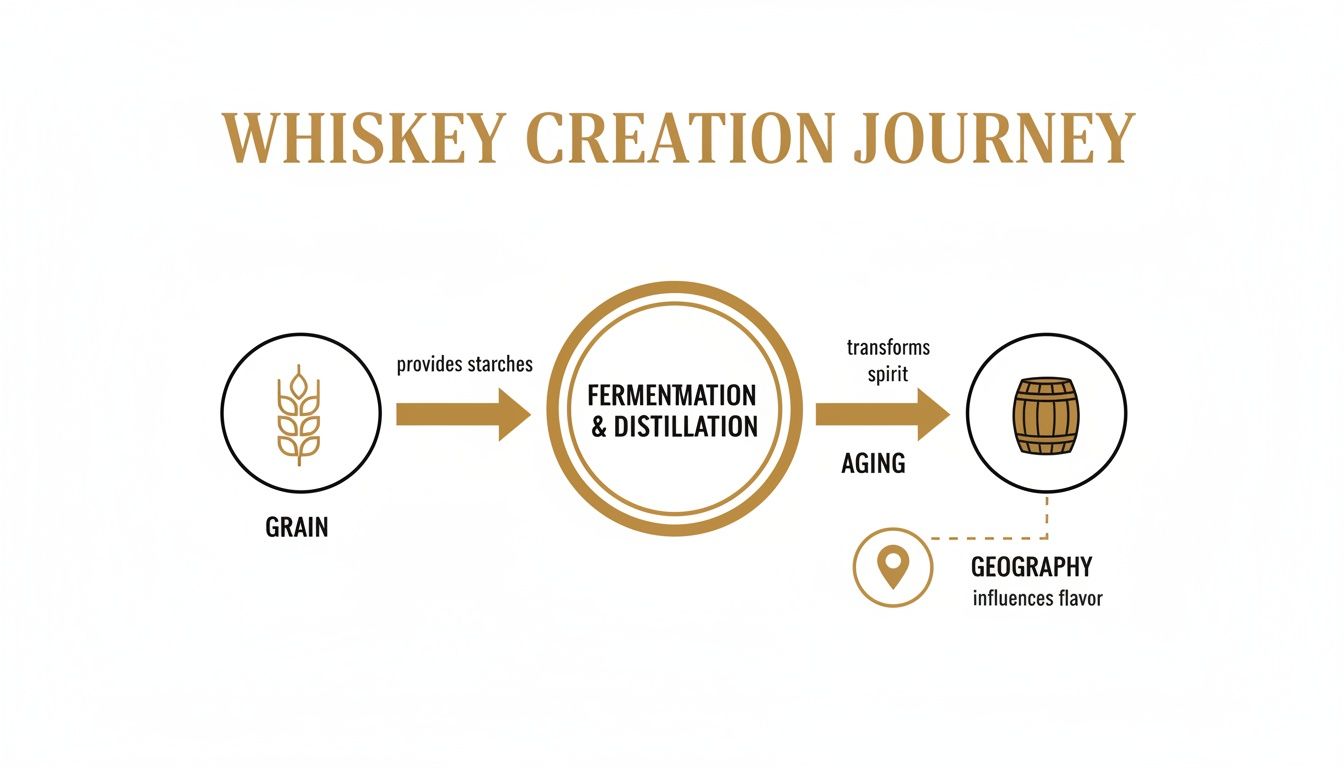
This journey from field to bottle shows how that initial choice of grain, combined with the distillation location and the aging process, all work in harmony to shape the final spirit.
Bourbon: The Sweet Heart of America
Bourbon is arguably the most famous American spirit, and for good reason. To legally wear the "Bourbon" badge, a whiskey must be made in the United States from a mash bill of at least 51% corn. This high corn content is the secret to Bourbon's signature sweetness, often showing up as notes of caramel, vanilla, and honey.
But the rules don't stop there. Bourbon must also be aged in new, charred oak containers—almost always barrels. This step is absolutely crucial. The fresh, charred wood imparts those deep, rich flavors and that beautiful amber color we all recognize. While there’s no minimum aging requirement, to be called "Straight Bourbon," it has to see the inside of that barrel for at least two years.
Rye: The Spicy Contender
If Bourbon is the sweet and friendly one at the party, Rye is its spicy, assertive cousin. Just as the name implies, Rye whiskey must be made from a mash bill containing at least 51% rye grain. This is what gives it that distinctly peppery and sometimes fruity or floral character that makes it stand out so boldly.
Much like Bourbon, Rye has to be aged in new, charred oak barrels. Its punchy profile makes it a fantastic backbone for classic cocktails like the Manhattan or Old Fashioned, where its spice can slice right through the other ingredients. For a deeper look at how these two powerhouses stack up, you can check out our detailed guide on the difference between Bourbon and Rye.
Tennessee Whiskey: The Smooth Southerner
At first glance, Tennessee Whiskey looks a lot like Bourbon. It follows nearly all the same rules: made from at least 51% corn and aged in new, charred oak barrels. But there’s one extra, non-negotiable step that gives it a category all its own: the Lincoln County Process.
Before the new spirit even touches a barrel, it’s slowly filtered through several feet of sugar maple charcoal. This charcoal mellowing process is designed to strip away some of the harsher, rougher edges, resulting in a remarkably smooth and approachable whiskey with a subtly sweet finish. It’s what gives Tennessee Whiskey its famously gentle character.
To help you keep these straight, here’s a quick rundown of the key differences.
American Whiskey Types at a Glance
| Whiskey Type | Primary Grain | Flavor Profile | Key Production Rule |
|---|---|---|---|
| Bourbon | At least 51% Corn | Sweet, caramel, vanilla, oak | Aged in new, charred oak barrels |
| Rye | At least 51% Rye | Spicy, peppery, hints of fruit | Aged in new, charred oak barrels |
| Tennessee | At least 51% Corn | Smooth, sweet, charcoal, oak | Must use the Lincoln County Process |
This table gives you a simple, side-by-side look at what makes each of these classic American whiskeys tick.
While legacy brands have defined these categories for generations, the American craft whiskey scene is absolutely exploding with creativity. Small-batch distilleries like St. George Spirits in California and Westward Whiskey in Oregon are pushing boundaries with unique grains and aging techniques. For anyone new to whiskey, exploring these craft producers is a fantastic way to see the exciting evolution of American whiskey firsthand.
A Global Tour of Scotch, Irish, and Japanese Whisky
Alright, let's pack our bags. We're leaving the bold, sweet profiles of American whiskey behind and hopping across the pond to explore three absolute titans of the global scene: Scotch, Irish, and Japanese whisky. Each one tells a story of its homeland, shaped by centuries of tradition, unique climates, and fiercely protected production methods. Getting to know these international players is the key to unlocking a whole new world of flavor.
Our first stop is Scotland, the ancestral home of whisky (spelled without the "e," mind you). The rules here are simple but strict: it must be aged in oak casks for a minimum of three years to earn the name Scotch. But from there, things get wonderfully complex, with a diversity that’s best understood by looking at its two fundamental styles.
Scotch Whisky: The Spirit of Scotland
The world of Scotch can feel massive, but it really boils down to two main categories you absolutely need to know:
- Single Malt Scotch: This is the purist's choice. To be a single malt, the whisky must be made from 100% malted barley at just one single distillery. It’s the most direct expression of a distillery's unique character and the land around it—from the smoky, salty whiskies of Islay to the light, orchard-fruit notes of Speyside.
- Blended Scotch: Don't let the term "blend" fool you; this is an art form. Blended Scotch is a meticulously crafted mix of one or more single malts with various grain whiskies. The goal is to create a consistent, balanced, and often more approachable flavor profile that tastes the same year after year.
Scotch is a global icon, representing a huge slice of the over $72 billion global whiskey market. While the category saw a minor dip in exports in 2024, the demand for premium, high-end Scotch continues to boom, showing a fascinating parallel to the rise of craft spirits in the U.S. This incredible range makes Scotch a perfect candidate for a blind tasting, forcing you to rely on your palate, not the label.
Irish Whiskey: The Smooth Originator
Just a short trip across the water, we find ourselves in Ireland, a place with a history of distillation that runs incredibly deep. If there’s one word that defines Irish whiskey, it’s smoothness. This signature quality makes it one of the most welcoming and easy-drinking styles for anyone new to whiskey.
That legendary smoothness isn't an accident; it's a direct result of how it's made.
Tip for New Drinkers: Irish whiskey is often triple-distilled, a process that removes more impurities and results in a lighter, cleaner, and exceptionally smooth spirit. This makes it a fantastic starting point for anyone just beginning their whiskey journey.
This extra step in the still, compared to the more common double-distillation in Scotland, is what creates that approachable character. Think light fruit, delicate floral notes, and a touch of honey. It's the perfect dram to kick off an exploration of world whiskies.
Japanese Whisky: The Art of Harmony
Our final destination is Japan, a relative newcomer that has completely taken the whisky world by storm over the past few decades. While the Japanese were initially inspired by Scottish methods, they've refined them with a uniquely Japanese philosophy built on precision, balance, and the pursuit of harmony.
Japanese distillers are absolute masters of their craft, particularly in blending and cask management. It’s common for a single distillery to produce a huge variety of whisky styles in-house, giving their blenders a vast palette of flavors to work with. The result is a whisky celebrated for its impeccable balance, subtle complexity, and undeniable elegance. To truly appreciate its distinct character, there's no better way than to experience it firsthand in one of Tokyo's notable whisky bars.
Cracking the Code on a Whiskey Label
Walking up to a wall of whiskey can feel like you’re trying to read a foreign language. But once you get a handle on a few key terms, you'll be able to translate any label with confidence. Think of this as your cheat sheet to understanding what's really inside the bottle before you even pop the cork.
The first big fork in the road is usually between Single Malt and Blended. A single malt is the purest expression of one distillery's craft, made from 100% malted barley at a single location. It’s a snapshot of a specific place and process.
A blended whiskey, on the other hand, is a carefully constructed combination of different whiskies, often from multiple distilleries. It's a true art form, all about creating a consistent, balanced, and approachable flavor. It’s not about one being better than the other; they’re just two different philosophies for making great whiskey.
Terms That Signal Serious Flavor
If you spot "Cask Strength" or "Barrel Proof" on a label, brace yourself for an intense ride. These terms mean the whiskey was bottled straight from the barrel at its natural alcohol by volume (ABV), with no water added to dilute it.
What you get is a much higher-proof whiskey with a concentrated, punchy flavor profile. For newcomers, this might sound intimidating, but a little splash of water can be your best friend here, opening up the aromas and taming the alcoholic heat.
Tip for New Drinkers: Don't shy away from cask strength bottles! They offer an unfiltered taste of the whiskey's true character. Just start with a tiny sip, then add a few drops of water and see how the flavors completely transform.
The Hallmarks of American Craft Whiskey
The American craft whiskey scene is absolutely booming, and a couple of terms have become the calling cards for quality and character. Knowing these will help you navigate the exciting world of smaller distilleries.
- Single Barrel: This is exactly what it sounds like. Every single bottle in the release comes from one, individual cask. Since no two barrels are ever truly identical, each single barrel is a unique, one-of-a-kind bottling with its own distinct personality. Craft producers like Texas-based Balcones are famous for their incredible single barrel programs.
- Small Batch: This term is a bit more flexible, but the spirit of it is that the whiskey is a blend from a select, limited number of barrels. While there's no legal definition for "small," it signals a more hands-on, curated approach to create a specific, high-quality flavor profile. Brands like Boulder Spirits out of Colorado use this to highlight just how meticulous their process is.
Learning this language is your ticket to moving beyond the big, familiar names and discovering some truly incredible hidden gems. It turns shopping from a guessing game into a confident exploration, helping you pick bottles you know you’re going to love.
How to Taste Whiskey and Find Your Flavor Profile
Alright, this is where the real fun begins. Let's talk about how to actually taste whiskey. Forget any stuffy, intimidating rituals you might have seen in movies. This isn't about rules; it's about paying attention and building a little confidence in your own palate.
The goal here is simple: learn what your senses are telling you. When you can pick out certain aromas and flavors, you can start connecting the dots back to how a whiskey was made. That’s how you truly discover what you love.

This whole process is less about getting a "right" answer and more about exploration. It's the first real step toward finding the type of whiskey that clicks with you, whether it’s from a legendary producer or a small American craft distillery you've never heard of.
A Simple Guide for New Whiskey Drinkers
Tasting whiskey is a full-sensory experience that’s about way more than just taking a swig. To really unlock what's in the glass, you need to bring your nose to the party just as much as your taste buds. This two-step dance will reveal layers of complexity you’d completely miss otherwise.
-
Nosing Your Whiskey: Give the whiskey a gentle swirl in your glass. This little action helps release all the aromatic compounds. Now, bring the glass up to your nose, but keep your mouth slightly open—trust me, this simple trick prevents the alcohol vapor from burning out your senses. Take short, easy sniffs. What are you getting? Is it sweet like caramel or vanilla? Fruity like apples or dark cherries? Maybe something spicy, like cinnamon or black pepper?
-
Sipping for Flavor: Start with a tiny sip and let it roll across your entire tongue. This first taste, sometimes called the "Kentucky Chew," just gets your palate ready for the proof. On the second, more deliberate sip, really focus on the flavors. Do they line up with what you smelled? Can you taste that grainy sweetness from the corn or the peppery kick from rye? And don't forget the finish—that lingering taste that stays with you after you swallow.
For a deeper dive, our complete guide on how to taste whiskey is packed with even more pro tips to get you started.
Connecting Flavors to Production
The more you practice, the more these connections will start to snap into place. That blast of vanilla and caramel you're tasting? It's a dead giveaway for aging in new charred oak barrels, which immediately points you toward Bourbon. A distinct, peppery spice probably means you’re dealing with a high-rye mash bill.
Suddenly, tasting isn’t just a passive activity—it’s like solving an exciting puzzle with every glass.
By far, the most powerful tool for developing your palate is blind tasting. When you strip away the fancy label, the marketing hype, and the high price tag, all you're left with is the liquid. It's the only honest way to let your taste buds decide what you genuinely like.
This approach gives you the freedom to discover amazing spirits you might have walked right past on the shelf. You might just find that a lesser-known American craft whiskey from a distillery like Westland Distillery has a profile you prefer over a world-famous brand.
Blind tasting removes all the bias and puts your palate in the driver's seat. It makes every pour a genuine discovery and, honestly, it’s the most fun and effective way to find your perfect dram.
As you get deeper into the world of whiskey, you'll start noticing a few questions that come up again and again. Let's tackle some of the most common ones right here, so you can feel more confident as you keep exploring every unique type of whiskey.
Is It "Whiskey" or "Whisky"?
First things first, let's clear up the spelling. Is it "whiskey" or "whisky"? The short answer is: it just depends on where it's from.
It's a simple geographical quirk. A good rule of thumb is if the country has an "e" in its name, so does its whiskey. Think United States and Ireland. If the country's name doesn't have an "e"—like Scotland, Canada, or Japan—then they make whisky. It's the same spirit, just a nod to tradition.
What Does a "Smooth" Whiskey Really Mean?
You'll hear the word "smooth" thrown around constantly, but what does it actually mean? It’s a surprisingly personal term. For most people just starting their whiskey journey, a smooth whiskey is simply one that doesn't have that aggressive alcoholic burn. It goes down easy, feeling pleasant to sip without any harshness.
This easy-sipping quality usually comes from the way it's made and aged. For instance, Irish whiskey is famous for its smoothness, which is often credited to its signature triple-distillation process. Similarly, Tennessee Whiskey gets its gentle character from being filtered through charcoal. As your palate gets more experienced, your definition of "smooth" might evolve, but for now, just think of it as a whiskey that’s inviting and easy to enjoy.
Is It Okay to Add Water or Ice to My Whiskey?
Let’s settle this debate once and for all: yes, it is absolutely, 100% okay to add water or ice to your whiskey. Anyone who tells you differently is missing the whole point. The goal is to enjoy what's in your glass, and you should drink it however you like it best.
In fact, here's a little insider tip for anyone new to whiskey:
- A few drops of water can actually "open up" a whiskey, especially a high-proof or cask strength one. It tames the alcohol burn just enough to let the more subtle aromas and flavors come forward.
- A single, large ice cube is your best friend if you like your whiskey chilled. It melts much slower than a handful of small cubes, cooling your drink down without watering it down too quickly.
Tip for New Drinkers: The best way to enjoy whiskey is your way. There are no right or wrong answers. Experimenting is part of the fun—a splash of water or a bit of ice is a great way to see how the flavors change and find your personal sweet spot.
Ultimately, your whiskey journey is all about personal preference. Don't let anyone gatekeep how you're "supposed" to appreciate a spirit. The more you taste, the more you'll learn about your own palate and what makes a particular whiskey a winner for you.
Ready to put your palate to the test and discover your next favorite American craft whiskey? At Blind Barrels, we take the guesswork and brand bias out of the equation. Our blind tasting subscription sends you curated samples from incredible, under-the-radar distilleries, letting your taste buds lead the way to amazing new spirits. Start your adventure today at https://www.blindbarrels.com.