

Welcome to the rich and complex world of bourbon, America’s native spirit. While all bourbon is a type of whiskey, the term covers a massive family of styles. From spicy high-rye bourbons to smooth wheated ones, the real magic comes from the specific grain recipes and aging processes used by each distiller.
These key differences are what create the distinct types of whiskey bourbon you see lining the shelves.
Your Journey into Bourbon Whiskey Begins Here
Diving into bourbon for the first time can feel like learning a new language. You’ll hear terms thrown around like "mash bill," "charred oak," and "single barrel" and wonder what it all means. Don't worry—the basics are much simpler than they sound. Think of this guide as your personal translator, built to make the world of bourbon feel approachable and, most importantly, fun.
Our goal is to give you the confidence to walk into any liquor store or whiskey bar and know exactly what you’re looking at. We’ll break down the core ideas that define this classic American spirit, turning confusing jargon into practical knowledge you can use right away.
Understanding Bourbon's Appeal
Bourbon is so much more than just a drink; it's a story of American heritage, deep-rooted craftsmanship, and nowadays, booming innovation. This isn't just a niche spirit for connoisseurs anymore—it's become a global phenomenon.
In fact, U.S. bourbon sales recently jumped by 12% year-over-year, hitting a record $5.3 billion in revenue. Much of that growth is driven by drinkers moving towards high-end, aged, and single-barrel expressions.
This incredible growth is powered by a vibrant community of distillers. Beyond the iconic names you know, there are now over 2,500 craft distilleries across the United States, each putting a unique spin on tradition. These smaller producers are pushing the boundaries of flavor, offering an exciting range of bourbons that showcase regional grains and creative aging techniques.
For new enthusiasts, the best way to start is by simply tasting. Don't get bogged down in trying to get it "right." The only goal is to discover what flavors you enjoy—whether it's the sweetness from corn, the spice from rye, or the soft character of wheat.
What to Expect from This Guide
We’ve laid this guide out to build your knowledge one step at a time. By the end, you'll have a solid grasp of the key elements that make one bourbon so different from another.
Here’s a glimpse of what you'll learn:
- The Foundational Rules: We’ll cover the non-negotiable laws that a spirit must follow to legally be called "bourbon."
- Decoding the Mash Bill: You’ll discover how the grain recipe—the mash bill—is the primary source of a bourbon's unique flavor profile.
- Making Sense of Labels: We’ll explain what terms like "Small Batch," "Single Barrel," and "Bottled-in-Bond" actually mean so you can choose your next bottle with confidence.
Whether you're just starting your journey or looking to deepen your appreciation, you're in the right place. For those brand new to the spirit, our guide on whiskey for beginners offers some great foundational tips to get you started.
Let's dive in and explore the fascinating world of bourbon together.
The Unbreakable Rules of Making Bourbon
Before we can really dive into the different styles of bourbon, we have to get one thing straight: what makes a whiskey a bourbon in the first place? It's not just any brown spirit in a bottle. Bourbon is America's native spirit for a reason, and it’s legally protected by a strict set of rules.
Think of these rules as the spirit's DNA—a foundational recipe that guarantees quality and its uniquely American character. Every single drop must stick to these non-negotiable standards, which is what separates bourbon from every other whiskey on the planet.
The Five Pillars of Bourbon Law
To earn the name "bourbon" on its label, a whiskey has to meet some very specific criteria laid out by the U.S. government. These aren't just suggestions; for American distillers, this is the law of the land.
- Made in the USA: While Kentucky is the heartland of bourbon, the spirit can legally be produced anywhere in the United States. From the Bluegrass State to the mountains of Colorado, craft distillers like Laws Whiskey House are proving that exceptional bourbon is an American spirit, not just a Kentucky one.
- A Corn-Heavy Mash Bill: The recipe of grains, known as the mash bill, has to be at least 51% corn. This is the non-negotiable soul of the spirit, giving bourbon its signature sweetness and rich, full-bodied character.
- Aged in New Charred Oak Barrels: This one is a big deal. Bourbon must be aged in brand-new, charred oak containers. A barrel can only be used once to age bourbon, which is why that interaction between the fresh wood and the new spirit is so intense and flavorful.
- Strict Distillation and Barreling Proofs: The spirit can't be distilled to more than 160 proof (80% ABV). When it's time for aging, it must go into that new barrel at no more than 125 proof (62.5% ABV).
- Bottling Proof: Finally, when the aging is done, bourbon must be bottled at a minimum of 80 proof (40% ABV). The only thing that can be added is water to bring it to the right proof—no coloring, no flavoring. Period.
These federal standards are what make bourbon, well, bourbon. To make it a bit easier to digest, here's a quick summary of the legal bedrock of America's native spirit.
The Legal Requirements of Bourbon Whiskey
| Requirement | Specification |
|---|---|
| Country of Origin | Made in the United States of America |
| Mash Bill | Must contain a minimum of 51% corn |
| Aging Container | Must be aged in new, charred oak containers |
| Maximum Distillation Proof | Cannot exceed 160 proof (80% ABV) |
| Maximum Barreling Proof | Cannot enter the barrel at more than 125 proof (62.5% ABV) |
| Minimum Bottling Proof | Must be bottled at a minimum of 80 proof (40% ABV) |
| Additives | Nothing can be added at bottling except water (no color or flavor) |
These rules ensure that every bottle labeled "bourbon" shares a common heritage and a baseline of quality you can count on.
The Significance of Straight Bourbon
You’ll often see "Straight Bourbon" on a label, and that's not just marketing fluff. It’s a term that signals an even higher standard of quality, telling you the whiskey meets some extra aging requirements.
A "Straight Bourbon" must be aged for a minimum of two years in those new charred oak barrels. If it's aged for less than four years, the distiller has to state the exact age on the label. This designation is a mark of purity and patience.
This is a key distinction, especially if you're new to the whiskey world. When you grab a bottle of "Straight Bourbon," you know you're getting a pure product with no added colors or flavors that has spent some serious time developing character in the barrel.
In fact, Straight Bourbon is so fundamental to the spirit's identity that it makes up the lion's share of all bourbon sold in the U.S. If you want to dig deeper, you can find more details on bourbon industry stats and its legal framework at The Lane Report. Getting these rules down is your first step to truly appreciating the vast and varied world of bourbon.
How a Mash Bill Creates Different Bourbon Flavors
If the strict rules for making bourbon are its DNA, then the mash bill is its soul. It's a simple term for the grain recipe used to make the whiskey, and it’s the single biggest factor in how a bourbon tastes right out of the gate. Think of it like a baker choosing different flours for their bread—each grain brings its own unique personality to the final product.
While all bourbon must legally be made with at least 51% corn, which gives it that signature sweetness and rich body, distillers get to play around with the other 49%. This is where the real magic happens. The secondary, or "flavoring," grains—usually rye or wheat—are what create the incredible diversity you find in the world of bourbon.
The infographic below lays out the foundational rules every mash bill has to follow for a whiskey to legally be called bourbon.
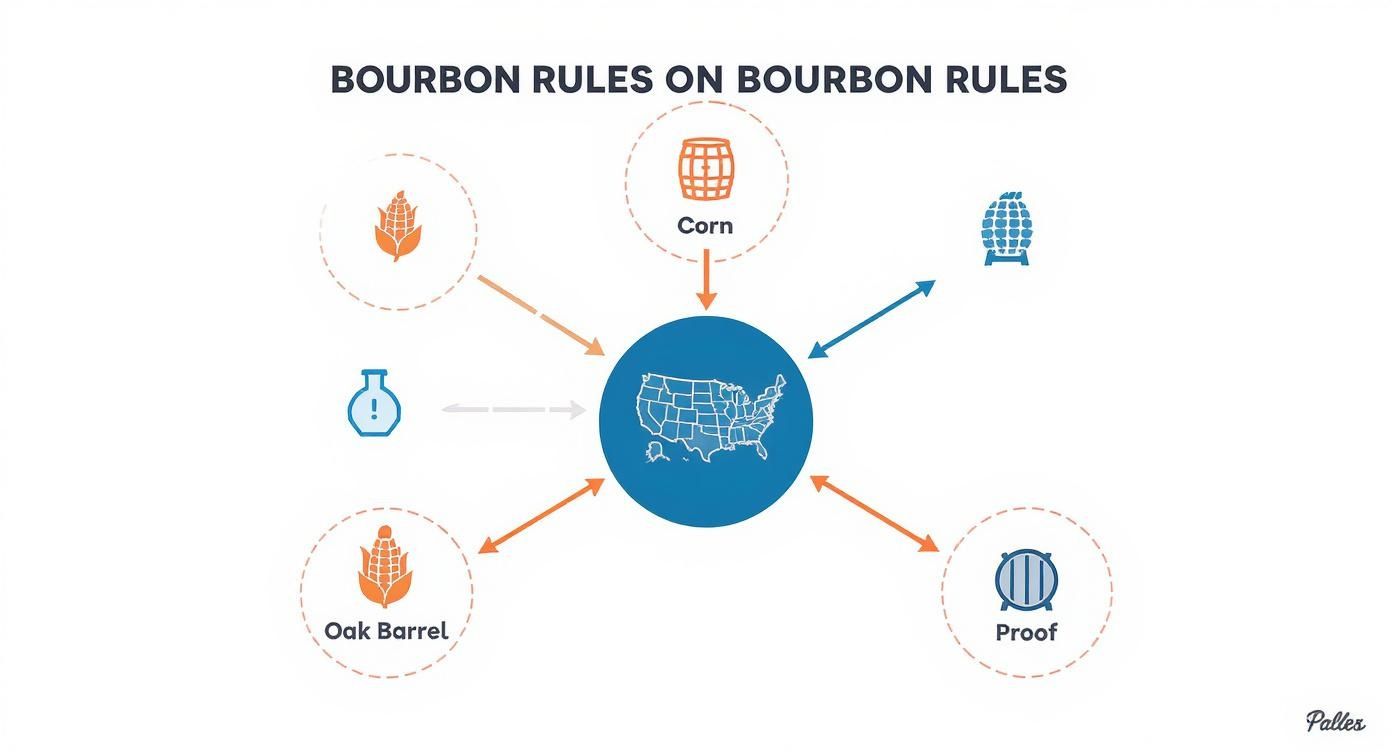
This visual shows the non-negotiables: being made in the U.S., the corn base, aging in new charred oak, and the proof requirements. This is the canvas, and the unique grain recipes are the paint.
The Spicy Character of High-Rye Bourbon
When a distiller decides to add a healthy dose of rye to the mash bill—typically anywhere from 18% to 35%—they create what we call a high-rye bourbon. Rye is the bold, assertive member of the grain family. It brings a distinct peppery spice, along with notes of cinnamon, nutmeg, and sometimes even a little mint or dark fruit.
If you’re someone who enjoys a robust, stimulating flavor, a high-rye bourbon is right up your alley. The rye spice cuts through the sweetness from the corn, creating a beautifully balanced and complex spirit that often finishes long and warm.
Great Examples to Try:
- Four Roses Single Barrel: A classic, widely available high-rye bourbon known for its lovely fruit notes and a very clear rye spice kick.
- Laws Whiskey House Four Grain Straight Bourbon: This Colorado craft distiller uses a unique four-grain recipe where the rye really shines, creating a complex whiskey with notes of black tea, orange, and spice. It’s a fantastic look at craft innovation.
The Softer Side of Wheated Bourbon
For a totally different experience, distillers can swap out that spicy rye for a much gentler grain: wheat. A wheated bourbon, or "wheater," uses wheat as its secondary flavoring grain. This gives the bourbon a much smoother, sweeter, and more mellow profile than its rye-heavy cousin.
Wheated bourbons often feel creamier and softer in your mouth. You’ll find notes of vanilla, caramel, honey, and fresh-baked bread. For anyone new to whiskey, a wheated bourbon can be a perfect starting point, as its gentle character is very approachable and less aggressive on the palate.
Tip for New Drinkers: If you've tried some bourbons and found them too "spicy" or "hot," a wheated bourbon is probably what you're looking for. Its softer profile is often described as smooth and easy-sipping, making it a favorite for those just starting their tasting journey.
Great Examples to Try:
- Maker's Mark: One of the most iconic wheated bourbons out there. It’s famous for its soft red winter wheat recipe that delivers a gentle sweetness and an incredibly smooth finish.
- Frey Ranch Straight Bourbon Whiskey: This Nevada "farm-to-glass" distillery grows all of its own grains. While not a pure wheater, its flagship bourbon includes winter wheat in its four-grain mash bill, giving it a wonderfully balanced profile with a creamy texture and hints of citrus and honey.
The Complexity of Four-Grain Bourbon
Why choose between rye and wheat when you can have both? A four-grain bourbon does exactly that, typically using corn, malted barley, rye, and wheat in its mash bill. This approach is a true masterclass in balance, as the distiller has to harmonize the sweetness of corn, the spice of rye, and the softness of wheat.
The result is often a remarkably complex and layered whiskey. You might taste the sweet caramel from the corn and wheat up front, followed by a wave of rye spice on the finish. These bourbons are a testament to the distiller's skill and offer a little something for everyone. While many distillers are exploring unique recipes, you can learn more about the rise of alternative grains in craft whiskey and how they are changing the flavor landscape.
Decoding the Language on a Bourbon Label
Walking down the whiskey aisle can feel like trying to read a foreign language. The labels are a sea of terms like "Single Barrel," "Small Batch," and "Bottled-in-Bond," but what do they really tell you about the liquid gold inside the bottle? Getting a handle on this lingo is your first step to unlocking the story behind each bourbon.
These aren't just clever marketing buzzwords; they're specific classifications that give you real insight into how the bourbon was made, aged, and ultimately chosen. Learning to decode them helps you see past the fancy label art and price tag to find a whiskey that genuinely clicks with your taste. Think of each term as a clue to the flavor, consistency, and character you're about to pour.
Single Barrel: A Unique Snapshot in Time
A Single Barrel bourbon is exactly what it claims to be: it's whiskey bottled entirely from one individual barrel. You can think of it as a solo performance. While most bourbons are a blend of many barrels to nail a consistent taste, a single barrel is a one-of-a-kind snapshot of what happened inside that specific cask.
No two oak barrels are ever truly identical. Each one has its own grain pattern, char level, and even its own spot in the rickhouse, all of which shape the final spirit. This means every single barrel bottling will have its own unique personality. One might be a "honey barrel" dripping with sweet, rich notes, while another from the very same distilling run could be spicier or more oak-forward. It’s this unpredictability that makes them so exciting for whiskey lovers hunting for a distinct experience.
- Tip for New Drinkers: If you fall in love with a single barrel bourbon, grab another bottle from that same barrel if you can. The next one, even from the same distillery, will be a different beast entirely. That's the thrill of the chase.
Small Batch: The Art of Blending
If a single barrel is a solo artist, a Small Batch bourbon is a masterfully conducted orchestra. This term signifies that the bourbon is a blend of a select number of barrels, all mingled together to achieve a specific and consistent flavor profile. The distiller here is playing the role of a master blender, carefully choosing barrels that complement one another to create a final product that is balanced, reliable, and delicious.
Now, there's no legal definition for "small"—one distillery’s small batch might be 10 barrels, while another's could be 200. The intent, however, is always the same: quality control and consistency. By blending, distillers can smooth out the eccentricities of individual barrels to deliver the signature taste their brand is known for, bottle after bottle.
For a fantastic example from the craft world, look at Laws Whiskey House in Colorado. Their Small Batch bourbons are a clinic in meticulous blending, creating a consistent yet deeply complex profile that puts the quality of their estate-grown grains front and center. It’s an approach that produces a reliable pour that still feels special and thoughtfully crafted.
Bottled-in-Bond: A Historic Seal of Quality
The Bottled-in-Bond designation is one of the most historically important and dependable marks of quality you'll find on a bourbon label. It actually dates all the way back to the Bottled-in-Bond Act of 1897, a piece of old-school consumer protection law designed to fight the rampant problem of shady, watered-down, and often dangerous whiskey.
To earn the Bottled-in-Bond label, a whiskey has to meet a strict set of government-regulated standards. It must be the product of one distillery from a single distilling season (either January-June or July-December), aged for a minimum of four years in a federally bonded warehouse, and bottled at exactly 100 proof (50% ABV).
This designation is, in essence, a guarantee of authenticity. It tells you exactly where the bourbon came from, when it was made, and that it has been aged to a respectable maturity without any funny business or additives. For drinkers of all experience levels, the Bottled-in-Bond seal is a trustworthy sign you’re getting a pure, robust, and well-made spirit. It’s a nod to history that still promises an excellent pour today.
How to Begin Your Bourbon Tasting Adventure
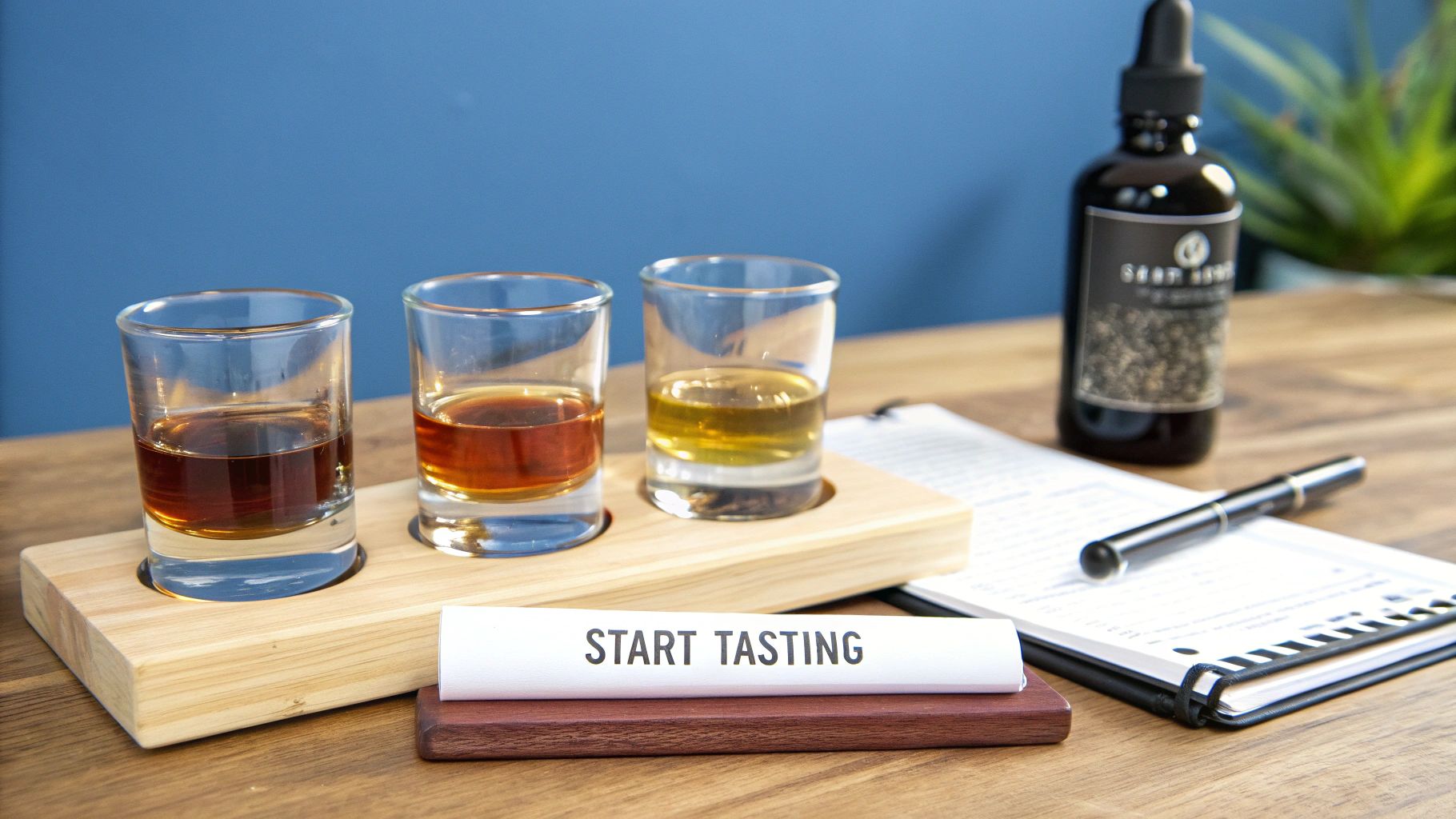
Sure, you can read about mash bills and label definitions all day, but the only real way to understand bourbon is to taste it. Your palate is the ultimate guide, and figuring out what you like is one of the most rewarding parts of the whiskey journey. This isn’t about becoming a master sommelier overnight. It's about discovery.
Think of this section as your field guide. We'll walk through the practical steps to get you started, from the right glass to the simple techniques that unlock a bourbon's true character. Let's get to it.
Setting Up Your First Tasting
A little prep work makes a huge difference. You don't need a fancy lab, but the right setup helps you zero in on all the aromas and flavors hiding in the glass, making the whole thing more fun and educational.
First, let's talk glassware. That standard rocks glass is fine for a casual pour, but for a real tasting, you'll want something tulip-shaped, like a Glencairn. The wide bowl lets the aromas gather, and the narrow rim funnels them right to your nose. It’s a game-changer.
Next, pour just a small amount. About one ounce is perfect. This gives you enough to work with but also lets the bourbon breathe and open up.
The Art of Tasting Bourbon
Tasting is a full-sensory experience, way more than just taking a swig. The pros have a simple process they follow to deconstruct what's in the glass. For a much deeper dive into the specifics, check out our complete guide on how to taste whiskey.
But for now, here’s a quick-start version:
- Look: Hold your glass to the light. The color gives you clues about its age and barrel. Deep amber usually means more time in the oak.
- Smell (Nose): Give the glass a gentle swirl and bring it toward your nose with your mouth slightly open. Take short, easy sniffs—you’re trying to smell the whiskey, not the alcohol burn. Can you pick out caramel, vanilla, fruit, or spice?
- Taste: Take a tiny first sip and let it coat your mouth. This one might feel a little hot, so don't analyze it too much. It's the second sip where you'll start to pinpoint specific notes like cherry, leather, or cinnamon.
- The Kentucky Chew: This is a classic move. You simply "chew" the whiskey for a few seconds, moving it around your mouth. It sounds a little silly, but it aerates the bourbon and hits all your taste buds, revealing subtle flavors you'd otherwise miss.
Don't be afraid to add a few drops of water, especially with a high-proof bourbon. A little water can tame the alcohol heat and "open up" the spirit, allowing more delicate floral and fruit notes to come forward.
Beginner-Friendly Bourbons to Explore
You don't need to spend a fortune to start your journey. Plenty of fantastic, accessible bourbons out there serve as a perfect introduction to the different styles we’ve talked about.
Accessible Bourbons for New Drinkers:
- Maker's Mark (Wheated): This is the classic wheated bourbon for a reason. It's incredibly smooth and approachable, loaded with soft caramel and vanilla notes. A perfect entry point into the softer side of bourbon.
- Buffalo Trace (Traditional/Low-Rye): A true crowd-pleaser known for its incredible balance. It has all those classic brown sugar and oak flavors without being aggressive, making it a go-to for many enthusiasts.
- Frey Ranch Straight Bourbon Whiskey (Craft Four-Grain): Want to see what American craft distillers are up to? This is your bottle. It’s made from four grains grown right on their farm, delivering a beautiful complexity of sweet, spicy, and creamy notes at a great price.
Here is the rewritten section, crafted to sound completely human-written and natural, following the provided style guide and examples.
Exploring Bourbon's Rise as a Global Spirit
For the longest time, bourbon felt like America’s best-kept secret. It was a spirit tied to the soil of Kentucky, deeply woven into our national heritage. But that secret is officially out. Bourbon has shattered its regional image and exploded onto the world stage, building a devoted international following that’s impossible to ignore.
This journey from a local classic to a global phenomenon isn’t an accident. It’s been fueled by a perfect storm of consumer trends. Drinkers worldwide are actively seeking out premium, authentic products with a real story behind them, and bourbon fits that bill perfectly. The appeal of American craft culture—with its focus on quality ingredients and hands-on production—has also captured the imagination of whiskey lovers everywhere.
Bourbon's Expanding Global Footprint
American whiskey, with bourbon leading the charge, is now booming in markets once dominated by Scotch or Japanese whisky. This isn't just a minor trend; we're witnessing a major economic and cultural shift.
The global appetite for bourbon has skyrocketed, both in established markets and new frontiers. Europe, Japan, and Australia have become massive export destinations, while emerging markets across the Asia Pacific region are also developing a serious taste for American spirits. This growth is so significant that the American whiskey segment in Asia Pacific is projected to hit $3.1 billion by 2025. You can dig into more details on the global American whiskey market to see just how big this movement has become.
Craft Distillers on the World Stage
It's not just the big, historic names driving this global expansion, either. Innovative American craft distilleries are playing a massive role by offering unique expressions that showcase the incredible diversity of types of whiskey bourbon available today.
For a new whiskey drinker, this global boom is fantastic news. It means you have access to a wider variety of bourbons than ever before, including small-batch and single-barrel offerings from producers who are really pushing the creative envelope.
Brands like Nevada's Frey Ranch, with its "farm-to-glass" approach, and Colorado's Laws Whiskey House, with its focus on heirloom grains, are earning well-deserved international recognition. They represent a new wave of American whiskey makers whose dedication to craftsmanship resonates with consumers far beyond our borders. This movement reinforces bourbon's status not just as an American spirit, but as a world-class whiskey that stands proudly alongside the best from any country.
Your Top Bourbon Questions Answered
As we wrap up our deep dive into the world of bourbon, a few questions always seem to pop up. It’s only natural. This last section is here to tackle some of the most common points of confusion and really cement your understanding of America’s native spirit.
Think of it as the final, clarifying sip—making sure you feel completely confident the next time you're talking bourbon or browsing the shelves.
Does All Bourbon Have to Be from Kentucky?
This is easily the biggest myth out there. While it's true that a whopping 95% of the world's bourbon is proudly distilled in Kentucky, it can legally be made anywhere in the United States. The only geographical requirement is that it must be made in the U.S.
We're seeing incredible craft distilleries popping up and making world-class bourbon in states like Texas, New York, and Colorado. Brands like Frey Ranch out in Nevada are a perfect example, proving that great bourbon is an American story, not just a Kentuckian one.
What Makes Tennessee Whiskey Different from Bourbon?
Tennessee Whiskey is a very close cousin to bourbon, but it has one critical, defining step that sets it apart. It meets all the legal requirements for bourbon—at least 51% corn, new charred oak barrels, the whole nine yards—but then it undergoes the Lincoln County Process.
This extra step involves filtering the brand-new spirit through a thick bed of sugar maple charcoal before it ever touches the inside of a barrel. This process mellows the whiskey, smoothing out any harshness and adding a unique character. So, while every bottle of Tennessee Whiskey could legally be labeled as bourbon, its producers choose to honor that unique regional tradition.
Tip for New Drinkers: If you find some bourbons a little too punchy at first, trying a Tennessee Whiskey is a great move. That charcoal filtering often creates a smoother, more approachable profile that’s perfect for a developing palate.
Will Bourbon Improve if I Age It in the Bottle?
Unlike wine, whiskey stops maturing the second it leaves the barrel and goes into the bottle. All of its rich color, complex flavor, and distinctive character come from its years spent interacting with the charred oak.
An 8-year-old bourbon will always be an 8-year-old bourbon, even if it sits unopened on your shelf for another 20 years. Just store the bottle upright and out of direct sunlight to preserve its quality, but don't expect it to change.
What Does Proof Mean for Bourbon?
Proof is simply the measurement of alcohol content in the spirit. In the U.S., the system is straightforward: the proof is exactly double the alcohol by volume (ABV) percentage. So, a 100-proof bourbon is 50% ABV.
By law, bourbon has to be bottled at a minimum of 80 proof (40% ABV). You'll also spot "barrel proof" or "cask strength" bourbons on the shelf. These are the real heavy hitters—they aren't diluted with water before bottling, giving you a raw, intense, and full-flavored experience straight from the cask.
The absolute best way to understand bourbon is to taste it, and the best way to taste is without any preconceived notions. Blind Barrels delivers a blind whiskey tasting subscription that strips away the brand hype, letting your palate be the only judge. Discover incredible American craft distilleries and find out what you truly love at https://www.blindbarrels.com.