

Cask strength whiskey is, quite simply, whiskey bottled straight from the barrel. No water added, no dilution, no messing around.
Think of it like getting your coffee straight from a high-end espresso machine—a pure, concentrated shot of flavor—instead of a watered-down Americano. You get the richest, most intense, and unadulterated spirit the distiller created.
Your First Taste Of Cask Strength Whiskey
When you see "cask strength" on a label, it’s basically an invitation to taste whiskey in its most authentic state. Most of what you see on the shelf has been diluted with water before bottling to hit a standard, consistent proof, usually around 40% Alcohol By Volume (ABV). Cask strength expressions skip that step completely.
This means you’re tasting the whiskey just as the master distiller did when they pulled the sample right from the oak. For someone new to whiskey, that might sound a little intimidating, but it's really an opportunity. You’re in the driver's seat, able to add water drop by drop to find the perfect balance that suits your own palate. It’s the ultimate way to engage with a distillery's art.
Understanding the Intensity
The first thing you'll notice is the proof. Cask strength whiskey packs a punch, typically landing somewhere between 50-75% ABV. Most fall into that sweet spot of 60-65%—that's a serious jump, often over 50% stronger than the standard 40% ABV whiskey. You can discover more insights about cask strength whiskey on blackenedwhiskey.com.
This isn't a challenge to conquer; it's an invitation to customize. The power of a cask strength pour is that you decide the final drinking strength, unlocking different layers of flavor with every drop of water.
That higher alcohol content does more than just add heat; it carries more flavor compounds, oils, and esters that would otherwise be diluted away. The result is a richer mouthfeel and a far more dynamic taste. As you begin your journey, remember there’s no right or wrong way to enjoy it. The goal is just to explore.
If you're looking for some guidance on how to approach that first glass, check out our guide on how to taste whiskey.
Why No Two Cask Strength Proofs Are The Same
Ever lined up a few cask strength bottles and noticed the proofs are all over the map? You might see a bourbon at 125 proof sitting right next to another from the very same distillery hitting 135 proof. It’s not a mistake. The final proof of a cask strength whiskey is anything but a fixed number—it's a story written by time, climate, and the unique life of its barrel.
The biggest character in this story is the “angel’s share,” which is the poetic term for the natural evaporation of spirit during its long slumber in the barrel. Think of the barrel as a living, breathing container. As it sits year after year in the rickhouse, both water and alcohol slowly seep through the wood. The catch is, they don't always leave at the same rate. This delicate dance is what dramatically shapes the final proof.
Climate Is King
The environment around the barrel is the single most important factor. The climate dictates whether the proof goes up or down, which is why a Kentucky bourbon and a Scotch whisky often age in completely opposite directions.
In the humid, wildly fluctuating temperatures of a Kentucky rickhouse, something fascinating happens. Water molecules, being smaller than alcohol molecules, escape more easily through the oak pores. With more water leaving than alcohol, the concentration of alcohol left behind actually rises over time.
Now, jump across the pond to the cool, damp, consistent climate of Scotland. Here, the script is flipped. The high humidity in the air means less water evaporates from the barrel, while the more volatile alcohol escapes at a faster rate. As a result, the proof of a Scotch whisky typically decreases as it matures.
The final number on a cask strength bottle is anything but random. It’s a direct reflection of the whiskey's journey, capturing the essence of its origin, the seasons it endured, and the specific barrel it called home.
From Kentucky Heat to Scottish Mist
This climatic effect is seriously pronounced. In Kentucky, a bourbon that goes into the barrel at 125 proof can climb dramatically higher, with some batches being bottled at a fiery 60-66% ABV (120-132 proof).
Meanwhile, a Scotch whisky might lose about 2% ABV per year to the angels, dropping from a starting proof of 63% ABV down to 52% ABV after a decade in the barrel. It’s lost strength, but it's still bottled pure and undiluted.
This infographic lays out the straightforward, yet powerful, journey of a cask strength whiskey from barrel to bottle.
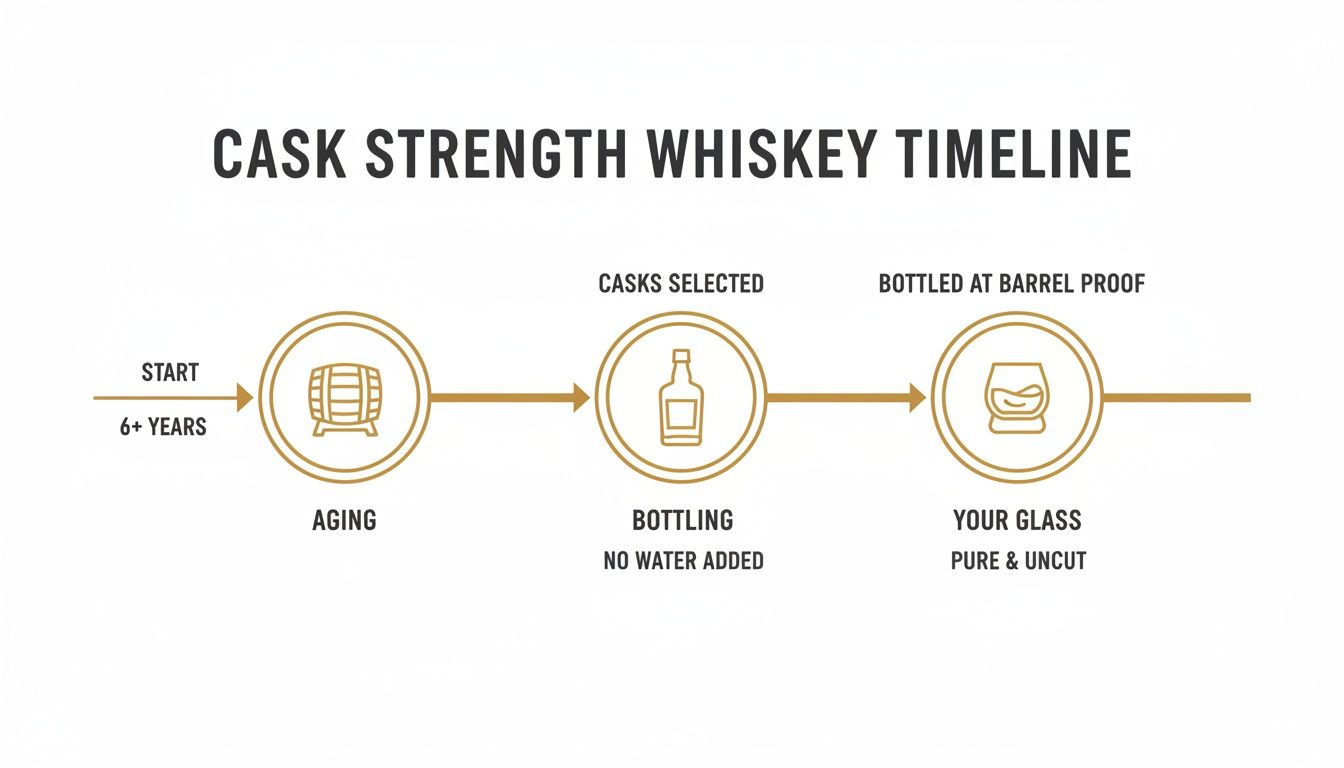
As you can see, the critical difference is at the very end: no water is added. The spirit is bottled at its natural, unaltered proof straight from the cask.
Today, this story is getting even more interesting. Innovative American craft distilleries like Balcones in Texas or Westland in Seattle are mastering their own regional climates, from the scorching dry heat of the south to the salty coastal air of the Pacific Northwest. They are creating truly one-of-a-kind, high-proof whiskies that tell a story of place. This incredible variability is at the very heart of what proof means in whiskey.
How To Approach Your First High Proof Pour
That first sip of a cask strength whiskey can feel like a big moment. The high proof promises intense flavor, but it also packs a serious punch. The good news is, you don’t need to brace for impact. Approaching it correctly is all about a simple, deliberate process that puts you in control and unlocks a huge range of flavors.
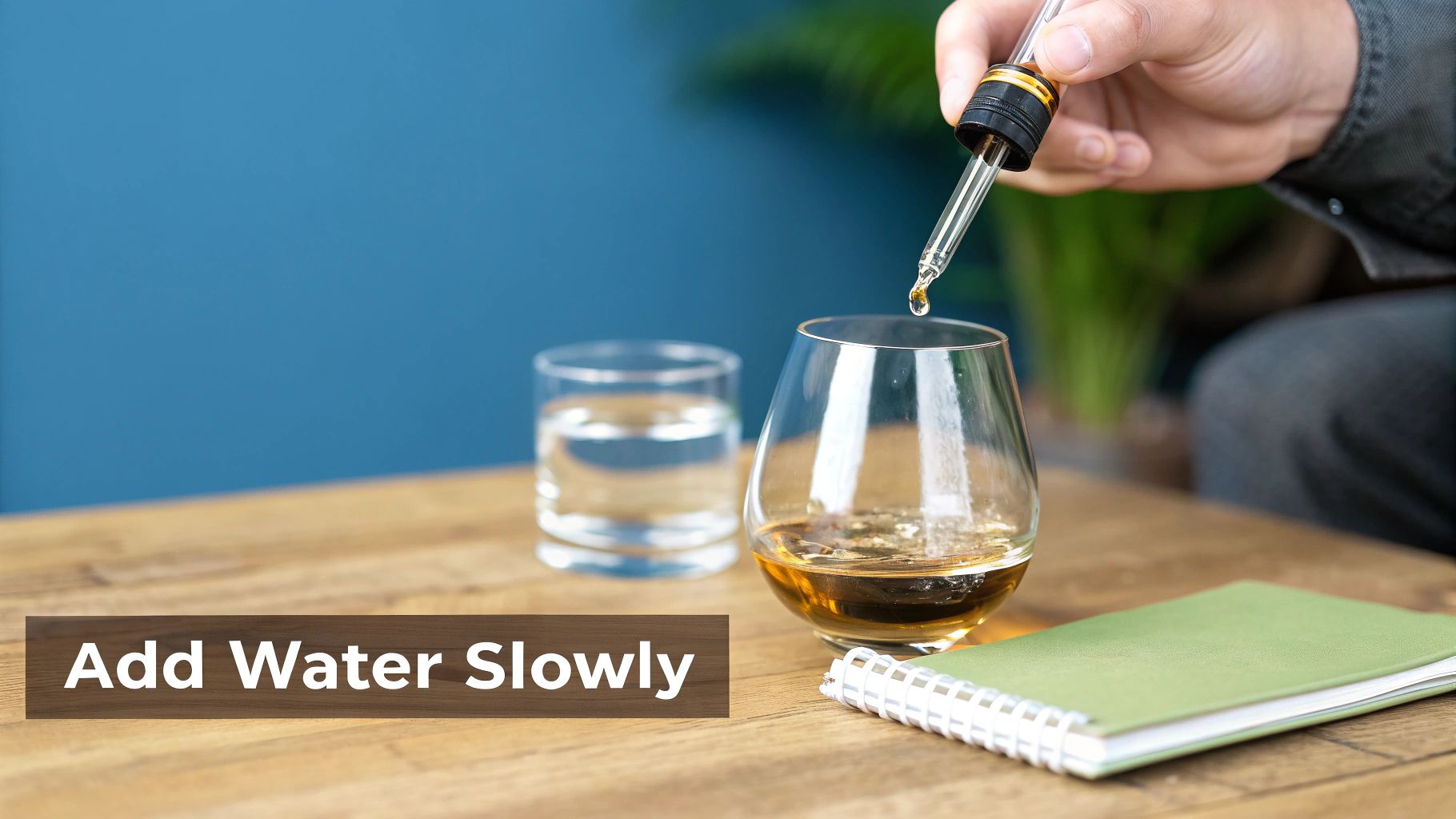
Think of it less as drinking and more as exploring. By following a few easy steps, you can tame the beast, navigate the heat, and find the subtle complexities that make these pours so special. Many newcomers find this method completely changes their view of high-proof spirits.
Start Small And Go Slow
Your first move is simple: pour less than you normally would. A half-ounce is plenty for a first tasting. This isn't about volume; it’s about analysis. A smaller pour is just easier to manage and encourages you to take your time.
Next, approach the nosing process gently. Unlike a standard 80-proof whiskey, a cask strength pour can be overpowering on the nose. Don't stick your nose deep into the glass and take a huge whiff. Instead, hold the glass a few inches from your face and wave it back and forth, letting the aromas drift up to you. This keeps the alcohol vapor from burning out your senses, allowing you to actually pick up notes of fruit, spice, or oak before you even take a sip.
When you’re ready, take a tiny sip—just enough to coat your tongue. This is your baseline. Notice the texture, the initial flavors, and, of course, the heat. This first taste gives you a pure, unadulterated snapshot of the whiskey exactly as the distiller intended it. Now, the real fun begins.
Tip for Beginners: The goal isn't just to drink the whiskey; it's to deconstruct it. Adding water is your primary tool for separating the alcoholic heat from the underlying flavors, revealing what’s hiding behind the high proof.
The Magic Of Adding Water
The secret to truly enjoying cask strength whiskey is adding water. This isn’t about "watering it down" in a bad way; it's a technique used by master blenders and seasoned enthusiasts to open up the spirit. Just a few drops can spark a dramatic chemical reaction in the glass, breaking down oils and releasing entirely new aromatic compounds.
Here’s a simple process to find your personal sweet spot:
- Use a Dropper or Straw: Precision is key here. A whiskey dropper is great, but even a simple drinking straw works perfectly for adding water one or two drops at a time. This gives you total control.
- Add, Swirl, and Wait: After adding a couple of drops, give the glass a gentle swirl. Let it rest for about 30 seconds to let the water and whiskey fully integrate.
- Nose and Sip Again: Go back and smell it. You’ll probably notice the alcoholic prickle has softened, and new, more delicate scents have emerged. Take another small sip and pay close attention to how the flavor has changed. Has a fruity note become more prominent? Is a spicy element clearer now?
- Repeat as Needed: Keep this process going—adding a few drops at a time—until the whiskey hits a balance of flavor and intensity that you love. There is no "correct" amount of water. It’s all about your personal preference.
This methodical approach makes cask strength less intimidating and way more interactive. It’s an engaging experience that lets you customize each pour, making it uniquely yours. It’s the perfect way to appreciate the hard work of American craft distilleries like Stranahan's or Laws Whiskey House, as you get to taste their product in its purest form and then tailor it perfectly to your own palate.
Decoding the Labels: Cask Strength vs. Barrel Proof
Walking down the whiskey aisle can feel like learning a new language. You're hit with terms like “Cask Strength,” “Barrel Proof,” and “Small Batch,” and it's easy to get lost in the jargon. Let's clear the air and demystify these labels so you can shop with confidence, knowing exactly what you're getting in the bottle.
For the most part, you can treat Cask Strength and Barrel Proof as interchangeable terms. Both mean the whiskey is uncut and undiluted—bottled at the same proof it was when it came out of the barrel. You're getting the whiskey in its most raw, high-octane state.
But the whiskey world loves its nuances, especially among the creative minds at American craft distilleries. Some producers use these terms to tell a slightly different story about their spirit.
Digging Deeper Into the Definitions
While it’s far from a hard-and-fast rule, some craft distillers make a subtle distinction between the two. Understanding it can give you a deeper appreciation for the artistry behind the bottle.
-
Barrel Proof: More often than not, this term points to a single-barrel bottling. The whiskey is drawn from one individual barrel, and the proof on the label is the exact proof of that specific cask. It’s a pure snapshot of one barrel’s unique journey.
-
Cask Strength: This label might be used when a distillery blends a small batch of barrels together. The whiskeys are married without adding any water, and the final proof you see is the natural, combined proof of all the barrels in that particular blend.
Think of it this way: Barrel Proof is a solo performance, showcasing the distinct character of one barrel. Cask Strength is more like a small ensemble, where several barrels harmonize to create a complex, layered final product—still at full volume.
How Do They Compare to Standard Labels?
To really grasp what makes cask strength special, it helps to see how it stacks up against the other common terms on the shelf. Here’s a quick breakdown to put everything in context.
-
Single Barrel (Standard Proof): Just like a barrel proof whiskey, this spirit comes from a single cask. The big difference? It has been "proofed down" with water to a standard bottling strength, usually somewhere between 80-100 proof.
-
Small Batch (Standard Proof): This is a blend of a select number of barrels, but it has also been diluted with water to hit the distillery’s target proof.
The key distinction is always the water. Cask strength and barrel proof expressions are your ticket to tasting a spirit at its most powerful and authentic—just as the distiller does. They represent the peak of flavor intensity before the final product is shaped for a wider audience.
The True Value Of A Cask Strength Bottle
It’s no secret that cask strength whiskeys often carry a higher price tag. This naturally leads to the big question: are they actually worth it?
Once you understand what you’re really paying for, the value becomes crystal clear for anyone who genuinely loves an authentic spirit.
When you get down to it, the higher price reflects a simple truth: you’re buying more pure, unadulterated whiskey and a lot less water. A standard 750ml bottle at 40% ABV is, by definition, 60% water. Compare that to a cask strength bottle at 60% ABV, and you can see you’re getting significantly more of the actual spirit.
This puts you in the driver's seat. You get more control and, in a very real way, more whiskey for your money. If you find the proof a bit too punchy, you can add your own water, effectively stretching a single bottle into more servings than you'd get from its standard-proof cousin.
More Than Just Proof
But the real value of cask strength goes far beyond simple math. It’s about experiencing the absolute peak of flavor and texture. It's also why most cask strength bottlings are proudly labeled as non-chill filtered—a small detail that makes a massive difference in the glass.
The drinker who chooses cask strength values authenticity above all. They want to experience the spirit in its most direct and flavorful form, just as the master distiller tasted it from the barrel.
Chill filtration is essentially a cosmetic process. It involves cooling the whiskey down and running it through a fine filter to remove natural fatty acids, oils, and esters. The goal is to prevent the whiskey from getting hazy when you chill it or add ice.
While it makes the spirit look crystal clear, it also strips away key components that create a rich mouthfeel and a more dynamic, complex taste.
By skipping this step, American craft distilleries preserve every last drop of character. You're left with a whiskey that has a fuller body, a more viscous texture on the palate, and a taste profile that is deeper and far more robust. This is the spirit in its most honest state—an unfiltered expression of the grain, the barrel, and the distiller's art. For many of us, that raw, uncompromised experience is priceless.
Exploring Cask Strength Through Blind Tastings
This is where the real fun begins. Cask strength whiskeys are practically made for blind tastings, precisely because their raw intensity and layered complexity demand your undivided attention. When you strip away the powerful bias of a fancy label or a distillery’s reputation, you’re left with just one tool: your senses.
That higher proof isn’t just about the alcoholic heat; it’s a superhighway for a dense concentration of flavor compounds, oils, and esters. It creates a playground for your palate, offering a depth that standard-proof whiskeys often can't touch. You’re getting an unfiltered, honest expression—the perfect candidate for a truly objective tasting.
Why It Levels The Playing Field
Blind tasting is the ultimate equalizer in the whiskey world. It tears down the walls of marketing, price tags, and preconceived notions, leaving only the spirit itself to do the talking. For anyone new to whiskey, it’s an incredible way to build confidence in your own palate.
The format forces you to evaluate a whiskey on its own merits. You might be shocked to find your favorite of the night isn’t the one with the highest age statement or the most prestigious name, but a bold, innovative release from an up-and-coming American craft distillery. It’s a powerful way to discover what you genuinely enjoy.
When you taste blind, every whiskey gets an equal shot. It’s a powerful way to sharpen your tasting skills, challenge your assumptions, and discover incredible new spirits based on merit alone.
Imagine the thrill of nosing a sample, being completely blown away by its rich character, and then finding out it’s from a small, family-owned operation like Frey Ranch in Nevada or Ironroot Republic in Texas—producers you might never have reached for otherwise.
Tips For Your First Blind Cask Strength Tasting
If you’re setting up your own tasting, especially with high-proof spirits, a few simple guidelines can make all the difference. A well-organized event is a fantastic way to learn, and you can get everything you need with a dedicated blind whiskey tasting kit.
Here’s how to get started:
- Serve Smaller Pours: A half-ounce pour is more than enough. This keeps things responsible and encourages a focus on analysis rather than just drinking.
- Provide Water Droppers: Make sure water and droppers are handy for every taster. This is crucial for allowing everyone to dial the proof down to their own comfort level, unlocking different layers of flavor along the way.
- Encourage Discussion: The best part of blind tasting is sharing notes. Talk about what you smell and taste. You’ll be amazed at how discussing it with others helps you pinpoint notes you couldn’t quite place on your own.
This approach transforms whiskey drinking from a passive activity into an engaging, educational, and deeply rewarding experience. It's the best way to truly understand what cask strength means in a practical, hands-on way.
Still Have a Few Questions About Cask Strength?
Even after diving into the details, a few practical questions always seem to pop up. Let's clear the air so you can continue your tasting journey with confidence and get the most out of every high-proof pour.
Is Cask Strength Whiskey Actually Better?
While "better" always comes down to personal taste, many whiskey lovers would argue it’s more authentic. Think of it as the purest expression of a distillery's craft. It’s bottled straight from the barrel, without water dilution or chill-filtration, which means you're getting the absolute maximum flavor and texture the whiskey has to offer.
The biggest advantage is the control it gives you. You get to be the master blender, deciding the final drinking strength by adding water drop by drop to find your own personal sweet spot. This makes it a far more versatile and personalized experience than a standard bottling.
Can You Drink Cask Strength Whiskey Neat?
Absolutely—but it’s a good idea to ease into it if you're not used to high-proof spirits. That intense proof can easily overwhelm your palate on the first sip, scorching your taste buds with alcoholic heat and masking all the subtle flavors hiding underneath.
A great way to approach it is to take one tiny, tentative sip neat just to understand the whiskey's raw, untamed character. Then, add a few drops of water to "open it up." This simple act tames the alcoholic bite and allows a whole new world of aromas and flavors to blossom.
Does The Proof Change After Opening The Bottle?
Nope, not in any meaningful way, as long as you store it properly. Unlike wine, whiskey’s aging process screeches to a halt the second it leaves the barrel and goes into a bottle.
Just make sure you seal the bottle up tight and store it upright, away from direct sunlight and crazy temperature swings. If you do that, the proof and flavor will stay rock-solid for years. Significant evaporation isn't really a concern for a properly sealed bottle, so feel free to take your time and savor it.
Ready to put your palate to the test and discover your next favorite American craft whiskey? The Blind Barrels tasting experience strips away all the labels and hype, letting you explore incredible cask strength and standard proof spirits based on taste alone. Start your blind tasting adventure today!