

If you’ve spent any time looking at a whiskey label in the United States, you’ve seen the term ‘proof’. In the simplest terms, proof is just the alcohol by volume (ABV) multiplied by two.
So, that 80-proof bottle of Jack Daniel's on the shelf is 40% alcohol, and a 100-proof bottle of Wild Turkey is a straight 50% alcohol. It's the most direct measure of a whiskey's strength.
What Whiskey Proof Means In Simple Terms
While the math is straightforward, that number on the label is your first and best clue to the entire story of the whiskey inside. It tells you about its historical roots and has a massive influence on the final flavor you get in the glass.
For anyone new to the world of whiskey, getting a handle on proof is the first real step toward finding spirits you'll truly enjoy. Think of it as a roadmap. A lower proof often points to a softer, more approachable sip, while a higher proof signals a bolder, more intense character. This guide will demystify proof once and for all, so you can walk the whiskey aisle with confidence.
Common Whiskey Proofs and Their ABV
This quick reference table helps you instantly translate the proof on a bottle to its actual alcohol content and what that might mean for your tasting experience.
| Whiskey Proof | Alcohol By Volume (ABV) | What This Means for Drinkers |
|---|---|---|
| 80 Proof | 40% ABV | The legal minimum for most American whiskeys. It's often smoother and more approachable, making it a great starting point for beginners. |
| 90 Proof | 45% ABV | A slight step up in intensity. Flavors are more pronounced, and the alcohol warmth is more noticeable. A common strength for many craft bourbons. |
| 100 Proof | 50% ABV | Known as "Bottled-in-Bond" if it meets certain criteria. This is a classic, robust proof that holds up well in cocktails or on the rocks. |
| 115 Proof | 57.5% ABV | We're getting into "barrel proof" or "cask strength" territory here. Expect bold, concentrated flavors and a significant alcoholic punch. |
| 125 Proof | 62.5% ABV | A high-octane pour. These are often undiluted, straight-from-the-barrel whiskeys that deliver an intense, full-flavored experience. |
Understanding these common benchmarks makes it much easier to predict how a whiskey will feel and taste before you even open the bottle. It's the first filter you can use to find your next favorite pour.
The Surprising History of Gunpowder and Rum
Believe it or not, the term ‘proof’ has an explosive origin story that goes all the way back to the 16th-century British Royal Navy. Back then, sailors received a daily ration of rum, but there was a constant problem: shady suppliers would water down the spirits to stretch their profits.
To make sure they weren't being cheated, sailors developed a simple but effective test to "prove" the rum's strength.
They’d mix a bit of gunpowder with the rum and try to light it. If the concoction caught fire and burned with a steady flame, the spirit was considered ‘at proof’. This meant it was strong enough—at least 57.1% ABV. A rum that was too weak would just fizzle out, exposing the diluted product. You can read more about this old-school quality check on Wikipedia's page on alcohol proof.
This clever, rugged test wasn't just for keeping sailors happy. It laid the groundwork for the formal systems of taxation and regulation we use today, and its legacy can still be felt in the standards of modern American craft whiskey.
How Proof Shapes Whiskey During Production
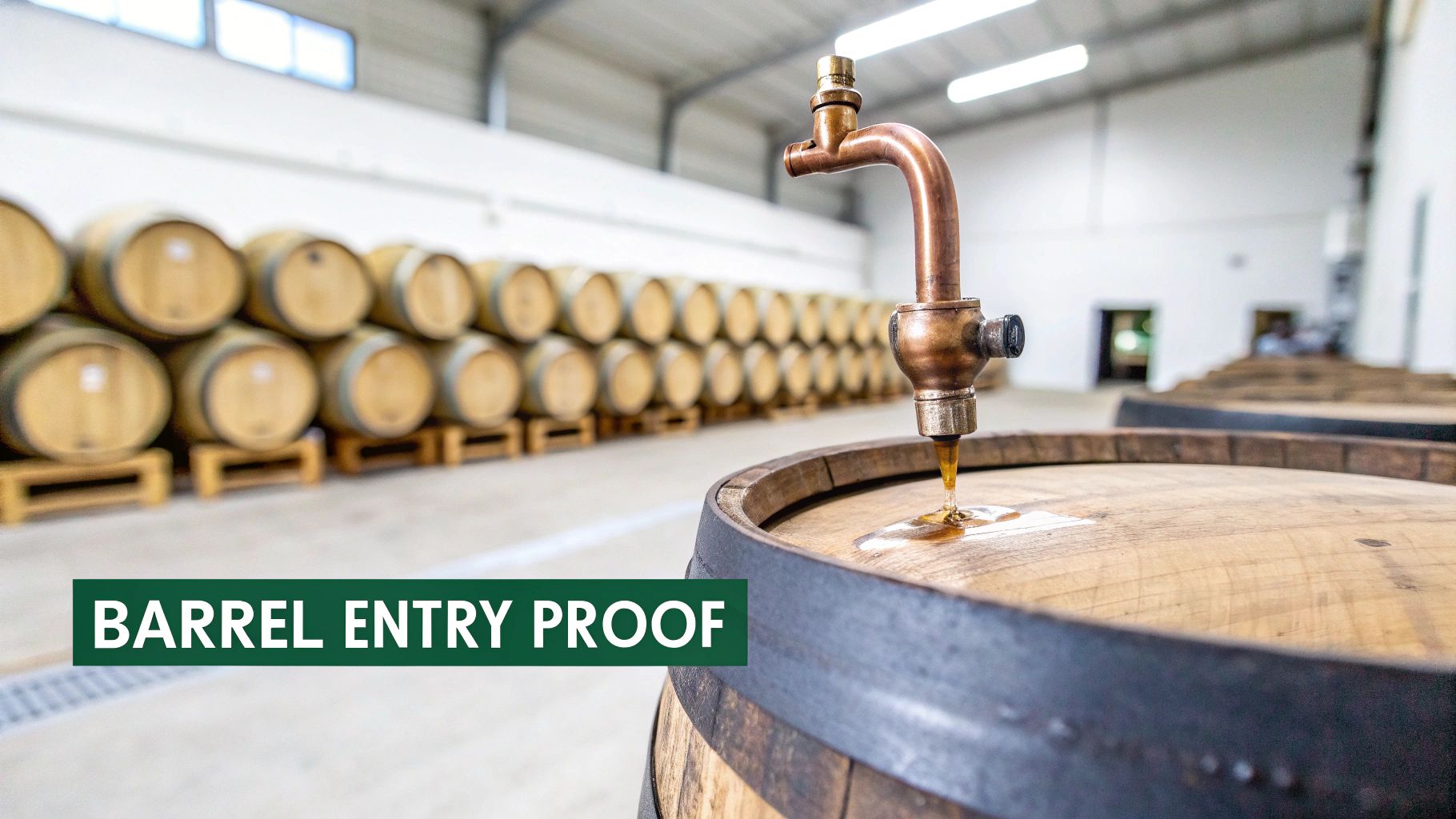
Before a drop of whiskey ever sees a bottle, its proof plays a huge role in how it matures. The concept here is called barrel entry proof—basically, how strong the spirit is when it first goes into the oak barrel. It’s a decision that directly shapes the final flavor of the whiskey.
For a long time, the common wisdom among distillers was that a lower entry proof, often around 100 proof, led to a smoother, more refined spirit after years of aging. Many modern American craft distillers, like Leopold Bros. in Colorado, are returning to this philosophy.
That all changed in 1962. A landmark decision by the U.S. Treasury raised the maximum allowable barrel entry proof to 125. This wasn't just a minor tweak; it fundamentally altered American whiskey production. For a deep dive into this industry shift, the folks at PM Spirits have some fascinating research.
This change allowed distillers to use fewer barrels and less warehouse space, a major economic advantage. Higher proofs extract different flavor compounds from the wood, meaning this decision altered the very taste of American whiskey. The raw spirit's character, defined by its journey through various stills, interacts differently with oak at different proofs. You can explore more about the art of whiskey distillation in our guide.
Decoding the Proof on a Whiskey Label
When you're staring down a wall of whiskey, that little number on the label—the proof—is your best friend. It’s more than just a number; it's a quick guide to the intensity, flavor, and even the history of what's inside the bottle.
Let’s break down what you’ll typically see.
Many entry-level whiskeys will clock in right at the legal minimum of 80 proof (40% ABV). This is a great starting point, offering a softer, more approachable experience. It’s a common benchmark for whiskeys designed for easy sipping or mixing.
Then you have the historic Bottled-in-Bond designation, which is always, without exception, 100 proof. This isn't just a random number. It's a seal of quality born from the Bottled-in-Bond Act of 1897, a law created to protect drinkers from sketchy, adulterated spirits. To earn this label, a whiskey must be the product of a single distillery from one season, aged at least four years, and bottled at exactly 100 proof. Many American craft brands, like New Riff Distilling, proudly feature Bottled-in-Bond expressions.
Finally, you’ll run into the heavy hitters: Cask Strength or Barrel Proof whiskeys. These are the real powerhouses, bottled straight from the barrel with zero dilution. Their proof can soar, often landing anywhere from 110 to 135+ proof. Curious about what makes these so special? We've got a whole guide explaining what cask strength whiskey is and why it's a favorite among serious enthusiasts.
How Proof Influences Flavor and Your Palate
Think of a whiskey's proof like the volume knob on a stereo. A higher proof isn't just "louder" with alcohol; it's a more concentrated, intense delivery of the spirit's core flavors. It’s the full, unbridled expression of the whiskey straight from the barrel.
Lower-proof whiskeys, typically in the 80-94 proof range, are often much more approachable. The edges have been softened, making them fantastic starting points if you're just getting your bearings. Higher-proof spirits (100+) crank that flavor intensity way up, but they can also bring a noticeable alcohol ‘burn’ if you're not ready for it.
But here’s the secret: you’re in control. You don’t have to drink that cask-strength monster straight. Adding a few drops of water—a move we call ‘proofing down’—is a classic way to customize your pour.
Tip for New Drinkers: Don't be intimidated by high-proof whiskey! Adding a few drops of water can dramatically tame the alcoholic heat and unlock new layers of aroma and flavor that were hiding behind the alcohol, letting you dial in the whiskey to your personal sweet spot. To get this technique just right, check out our full guide on adding water for bourbon and other whiskeys.
To give you a better idea of what to expect, we've broken down the typical tasting experience across different proof levels. This isn't a hard-and-fast rulebook, but it's a great starting point for finding a bottle that fits your taste.
Tasting Notes by Proof Range
| Proof Range | Typical Characteristics | Best For... |
|---|---|---|
| 80-90 Proof | Light, delicate, and often fruit or grain-forward. Less alcohol heat allows subtle notes to shine. Very approachable. | New drinkers, easy sipping, cocktails where you don't want the whiskey to overpower other ingredients. |
| 90-100 Proof | The "sweet spot" for many. Balanced character, with more pronounced oak, spice, and caramel notes. Richer mouthfeel. | Versatile sipping, classic cocktails like an Old Fashioned, and exploring a whiskey's core profile. |
| 101-115 Proof | Bold and robust. Flavors are deep and concentrated. The alcohol is more present but brings rich oils and complexity with it. | Experienced drinkers, slow sipping with a drop of water, or anyone looking for a full-flavored experience. |
| 116+ Proof | Intense, oily, and powerful. Often labeled as Cask Strength or Barrel Proof. Can be hot, but also incredibly complex. | The adventurous sipper. Best enjoyed with a bit of water to unpack the dense layers of flavor. |
Ultimately, there's no "right" or "wrong" proof. It's all about what you enjoy. Use this as a guide to explore, and don't be afraid to experiment with a little water to see how it transforms your dram.
Practical Tips for Choosing Your Next Bottle
So, you're ready to put this newfound knowledge to the test. Good. Understanding proof is one of the best tools you have for walking into a liquor store and walking out with a bottle you’ll genuinely enjoy.
Tip for New Whiskey Drinkers: If you’re just starting your whiskey journey, a great place to begin is in the 80-94 proof range. These whiskeys tend to be much smoother and more approachable, letting you pick out flavors without being overwhelmed by alcoholic heat. Look for a quality American craft bourbon in this range to start.
Did you grab a bottle that’s a little too fiery? Don't be shy about adding a single drop of water or a large ice cube. It's a simple trick, but it can work wonders to tame the heat and unlock some of the deeper, more subtle flavors hiding in the glass.
For a real hands-on lesson, head to a good whiskey bar and ask for a "proof flight." Tasting a standard bourbon like Buffalo Trace right next to its much higher-proof sibling, Stagg, is a fantastic way to discover what you truly prefer. At the end of the day, there is no "best" proof—only what’s best for you.
This chart gives a great visual of the general relationship between a whiskey's proof and its flavor intensity.
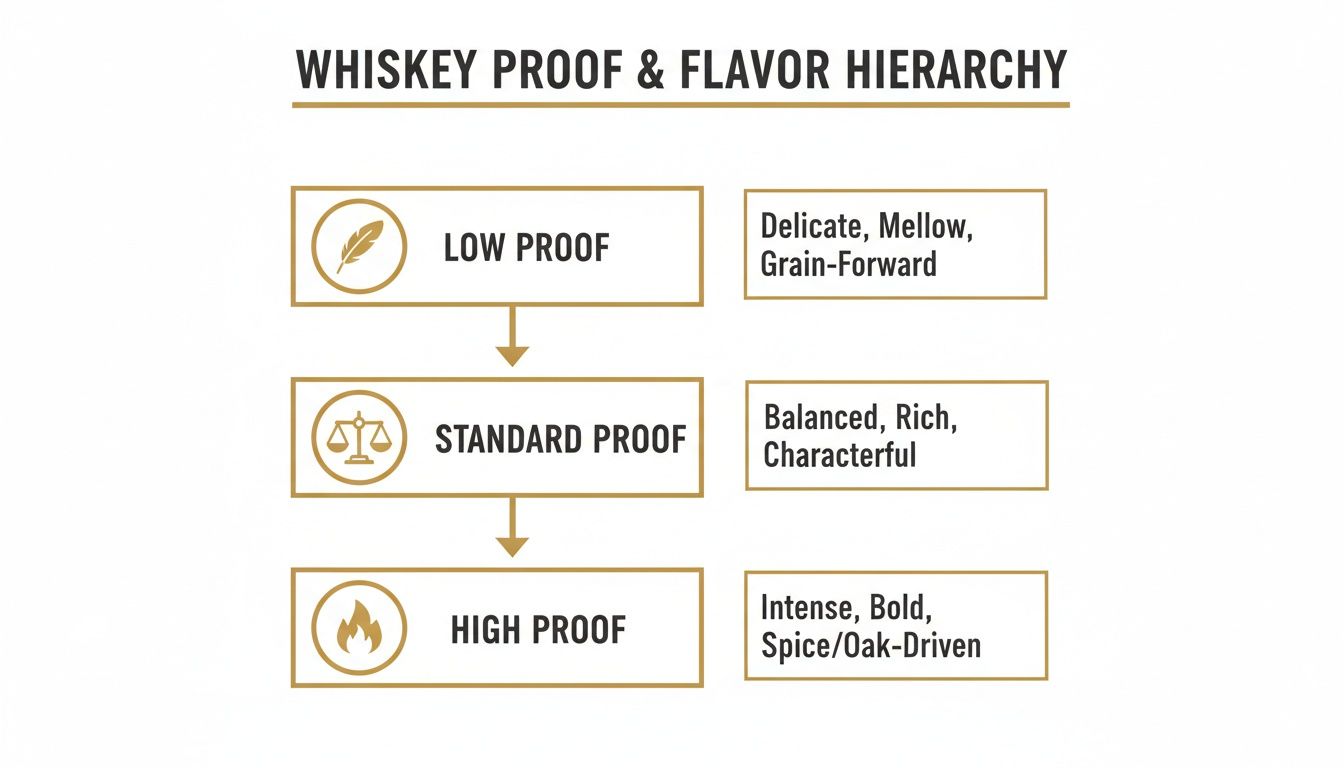
As you can see, the higher proofs almost always deliver a bolder, more concentrated flavor profile. It's all about finding the balance you enjoy most.
Still Have Questions About Whiskey Proof?
Alright, let's wrap this up by hitting a few of the most common questions that come up when people start digging into the world of whiskey proof.
Is Higher Proof Whiskey Automatically Better?
Absolutely not. It's a classic rookie mistake to think that a bigger number on the bottle means a better whiskey. "Better" is entirely up to you and your palate.
Sure, a higher proof whiskey packs more flavor and a bigger alcoholic punch, which can be fantastic if that's what you're after. But for many, the sweet spot is a smoother, more approachable 80 or 90-proof bottle. The "best" proof is simply the one you genuinely enjoy drinking.
Wait, How Can Whiskey Gain Proof in the Barrel?
This is one of those cool, counterintuitive bits of whiskey science. It usually happens in hot, humid climates—think Kentucky in the summer.
In these conditions, the barrel breathes. But here’s the trick: water molecules are smaller than ethanol molecules, allowing them to escape through the wood staves more easily. As more water evaporates than alcohol, the remaining liquid becomes more concentrated, and just like that, the proof starts to climb.
How Much Water Should I Add to a Cask Strength Whiskey?
There's no magic recipe, and the best advice is to start slow. Seriously, just a drop or two at a time.
Use a whiskey dropper or even a straw to add a tiny amount of water. Give the glass a swirl, take a sip, and see what’s changed. Has a new flavor popped up? Has the alcohol burn softened? Keep adding a drop at a time until you find that perfect balance for your taste. The idea is to gently coax out the flavors, not to drown them.
Ready to put your palate to the test and figure out what proof you really prefer, without any brand bias getting in the way? The Blind Barrels tasting kit is your ticket to exploring incredible American craft whiskeys, letting you discover a new favorite based purely on what's in the glass. Join our blind whiskey tasting club today!