

You've opened the box, lined up the little bottles on the kitchen counter, and discovered that the hardest part isn't choosing a whiskey. It's figuring out what to do first. Should you read the notes, taste blind, add water, or just pour and enjoy?
A whiskey subscription box turns that moment of uncertainty into a guided tasting. Instead of committing to a full bottle based on a label, you receive a curated selection, tasting materials, and a repeatable way to compare expressions. The core value isn't just the liquid in the package. It's the structure that helps you understand what you like.
What a Whiskey Subscription Box Actually Is
A whiskey subscription box is a recurring delivery service that sends curated whiskey samples on a set schedule, often monthly or quarterly. The box may include tasting cards, producer information, aroma prompts, a scoring sheet, pairing suggestions, or access to a community tasting. Some services identify every whiskey immediately. Others keep the bottles anonymous until you've finished tasting.
The model exists because whiskey is difficult to explore systematically. Distilleries release expressions from different mash bills, cask programs, regions, and production styles, while retail shelves tend to favor familiar brands. A newcomer can spend a long time comparing labels without ever learning whether they prefer a sweeter bourbon, a peppery rye, or a lighter single malt.
A subscription packages three jobs together:
- Selection: Someone chooses expressions that are meant to create contrast or tell a story.
- Portioning: You can try samples without buying several full bottles.
- Education: Notes and tasting prompts give you a vocabulary for what you're experiencing.
That combination makes the box closer to a tasting curriculum than a simple alcohol delivery. The recurring format also creates a learning arc. You can compare one shipment with the next, notice which aromas keep appearing, and gradually become more confident about your preferences.
How it differs from other formats
A whiskey-of-the-month club usually sends a full bottle. That can be useful if you already know what you enjoy, but it offers less room for comparison. A one-time tasting flight, meanwhile, can be excellent for an evening with friends, yet it doesn't necessarily provide a continuing path for learning.
A subscription sits between those formats. It gives you several expressions in smaller portions and asks you to pay attention to differences rather than judge one bottle in isolation. That's particularly useful for American craft whiskey, where smaller producers may not have broad retail distribution.
The market context supports this discovery-focused format. One industry report valued the global alcohol subscription-box market at USD 596.5 million in 2023 and projected it to reach USD 2.43 billion by 2030, implying a 22.2% CAGR from 2024 to 2030. The market report connects this growth with convenience, discovery, and premium experiences.
Practical rule: Judge the box by the experience it creates, not by the number of bottles shown in the product photo.
How Whiskey Subscription Services Work Behind the Scenes
Every service turns a few operating choices into a particular kind of tasting experience. Before you compare brands, look at the dials you're agreeing to accept when you subscribe.
The four choices that shape the box
Cadence determines how quickly you'll receive new material. Monthly delivery creates a frequent habit, while a quarterly schedule gives you more time to taste, compare, and discuss each shipment. Some services use a bi-monthly rhythm. The right option depends on whether you want an ongoing ritual or occasional events.
Sample size affects how much flexibility you have. A smaller sample may be enough for one careful tasting, while a larger sample gives you room to revisit the pour, add water, or share it. Don't assume that a larger sample automatically means better value. The educational materials and quality of the selections matter too.
Curation source tells you who makes the choices. An in-house tasting panel may build a deliberate progression. Partner distilleries may highlight their own releases. Member voting can make a box feel more community-led, though it may produce a less structured lineup.
Price tier usually reflects the rarity of the whiskey, the amount shipped, the materials included, and the level of access provided. A low-cost sampler can be useful for exploration, while a premium tier may focus on harder-to-find craft expressions. Compare the delivered total, not just the advertised subscription price.
| Lever | Common Range | What It Means For You |
|---|---|---|
| Cadence | Monthly, bi-monthly, or quarterly | How often you need to make time for tasting |
| Sample size | Small samples to generous tasting portions | Whether you can retaste, dilute, or share |
| Curation source | In-house, producer-led, or member-informed | How much selection philosophy shapes the lineup |
| Price tier | Entry, standard, or premium | What you're paying for whiskey, guidance, and access |
The logistics you don't see
Alcohol shipping adds another layer. Services must follow applicable state and carrier requirements, and deliveries generally require an adult signature. FedEx alcohol shipping guidance specifies 21+ signature delivery and recommends minimum 2-mil watertight bags, corrugated outer packaging, and insulating materials for liquid shipments.
Temperature matters as well. The same guidance warns that spirits can cloud below roughly 20°F, so responsible fulfillment teams need to consider insulation and extreme weather. A leaking or heat-damaged sample can ruin an otherwise thoughtful experience.
Inside the package, you'll typically find sealed sample bottles, printed or digital tasting cards, and instructions for recording impressions. Some services add glassware, food pairings, games, or community access. Those extras aren't merely decoration. They can determine whether the box becomes a solitary drink or a repeatable activity with other people.
For a practical explanation of the subscriber experience, this guide to how whiskey subscription boxes work is useful to read alongside each service's own shipping, renewal, and cancellation terms.
Blind Tasting Versus Labeled Sample Packs
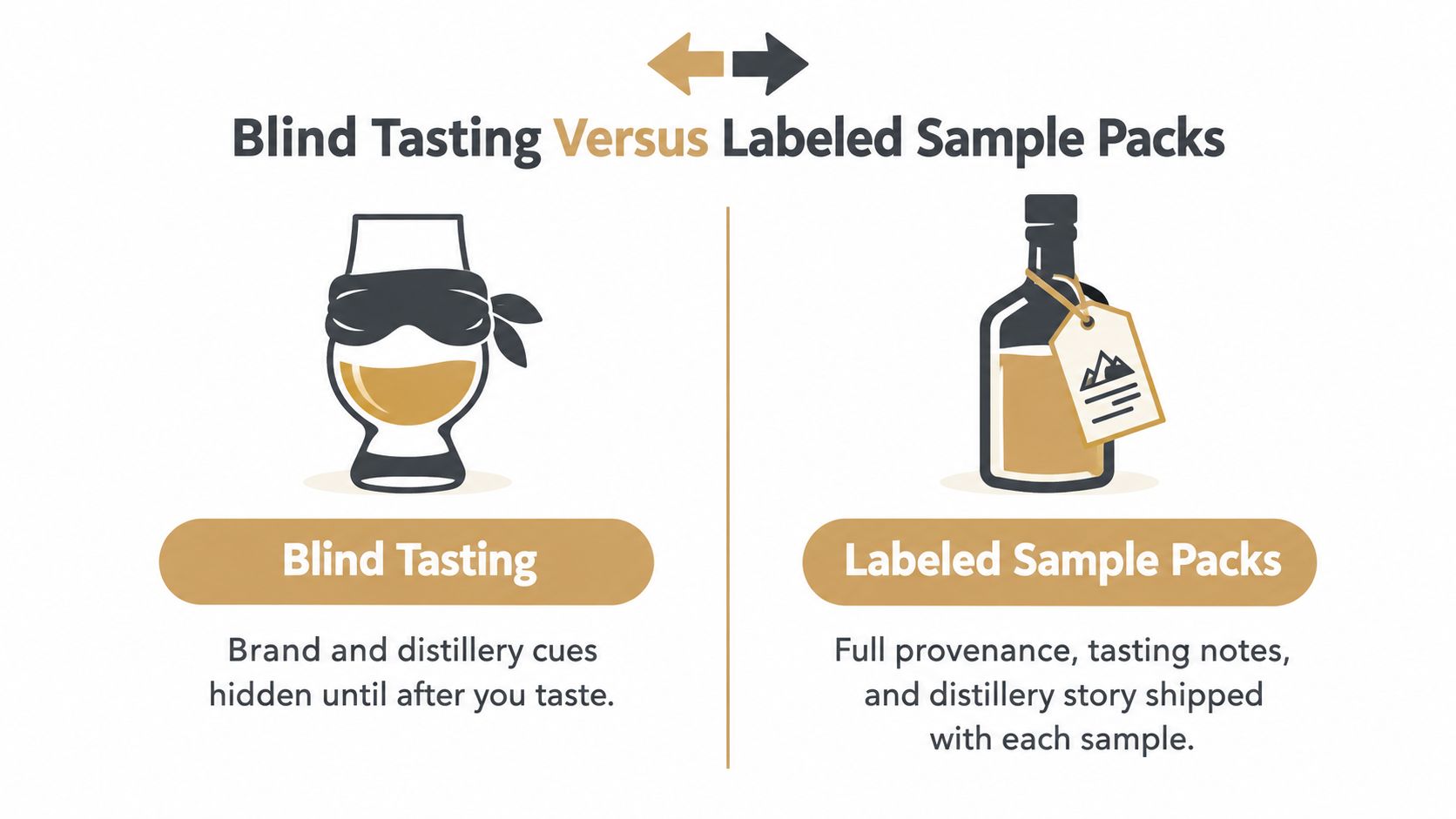
A labeled sample tells you what you're drinking before the first sip. You may see the distillery, age statement, mash bill, proof, region, and tasting notes. That information gives the whiskey a story, and the story can make the tasting more memorable.
A blind sample removes those cues until later. You evaluate the whiskey before knowing whether it comes from an established producer or a small distillery, and before a price or reputation can influence your expectations.
What blind tasting changes
Blind tasting shifts your attention toward observable details. You can examine color, watch how the liquid moves around the glass, assess aroma concentration, notice palate weight, and track the length and character of the finish. You may still make a wrong guess about the whiskey, but you're practicing the more useful skill of describing what you experience.
Expectation bias can materially affect judgment. Controlled tasting research also indicates that presentation order can influence evaluations, even when the samples are blind. A well-designed service should therefore use neutral sample codes and randomize the tasting sequence rather than allowing the first pour to set the standard for everything that follows. This research on blind tasting and presentation order explains why tasting design matters.
Labeled packs teach a different lesson. Once you know the provenance, you can connect a region, mash bill, maturation approach, or age statement with the flavor in the glass. That builds whiskey knowledge more directly, especially if you're trying to understand why two bourbons or ryes taste different.
Which format should you choose?
Neither approach wins in every situation.
- Choose blind tasting if you want to challenge assumptions, play a guessing game, or discover that your palate prefers an unexpected expression.
- Choose labeled packs if you care about distillery stories, production details, and learning the relationship between information and flavor.
- Look for a hybrid if you want to taste first and reveal the details afterward.
The strongest format for a group often combines both. Everyone tastes without labels, records a guess, and then scans a card or code to reveal the answers. That sequence preserves the sensory challenge while still delivering the context afterward.
For a deeper look at the method, this blind whiskey tasting guide shows how removing brand and price cues can make the tasting more deliberate.
The Tasting Ritual Every Box Is Built Around
You don't need a trained palate to start. You need a consistent sequence and enough patience to notice what changes from one step to the next.
1. Examine
Pour a small amount into a glass and hold it near a light source. Look at the color, clarity, and movement. A gentle swirl can reveal how the whiskey coats the glass, though appearance alone won't tell you whether you'll enjoy the flavor.
This first pause prevents you from rushing straight to alcohol heat. It also gives you a neutral opening note, such as pale gold, amber, copper, clear, light-bodied, or slow-moving.
2. Nose
Bring the glass toward your face without forcing your nose deep into it. Take short, gentle sniffs. Keeping your mouth slightly open can make the aroma feel less sharp, especially if you're new to spirits.
Try to identify broad categories before searching for exact flavors. Fruit, vanilla, cereal, oak, spice, smoke, caramel, and herbs are useful starting points. You don't need to name a specific fruit or dessert to make a good observation.
3. Sip
Take a small sip and let it move across your tongue. Notice the arrival, the texture, the warmth, and the way the flavor develops from the front of your mouth toward the back. The first sip may feel more alcoholic than the next one, so avoid making a final judgment immediately.
Plain water can help you compare the whiskey at its original strength and after dilution. A few drops may change the aroma or soften the texture, but you don't have to add water if you prefer the undiluted pour.
4. Finish
The finish is what remains after you swallow or spit. Does the flavor disappear quickly, or does spice, oak, fruit, or sweetness stay with you? Does the warmth fade cleanly, or does it become bitter or drying?
Record the finish separately from the main taste. A whiskey can be pleasant on the palate but short on the finish, or it can develop its most interesting character after the sip has gone.
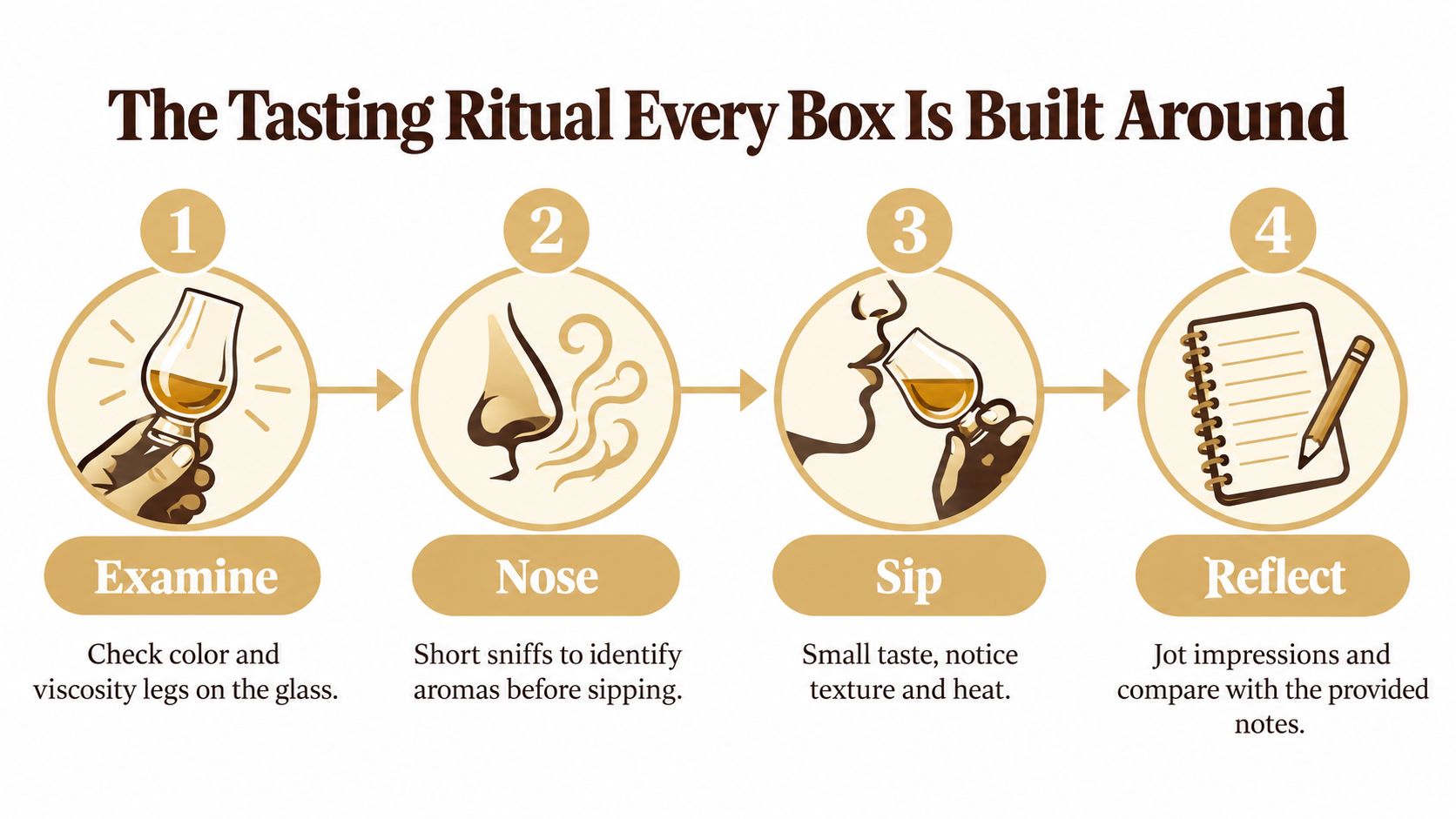
A sample box supports this ritual through portion size, glassware, tasting cards, and water. Repeating the same sequence across several expressions helps you notice patterns. This whiskey tasting guide also emphasizes the value of moving from appearance to aroma, taste, and finish while taking notes.
The ritual isn't a test you can fail. It's a way to slow down long enough to notice your own response.
A Look Inside a Curated Craft Whiskey Kit
A quarterly craft kit from Blind Barrels offers a clear example of how curation can become an activity rather than a package of unrelated samples. The box contains four 50 mL blind whiskey samples, shipped every quarter, with each sample featuring a small American craft distillery.
The unboxing starts with sealed sample vessels rather than a full retail bottle. That changes the question from “Do I like this brand?” to “What do I notice before I know the brand?” The smaller format also allows the shipment to present several expressions as a group, so the drinker can compare texture, aroma, proof, and finish during one tasting session.
What the tasting materials do
The printed tasting table guides the drinker through aroma, taste, and finish notes. It gives newcomers a place to write observations without requiring specialist vocabulary. “Sweet,” “spicy,” “dry,” “fruity,” and “warm” are perfectly reasonable starting points.
A QR code reveals the identity and background of each sample after the blind tasting. The information includes the distillery, mash bill, ABV, age statement, aroma and tasting notes, and distillery story. This reveal preserves the suspense while still giving the drinker useful production context afterward.
Why the extras matter
The kit also includes a game built around guessing details such as age, proof, and whiskey type. That turns the tasting into a shared challenge for couples or friends. Participants can compare guesses, discuss what led them toward an answer, and see how closely their impressions matched the revealed information.
The final piece is the path to a full bottle. A storefront link or code lets members revisit a sample they enjoyed and purchase the corresponding bottle at a discounted price. That connection makes the box more useful than a sampler that ends when the final pour is gone. It links discovery with a considered buying decision, without forcing the subscriber to buy every expression upfront.
Choosing the Right Box for Your Goals
Start with the experience you want, then inspect the product details. A box designed for blind group tastings may not suit someone who wants detailed distillery education, and a provenance-heavy pack may feel less exciting to someone who wants a guessing game.
The comparison checklist
| Criterion | What To Look For | Red Flag |
|---|---|---|
| Sample size | Enough liquid for a careful tasting and possible retaste | Tiny portions with no clear serving guidance |
| Provenance | Distillery, mash bill, strength, age, and sourcing details revealed clearly | Vague claims about “premium” whiskey |
| Tasting materials | Cards, booklets, scoring tables, or digital notes | A box that supplies bottles without guidance |
| Curation | A stated reason the expressions appear together | Random samples with no contrast or theme |
| Extras | Games, pairings, community events, or glassware that fit the format | Promotional items replacing useful content |
| Bottle access | A clear route to buy a full bottle after discovery | No information about where featured whiskey can be found |
| Flexibility | Gift plans, pauses, skips, and transparent cancellation terms | Automatic renewal that's difficult to understand |
| Shipping | Adult-signature rules, delivery areas, and packaging details | No clear explanation of alcohol shipping restrictions |
Match the box to the occasion
For a first exploration, prioritize approachable guidance and samples that create contrast. You'll learn more from a thoughtful range than from four expressions that taste nearly identical.
For gifting, check whether the recipient can receive a one-time shipment without being enrolled in an unwanted renewal. Current market examples offer one-time, three-month, six-month, and twelve-month options, while some services also provide pause and cancellation controls. This whiskey subscription tasting-box example illustrates why gift length and commitment flexibility deserve attention before checkout.
For blind tasting, confirm that the labels are fully concealed and that the reveal happens after you've recorded your impressions. Ask whether the service provides neutral codes and a recommended order.
For buying guidance, look for bottle access after the tasting. A sample is most valuable when you can identify a full bottle you would want, rather than ending with an interesting note and no practical next step.
The subscription terms deserve as much attention as the tasting notes. Verify delivery timing, adult-signature requirements, duties where relevant, and what happens if nobody is available to sign. A box that fits your palate but not your schedule won't remain enjoyable for long.
Tips for New Whiskey Drinkers
A first tasting becomes easier when you remove a few common sources of confusion. Treat these suggestions as guardrails, not rules carved into stone.
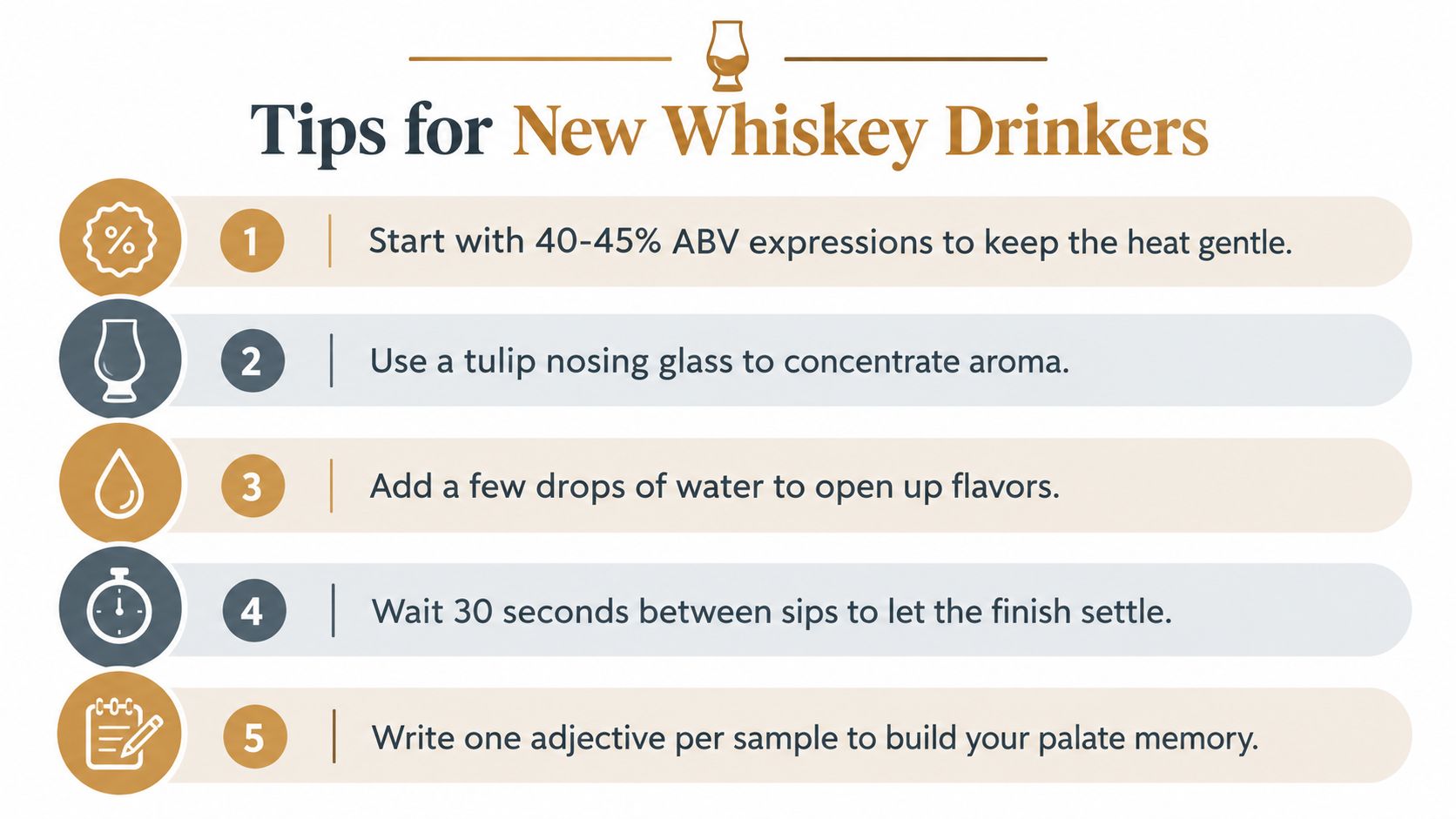
Start with whiskey in the 40% to 46% ABV range if you're learning. That range is commonly recommended as a friendly starting point because it can make flavor balance easier to notice without overwhelming the palate with alcohol heat. This beginner's whisky tasting advice also recommends using a glass that narrows toward the top.
A tulip-shaped nosing glass, such as a Glencairn, concentrates aromas more effectively than a wide tumbler. Hold the glass by the stem or base when possible, take short sniffs, and keep your mouth slightly open. If the first aroma feels too intense, move the glass farther away rather than taking a larger breath.
Keep the session comfortable
- Use water thoughtfully: Add a few drops if you want to see whether the aroma opens or the alcohol heat softens.
- Taste slowly: Give each pour time to develop instead of treating the sample like a shot.
- Cleanse gently: Plain water or plain crackers can give your palate a neutral reset.
- Write in your own words: “Warm apple,” “dry oak,” or “peppery finish” is more useful than copying a professional note you don't understand.
- Stop when your palate gets tired: A subscription box doesn't need to be finished in one sitting.
A notebook helps you build palate memory. Divide each entry into appearance, aroma, taste, and finish, then add a final line for whether you'd drink it again. This structured tasting explanation supports that progression and shows why the order matters.
You don't need to identify the exact distillery or age. If you can describe what you notice and compare one sample with another, you're already learning.
Why a Whiskey Subscription Box Is Worth Considering
A whiskey subscription box makes the most sense when you want discovery with structure. It can introduce you to limited-distribution American craft producers, offer expressions you might not notice in a crowded store, and give a couple or group a reason to sit down and taste together.
It also suits gift buyers who want to give an experience rather than a single bottle. A flexible plan is especially useful when the recipient enjoys whiskey but doesn't necessarily want a long-term commitment. The ability to pause, skip, cancel, or choose a defined gift period can matter as much as the whiskey itself.
The trade-offs are real. Alcohol shipping rules can limit delivery areas and require an adult signature. The delivered cost may include shipping, taxes, duties, or other fees, and smaller samples won't satisfy someone who wants a familiar full bottle. Some services disclose flat shipping fees and recipient-paid customs duties, so compare the final checkout total rather than relying on the headline subscription price. This analysis of subscription culture and whiskey discovery discusses why smaller tasting formats are increasingly built around exploration rather than full-bottle ownership.
The useful question isn't “Is this the cheapest way to buy whiskey?” It's “Will this help me discover, understand, or share whiskey in a way a single bottle won't?”
Think of the format in three layers. First, it's a learning tool that gives you repeated comparisons. Second, it's a tasting ritual supported by prompts, reveals, and conversation. Third, it's a product pathway that may help you choose a full bottle after you've found something you enjoy.
Choose a labeled pack if provenance is your priority. Choose blind tasting if you want to reduce expectation bias and test your instincts. Choose a gift-flexible option if the occasion matters more than ongoing membership. Once you know which job the box needs to perform, the right subscription becomes much easier to evaluate.
Blind Barrels offers a quarterly blind whiskey tasting box with four samples from small American craft distilleries, guided tasting materials, a reveal experience, and a game for comparing your guesses. Visit Blind Barrels to explore the format and decide whether a curated tasting fits your next whiskey night.