

So, what exactly is a barrel-aged whiskey? At its core, it's a spirit that gets its color, aroma, and a huge chunk of its flavor from time spent maturing in a wooden barrel—almost always oak. This isn't just about storage; it's an active, alchemical transformation.
The clear, raw spirit, often called "white dog," goes into the barrel and begins a slow dance with the wood. Over months and years, it evolves into the complex, amber-hued drink we know and love. This aging process is arguably the single most important step in shaping a whiskey's final character.
The Art of Aging Whiskey in Barrels
Think of that unaged "white dog" as a blank canvas. It’s potent and grainy, but it completely lacks depth and nuance. The barrel is the artist's brush, layering on color, texture, and flavor over time. It’s a lot like steeping a tea bag in hot water; the barrel infuses the spirit with compounds from the wood, fundamentally changing its chemical makeup and everything you smell and taste.
This transformation is why many distillers call the barrel the most important "ingredient" in their whiskey. While the grain recipe and distillation method lay the groundwork, the time spent in oak is responsible for an estimated 60-80% of the final flavor.
Why Oak Is the Wood of Choice
Oak has become the universal standard for aging whiskey for a few critical reasons. For one, it's strong enough to hold liquid without leaking but just porous enough to allow a slow, gentle interaction with oxygen, which helps mellow out the harshness of the young spirit.
But more importantly, oak contains specific chemical compounds that create those classic whiskey flavors we all recognize:
- Vanillin: This is where those rich notes of vanilla, custard, and even cream soda come from.
- Lactones: These are responsible for imparting flavors of coconut, delicate florals, and toasted wood.
- Tannins: These add structure, a pleasant astringency (think strong tea), and spice, keeping the whiskey from tasting flat or overly sweet.
Legal Standards and Craft Distillers
Different types of whiskey are governed by strict rules for aging. American Bourbon, for instance, has a legal mandate: it must be aged in new, charred oak containers. This rule is non-negotiable and ensures every drop of Bourbon interacts with fresh, virgin wood, which is key to creating the bold, sweet, and oak-forward profile it’s famous for.
The scale of this operation is just staggering. In Kentucky alone, there are roughly 16.1 million barrels currently aging—a testament to the industry's deep commitment to this method. You can read more about the significance of bourbon barrel aging to really grasp its market impact.
American craft distilleries, like Colorado's own Laws Whiskey House, fully embrace these traditions while putting their unique stamp on them. They use new charred oak barrels to create those classic, robust profiles, beautifully demonstrating how these fundamental principles of barrel aging produce the rich caramel, vanilla, and spice notes that define a truly great barrel-aged whiskey.
Once you understand this foundational step, you can better appreciate the incredible journey every spirit takes from the still all the way to your glass.
How the Barrel Crafts the Flavor
The journey from a raw, clear spirit to the complex amber liquid in your glass is a story written in wood. That oak barrel is far more than a storage container; it’s an active ingredient, a chemical reactor, and the single most important factor defining what a barrel aged whiskey will become. Every choice a distiller makes about that barrel—from the species of oak to the intensity of the char—dictates the final flavor.
Think of it like a chef’s spice rack. The distiller isn’t just storing the spirit; they are intentionally seasoning it. This process is a beautiful blend of generational artistry and hard science, where compounds within the wood are slowly extracted over time, infusing the whiskey with the classic notes of vanilla, caramel, and spice that we all know and love.
This simple visual captures that essential transformation.
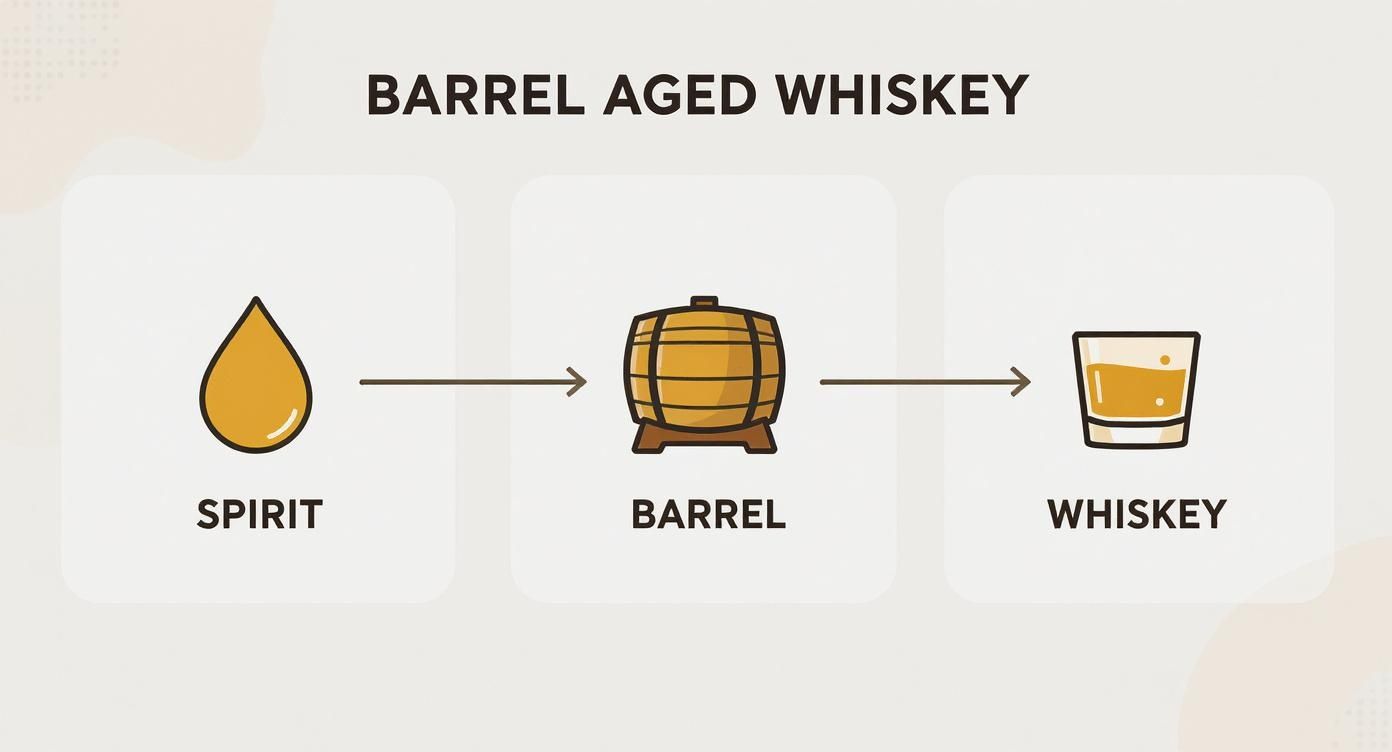
As you can see, the barrel is the indispensable bridge, turning a basic distillate into a rich, nuanced whiskey. Let's break down exactly how it works.
The Influence of Oak Varieties
Not all oak is the same. Just like grapes in wine, the origin of the wood plays a massive role in the final taste. For anyone starting their whiskey journey, understanding the two primary types of oak is a fantastic shortcut to predicting a bottle's character.
- American Oak (Quercus alba): This is the workhorse for American whiskeys like Bourbon and Rye. It's known for its fast growth and high levels of a compound called vanillin. This directly translates into those prominent notes of vanilla, caramel, coconut, and sweet baking spice.
- European Oak (Quercus robur): Often the choice for Scotch and other world whiskies, this oak tells a different story. It’s higher in tannins, leading to more savory, spicy, and dried fruit notes—think clove, nutmeg, and raisin.
A tip for new drinkers: To really taste the impact of American oak, start with a classic Bourbon. It’s the quintessential expression of those sweet, approachable flavors that make this wood so beloved.
How Barrel Choices Shape Whiskey Flavor
To make this even clearer, here’s a quick breakdown of how a distiller’s key barrel decisions translate directly to the flavors in your glass.
| Barrel Factor | Description | Common Flavor Notes Imparted |
|---|---|---|
| Oak Type | The species of oak tree used for the barrel staves. The two most common are American and European oak. |
American Oak: Vanilla, caramel, coconut European Oak: Dried fruit, clove, tannins |
| Char Level | The intensity of the flame applied to the barrel's interior, ranging from a light toast to a heavy "alligator" char. |
Light Char: Subtle vanilla, light toast Heavy Char: Deep caramel, smoke, toffee |
| Cask Finish | A secondary aging period in a barrel previously used for another spirit, like Sherry, Port, or Rum. |
Sherry: Nuts, raisin, spice Port: Red berries, chocolate Rum: Brown sugar, tropical fruit |
This table is a great starting point, but the real fun is tasting how these elements combine and play off one another in the final whiskey.
Charring The Wood to Unlock Sugars
Before any spirit gets near the wood, the inside of the barrel is hit with an open flame. This isn't just for dramatic effect; it's a critical step that fundamentally changes the wood's chemistry and unlocks its flavor potential.
Think about toasting a marshmallow. A light toast brings out a delicate sweetness, but a heavy char creates that smoky, caramelized crust. Barrels work the same way.
Charring the interior of a barrel caramelizes the wood's natural sugars and creates a layer of activated carbon. This charcoal layer does two things: it acts as a natural filter, stripping out harsh sulfur compounds from the young spirit, and it unlocks deep flavors of vanilla, toffee, and smoke.
Distillers can request different char levels, often on a scale from 1 to 4. A Level 1 is a light toast, while a Level 4—often called an "alligator char" because the wood cracks and looks like reptile skin—is incredibly intense. Generally, a heavier char leads to a darker, sweeter, and smokier whiskey. You can go deeper on how barrel preparation affects whiskey taste in our detailed guide.
Cask Finishing: A Whiskey's Final Touch
Some of the most exciting innovations in modern barrel aged whiskey come from a technique called cask finishing. This is where a whiskey, after maturing in its primary barrel, is moved into a different type of used barrel for a final aging period.
It’s like a "finishing school" for the spirit, adding a final layer of complexity and nuance you just can't get from a single barrel. It’s a playground for distillers, allowing them to create truly unique and memorable flavor profiles.
Common finishing casks include:
- Sherry Casks: Impart rich notes of dried fruit, nuts, and baking spices.
- Port Casks: Add flavors of red berries, plum, and dark chocolate.
- Rum Casks: Contribute hints of tropical fruit, molasses, and brown sugar.
American craft producers are masters of this technique. For example, a distiller might finish their spicy rye whiskey in a rum cask to round out the edges with some tropical sweetness. This creativity gives us, the whiskey drinkers, a whole world of incredible expressions to explore. It's the perfect example of how the barrel's journey directly crafts the flavor in your glass.
The Role of Time and Environment
A barrel filled with new make spirit doesn't mature in a vacuum. Once the cooper's work is done and the barrel is filled, two invisible but powerful forces take over: time and the surrounding environment. These two elements conduct a slow, deliberate transformation and are every bit as crucial as the oak or char level in shaping the final barrel aged whiskey.
To wrap your head around this, imagine two identical barrels filled with the exact same new spirit. Place one in a Kentucky rickhouse, where temperatures swing wildly from season to season, and the other in a cool, stable Scottish warehouse. After five years, you won't just have two different whiskeys; you'll have two entirely different stories in a bottle.
The environment is the director of the aging process, telling the spirit how quickly and deeply to interact with the oak.

This interaction is a very physical process. As temperatures rise, the whiskey expands and pushes deep into the charred staves of the barrel, soaking up sugars and flavor compounds. When it cools, the spirit contracts, pulling those delicious elements back out with it. This is the whiskey breathing.
Climate and Maturation Speed
Climate is the engine that drives this cycle of breathing. A region with big temperature swings, like Kentucky or Texas, forces a much more aggressive and rapid maturation. The constant expansion and contraction means the whiskey is working that wood at an accelerated rate.
This is exactly why an American craft whiskey from a hot climate might achieve a rich, deep flavor profile in just a few years—a profile that could take a decade or more in a cooler, steadier place like Scotland or Ireland.
- Warm, Fluctuating Climates (e.g., Kentucky): This promotes rapid aging, intense flavor extraction, and higher evaporation. The result is bold notes of caramel, vanilla, and deep oak.
- Cool, Stable Climates (e.g., Scotland): This encourages a slow, gentle maturation. The whiskey develops more subtle, delicate, and often fruitier flavors over a much longer period.
The Angel's Share
While the whiskey breathes inside the barrel, a certain portion of it evaporates right through the porous oak. This loss is poetically known as the "angel's share." It might sound like a simple loss, but this process is absolutely essential for creating a quality spirit.
Evaporation doesn't just reduce the volume in the barrel; it concentrates the remaining liquid. As water and alcohol escape, the flavors and textures become richer, denser, and more complex. The angel's share is the sacrifice a distiller makes for a more flavorful whiskey.
The rate of evaporation varies wildly depending on the climate. In hot and dry locations, the angel's share can be as high as 5-10% per year. In the cool, damp warehouses of Scotland, it might be a mere 2%. To dig deeper into this critical process, you can read our guide on the economics of evaporation and the angel's share.
The Myth of Age
One of the biggest misconceptions for new whiskey drinkers is that older always means better. That’s simply not true. The real goal is not maximum age but peak maturity.
Over-aging is a very real risk. A whiskey left in the barrel too long, especially in a hot climate, can become bitter, tannic, and overwhelmingly woody. It's like leaving a tea bag in hot water for an hour.
A master distiller’s true craft is knowing exactly when to pull a barrel. A 4-year-old whiskey from a craft producer in Texas might be at its absolute peak, while a 15-year-old Scotch is just hitting its stride. Age is just a number; balance and maturity are what truly matter.
Proof Matters
Finally, the alcohol content of the spirit when it first enters the barrel—its entry proof—also steers the flavor. Alcohol and water are both solvents, but they pull out different compounds from the wood.
- Higher Entry Proof: Alcohol is better at dissolving wood sugars (lignin), which results in a sweeter, more vanilla-forward whiskey.
- Lower Entry Proof: Water is more effective at pulling out tannins, creating a spicier, more structured, and wood-driven spirit.
By carefully selecting the entry proof, distillers gain another layer of control over the final profile. It’s one more crucial variable in the complex equation that produces the perfect barrel aged whiskey.
How to Taste Whiskey Like an Expert
Tasting a barrel aged whiskey is so much more than just taking a sip. It's a full sensory experience, a chance to decode the story the distiller and the barrel have written together. If you approach it with a simple, structured method, you can unlock a surprising depth of flavor and truly appreciate the craft in your glass. It turns a simple drink into a rewarding activity.
Forget the idea that you need some kind of "super palate" to enjoy whiskey properly. All it really takes is a bit of curiosity and a willingness to pay attention. We'll break it down into three easy steps—look, smell, and sip—that will have you tasting with confidence and figuring out what you genuinely enjoy.
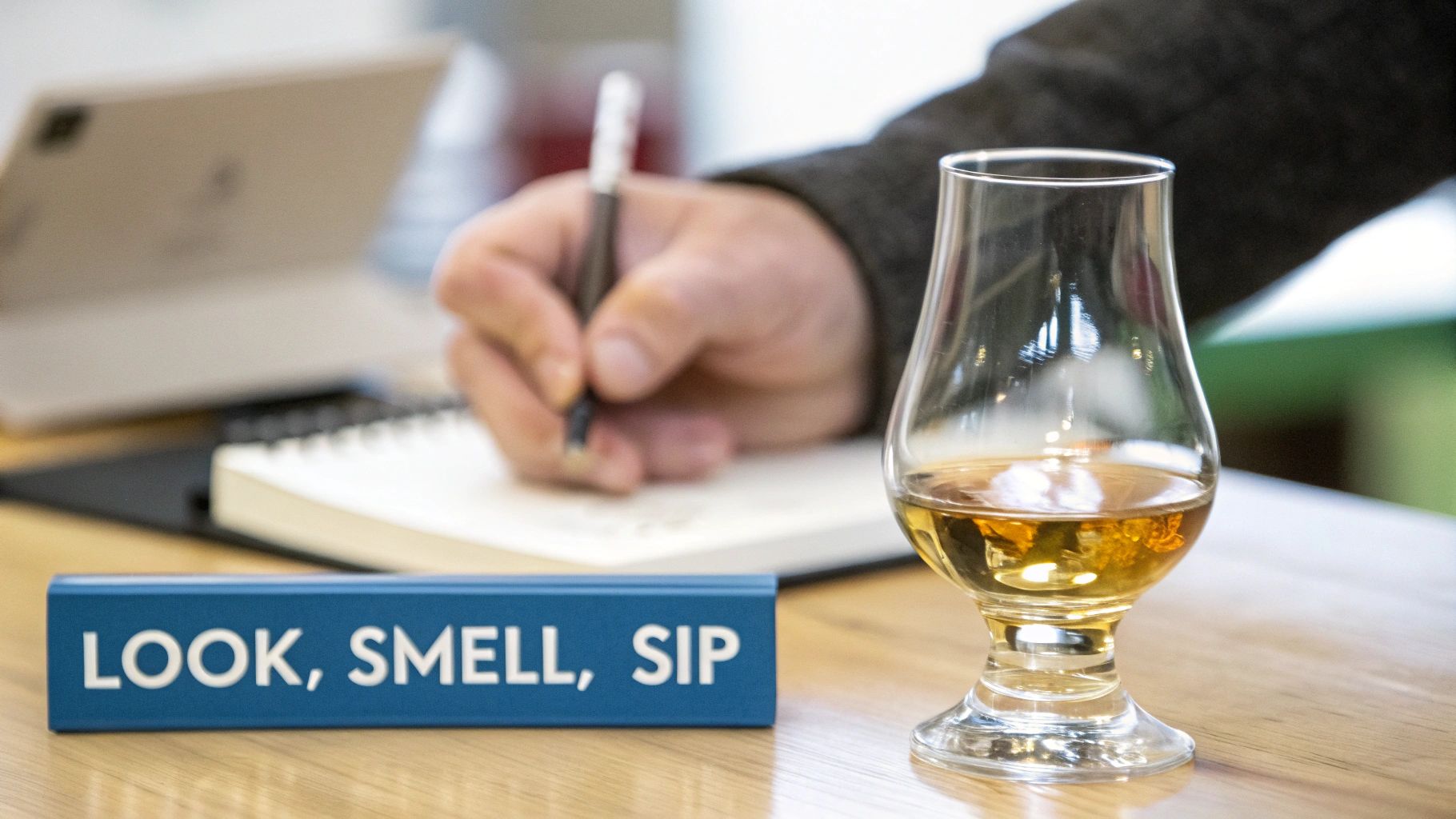
Step 1: Look at the Color and Body
Before the glass even reaches your lips, hold it up to a neutral light source. What do you see? The color of a whiskey offers the first clues about its journey.
A pale, straw-like color might suggest a younger whiskey or one aged in a second-fill barrel that's already given up a lot of its influence. On the flip side, a deep amber or rich mahogany often points to a longer maturation, a heavy barrel char, or time spent finishing in a wine cask like sherry or port.
Next, give the whiskey a gentle swirl in your glass and watch the liquid run back down the sides. These streaks are what we call "legs" or "tears."
- Thick, slow-moving legs often indicate a higher alcohol content (ABV) and a richer, more viscous mouthfeel.
- Thin, fast-moving legs might suggest a lower proof and a lighter-bodied spirit.
This first look sets the stage, giving you a few expectations about the whiskey's age, barrel influence, and texture before you even take a sniff.
Step 2: Smell the Aroma
Your sense of smell is responsible for the vast majority of what you perceive as taste. Because of this, nosing the whiskey is arguably the most crucial step in appreciating its complexity.
Take a gentle sniff from the top of the glass. The first thing you’ll probably notice is the alcohol, but try to smell past it. Here’s a great tip for new whiskey drinkers: keep your mouth slightly open as you inhale through your nose. This simple trick helps aerate the alcohol vapors, preventing that sharp "burn" and allowing the more delicate aromas to shine.
Don't rush this part. Move the glass around, smelling from different angles. What are you picking up? To help organize your thoughts, try to identify aromas from these common categories:
- Sweet: Caramel, vanilla, honey, brown sugar, butterscotch.
- Fruity: Apple, pear, cherry, dried apricot, raisin.
- Spicy: Cinnamon, clove, black pepper, nutmeg, baking spice.
- Woody: Toasted oak, cedar, campfire smoke, leather.
These notes come directly from the grain, the yeast, and—most importantly for a barrel aged whiskey—all that time spent interacting with the oak.
Step 3: Sip and Savor the Flavor
Now, it’s finally time to taste. Take a small sip and let it coat your entire tongue. This first taste, sometimes called the "Kentucky Chew," just gets your palate acclimated to the alcohol.
On the second sip, hold the whiskey in your mouth for a few seconds. Try to identify the flavors as they evolve across your palate.
The tasting experience unfolds in three distinct acts: the initial taste on the front of your palate, the development of flavors in the middle, and the lasting impression of the finish. Pay attention to how the story changes from start to end.
Finally, swallow the whiskey and breathe out gently through your nose and mouth. This is the finish—the lingering flavors and sensations left behind. Is it short and clean, or does it stick around for minutes? Is it warm, spicy, sweet, or smoky? A long, complex finish is often the hallmark of a well-made, mature whiskey. For a more detailed walkthrough, you can explore our full guide on how to taste whiskey and really refine your technique.
Try a Blind Tasting at Home
The absolute best way to discover what you genuinely like, free from the influence of a fancy label or a high price tag, is a blind tasting. It’s fun, educational, and surprisingly easy to set up.
- Gather Your Whiskeys: Choose three different American craft whiskeys. For example, grab a high-rye bourbon from a distillery like New Riff, a wheated bourbon from a producer like Frey Ranch, and a bold single malt from Westward.
- Pour and Label: Have a friend pour a small amount of each into identical glasses, labeling them only with a number or letter on the bottom.
- Taste and Take Notes: Go through the look, smell, and sip process for each sample without knowing what it is. Write down everything you notice about the color, aroma, flavor, and finish.
- Rank and Reveal: Rank them from your favorite to least favorite. Only then should you reveal which whiskey was in each glass.
You might be shocked by what you find. This simple exercise strips away all bias, letting your palate lead the way and helping you find the specific profiles you truly enjoy in a barrel aged whiskey.
Choosing Your First Bottle of Whiskey
Now that you have a handle on how a barrel aged whiskey gets its unique character, you’re ready for the fun part: picking out a bottle. Let’s be honest, walking into a liquor store and seeing a wall of whiskey can be intimidating. But think of each label as a treasure map—it tells you exactly what to expect from the liquid inside. Learning to read that map is the key to finding a whiskey you’ll truly love.
This isn't about memorizing a dictionary of terms. It's about spotting a few key signposts that point you toward a flavor profile that matches your own. It's a simple process that puts you in the driver's seat.
Decoding the Whiskey Label
The words on a whiskey label aren't just clever marketing; they’re often legally defined terms that tell you a lot about the spirit. Nailing down just a few of these will make your search infinitely easier and help you zero in on a bottle that speaks to your palate.
Here are a few essential terms to keep an eye out for:
- Straight Bourbon/Rye Whiskey: This is an immediate mark of quality. It tells you the whiskey was aged for a minimum of two years in new, charred oak barrels and contains no additives other than water to reach the desired proof.
- Single Barrel: Every single drop in this bottle came from one individual barrel. Since no two barrels are exactly alike, these whiskeys offer a unique, one-of-a-kind flavor profile that captures a specific moment in time. They can be truly special.
- Cask Strength (or Barrel Proof): This is whiskey in its purest form. It’s bottled at the same alcohol by volume (ABV) it had when it was pulled from the barrel, with zero dilution. It’s an intense, full-flavored experience—perfect for experienced drinkers, but beginners may want to add a few drops of water.
These terms give you a clear picture of the whiskey's style and intensity before you ever twist the cap.
Matching Your Taste to the Bottle
So, how do you translate that label into actual flavor? The most important thing is your own preference. Use what you already enjoy in other foods and drinks as your starting point.
If you're a fan of rich, sweet desserts like crème brûlée or vanilla bean ice cream, a high-corn Bourbon is a fantastic place to start. The corn-heavy mash bill combined with aging in new, charred American oak is the perfect recipe for those decadent caramel and vanilla notes.
If, on the other hand, you prefer things with a bit more spice and kick, a Rye whiskey might be your new best friend. The rye grain brings bold notes of black pepper, cinnamon, and even mint that are fantastic on their own or in a classic cocktail like an Old Fashioned.
Don't forget to look for the innovators. The world of barrel aged whiskey is buzzing with creativity from American craft distilleries. Distillers like Balcones in Texas or St. George Spirits in California are constantly pushing the envelope. They’re playing with different wood types, unique finishing casks, and aging in dynamic climates to craft flavors you simply won’t find anywhere else. These craft bottles are a brilliant way to explore the full, exciting spectrum of what whiskey can be.
Simple Pairing Ideas to Get Started
A great bottle of whiskey is only half the fun. Pairing it with the right food can take the whole experience to another level. You don’t need to cook up a five-course meal—some of the best pairings are the simplest.
- Spicy Rye and Dark Chocolate: The bold, peppery spice of a good rye cuts right through the richness of dark chocolate, while the chocolate has a way of coaxing out the whiskey's subtle sweet and oaky notes.
- Sweet Bourbon and Salted Caramel: This pairing is a classic for a reason. The warm vanilla and caramel notes in a Bourbon are a perfect match for the salty, buttery goodness of the treat. It’s pure harmony.
The rising demand for these complex spirits is fueling major growth in the cooperage industry—the folks who make the barrels. The global market for whiskey barrels is projected to hit USD 3.4 billion by 2035, a clear sign of whiskey's growing popularity and the boom in craft distilleries. You can dive deeper into the growing barrel market and its impact on futuremarketinsights.com. This growth is great news for us, as it means distillers will have the tools they need to keep crafting incredible whiskeys for years to come.
Answering Your Top Whiskey Questions
As you dive deeper into the world of barrel aged whiskey, you're bound to have some questions. It's a natural part of the journey, moving from the basics to feeling confident picking out your next bottle. A few questions tend to pop up time and time again.
Think of this as your go-to guide for those nagging curiosities. We'll tackle them head-on with clear, simple answers. The more you understand, the more you can appreciate the incredible craft that goes into every single drop.
Does a Darker Whiskey Mean It’s Older or Better?
This is probably the most common assumption out there, and the answer is a hard no. While it’s true that whiskey gets its color from the oak barrel and darkens over time, age is just one piece of a much larger puzzle.
Many other factors can create that deep, rich amber hue much faster. A whiskey aging in the Texas heat, for instance, will interact with the wood far more aggressively than one sitting in a cool Scottish warehouse, pulling out color and flavor at an accelerated rate. The level of char on the barrel makes a huge difference, too—a heavy "alligator char" can impart a dark, rich color in just a few years. Even the barrel's size matters; smaller casks mean more spirit-to-wood contact, speeding up the entire process.
Tip for beginners: Don’t judge a whiskey by its color. The real character is in the aroma and the taste. Trust your palate, not just your eyes.
It's also important to know that while "straight" American whiskeys like Bourbon and Rye are legally barred from using additives, some other whiskies around the world can legally add caramel coloring (E150a) to keep their color consistent from one batch to the next.
What Is the Difference Between Bourbon and Other Whiskeys?
It all comes down to the rulebook. To earn a specific name like "Bourbon" or "Scotch," a spirit has to follow a strict set of legally binding regulations that define its character. For Bourbon, those rules are what give it its signature flavor profile.
To be called Bourbon, a whiskey must check all these boxes:
- Be made right here in the United States.
- Have a grain recipe (mash bill) of at least 51% corn.
- Be aged in new, charred oak containers.
- Come off the still at no more than 160 proof (80% ABV).
- Go into the barrel for aging at no more than 125 proof (62.5% ABV).
Scotch, on the other hand, must be made in Scotland from malted barley and aged for a minimum of three years in oak casks. But here’s a critical difference: Scotch distillers almost always use ex-bourbon or ex-sherry barrels. This reuse of barrels imparts completely different flavors than the brand-new oak required for Bourbon. These legal guardrails are what give each style of barrel aged whiskey its one-of-a-kind identity.
How Should I Store an Open Bottle of Whiskey?
So you've opened a fantastic bottle and want to keep it that way. Great news: whiskey is far more resilient than wine. Once it's in the bottle, the aging process stops completely.
To keep it tasting its best, just follow a couple of simple rules. First, always store your bottle upright. If you lay it on its side for too long, the high-proof alcohol can slowly eat away at the cork, tainting your whiskey and eventually causing the seal to fail.
Second, find a cool, dark spot for it, away from direct sunlight and big temperature swings. Sunlight is the enemy—it breaks down the organic compounds in the whiskey, fading both its color and its flavor over time. An opened bottle can stay in great shape for a year or two, but as more air gets inside, oxidation will begin to slowly soften and change the flavors.
Is It Okay to Add Water or Ice to My Whiskey?
Absolutely. There's only one right way to drink whiskey: the way you enjoy it most. Don't let anyone tell you otherwise. Adding a little water or ice can actually open up the experience, especially if you're new to sipping spirits neat.
A few drops of room-temperature water can be a total game-changer, particularly for high-proof or "cask strength" whiskeys. The water dials back the alcoholic burn just enough to let the more subtle aromas and flavors come forward. It literally "opens up" the whiskey.
Ice is all about chilling the drink and making it more refreshing. A large ice cube or sphere is your best bet here, as it melts much slower than small cubes, cooling the spirit without watering it down too quickly. While chilling can mute some of the more delicate notes, on a hot day, a whiskey on the rocks is tough to beat. The bottom line? Experiment and find what you like. It’s your glass, after all.
Ready to put your newfound knowledge to the test and discover your next favorite American craft whiskey? At Blind Barrels, we take the guesswork out of discovery. Our blind tasting subscription sends you a curated kit each quarter, letting you explore top-shelf whiskeys without any preconceived notions. Learn more and start your tasting adventure.