

A liquor store shelf can turn a confident whiskey drinker into a hesitant shopper. You see bourbon from small Kentucky producers beside familiar national labels, bottles at modest prices beside releases that cost several hundred dollars, and very little guidance about what will actually suit your palate. Buying by reputation alone often leaves you with a bottle you admire more on the shelf than in the glass.
The best bourbon subscription solves that problem by turning random bottle hunting into guided discovery. The strongest services don't just deliver whiskey. They give you a structured way to compare mash bills, proof, aging character, cask influence, and regional style, often with American craft whiskey brands that aren't easy to find locally. For most drinkers, a blind tasting format offers more lasting value than another recognizable bottle chosen by someone else.
| Bourbon Subscription Feature Matrix | Blind Tasting Kit | Branded Bottle Club | Best For |
|---|---|---|---|
| Format | Unlabeled samples for comparison | Full-size bottles with visible labels | Palate development or shelf building |
| Discovery method | Taste first, reveal details later | Choose from the brand and description | Curious drinkers or collectors |
| Producer focus | Often small-batch and craft distilleries | Often established, recognizable labels | Regional exploration or brand loyalty |
| Educational perks | Tasting sheets, reveal cards, scoring tools | Product notes and release information | Learning or immediate enjoyment |
| Delivery rhythm | Usually monthly or quarterly | Often quarterly or seasonal | Frequent practice or occasional sessions |
| Main advantage | Reduces brand and price bias | Adds visible bottles to a home bar | Objective tasting or collection building |
Navigating the Modern Bourbon Boom
The crowded shelf is a symptom of bourbon's success. Bourbon is a multi-billion-dollar category with sustained growth across major markets, and one market report projects the global market to rise from USD 8.71 billion in 2025 to USD 9.27 billion in 2026, then reach USD 12.68 billion by 2031, implying a 6.5% CAGR from 2026 to 2031. A separate U.S. estimate is more conservative, placing the domestic market at USD 5.75 billion in 2025, USD 5.99 billion in 2026, and USD 8.30 billion by 2034, with a projected 4.16% CAGR from 2026 to 2034. Those figures come from Mordor Intelligence's bourbon market report.
That growth gives shoppers more choice, but choice without context creates friction. A familiar label can feel safe, while a less recognizable bottle can seem risky even when its flavor profile is a better match for your preferences. A curated subscription narrows the field before you spend money on a full bottle, then gives you a repeatable way to decide what deserves a place in your cabinet.
Why craft bourbon changes the shopping problem
The modern bourbon scene isn't limited to a handful of famous producers. Independent market research reports that active U.S. distilleries grew from about 800 in 2015 to more than 1,800 in 2025, while craft bourbon's share of category volume rose from 2.1% to 7.8% during that period. The same source projects craft bourbon could reach 12.5% of category volume by 2034, according to Marketintelo's bourbon whiskey market research.
That expansion creates a better discovery pool. Small producers can offer different grains, fermentation choices, barrel programs, and finishing techniques rather than reproducing the profile of a major label. New Riff Distilling has distilled and aged entirely on-site since 2014, while Wilderness Trail Distillery is known for a proprietary sweet-mash process, examples discussed in this craft bourbon brand guide.
My buying rule: Let a subscription introduce you to a style before you commit to a bottle. Your palate should make the first decision, not the label.
A good service saves time in two ways. It removes the need to research every unfamiliar producer, and it lets you sample expressions that your local retailer may never carry. The result isn't just a box of whiskey. It's a practical filter for deciding whether you prefer a high-rye bourbon, a soft wheated profile, a heavier oak character, or a bold cask-strength pour.
For a useful history of why independent American producers matter to today's whiskey drinkers, explore the rebirth of American craft whiskey.
Blind Tasting Kits Versus Branded Bottle Clubs
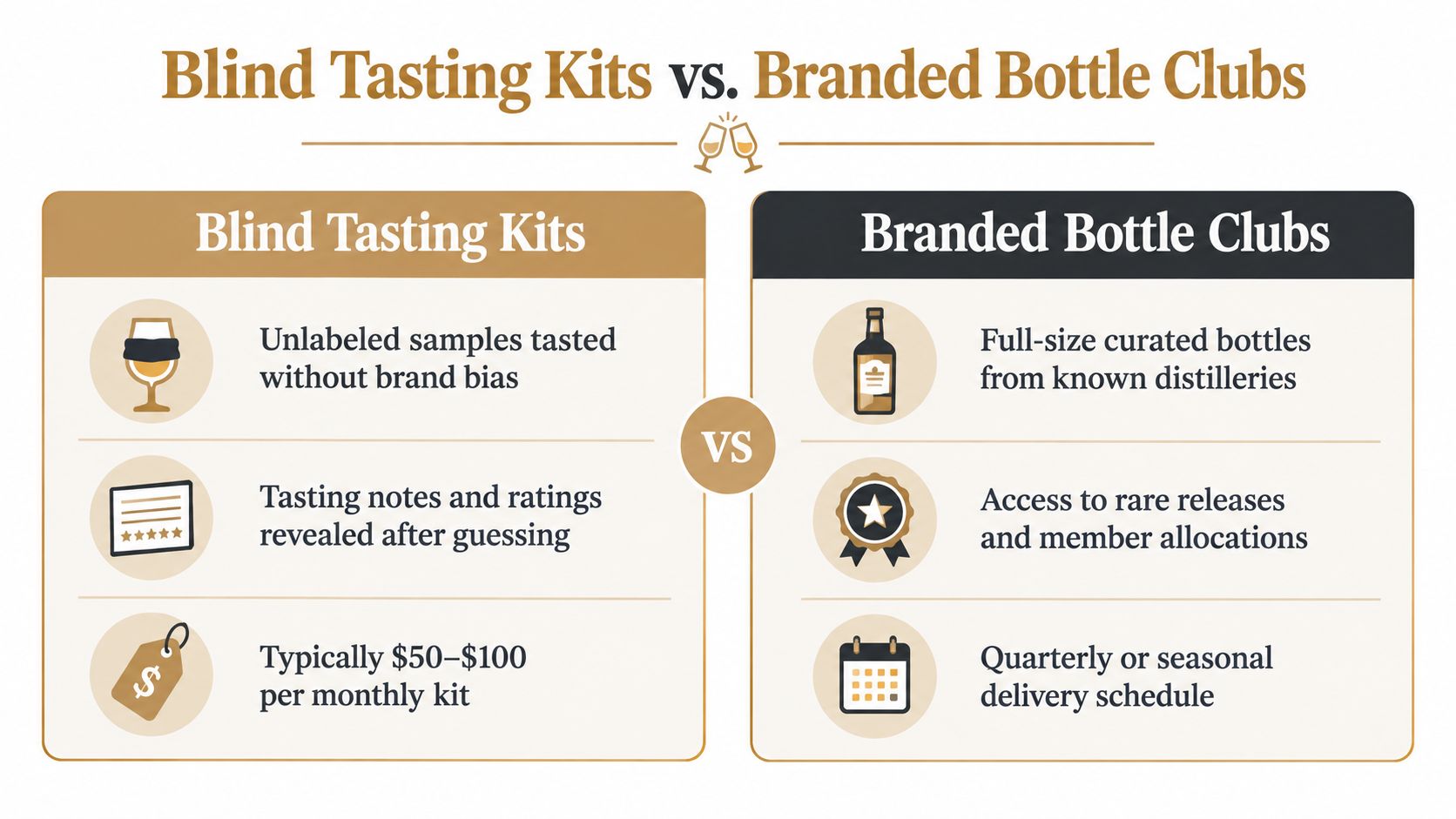
The two main subscription models serve different ambitions. Branded bottle clubs are designed for ownership, while blind tasting kits are designed for evaluation. Neither format is automatically superior, but they reward different habits.
A branded club sends a full-size bottle, often selected around a known distillery, a seasonal release, or an allocation opportunity. You can display it, pour it for guests, and build a collection around producers you already recognize. This model works well if your main pleasure comes from owning scarce bottles or discovering releases through a trusted curator.
Blind kits remove the label before the first pour. The sample may be identified by a code, but the distillery, age, proof, mash bill, and price remain hidden until you've recorded your impressions. That small change has a large effect on the tasting experience. A prestigious name can make a pour seem more complex, while a high price can make a drinker search for qualities they expect to find. Blind tasting forces you to judge aroma, texture, balance, and finish without those prompts.
What each format does well
Choose a branded bottle club if:
- You collect bottles: A recognizable label and a full-size format matter to you.
- You value immediate access: You want to open the bottle without completing a tasting exercise first.
- You follow specific producers: You'd rather deepen your relationship with a known distillery than compare unknown samples.
- You host casual drinks: A full bottle is convenient when guests want a straightforward pour.
Choose a blind tasting kit if:
- You want to train your palate: Comparing multiple samples reveals patterns that one bottle can't.
- You dislike hype-driven buying: The format separates your reaction from brand prestige and shelf reputation.
- You enjoy games: Guessing proof, age, style, or producer turns tasting into an active challenge.
- You want craft discovery: Small American distilleries, single-barrel releases, and alternative cask finishes become easier to explore.
The craft sector gives blind subscriptions a particularly strong advantage. As the number of active distilleries grows, curators have more opportunities to rotate producers and present expressions with distinct origins. A service can frame each sample around mash bill, fermentation, distillation method, barrel selection, and finishing, giving you specific reasons to compare one bourbon with another.
Traditional clubs still have a clear place. They offer shelf appeal, convenience, and the satisfaction of opening a bottle with a story already attached. But if your goal is to learn what you like, start blind. A dedicated blind whiskey tasting kit makes the tasting process the central product rather than an extra feature.
Mastering the Art of Whiskey Evaluation
A premium sample deserves more attention than a quick sip beside the television. You don't need an elaborate home bar, but you do need a consistent method. Without one, the strongest sample often wins only because it has more alcohol, more sweetness, or a more familiar flavor.
Prepare the pour correctly
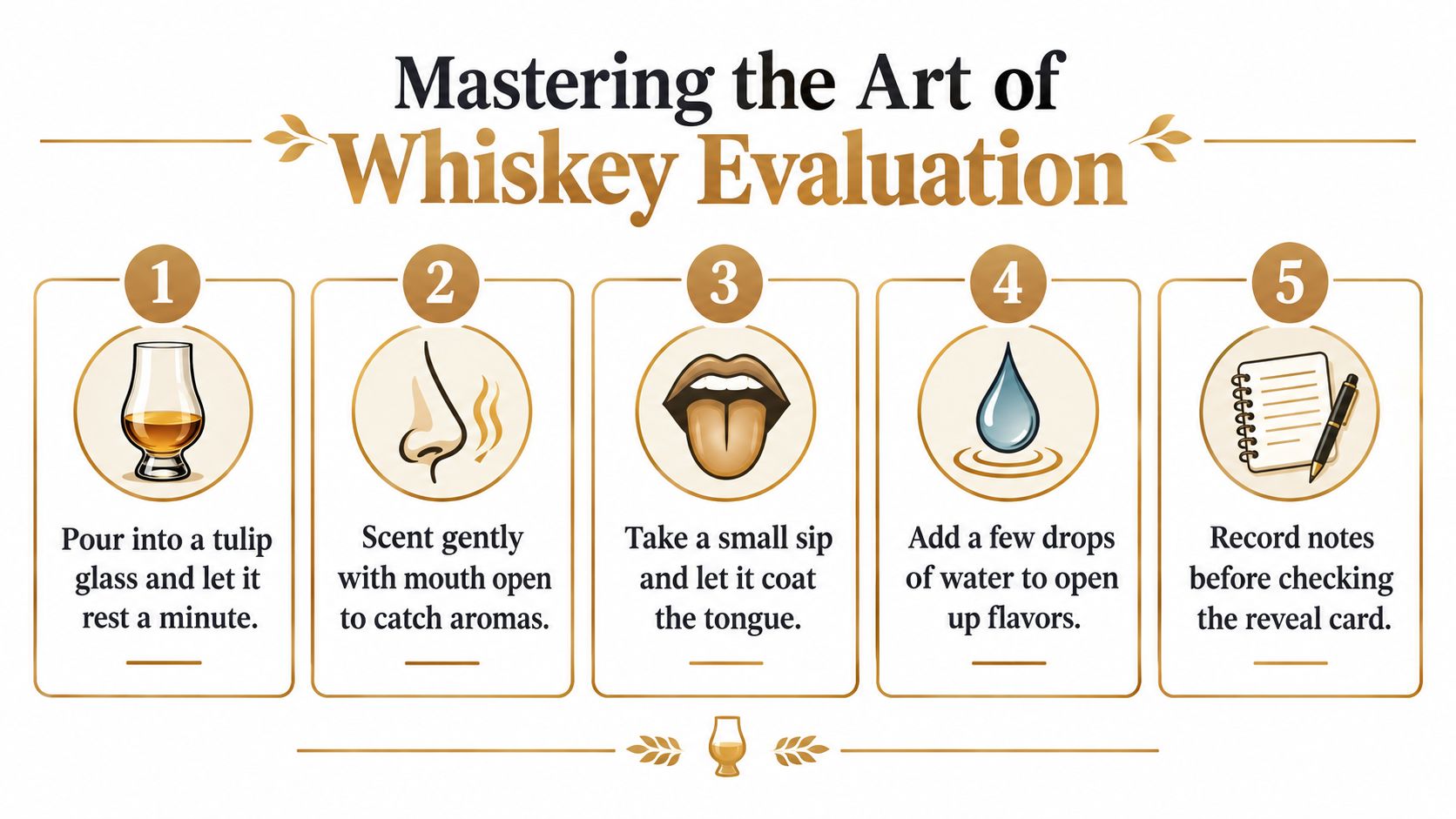
Start with a small pour of about 0.5 to 1 ounce, then let the whiskey rest for 5 to 10 minutes before nosing, following beginner guidance from Beam Distilling's whiskey notes guide. Resting gives volatile alcohol time to settle and lets the aroma become easier to read. A tulip-shaped glass concentrates those aromas, but any narrow bowl-shaped glass is better than a wide tumbler for serious comparison.
Hold the glass below your nose and sniff gently from a few inches away. Keep your mouth slightly open. That reduces the sharpness of the ethanol and helps you notice softer aromas such as vanilla, toasted grain, dried fruit, cinnamon, mint, or oak.
Don't chase a perfect note immediately. First ask simple questions:
- Is the aroma sweet, grainy, fruity, floral, spicy, or woody?
- Does the whiskey feel light, oily, hot, dry, or rounded?
- Does the finish disappear quickly or develop after the swallow?
Take the first sip as calibration. Let it coat the tongue, notice the alcohol, and avoid deciding whether you love it yet. The second sip usually gives you a more useful impression because your palate has adjusted to the proof.
Score the whiskey before checking the reveal
Professional whiskey evaluation commonly uses a 100-point scoring scale for aroma, palate, balance, and finish, as explained in this guide to whiskey tasting rubrics. Use that framework as a private benchmark, not as a way to pretend your preference is objective truth.
Break your notes into categories instead of writing one vague sentence such as “good bourbon.” Record aroma separately from palate, texture, balance, finish, and overall enjoyment. A whiskey can have a compelling nose but a thin palate, or a fiery opening that develops into a long, satisfying finish.
Practical rule: Write your score and tasting notes before scanning the reveal card. Once you see the producer or price, your memory starts editing the experience.
Add water only after tasting the bourbon neat. Beginner guidance recommends a minimal adjustment, often two or three drops per ounce, especially for higher-proof whiskey, according to Beam Distilling's whiskey tasting notes guide. Taste again and record what changes. Water may lift fruit and floral aromas, soften heat, or expose oak, but it won't rescue a profile you dislike.
New drinkers should also resist starting with the most aggressive sample. Beginner advice commonly favors lighter, smoother styles before moving into smoky or fuller-bodied expressions, as outlined in Malts' beginner whiskey guide. Bourbon isn't usually defined by peat in the way some Scotch is, but proof, oak, spice, and concentrated barrel character can still overwhelm an untrained palate.
For a deeper approach to recognizing recurring aromas and building memory, use this guide to training your palate.
Comparing the Top Bourbon Discovery Services
Ignore the phrase “best” until you've defined the experience you want. Subscription services compete on format, producer access, educational material, and delivery rhythm. The right choice isn't the one with the most impressive marketing language. It's the one that makes you want to taste attentively and return to your notes.
| Service Type | Format | Frequency | Educational Perks |
|---|---|---|---|
| Blind craft tasting service | Several unlabeled samples from independent American producers | Monthly or quarterly | Reveal cards, tasting tables, aroma prompts, scoring games |
| Full-bottle bourbon club | Recognizable bottles selected by a curator | Quarterly or seasonal | Producer notes, release background, collection guidance |
| Single-barrel allocation club | Full bottles or limited single-barrel releases | Irregular or seasonal | Barrel information, producer details, allocation access |
| Beginner tasting box | Smaller samples with accessible profiles | Recurring or occasional | Basic tasting instructions, flavor vocabulary, progression advice |
| Premium discovery club | High-end samples or bottles selected around a theme | Usually quarterly | Detailed provenance, cask information, guided comparisons |
The strongest choice for objective discovery
A blind craft service earns its place by making comparison possible. Four samples tasted in one session can show you whether you favor sweetness over spice, rye lift over corn-forward softness, or a dry oak finish over a richer texture. The reveal then adds context after your palate has formed an opinion.
Look for a tasting table that separates aroma, tasting, finish, proof, age, and overall score. A QR-linked reveal system is also useful because it keeps the information hidden until you're ready to check it. The educational material should answer practical questions, not just repeat brand copy.
A monthly full-bottle club offers more whiskey per shipment, but that isn't the same as offering more insight. If you don't like the bottle, you've paid for a full-size mistake. A blind kit limits the commitment and gives you several points of comparison, which makes it better suited to drinkers who are still mapping their preferences.
Where traditional clubs win
Bottle clubs are stronger for collectors. They make sense when you already know you enjoy a producer's style, want access to a release, or care about building a visually impressive home bar. They also work well for gifting when the recipient values recognizable labels more than an interactive tasting exercise.
Single-barrel clubs occupy the middle ground. They can introduce meaningful variation within a familiar distillery, but the experience still begins with the label. If your priority is removing bias, a coded sample remains the cleaner test.
My recommendation is straightforward. Choose blind craft discovery for learning, full bottles for collecting, and single-barrel access for deepening an existing interest. Don't pay for a collector's format if what you really want is palate education.
Matching the Right Subscription to Your Lifestyle
The ideal bourbon subscription has to fit the way you drink. A serious collector, a curious beginner, and a couple looking for a Friday-night activity don't need the same format.
For couples and shared evenings
Choose a blind kit if you want the subscription to create an activity rather than deliver alcohol. Pour the same samples, keep separate scores, and compare your guesses before revealing the answers. The disagreement is part of the fun. One person may prefer the sample with the longest finish, while the other chooses the one with the softest texture.
This format also suits spouses buying for whiskey fans who already own plenty of bottles. A new full-size bottle can feel repetitive if the recipient has a crowded cabinet. A guided blind session gives them something to do, discuss, and remember.
For beginners
New drinkers should favor clear instructions, approachable samples, and a gradual path toward stronger or more assertive profiles. Avoid services that assume you already know how to distinguish mash bills, barrel proof, finishing casks, or age statements.
Look for:
- Plain tasting vocabulary: The materials should explain terms such as body, heat, oak, spice, and finish.
- A reveal after evaluation: You should be able to taste without seeing the producer first.
- A scoring system: Even a simple rubric helps you identify patterns over time.
- Style variety: A useful box should teach contrast rather than send several nearly identical pours.
For collectors
Collectors should prioritize access, provenance, and bottle purchasing options. A full-bottle club may suit you if you want recognizable releases, while a craft-focused blind service is more useful for finding producers before committing to a complete bottle.
For hosts
If you regularly invite friends over, choose a format with matched samples, printed tasting guidance, and enough structure to keep the evening moving. The subscription should make hosting easier, not leave you searching for tasting notes while guests wait.
The Hidden Value of Palate Education and Perks
The liquid is only part of the subscription's value. A bottle club can send excellent whiskey and still teach you almost nothing. The better discovery services build an educational layer around each pour, turning consumption into a record of your preferences.
A strong tasting table should guide you through aroma, palate, finish, balance, and overall impression. That structure prevents the common beginner mistake of writing only “smooth” or “strong.” Those words describe a reaction, but they don't tell you whether the whiskey was fruity, dry, oily, spicy, woody, or hot.
Digital tools add another useful layer. A guessing game can ask you to estimate proof, age, or whiskey type before revealing the answer, then show how closely your perception matched the hidden details. The score isn't a verdict on your skill. It's a way to make attention measurable and encourage you to notice where your assumptions go wrong.
Education beats passive delivery
A full bottle encourages repetition of one experience. A blind kit encourages comparison. Comparison creates the sharper learning loop because your palate can identify differences immediately, especially when the samples vary in proof, mash bill, regional origin, or cask treatment.
The best materials also explain why a sample tastes the way it does. A note about a wheated mash bill, a sweet-mash process, on-site distillation, or an alternative cask finish gives you a technical connection between production and flavor. That information becomes useful only after you've tasted, which is why the reveal should come second.
Perks should lead to better buying decisions
A subscription has long-term value when it helps you buy fewer disappointing bottles. Direct access to a preferred full-size expression can be useful, particularly when the reveal provides producer details, mash bill, proof, age statement, and tasting notes. The purchase opportunity should follow discovery, not replace it.
The point of a tasting kit isn't to make you sound like an expert. It's to help you choose your next bottle with greater confidence.
Community features matter, too. A shared scorecard, group game, or recurring tasting night gives the subscription a social rhythm. You aren't just accumulating samples. You're building a reference library of your own palate.
Hosting Your Own Blind Tasting Event
A blind tasting party works best when the setup is simple and the reveal stays controlled. Use one sample per person, identical glasses if possible, water for palate resets, and a neutral snack such as plain crackers.
Set the table
Label each glass with a code rather than a producer name. Put the tasting sheets and pens beside the glasses, then serve the samples in the same order for everyone. Keep the reveal information out of sight until all guests have finished their first round of notes.
Start with aroma. Ask guests to describe sweetness, grain, fruit, spice, oak, and alcohol before they taste. That pause keeps the first sip from dominating the entire evaluation.
Taste in stages
Take a small sip, let it coat the tongue, and treat it as calibration. Take a second sip to assess texture, balance, and finish. If a sample feels hot, add a few drops of water, wait briefly, and taste again. Everyone should record whether the water made the whiskey softer, more aromatic, sweeter, or less balanced.
Have guests score each sample independently. Don't let the most experienced drinker announce an opinion first, because the group may unconsciously follow it.
Reveal and compare
Reveal one sample at a time. Discuss the actual producer, style, proof, age, and tasting notes only after the group has committed to its scores. Then compare the results.
Crown a palate champion using the scores from the guessing game or the closest identification, but don't treat the highest score as the best palate. The most valuable result is the pattern in the preferences. If one guest consistently favors sweeter pours and another prefers oak and spice, the next bottle purchase becomes much easier.
A quarterly tasting can become a reliable social anchor. Friends learn the ritual, couples develop shared vocabulary, and beginners gain confidence without needing to perform expertise. That's a far better use of a subscription than letting another bottle collect dust.
Blind Barrels offers a quarterly blind whiskey subscription with four 50 mL samples from small American craft distilleries, tasting tables, QR-coded reveals, bottle access, and a game for guessing age, proof, and whiskey type. If you want to compare craft bourbon without brand or price bias, visit Blind Barrels and make your next tasting a guided experience.