

Many people file Canadian whisky under the polite, easygoing bottles made for mixing. That misses the core story. Blended Canadian whisky is often where the category shows its most careful design, because the blender is arranging multiple grain whiskies the way a cabinetmaker fits different pieces of wood into one sturdy table. The result is not a neutral compromise. It is a planned profile, built to give the drinker balance, texture, and a clear shape in the glass.
That planning is part of what makes the style useful to study. Canadian whisky gives blenders more room than many newcomers expect, so the bottle can be assembled for smoothness, spice, sweetness, or a lighter grain profile without losing its identity. For a first blind tasting, that means the clues are often subtle but readable. A soft entry may lead to cereal grain, light vanilla, or gentle wood, while a spicier blend can feel more angular and energetic. Once you know the architecture, the whisky becomes easier to read, one layer at a time.
The category's size also reflects how much producers rely on this approach, but the commercial picture belongs in the broader market discussion rather than this opening overview market report. Here, the useful point is simpler. Blended Canadian whisky is not a side note. It is the style that shows how Canadian producers turn legal flexibility and blending craft into a bottle that can still surprise you on a blind pour.
Why Blended Canadian Whisky Deserves Your Attention
The fastest way to misunderstand Canadian whisky is to file it under “smooth” and stop there. Smoothness can be part of the picture, but it is not the whole portrait. In blended Canadian whisky, the blender is making choices the way a chef balances salt, acid, fat, and heat, except the ingredients are grain whiskies, age, wood influence, and sometimes a touch of added flavoring within the rules.
A blend matters because it gives the producer a way to shape the glass with precision. Some whiskies are built like a solo performance, where one mashbill carries everything. Canadian blending works more like a chamber group, where each spirit brings a different line and the final result depends on how those lines fit together. That is why one bottle can feel soft and rounded while another feels brighter, drier, or more peppery, even when both sit under the same broad category.
Why the blend matters more than the label
Canadian whisky's history helps explain why blending became central. Canada was the first country to legislate an age requirement for whisky in 1887, and the category later settled into a legal structure that rewards consistency and control Canadian whisky industry statistics. That kind of framework encourages producers to compose a finished profile instead of betting everything on one mashbill. It works like arranging pieces in a mosaic, where the pattern becomes clear only after the parts are set beside each other.
That is also why the word “blended” should not be read as a downgrade. Many Canadian whiskies are built from separate grain whiskies, distilled and aged on different tracks, then married into a house style. The result can be softer, yes, but it can also be deeper, spicier, or more structured than newcomers expect. A blend can carry the easygoing note people notice first, then keep unfolding with cereal grain, vanilla, light oak, or a dry spice line that appears a few seconds later.
Practical rule: If a whisky tastes unusually consistent from bottle to bottle, blending is usually doing more work than the label lets on.
For a newcomer, that consistency is useful because it makes the category easier to read in a blind pour. A whisky that stays balanced from the first sip to the finish gives you a cleaner set of clues, especially if you are trying to separate grain sweetness, wood influence, and spice. That is why a Canadian blend can feel modest at first glance and still reward attention. It gives you a clear track to follow instead of throwing every flavor at you at once.
Why new drinkers should care
A first blind tasting usually exposes one big mistake: people confuse familiarity with quality. A lighter Canadian blend can look plain beside a forceful rye or a bourbon with heavy oak, yet that same blend can be the more useful whisky in a highball, a classic cocktail, or a neat pour for someone who wants balance instead of drama. That is the test of the category. It asks whether the whisky feels coherent, not just loud.
The style also deserves attention because it shows how legal flexibility can change what reaches the glass. If you want the clearest plain-English guide to the basics of whisky style, the overview from what makes a whiskey a whiskey is a helpful companion. Once you understand that frame, Canadian blending makes more sense. It is less about hiding behind softness and more about building a profile that can hold together in a neat pour, a cocktail, or a blind tasting where the label gives you no help at all.
The Legal Framework Behind Every Bottle
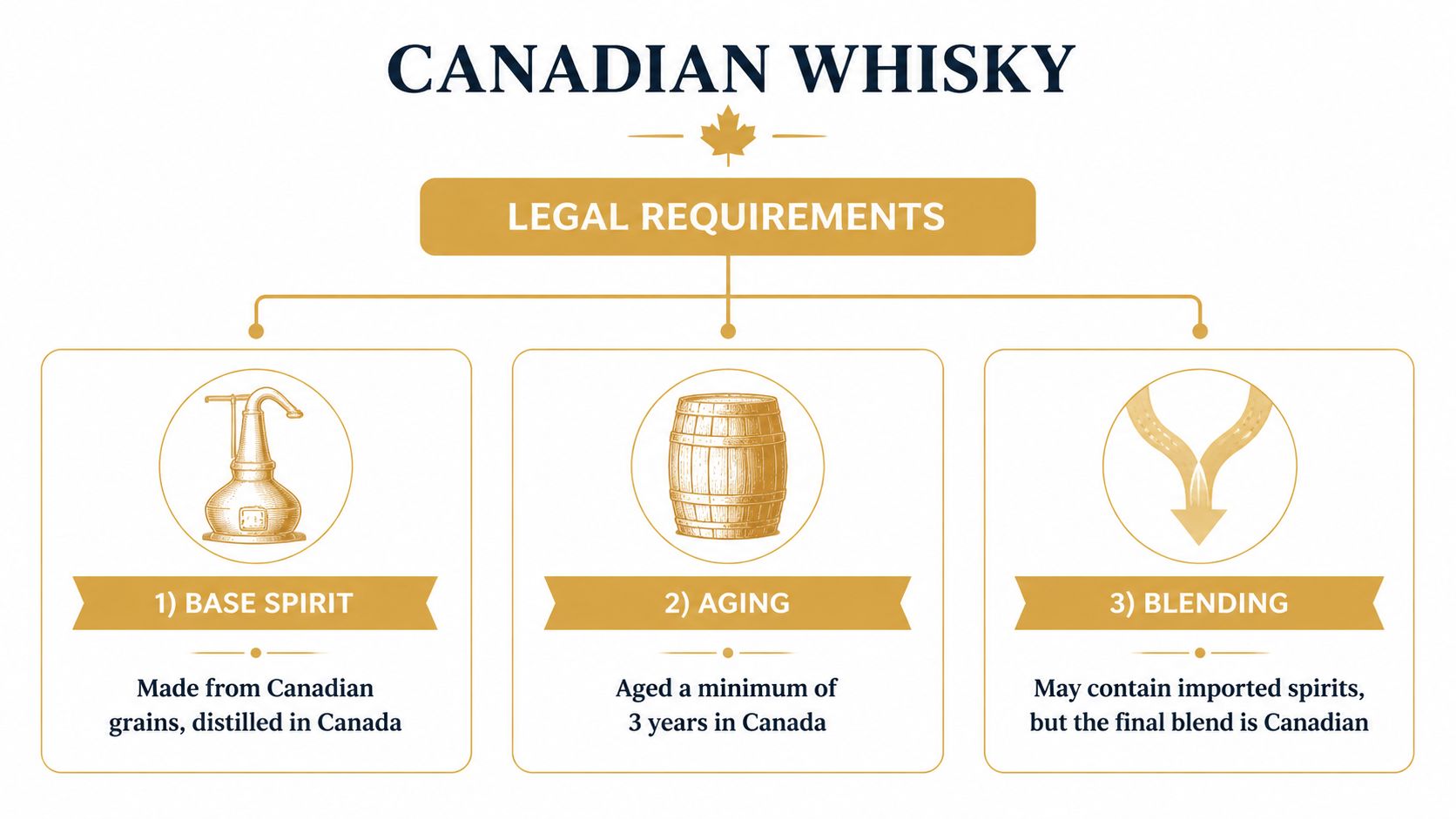
Canadian whisky has a narrow legal lane, and that lane is exactly what gives blenders room to play. The spirit must be mashed, distilled, and aged in Canada, aged in small wood vessels no larger than 700 liters for at least three years, and bottled at no less than 40% ABV Distiller. Those rules sound bureaucratic until you think about what they do to flavor.
What the aging rules change in the glass
Three years in wood is a floor, not a promise of character. The minimum still matters because whisky and wood are always in conversation. Smaller vessels expose more liquid to the wood surface than a giant cask would, so maturation can move faster and more deliberately toward color, spice, and rounded grain notes. The effect is like steeping tea in a small cup instead of a deep pot, the contact changes, and the flavor follows.
That rule also carries historical weight. Canada was the first country to legislate a whisky age requirement in 1887, and the modern minimum of three years keeps that tradition in place while giving producers a clear production baseline Canadian whisky industry statistics. In a blind tasting, that baseline matters because it means even an affordable bottle usually arrives with some wood integration already built in.
Why the bottling strength and vessel size matter
The 40% ABV bottling floor helps shape how the whisky feels in the glass. It keeps the category in a range that usually reads as approachable without automatically turning thin. The 700-liter vessel cap works in the opposite direction, stopping producers from aging in something so large that the wood influence becomes too slow and too diffuse Distiller. Together, those rules help explain why Canadian whisky can seem clean while still having real texture.
For a newcomer, the legal frame is easier to grasp if you connect it to what you taste. The whisky must be Canadian from mash to maturation, but the law still leaves space for the blender to shape the final profile. A plain-English overview of what makes a whiskey a whiskey helps place that structure in context. Canadian whisky is flexible inside a fixed frame, and that is why it can show so many different faces in a neat pour or a blind tasting.
A good Canadian whisky often tastes less like a single decision and more like several good decisions that landed in the same glass.
How Blending Architecture Creates Flavor
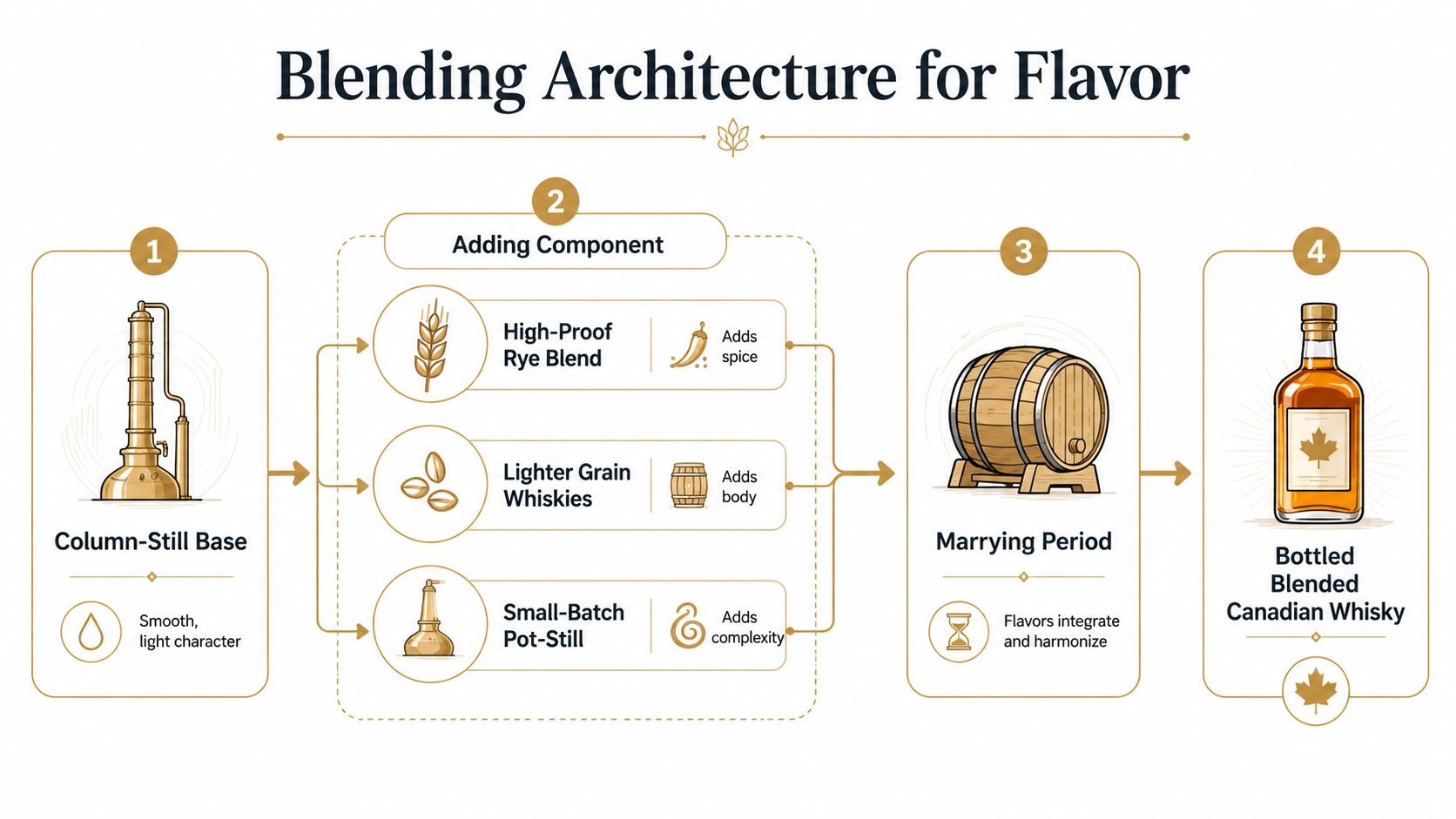
A blended Canadian whisky is built like a set of rooms that have to work together. Producers often make separate whiskies from different grains, age them on their own terms, and then decide how much of each stream belongs in the final bottle. That gives the blender control over sweetness, spice, body, and finish in a way a single stream cannot always match.
What those separate streams do
A corn-heavy base whisky usually brings a softer shape and a rounder sweetness. Rye pushes in the other direction with pepper, baking spice, and a little lift. Wheat tends to smooth rough edges, while barley can add depth and a nuttier feel. Kept apart until blending, those pieces can be arranged with real intention, the way different tools get used for different parts of a repair.
For a first blind tasting, that matters because the whisky often reveals itself in layers. The nose may open with vanilla, the middle can drift toward grain sweetness, and the finish may tighten with spice or wood. That progression is part of the craft, and it gives you clues about how the blend was assembled.
Blending also works like pacing in a conversation. One component starts the sentence, another supplies the emphasis, and another leaves the last impression. A whisky that feels balanced in the glass often owes that balance to separate parts doing different jobs, then meeting in one bottle.
The same idea is explored in more depth in this look at the art of blending.
The 9.09% rule and why it is not a gimmick
Canadian whisky law allows up to 9.09% of the final product to consist of added spirits, wine, caramel coloring, or flavoring without losing the designation Pendleton Whisky guide. That same threshold is often described as one-eleventh of the blend, and if the added spirit or wine is used as a flavoring component, it must be at least two years old Pendleton Whisky guide. That is not a loophole in the casual sense. It is a blending tool.
Used well, that flexibility helps producers keep a house style steady from batch to batch. It can also shape a recognizable aromatic fingerprint, whether that means a little more dried fruit, a darker color, or a rounder finish. The law gives blenders room to tune the instrument before the performance starts.
Why the stereotype keeps falling apart
The common stereotype says Canadian whisky is always soft, light, and interchangeable. That is too blunt. Explanations of the category show producers making distinct base whiskies and then blending for a target profile, rather than hiding behind generic uniformity Canadian whisky blending techniques. The result can be supple, but it can also carry real assertiveness, especially when rye components are used with intent.
For a blind taster, that means blended should never mean boring. It usually means calibrated. If the whisky tastes more balanced than obvious, that often points to the blender doing the job well.
Canadian Whisky Versus Bourbon Rye and Single Malt
A newcomer often asks the right question in the wrong order, which bottle is “best.” A better question is which style is built for which kind of drinking. Canadian whisky, bourbon, rye, and single malt each solve a different problem, and once you compare the rules side by side, the shelf stops looking random.
Style comparison at a glance
| Style | Grain Requirement | Aging Rule | Typical Flavor Profile |
|---|---|---|---|
| Blended Canadian Whisky | Can use multiple grains, then blend them | Must be mashed, distilled, and aged in Canada, with at least 3 years in small wood and bottled at 40% ABV minimum Cornell law | Balanced, often smooth, with grain sweetness, spice, and wood influence |
| Bourbon | Must be at least 51% corn | Aged in new charred oak | Sweet oak, caramel, vanilla, baking spice |
| American Rye | Must be at least 51% rye | Must meet U.S. whiskey aging rules, style often emphasizes new oak or clear oak influence | Peppery, dry, spicy, more angular |
| Single Malt | Made from malted barley at one distillery | Style depends on its country's rules and production model | Malt-driven, layered, often more distillery-specific |
The main difference is not only grain, it is philosophy. Bourbon builds sweetness around new charred oak. American rye usually pushes spice and bite to the front. Single malt asks you to taste one distillery's barley-driven voice, the way one instrument carries a melody without a full orchestra behind it.
Canadian whisky sits between those poles, and that middle position is part of its strength. The category can use blending like a mixer at a console, bringing different tracks forward or back until the final note feels balanced. That is why a blind tasting can be so useful. You are not just asking whether a whisky is smooth, you are asking what kind of structure is making it feel smooth.
Where Canadian whisky sits
Canadian whisky often feels softer than rye, more flexible than bourbon, and more openly blended in spirit than many single malts. That makes it a practical starting point for new drinkers, because the category can show character without demanding that you already know every flavor reference in the room.
Under U.S. labeling rules, a product sold as blended Canadian whisky is whisky manufactured in Canada in compliance with Canadian law, and if it is a mixture of whiskies, the U.S. designation is specifically “blended Canadian whisky” or “Canadian whisky, a blend” Cornell law. That naming detail matters because it tells you the style is legally recognized as a blend, not just marketed that way. For a newcomer, that is a clue to look for integration, not a single dominant note.
A useful comparison for a first tasting flight is Canadian whisky versus bourbon. Bourbon can be the louder bottle. Canadian whisky can be the better teacher.
Tasting Notes and Serving Suggestions for Every Occasion
A well-made Canadian blend usually gives you a friendly nose before it gives you a firm palate. Look for vanilla, caramel, and grain sweetness first, then see whether rye or wood pulls the finish toward pepper, baking spice, or a drier edge. If the whisky feels easy without feeling flat, the blender likely built it with balance in mind.

What to expect in the glass
Corn-forward blends often come across with toffee, soft vanilla, and a rounded mid-palate. Rye components can sharpen the edges with baking spice and a little pepper, but in Canadian whisky that spice is often integrated rather than aggressive. Age in small wood vessels tends to add a dry frame around those flavors, which is why some bottles feel clean on entry and warmer on the finish.
Useful shortcut: If the first sip tastes gentle but the finish lingers with spice or oak, you're probably dealing with a blend that used its components with discipline.
How to serve it without overthinking it
Neat service works best when you want to hear the blend speak plainly. A tulip-shaped glass or a small whiskey glass gives the aromas a place to collect, and a teaspoon of water can open the nose if the whisky feels tight. On the rocks, the lighter styles stay refreshing, especially if you're drinking slowly.
For cocktails, Canadian whisky has earned its keep. A Whisky Sour benefits from a blend that isn't too aggressive, while an Old Fashioned gets more structure from a bottle with rye notes or extra wood depth. If you're mixing for guests who usually say they don't like whisky, a Canadian blend is often the safest place to start because it can bring flavor without forcing the issue.
Premium and finished expressions deserve a slower pour. Those bottles are often aiming for a more transparent component story, sometimes with clearer grain details or finishing choices that move them beyond the standard shelf profile. The bottle doesn't need to shout to be interesting.
Evaluating Canadian Blends in a Blind Tasting
Blind tasting is where Canadian whisky stops leaning on its label and has to speak for itself. Pull away the name and the shelf polish, and you start hearing whether the blend was assembled with care or merely made to drink easily. That shift matters, because blending in Canada often works like arranging a small ensemble. Each part can play a different role, and the result in the glass depends on how well those roles fit together.
A simple way to spot the style
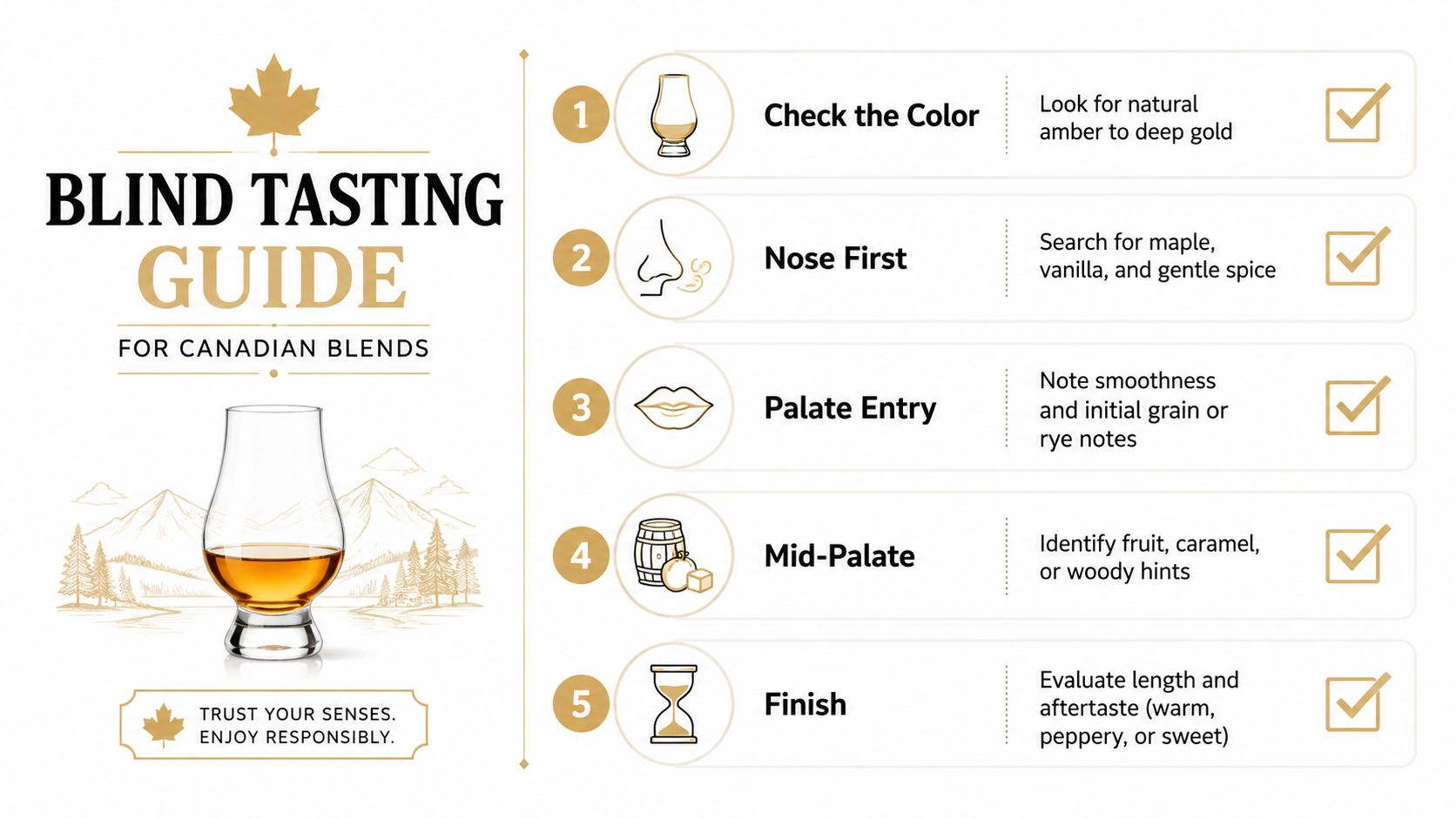
Start with color, then move to aroma. Canadian blends often sit in the amber-to-gold range, and the nose may bring vanilla, maple-like sweetness, grain, or a gentle spice. A polished first impression usually tells you something, too. If the aromas feel rounded instead of sharp, the blend is already showing its structure.
Then taste for structure. Many newcomers hear the word “blended” and expect something thin or anonymous, but a good Canadian blend usually opens cleanly, shows a middle with grain sweetness or rye lift, and finishes without falling apart. The point is to notice how those parts hold together, the way a well-built bridge carries weight across the span.
A tasting table helps more than memory
| What to Note | What It Might Suggest |
|---|---|
| Aroma | Vanilla, grain, gentle spice, light fruit, or darker wood tones |
| Palate entry | Smooth opening, sweet grain, or a subtle rye edge |
| Mid-palate | Caramel, orchard fruit, baking spice, or oak |
| Finish | Warm, peppery, sweet, or drying |
The 9.09% blending allowance can leave a noticeable aromatic footprint when it is used, especially if the blender wants more color or a specific flavor accent. The point is not to guess the law from the glass. The point is to notice whether the whisky feels more layered than its label language would lead you to expect. That kind of layering is exactly what a blind tasting can reveal, because the nose and palate pick up on balance before they care about branding.
Blind tasting habit: Write down the first aroma, the mid-palate shift, and the last flavor that stays on your tongue. That sequence tells you more than a score alone.
For a practical side-by-side tasting mindset, some collectors even use resources like Clos Pegase membership as a reminder that a good collection is built around variety, not just prestige. That same idea works with whisky, too. Pick bottles that teach different lessons.
The Premium Shift and Building Your Collection
Canadian whisky is shedding the old supermarket-only reputation. The most interesting bottles now lean on transparency, clearer grain details, age statements, and finishing choices that make the blend feel deliberate instead of anonymous Serious Eats. That's good news for anyone who wants a shelf that teaches something.
What to look for on the label
A stronger label usually gives you more to work with. Look for age statements, proof, and any mention of component whiskies or finishing barrels. If the producer explains what's inside, you can start connecting label language to the flavor you're getting.
This is also where the category starts overlapping with the kind of curiosity people bring to American craft whiskey. The blending mindset is similar, even if the legal framework is different. A bottle doesn't need to be rare to be specific, and specificity usually tastes better than marketing.
For a practical side-by-side tasting mindset, some collectors even use resources like Clos Pegase membership as a reminder that a good collection is built around variety, not just prestige. That same logic works with whisky, too. Pick bottles that teach different lessons.
How to build a small, useful lineup
Start with one approachable blend, one rye-leaning Canadian whisky, and one more transparent premium bottle if you can find it. That gives you a useful triangle, easy, spicier, and more detailed. Once you taste across those styles, the category stops feeling generic and starts feeling navigable.
A thoughtful collection doesn't need to be large. It needs to be varied enough that you can pour side by side and notice what changed. Canadian whisky is particularly good at rewarding that kind of comparison.
If you want to sharpen your palate with the same blind-tasting mindset that makes blended Canadian whisky so rewarding, Blind Barrels delivers blind samples that let you focus on aroma, taste, and finish before brand bias gets in the way. It's a smart fit for this category, because Canadian whisky teaches best when you judge what's in the glass first.