

You're standing at the grill with a shaker of brown sugar bourbon seasoning, pork chops ready, and guests arriving in an hour. The last batch went black before the meat was done, and nobody could taste any bourbon at all.
That's not a talent problem. It's a ratio and heat problem, and both are fixable tonight with a scale, a sieve, and a little restraint.
Ingredient Ratios for a Balanced Batch
Start with a weighed batch you can repeat. Volume alone won't do it, because packed brown sugar and kosher salt change density from brand to brand and scoop to scoop.
The Base Batch for About One Cup
| Ingredient | Volume | Weight | Role in the blend |
|---|---|---|---|
| Brown sugar, packed | 1/2 cup | 110 g | Sweetness, molasses depth and crust color |
| Diamond Crystal kosher salt | 2 tbsp | 18 g | Seasons and balances the sugar |
| Smoked paprika | 2 tbsp | 12 g | Smoke and red color |
| Garlic powder | 1 tbsp | 8 g | Savory base |
| Onion powder | 1 tbsp | 8 g | Savory base |
| Coarse black pepper | 2 tsp | 4 g | Bite and aroma |
| Cayenne (optional) | 1 tsp | 2 g | Background heat |
| Dry bourbon flavor (optional) | 1 tsp | Varies by brand | Bourbon aroma without added liquid |
Brown sugar isn't just sweetener here. Its molasses brings moisture, darker color, and caramel-like, toffee notes that plain white sugar doesn't give you. That's why this blend browns fast and tastes deeper than a standard sweet rub.
Sugar makes up about two-thirds of this mix by weight. That makes the base version a sweet finishing rub, not a blend you should blast over direct flames from the start.
Two Versions Worth Keeping
- Finishing and indirect version: Keep the sugar at 110 g. Use it when you're cooking indirect first, roasting, or adding flavor near the end.
- Direct-heat version: Drop the sugar to 75 g and add 6 g more smoked paprika. You'll lose a little candy-like crust, but you'll gain color and smoke without scorching as quickly.
Salt needs attention. Diamond Crystal is lighter by volume than Morton kosher salt, so a spoon-for-spoon swap makes the batch noticeably saltier. Weigh the 18 g, or halve the volume if you're substituting and can't weigh it.
Weigh the salt even if you scoop everything else. It's the fastest way a good batch turns harsh.
For a cost check, H-E-B listed McCormick Brown Sugar Bourbon Seasoning at $1.97 for 3 ounces, or $0.66 per ounce, in 2026. Compare your homemade cup against that benchmark after you price the sugar, paprika, and dry flavor. You'll usually get fresher aroma at home, and you control the sugar share.
Choosing the Bourbon and What to Pour With It
If you're new to whiskey, the word bourbon on a label tells you more than marketing language does. It's a legal definition, not a flavor promise.
For a whiskey to be legally labeled bourbon in the United States, its fermented mash must contain at least 51% corn, with distillation limited to no more than 160 proof, entry into charred new oak at no more than 125 proof, and bottling at no less than 80 proof, with no added coloring, flavoring, or blending materials permitted, under the federal bourbon standards in 27 CFR Part 5. That same framework prohibits neutral spirits in bourbon.
What to Read on the Label
Read two things first. Bourbon describes how it was made, including the corn requirement and new charred oak. Proof tells you alcohol strength, and it doesn't tell you age or quality.
A bourbon flavor wheel helps you name what you're tasting, whether it's caramel, vanilla, toasted grain, or baking spice. Use those words when you shop, and you'll pick a bottle that matches your rub instead of guessing.
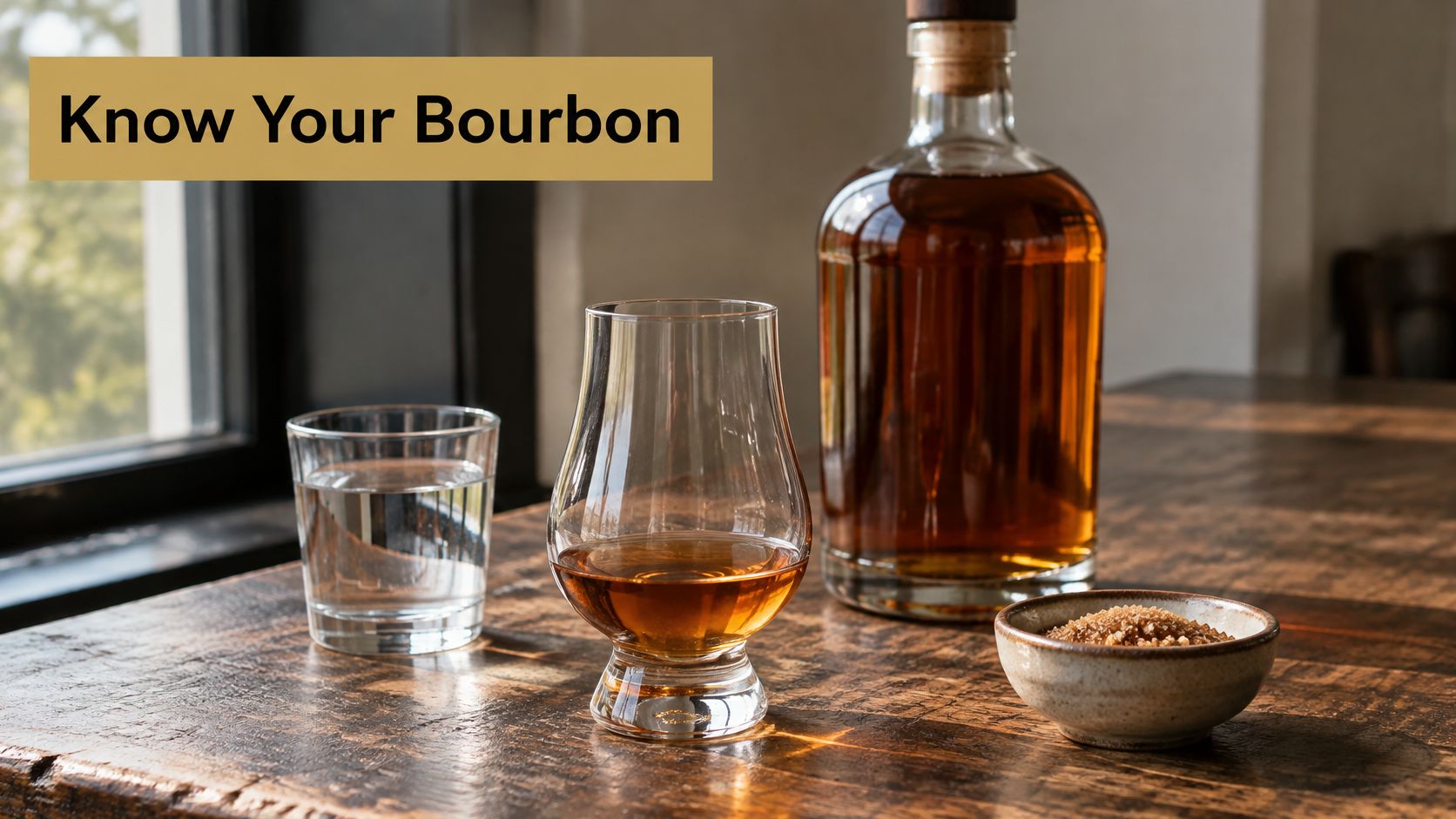
For cooking, a 90 to 100 proof bourbon reduced into a glaze carries caramel and vanilla without turning harsh. A higher-rye bourbon adds spice, which works well if your batch leans into cayenne and black pepper.
Don't overlook American craft whiskey brands. Small distilleries in California, New York, Texas, Washington, and beyond make bottles with distinct grain and oak character, including names like Frey Ranch and Southern Star that craft drinkers seek out. They often give you clearer vanilla, fruit, or spice notes to match against pork, chicken, or dessert.
Pour the same bourbon you used in the glaze alongside pork chops. Try a lighter, softer pour with chicken, and save a sweeter bourbon for dessert. Add one or two drops of water to your glass if the aroma feels closed, since it can open things up without diluting the drink into nothing.
Taste the bourbon alone before you cook with it. The flavors you notice in the glass are the ones most likely to survive heat.
Alcohol Content and Who Should Skip Bourbon Blends
Don't assume a blend called bourbon is alcohol-free, and don't assume it contains bourbon either. Both mistakes are common.
Commercial products vary widely. Some list bourbon whiskey or salted bourbon whiskey, some use natural whiskey flavor or bourbon extractives, and some rely only on smoke and sweetener, as shown by retail ingredient listings for bourbon-style seasonings and rubs. Similar names can hide very different formulas.
Seasoning goes straight onto food, often near the end. Reduction, grilling, broiling, and brief cooking don't guarantee complete alcohol removal, because the amount used, cooking method, surface area, temperature, and time all affect what remains.
If you're still learning labels, understanding what proof means in alcohol helps you separate strength from flavor. It won't tell you whether a seasoning is alcohol-free, though. Only the current ingredient list does that.
Who Should Use the Alcohol-Free Route
- Families with children: Choose a blend that doesn't list bourbon or whiskey when avoidance matters to you.
- People avoiding alcohol: Don't rely on cooking to remove it all.
- Halal or kosher households: Check the current package and certification, not an old recipe or product name.
You can build a convincing caramel and oak impression without alcohol. Use oak-smoked salt for the barrel note, vanilla for the sweet woody layer, and molasses or maple for depth. Nonalcoholic bourbon flavoring works when you want a clearer bourbon character.
Bourbon-barrel-aged products are another useful option. They can carry bourbon-like character without containing bourbon itself, which is exactly why label reading matters.
For the homemade versions here, the dry base batch with dry bourbon flavor contains no alcohol. The reduced bourbon glaze does contain alcohol, so serve it only when your guests can have it, and label the alcohol-free jar clearly.
How to Mix, Store and Label Your Batch
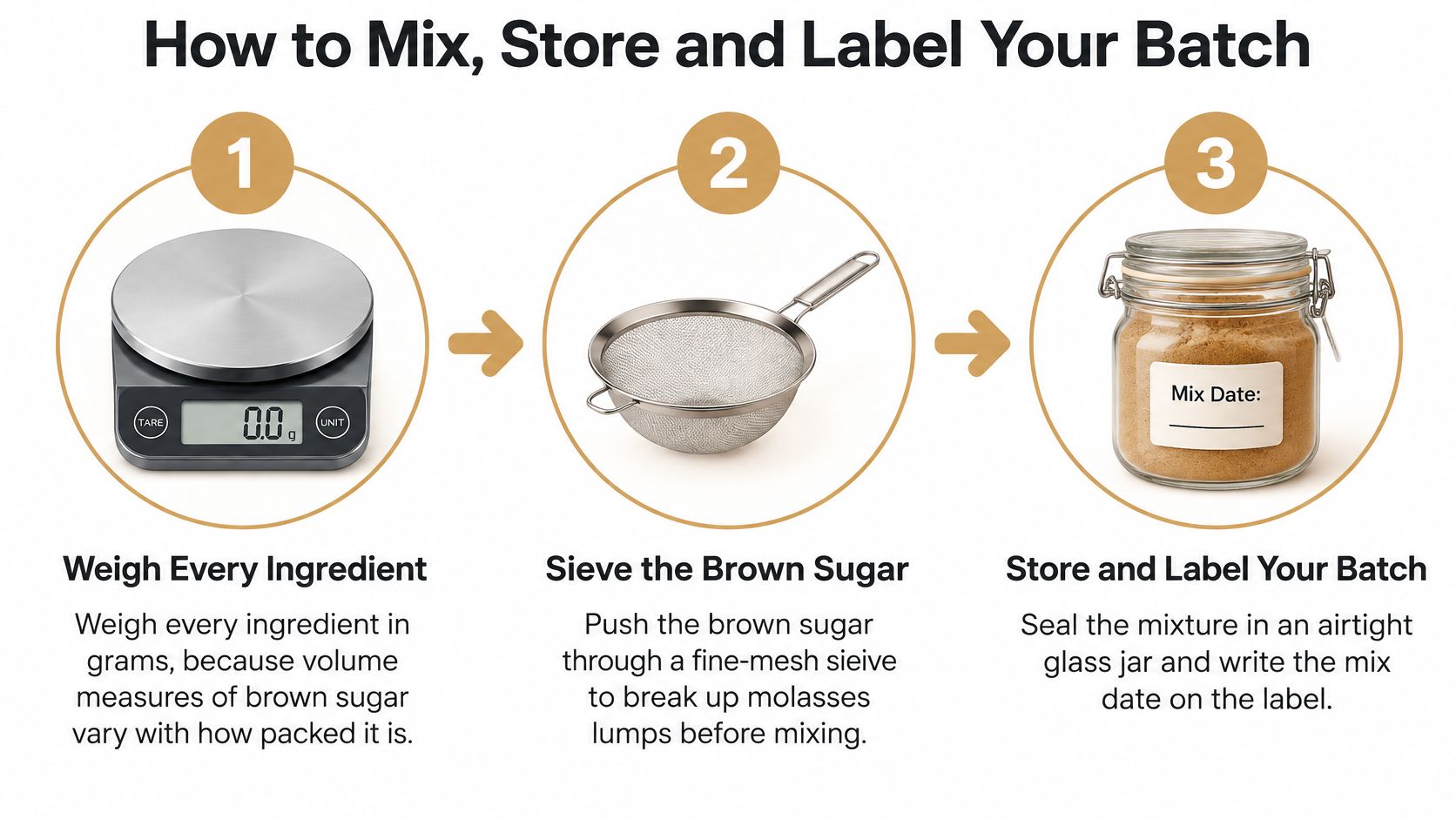
A good blend starts boring. Weigh, sieve, whisk, jar, label. That routine is why your second batch tastes like the first.
The Mixing Routine
- Weigh every ingredient in grams. Brown sugar volume changes with how tightly it's packed, so grams keep your sugar-to-salt ratio stable.
- Sieve the brown sugar. Push it through a fine-mesh sieve to break up molasses lumps, or pulse it briefly in a food processor and stop before it turns to powder.
- Add the savory ingredients. Add salt, paprika, garlic, onion, pepper, and cayenne, then whisk for one to two minutes until the color looks even with no pale streaks.
- Jar it clean and dry. Spoon the blend into a clean, dry glass jar and leave a little headspace so the lid seals well.
- Label the ratio and date. Write something useful like 110 g sugar to 18 g salt, plus the mixing date, so you know which version you're holding.
The most common slip I've made is adding wet bourbon straight to the jar. Don't. It clumps the sugar, dulls the spices, and invites mold in storage.
Use dry bourbon flavor in the jar instead. Save liquid bourbon for the reduced glaze you'll brush on during cooking, where moisture and timing are under your control.
Jar rule: If it's wet, it doesn't go in the storage jar. Glazes live in the pan, not the pantry.
Storage That Protects Aroma
Keep the jar airtight in a dark cupboard. Stored that way, the blend keeps its aroma for roughly four to six months, with paprika and bourbon notes fading first.
Refrigeration is a poor choice. Every time a cold jar comes out, condensation can form inside and clump the sugar.
Freezing works for longer storage if you seal the jar inside a double bag. Bring it fully to room temperature before opening, so moisture stays outside the blend instead of settling into it.
You'll know a batch is stale when the paprika smells flat, the bourbon aroma is gone, and the sugar forms hard lumps that a sieve can't fix. At that point, make a fresh half batch rather than trying to rescue it with extra spices. Fresh garlic and paprika can't fix tired sugar.
Label direct-heat and finishing versions differently, too. A jar marked 75 g sugar prevents you from grabbing the sweet batch for a hot sear by mistake.
Matching the Blend to Rubs, Glazes and Foods
A rub does its work before the heat. A glaze does its work at the end. Keep each in its lane and this blend behaves; cross them and you get scorched sugar or a marinade that never sets.
For meat, apply about 1 tbsp per pound and let it rest 15 to 30 minutes before cooking. That gives salt time to start dissolving while most of the sugar stays on the surface, where you want it for crust.
Application by Food
| Food | Method | Amount | When to apply | Heat approach |
|---|---|---|---|---|
| Pork chops or ribs | Dry rub | 1 tbsp per pound | 15 to 30 minutes before cooking | Indirect first, sear at the end |
| Chicken thighs | Dry rub | 1 tbsp per pound | 15 to 30 minutes before cooking | Indirect first, brief sear at medium once the skin dries |
| Chicken thighs, direct grilling | Dry rub, 75 g sugar version | 1 tbsp per pound | 15 to 30 minutes before cooking | Medium direct heat, watch the crust |
| Salmon fillet | Light dusting | 1/2 tsp per 6 oz fillet | 10 minutes before cooking | Medium, skin side down |
| Carrots or squash | Oil, then rub | 1 tbsp per pound | Before roasting | Moderate oven, about 400°F, rub added after oiling |
| Mushrooms or tofu | Oil, then rub | 1 tsp per cup | Before roasting | Hot oven or skillet after surface moisture cooks off |
| Popcorn or nuts | Toss | 1 tsp per cup | Warm, straight out of the pan | No added heat |
| Glaze for any protein | Simmered glaze, 1/4 cup bourbon plus 2 tbsp blend | Brush on | Final 3 to 5 minutes | Medium-low |
For the glaze, simmer 1/4 cup bourbon with 2 tbsp of the blend for two to three minutes until it looks syrupy. Brush it on during the final 3 to 5 minutes, when it can set without burning. If you're choosing a bottle for that job, guidance on whiskey for cooking helps you match proof and flavor to the food.
Vegetables need oil first so the rub sticks instead of falling to the pan. Mushrooms and tofu need their surface moisture cooked off, or the seasoning turns pasty.
A squeeze of lemon or a splash of apple cider vinegar cuts bourbon's richness and keeps the sugar from reading as candy. That acid balance matters most on pork, salmon, and roasted squash.
You don't need much for a finish. Hannaford reported in 2026 that a 5.64-ounce container of McCormick Brown Sugar Bourbon Seasoning contains 177 servings, with a serving size of 0.25 teaspoon. That small serving is a good reminder to dust popcorn and nuts lightly, taste, then add more.
One thing worth checking on store-bought versions: plenty of bottles labeled "bourbon" get there with flavoring rather than actual whiskey. If real bourbon matters to you, read the ingredient line or mix your own batch. Either way, roasted carrots, squash, mushrooms, and tofu all take the sweet, smoky profile well when you respect moisture and timing.
Fixing Burnt, Bitter or Pale Crusts
Sugar has a narrow window. Work inside it and you get amber crust. Miss it and bitterness arrives before the meat is done.
Sucrose begins caramelization at approximately 160 to 170°C (320 to 338°F), while prolonged exposure near 188 to 204°C (370 to 400°F) produces darker, increasingly bitter flavors, and a sugar-heavy coat left over high heat scorches before the interior reaches serving temperature, according to a detailed guide to caramelization temperatures and pitfalls. Excess bourbon liquid hurts too, because surface moisture delays browning.
Your target is golden to amber. If the crust reads dark mahogany early, move the food.
Crust Symptoms, Causes and Fixes
| Symptom | Likely cause | Fix |
|---|---|---|
| Black crust within five minutes | Sugar-heavy rub sitting over high direct heat | Keep the 15 to 30 minute rest, but move the food to indirect heat or drop the flame |
| Pale, sticky coating | Wet surface or crowded pan | Pat the food dry, space pieces apart, add the rub after drying |
| Bitter aftertaste | Scorched sugar or carryover heat | Lower the heat and cut the sugar to 75 g per batch for direct grilling |
| Bitter only after resting | Residual heat intensifying dark sugar | Pull the food a little earlier and judge the flavor after 5 to 10 minutes |
| Weak bourbon flavor | No dry bourbon flavor, or wet bourbon burned off | Add dry bourbon flavor or brush on the reduced glaze in the last minutes |
| Crust browns but flavor is flat | Too little savory base relative to sugar | Add paprika and pepper in small steps before adding more sugar |
One row deserves a second look. Weak bourbon flavor often traces back to the bottle or bag itself. Plenty of bourbon-labeled blends contain no bourbon at all, only flavoring, and no heat fix rescues a seasoning that never had whiskey in it.
Don't confuse Maillard browning with caramelization. Amino acids and reducing sugars can brown at lower temperatures than sucrose needs to caramelize, so a crust can look done before the sugar flavor has fully developed.
I've burned enough batches to know the usual sequence. The rub goes on heavy, the grill is hotter than I admit, and the sugar blackens while the center is still underdone. A lighter first coat and a late second dusting give you more aroma with less risk.
For consistency, record blend mass, application rate, cooking temperature, surface color, and bitterness for each cook. Score bitterness from 1 to 5, and reject a version with visibly blackened areas or bitterness above 2 out of 5.
That record beats guessing from cooking time alone. Grills, pans, and sugar batches vary, but your notes show you exactly which change fixed the crust.
Test Three Versions Before Your Cookout
Don't trust one lucky batch. Run a small test while the stakes are low, then cook for guests with the winner.
Make three sugar levels at 75 g, 90 g, and 110 g per cup of blend, keeping everything else the same. Cross each version with three application rates, such as 1/2 tbsp, 1 tbsp, and 1.5 tbsp per pound.
Cook identical portions of boneless chicken thighs or pork chops for identical times. Use the same pan or grill zone so heat doesn't become another variable you're chasing.
Score every sample from 1 to 5 on sweetness, bourbon aroma, saltiness, crust adhesion, bitterness, and aftertaste. Judge after the food rests 5 to 10 minutes, because dark sugar bitterness can grow as it sits in residual heat.
Log blend mass, application rate, cooking temperature, and surface color beside each score. Duplicate the two or three leading formulas before you decide.
Pick the version that stays acceptable after cooling. You'll often land on 75 g for direct grilling and 110 g for oven finishing, but let your scores decide.
For a blind check, have a friend serve two unlabeled versions and see whether you pick your favorite. Reject anything with blackened areas or bitterness above 2, then weigh one base batch this week and test it on a single protein.
Once your seasoning is dialed in, sharpen the palate that chose the bourbon for it with quarterly blind tastings of small American craft whiskeys from Blind Barrels. Each kit includes four top-shelf blind samples, guided tasting notes, and a reveal that lets you buy full bottles you loved, without label or price bias.