

When you see 'proof' on a whiskey bottle in the United States, it’s a simple, direct measure of the spirit's alcohol content. The rule is dead simple: proof is just double the Alcohol By Volume (ABV). So, that 100-proof bourbon from a distillery like Stellum Spirits on the shelf is exactly 50% alcohol.
Your Quick Guide to Alcohol Proof
If you're just getting into whiskey, numbers like "90 proof" or "121.8 proof" can feel like insider jargon. But getting a handle on this one term is one of the fastest ways to level up your tasting game and make smarter picks at the liquor store, especially when diving into the incredible world of American craft whiskey.
Think of proof as the intensity dial on a spirit. It gives you an immediate sense of how much alcoholic "heat" or warmth to expect before you even take a sip. This number isn't just a technicality; it’s a critical clue to the whiskey's potential character, body, and flavor.
Connecting Proof to the Pour
A higher proof almost always means a more concentrated, robust flavor profile. On the flip side, a lower proof usually delivers a smoother, more approachable experience. Understanding this link between the number on the label and the sensation in the glass is fundamental.
For instance, many of the big-name bourbons are bottled at a standard 80 or 90 proof. But an adventurous craft distillery like Frey Ranch or Westward Whiskey might drop a special "barrel proof" or "cask strength" expression that clocks in at a fiery 120+ proof. The difference you'll experience is immediate and striking.
Tip for New Drinkers: Don't assume higher proof is better! Start with whiskeys in the 80-90 proof range to get comfortable with the flavors before exploring hotter, more intense spirits.
Grasping this concept is a superpower in a blind tasting. By learning how to gauge the warmth and viscosity in your glass, you can start making educated guesses about a whiskey's strength. It adds a fun, detective-like element to your journey and seriously sharpens your palate. This skill is a fantastic first step on the path to mastering how to taste whiskey like a true pro.
The Explosive History of Alcohol Proof
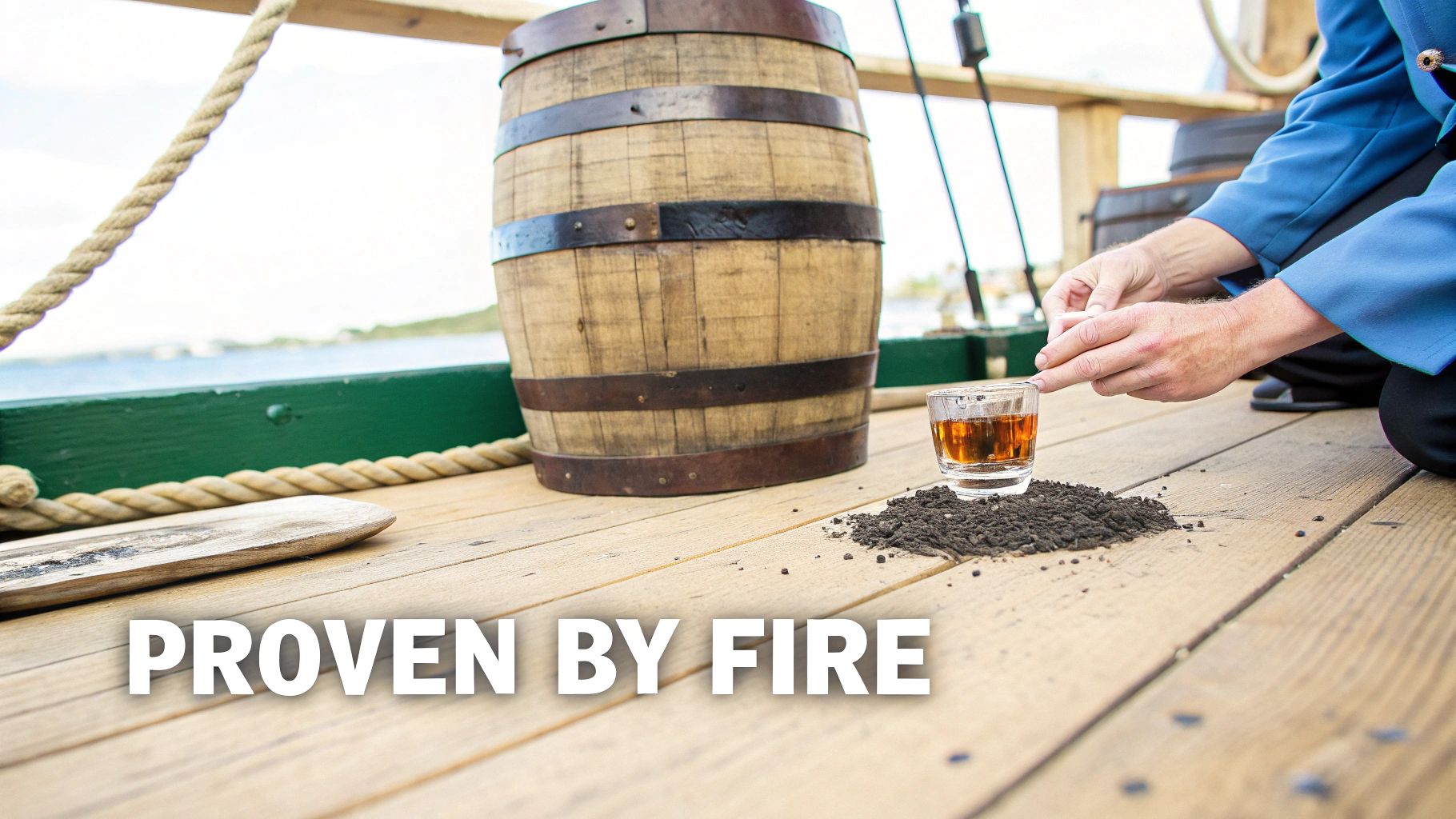
Way before we had labs and precise instruments, the word 'proof' was born from fire, suspicion, and a healthy measure of gunpowder. Our story kicks off back in 16th-century England, where sailors in the British Royal Navy were given a daily ration of rum. This wasn't just a perk—it was a core part of their payment.
Naturally, these sailors were always on guard against their precious rum being watered down by shady pursers trying to pocket a few extra shillings. To make sure their spirits were full-strength, they came up with a rugged and brilliant test right there on the ship decks. They’d pour a bit of rum over a small pile of gunpowder and try to light it.
If the powder flared up with a satisfying whoosh, the rum was considered "proven" to be strong enough. This spirit was called ‘above proof,’ and the crew knew they were getting a fair deal. But if the mixture just fizzled out in a damp mess, it was ‘under proof’—a clear sign it had been diluted.
From Gunpowder to Government
This fiery field test wasn't just for sailors. The practice quickly became a vital tool for tax collectors. When people ask, “what does proof mean in alcohol,” they’re usually surprised to find out it started as a government method for classifying spirits. Excise officers used the very same gunpowder test to figure out which spirits were potent enough to slap with a higher tax rate. A successful ignition meant a bigger tax bill for the distiller.
This rough-and-ready system eventually made way for more scientific tools like the hydrometer. By 1816, Britain officially defined 100 proof as a spirit with a specific gravity of 12/13 that of water, which works out to about 57.06% ABV.
This old standard is the direct ancestor of modern proof ratings. Terms like "Navy Strength," which you often see on gin and rum bottles today, are a direct tribute to this explosive heritage, typically signaling a spirit bottled around 57% ABV.
The American Connection
Understanding this history gives you crucial context for American whiskey traditions, especially when it comes to the Bottled-in-Bond Act of 1897. This act was a landmark moment for consumer protection in the U.S., guaranteeing a whiskey's authenticity and quality.
One of its most important rules? The whiskey had to be bottled at exactly 100 proof (50% ABV). That wasn't just some random number. It was a clear nod to the historical benchmark for a full-strength, unadulterated spirit—a promise of quality from the government itself, echoing those sailors who demanded their rum be "proven" true centuries earlier.
Understanding American Proof: The Simple Math
After that fiery history of gunpowder and dubious sailors' tests, the modern American system for measuring alcohol strength is refreshingly simple. For fans of American craft whiskey, there's no complex conversion or historical guesswork. The math is clean, consistent, and easy to remember.
In the United States, proof is exactly double the Alcohol By Volume (ABV). That's it. This direct relationship means you can glance at any bottle of American whiskey and know its precise strength in a heartbeat. See 45% ABV on the label? You know it’s 90 proof.
This straightforward system gives whiskey drinkers, new and old, a ton of confidence. You're not left wondering what the numbers mean; you have a clear formula to rely on every single time. It empowers you to easily compare bottles and understand exactly what you're pouring.
Putting the Formula into Practice
Let's look at this with some real-world examples you'll run into when exploring American craft distilleries. The difference in proof isn't just a number—it fundamentally changes the entire experience in your glass.
- A Standard Bourbon: Many approachable bourbons are bottled at 80 proof, which is exactly 40% ABV. This is a fantastic starting point for newcomers, offering a smoother profile with less alcoholic heat.
- A Bottled-in-Bond Rye: A classic American designation, Bottled-in-Bond whiskeys are required by law to be 100 proof, meaning they are precisely 50% ABV. You can expect a much bolder, more robust flavor from these.
- A Cask Strength Release: An exciting find from a craft distiller like Laws Whiskey House might be a "cask strength" or "barrel proof" whiskey. These are bottled straight from the barrel without any dilution, often landing at high proofs like 125, which translates to a powerful 62.5% ABV.
This simple math lets you anticipate the intensity before you even take your first sip. An 80-proof whiskey will be gentle and inviting, while a 125-proof one will be a flavor bomb that absolutely demands respect.
Tip for New Drinkers: If you're trying a cask strength whiskey for the first time, don't be shy about adding a few drops of water. It tames the alcohol "burn" and can unlock amazing hidden flavors.
Why This Standard Matters
This clear-cut system was officially formalized in the U.S. way back in 1848, creating a reliable standard for both distillers and consumers. Today, federal regulations commonly treat 40% ABV (80 proof) as the minimum strength for a spirit to be sold and labeled as whiskey, ensuring a baseline of quality and potency across the board. You can discover more insights about this standard on Alcohol Professor.
Understanding this simple conversion from ABV to proof is more than just trivia; it's a practical skill for any whiskey lover. It connects the data on the bottle directly to the sensory experience, helping you make smarter choices and better appreciate the craft behind every single pour.
How Proof Shapes Your Whiskey Tasting Experience
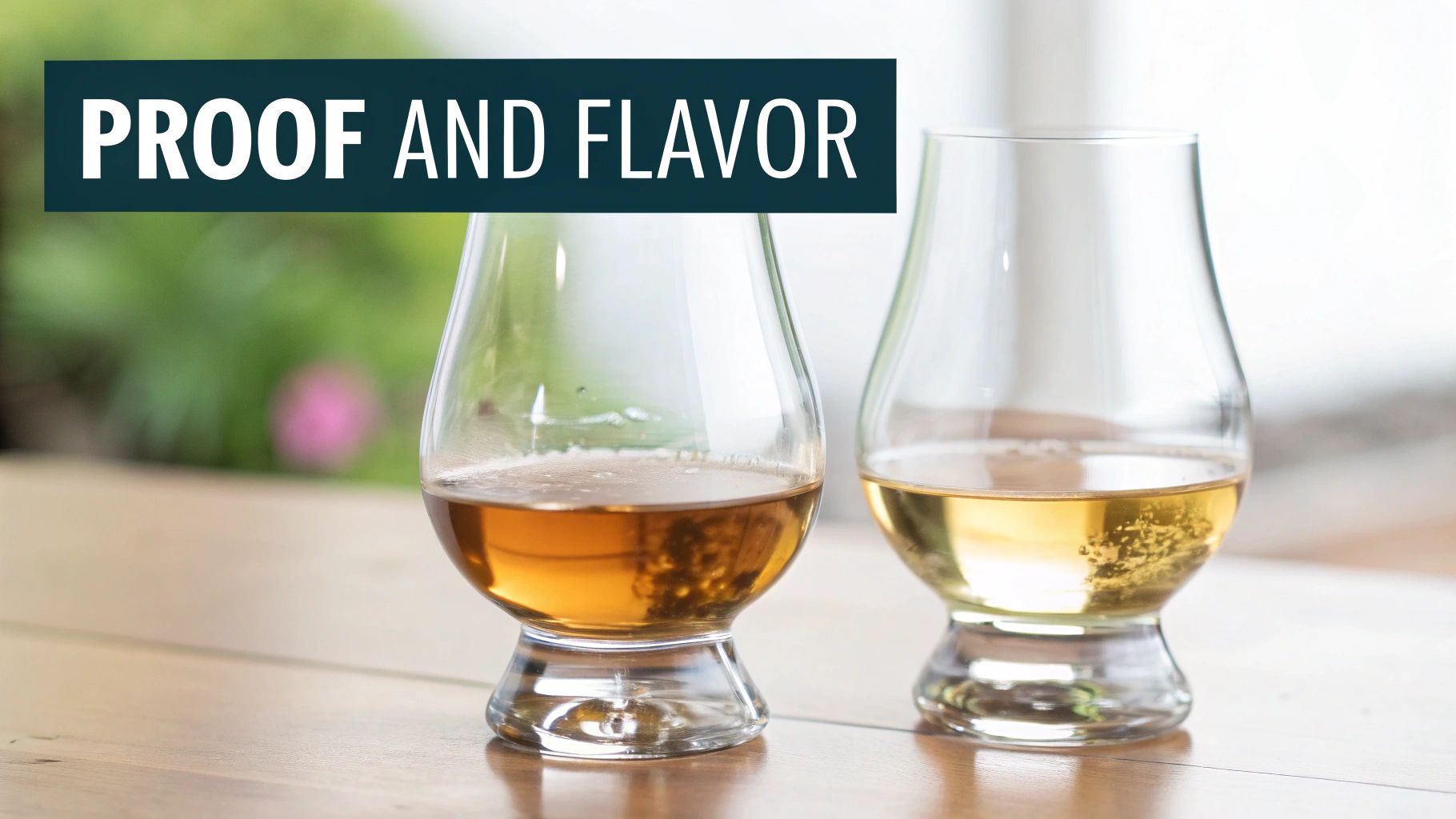
Alright, we’ve handled the math. Now for the fun part: seeing how those numbers on the bottle translate directly into the aromas, flavors, and feelings in your glass. Understanding what proof means isn’t just a technicality; it's the key that unlocks why a whiskey behaves the way it does.
Think of alcohol as the delivery truck for flavor. A higher proof spirit is like a bigger, more powerful truck, capable of hauling a massive payload of delicate aromatic compounds from the barrel right to your nose. It’s why high-proof whiskeys often just explode with a rich, complex bouquet.
Of course, that intensity comes with a feisty passenger you can’t ignore: alcoholic heat. This is that warm, sometimes prickly sensation that high-proof spirits are famous for. For seasoned drinkers, it’s part of the thrill, but if you’re new to the game, it can feel a little overwhelming at first.
The Impact of Proof on Aroma and Flavor
A whiskey's proof directly dictates the balance between flavor intensity and drinkability. It's important to remember that neither high nor low proof is inherently "better"—they just offer different experiences for different palates and occasions.
-
Higher Proof (100+): These are the bold, assertive whiskeys. They deliver a concentrated punch of flavor, bringing forward deep notes of oak, caramel, and spice that might be hiding in a more diluted spirit. They also tend to have a thicker, more viscous mouthfeel, coating your palate in a really satisfying way.
-
Lower Proof (80-90): These bottlings are often much smoother and more delicate. With less alcohol in the way, gentler notes like fruit, vanilla, and florals can really shine without being steamrolled by alcoholic heat. They are incredibly approachable and a fantastic starting point for anyone just beginning their whiskey journey.
For many enthusiasts, a whiskey's proof is a very deliberate choice by the distiller. That number on the label represents the exact point where they believe the spirit's character, flavor, and texture are in perfect harmony.
Tips for Tasting High-Proof Whiskeys
If you're just dipping your toes into higher-proof American craft whiskeys, going straight in can be a shock to the system. A little bit of technique goes a long, long way in taming that heat and unlocking the incredible flavors hidden inside.
Proper Nosing Technique
Resist the urge to stick your nose deep into the glass—that’s a recipe for an overpowering snootful of ethanol. Instead, hold the glass a little away from your face. Keep your mouth slightly open and gently waft the aromas toward you. This little trick lets you pick up all the nuanced scents without the burn.
The Power of Water
Adding a few drops of water to a high-proof whiskey is a complete game-changer. This simple act lowers the proof just enough to dial back the alcoholic heat, but it also kicks off a chemical reaction that "opens up" the spirit. You’ll be amazed as new layers of aroma and flavor emerge that were completely hidden before, transforming the entire experience. This is especially true when exploring whiskeys bottled at their natural barrel strength.
If you want to dive deeper into these undiluted powerhouses, you should read our guide on what is cask strength whiskey. It's a fantastic look into why these expressions are so revered.
How to Estimate Proof in a Blind Tasting
Turning a tasting into a game of detective work is one of the most rewarding skills you can build as a whiskey drinker. Learning to estimate a spirit’s proof without peeking at the label sharpens your palate and gives you a much deeper appreciation for the distiller's craft. You don’t need any special gadgets for this—just your senses and a bit of practice.
The first clue is also the most obvious: the alcoholic heat or "burn." Take a small sip and let it sit on your tongue for a moment. Is it a gentle, pleasant warmth that spreads slowly? Or is it an intense, prickly heat that snaps your senses to attention?
That feeling is your primary indicator. A lower-proof whiskey, like a standard 80 proof (40% ABV) expression, will feel relatively soft and smooth. On the other hand, a high-proof, cask-strength bottle will deliver a powerful, fiery kick that can make your eyes water if you aren't ready for it.
Reading the Clues in the Glass
Before you even take a sip, you can find clues right there in the glass. Give the whiskey a gentle swirl and watch how it runs back down the sides. This creates what we call "legs" or "tears."
The science is simple: alcohol is more viscous than water. A higher proof means more alcohol, which results in thicker, slower-moving legs that seem to cling to the glass.
- Thin, Fast-Moving Legs: These suggest a lower proof, probably in the 80-90 range. The liquid looks almost watery as it quickly slides back down.
- Thick, Slow-Moving Legs: This is a dead giveaway for higher alcohol content. These syrupy legs point toward a whiskey that is 100 proof or even much higher, a common signature of Bottled-in-Bond or barrel-proof bourbons.
Tip for New Drinkers: Guessing the proof can be a fun game. Pour two different whiskeys, one around 80 proof and one around 100 proof. Taste them side-by-side to feel the difference in heat and see the difference in the legs.
A Practical Framework for Guessing
When you're just starting out, it helps to think in categories. Most American whiskeys fall into one of three buckets, and using this framework is a great way to hone your skills, especially when you're tasting with friends.
- The Gentle Sipper (80-90 Proof): You'll notice a mild warmth, a thinner mouthfeel, and quick legs. The alcohol feels like it’s woven into the spirit’s flavors, not sitting on top of them.
- The Bold Standard (90-105 Proof): This is the sweet spot for many great whiskeys, including most Bottled-in-Bond expressions. Expect a noticeable but pleasant warmth, a fuller body, and well-defined legs. The heat is there, but it’s in balance with everything else.
- The Powerhouse (110+ Proof): You'll know it when you taste it. This category brings intense heat, a rich, oily mouthfeel, and slow, syrupy legs that take their time. It’s an assertive experience that often opens up beautifully with a drop of water.
Putting these techniques into practice is a fantastic way to train your palate. To make it even more fun and effective, try organizing a tasting with a dedicated whiskey tasting kit. It removes any bias from the bottle’s appearance and lets your senses do all the work.
Decoding Proof Around the World
While the American system for defining proof is refreshingly direct, step outside the U.S. and you'll find the story gets a bit more complicated. Understanding these global differences is key for any whiskey drinker, explaining why a bottle of Scotch rarely mentions "proof" and helping you accurately compare an American craft rye with spirits from across the globe.
Think of it this way: "proof" isn't a universal language, but ABV is. The American 2x ABV rule is the exception, not the global standard. Historically, other countries came up with their own ways to measure and label alcohol strength, which led to different numbers for the exact same spirit.
A Brief Global Tour of Proof
The historical British system, for example, was far more complex. For a long time, the UK used a system where the conversion was roughly ABV × 1.75. Under this rule, a standard 40% ABV whiskey would be 70 proof in the UK, while that same bottle is 80 proof in the United States.
France took yet another route. In 1824, chemist Joseph‑Louis Gay‑Lussac introduced a scale where the proof number simply equaled the ABV percentage. This meant a 40% ABV spirit was also 40 proof. You can find more details on these fascinating global alcohol standards and their history.
Ultimately, these varied systems are why the global spirits industry has largely standardized on using Alcohol By Volume (ABV). It’s the one clear, unambiguous measurement that lets you compare a bourbon from Kentucky to a single malt from Scotland with total confidence.
This chart shows a simple way to think about blind tasting using your primary senses, a skill that transcends any single proof system.
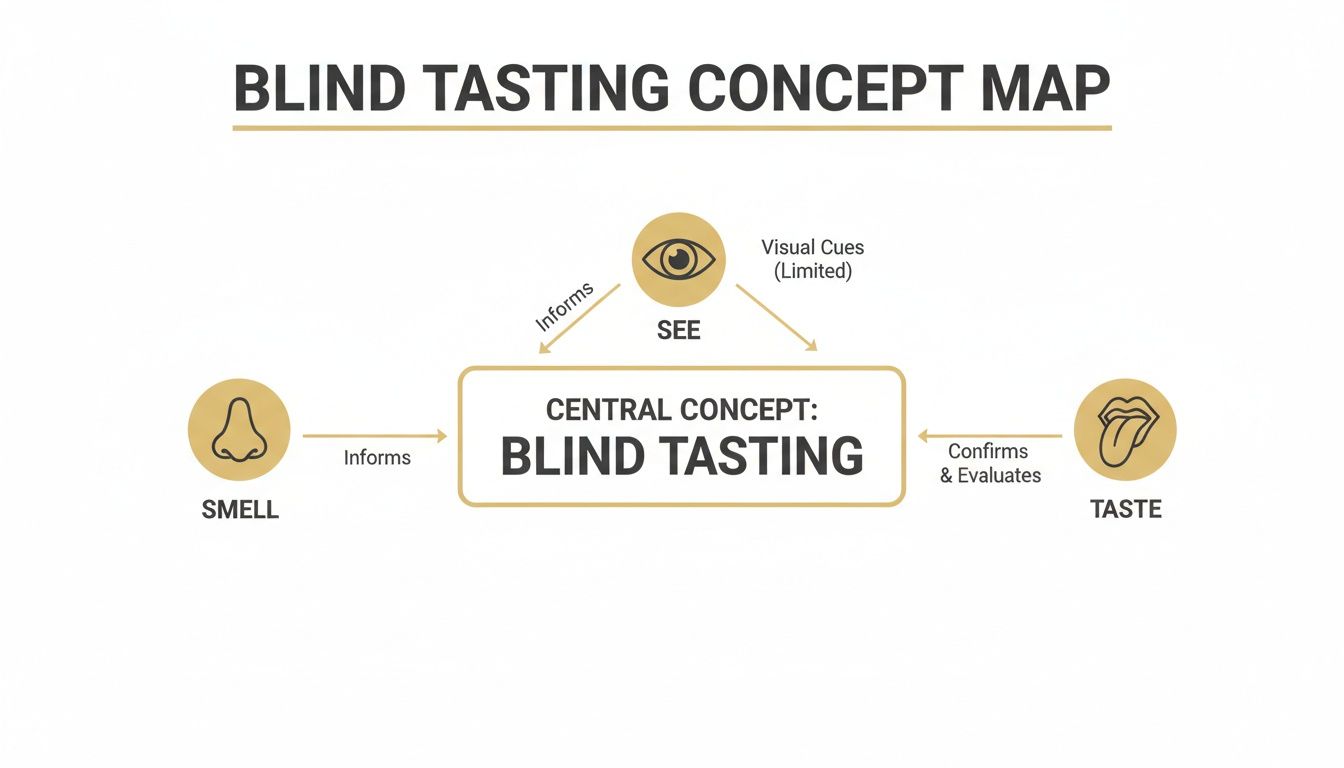
The visualization highlights how smell, sight, and taste work together to help you build a complete picture of a whiskey, no matter where it's from. By focusing on these sensory inputs, you can learn to estimate strength and character, turning every pour into a learning experience.
Even after you've got the basics down, a few common questions about alcohol proof always seem to pop up. Let's tackle a few of them to really solidify your understanding and get you feeling confident when you're exploring the world of American craft whiskey.
Is Higher Proof Whiskey Always Better?
Not a chance. The idea of a "better" whiskey is entirely in the eye of the beholder—or, more accurately, on the palate of the taster.
Higher proof whiskeys pack a serious punch, delivering intense, concentrated flavors but also bringing a lot more alcoholic heat. Some people absolutely live for that bold, complex experience you get from a cask-strength pour straight from a craft distillery. Others, however, find they prefer the smoother, more mellow profile of a lower-proof spirit.
Ultimately, the best proof is just the one you enjoy drinking the most. Simple as that.
What Is the Minimum Legal Proof for Whiskey?
Here in the United States, a spirit has to be bottled at a minimum of 80 proof (40% ABV) to legally wear the "whiskey" label. This rule applies across the board to bourbon, rye, and American single malt, ensuring a consistent standard of strength that drinkers can count on.
Any spirit bottled below that 80-proof line can't be sold as "whiskey" in the U.S. It's a regulation that helps protect the integrity of the entire category.
Why Do Some Whiskeys Have Odd Proof Numbers?
You’ll see plenty of whiskeys at familiar proofs like 80, 90, or 100, which are great for product consistency. But when you spot an odd number like 93 or 117.2, it usually means the distiller made a very specific choice.
Often, that quirky number signals a "barrel proof" or "cask strength" whiskey. It's been bottled at its natural strength, exactly as it came out of the barrel, with zero dilution. In other cases, it means the distiller has carefully proofed the whiskey down to the precise point where they believe its flavor is at its absolute peak. It's less about hitting a round number and all about hitting the perfect taste.
Ready to put your palate to the test? With Blind Barrels, you can explore incredible American craft whiskeys without any preconceived notions. Our blind tasting kits remove brand bias, letting you discover what you truly love based on taste alone. Join our community and start your tasting adventure today at https://www.blindbarrels.com.