

The usual advice for finding a cool whiskey bottle is to choose the one that looks most impressive on a shelf. That's a good way to buy decoration, but an unreliable way to choose your next favorite whiskey. A better approach is to judge the bottle as a designed object, read its production details, and let the whiskey earn its place in your glass.
Why a Cool Whiskey Bottle Is Not Always a Good Whiskey
A shelf of sculpted glass, elaborate stoppers, and metallic labels can look more exciting than the pours taste. In a hypothetical tasting, a modestly packaged American craft whiskey might become your favorite while the centerpiece bottle leaves you indifferent. That wouldn't make its design worthless. It would mean you enjoyed the packaging and the whiskey differently.
Visual appeal and personal preference are separate judgments. A designer can make a bottle feel ceremonial, rugged, contemporary, or nostalgic. None of those qualities tells you whether you'll enjoy the whiskey's aroma, texture, or finish.
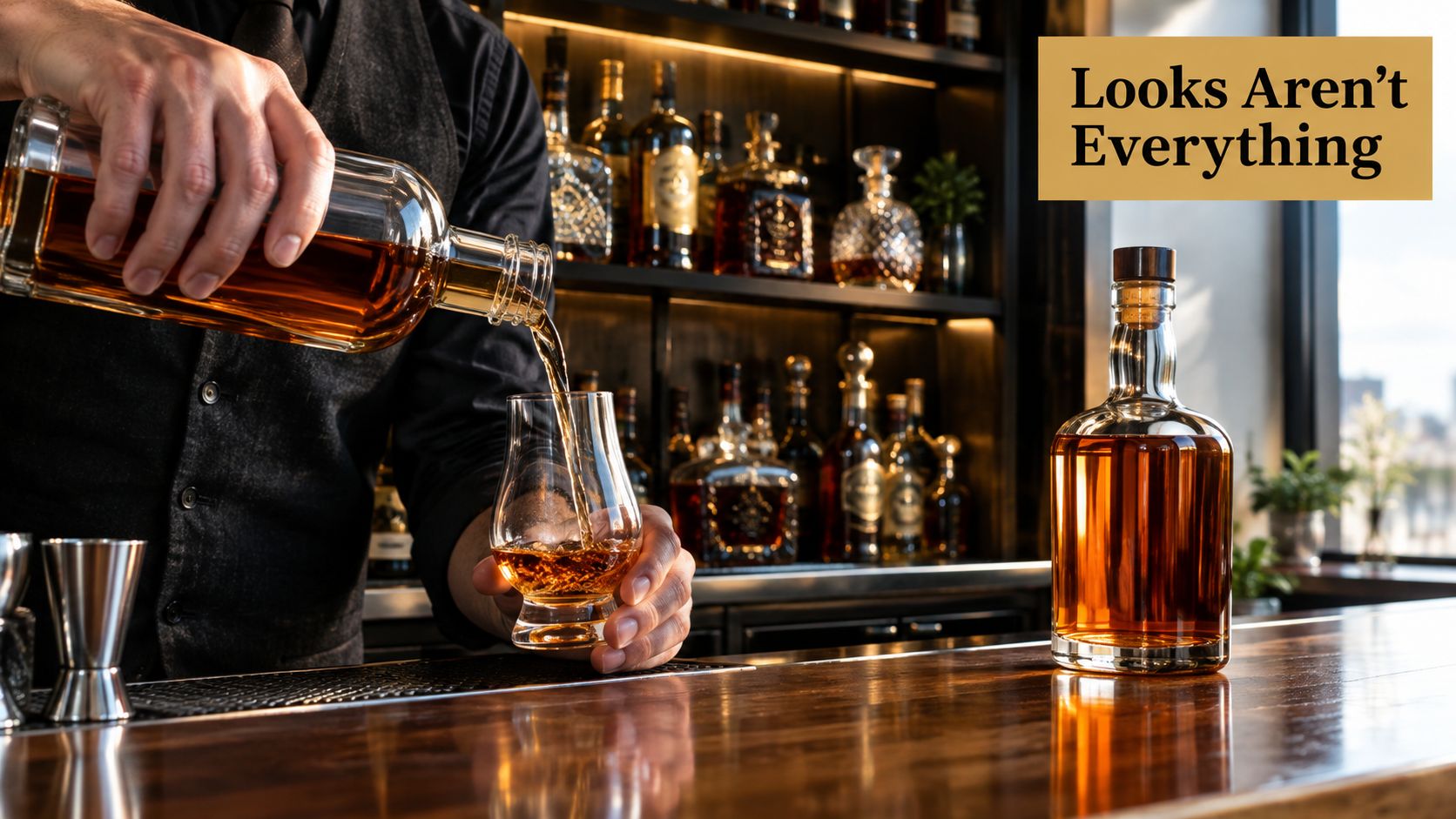
Separate the object from the drink
Start by asking what attracts you. Is it the silhouette, the label's illustration, the way the closure feels, or a connection to a particular American craft producer? Being specific helps you distinguish genuine appreciation from the assumption that expensive-looking glass must contain exceptional whiskey.
Then ask a different question: what would make you want another pour? Perhaps you prefer a softer drinking experience, a distinctive grain character, or a finish that stays pleasant rather than becoming tiring. Those are tasting preferences, not packaging features.
Host's rule: Admire the bottle with your eyes. Decide whether you love the whiskey with your palate.
A cool whiskey bottle can still be a worthwhile purchase for its appearance. A collector might value display, while a couple might want a memorable object from a shared evening. The mistake isn't enjoying design. It's expecting design to answer questions it can't.
For newcomers, this distinction removes pressure to buy the most imposing bottle. Learn to recognize thoughtful form, useful labeling, and comfortable handling instead. You'll have better conversations about craft whiskey, and fewer purchases based on a stopper you liked more than the spirit beneath it.
How the Modern Whiskey Bottle Came to Be
The modern whiskey bottle began as a practical solution, not a luxury accessory. During much of the nineteenth century, glass bottles were hand-blown and relatively expensive, which limited widespread distillery bottling. Machine-made bottles in the 1880s sharply reduced production costs, helping distillers move from bulk barrels and refillable containers toward branded retail bottles; the Bottled-in-Bond Act of 1897 then established a protected category requiring government oversight and a sealed bottle, tying packaging to quality assurance and consumer trust, as described in this history of whiskey bottles.
That transition changed what a buyer could recognize and verify. A branded bottle gave the producer a consistent object on which to place identifying information. The seal also made the container part of the product's assurance, rather than merely a vessel supplied by the customer.
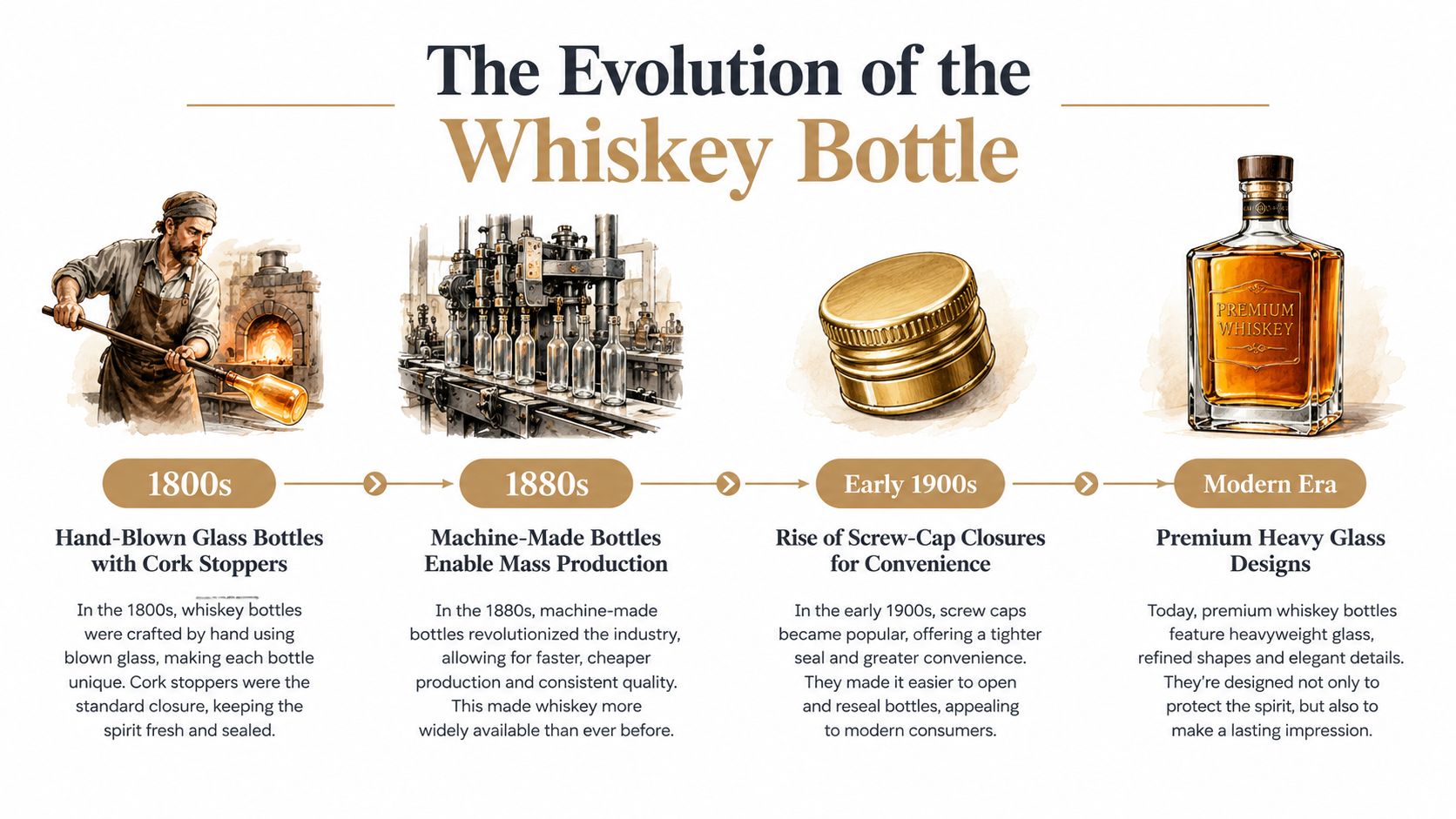
Read historical style without mistaking it for age
Against that background, a flask-like outline or an old-fashioned label becomes easier to interpret. A contemporary craft distiller can use those features to suggest continuity with earlier whiskey culture. You're looking at a design reference, not evidence that the whiskey itself is old.
The same distinction applies to closures. A traditional-looking stopper may make opening the bottle feel ceremonial, but the appearance alone doesn't establish better engineering. Its practical job is to fit and seal the container.
- Shape: Consider whether a historical silhouette also works comfortably in your hand.
- Seal: Look for a closure that feels secure, rather than judging it by ornamentation.
- Identity: Separate nostalgic artwork from concrete information about the producer.
This history explains why bottle presentation carries such cultural weight. Buyers don't encounter glass as a neutral object; they encounter conventions associated with authenticity, hospitality, and trust.
American craft brands can draw on those conventions without copying every old visual cue. A restrained contemporary bottle can communicate care just as effectively as an elaborate vintage-style package. The useful question is whether the producer has made the object coherent, legible, and practical, not whether it looks as though it came from another century.
Design Ingredients That Make a Whiskey Bottle Stand Out
Describe a bottle as “cool,” and everyone may imagine something different. Describe it as square-shouldered, ribbed, dark-glass, or decanter-style, and you've started identifying the actual design.
Silhouette is the outline you recognize before reading anything. A broad, angular bourbon bottle might suggest sturdiness, while a tall decanter-style form might feel more formal. These are visual interpretations, not promises about the whiskey.
Label hierarchy determines what you notice next. Can you quickly find the whiskey type and strength, or does decorative lettering crowd out useful information? Packaging specialists identify shape, color, contrast, and logo visibility as ways buyers interpret spirits before reading the label, as discussed in retailers' expectations for spirits packaging.
Common Cool Whiskey Bottle Design Ingredients
| Design Element | What It Signals | Best Use Case |
|---|---|---|
| Broad, square shoulders | A sturdy or traditional visual character | A prominent home-bar display |
| Tall decanter-style silhouette | Formal presentation | A bottle intended for table service |
| Ribbed or embossed glass | Texture and attention to surface detail | Buyers who enjoy tactile design |
| Dark glass | A subdued, apothecary-like appearance | A restrained shelf arrangement |
| Decorative bar-top closure | A ceremonial opening experience | Gifting where handling remains comfortable |
| Clear label hierarchy | Confidence through readable information | New drinkers comparing unfamiliar craft brands |
Treat these signals as design vocabulary, not universal meanings. A square bottle can look understated or theatrical depending on its proportions and graphics. A simple round bottle can become distinctive through a well-chosen illustration or thoughtfully placed embossing.
Restraint versus excess
Tactile finish is what your fingers encounter: raised lettering, textured glass, a paper label, or a smooth closure. Good tactile design should invite handling without making pouring awkward. Ornamentation deserves the same test.
For a useful shelf exercise, compare bottles from Frey Ranch, Southern Star, and another American craft brand available locally. Don't assume they share a style or production method. Examine each independently and name the feature you find compelling.
The strongest design doesn't need to maximize every ingredient. If the silhouette is expressive, the label may benefit from quiet typography. If the artwork is intricate, simpler glass can keep the whole package from feeling crowded.
American Craft Whiskey and the Small-Batch Bottle
A striking bottle can introduce an American craft distiller, but it cannot tell you whether the whiskey will suit your taste. Craft producers offer a wide range of names and presentations to explore. The number of U.S. craft distilleries grew from 76 to almost 2,300 in less than two decades, while the broader craft-spirits market recorded more than 12.7 million 9-liter cases in U.S. retail sales during 2024, representing 4.5% of spirits volume and 7.5% of value, according to this analysis of American whiskey's craft expansion.
Those figures describe craft spirits broadly, not the quality or style of any individual whiskey. They do help explain why shoppers may encounter unfamiliar producers with regional identities and distinctive packaging.
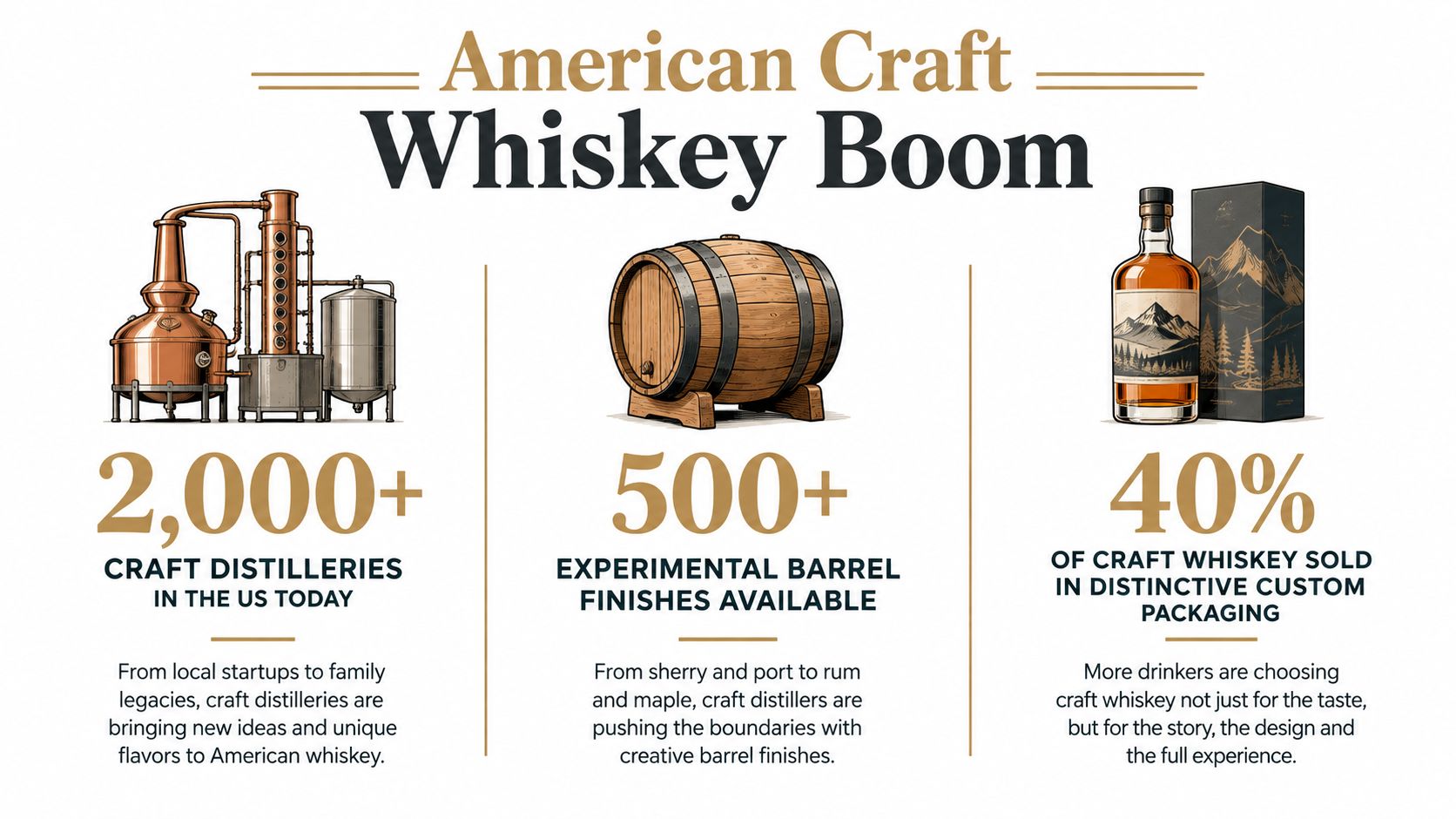
A label featuring local imagery can make a bottle a memorable gift, especially when the recipient has a connection to that place. Still, presentation is only the invitation. Production details give you a better sense of what is inside, while the recipient's preferences remain unknown unless you know what they enjoy.
Frey Ranch and Southern Star are examples to consider when browsing American craft whiskey. Compare the specific releases in front of you rather than assuming every bottle from one producer shares the same character. For more context, explore this guide to American craft whiskey.
Read the label for details about ingredients, maturation, and finishing. A place name or family story can add meaning, but it may not answer those practical questions. If you are choosing a gift, a vivid design may appeal on the shelf; readable information can make an unfamiliar bottle feel like a more considered choice.
The phrase small batch catches the eye, but it does not replace details about a particular release. Ask a shopkeeper about the exact bottle, and note what interests you so you can compare it with your tasting experience later. A distinctive package starts the conversation. The whiskey itself decides whether you want to continue it.
Glass, Engineering, and the Trade-Offs Behind Premium Feel
A heavy bottle feels substantial because you're lifting substantial material. That sensation is real, but it doesn't measure the quality of the whiskey. It also doesn't tell you whether the complete package will survive handling and shipping.
A premium oval spirits bottle specification illustrates the engineering involved: a 750 mL bottle can weigh approximately 790.5 g and measure 320 mm tall, 93.17 mm wide, and 60.6 mm deep, with neck dimensions, tolerances, color, and testing requirements forming part of the specification, as shown in these spirits-bottle technical details.
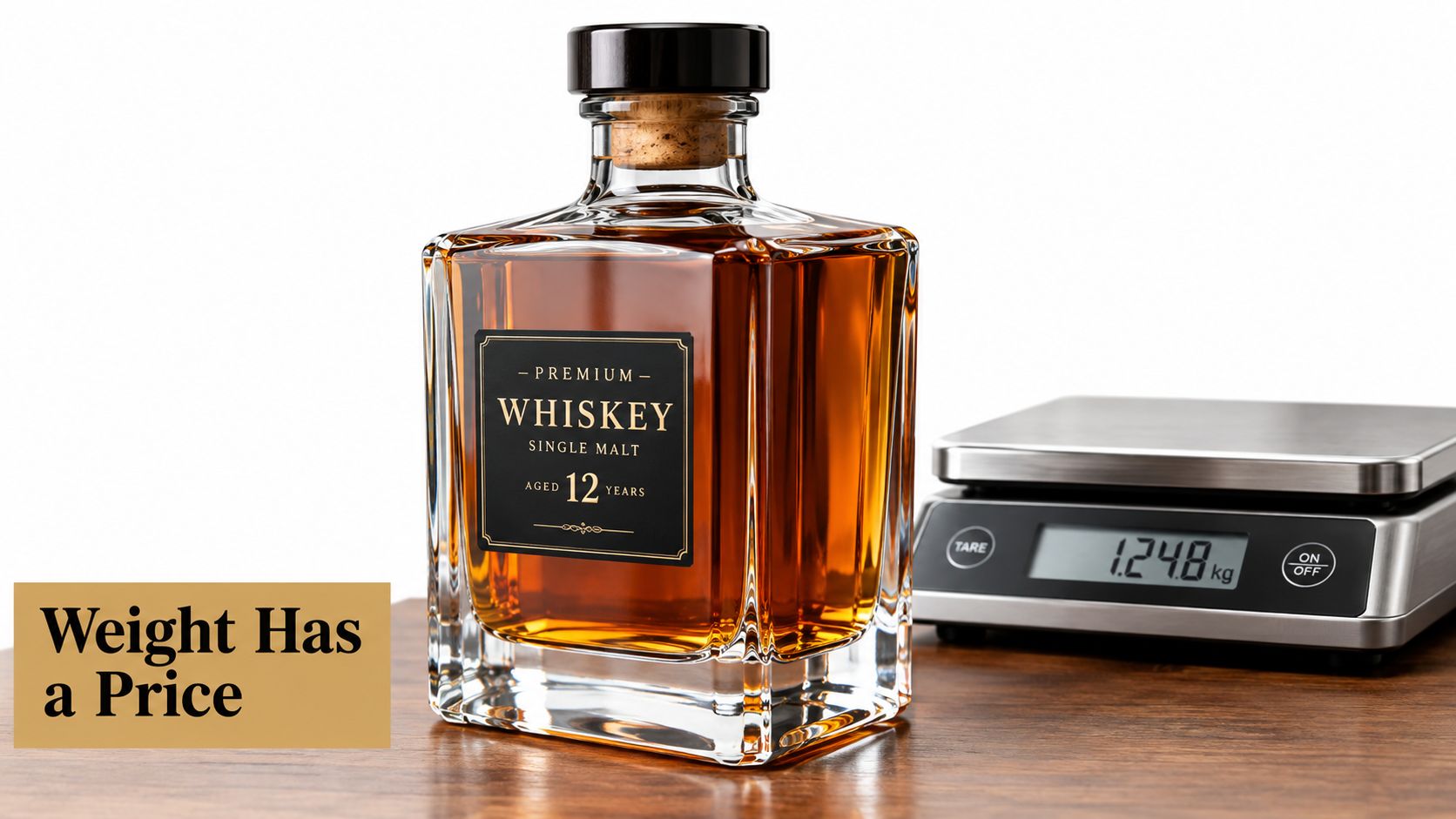
Judge the bottle as a working system
The neck finish is the shaped opening that must match the closure. For manufacturers, dimensional tolerances, screw-cap torque, stopper insertion force, and fill-height consistency matter alongside appearance. A handsome bottle with an unreliable seal hasn't succeeded at its basic job.
Weight also needs context. A shorter, heavier form can resist tipping, but extra mass increases shipping burden; glass weight alone doesn't establish breakage resistance. Protective inserts should support the bottle appropriately rather than concentrate force against vulnerable areas.
A premium bottle should feel considered when you pour from it, not merely impressive when you lift it.
Clear glass versus protected whiskey
Clear glass makes the whiskey visible, which can be attractive on a table. It also creates a storage consideration: light exposure can change aroma-active compounds, while dark or amber glass generally offers more protection, with performance depending on glass composition and thickness, as explained in this guidance on whiskey storage and light exposure.
- Clear presentation: Keep the bottle away from direct sunlight and use its carton when appropriate.
- Dark-glass presentation: Appreciate the protection without assuming it makes storage conditions irrelevant.
- Secondary packaging: Favor packaging that protects the bottle rather than adding layers solely for spectacle.
For an American craft purchase, this is a useful counterweight to shelf appeal. Ask whether the bottle pours comfortably, reseals securely, and fits your storage space. The thoughtful choice is the package that supports enjoying the whiskey, not necessarily the one with the greatest heft.
Choosing a Cool Bottle as a Gift When You Don't Know Their Taste
A striking bottle can make a memorable gift, but its appearance cannot tell you whether the whiskey suits the person receiving it. Start with the kind of experience you want to give: something to drink, a conversation starter, or a bottle they may keep on display. Those goals can point to different choices.
If you know they enjoy American craft whiskey but not which styles they prefer, ask what they have liked recently. Barrell Craft Spirits or Ironroot Republic might be useful names to investigate, but recognition alone isn't enough. A producer's name can narrow the search, while the recipient's preferences should guide the final choice.
For someone who enjoys opening and sharing a bottle, prioritize a style they recognize or can describe. For a collector who values presentation, a distinctive silhouette or expressive label may be part of the pleasure. A reusable decanter-style bottle can suit display, provided it pours cleanly and closes reliably. As a guide to choosing whiskey for a gift suggests, the recipient matters more than a bottle's shelf appeal.
Heft can suggest substance, yet it is not proof of quality. Lightweight packaging offers a useful counterexample: Johnnie Walker introduced a 180-gram whisky bottle, another spirits brand reduced glass use by 30% compared with competitors, and reporting estimates that removing 1 gram of glass cuts more than 0.5 grams of production-related carbon emissions. Pernod Ricard's 25% lighter Chivas Regal 18 bottle is expected to save more than 500 tonnes of glass annually, according to this examination of lightweight spirits packaging. These examples show why a heavy bottle should not be treated as the only sign of thoughtful presentation.
Before buying, ask what the recipient would enjoy. Will they sip it neat, use it in mixed drinks, or display it? Can they comfortably lift, open, and pour it? Does the packaging clearly identify the whiskey type and strength? If display is part of the gift, can the bottle be cleaned and resealed?
For a wedding party with varied preferences, whiskey may not suit everyone. A thoughtful alternative such as personalized fragrance gifts for groomsmen avoids assuming every recipient drinks. The best gift fits the person; a cool bottle should add to that fit, not try to replace it.
Label Literacy and Tips for New Whiskey Drinkers
A striking label can tell you less than a plain line of type. Turn the bottle around and look for whiskey type, proof, age, and producer identification. Those details help you understand what's inside, while an embossed crest mainly shapes the presentation.
For American craft distillers, clear label information gives a newcomer a way to assess an unfamiliar bottle without relying on brand recognition. Bourbon must be distilled and aged in the United States and aged in charred new oak barrels. Bottled-in-bond whiskey follows more specific rules: it must come from one distilling season, one distiller, and one distillery, spend at least four years in a federally bonded warehouse under government supervision, and be bottled at 100 proof, or 50% alcohol by volume. Its label must identify the distillery's DSP number, and note a different bottling location when applicable, under federal spirits labeling regulations.
Separate proof, age, and preference
Proof and age answer different questions. U.S. proof is twice the alcohol percentage. The stated whiskey age measures time in oak between distillation and bottling, and generally refers to the youngest whiskey in the bottle. Time on your shelf does not add to that age, according to the TTB's whiskey labeling guidance.
Neither number predicts whether you'll enjoy the taste. A higher proof describes strength, while age describes time in oak. Treat them as clues, not a scorecard.
When comparing unfamiliar craft bottles, start with the category, then check the strength and producer details. For bonded whiskey, the DSP identification offers a concrete clue about provenance. Keep age in its own column rather than turning it into a personal ranking.
Beginner's practice: Taste a small pour at labeled strength, then add a little water. Notice what changes in the aroma and flavor.
Brief notes are enough. “Easier to smell after water” records your experience more clearly than borrowed tasting language that doesn't fit what you notice.
Blind Tasting and What a Cool Bottle Is Really Worth
Covering the labels changes the question from “Which bottle impresses me?” to “Which whiskey do I enjoy?” That's a valuable exercise in a category with 2,282 active U.S. craft distillers as of August 2025, down from 3,069 in August 2024, according to the American Craft Spirits Association's craft-spirits data project.
Those counts don't describe taste. They show why relying on a recognizable package leaves so much unexplored. A visually unfamiliar bottle deserves a fair tasting, and a striking one deserves the same scrutiny.
Make the comparison useful
Ask someone else to conceal the identities and serve the whiskeys in identical glasses. Keep the setup consistent, and avoid discussing brand guesses before everyone has recorded their impressions. A practical introduction to blind whiskey tasting can help you organize the session.
- Aroma: Write what you notice before taking a sip.
- Palate: Describe flavor and texture in everyday language.
- Finish: Note what remains and whether you enjoy it.
- Reveal: Compare your preferences with the bottle information only after recording them.
If finding words is difficult, Cumbre Coffee's guide to compare coffee taste profiles offers a related sensory exercise. Use familiar food associations rather than trying to sound expert.
After the reveal, return to the packaging with a better-informed opinion. You may appreciate a favorite bottle more because the whiskey earned your enthusiasm, or admire another purely as an object. A cool whiskey bottle is worth what it contributes to your enjoyment, whether that's design, a meaningful gift, or a memorable pour.
Blind Barrels offers quarterly kits featuring four blind samples from small American craft distilleries, a tasting table, and a QR-code reveal with access to discounted full bottles. Use the included age, proof, and whiskey-type guessing game to explore your preferences before choosing your next shelf centerpiece. Visit Blind Barrels to make discovering a cool whiskey bottle a shared tasting experience.