

You're at a tasting table with two glasses that both smell sweet. One seems soft and round; the other brings vanilla and caramel. You might guess that both are high-corn bourbons, but those impressions alone can't tell you what's in the mash bill. A young whiskey, gentle oak, proof, or maturation can all shape what you taste.
That's why high corn is a useful hypothesis, not a promise of sweetness. Once you know what the recipe can contribute, you can test it against the whiskey in your glass, without letting a label or expectation make the call for you.
Why High Corn Bourbon Is Harder to Taste Than It Sounds
At a blind tasting, start by considering two samples that seem equally sweet. The first gives you a soft, cereal-like impression on the first sip, then a short, gentle finish. The second opens with vanilla and caramel and keeps a more pronounced oak character as you swallow. Both may taste sweet, but the sources of that sweetness could be different.
The first sample might suggest a grain-forward profile. The second's sweetness could come more from the barrel than from the grain recipe. Without seeing the bottles, you can't know the mash bills from those clues alone, and it's easy to confuse a familiar flavor with proof of a particular recipe.
High-corn bourbon commonly uses substantially more corn than bourbon's legal minimum, often around 70% or more. It's a style description, not a separate federally defined whiskey class. That distinction matters: bourbon gives you a regulated category to start from, while “high corn” points to a recipe emphasis that doesn't guarantee one particular flavor.
Corn can contribute a sweet-grain character, but the whiskey's aroma, palate, and finish reflect more than its mash bill. Proof affects how intensely flavors register, while maturation and oak can add or emphasize other notes. Rye or wheat in the remaining grain bill can also influence spice, grain character, and texture.
A useful tasting question isn't “Is this sweet?” It's “What kind of sweetness am I tasting, and what else supports my guess?” Look for grain or cereal notes alongside softness, then check whether oak, spice, and finish tell a different story. This approach keeps the recipe in view without treating it like a flavor meter.
Defining High Corn Bourbon Without Confusing the Categories
Start with the category itself. Bourbon must contain at least 51% corn in its mash bill, the combination of grains used to make the whiskey. A recipe that meets that minimum can still differ substantially from one with much more corn and less room for rye, wheat, or malted barley.
From there, “high corn” describes a style rather than a separate federal bourbon designation. People often use 80% corn as a practical shorthand, but that figure isn't a universal legal line for high-corn bourbon. The distinction between bourbon and corn whiskey also can't be read from the corn percentage alone. Corn whiskey is a separate category with different production and aging rules, as this overview of bourbon types and corn whiskey explains.
If you're comparing recipes, a guide to bourbon grain bills can help you recognize how the secondary grains fit into the picture. The key is to check what a bottle discloses instead of assuming that “high corn” has a single official meaning.
| Term | What It Communicates | What It Does Not Guarantee |
|---|---|---|
| Bourbon | A regulated whiskey category with a minimum corn requirement | A particular sweetness level or mash bill beyond that requirement |
| High-corn bourbon | A bourbon style emphasizing a larger share of corn | A federally standardized designation or one predictable flavor |
| Corn whiskey | A separate whiskey category with its own production and aging rules | That it follows bourbon's production requirements |
| “High corn” on a label | The maker is drawing attention to corn in the recipe | A disclosed percentage, unless the mash bill provides one |
For shoppers, the most informative detail is a published mash bill with grain proportions. If a bottle uses “high corn” without providing those proportions, treat the phrase as a clue about the intended style, not a complete recipe disclosure. And even a disclosed percentage describes the grains, not every production choice that shapes the finished whiskey.
How Corn Becomes Bourbon in the Production Process
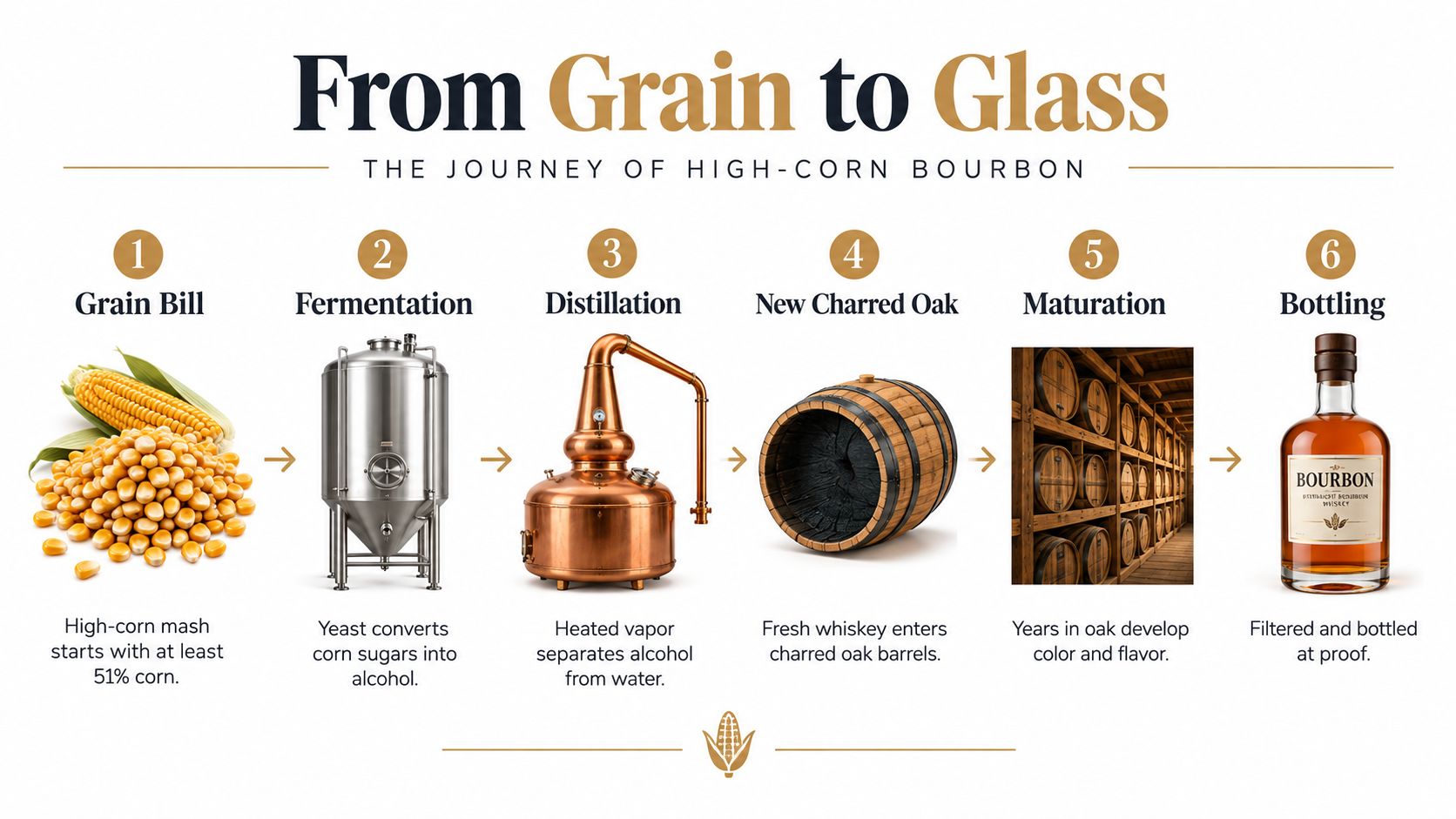
Think of the mash bill as choosing an instrument's basic voice. Corn may give the unaged spirit a sweet-grain character, while other grains contribute their own sensory possibilities. But the voice changes along the way. Fermentation, distillation, barrel entry, maturation, and bottling all help determine what reaches your glass.
From grain to new make
A distiller first decides the grain proportions. A high-corn recipe gives corn a larger share, while the remaining grains leave room for different combinations of rye, wheat, and malted barley. Those choices set the starting point, but they don't predetermine exactly how the finished bourbon will taste.
During fermentation, yeast converts sugars into alcohol and creates compounds that influence aroma and flavor. Distillation then separates alcohol from water and other components. The choices made at each stage affect which characteristics carry forward, so two recipes with similar corn proportions can still develop differently.
Oak transforms the starting voice
Bourbon enters new charred oak for maturation. The barrel contributes color and flavors associated with oak, including notes that can come across as vanilla, caramel, toasted wood, or drying tannin. As the whiskey matures, those barrel-derived impressions may become more prominent than fresh-grain character.
Bottling decisions matter, too. Proof affects the intensity of the pour, and filtration or blending can influence what the drinker experiences. The finished bottle is therefore the result of the recipe and the process, not a direct translation of corn percentage into a guaranteed flavor.
The same principle appears in wine, where winemaking decisions that define grapes can shape how the raw ingredient expresses itself. In whiskey, the grain bill is a starting point. Production choices keep working on that starting point before the bourbon reaches the glass.
Reading Sweetness, Spice, Texture, and Oak
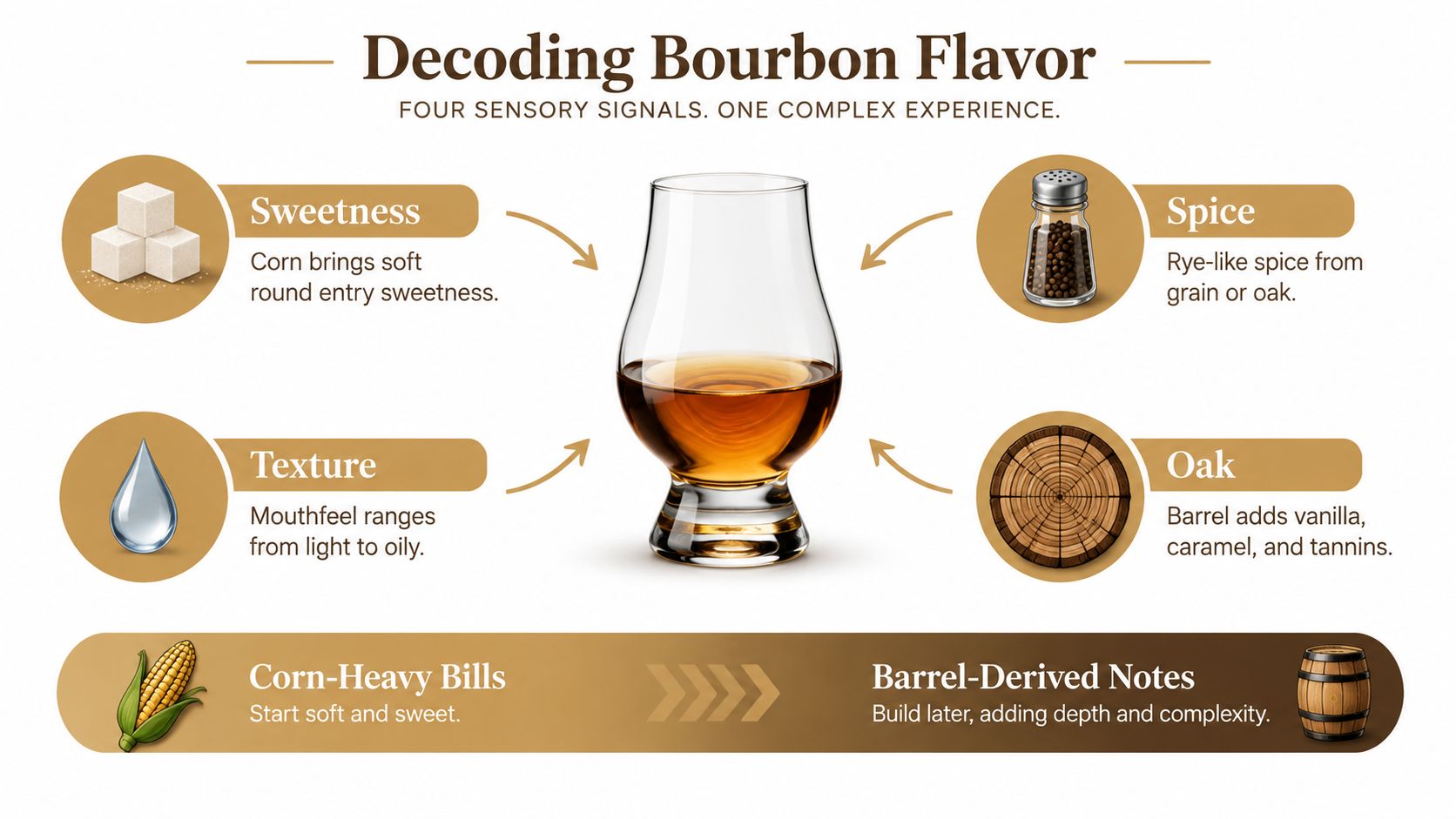
The word “sweet” can mean several different things in a tasting note. It might describe a fresh-grain impression, a candy-like aroma, ripe fruit, or the vanilla and caramel associated with oak. These sensations can overlap, so try to name the specific impression instead of bundling them together.
A high-corn bourbon may have a softer entry and rounder mid-palate than a rye-forward style, particularly when it's relatively young. Rye can bring a sharper impression of spice, while wheat or other grains can contribute different textural or grain notes. Neither direction is automatically better. The useful question is how the grain character sits alongside the whiskey's proof, oak, and finish.
Separate grain impressions from barrel impressions
On the palate, notice whether sweetness feels like cereal or fresh grain, or whether it comes across more as vanilla, caramel, or confectionery. Then consider fruit, spice, body, and finish. A soft entry doesn't tell you by itself whether the whiskey's sweetness comes from corn, barrel maturation, or some combination.
Age can change the balance as well. With more maturation, oak-derived flavors can increasingly overlay the original grain character. A whiskey may still have a corn-heavy mash bill yet taste less like fresh corn and more like integrated oak and creamy sweetness.
A descriptive-analysis study found that mash bill and bottling age affected 18 of 35 sensory attributes. Higher corn content and longer aging were associated with potentially positive descriptors such as vanilla and apple, while shorter aging correlated more with vegetal and hay-like notes, according to the study of whiskey sensory attributes.
Tasting cue: Sweetness suggests a direction to investigate. It doesn't identify the grain bill on its own.
To judge balance, consider whether the bourbon's sweet notes work with the oak and structure. A round, sweet palate that finishes with drying tannin offers a different experience from one that stays soft and integrated. Pay attention to the whole arc rather than rewarding sweetness alone.
Tasting High Corn Bourbons Without Guessing the Mash Bill
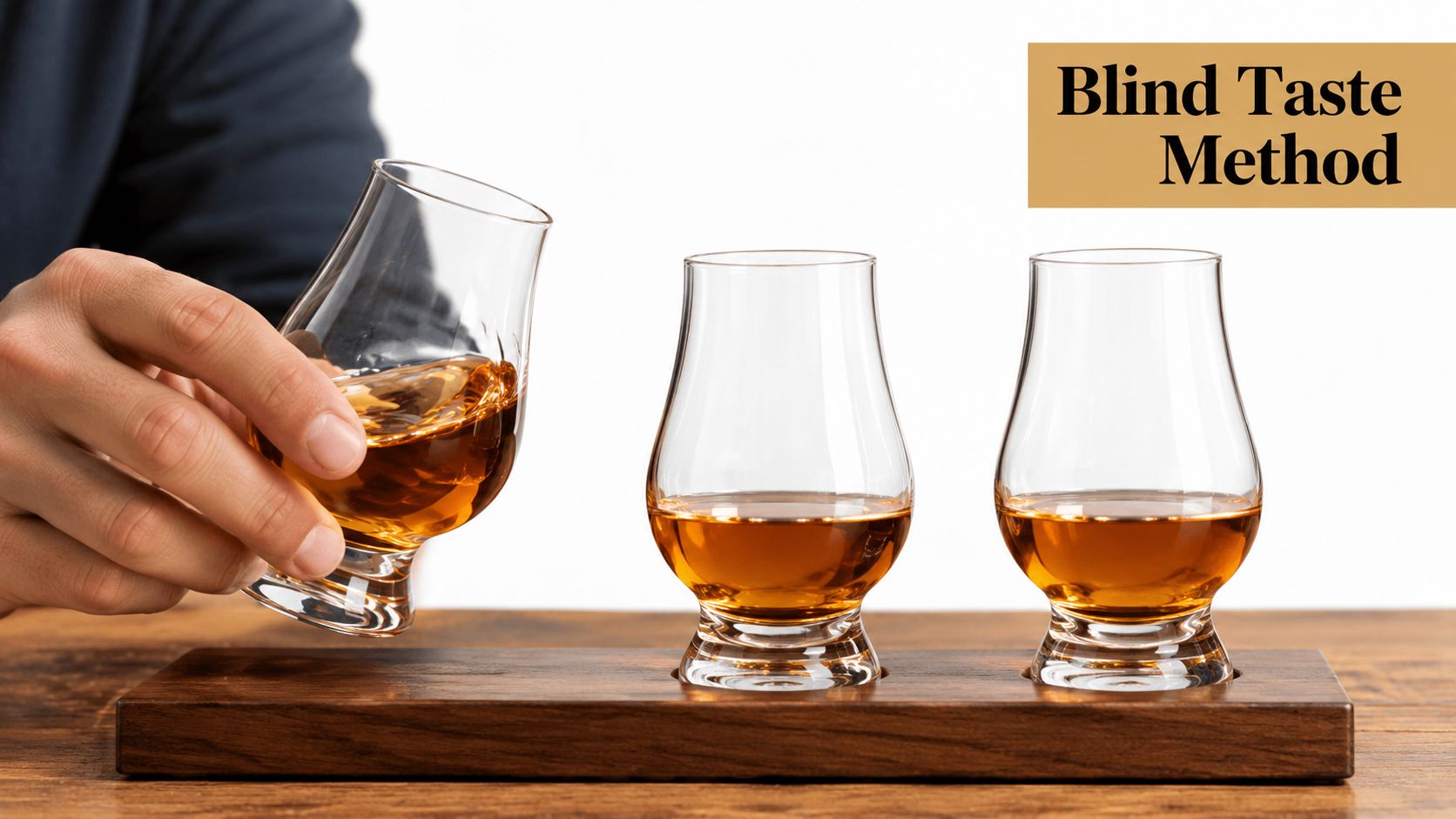
A blind tasting works like a small experiment, and the mash bill is your hypothesis. Write down what you notice before learning the brand or recipe, and compare samples at similar proof and age where you can. Those two variables change how intense the whiskey feels and how strongly oak or grain character comes through, so controlling them gives corn a fairer chance to speak for itself.
Taste first, reveal later
Begin with the aroma. Look for grain, cereal, fruit, vanilla, caramel, toasted wood, or spice. Take a small sip and notice how the whiskey enters, how its texture develops, and what lingers in the finish.
A simple note sheet keeps the exercise honest:
- Entry: Soft, sharp, or hot?
- Grain: Fresh or cereal-like, or difficult to pick out?
- Sweetness: Grain-like, candy-like, fruity, or more like vanilla and caramel?
- Spice and oak: Pronounced, gentle, drying, or well integrated?
- Finish: Does it remain sweet and round, or turn dry and tannic?
A sensory evaluation method can help you keep those observations organized. Recording before deciding matters in any precise task; even avoid kitchen mistakes with this guide makes the same point about reading before assuming. Apply that habit here: log your impressions before the mash bill reveal, then compare your guess with the disclosed recipe rather than revising your notes to match.
If the alcohol feels intense, you don't have to force a neat pour. Whiskey educator Lynn House recommends approximately 86–92 proof for beginners and notes that adding a splash of water or ice can reduce intensity and make whiskey easier to appreciate, according to her advice for new whiskey drinkers.
Add water gradually and watch what changes. If the sample seems sweeter after dilution, ask whether you notice more grain character, more oak, or less alcohol heat. The reveal tests your hypothesis; it doesn't grade your palate. Treat each surprise as data about which variable fooled you, and the next flight gets easier to read.
American Craft Recipes in Practice
American craft distillers show why “high corn” doesn't describe one flavor template. Compare published grain recipes, and you'll see how changing the proportions of secondary grains can produce different starting points for a bourbon, even before maturation adds its influence.
Casey Jones Distillery lists a bourbon recipe of 96% corn, 3% rye, and 1% malted barley. It also lists another recipe with 80% corn and 16% rye, as shown in the distillery's published bourbon recipes. Those recipes give tasters a practical comparison: one puts nearly all the grain emphasis on corn, while the other leaves more room for rye's contrasting influence.
That difference is worth testing, not turning into a prediction. Taste the two samples blind, if available, and note their sweetness, spice, body, and finish before checking their recipes. A corn-heavy recipe might support a sweet-grain impression, but proof and maturation can still reshape what you notice.
ASW Distillery offers another example of craft producers using grains in less conventional ways. Its Fiddler bourbon combines a high-malt component made with 56% corn and 44% various malts with a high-wheat component made with 51% corn, 45% wheat, and 4% malted barley, according to ASW's description of Fiddler. The example shows how separate distillates and unusual grain proportions can contribute to a final whiskey that doesn't fit a simple “more corn equals sweeter” formula.
Blind-tasting prompt: Write down what the whiskey does before you write down what you think the recipe must be.
These craft recipes are useful as comparison prompts, not rankings. A published mash bill helps you understand the distiller's choices, while tasting lets you decide what those choices mean in the glass. Keep both in view, and don't let the novelty of a recipe substitute for your own sensory evidence.
Pairing Food With Sweetness and Structure
Pair a bourbon with the food's intensity and structure, not just its sweetness. A soft whiskey with gentle vanilla can be easy to lose beside a rich, smoky dish. A more pronounced oak or spice character may hold its place more clearly, depending on the food and how the bourbon is served.
Try matching notes rather than following a universal rule. Vanilla and caramel can complement baked foods or desserts, while ripe-fruit impressions may work with fruit-forward dishes. Toasted oak and gentle spice can suit roasted flavors. Those are starting points, not guaranteed matches: proof, aging, oak, fermentation, distillation, and blending all help shape the bourbon, as does corn's association with sweetness and body. The effects of grain choice and other bourbon-making factors can't be reduced to corn alone.
Acidic or very dry foods may make a pour seem sharper, while bold, smoky flavors can crowd out a lighter whiskey. If a dessert makes the bourbon feel overly intense, try a smaller pour or add a little water. Adjust one thing at a time so you can tell whether the change came from the food, the serve, or your palate.
For a fair comparison, taste the whiskey before the food, then take a bite and return to the glass. Keep the serving temperature and tasting order consistent across samples. A bourbon and food pairing guide can give you more ideas, but your own notes will show which combinations work for your palate.
A Practical Framework for Choosing and Tasting
When you're shopping or joining a blind flight, start with the label and then let the whiskey have the final say. Kentucky distillers purchased 27.3 million bushels of corn in 2024, up from 16.9 million in 2014, with 84% of the 2024 corn coming from Kentucky farmers, according to a Kentucky distilling-industry presentation. Corn's role in bourbon connects a recipe choice to a major regional agricultural supply chain.
Use this checklist as you taste:
- Read the claim carefully. Bourbon has a legal corn minimum; “high corn” is a style description, and a disclosed mash bill offers more detail.
- Compare like with like. Similar proof and age make it easier to focus on grain differences.
- Name the sweetness. Separate cereal or candy-like impressions from vanilla, caramel, and oak.
- Check the finish. Notice whether the texture stays round or turns dry and tannic.
- Taste before pairing. Form an initial impression before food changes your perception.
The central lesson is simple: high corn describes a meaningful recipe tendency, not a guarantee of sweetness, smoothness, quality, or blind identifiability. Keep your expectations flexible, take notes, and judge each bourbon by what is in the glass.
Blind Barrels sends members a blind whiskey-tasting kit featuring samples from small American craft distilleries, with a tasting table for aroma, palate, and finish notes. Use the exercise to test your expectations about high-corn bourbon, then visit Blind Barrels to explore its blind tasting experience.