

If a bourbon costs more but you don't prefer it with the label hidden, what makes it high end? Age, scarcity, and an impressive bottle can explain the price without explaining whether you'll enjoy the whiskey.
A useful approach to high end bourbon separates production credentials from drinking pleasure. Check what the producer discloses, taste under consistent conditions, and decide how much the experience is worth to you. You don't need an expert palate to begin. You need a glass, a few honest notes, and permission to prefer the less expensive pour.
Price Tiers and What Each One Buys
Use these illustrative shopping bands, not official quality categories. The age and proof profiles describe bottles to compare, not promises that every bottle in a price band will meet.
| Tier | Typical Price | Typical Age | Typical Proof | What You Get |
|---|---|---|---|---|
| Entry premium | $30-70 | 4-6 years or no age statement | 90-100 proof | A starting point for solid craft quality with a disclosed mash bill and proof |
| Upper premium | $70-130 | 6-10 years | 100+ proof | Small-batch or single-barrel releases to investigate for deliberate barrel selection |
| Allocated and rare | Above $130 | 10+ years or limited release | Release-specific stated proof | Scarce bottles whose prices can reflect allocation as much as liquid |
Spend more only when you can identify what changes. An older age statement gives you additional maturation information. A single-barrel release offers a particular barrel's character. A stronger bottling gives you more room to adjust dilution, but none of these automatically makes the bourbon more enjoyable.
Say you're comparing a hypothetical $45 bottle with a stated age and 100 proof against a $120 bottle without an age statement. The cheaper bottle gives you clearer starting information. The expensive bottle needs another justification, perhaps distinctive flavor, documented barrel selection, or provenance you personally value.
Separate production costs from prestige
American craft whiskey brands deserve attention because their production choices can make comparisons interesting, not because small automatically means superior. Ask whether the producer explains its grain recipe, maturation approach, and role in making the whiskey.
Bourbon also belongs to a substantial manufacturing economy: AP News reported that Kentucky distillers produced a record 2.7 million barrels in 2022, alongside approximately $9 billion in annual industry economic impact. That context helps explain the businesses behind the bottle, but it doesn't establish the quality of an individual release.
Budget rule: Choose a comfortable spending ceiling before choosing a famous label.
Find the range you can afford, then compare bottles within it. Don't stretch your budget just to enter a category a retailer calls premium.
Label Terms That Confirm Real Credentials
Start with the category, then examine the producer's claims. Bourbon's basic requirements establish how it's made, not how highly you should score it.
The LegalClarity bourbon guide describes a mash bill containing at least 51% corn, distillation at no more than 160 proof, entry into new, charred oak barrels at no more than 125 proof, and bottling at a minimum of 80 proof. These are different production checkpoints. The strength printed on a finished bottle isn't necessarily its barrel-entry strength.
| Label Term | What It Guarantees | What It Does Not Guarantee |
|---|---|---|
| Straight bourbon | At least two years of aging, no added coloring or flavoring | A particular quality level; some straight bourbon must carry an age statement |
| Bottled-in-bond | One distiller, one season, at least four years, bottled at 100 proof | That it's the best bottle in its price band |
| Single barrel | Whiskey drawn from one barrel, often identified by a barrel number | Better taste than a small-batch blend |
| Small batch | A selection of barrels presented as a limited batch | A legally fixed barrel count or a specific age |
| Distilled by | Identifies the named distiller as the maker | Any particular age or flavor |
| Bottled by | Identifies who bottled the product | That the bottler distilled the whiskey |
| No age statement | No age is disclosed on the label | That the whiskey must be young or poor quality |
Read the production credit carefully
Distilled by and bottled by answer different questions. A brand may select and bottle excellent whiskey made elsewhere. Sourcing isn't a defect, but unclear sourcing makes it harder to judge the story behind a premium price.
Be equally careful with small batch. A skillful blend can be more balanced than an individual barrel, so don't treat single barrel as a promotion above blended selections.
For a closer label-reading reference, use our guide to bourbon whiskey labels. Your practical test is straightforward: connect a claim to something checkable, such as a named distillery, age statement, batch identifier, or barrel number. Decorative wording alone gives you little to evaluate.
The Five Markers That Set High-End Bourbon Apart
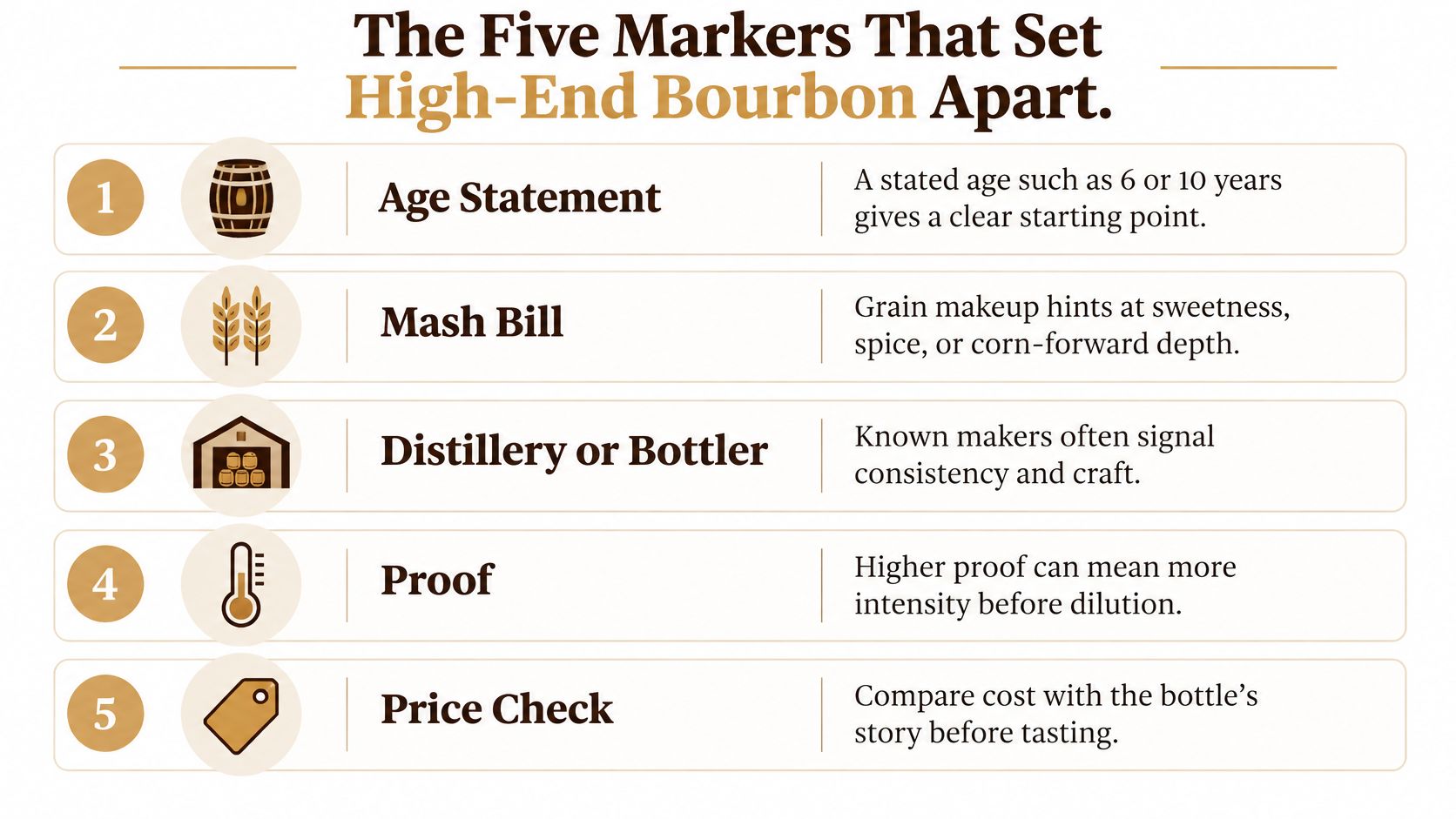
A premium price is easy to charge and hard to verify. A more reliable screen is a set of five checkable details: age disclosure, mash bill, proof, barrel selection, and production transparency. Score each as a pass or a flag before you taste. A flag means you need more information, not that the bourbon is bad.
| Marker | Strong Sign | Weak Sign |
|---|---|---|
| Age statement | A stated age, such as 6 or 10 years | No age statement accompanying a premium price |
| Mash bill | Corn-forward recipe with rye or wheat identified | Recipe not disclosed |
| Proof | Clearly stated strength that suits your tasting preferences | Missing strength information in the sales description |
| Barrel selection | Barrel number or useful single-barrel or small-batch detail | Select or reserve wording without supporting detail |
| Production | Named distiller and clear disclosure of who made the whiskey | Sourced whiskey presented without disclosure |
Each marker answers a different question, and none measures flavor directly.
Age is a starting point, not a grade. It tells you how long the whiskey sat in wood, while the glass tells you whether that wood influence is pleasant. An undisclosed mash bill limits your ability to compare recipes across bottles, but it doesn't prove careless production. Both give you context for tasting rather than a verdict on quality.
Proof deserves particular care, because it confuses new drinkers most often. A stronger whiskey can deliver greater intensity, yet alcohol heat can mask the flavors underneath until you learn to read past it. High proof tells you about concentration; it says nothing about whether the flavors suit you. The guide to bourbon whiskey proof helps you separate strength from quality.
Prefer specifications to prestige
A useful historical example is the Bottled-in-Bond Act of 1897. It defined quality as conditions anyone could check: whiskey from one distiller at one distillery during a single season, aged in a bonded warehouse for at least four years, and bottled at 100 proof, or 50% alcohol by volume. The law treated trust as a checklist, and the same habit serves you well today.
Apply that preference for specifics to American craft whiskey producers. A small distiller that names its recipe, its barrel selection, and who made the whiskey hands you material for comparison. A polished origin story without production details hands you nothing to test.
Score the markers before you sip, and keep that sheet separate from your sensory notes. Otherwise attractive credentials earn credit the liquid has not won. A bottle with several flags needs a particularly convincing pour to justify its price, and even a fully transparent bottle still has to taste good.
How to Taste High-End Bourbon Neat, Then With Water
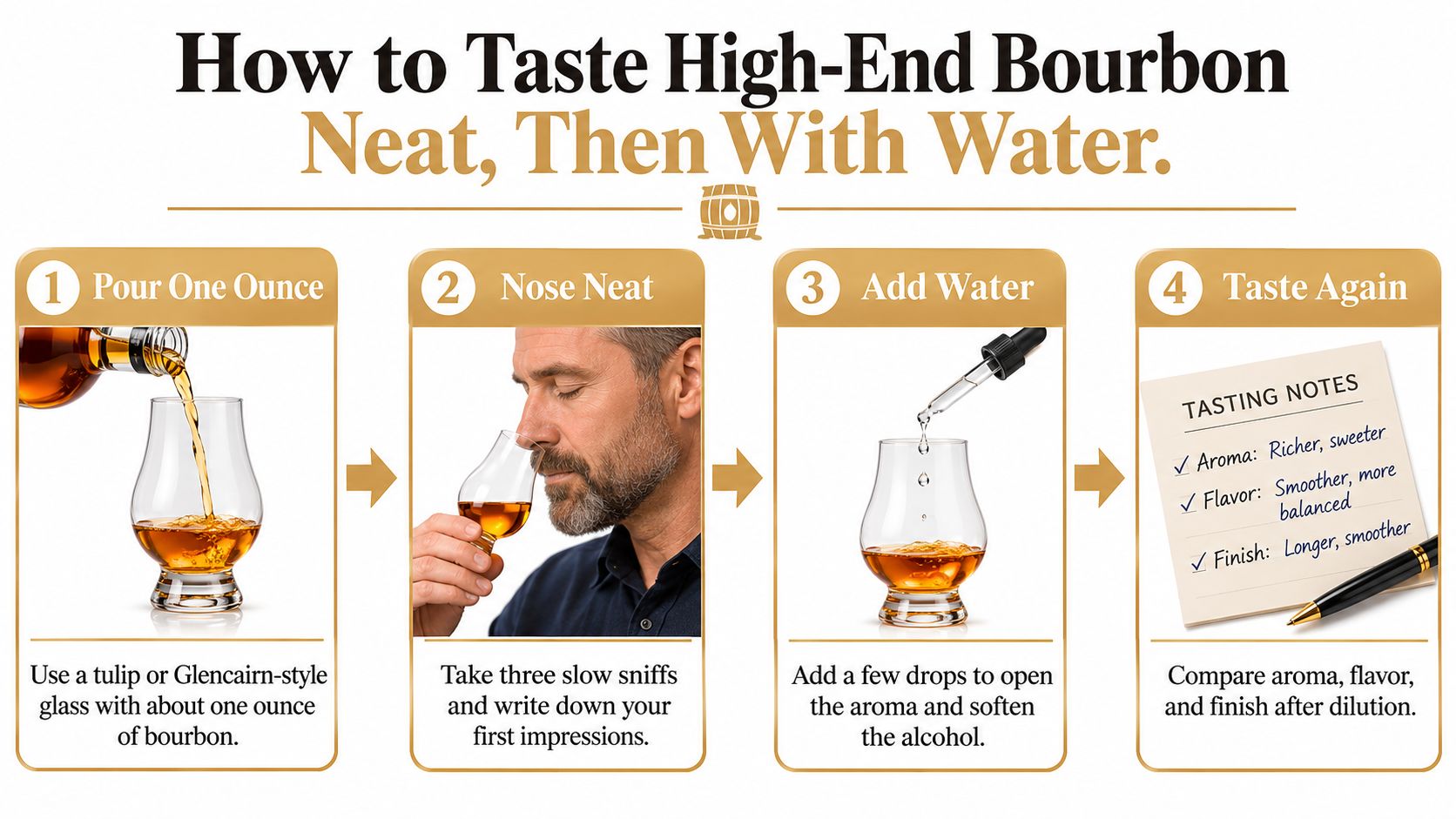
Use a tulip or Glencairn-style glass, room-temperature whiskey, and plain drinking water. About an ounce is a workable practice pour, but you don't need to finish it. Keep food, scented candles, and strong fragrances away from the evaluation.
Tasting Table's explanation of the official bourbon tasting wheel recommends tasting neat before adding a drop or two of water, which can increase the perception of aromatic compounds. It also advises beginners to start with a lower-proof whiskey they enjoy rather than immediately tackling overproof or heavily aged expressions.
A repeatable practice routine
- Nose the neat pour. Take three gentle sniffs, keeping your nose above the rim rather than burying it inside. Write your first impressions before sipping, even if they're sweet, fruity, or woody.
- Take a small sip. Hold it briefly, using about three seconds as a practice cue, then note heat, sweetness, and texture. Don't force yourself to hold a sip that feels uncomfortable.
- Introduce water cautiously. Use a dropper for control and give the pour about two minutes before retasting. Small additions let you notice change without immediately washing out the whiskey.
- Compare rather than assume improvement. Record what became clearer and what faded. Water may reveal fruit or soften heat, but you may prefer the original balance.
- Separate the oak-related sensations. Give vanilla, caramelized sugar, toasted wood, tannin, and lingering dryness individual intensity scores from 1 to 5. Treat these as descriptive measurements, not points to add toward a winner.
- Return after a short rest. Give the glass about five minutes, then take another small sip and assess the finish after swallowing. Judge what remains, not just how forcefully the whiskey arrives.
Barrel aging involves chemical transformation rather than passive storage. A USDA Agricultural Research Service publication describes how charring changes oak cellulose and subsequent contact with distillate releases wood-derived sugars.
That's why oak intensity and perceived maturity need separate notes. Strong wood flavor isn't proof of better aging.
You're looking for a finish you want to revisit, not a test of how much alcohol heat you can tolerate.
A satisfying result leaves sweetness, spice, fruit, and wood in a relationship you enjoy, without sharp bitterness taking over.
Flavor Cues and the Foods That Match Them
Toast and char change which oak compounds become available to the spirit. An oak-maturation study published by Springer identifies pyrazines and pyrroles as roasted-aroma contributors and describes how thermal history and spirit conditions influence their release. The practical lesson is that flavor develops through the interaction of spirit and treated wood, not oak presence alone.
Similar recipes and ages can therefore produce noticeably different pours. Look for roasted notes that complement fruit, grain, spice, and sweetness rather than measuring how much wood you can taste.
| Flavor Profile | Typical Notes | Food Pairing |
|---|---|---|
| Caramel and vanilla | Brown sugar, toffee, vanilla bean | Vanilla ice cream or crème brûlée |
| Oak and toast | Toasted wood, cigar box, dark roast coffee | Dark chocolate or roasted nuts |
| Spice and rye | Cinnamon, black pepper, clove | Smoked brisket or aged cheddar |
| Dried fruit | Dried cherry, raisin, orange peel | Pecan pie or dark berry tart |
| Dry tannin finish | Drying tannin, bitter edge | Rich beef or sharp cheese to soften the contrast |
Match intensity before chasing clever combinations
Start with a plain spoonful of vanilla ice cream alongside a caramel-forward bourbon. The familiar dessert makes it easier for a new drinker to identify vanilla and toffee without searching for elaborate descriptors.
For a spicy, rye-forward style, try aged cheddar. Its richness gives you a useful contrast to peppery or clove-like impressions without adding the many competing flavors of a heavily sauced dish.
Use these pairing suggestions as experiments, not fixed rules:
- Match strength of flavor. Delicate whiskey can disappear beside heavily smoked food.
- Choose an echo or a contrast. Sweet foods can echo caramel notes; salt and fat can provide contrast.
- Evaluate the whiskey first. Take your tasting notes before eating so you don't mistake a food-driven impression for the bourbon's character.
American craft whiskey offers plenty of opportunities to explore distinctive profiles. Still, taste the actual release rather than assuming every bottle from a producer will share the same balance.
Food can make a drying finish more pleasant, but it shouldn't disguise a purchasing disappointment. If you only enjoy a costly bourbon beside rich food, decide whether that matches how you intend to drink it.
Testing Whether Price Predicts Taste
An expensive bottle may win your blind tasting. The important point is to let it compete without receiving credit for its reputation.
Baron Spirits' discussion of blind tasting and prestige pricing describes how price and brand knowledge can influence reported enjoyment, and recounts anonymous tastings in which highly allocated bourbons didn't outperform much less expensive alternatives. That's a reason to test your own preferences, not a guarantee that cheaper bourbon always wins.
Keep description separate from preference
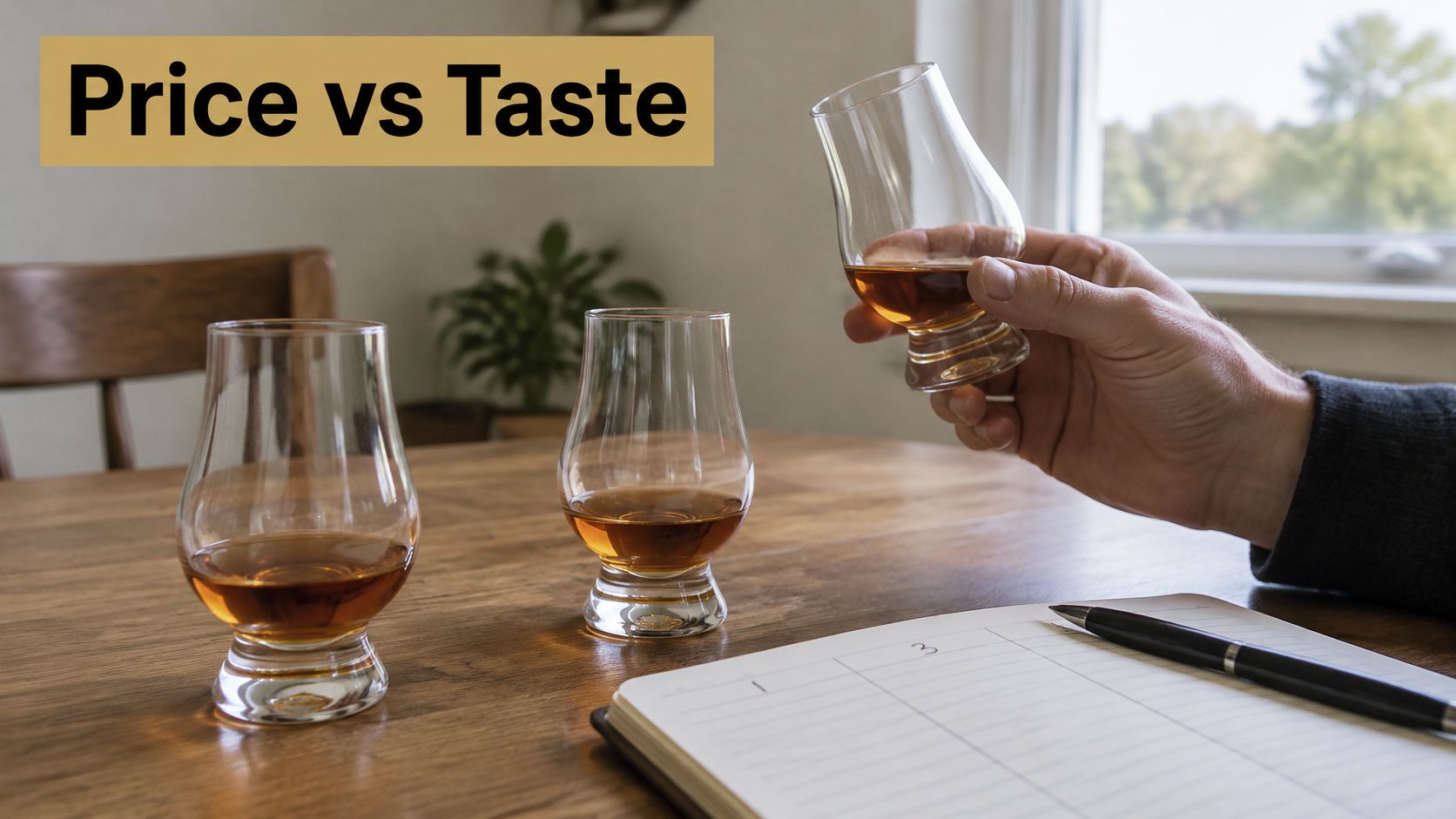
Ask a friend to pour a small set into identical coded glasses and keep the identities hidden. Include a readily available bottle, a more expensive comparison, and an American craft bourbon you're curious about. Keep serving conditions consistent and record impressions before discussing them.
Use the oak-related intensity ratings from your tasting routine, then add separate quality judgments:
- Balance and texture. Do the flavors fit together, and does the mouthfeel support them?
- Heat and complexity. Can you distinguish several impressions without alcohol overwhelming them?
- Finish quality. Rate how pleasant the aftertaste is, not merely how long it lasts.
- Desire to return. Which glass would you choose for another small pour?
Don't total vanilla, tannin, and dryness as if more of everything meant better bourbon. A high dryness rating describes a sensation; it isn't an award. Our sensory evaluation method offers a way to organize these observations.
Reveal the labels after committing to a choice
Write down your preferred glass before learning the prices. After the reveal, record whether the brand story changes how you feel, but preserve the original result.
If the mid-priced bourbon matches or beats the allocated release for your enjoyment, the premium hasn't demonstrated a sensory advantage for you in that comparison. You might still value provenance or collectibility, but that's a different purchase.
Repeat with another lineup before generalizing. A blind result is useful evidence about your preferences, not a universal ranking of distilleries.
Buying and Gifting Without Overpaying
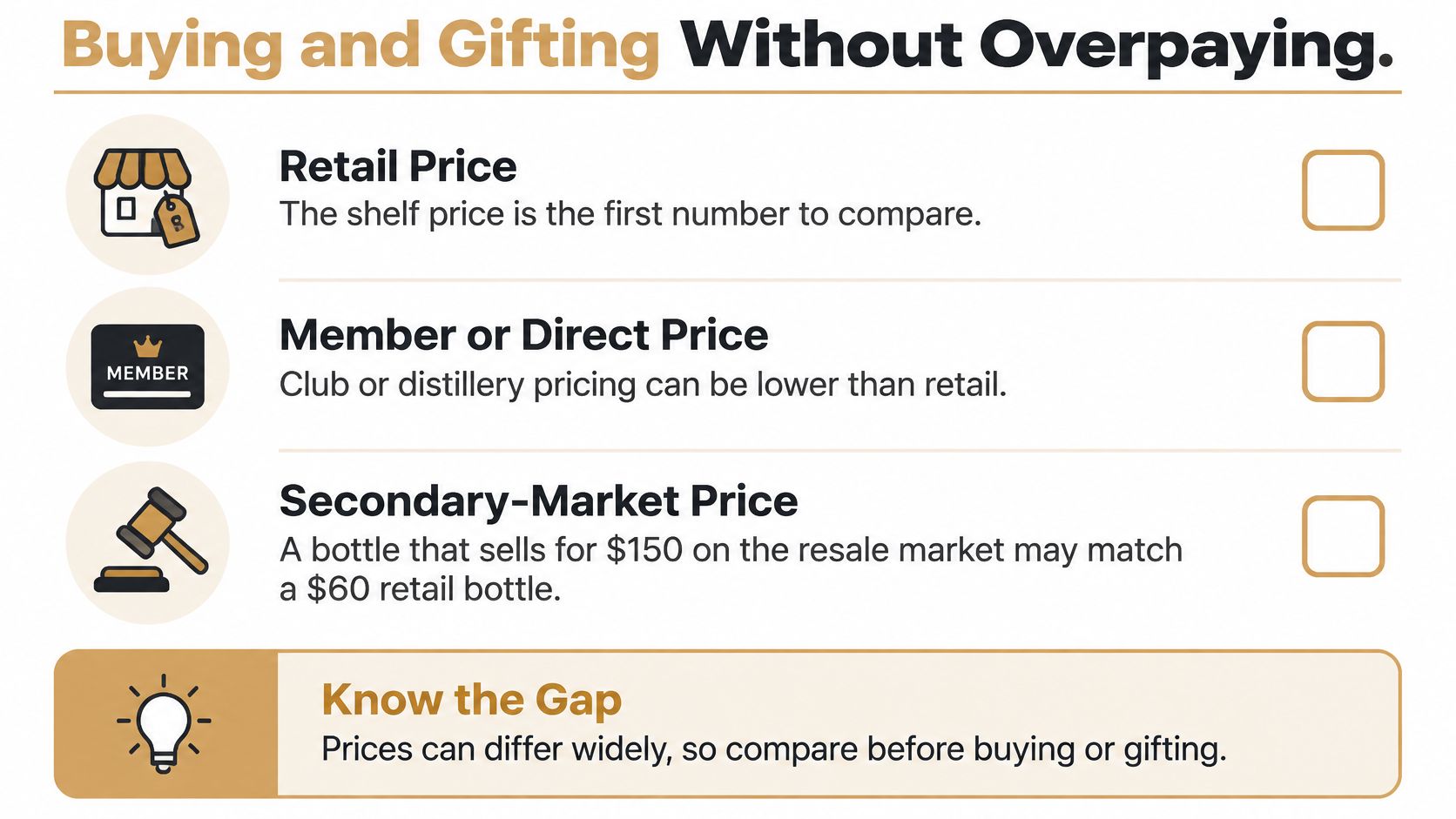
The price trap is treating resale demand as a tasting credential. Retail, member, direct, and secondary-market prices describe different transactions, not different liquid inside the same release.
For example, a hypothetical $150 resale bottle might offer you no more pleasure than a $60 retail alternative. You won't know from the asking price alone, and an unusually large markup deserves scrutiny rather than admiration.
Check the transaction before paying
- Establish a retail reference. Compare the same release and bottle size across licensed sellers before paying an allocation premium.
- Confirm provenance. Determine who distilled, selected, and bottled it. Clear sourcing deserves a fair evaluation; evasive descriptions don't.
- Normalize bottle size. Divide price by volume, then consider whether the documented maturation and bottling strength matter to your preferences.
- Identify the release. Look for batch or barrel details so you know what you're buying, especially when recommendations concern a particular selection.
- Protect the gift purchase. Buy through licensed retailers, keep the receipt, and check the seller's return rules before assuming alcohol can be returned.
The Lane Report's bourbon industry outlook describes Kentucky inventories exceeding 16 million aging barrels and renewed attention to core bottles around $30-70. Broad inventory abundance doesn't ensure every sought-after release is available, but it weakens the assumption that you must chase scarce bottles to drink well.
For a gift, choose the recipient's preferences over your own ambitions. A new drinker may appreciate approachable strength and recognizable flavors more than an imposing cask-strength release.
Gift advice: Include a blank tasting card, not a declaration that the recipient is holding the best bourbon.
A clearly explained American craft whiskey can make a thoughtful present. Give the recipient enough context to explore it, without telling them what they're supposed to taste.
Confirm Your First High-End Bottle Before You Buy
Buy the bottle whose liquid you prefer within your budget. Build a shortlist with an entry-premium candidate offering clear age and proof information, an upper-premium barrel selection, and a small American craft producer that explains who distilled its whiskey.
Have someone conceal the identities while retaining enough strength information to serve the gentlest pour first. Record your flavor intensities, finish quality, and overall preference before inspecting the credentials. If the winner exceeds your spending ceiling, choose the strongest affordable alternative rather than rationalizing the stretch.
Use specific flavors to sharpen your shortlist
These American whiskey examples illustrate how different a premium pour can be:
- Nashville Barrel Company Cask Strength bourbon tastes of sweet brown sugar, like a funky molasses rum, with herbaceousness on the palate and spicy honey in the background.
- The 13th Century Whiskey Company Toasted Barrel Straight Bourbon Whiskey includes rich mahogany, cigar box, leather, walnut skins, sarsaparilla, candied ginger, and S'Mores with strawberry marshmallows.
- Bull Run Distilling Company's Cask Strength Straight Bourbon Whiskey has a medium long finish with lingering cedar and licorice.
Those descriptions are comparison prompts, not a vocabulary test. Your notes might be simpler, and they should remain your own.
Blind Barrels offers blind sampling kits as one way to conduct this comparison; a friend-prepared lineup also works. Keep the original scores and the purchase price together so your next decision starts with evidence rather than memory.
Choose the bottle that scored highest for enjoyment, not the one that cost the most.
Blind Barrels offers a quarterly blind whiskey tasting subscription featuring small American craft distilleries, with tasting guidance and QR-coded reveals to explore each sample after recording your impressions. Visit Blind Barrels to try a guided comparison and discover which premium whiskey you prefer before choosing a full bottle.