

“Buy it before it disappears” is often the worst advice you'll hear about limited edition bourbon. Say you walk into a liquor store for a birthday gift and find a bottle behind the counter with a purchase limit. Before paying the premium, you need to know whether the distiller made very little whiskey or the retailer made it difficult to buy.
Those are different stories, and neither tells you how the bourbon tastes. A better approach starts with the supply claim, moves to the glass, and leaves the price tag covered until you've formed an opinion.
Four Meanings of Limited Edition Bourbon
Four kinds of limited edition bourbon
| Scarcity type | What it means | Supply signal | Premium buys | Resale risk |
|---|---|---|---|---|
| Production scarcity | Selected barrels bottled once | Disclosed barrel and bottle count | Flavor and provenance | High only for documented icons |
| Temporary launch scarcity | Debut or annual drop that can return | New year or batch on a repeating label | Early access | Usually fades after launch |
| Regional allocation | Real volume, uneven distribution | State or shop limits, no tiny bottle count | Geography and access | Low outside hype markets |
| Retailer or marketing scarcity | A cap or the word limited with no count | Purchase limit or vague label language | Speculation or status | Low; skip the markup |
The resale column describes the strength of a resale proposition, not a guarantee. Even a documented icon can lose value, and a bottle with little resale appeal can still be wonderful to drink.
Production scarcity starts in the rickhouse. A distiller selects particular barrels, bottles their contents, and doesn't plan to reproduce that exact batch. The useful evidence is a disclosed yield, not an ornate box.
Temporary launch scarcity starts on the calendar. An annual release may sell quickly while returning next season with different barrels and a fresh date. You're paying for access to this edition, not necessarily the last opportunity to taste that style.
Identify who controls access
With regional allocation, the bottle may be scarce in your town but readily available elsewhere. A traveler finding it on an ordinary shelf hasn't discovered counterfeit rarity. They've crossed a distribution boundary.
Retailer or marketing scarcity needs more skepticism. A members-only sale or purchase cap tells you how the shop sells the bottle, but not how much the producer made.
Oakspire Club's allocation-season coverage describes a split through 2024 and 2025: iconic tiny releases retained attention while mid-tier allocated bottles became easier to find and premiums compressed as supply increased, prices rose, and buyers grew more selective. That's a reason to investigate urgency, not obey it.
Before buying, place the bottle in one table row, then inspect:
- Production disclosure: Look for bottle count, barrel count, and whether the batch will return.
- Liquid identity: Record age, mash bill, finish, and proof.
- Distribution footprint: Find out whether availability is local, regional, or broad.
- Release history: Compare previous editions and see what remains on shelves a month after launch.
Say a shop describes a bourbon as nearly impossible to find, but the producer publishes neither a count nor a distinct barrel selection. Treat that as an access claim until someone supplies production evidence. Your drinking budget shouldn't become a wager on the retailer's adjective.
Why Distilleries Save Barrels for Special Releases
Think of a rickhouse as a library. The core bourbon is the open shelf, assembled so readers can return to a familiar volume. A limited release is a particular book the distiller pulls aside because it tells a different story.
Say a blender tastes through barrels intended for the regular label. Most fit the house profile, but a few carry an unusual balance of dark fruit, grain sweetness, and mature oak. The blender can fold those barrels into the familiar blend or reserve them for a distinct release.
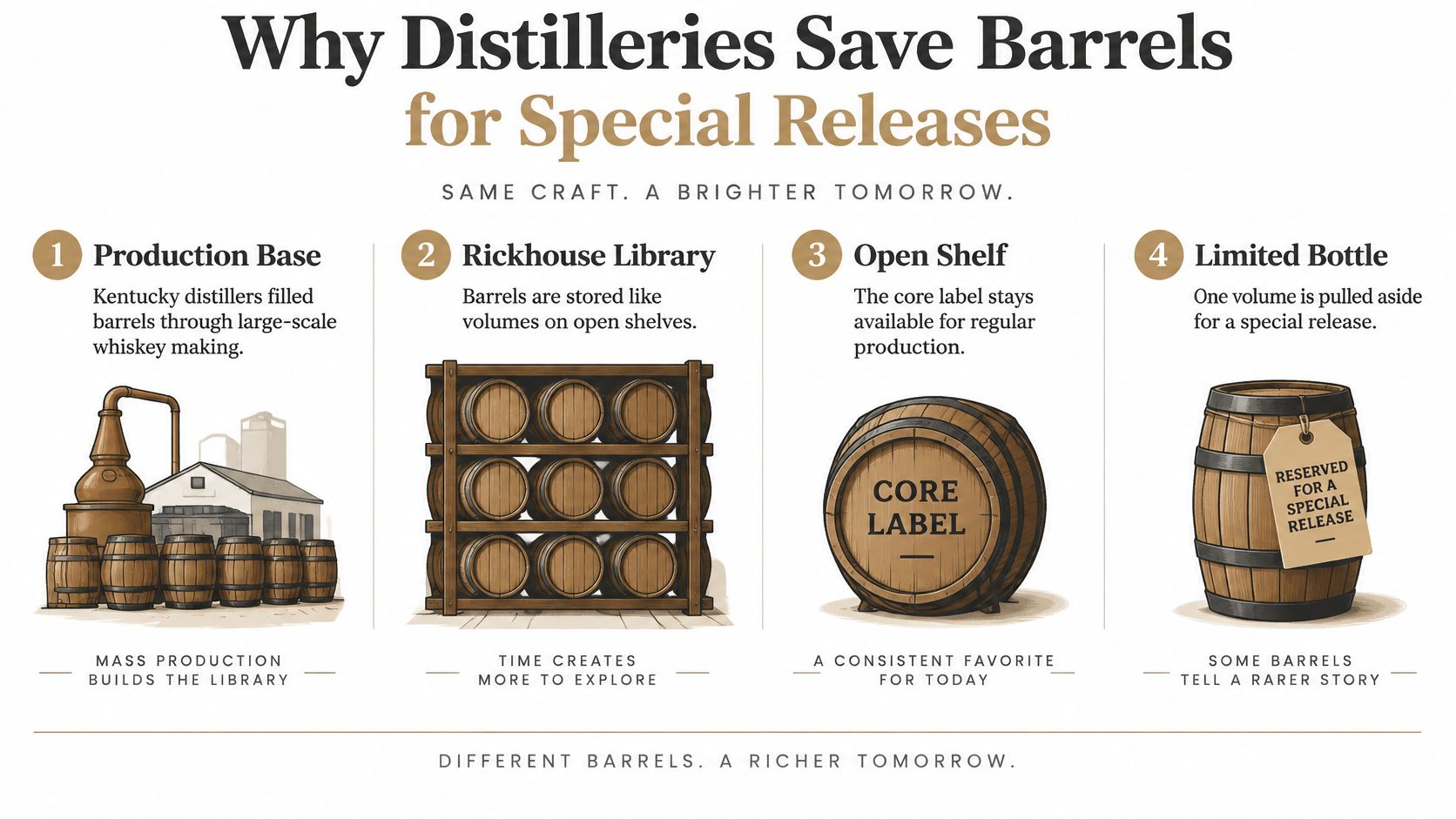
A larger library creates more choices
The Kentucky Distillers' Association production account records 1,886,821 bourbon barrels filled in 2020, the highest annual total in 48 years, just below 1,922,009 in 1967; output had risen from 455,078 barrels in 1999, an increase of more than 315%. A later association report recorded approximately 2.6 million barrels in 2021, described as the fourth consecutive year above 2 million and a 475% increase since 1999.
These are production snapshots, not a count of rare bottles waiting for buyers. Their practical meaning is that a large aging inventory gives distillers room to reserve older stocks, unusual mash bills, or high-proof batches rather than route every suitable barrel into the standard expression.
The selection still needs an explanation. A compelling release might preserve a particular barrel's character, show how a familiar recipe develops with more maturation, or combine stocks that wouldn't suit the everyday label.
Practical rule: Ask what the distiller selected, not just what the distiller withheld.
Read the difference between releases
Compare the current bottle with its predecessor. Did the age change? Did the blender choose a different mash bill, warehouse source, or bottling strength? Those details give you something testable in the glass.
A new package alone doesn't answer those questions. Neither does a claim that the whiskey was held back for a special occasion.
Limited editions are a curated slice of a much larger aging pool. Their growing visibility reflects an expanded industry and more opportunities for selection, not the disappearance of everyday bourbon. The romance becomes more interesting when you can name the actual decision behind it.
Proof Rules and a Tasting Routine for Limited Bottles
Start with the legal baseline, then separate it from the tasting judgment. Under the TTB's spirits labeling guidance, bourbon enters new charred oak at no more than 125 proof, standard bottling is at least 80 proof, and bottled-in-bond whiskey is exactly 100 proof, with additional production requirements and at least four years of aging.
The federal standards of identity generally require at least two years in oak for straight bourbon. That designation establishes a minimum, not a promise that you'll prefer it to another whiskey.
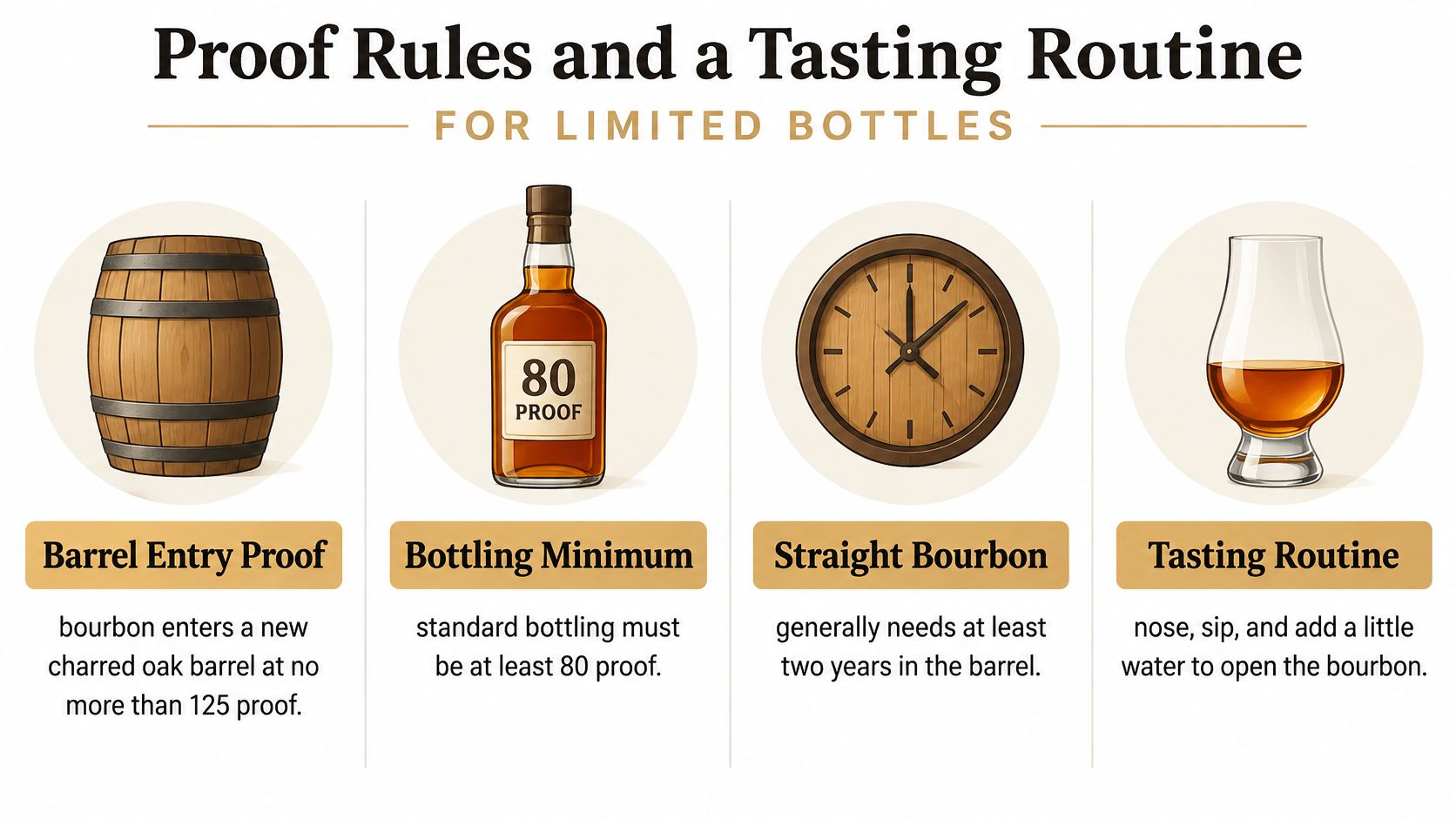
Read strength without awarding points
The TTB's whisky classification guide provides the proof scale: 80 proof is 40% alcohol by volume, 120 proof is 60%, and bourbon's distillation ceiling is 160 proof. That last ceiling shouldn't be generalized to every American whiskey category.
Barrel-entry proof and bottling proof describe different moments. Entry strength affects extraction during aging, including the balance between water-mediated extraction and ethanol-soluble oak compounds. Bottling strength affects how forcefully alcohol and aromas present themselves when you pour.
Cask strength preserves concentration, but concentration isn't the same as complexity. Alcohol intensity can obscure fruit and floral notes, especially when you're new to stronger whiskey. Our explanation of what proof means in whiskey helps distinguish strength from character.
Core bourbon versus common limited styles
| Style | Age cue | Proof cue | Typical scale | What changes in the glass |
|---|---|---|---|---|
| Core shelf bourbon | Often unstated; straight follows the minimum above | Standard bottling minimum applies | Ongoing national supply | Consistency from batch to batch |
| Single-barrel limited | May carry a stated age | May be reduced or cask strength | One barrel's yield | A particular barrel's character |
| Small-batch limited | Selected barrels of potentially different ages | High proof is common, not required | A selected group of barrels | A curated blend |
| Bottled-in-bond special | Bonded aging minimum applies | Exact bonded strength above | One season and one distillery | A legal benchmark, not a flavor guarantee |
| Finished limited | Bourbon maturation plus additional finishing | Read the stated bottling strength | A selected second-cask run | Wine, rum, or toasted-wood influence |
Older isn't automatically better, either. Extended oak contact can overwhelm sweetness and fruit with drying tannin, woody bitterness, or pencil-shaving notes. Score oak intensity separately from maturity so an aggressive barrel doesn't receive credit for being loud.
Use a repeatable tasting routine
Keep a clean glass, drinking water, a dropper, and a notebook nearby. Don't read the producer's tasting notes first, because you want your own observations rather than a search for flavors someone has already named.
- Pour a small taste and smell before sipping. Approach the glass gently rather than burying your nose in it. Write down broad impressions such as grain, fruit, vanilla, or oak.
- Taste neat and write separate observations. Put alcohol heat first, then the flavors underneath. “Hot, with cherry and caramel underneath” is more useful than “powerful.”
- Add a few measured drops of ordinary drinking water. Wait several minutes before returning to the glass. The Hobby Library's beginner tasting guidance recommends controlled additions and recognizes that dilution has no single correct result.
- Retaste for a specific change. Does fruit become clearer? Does grain sweetness emerge? Alternatively, does the whiskey become thin, woody, or more obviously bitter?
- Score before revealing the story. Assess balance, complexity, finish, and flaws before checking age, price, or reputation.
For a cask-strength comparison, choose similar mash bills at different bottling strengths when possible. Keep the glassware and tasting conditions consistent so you're not confusing a different recipe with a difference in proof.
Water isn't a rescue operation or a test of toughness. It's a way to hear the whiskey at a different volume.
A long finish deserves description, not automatic praise. Lingering caramel and spice may be enjoyable; lingering burn or astringency may not be. Your preference belongs in the notes alongside the technical observations.
Craft Releases That Show Real Scarcity
Say you stop at a regional distillery after lunch and find a handwritten release card beside a bourbon you've never heard of. There's no national waiting list, but the tasting-room employee can explain the grain recipe and which barrels went into the batch.
That's a useful starting point for a newcomer. An unfamiliar name can belong to a small local producer, not merely an obscure label owned by a much larger supplier.
Small operations can mean small runs
A University of Kentucky agricultural publication describes growth from fewer than 100 craft operations in 2005 to more than 3,000 craft distilleries, with most classified as nano- or microdistilleries producing fewer than 100,000 proof gallons annually. That scale helps explain why a regional release can be difficult to replace without being a celebrated collectible.
A small stillhouse might reserve a wheated recipe, select a barrel, or try a toasted-cask finish because that's what its production and storage allow. The limitation can be practical rather than theatrical.
American craft names such as Kings County, Frey Ranch, and Southern Star are useful starting points for exploration, not shortcuts around checking the label. Ask the same questions of a familiar craft brand that you would of an unknown tasting-room bottle.
- Small producer: Is the run limited because the whole operation makes relatively little whiskey?
- Special barrels: Did the distiller isolate a distinct flavor profile from the regular production?
- Release event: Is this an annual occasion with a new batch and another launch next season?
A barrel and an annual event tell different stories
A true single-barrel release ends when that barrel's contents are bottled. A recurring seasonal blend can remain interesting while returning under a familiar name. Neither format guarantees quality, but the distinction changes what you should expect to replace later.
For new drinkers, what single-barrel bourbon means is a helpful place to start before treating the term as a quality award. It describes the source of the liquid, not your likely enjoyment.
At a tasting room, ask to compare the limited pour with the core bourbon. Listen for concrete production choices: grain selection, barrel size, maturation, and finishing. If the limited whiskey tastes more distinctive but less balanced to you, that's a valid result.
Seek out family-run and regional houses where you can taste before buying. You don't need a festival unicorn to discover a bourbon worth remembering, and you don't need allocation expertise to ask a thoughtful question.
What Limited Bottles Are Worth and How to Check Them
A tiny barrel count, a regional allocation, and a high asking price describe different things. Score the whiskey in the glass before letting any of them set its value.
The Lane Report's coverage of King of Kentucky gives one documented example of production scarcity:
| Bottle | Release | Barrels | Bottles | Price signal |
|---|---|---|---|---|
| King of Kentucky fourth modern edition | 2021 | 33 | 2,700 | A limited production run, not an auction estimate |
King of Kentucky began in 1881, was discontinued in 1968, and later returned as a limited bourbon. That history helps explain the interest, but it does not set a fair price for every bottle bearing the name.
A distillery can have few barrels to release. A launch can sell out quickly, a region can receive only part of a batch, or a marketing limit can make a release appear scarce. Those are different forms of scarcity, and none tells you whether the whiskey tastes good to you.
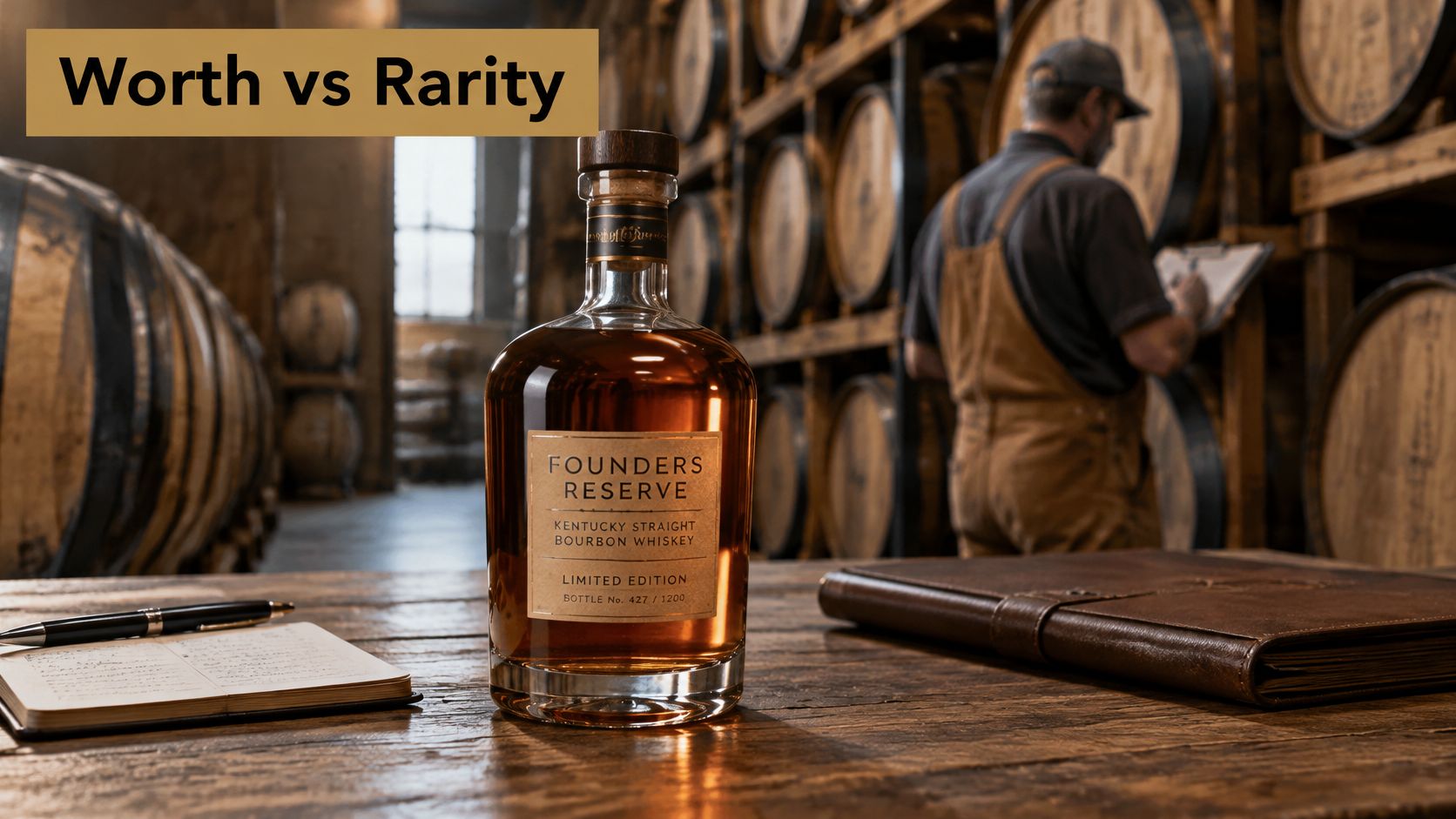
Build a bottle record before judging price
Write down the release year, barrel count, age, proof, stated bottle quantity, and provenance. Photograph the label and identifying code so you can compare the exact edition with other offers.
Say a seller offers a rare bourbon but provides only a distant photograph and a story about knowing someone at the distillery. Ask for readable images and a documented purchase history before considering a premium.
Use this buy-or-walk check:
- Closure and fill: Inspect the capsule for disturbance. Consider whether the fill level fits the bottle's age and storage history.
- Era and identifiers: If a tax stamp is present, check whether it fits the era. Compare bottle numbers or codes with release information.
- Seller history: Ask which retailer originally sold the bottle and request supporting documentation.
- Payment pressure: Walk away from demands to pay off-platform or before receiving clear photographs.
These are screening cues, not proof of authenticity. A convincing capsule doesn't establish what is inside, and an unfamiliar stamp doesn't automatically prove fraud.
Separate collecting from drinking value
A collector may care about a bottle's history, while a drinker may care more about flavor and price. For another category's perspective on rarity and price, read this guide to rare Japanese whiskey and its value.
If flavor is the priority, compare the asking price with bottles you can taste. The guide to whiskeys that offer value for the price can help frame that comparison.
Score the liquid first. Then decide whether the history, scarcity, and price add enough for you.
Selling a Limited Bottle at a Fair Price
Start with what buyers pay, not what an optimistic seller asks. In a 561-person survey, Breaking Bourbon's limited-release analysis concluded that most limited-release transactions occurred at or near MSRP, rather than at inflated secondary prices.
That finding describes the survey's transactions, not every buyer or marketplace. It still gives an ordinary seller a better starting assumption than an exceptional auction headline.
Price the exact edition
A repeating annual release or retailer-limited bottle rarely supports an automatic expectation of profit. When buyers can find alternatives, a high listing price is an unaccepted proposal.
Use a short selling routine:
- Write the identity record. Include release year, barrel count, age, proof, provenance, and stated bottle quantity where disclosed. Mark missing information clearly.
- Compare completed sales. Check the original shelf price and recent sales of the same edition, condition, and format. Don't substitute the most ambitious active listing.
- Classify the bottle realistically. A documented tiny production run and a mid-tier allocated release shouldn't receive the same scarcity assumption.
- Preserve and photograph condition. Keep the capsule and any tax stamp intact. Photograph the fill level, label, and bottle number alongside the matching release information.
- Use a lawful, accountable channel. Alcohol resale rules differ by jurisdiction. Choose an appropriately licensed retailer or auction platform that can review provenance, and reject off-platform payment requests.
Count what you'll actually receive
Ask about seller fees, shipping arrangements, insurance, and the platform's handling requirements before agreeing to a sale. A headline price isn't your net return, and an informal handoff can create problems beyond disappointing payment.
A fair asking price should survive comparison with a completed sale, not just another seller's hope.
If you bought the bottle to drink and no longer want it, recovering something close to your purchase cost can be a sensible outcome. You don't need to turn every unopened bourbon into an investment thesis.
A bottle bought at shelf price and sold near it protects the drinker's money as well as the liquid. Keep the record accurate, the condition intact, and the expectations modest.
Decide Whether to Drink Collect or Taste Blind
If the bottle is retailer-limited or a repeating annual recipe, buy it to drink or give, not to store for a payday. If the producer discloses a tiny selection with traceable provenance, decide whether owning that particular story matters more to you than opening it.
Collectors and drinkers can reach different answers without either being wrong. The mistake is paying a collecting premium while expecting a proportionate improvement in flavor.
Make the glass earn your preference
For newcomers, keep balance, complexity, finish, and alcohol heat separate in your notes. Couples and gift buyers can make the comparison together, with the labels hidden until everyone has committed to an opinion.
A reveal can change how you understand a whiskey. It shouldn't erase what you tasted.
- Drink or give: Choose the bottle you enjoy and can afford to replace.
- Collect deliberately: Pay for documented history because you want it, not because someone promises appreciation.
- Taste blind: Remove the brand and price cues when you're unsure what's driving the attraction.
At Blind Barrels, we offer a blind-tasting experience of rare craft whiskey in every box, featuring hard-to-find distilleries. Each quarter, members receive four blind samples, a tasting table for aroma, taste, and finish, and a game scoring guesses of age, proof, and whiskey type; the reveal also provides access to member pricing on full bottles.
One concrete comparison is KROBAR Cask Strength Bourbon Whiskey, listed at $59.99 for members, against a regular price of $119.99. That's an invitation to evaluate a specific whiskey, not a reason to assume any discount or scarce label guarantees your preference.
Try a blind round before paying someone's secondary price. Let the pour establish your interest before the bottle supplies its reputation.
At Blind Barrels, we pair rare American craft whiskey samples with a tasting table and a reveal that helps you understand what you enjoyed. Visit us to plan a blind tasting for yourself or someone you share whiskey with. Taste something scarce without the label, then decide what a limited edition is worth in the glass.