

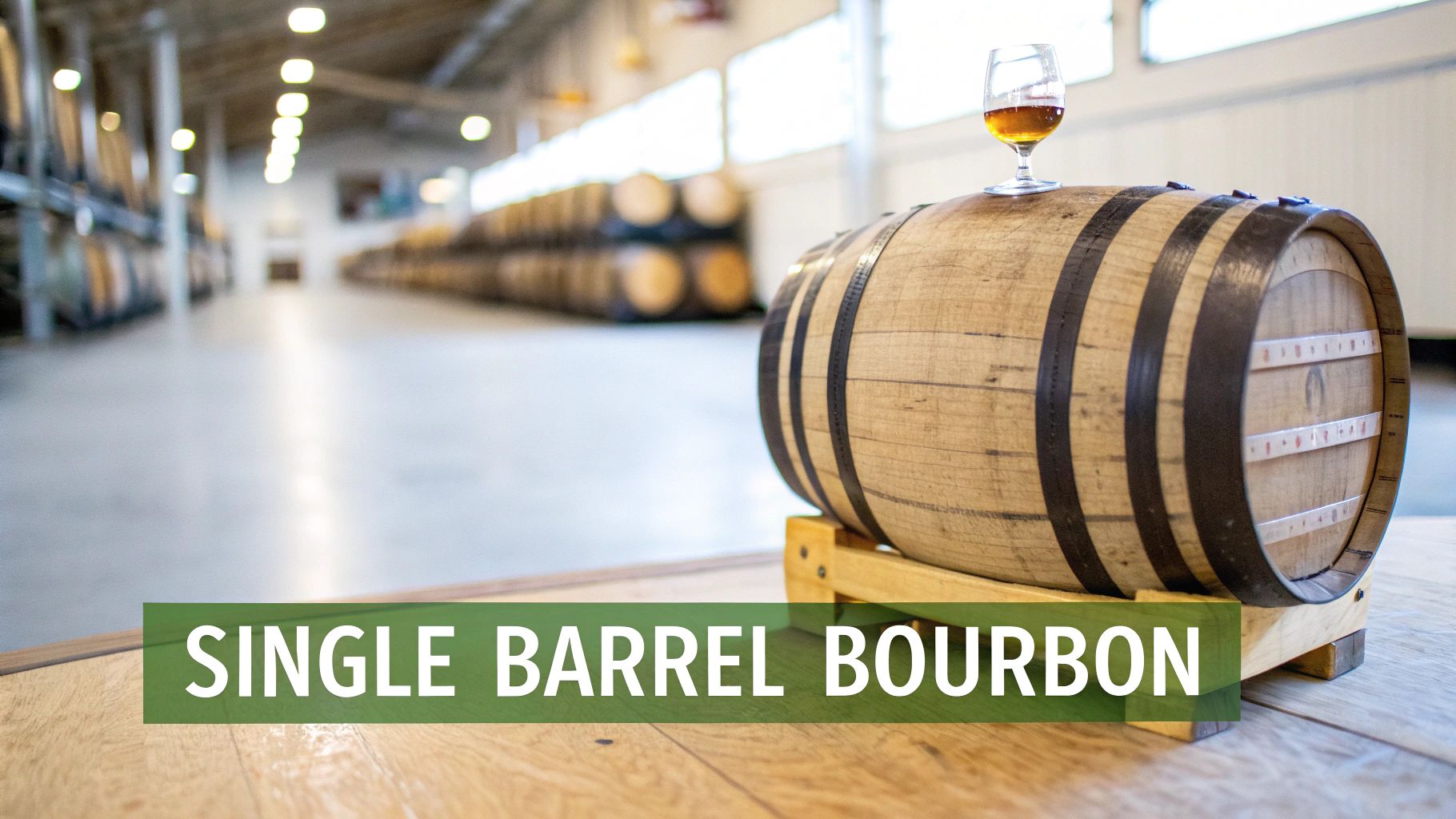
In the world of bourbon, some terms get thrown around so much they start to lose their meaning. But "single barrel" is one you’ll want to pay close attention to. At its heart, it’s exactly what it sounds like: bourbon that comes from one, individual barrel.
That’s it. It’s never mixed or blended with whiskey from other casks. This simple rule creates a whiskey experience that’s truly one-of-a-kind, offering a pure snapshot of that single barrel's life.
The Allure of Individuality
Think of standard bourbon as an orchestra. A master blender carefully combines the sounds of hundreds—sometimes thousands—of different instruments (barrels) to create a consistent, harmonious symphony. It’s beautiful, reliable, and sounds the same every time you hear it.
A single barrel bourbon, on the other hand, is a solo artist. It’s the raw, unfiltered performance from one exceptional cask. You get to experience every nuance, every quirk, and all the distinct character that barrel developed over years of aging.
This is what makes single barrel expressions so exciting, especially when you’re just getting into whiskey. You’re not just tasting a brand’s house style; you're tasting a specific moment in time from one exact spot in the rickhouse.
What Defines a Single Barrel Bourbon
The concept is straightforward, but the implications are huge. Most distilleries blend countless barrels together to smooth out imperfections and hit a specific, repeatable flavor profile. Single barrel throws that playbook out the window.
Committing to bottling from a single source means you’re getting a truly unique product. Here’s what that means for the whiskey in your glass:
- A One-of-a-Kind Flavor Profile: Every barrel is a world of its own. Its final flavor depends on its location in the warehouse, the specific grain of its wood, and the wild temperature swings it weathers over the years. No two barrels will ever taste identical.
- It’s Naturally Limited: A typical bourbon barrel only yields about 150–250 bottles. Once that barrel is empty, that exact whiskey is gone for good. This makes every single barrel release a limited edition by nature.
- The Story is on the Label: Most single barrel bottles tell you a story. You’ll often find details like the barrel number, the warehouse it came from, and the date it was bottled, giving you a direct line back to that whiskey’s origins.
A single barrel is bourbon in its purest form—a direct expression of one barrel’s life, untouched by blending. It’s a celebration of variation, not an attempt to smooth it out. This makes every bottle a potential discovery.
This philosophy is why so many American craft whiskey brands, which often champion uniqueness and hands-on production, really shine with their single barrel releases. Brands like Balcones in Texas or Westward in Oregon often feature single barrel expressions that showcase their unique regional character.
For a deeper dive into the factors that make each barrel so distinct, this guide to single barrel whiskey is a fantastic resource.
Here's a quick cheat sheet to help you remember the essentials of what makes a single barrel bourbon special.
Single Barrel Bourbon at a Glance
| Characteristic | Description |
|---|---|
| Source | Comes exclusively from one individual barrel; never blended with other barrels. |
| Flavor Profile | Highly variable and unique to each barrel, reflecting its specific aging conditions. No two are ever the same. |
| Consistency | Inconsistent by design. Flavors can vary dramatically from one barrel to the next, even from the same distillery. |
| Availability | Extremely limited. A single barrel yields only 150-250 bottles on average, making each release inherently rare. |
| Transparency | Labels often include details like barrel number, warehouse location, and bottling dates, offering a direct link to the whiskey's journey. |
| The "Why" | Celebrates individuality and variation. It's for drinkers who enjoy discovery and experiencing a whiskey's raw, unblended character. |
Ultimately, single barrel bourbon is an adventure in a bottle, offering a direct taste of the distiller's craft and the magic of maturation.
The Art of Selecting a Single Barrel
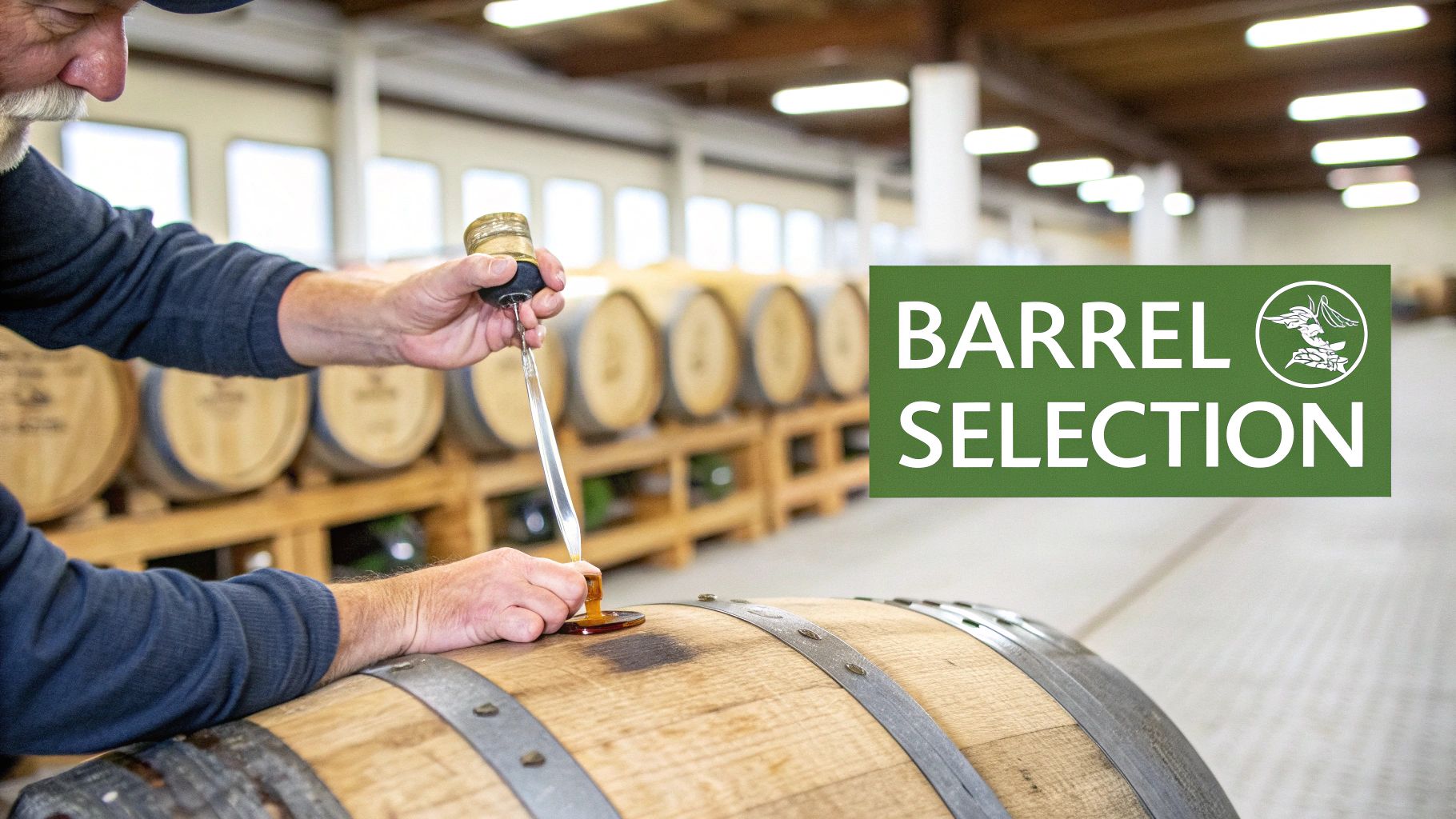
So, what does single barrel bourbon mean in the real world? It means that out of thousands of barrels aging quietly in a massive rickhouse, a precious few are singled out to stand on their own. This isn't some random lottery; it's a careful, deliberate hunt for excellence, led by people with the most experienced palates in the business.
The whole process usually kicks off with a master distiller or a dedicated tasting panel. Their mission? To find the "honey barrels"—those rare casks that have developed a character so delicious and unique they’re considered too good to be blended away into a larger, more uniform batch.
They aren’t just looking for barrels that hit the distillery’s standard flavor profile. Nope. They’re on the lookout for the outliers, the barrels that deliver something truly special and deserve their own spotlight.
What Makes a Barrel a Standout?
Choosing a barrel for a single barrel release is as much an art as it is a science. The selection team uses a tool called a "whiskey thief" to pull samples straight from different casks, tasting each one to see what it has to offer.
And their evaluation goes way beyond a simple "tastes good." They're hunting for specific qualities that make a barrel worthy of its very own bottling:
- Exceptional Character: Does this barrel have a bold, memorable personality? Maybe it’s bursting with intense notes of dark cherry, deep caramel, or a unique spice that just jumps out of the glass.
- Complexity and Depth: A truly great single barrel offers layers of flavor. The team is looking for a whiskey that evolves on the palate, revealing different notes from the first sip all the way through the long, lingering finish.
- Balance and Maturity: The whiskey has to be well-rounded. Even with a powerful profile, the oak, sweetness, and spice need to play nicely together, with no single element overpowering the others.
The selection process is a powerful reminder of the human touch in a world of scaled-up production. It boils down to a master distiller tasting a sample and declaring, "This one is special. It needs to be bottled on its own."
Many American craft whiskey brands, like Frey Ranch Distillery in Nevada or Southern Star out of North Carolina, have built their reputations on this exact kind of discerning selection process. They're proving how finding that one perfect barrel can define a distillery's entire commitment to quality. You can get a much deeper look into the craft of barrel picks from selection to custom stickers to see just how detailed this journey really is.
From Rickhouse to Bottle
Once a barrel gets the nod, its journey to the bottle is handled with extreme care to preserve its one-of-a-kind identity. The entire contents of that single cask are "dumped" into a trough and then sent down the bottling line.
The label essentially becomes a birth certificate for the whiskey inside. It tells the story of that specific barrel, often listing key details like:
- Barrel Number: Its unique ID at the distillery.
- Rickhouse Location: The warehouse—and sometimes even the specific floor—where it aged.
- Dump Date: The exact day the whiskey was emptied from the barrel for bottling.
For new whiskey drinkers, paying attention to these details is your first real step toward becoming a connoisseur. It creates a direct connection to that barrel's life, turning a simple purchase into a tangible piece of the distillery's history. It’s the ultimate expression of transparency and craftsmanship.
Why No Two Single Barrels Taste Alike
Think of it like this: you can have a set of identical twins, raised in the same house by the same parents. They share the exact same DNA, but as they grow, they develop entirely unique personalities. Why? Because of tiny, everyday differences in their experiences. Bourbon barrels aging in a rickhouse are a lot like that.
Even if two barrels are filled with the same new make spirit on the very same day, they’ll emerge years later as completely different whiskeys. This fascinating inconsistency isn't a bug—it's the main feature. The specific journey each barrel takes, influenced by a ton of environmental factors, creates a one-of-a-kind microclimate inside the oak, guaranteeing no two will ever taste exactly the same.
The Rickhouse Effect: Location is Everything
The biggest reason for this beautiful chaos is the barrel's physical spot within the warehouse, or rickhouse. These multi-story buildings are rarely climate-controlled, leaving them completely exposed to the whims of the seasons. This constant dance with Mother Nature creates some seriously dramatic temperature swings from top to bottom.
- Top Floors: Barrels up in the rafters take a beating from the intense summer heat. This forces the whiskey to expand deep into the wood's pores, pulling out heavy-hitting flavors of oak, vanilla, and caramel. The heat also cranks up evaporation, concentrating the liquid and often jacking up the proof.
- Bottom Floors: Down on the cooler, more stable bottom floors, barrels enjoy a much gentler maturation. The whiskey’s conversation with the wood is less aggressive, leading to a softer, more nuanced profile that might let the grain character of the mash bill shine through.
From a distiller's perspective, these variations are huge. Factors like warehouse position and floor level create measurable differences in how a whiskey matures. Those temperature gradients can seriously speed up aging on the upper floors. It’s common for barrels from different spots to have different alcohol concentrations, colors, and flavor markers after the same amount of time. You can explore more about how barrel char and wood influence flavor in our detailed guide.
The Angel's Share and Wood's Individuality
Another huge piece of the puzzle is the "angel's share," which is just a poetic way of saying the whiskey that evaporates through the oak staves over time. On the hot, dry top floors, more water escapes than alcohol, which concentrates the whiskey and raises its proof. But down on the cooler, more humid lower floors, the opposite can happen. This process means that even two barrels sitting right next to each other can end up with different final proofs and flavor intensities.
The beautiful inconsistency of single barrel bourbon is a direct result of its environment. Each barrel tells a unique story of heat, cold, time, and its own wooden DNA, a story that can never be exactly replicated.
This is why single barrel labels almost always list things like the dump date and barrel number—it's a way of documenting this natural variation for whiskey nerds. Since these bottlings are unblended, every bottle is a direct snapshot of these micro-variations. It’s how two barrels filled from the same batch can end up tasting wildly different.
Here’s a great tip for anyone new to whiskey: one of the best ways to train your palate is to grab two different single barrel releases from the same distillery. Tasting them side-by-side is the perfect way to start spotting these subtle, magical differences for yourself.
Single Barrel vs. Small Batch vs. Blended Bourbon
To really get a handle on what makes a single barrel bourbon so special, it helps to meet the rest of its family. While all bourbon shares the same DNA, the way it’s bottled creates wildly different experiences in the glass.
Think of it like a really great coffee shop. A single barrel is like a single-origin pour-over, where every nuance of a specific farm shines through. Small batch is the carefully crafted house blend, balanced and beloved. And a standard batched bourbon is the big, reliable urn of drip coffee—always good, always the same.
Each one has its place, but they are far from the same thing. The biggest differences boil down to the source of the whiskey, the goal of consistency, and what the distiller is ultimately trying to achieve. Understanding these distinctions is one of the best things a new bourbon drinker can do to navigate a packed bar menu or liquor store shelf with confidence.
Decoding the Main Bourbon Types
Let’s break down the three main categories you’ll run into. Each represents a totally different philosophy in whiskey making, from celebrating a one-of-a-kind barrel to perfecting a signature flavor profile that never changes.
-
Single Barrel Bourbon: This is the purist's pick. Every last drop in the bottle comes from one individual barrel, hand-selected because its character is just too good to blend away. It’s a liquid snapshot of that specific cask's life, with no other barrels mixed in to smooth out its unique personality.
-
Small Batch Bourbon: Think of this as the artisan's blend. It’s a curated mix from a select number of barrels. But be warned: the term "small" has no legal definition and can mean anything from two barrels to two hundred. The goal here is to craft a specific, elevated, and reliably delicious flavor that’s a clear step up from a distillery's standard offering.
-
Standard ‘Blended’ Bourbon: This is the workhorse of the bourbon world. It’s a massive blend of many barrels—often hundreds or even thousands—that are meticulously married together to nail the distillery’s flagship taste. The number one priority is unwavering consistency, ensuring the bottle you buy today tastes exactly like the one you loved last year.
Plenty of distilleries play in all these sandboxes. A renowned brand like Four Roses, for example, offers both a fantastic Small Batch and several sought-after Single Barrel expressions. It’s a perfect way to taste both the art of a masterful blend and the singular voice of an individual cask. To get a better sense of how distillers pull this off, you can dive deeper into the art of blending and how craft whiskey distillers create complex flavors.
This is exactly why no two single barrels are ever identical. The diagram below shows just a few of the countless variables that shape a barrel's destiny before it's ever even considered for bottling.
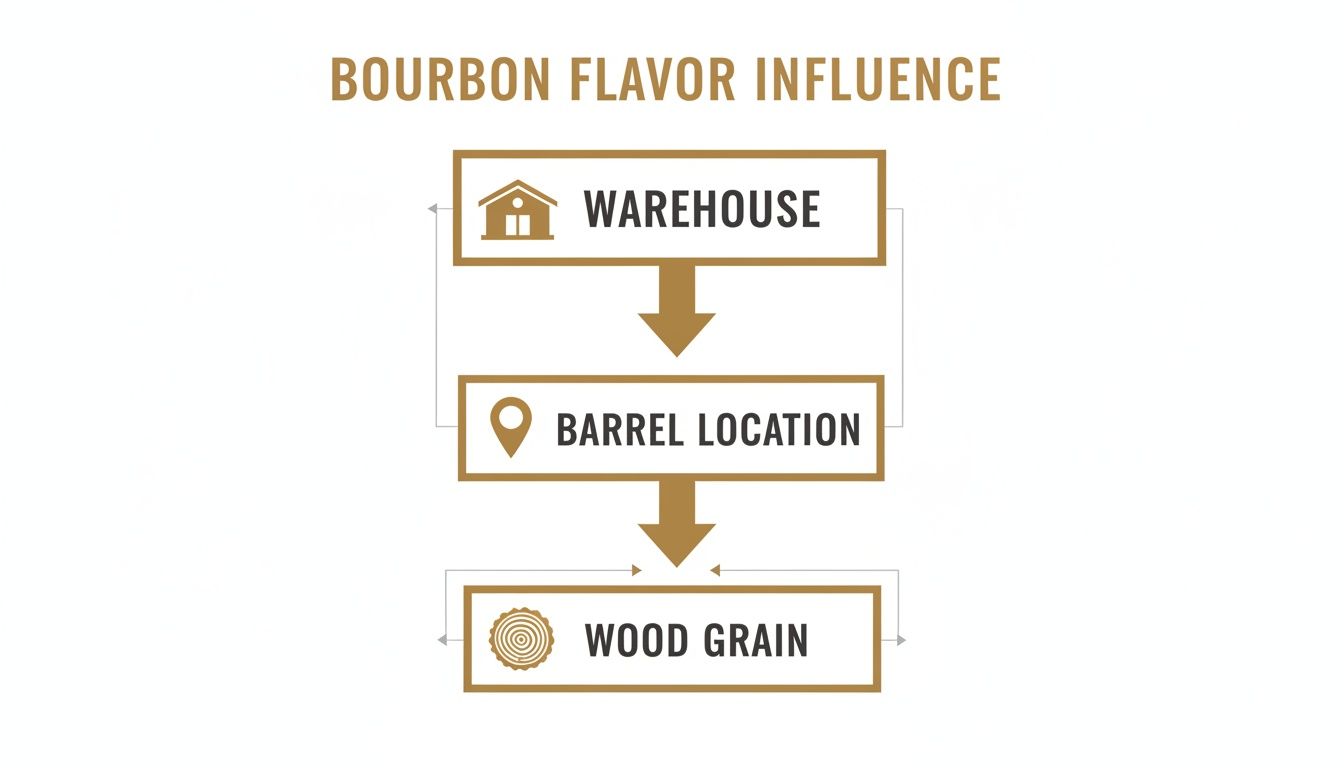
From the specific rickhouse it rests in to its exact location on the rack, every element nudges the whiskey in a slightly different direction, creating a truly one-of-a-kind spirit.
A Head-to-Head Comparison
To lay it all out, here’s a simple table breaking down how these bourbon types stack up against one another. This is your cheat sheet for the next time you're staring at a wall of whiskey.
Comparing Bourbon Types: Single Barrel vs. Small Batch vs. Blended
| Feature | Single Barrel Bourbon | Small Batch Bourbon | Standard (Blended) Bourbon |
|---|---|---|---|
| Source | One individual barrel | A select number of barrels | Hundreds or thousands of barrels |
| Flavor Profile | Unique and variable | Balanced and consistent | Highly consistent house style |
| Best For | Discovery and special occasions | Reliable sipping and craft cocktails | Everyday mixing and accessibility |
| Price Point | Typically premium | Mid-range to premium | Most affordable |
As you can see, there's no single "best" type—it all comes down to what you're in the mood for. Are you chasing a new and exciting flavor, or do you want the comfort of a familiar favorite? Each bottling style offers a different answer.
How to Choose and Appreciate Your First Single Barrel
Diving into your first single barrel adventure is one of the most exciting steps for any whiskey drinker. It's a chance to taste something truly unique, but let's be honest—the labels and options can feel a little intimidating at first. The key is knowing what to look for and approaching the whole experience with a healthy dose of curiosity.
The first step is learning to read the label like a pro, because that's where the whiskey's story begins. Look past the brand name and search for the details that really matter: the barrel number, the rickhouse location, and the dump or bottling date. These aren't just specs; they are clues to the whiskey's individual journey and what makes it a one-of-a-kind expression.
Getting Started with Accessible Craft Brands
For those just starting out, you don’t need to hunt down the rarest, most expensive bottle on the shelf. In fact, many American craft distilleries offer fantastic and approachable single barrel bourbons that are perfect for getting your feet wet. Look for releases from brands known for quality and transparency—they often deliver exceptional character without an astronomical price tag.
Here are a few tips for picking out that first bottle:
- Ask for Recommendations: Don't be shy! Talk to the staff at your local liquor store. They often get to taste new arrivals and can point you toward a single barrel that’s drinking exceptionally well right now.
- Look for "Store Picks": Many retailers collaborate with distilleries to select their own exclusive single barrel. These are often chosen specifically for having a distinct and crowd-pleasing profile, making them a fantastic starting point.
- Start with a Familiar Distillery: If you already enjoy a particular brand's standard or small batch bourbon, trying their single barrel expression is a great way to experience a more amplified and unique version of a profile you already know you like.
The Art of the First Sip
Once you have your bottle, the real fun begins. To truly appreciate what makes single barrel bourbon mean so much to enthusiasts, you have to taste it the right way. The whole goal is to isolate its unique character.
For your first tasting, always try the whiskey neat—no ice, no water, just the spirit in the glass. This is the only way to experience its undiluted aroma and flavor profile exactly as the distiller intended.
Let the bourbon sit in the glass for a few minutes before you take a sip. Swirl it gently and nose it to pick up all the distinct aromas. When you finally take that first taste, let it coat your entire palate to identify all the different notes. After you’ve gotten a pure impression, you can add a single drop of water to see how it opens up the flavors.
To elevate the experience, the right presentation can make all the difference; consider incorporating a sophisticated decanter drinkware set into your serving ritual.
Here's a great experiment: taste a distillery's single barrel release right alongside its standard small batch offering. This side-by-side comparison is the single best way to understand and appreciate the beautiful, delicious inconsistency that defines single barrel bourbon.
From Distillery Secret to Coveted Collectible: The Rise of Single Barrel
Single barrel bourbon wasn't always the premium pour we hunt for today. For decades, it was more of an inside secret, a quiet tradition where master distillers would squirrel away exceptional "honey barrels" for special occasions. These weren't for sale; they were reserved as unique gifts for distinguished guests, hardworking employees, and close friends—a personal nod to a single cask that had become something truly special.
This quiet practice started to shift as the bourbon world woke up to the magic of uniqueness. One of the most famous origin stories points to Colonel Albert B. Blanton, who ran what is now the Buffalo Trace Distillery. Back in the 1940s and 50s, he would personally hand-select the best barrels from the sweet spot in the center of Warehouse H, bottling them individually for ambassadors and other VIPs. It was a gesture that elevated a single barrel from a mere container to a statement of quality. You can learn more about how this practice evolved at places like Still Austin.
From Niche to Mainstream
The real turning point came with the bourbon boom of the late 20th and early 21st centuries. As drinkers became more educated and adventurous, they started craving more than just predictable consistency. They wanted a story, a sense of discovery, and a taste of something that simply couldn't be mass-produced. Distilleries listened, formalizing their single barrel programs and turning that old-school tradition into a sought-after product line.
Today, single barrels are a vital, thrilling part of the modern whiskey landscape. They play a few key roles that get both distillers and drinkers excited:
- Limited Editions: These special releases generate serious buzz and give a distillery a chance to show off its absolute best aging stock.
- Store and Group Picks: Retailers and whiskey clubs now get to select their own barrels, offering customers a truly exclusive bottle they can't find anywhere else on the shelf.
- A Driver of the Craft Movement: For many American craft whiskey distilleries, single barrel offerings are the heart of their philosophy, proving their skill in producing exceptional, one-of-a-kind spirits.
Single barrel bourbon transformed from a personal gesture of quality into a public symbol of it. It offers a direct connection to the distiller's craft, turning a simple bottle of bourbon into a sought-after collectible with a unique identity.
This evolution is exactly what gives single barrel bourbon its special status. It's a tangible piece of a distillery’s history, a celebration of individuality, and a thrilling hunt for that perfect, unrepeatable pour that keeps all of us coming back for more.
A Few Final Thoughts on Single Barrel Bourbon
As we wrap up, let's tackle a few common questions that pop up when people start digging into the world of single barrels.
Is Single Barrel Bourbon Always Better Than Small Batch?
That's the million-dollar question, isn't it? The honest answer is: not always. "Better" is completely in the eye of the beholder. A single barrel bourbon offers a snapshot in time—a unique, unrepeatable profile that can be absolutely magical... or just a bit quirky. It’s all about the thrill of the hunt.
On the other hand, a small batch bourbon is a masterclass in blending. The goal is a specific, high-quality, and consistent flavor that you can count on bottle after bottle. If you're someone who loves discovery and a bit of delicious unpredictability, single barrels are your playground. If you value masterful balance and knowing exactly what you're getting, a fantastic small batch might be your go-to.
Why Do Single Barrels Cost More?
It really comes down to a few key things. First, simple scarcity. A single barrel only yields about 150-250 bottles. Once it's gone, it's gone forever. Second, these barrels are almost always hand-selected by the master distiller for being exceptional—they're the standouts, the "A+" students of the rickhouse.
Finally, the logistics are just more intensive. Finding, tracking, and individually bottling single barrels takes a lot more hands-on effort than blending thousands of gallons at a time. That combination of rarity, standout quality, and pure craftsmanship is what you're paying for.
The core idea of single barrel is celebrating individuality. It’s an embrace of variation, which is why tasting different single barrels—even from the same distillery—is such a rewarding tip for new whiskey drinkers.
Can Bottles From The Same Single Barrel Taste Different?
Nope. Every single bottle from one specific single barrel release should be virtually identical. The distillery dumps the entire contents of the barrel into a holding tank before bottling, which ensures every drop is consistent.
But here’s the fun part: two different single barrels from the same distillery, even if they were filled on the same day and aged right next to each other, will almost certainly have noticeable differences. That’s the magic we keep talking about.
Discovering the unique story behind each cask is what makes whiskey tasting so exciting. With Blind Barrels, you can remove brand bias and let your palate lead the way. Explore exceptional American craft whiskeys and find your next favorite through the fun of a blind tasting experience at https://www.blindbarrels.com.