

When you're trying to figure out the difference between scotch vs bourbon vs whiskey, it's actually pretty simple at its core. Just remember this: all Scotch and Bourbon are types of whiskey, but not all whiskey is Scotch or Bourbon.
The real distinctions boil down to three things: where it’s made, what it’s made from, and how it’s aged. Think of "whiskey" as the big family name, with Scotch and Bourbon being two very specific, legally-protected members of the clan.
Unpacking the Whiskey Family Tree
Diving into the world of whiskey for the first time can feel like learning a whole new language. You'll hear terms like single malt, rye, and Tennessee whiskey thrown around, but the foundational debate usually kicks off with Scotch versus Bourbon. Getting a handle on these two titans is the perfect first step for any aspiring whiskey drinker looking to figure out what they like.
At its most basic level, whiskey is a distilled spirit made from a fermented grain mash—which could be anything from corn and barley to rye or wheat—that's then aged in wooden barrels. This broad definition is what allows for such an incredible diversity of styles, from Irish and Canadian expressions to the exciting boom in American craft whiskey.
This infographic gives you a quick visual breakdown of those key differentiators: geography, ingredients, and aging.
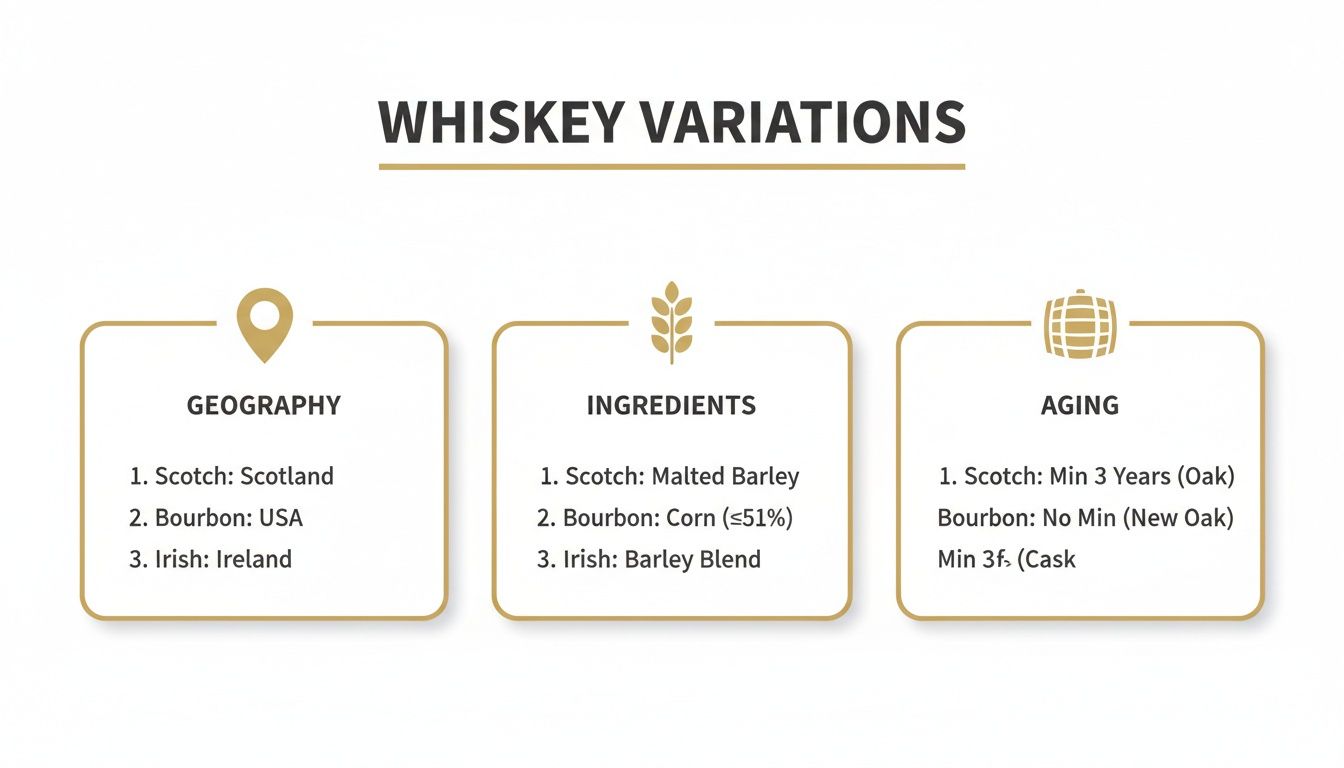
These core pillars aren't just suggestions; they are strict legal requirements that define the spirit in your glass.
The Ground Rules for Bourbon and Scotch
To earn the name Bourbon, a whiskey has to follow a strict set of rules, cementing its identity as "America's Native Spirit." These non-negotiable standards are exactly what give Bourbon its famously sweet and full-bodied character.
On the other side of the Atlantic, Scotch whisky has its own protected status. It must be produced entirely in Scotland, and its flavor can run the gamut from light and floral to intensely smoky and peaty, a range heavily influenced by regional traditions and production methods.
The legal definitions aren't there to stifle creativity; they exist to preserve heritage and guarantee a consistent standard of quality. When you grab a bottle labeled "Bourbon" or "Scotch," you know it has met a specific set of criteria that shapes exactly how it tastes.
To make things even clearer, let's break down these foundational differences in a quick table.
Core Differences at a Glance
This table gives you a side-by-side look at the defining characteristics of Scotch, Bourbon, and the wider world of whiskey.
| Attribute | Scotch | Bourbon | Whiskey (General) |
|---|---|---|---|
| Origin | Must be made in Scotland | Must be made in the U.S. | Can be made anywhere in the world |
| Main Ingredient | Primarily malted barley | At least 51% corn | Varies (corn, barley, rye, wheat) |
| Aging Process | Aged in oak barrels for at least 3 years | Aged in new, charred oak barrels | Varies, can be new or used barrels |
| Common Flavor Profile | Complex, from smoky & peaty to fruity & floral | Sweet, with notes of caramel, vanilla, & oak | Extremely diverse; can be spicy, smooth, or sweet |
As you can see, the specific rules for Bourbon and Scotch give them their unique identities, while the broader "whiskey" category leaves plenty of room for distillers around the globe to innovate.
Comparing the Legal Distinctions
To really get to the bottom of the Scotch vs. Bourbon vs. whiskey debate, you have to look at the rulebooks. These spirits aren't just defined by flavor; they’re shaped by strict legal standards that protect their heritage and guarantee a certain level of quality. Think of these laws as the DNA of the spirit, dictating everything from where it's made to the kind of barrel it rests in.
For Scotch, geography is everything. To earn the name Scotch whisky, the spirit absolutely must be distilled and matured entirely within Scotland for at least three years. This "Appellation of Origin" works just like the protections for Champagne in France—it ensures that every single drop is a genuine product of its homeland.
Bourbon, on the other hand, is proudly American. Declared "America's Native Spirit" by a 1964 act of Congress, it has to be produced somewhere in the United States. While most of us think of Kentucky as its heartland, distilleries from Texas to New York can legally produce Bourbon, as long as they stick to the other critical rules.
The Mash Bill Mandate
The recipe of grains, known as the mash bill, is one of the biggest legal lines in the sand. This is the starting point, the foundation that shapes the spirit’s fundamental character long before it ever sees a barrel.
For a whiskey to be legally called Bourbon, its mash bill must contain at least 51% corn. This high corn content is the very source of Bourbon's trademark sweetness, lending those classic notes of caramel, vanilla, and a rich, full-bodied mouthfeel. The other grains, typically rye or wheat plus some malted barley, are there to add layers of spice or softness to the final product.
Single Malt Scotch, however, has a much simpler requirement: it has to be made from 100% malted barley. This singular focus on barley creates a totally different flavor foundation, often described as malty, biscuity, or cereal-like, which then acts as a canvas for other parts of the production process to paint on.
The mash bill is the first critical fork in the road. Bourbon's required corn base guarantees a certain sweetness, while Scotch's barley-centric approach provides a different canvas for distillers to work with.
For those just starting their journey, this grain difference is one of the easiest ways to predict what a whiskey might taste like. Here's a tip: if you're new to the scene, try starting with a "wheated" bourbon, like those from American craft brand Wyoming Whiskey. The wheat really softens the spice, making the spirit exceptionally smooth and approachable.
Rules of the Barrel
Aging is where the real magic happens, and the laws governing barrels are just as strict—and just as impactful—as the ones for grain. This is where Bourbon and Scotch take dramatically different paths.
Bourbon law is explicit: it must be aged in new, charred oak containers. This rule is a game-changer. That fresh, heavily charred wood imparts a massive amount of flavor—oak, vanilla, spice—in a relatively short amount of time. There are no exceptions. Once a barrel has been used to age Bourbon, it can never be used for Bourbon again. To dig deeper into how this and other rules create such distinct spirits, you can explore the key differences between Bourbon and whiskey in our detailed guide.
Scotch maturation, by contrast, offers far more flexibility. It has to be aged in oak casks for a minimum of three years, but distillers can use a huge variety of barrels. Most commonly, they use ex-bourbon barrels, which lend softer, sweeter notes to the Scotch. But they also frequently use casks that previously held other spirits or wines—like sherry, port, or rum—to add unique layers of fruity, nutty, or spicy complexity. This creative use of casks is a true hallmark of the Scotch industry, allowing for an incredible spectrum of flavor profiles.
This legal distinction in barrel use is a perfect example of how American craft whiskey brands are now innovating. Distilleries like Westward Whiskey in Oregon are borrowing a page from the Scotch playbook, often finishing their American Single Malts in stout or pinot noir casks to create some really exciting new flavors.
How Production Methods Shape the Spirit
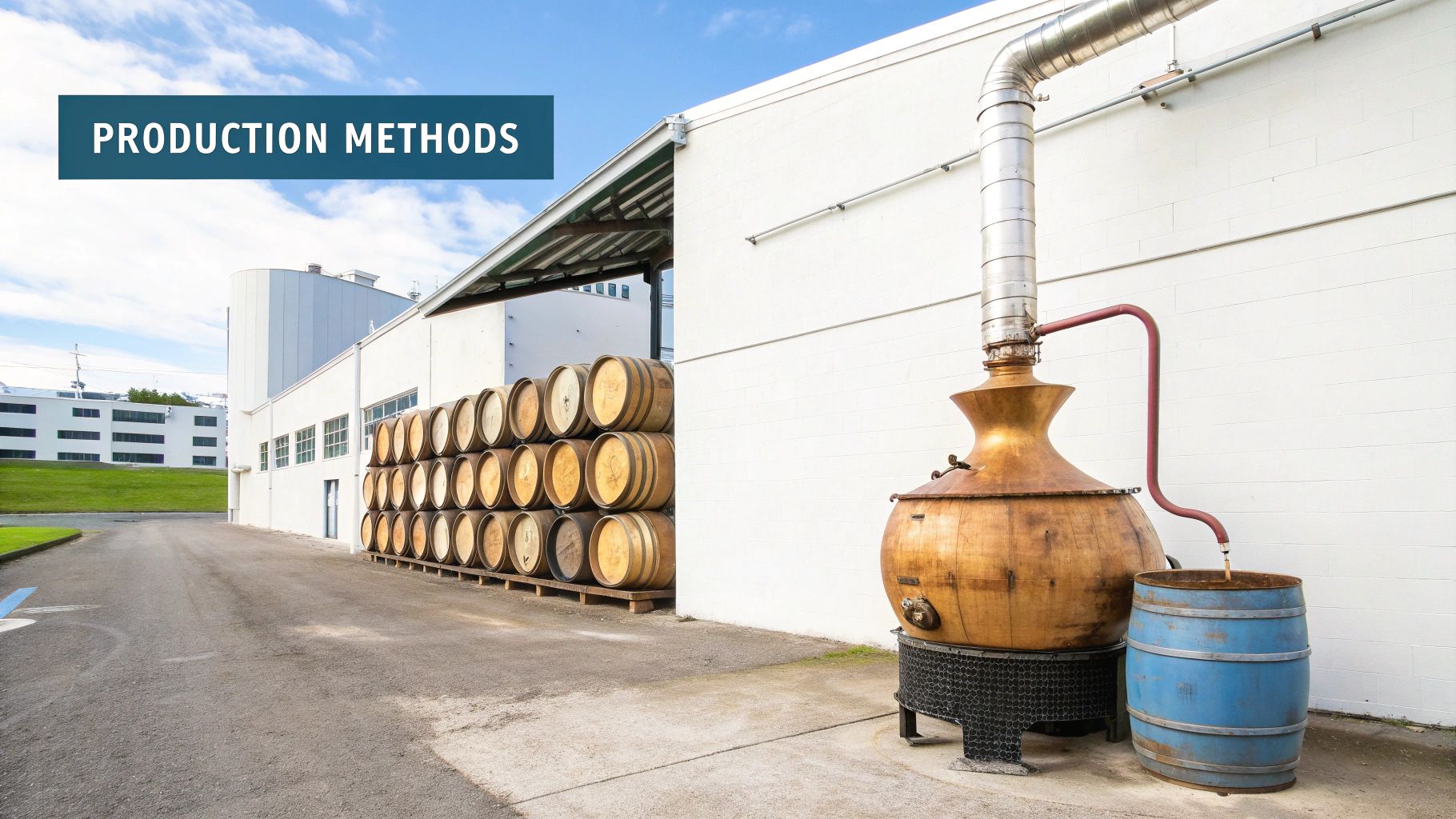
While the legal definitions draw the lines, it’s the hands-on production methods where a whiskey’s soul is truly forged. Every choice a distiller makes—from how they dry the grain to the very shape of the still—creates the vast spectrum of flavors that separates a Scotch from a Bourbon. These are the steps that turn humble grain and water into a spirit with real character.
The journey starts with the grain itself. In Scotland, the malting process for many iconic Scotches involves a legendary ingredient: peat. When malted barley is dried over a smoky peat fire, it soaks up phenolic compounds. This is what gives Islay malts their signature smoky, earthy, and sometimes medicinal notes.
Bourbon, on the other hand, almost never sees peat. The entire goal is to preserve the sweet, clean character of the corn, which is the star of the show. This fundamental difference means you’ll rarely find that campfire smoke in a Bourbon; instead, you get a pure, unadulterated expression of the grain.
The Influence of Distillation
After fermentation, the liquid—now essentially a beer—heads to the stills for distillation. This is where the alcohol gets concentrated and the spirit’s body and complexity really start to develop. The type of still used has a massive impact on the final product.
Many Scotch distilleries, especially those making single malts, stick with traditional copper pot stills. It’s a batch process, which is less efficient but allows more of the original congeners—the flavor compounds from the mash—to carry over. This results in a whiskey that is often richer, more robust, and incredibly complex.
Bourbon is typically made using a continuous column still. This method is way more efficient, producing a higher-proof spirit much faster. The result is generally a lighter, smoother, and cleaner spirit, which perfectly sets the stage for the bold flavors it will soak up from the barrel. For a deeper dive into this crucial step, check out our guide on the art of whiskey distillation.
For new whiskey drinkers, here's an easy way to think about it: pot stills are like slow-simmering a stew to build deep, layered flavors. Column stills are like flash-searing at high heat for a clean, efficient result. Neither is "better," they just create entirely different styles of spirit.
Climate and the Angel's Share
Once distilled, the spirit goes into oak barrels for maturation. This is where geography comes back into play, this time through climate. The environment surrounding the rickhouse has a profound effect on how the whiskey and wood interact over time.
Scotland’s cool, damp, and stable maritime climate leads to a slow, gentle maturation. The low humidity and minimal temperature swings mean less whiskey evaporates from the barrel each year—a loss famously known as the “angel's share.” This patient aging allows Scotch to develop subtle, nuanced complexities over many years, even decades.
Contrast that with Kentucky's wild climate, with its blazing hot summers and cold winters. This creates a much more aggressive aging environment. The barrel staves expand in the heat, pulling whiskey deep into the wood, then contract in the cold, pushing it back out. This constant "breathing" turbocharges the maturation process.
This means a 5-year-old Bourbon can have a depth of flavor and color that might take a Scotch 10 to 12 years to achieve. American craft distilleries are masters of this dynamic. Take an American craft brand like Balcones in Texas, for example. They use the intense heat to create uniquely bold whiskeys in a fraction of the time it would take in a milder climate. This accelerated aging is a hallmark of American whiskey.
A Beginner's Guide to Tasting Notes
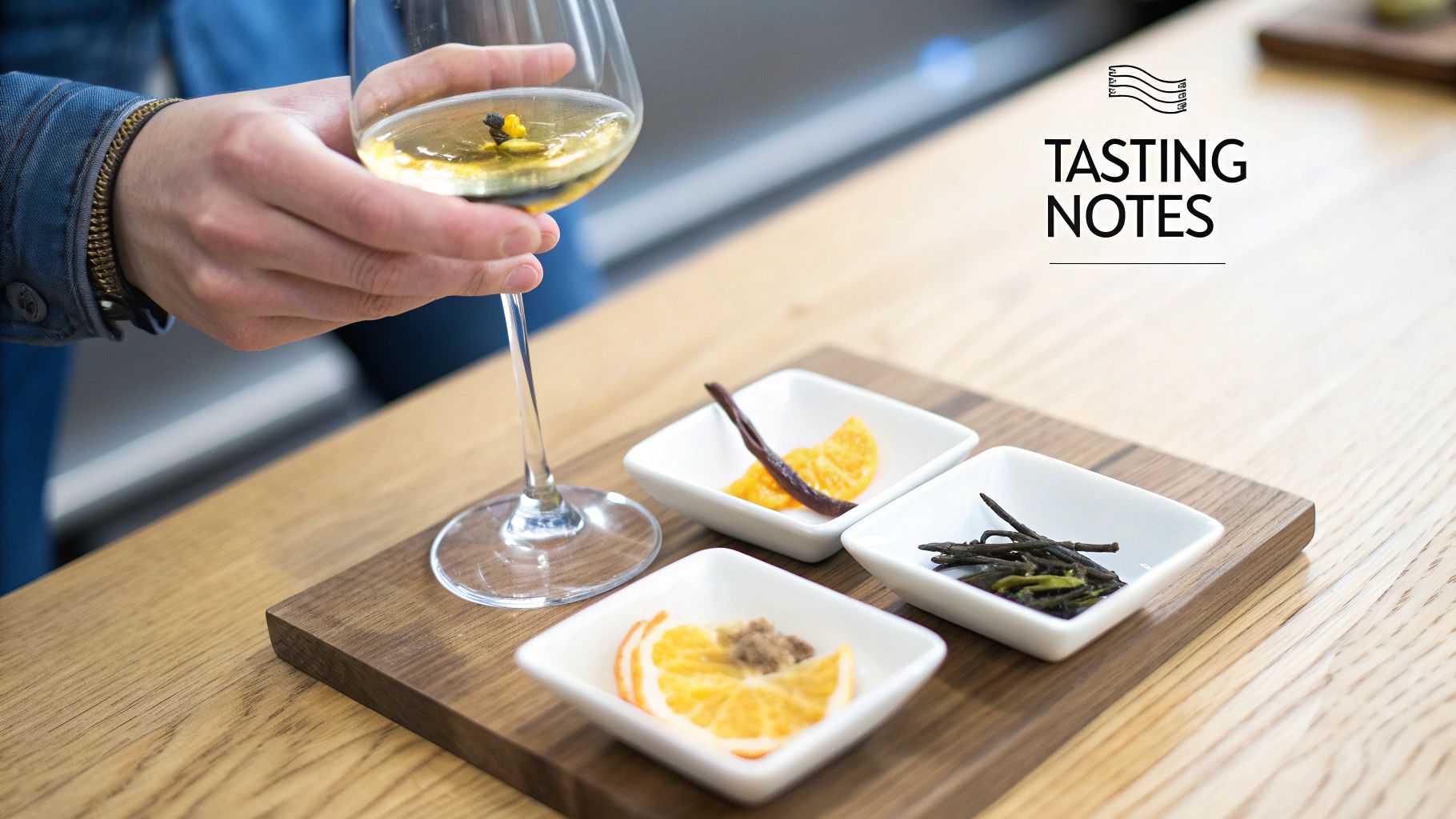
Okay, you’ve got the legal stuff and the production methods down. Now for the best part: figuring out what’s actually in your glass. This isn’t some innate talent; it’s a sensory skill that sharpens with practice. The trick is to shift from just "drinking" whiskey to actively identifying the specific aromas and flavors.
Tasting notes might sound fancy, but they’re really just words for the scents and flavors created by the grain, the still, and the barrel. Every sip tells the story of its journey, and learning to read those cues will completely transform how you enjoy a dram. You don't need a super-palate, just a simple framework to guide you.
The Flavor Map of Scotch Whisky
Scotch probably has one of the most diverse flavor landscapes in the spirits world, and that’s almost entirely down to its regional differences. A whisky from Islay tastes worlds apart from one made just a few hundred miles away in Speyside.
For many, the first thing that comes to mind with Scotch is smoke, a direct result of drying malted barley over a peat fire. But it’s so much more complex than just "smoky."
- Islay: This is peat country. Brace yourself for bold flavors of bonfire smoke, iodine, sea brine, and even a medicinal note some people compare to bandages. It’s an intense profile, but incredibly rewarding once you get it.
- Speyside: Known for elegant, often gentler malts. Here you’ll find fruity and floral notes—think apple, pear, honey, and vanilla. It’s pretty much the opposite end of the flavor spectrum from Islay.
- Highlands: This massive region produces a huge variety of styles. Still, many share a rich character with notes of dried fruit, nuts, heather, and sometimes just a gentle, heathery wisp of smoke.
Tip for New Drinkers: Please don't start with a heavily peated Islay Scotch. Ease into the category with a Speyside malt like a Glenlivet or Glenfiddich. Their lighter, fruit-forward profiles are far more approachable and help train your palate to pick out subtleties before you dive headfirst into the smoke.
The Signature Sweetness of American Whiskey
While Scotch runs the gamut of flavors, Bourbon and other American whiskeys tend to have a more focused, recognizable core profile. That consistency comes straight from the law: a mash bill of at least 51% corn and aging in new charred oak barrels. These two rules are the bedrock of its taste.
The high corn content lays down a foundation of sweetness, while the fresh, charred oak barrels impart deep, rich flavors. This classic combination creates a flavor map that is distinctly American.
- Bourbon: The quintessential notes here are caramel, vanilla, and oak. You’ll also find hints of brown sugar, toffee, baking spices like cinnamon, and a touch of dark fruit. High-rye Bourbons bring a peppery spice to the party, while wheated Bourbons are softer, with notes of bread dough and honey.
- Rye Whiskey: Legally required to have at least 51% rye in its mash bill, rye is Bourbon’s spicier cousin. Look for bold notes of black pepper, clove, and mint, all wrapped up in a drier finish. American craft distilleries like Frey Ranch in Nevada are making a name for themselves with exceptional "farm-to-glass" rye whiskeys.
How to Taste Whiskey Like an Expert
Tasting is a full-sensory experience that involves a lot more than just your tongue. By following a simple, structured approach, you can unlock a whiskey’s complete character. This method works perfectly whether you're comparing scotch v bourbon v whiskey or just enjoying a pour at home.
- Look: Hold your glass up to the light. The color can offer clues about its age and cask type. Darker colors often suggest longer aging or time spent in more active barrels, like new oak or sherry butts.
- Nose: This is the most critical step. Swirl the whiskey gently, bring the glass to your nose, and keep your mouth slightly open. Inhale slowly. What do you smell first? Fruit? Spice? Smoke? Don’t rush this part—the aroma will evolve as it sits in the glass.
- Sip: Take a small sip and let it coat your entire tongue. Try to pinpoint the initial flavors. Is it sweet, spicy, or savory? Pay attention to the mouthfeel—is it thin and light or rich and oily?
- Finish: After you swallow, notice the flavors and sensations that linger. This is the finish. Is it short and clean, or does it hang around for a while? Do new flavors emerge, like a late hint of spice or a lasting sweetness?
To get started documenting your own tasting adventures, it helps to have a guide. Our team put together a comprehensive whiskey tasting notes template that breaks down each part of the process. Using a template is a fantastic way for new drinkers to build confidence and develop a tasting vocabulary.
How to Best Enjoy Your Whiskey
Figuring out the legal definitions and tasting notes is one thing, but the real fun starts when you discover how you personally like to drink your whiskey. Let's be clear: there's no single "right" way. The best approach changes with the spirit, the occasion, and your own palate. This is your practical guide to deciding whether to sip, stir, or pair your next pour.
The character of the whiskey itself is often the best guide. A complex, contemplative single malt Scotch, for instance, tends to reveal its deepest secrets when you enjoy it neat. This lets its full spectrum of aromas and flavors—from delicate heather to robust peat smoke—shine through without any interference.
On the other hand, a drop or two of water can be magical, especially with higher-proof whiskeys. This simple addition can dial back the alcohol's intensity, opening up subtle notes that might otherwise stay hidden. If you're just starting out, it’s an excellent way to make a bold spirit more approachable.
The Right Spirit for the Right Occasion
The setting matters. Are you settling in for a quiet evening by the fire or mixing up a batch of drinks for friends? The whiskey's profile should match the moment.
- For Sipping Neat: A smoky, peaty Scotch is perfect for slow, contemplative sipping. Its layered complexity demands your attention and rewards a patient palate.
- For a Classic Cocktail: A high-proof Bourbon is the backbone of a great Old Fashioned. Its natural sweetness and bold vanilla notes stand up beautifully to bitters and sugar, creating a balanced, timeless drink.
- For a Refreshing Highball: A versatile, smooth American craft whiskey is ideal here. Its balanced profile won't get lost when mixed with soda water, making for a crisp and invigorating long drink.
Pairing Whiskey with Food
Just like wine, whiskey can be a fantastic partner for food, creating pairings that elevate both the dish and the dram. The trick is to match intensities—bold whiskeys for bold foods, and lighter whiskeys with more delicate fare.
A classic example is pairing a peaty Islay Scotch with smoked salmon; the whiskey's smoky, briny character is a perfect match for the rich, oily fish. For a truly American experience, try a sweet Bourbon with slow-cooked BBQ ribs. The spirit's caramel and vanilla notes harmonize beautifully with the smoky, sweet glaze on the meat. Many American craft distilleries, like Frey Ranch with its farm-to-glass approach, produce bourbons with enough personality to stand up to hearty meals.
For new whiskey drinkers, here's a simple but effective tip: start by pairing whiskey with sharp cheeses or dark chocolate. These pairings are straightforward yet do a great job of highlighting the core sweet or spicy notes in the spirit, making it easier to pinpoint what you enjoy.
The global fascination with the scotch v bourbon v whiskey debate is fueling some incredible market growth, especially for American styles. While the global whiskey market is projected to hit USD 116.01 billion by 2033, the U.S. market is exploding at a predicted 12.7% annual growth rate, driven by the cocktail boom and craft appeal. This boom means more fantastic options for every occasion.
If you're curious about how whiskey is enjoyed in popular mixed drinks, you can learn more about the classic Boilermaker cocktail. Ultimately, experimentation is your best tool for finding what you truly love.
Finding Your Preference with Blind Tasting
Reading about mash bills and finishing casks is a great start, but the only way to truly settle the Scotch vs. Bourbon debate for yourself is to let your palate be the judge. Blind tasting is the ultimate equalizer—it strips away the fancy labels, the marketing spin, and the intimidating price tags, leaving just the spirit in the glass. It’s the most honest way to figure out what you genuinely love to drink.
When you remove those preconceived notions, you’re forced to focus on what’s actually happening in your mouth. Is that sweetness coming from a corn-heavy bourbon, or is it a whisper from a sherry cask-finished Scotch? Is that spicy kick from a high-rye mash bill or simply a higher proof? A blind tasting makes you trust your own senses above all else.
From Reading to Tasting
A curated blind tasting experience is the perfect next step, moving you from being a passive reader to an active participant in your own whiskey journey. It’s a fun, hands-on way to connect the dots between a spirit’s backstory, its production process, and the final flavor profile that lands in your glass. This is where the real "aha!" moments happen.
Blind tasting is more than just a party game; it's a powerful tool for developing your palate. It helps you pinpoint the specific flavors you're drawn to, which makes you a more confident and informed buyer when you’re staring down a wall of whiskey at the local shop.
This is especially true when you start digging into the exciting world of American craft whiskey. So many small, independent distilleries are making exceptional spirits that just fly under the radar. By tasting blind, you might stumble upon a new favorite from a distillery you’ve never even heard of—maybe a bold single malt from Texas or a complex rye from a farm distillery in the Pacific Northwest.
Discovering What Your Palate Prefers
Ultimately, knowing the global spirits landscape helps frame your personal choices, but it shouldn't dictate them. Scotch whisky, for example, continues to captivate enthusiasts with its deep traditions and impressive market growth. The global Scotch market was valued at USD 36.38 billion in 2024 and is projected to hit USD 60.71 billion by 2032, driven largely by its stronghold in Europe. You can read more about these Scotch market findings and see just how big its global footprint is.
That kind of knowledge is interesting, but it has nothing to do with what you'll enjoy on a Tuesday night. Blind tasting gives you the freedom to decide for yourself whether you prefer the smoky allure of a traditional Scotch or the sweet, oaky character of an innovative American bourbon, regardless of market trends. It’s the final call to action: stop reading and start tasting.
Common Questions Answered
Diving into the world of whiskey brings up a lot of questions, especially when you start comparing styles like Scotch and Bourbon. Let's tackle some of the most common ones we hear from folks just starting their journey.
Can Bourbon Be Made Outside Of Kentucky?
Absolutely. While Kentucky is without a doubt the spiritual home of Bourbon, it can legally be produced anywhere in the United States.
As long as the spirit follows the strict legal recipe—a mash bill of at least 51% corn, aged in new charred oak barrels, and bottled at 80 proof or higher—it rightfully earns the title "America's Native Spirit." In fact, some of the most exciting American craft whiskey is coming from states like Texas, Nevada, and Washington, proving that great Bourbon knows no borders.
Is All Scotch Smoky?
This is probably one of the biggest misconceptions out there. That intense, smoky, peaty flavor is really the signature of whiskies from specific regions, most famously Islay. But plenty of Scotch has no smoke at all.
Regions like Speyside and the Lowlands are known for producing malts with completely different, often more approachable, profiles:
- Speyside: Think light, grassy, and fruity, with notes of apple, pear, and honey.
- Lowlands: These are typically gentle and smooth, often with delicate floral and citrus notes.
A great tip for anyone new to Scotch is to start with a non-peated expression. It lets you appreciate the foundational malty character of the spirit before you dive into the more polarizing smoky styles. It's all about building your palate one step at a time.
What Is The Best Way For A Beginner To Drink Whiskey?
Honestly, the best way is whatever way you enjoy it most. There's no right or wrong answer here.
For beginners, a great place to start is with a splash of water or a single large ice cube. That little bit of dilution can soften the alcohol's punch and open up the more delicate flavors, making the whole experience more approachable.
Trying a classic cocktail is another fantastic route. A well-made Old Fashioned with a quality Bourbon or a crisp Whiskey Highball are perfect introductions that let the spirit's character shine without being overwhelming.
Ready to figure out your personal whiskey preferences without any bias? The Blind Barrels tasting experience is designed to help you explore top-shelf American craft distilleries and let your own taste buds lead the way. Find your next favorite bottle at https://www.blindbarrels.com.