

Bourbon is a special style of whiskey that leans on at least 51% corn, matures in new, charred oak barrels, and shuns any additives. By contrast, whiskey stands as a broad family of grain spirits—each with its own mash bill, barrel tradition, and geographic regulations.
Understanding Core Differences In Bourbon And Whiskey
- Legal Requirements – Bourbon must be distilled, barreled, and bottled in the U.S. within strict proof limits, whereas whiskey spans global producers, each following local standards.
- Mash Bills – Bourbon leans heavily on corn; most whiskeys freely blend barley, rye, wheat, or other grains.
- Aging Practices – Bourbon demands brand-new, charred oak casks; many whiskeys reuse barrels or experiment with finishes.
- Flavor Profiles – Bourbon delivers vanilla, caramel, and gentle baking spices; whiskey’s spectrum ranges from peppery rye to peaty, smoky malt.
- Craft Examples – American small-batch distillers like Frey Ranch Bourbon and Westland American Single Malt showcase how mash innovation and local grains redefine whiskey styles.
- Beginner Tip – Look for craft distilleries that share mash bills and barrel details on their labels to build your tasting knowledge.
Below is a concise breakdown of how bourbon stacks up against whiskey across these foundational elements.
Overview Of Bourbon Compared To Whiskey
| Aspect | Bourbon | Whiskey |
|---|---|---|
| Legal Definition | Must be produced in the U.S., distilled ≤ 160 proof, barreled ≤ 125 proof, no additives | Styles vary by country (e.g., Scotch, Irish, Canadian) with distinct distillation, aging, and additive rules |
| Mash Bill | Minimum 51% corn, balance often barley and rye | Any grain mix—barley, corn, rye, wheat—depending on style |
| Aging | New, charred oak barrels; Straight Bourbon needs ≥ 2 years | New or used casks; aging windows differ by type |
| Flavor Profile | Rich vanilla, caramel, toasted oak, subtle spice | Broad—from light, fruity notes to bold smoke or spice |
Craft Spotlight: Frey Ranch Bourbon and Westland American Single Malt illustrate the diversity of American craft whiskey, from corn-forward bourbon to barley-driven single malts.
Key Insight: Bourbon’s firm rulebook around mash and cask yields consistency. Whiskey’s open playbook fuels endless creativity.
Comparison At A Glance
The infographic below brings these contrasts into focus—highlighting each spirit’s signature ingredients, barrel artistry, and flavor hallmarks.
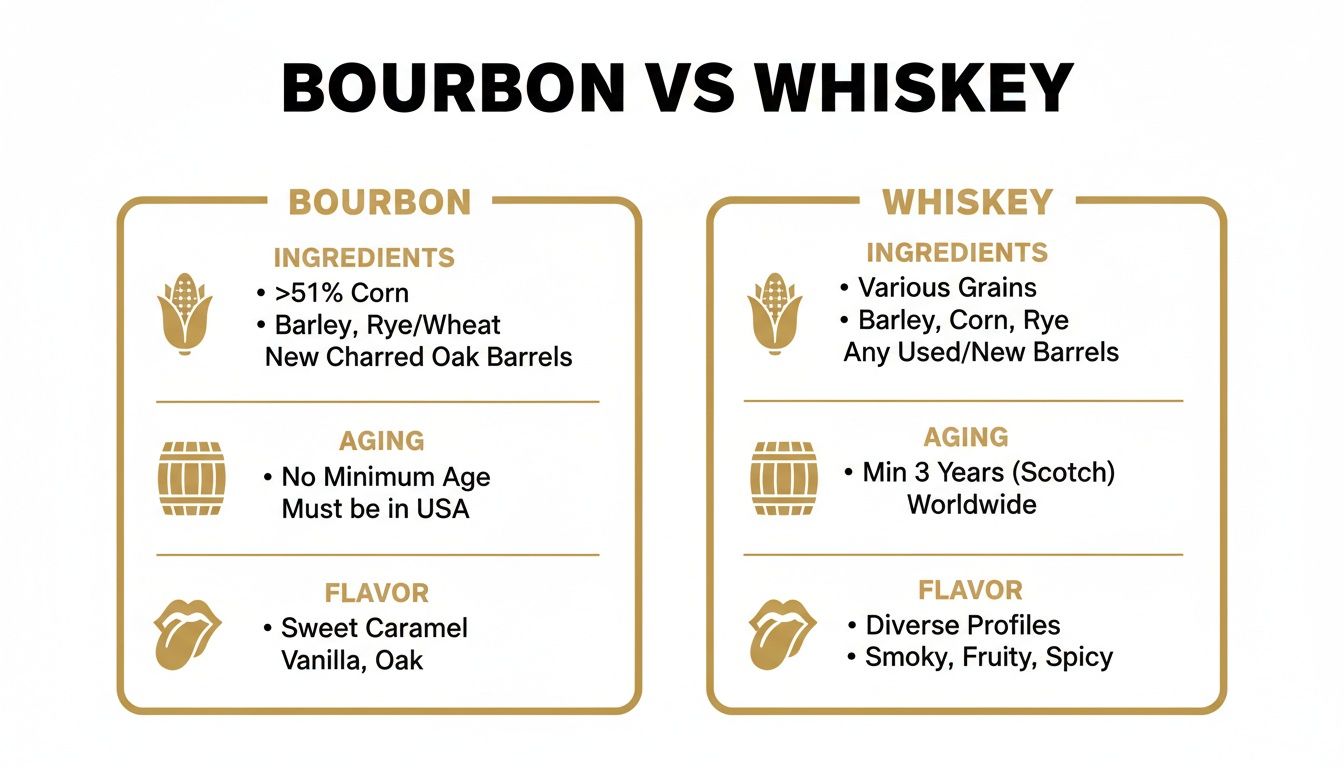
That visual makes it clear: bourbon’s strict corn mash and new oak aging drive its warm, caramel-forward essence. Whiskey’s mash bill freedom and varied casks unlock a world of spice, smoke, and fruit.
For someone seeking a reliable, sweet-leaning dram, bourbon fits the bill. If you love exploring unexpected flavor twists, broader whiskey categories invite discovery. Ready to taste these nuances side by side? Grab a Blind Barrels tasting kit and set up a quick blind-tasting exercise—your palate will thank you.
Understanding Legal Definitions
If you want a spirit to carry the bourbon badge, it must adhere to specific federal rules. This isn’t just tradition—it’s U.S. law. Every bottle of bourbon you see has jumped through these hoops.
- Minimum Mash Bill: 51% corn forms the backbone of bourbon’s signature sweetness and vanilla hints.
- Distillation & Barreling Proof: The liquid can’t come off the still above 160 proof, and it must go into its barrel at no more than 125 proof.
- Aging Vessels: Only new, charred oak barrels are allowed—this is where those toasty caramel and spice aromas develop.
- No Additives: No coloring. No flavoring. Only pure whiskey.
Craft Spotlight: Hudson Baby Bourbon by Tuthilltown Distillery exemplifies how American craft continues to push flavor boundaries within legal limits.
Beginner Tip: Always check the distillery’s backstory—craft labels often share mash bill and barrel details for deeper tasting context.
Why Rules Matter
Understanding these regulations isn’t just trivia for tasting soirées—it’s your secret weapon for reading labels like a pro. Bourbon stands out, too. It’s an American original, produced almost exclusively in Kentucky—over 95% of global bourbon comes from there.
In 2022, the U.S. pumped out about 22.7 million 9-liter cases of bourbon. That volume means bourbon makes up roughly 70–75% of all U.S. whiskey sales.
Learn more about the bourbon market on MarketGrowthReports.com
Key Insight Bourbon’s strict federal rules secure consistency but also drive craftsmanship and regional identity.
Check out our guide on what makes a whiskey a whiskey for deeper label decoding.
Once you understand these legal guardrails, you can match your taste goals with confidence—whether you’re at a bar or browsing shelves.
Labeling Considerations
Labels on bourbon bottles can feel like alphabet soup, but each term has a clear definition. For craft-focused kits like Blind Barrels, spotting these cues is essential.
| Label Type | Requirement |
|---|---|
| Straight Bourbon | At least two years of aging |
| Single Barrel | Bottled from one individual barrel |
Spotting these cues helps you bypass marketing fluff and zero in on authentic small-batch expressions. Next up: how mash bills shape flavor profiles in bourbon and beyond, complete with real-world examples.
Comparing Mash Bills And Ingredients
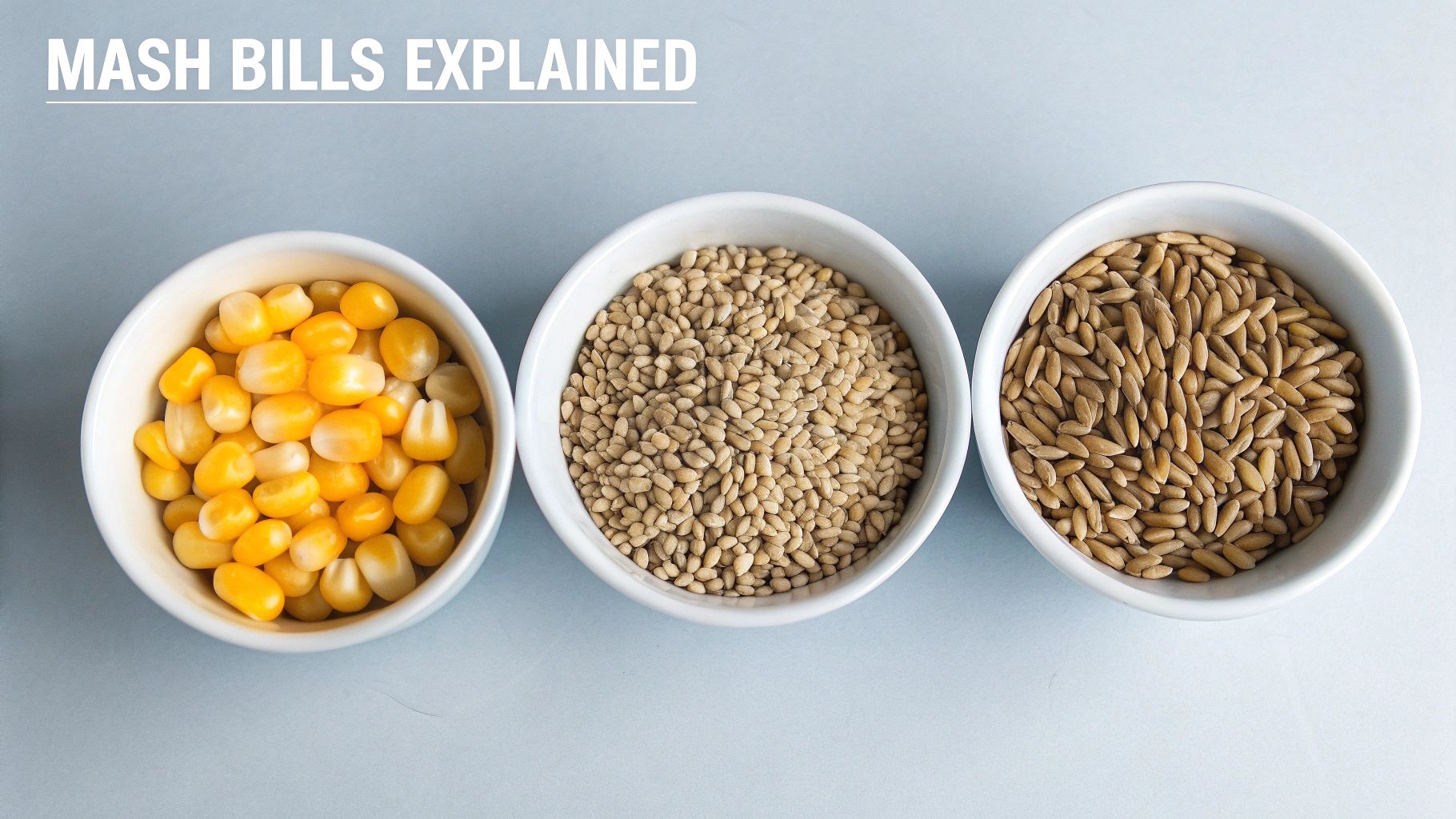
Bourbon owes much of its sweetness to a mash bill that contains at least 51% corn, bringing forward rich caramel, vanilla and toasty aromas.
Craft Spotlight: Balcones Texas Single Malt and Westland American Single Malt showcase how American distillers adapt mash bills beyond traditional grains, tapping heirloom varieties and novel ratios.
Distillers adjust the remaining grain proportions—rye, barley or wheat—to dial in spice, nuttiness or a softer mouthfeel.
In effect, your grain ratios become a flavor blueprint, guiding every sip toward its signature character.
Many craft outfits now explore heirloom or locally grown grains to capture a true sense of place in each batch.
For example, Pennsylvania distilleries often highlight heritage barley to introduce grassy, biscuit-like notes.
- Corn-Focused Mash: Natural sweetness and full body
- Rye-Heavy Mash: Peppery spice and a crisp finish
- Wheat-Forward Mash: Silky texture and gentle breadiness
Tip for New Whiskey Drinkers: Use a simple flavor wheel to link cereal, spice and fruit notes to their grain origins.
Breaking Down Grain Flavors
Link tasting cues directly to grain influence for quicker recognition.
- Corn-Led Whiskeys: Vanilla, honey or butterscotch
- Rye-Centric Drams: Pepper, clove or baking spice
- Barley-Rich Spirits: Cereal, toast or light nuttiness
| Grain Type | Bourbon Range | Flavor Impact |
|---|---|---|
| Corn | 51–80% | Vanilla, caramel |
| Rye | 0–43% | Pepper, spice |
| Barley | 0–10% | Cereal, nutty |
| Wheat | 0–25% | Soft, creamy |
“Grain choice shapes the soul of a whiskey,” a craft distiller reminds us.
Many labels now list detailed mash bills on the back. Side-by-side bottle comparisons will sharpen your palate over time.
That hands-on discovery is exactly what Blind Barrels’ tasting kits are built around—guiding members through aroma, mouthfeel and finish.
Regional Ingredient Explorations
From Tennessee’s charred-corn mash to Texas’ rye-forward blends, regional harvests are steering exciting mash innovations.
Local heroes: Balcones Field of Dreams uses heirloom corn in Texas, and Westward Whiskey in Oregon focuses on Pacific Northwest barley.
Use a simple tasting sheet to jot down observations and spark lively discussion during a home flight.
Bourbon and whiskey diverge significantly in market growth trajectories and regional dominance. Bourbon has carved out a premium niche in major global markets, while whiskey as a whole enjoys broader appeal. Learn more about bourbon and whiskey market findings in the Markspark Solutions report.
Check out our detailed breakdown of bourbon mash bills in our guide on Blind Barrels
Beginner Tip: When comparing regional whiskeys, note how humidity and terroir shape barrel interaction—take simple notes to guide your next craft purchase.
Exploring Aging Processes And Flavor Profiles
No two barrels age alike. From char level to barrel reuse and warehouse climate, every detail nudges bourbon and whiskey toward distinct taste signatures.
Bourbon, by law, must rest in new charred oak barrels, which layer in vanilla, cinnamon and spice. Whiskey, on the other hand, often spends years in used casks, where oak influence is more subtle and nuanced.
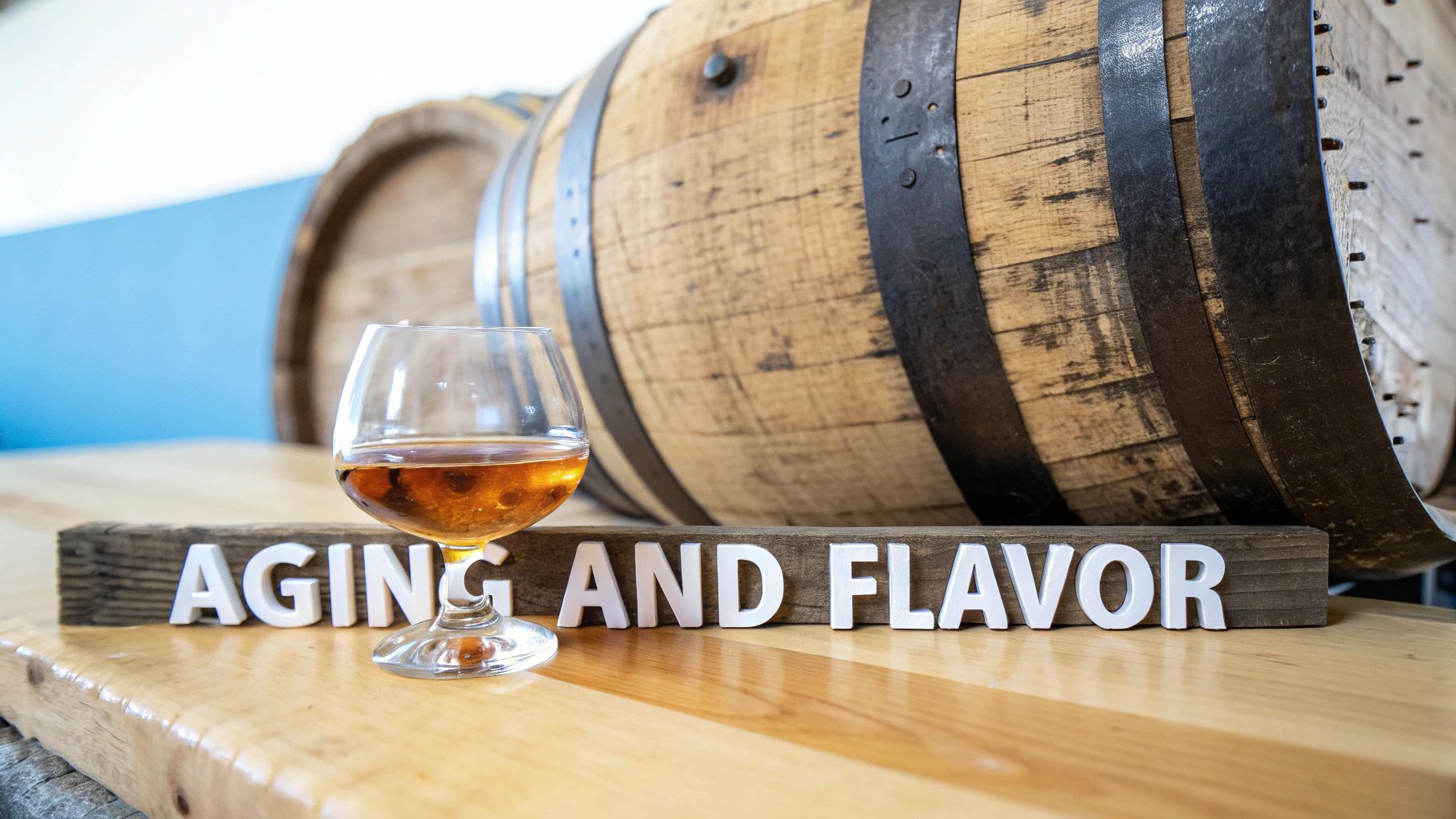
Craft Spotlight: Westward Whiskey Reserve Cask 10 Year provides insight into American single malt barrel aging, while Hudson Four Grain Bourbon shows how grain mix affects aging dynamics.
Char Levels And Barrel Dynamics
Char levels, numbered from #1 through #4, dictate how deeply the sugars caramelize and how intense those smoky notes become. A #3 char strikes a sweet spot: you get pronounced toasted oak aromas without erasing the grain’s natural character.
- Char Level: Depth of caramelization and toast
- Barrel Reuse: First-fill vs. second-fill flavor impact
- Rack-House Orientation: Varying heat cycles on different floors
Tip for New Whiskey Drinkers: Start with a low-charring level (like #2) whiskey to ease into oak influence before exploring darker charred variants.
Warehouse Influence
Temperature swings in warehouses amplify or slow down barrel interaction. Heat pushes bourbon into oak in the summer, while cooler months let the spirit pull back, softening tannins.
- Warehouse Type: Metal vs. brick structures
- Humidity Control: Higher moisture slows evaporation (“angel’s share”)
- Seasonal Cycle: Accelerated aging under extreme temperatures
Supply and demand also shape barrel sourcing and eco debates at distilleries. In Kentucky alone, bourbon production has jumped by 566% since 2000, now with 17.1 million aging barrels—more than three per resident. U.S. distilleries milled 2.8 billion pounds of grain in 2023. Dive deeper into bourbon’s market growth and sustainability in this detailed market report.
Barrel Aging Tips For Beginners
If you’re new to whiskey, these simple steps will sharpen your tasting skills:
- Check Age Statements: Older barrels often yield smoother pours.
- Note Warehouse Style: Extremes in climate add layers of spice or mellowness.
- Nose Before You Sip: Pinpoint vanilla, spice and subtle wood notes.
- Add Water Drop by Drop: A few drops can open hidden aromas and soften alcohol heat.
Discover more in our comprehensive guide on barrel aging whiskey.
Pro Tip: Begin with a gentle nosing session. Identify the vanilla and baking spice before letting the whiskey linger on your tongue.
Regional Climate Effects
Every season writes its own chapter in your barrel’s story. Summer heat drives flavor into the wood; winter chills round off harsh edges.
- Spring/Summer: Concentrated vanilla, cloves and baking spices
- Fall/Winter: Softer tannins and a silkier mouthfeel
- Humidity Shifts: Microclimates speed up or slow maturation
Tracking these notes will help predict how your next bottle will perform.
Blind Barrels tasting kits let you compare these subtleties side by side. Each kit walks you through aroma, palate and finish, turning barrel exploration into an interactive lesson.
Join our communal tastings to swap barrel notes. Enjoy the journey.
Uncovering Labeling Myths And Common Misconceptions
Reading a whiskey label can feel like trying to crack a code. Many enthusiasts ask what is the difference in bourbon and whiskey when they see marketing claims. But once you know what to watch for, the pieces start to click into place.
Take the idea that bourbon must rest in its barrel for at least four years before it’s “real.” That only applies if it wears the Straight Bourbon badge. In fact, any bourbon with an age statement can debut at whatever age its distiller declares.
Then there’s the notion that Small Batch automatically means superior quality. In most cases, it’s simply a marketing angle—a small blend of barrels, yes, but with no industry-wide definition of “small.”
Craft brands often offer transparency—look for distillers like Millstone Distilling for honest labeling practices.
Here are a few of the most persistent myths:
- Younger bourbon can’t be smooth.
- “Small Batch” guarantees premium character.
- “Cask Strength” and “Barrel-Proof” are one and the same.
Labels To Watch
| Designation | Meaning | Tip |
|---|---|---|
| Straight Bourbon | Aged ≥ two years, no additives | Always check for an age statement |
| Single Barrel | Bottled from one barrel, unique profile | Note the proof and origin |
| Small Batch | Blend of selected barrels, size undefined | Research each distiller’s batch policy |
“True authenticity is in the details, not in marketing slogans.”
Grasping these distinctions helps you hone in on genuine releases rather than flashy packaging. Whether you’re exploring major labels or niche finds in Blind Barrels, clearer labels make for better pours.
Quick Label Reading Tips
- Scan back labels for grain bills and barrel info.
- Compare proof, age statements, and finish notes side by side.
- Identify special finishes—port, sherry or wine casks—for flavor clues.
For example, a 100-proof Single Barrel from Tennessee will often showcase bold spice, while a 4-year Straight Bourbon leans into vanilla sweetness. Seeing both on the shelf tells you exactly what to expect when you sip.
Armed with these reading skills, newcomers and seasoned drinkers alike can cut through the jargon. These insights tie directly into Blind Barrels’ tasting game and quarterly samples, elevating your discovery journey.
Practical Tasting And Selection Guide
Tasting whiskey or bourbon isn’t just about pouring and sipping. It’s a deliberate process that invites you to explore aromas, textures, and finishes. By following a few structured steps, you’ll learn to pick out subtle flavor layers and make smarter selections when shopping or ordering.
This guide weaves together hands-on tasting techniques with real-world advice on choosing the right bottle for any occasion.
Tasting Techniques
Start by focusing on three core elements: aroma, mouthfeel, and finish. Each reveals a different facet of the spirit.
- Nose: Swirl the whiskey at a 45° angle, then inhale gently in short bursts. This teases out volatile aromatics without overwhelming your senses.
- Sip: Take a small sip and let it coat your tongue. Notice how the spirit’s weight shifts from the front to the midpalate.
- Assess: Track how flavors unfold—the initial notes, how they transform in the middle, and how long they linger on the finish.
Next, choose your glassware intentionally. A Glencairn glass focuses aromas for a detailed nosing session, while a heavy tumbler feels right for a relaxed, casual drink. Record your observations—aroma, palate, and aftertaste—on a simple tasting table.
| Glassware | Best Temp |
|---|---|
| Glencairn | 18–20°C |
| Tumbler | 20–22°C |
Serving your spirit between 18–22°C preserves those delicate notes without dulling the flavors.
Key Tip: Blind tasting removes brand bias and sharpens your palate by forcing you to judge flavor only.
Selection Scenarios
Choosing between bourbon and rye depends on how you plan to enjoy it. Let’s break down a few common situations:
- Cocktail Base: Reach for a mash-forward bourbon when you want rich caramel and vanilla notes in an Old Fashioned.
- Neat Enjoyment: A craft rye whiskey with balanced spice and a smooth finish shines on its own.
- Cheese Pairing: Try a wheated bourbon alongside aged cheddar—the sweetness and nuttiness complement each other.
Case Study: Three Craft Brands to Explore
- Frey Ranch Bourbon (California): Offers gentle vanilla, oak spice, and soft orchard-fruit notes.
- Southern Star Rye (Texas): Delivers peppery spice mellowed by toasted grain undertones.
- Westland American Single Malt (Washington): Showcases Pacific Northwest barley, citrus zest, and delicate malt complexity.
When you’re wondering about the real difference between bourbon and whiskey, nothing beats putting them side by side.
Blind Barrels kits help you dive in—they send curated samples, tasting tables, and even a blind-tasting game to test your palate.
Use this quick decision tree next time you’re bottle shopping:
- Prefer sweetness and vanilla? Look for a corn-rich bourbon.
- Crave spice and pepper? Opt for a high-rye whiskey.
- Enjoy soft grain notes? Seek out a wheat-forward expression.
- Love malt nuances? Try an American single malt from Westland or Balcones.
Best Practices For New Drinkers
If you’re just starting out, these tips will keep you confident:
- Begin with lower-proof bottles (80–90 proof) to let your palate adapt.
- Sip slowly, giving each flavor time to emerge.
- Compare two samples side by side—contrasting a bourbon and rye, for example—so differences leap out.
- Add a few drops of water to open up hidden aromas without diluting flavor.
Tasting isn’t a race. Take breaks, jot down your impressions, and revisit samples later. Before you know it, you’ll spot subtle shifts in spice, sweetness, and oak.
Happy tasting ahead!
Frequently Asked Questions
When you start asking, “What’s the real difference between bourbon and whiskey?” a few topics always pop up. Here’s a quick dive into the most common questions and clear-cut answers.
How Do Grain Percentages Affect Flavor Differences
Your mash bill shapes the soul of the spirit. Adjusting grain ratios can dial up sweetness, spice or a toasty mouthfeel.
- Corn (51%+): Lends rich vanilla and caramel notes
- Rye: Brings a peppery bite and drying spice
- Barley: Adds gentle cereal and nutty nuances
Can Bourbon Be Made Outside The United States
True bourbon wears a strict U.S. passport. Anything distilled and aged beyond American borders must pick another name—think Scotch, Irish or Canadian whiskey.
| Criterion | Bourbon Standard |
|---|---|
| Corn Content | ≥ 51% |
| Proof Limits | Distilled at or below 160 proof |
| Origin | Distilled and barreled in the United States |
What Is The Minimum Aging For Bourbon
Only Straight Bourbon carries a clock. It must rest in new charred oak barrels for at least two years. Any younger bourbon needs an age statement on its label.
How Can I Distinguish Flavor Profiles During A Blind Tasting
A systematic approach keeps your notes honest. Break it into three stages:
- Aroma: Vanilla, baking spice, light smoke
- Palate: Sweet corn, peppery kick, fruit undertones
- Finish: Length, warmth, lingering flavors
“Blind tasting removes bias and sharpens your palate,” says a craft distiller.
Tip for New Whiskey Drinkers: Keep a tasting journal to track your favorite craft brands and flavor discoveries.
Next Steps In Tasting
Put theory into practice with two flights—one showcasing corn-heavy bourbon, the other spotlighting a rye-driven whiskey. Sit them side by side and note the shifts in spice intensity and sweetness.
- Rinse your glass gently with water between pours.
- Choose a tulip-shaped glass to concentrate those aromas.
Ready to deepen your tasting skills? Join Blind Barrels for quarterly blind samples, guided tasting tables and interactive games.