

At its heart, a malt whiskey is a spirit made from 100% malted barley. That single grain is responsible for a huge spectrum of flavors, from rich and biscuity to fruity and even smoky. It's the very foundation of some of the world's most iconic spirits, including Single Malt Scotch, and represents a tradition of turning simple grain into liquid art.
The Foundation of Flavor
Think of malt whiskey as the purest expression of a single ingredient. While other whiskeys, like Bourbon or Rye, create their signature taste by blending different grains, malt whiskey goes all-in on the complex potential locked inside malted barley. This singular focus is exactly what gives it such a distinct and recognizable character.
For anyone new to whiskey, getting a handle on this fundamental difference is the key to navigating the liquor store aisle with confidence. It’s not about memorizing complicated rules; it’s about knowing where the flavor journey begins. For a malt whiskey, that journey begins and ends with barley.
The term "malt whiskey" isn't just a casual description—it's a specific category with some pretty clear standards. That precision means that when you're exploring different bottles, you can expect a consistent foundation of barley-driven flavor, making your tasting journey more predictable and enjoyable.
What Makes Malt Whiskey Unique?
This disciplined, barley-only approach creates a specific set of tasting cues that really set it apart. While Bourbon is famous for its corn-driven sweetness and Rye for its spicy kick, malt whiskeys offer a whole different experience.
Here’s a breakdown of what makes a malt whiskey what it is:
- The Grain: It's made exclusively from malted barley, which provides all the necessary sugars for fermentation. No corn, no wheat, no rye.
- The Flavor Profile: You’ll often find notes of cereal, toasted bread, honey, and orchard fruits like apple and pear. Depending on the region, you might also get a distinct smoky peatiness.
- The Process: It all hinges on malting—a process of germinating and then drying barley to unlock enzymes that convert starches into fermentable sugars.
This production process is legally defined in many parts of the world. Take Scotland, for example, which produces over 60% of the world's malt whisky. The rules there are famously strict: to earn the name "malt whisky," it must be made from 100% malted barley, distilled at a single distillery, and aged in oak for at least three years. For anyone in a blind tasting club, this matters a lot; seeing "malt" on a label is a promise of specific, barley-driven flavors. You can explore more about these global market specifics and production details.
Malt Whiskey vs Other Major Styles At A Glance
To help you get your bearings, it’s useful to see how malt whiskey stacks up against the other big players on the shelf. This table gives you a quick snapshot of the key differences you’ll taste and why they exist.
| Whiskey Type | Primary Grain | Common Flavor Notes | Primary Origin |
|---|---|---|---|
| Malt Whiskey | Malted Barley | Honey, Cereal, Biscuit, Orchard Fruit, Smoke | Scotland, USA, Ireland, Japan |
| Bourbon | Corn (at least 51%) | Caramel, Vanilla, Toasted Oak, Brown Sugar | United States |
| Rye Whiskey | Rye (at least 51%) | Black Pepper, Baking Spices, Mint, Dill | United States, Canada |
Seeing it laid out like this makes it clear: the primary grain is the first and most important domino in the chain of flavor. Start with barley, and you get a malt. Start with corn, and you get a bourbon. It’s that simple.
How Malt Whiskey Is Made From Grain To Glass
Every bottle of malt whiskey tells a story that begins with a single grain of barley. This journey from a humble field to the complex spirit in your glass is a testament to patience, tradition, and an almost alchemical craft. It might seem like a complex scientific process, but it's much more of a culinary art form, where each step carefully builds flavor on top of the last.
The entire transformation is a multi-stage journey, with each process carefully managed at the distillery long before the finished product ever reaches your glass.
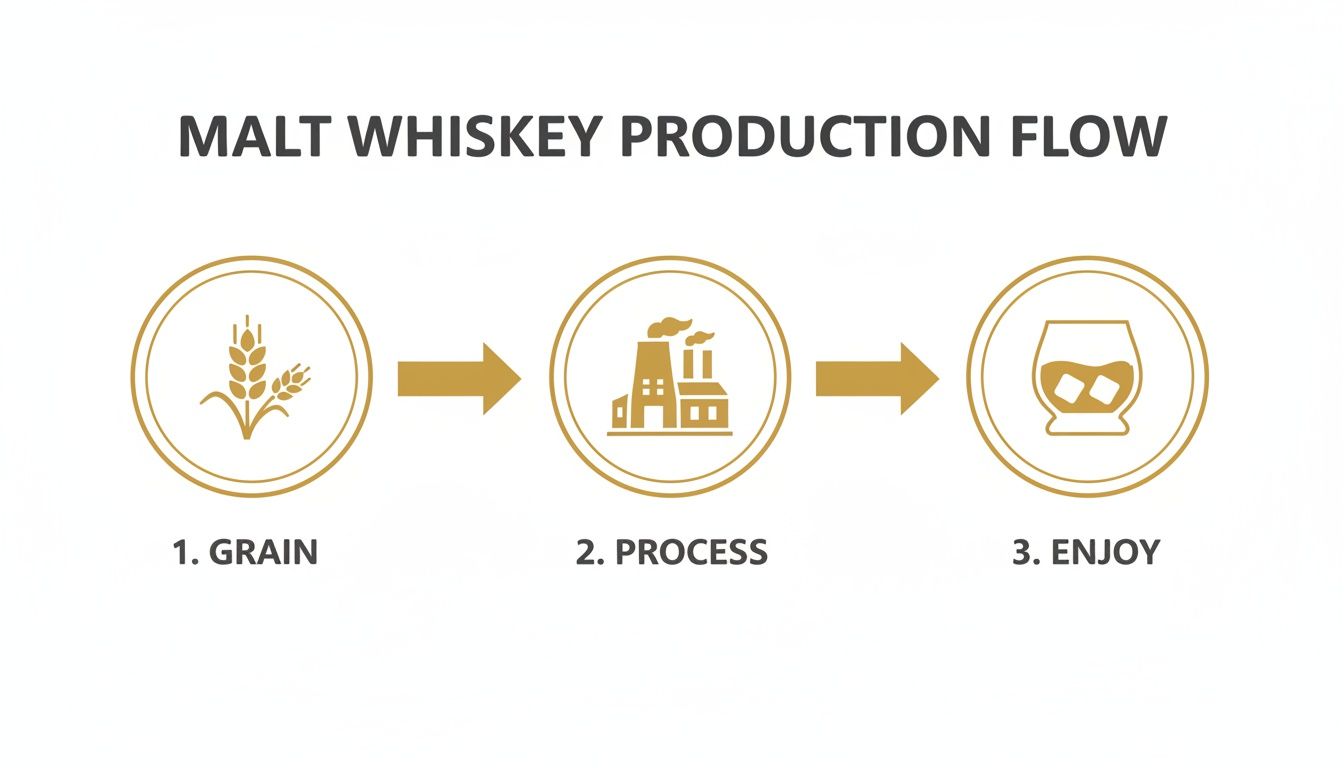
Step 1: Malting – The Foundation of Flavor
It all starts with malting. Think of this as waking the barley up from a long sleep. Raw barley grains are steeped in water, essentially tricking them into thinking it’s springtime and time to grow. This kicks off germination, where the grains begin to sprout.
This sprouting phase is absolutely critical because it activates natural enzymes inside the grain. These enzymes are the key that will unlock the barley's starches, which are later needed to create the fermentable sugars that yeast loves to eat. After just a few days, this process is stopped dead in its tracks by drying the barley with hot air in a kiln.
Pro Tip for New Drinkers: The heat source used during kilning is a massive fork in the road for flavor. If peat smoke is used, which is traditional for many Islay Scotches, the final whiskey will have that signature smoky, earthy character. In contrast, many American craft distilleries, like Westward Whiskey in Oregon, use unpeated barley or even experiment with local woods like mesquite to create truly unique regional profiles.
Step 2: Mashing – Creating The Brewer's Porridge
Once the barley is malted and dried, it’s milled into a coarse flour called “grist.” This grist is then dumped into a huge vessel called a mash tun and mixed with hot water. What you get is a thick, sweet, oatmeal-like porridge known as the mash.
The hot water brings those enzymes from the malting stage back to life, and they immediately get to work converting the grain's starches into simple sugars. The entire goal here is to extract as much of that sugary goodness as possible, creating a sweet liquid called wort. The wort is then drained off, leaving the spent grains behind.
Step 3: Fermentation – Where Yeast Works Its Magic
The sugary wort is cooled down and pumped into massive vats—traditionally made of wood but often stainless steel today—called washbacks. This is where yeast is pitched in, and the real transformation begins. We're talking about fermentation, the stage where alcohol is finally created.
The yeast goes on a feeding frenzy, devouring all the sugars in the wort. As it does, it produces two main byproducts: alcohol and carbon dioxide. But it also creates other chemical compounds called esters, which are hugely important for the whiskey's final flavor, often adding fruity and floral notes. After two to four days, the process is complete, and we’re left with what is essentially a strong beer, typically around 8-10% ABV, known as "distiller's beer" or "wash."
Step 4: Distillation – Concentrating The Spirit
Now it's time to take that beer and concentrate the alcohol. Distillation works on a very simple principle: alcohol boils at a lower temperature than water. The wash is heated in large copper stills, causing the alcohol to turn into vapor first. This vapor rises, gets collected, and is then cooled, condensing it back into a liquid with a much higher proof.
Malt whiskey is almost always distilled twice in beautiful, big-bellied copper pot stills. The first distillation run creates a spirit called "low wines," and the second, more precise distillation refines it into the "new make spirit." The distiller makes crucial "cuts" during this second run, separating the desirable "heart" of the spirit from the unwanted "heads" and "tails." Understanding the importance of malt in whisky is key to appreciating how this careful process preserves the grain's essential character.
Step 5: Maturation – The Slow Dance With Oak
The final, and often longest, step is maturation. That crystal-clear new make spirit is put into oak casks to age for a legal minimum of three years, though it’s often much, much longer. This is where the whiskey develops the vast majority of its flavor, all of its color, and its deep complexity.
During its time in the barrel, the spirit is constantly interacting with the wood in three critical ways:
- Additive: The whiskey pulls flavors directly from the oak itself—notes like vanilla, caramel, coconut, and spice.
- Subtractive: The charred layer on the inside of the cask acts like a natural charcoal filter, stripping out harsh, undesirable sulfur compounds.
- Interactive: The spirit, the wood, and tiny amounts of oxygen work together over the years to create brand new, complex flavors that didn't exist before.
This patient aging transforms a harsh, raw spirit into the smooth, flavorful, and aromatic malt whiskey we all know and love. It’s a journey of time and tradition, culminating in the very spirit you pour into your glass.
Decoding The Label: Single Malt Vs. Blended Malt
Now that you have a handle on how malt whiskey is made, it’s time to tackle the language on the bottle. Staring at a wall of whiskey, with terms like "single malt" and "blended" thrown around, can feel a little intimidating. Think of this as your field guide to reading a whiskey label so you know exactly what you’re getting.
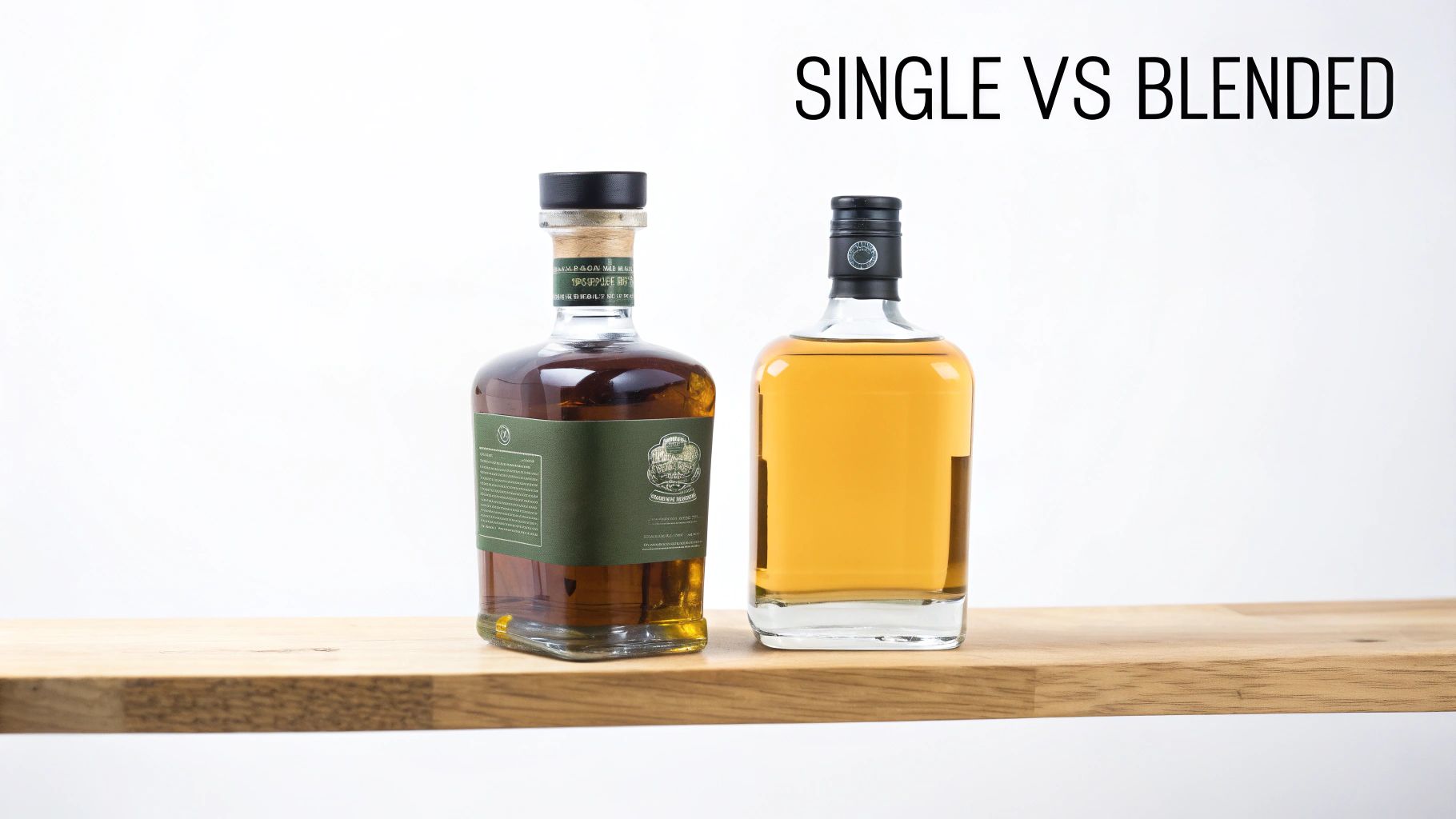
This isn't just trivia; it's the key to making confident choices that actually match your taste. Understanding these core categories empowers you to explore the wide world of malt whiskey, from iconic Scottish distilleries to the innovative craft producers popping up across America.
The Solo Artist: Single Malt Whiskey
A single malt whiskey is the purest expression of one distillery's character. The "single" part can be misleading—it doesn't mean the whiskey comes from just one barrel or a single batch. It simply means the liquid was produced entirely at a single distillery.
Think of it like a solo artist's album. Every note, every decision, and every nuance comes from one creative source. This gives the spirit a distinct, undiluted personality that reflects the distillery's unique water source, the shape of its stills, its cask management, and its overall philosophy.
A single malt is a snapshot of a specific place and process. It's an unblended showcase of one distillery's craft, offering a focused and authentic taste of its origin. This is why enthusiasts often seek out single malts—to experience that unique, singular vision.
The Supergroup: Blended Malt Whiskey
Next up is blended malt whiskey. This category is exactly what it sounds like: a blend of two or more single malt whiskeys from different distilleries. There's no lighter grain whiskey involved here—it's still 100% malted barley whiskey, through and through.
If a single malt is a solo artist, a blended malt is the whiskey world’s supergroup. A master blender artfully combines distinct single malts, each with its own character, to create something new, harmonious, and often incredibly complex. The goal is to produce a whiskey that is greater than the sum of its parts.
This blending process allows for fantastic consistency and balance. By layering different styles—maybe a smoky Islay malt with a fruity, honeyed Speyside malt—blenders can craft a perfectly rounded and sophisticated experience.
Understanding Blended Whiskey
This is where a crucial distinction comes in. While a blended malt contains only malt whiskeys, a plain old blended whiskey is a different beast altogether. This category typically includes a mixture of one or more single malt whiskeys combined with grain whiskey.
Grain whiskey is usually made from other grains like corn or wheat in an efficient column still, resulting in a lighter-bodied, less intensely flavored spirit. This combination makes blended whiskeys smoother and often more approachable for newcomers.
From a market perspective, malt whiskey is a premium player in a booming global landscape. The total global whisky market is projected to grow from USD 77.92 billion in 2025 to USD 116.01 billion by 2033. Still, blended whiskey commands a massive 48.29% share of that market, showing that malt-based styles remain a discovery for many.
The Rise of American Craft Malt
While Scotland is the historic heartland for single and blended malts, a new wave is cresting right here in the United States. American craft distilleries are taking the "single malt" concept and running with it, creating bold and innovative expressions that challenge the old guard.
These producers aren't bound by centuries of tradition, which allows them to experiment with unique grains, unusual cask finishes, and climate-specific aging techniques. A fantastic example is Stranahan's in Colorado, which pioneered the American Single Malt category and ages its whiskey in the state's unique high-altitude, dry climate. For a deeper look into this exciting movement, you can read our complete guide to the dynamic world of American single malt whiskey. This homegrown creativity is completely redefining what a malt whiskey can be.
Exploring The Global Flavors Of Malt Whiskey
Malt whiskey isn’t just a spirit; it’s a global language spoken with some seriously distinct regional accents. Even though the process kicks off with the same core ingredient—malted barley—the final flavor is profoundly shaped by the land, the climate, and local tradition. This journey, from Scotland's historic glens to the workshops of American craft distillers, reveals an incredible spectrum of taste.
Embarking on this worldwide tour helps you understand what a malt whiskey truly is by showing you what it can become. The character of the spirit changes dramatically from one country to the next, offering a diverse tasting adventure for any curious drinker.
The Scottish Highlands and Islands
When most people think of malt whiskey, their minds immediately jump to Scotland. It's the spiritual home of single malt, with distinct regions that each produce a signature style. Getting to know these classic profiles is essential for any whiskey enthusiast.
- Speyside: Known for its elegant, fruity, and often sweet single malts. Think of notes like apple, pear, honey, and vanilla. It’s a fantastic starting point for newcomers.
- Islay: Famous for its bold, heavily peated, and smoky whiskeys. The flavor here is often described as medicinal, briny, or like a coastal bonfire, thanks to the peat used to dry the barley.
- Highlands: This massive region produces a wide variety of styles, from rich and textured malts to more fragrant and floral expressions. There's no single Highland character, which makes exploring it so rewarding.
These traditional styles set the global standard for quality and complexity. They represent a legacy of craftsmanship that has been refined over centuries, creating the benchmarks against which all other malt whiskeys are measured.
The Innovative Spirit Of American Craft Malt
While Scotland honors tradition, the American single malt scene is defined by bold experimentation. Craft distilleries across the country are taking the foundational principles of malt whiskey and injecting them with a uniquely American sense of creativity and adventure. They aren't just trying to replicate Scotch; they are forging a new identity entirely.
This movement is all about a willingness to break from convention. American producers experiment with everything from locally grown barley varieties and unique yeast strains to aging in unconventional casks, such as ex-Amaretto or new American oak. These choices impart a distinctly different flavor profile than the ex-bourbon and sherry casks common in Scotland.
The beauty of American craft malt is its diversity. One distillery might use mesquite smoking to create a southwestern-style peat, like Whiskey Del Bac in Arizona, while another on the West Coast leverages the maritime climate for a briny, complex spirit. For new whiskey drinkers, this means a world of unexpected flavors awaits.
A World of Emerging Styles
But the story of malt whiskey doesn't end with Scotland and the United States. Other nations are making their mark with exceptional and unique expressions that further broaden the definition of what a malt whiskey can be.
- Irish Whiskey: Traditionally triple-distilled for an exceptionally smooth and light body, Irish single malts are often unpeated. This gives them a clean, fruity, and grassy profile that is incredibly approachable.
- Japanese Whisky: Meticulously crafted with a focus on balance and harmony, Japanese single malts are renowned for their elegance and complexity, often displaying subtle floral and sandalwood notes.
- World Whiskies: Countries like France, Germany, and Taiwan are also producing award-winning malts, often using local wine casks for maturation to impart unique regional character.
Historically, malt whisky’s journey from a rural spirit to a global luxury product got a major push in the 19th century. A pest devastated French vineyards, collapsing the brandy supply and flinging open export markets for Scotch. Today, while giants like Diageo and Pernod Ricard control about 65% of global malt whisky sales, the landscape is being reshaped by the passion of smaller craft and regional producers. This historical arc provides a rich context for modern blind tasting, where you can explore heritage styles alongside new craft interpretations without any label bias. You can discover more insights on the Scotch whisky industry's facts and figures.
A Beginner's Guide To Tasting Malt Whiskey
Jumping into the world of malt whiskey should be exciting, not intimidating. Think of this as your friendly starting point, built to give you the confidence to pick out a bottle, pour a glass, and start discovering the incredible flavors hidden inside. The best part? There are no wrong answers here. The only rule is to find what you genuinely enjoy.
That first step—choosing a bottle—can often feel like the hardest. When you’re new to the game, I always suggest looking for approachable styles. A lot of American craft single malts are a great place to start, as they tend to be fruit-forward and really well-balanced. You don’t need to grab the oldest or most expensive bottle on the shelf; just focus on finding a flavor profile that sounds good to you.
Setting The Stage For Your First Sip
Once you've got your bottle, how you serve it can make a world of difference. The right glassware really does concentrate the whiskey's aromas, making it much easier to pick out individual notes. A Glencairn glass, with its signature tulip shape, is designed specifically for this, but don't sweat it. A simple rocks glass works just fine when you’re starting out.
Then you get to the great debate: ice or no ice?
Beginner's Tip: For your first taste of any new malt whiskey, always try it neat—no ice, no water. This gives you an honest, unadulterated baseline of the spirit's true character, just as the distiller intended. After a few sips, go ahead and add a single drop of room-temperature water. You'll be amazed at how it can open up the flavors and tame the alcoholic heat.
A Simple Method For Tasting
Tasting whiskey isn’t about being an expert; it's about being observant. Using a simple, three-step process is the best way to guide your senses and start building your palate. It's the same method the pros use.
- Look: Hold your glass up to the light. The color, which can range from a pale straw to a deep amber, offers clues about the type of cask it was aged in and for how long.
- Smell: Give the glass a gentle swirl and bring it to your nose, keeping your mouth slightly open. What’s the first thing you smell? Is it fruity, like apples or berries? Sweet, like honey and vanilla? Or maybe something more earthy and smoky?
- Taste: Take a small sip and let it coat your entire mouth. Pay attention to the initial flavor, how it feels on your tongue (what we call the "mouthfeel"), and what flavors linger after you swallow (the "finish").
If you want a more structured way to practice, check out our detailed guide on how to taste whiskey like an expert. It walks you through each step with helpful tips and common flavor notes to look for.
Your Palate, Your Rules
Remember, the whole point of this is to discover what you like. If you find you enjoy a whiskey with a bit of ice, then that's the right way to drink it for you. The world of whiskey is absolutely massive, and there’s no single "correct" way to appreciate it.
To keep developing your palate and see how flavors play together, you might even consider something like a whiskey and beer pairing masterclass. Experiences like that are a fun, social way to learn more about what makes malt whiskey so special. At the end of the day, the best whiskey is the one you enjoy, shared in a way that brings you pleasure.
How To Train Your Palate And Taste Like A Pro
Alright, time to put all this knowledge into practice. Blind tasting is the best workout for your palate. It completely strips away the power of a cool label, a slick marketing campaign, or even a hefty price tag.
It’s just you and the whiskey. This is where you learn to trust your own senses and figure out what you genuinely love, appreciating the spirit for the pure craftsmanship in the glass. It’s like learning to identify a guitarist by their unique riff instead of just reading the album cover. With a little practice, you can absolutely learn to pick out the signature "sound" of a malt whiskey.
Finding The Malt Whiskey Signature
So, how do you spot a malt whiskey in a lineup? It really boils down to recognizing the core flavors that come straight from the malted barley itself. Unlike bourbon, which often shouts its presence with corn sweetness, or rye with its peppery spice, malt whiskey has its own distinct, foundational character.
Here are the key sensory cues I always look for:
- Cereal and Biscuit Notes: This is your number one clue. Malt whiskey almost always has a flavor that reminds you of breakfast cereal, toasted bread, or something like a digestive biscuit. It’s the grain speaking directly to you.
- Absence of Corn Sweetness: A classic bourbon is a dead giveaway with its caramel, vanilla, and sweet corn profile. If those notes are turned way down or missing entirely, and you're getting more of a gentle, honeyed sweetness with some fruit, you're probably in malt country.
- A Softer, Oilier Mouthfeel: I find that malt whiskeys often have a richer, more viscous texture that coats the palate. It’s a contrast to the sometimes sharp, spicy feel of a high-rye whiskey.
Blind tasting levels the playing field. It forces you to rely on nothing but your palate, which is the fastest way to build confidence and truly understand what makes a malt whiskey different.
Exploring the Spectrum with American Craft Malts
Once you’ve got a handle on the basics, the real fun begins. American craft single malts are a fantastic training ground because they show just how diverse this category can be. You might have a producer like Westland Distillery in Seattle delivering a beautiful, classic profile. Then, right next to it, you could have a whiskey from another craft distillery that was finished in an ex-Amaretto cask, creating something totally unique and dessert-like.
Tasting these different expressions blind is the best way to explore that wide range of honey, fruit, nut, or even smoke that defines different malt styles. It’s your fast track to becoming a more discerning and confident taster, one pour at a time.
Still Have Questions About Malt Whiskey?
Got a few lingering thoughts on what makes a malt whiskey tick? We've got you. This last section tackles some of the most common questions we hear, clearing up the confusion so you can start your tasting journey with confidence.
Is All Scotch a Single Malt Whiskey?
Not at all—and this is probably one of the biggest misconceptions out there! While single malt Scotch is famous worldwide, it's actually Blended Scotch Whisky that dominates global sales.
Blended Scotch is a mix, containing both single malt whiskies and lighter, column-distilled grain whiskies. So, while every single malt made in Scotland is a type of Scotch, the reverse isn't true. Most bottles you see on the shelf are blends.
What Is the Best Way to Start Drinking Malt Whiskey?
The best way in is usually through a lighter, unpeated style. Think of it as wading into the shallow end of the pool instead of diving headfirst into the deep. You might want to grab a classic from Scotland's Speyside region or try an approachable American single malt from a producer like Westland Distillery.
When you're ready to taste, pour it neat into a proper glass (a Glencairn is perfect for this). Take a sip. Then, add just a single drop of water and see how the aromas and flavors open up. The most important thing is to explore without any pressure. This is exactly why a blind tasting kit is so great for beginners—it lets you discover what you genuinely enjoy without a brand name telling you what you should like.
The single best piece of advice for new drinkers is to trust your own palate. Forget what you think you're "supposed" to like. The most exciting discoveries happen when you taste without bias and just focus on the story the whiskey in your glass is telling.
Does a Higher Age Always Mean a Better Malt Whiskey?
Not necessarily. It's easy to think older is better, but age is just one piece of the puzzle. While extra time in the barrel can add incredible complexity and smoothness, it doesn't automatically guarantee a superior whiskey. The quality of the cask, the climate it's aging in, and the distiller's skill are just as important.
You'll find plenty of younger craft whiskeys that are absolutely bursting with vibrant, interesting flavors. This is especially true for American distilleries that are experimenting with unique cask finishes. Imagine a whiskey aged for five years in an ex-bourbon barrel and then another five in an ex-Amaretto cask—you'd get an amazing, dessert-like profile you'd never find in a conventionally aged spirit. Blind tasting is the ultimate way to prove this to yourself. Let your taste buds decide, not the number on the bottle.
Ready to find out what you really like, without the brand bias? At Blind Barrels, we send you a curated blind tasting kit every quarter, packed with incredible whiskeys from America's best small-batch distilleries. It's all about letting your palate lead the way.
Start your blind tasting adventure with Blind Barrels today!