

Rye bourbon isn't a separate legal whiskey category. It's bourbon made with rye as the secondary flavoring grain, and it must still contain at least 51% corn.
That answer challenges the most popular advice about the style, which often treats “rye bourbon” as if it sits halfway between bourbon and rye whiskey. It doesn't. The phrase describes a flavor choice inside bourbon, not a new legal category. A bourbon can taste peppery, minty, dry, and distinctly rye-forward while remaining bourbon because corn is still the majority grain.
The Term That Confuses Almost Every New Whiskey Drinker
The easiest way to understand rye bourbon is to put the words in the right order. It is bourbon first, rye second. The distiller starts with a corn-dominant recipe that meets the rules for bourbon, then uses rye as one of the grains that shapes the spirit's character.
That distinction matters because the flavor can mislead you. A spicy bourbon may remind you of rye whiskey, especially when the finish brings black pepper, mint, clove, or dry herbal notes. Your palate can correctly detect a strong rye influence while still being wrong if it concludes that the bottle must be rye whiskey.
Start with the legal identity
Bourbon requires a fermented mash containing at least 51% corn. It must be produced in the United States, distilled to no more than 160 proof, entered into new charred oak containers at no more than 125 proof, and aged in those new charred oak containers. Rye can influence the remaining grain portion, but it can't replace corn as the majority grain if the spirit is going to carry the bourbon identity. These standards are set out in the Alcohol and Tobacco Tax and Trade Bureau's standards for distilled spirits.
Think of the term as a recipe description. “Bourbon” tells you the foundation and the production boundaries. “Rye” tells you which seasoning grain gives that foundation more energy. A wheated bourbon uses wheat in that flavor-grain role instead, while other recipes may use different combinations.
Then use your senses
For a blind tasting, don't ask, “Does this taste like bourbon or rye?” Ask two narrower questions:
- Does the pour show the sweet, rounded influence of corn?
- Does it also show a spicier, drier, more peppery rye influence?
That approach keeps category and flavor separate. The label tells you the legal identity, while the nose, palate, and finish help you estimate how strongly rye has shaped the experience. The rest of this guide turns that distinction into a practical toolkit for choosing a bottle and evaluating your next pour.
How Bourbon Is Actually Defined Under U.S. Standards
A bourbon mash bill works like a recipe with a required base. The recipe must contain at least 51% corn, so more than half of the fermented grain mixture has to come from corn. The remaining portion gives the distiller room to adjust aroma, texture, and spice.
The production rules add three more boundaries. The spirit can't be distilled above 160 proof, it can't enter the barrel above 125 proof, and it must mature in new, charred oak containers. It also has to be made in the United States. Those requirements, rather than a particular flavor profile, earn the whiskey its bourbon identity.
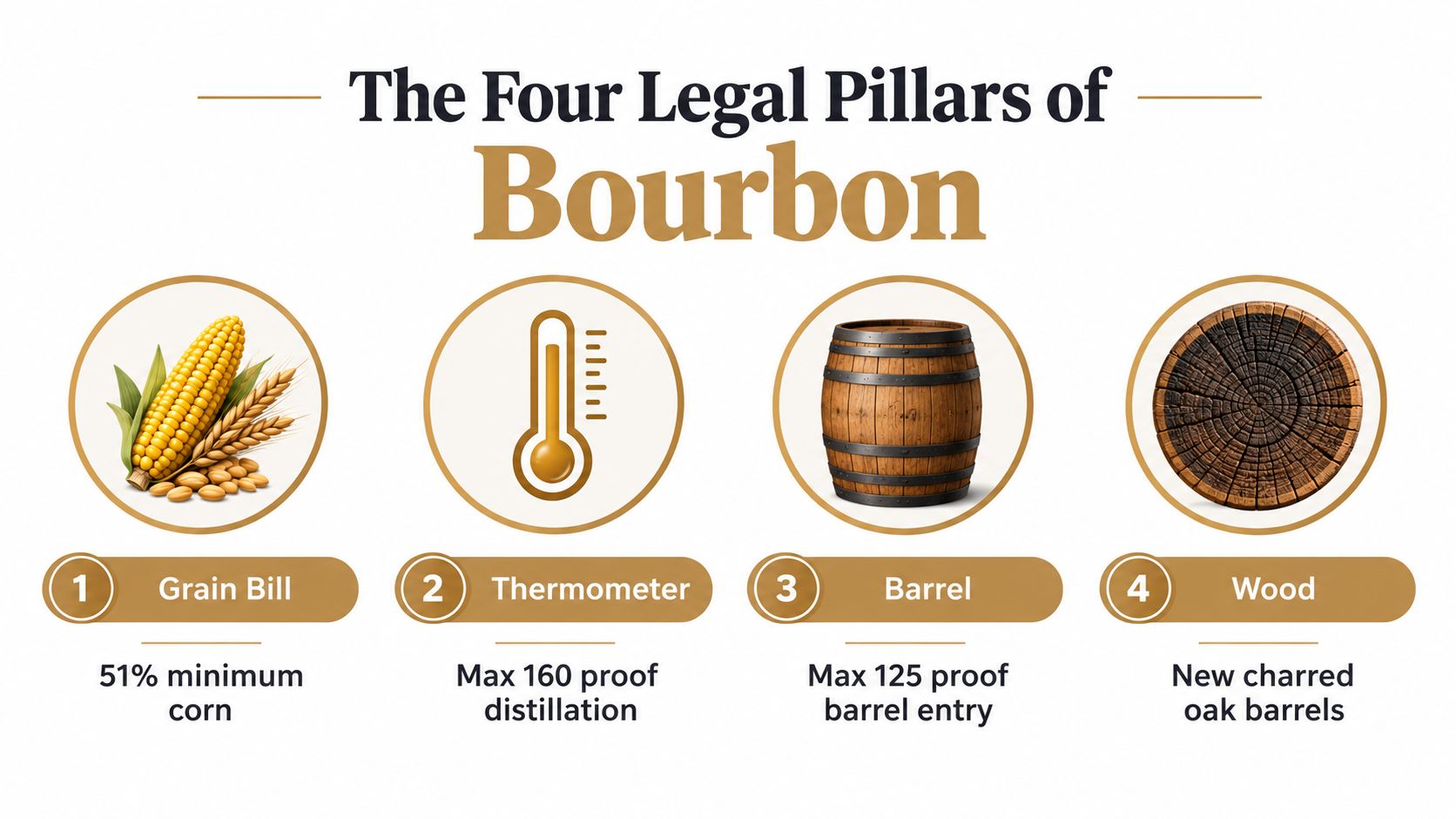
The four pillars in plain language
- Corn is the majority ingredient. At least 51% of the mash must be corn. That is why a recipe with a substantial rye portion can still be bourbon.
- Distillation has a ceiling. The spirit must be distilled to no more than 160 proof, or 80% alcohol by volume. This limit helps preserve a meaningful connection to the fermented grain rather than producing an extremely neutral spirit.
- Barrel entry has its own limit. The distillate enters the new oak at no more than 125 proof, or 62.5% alcohol by volume. Water may be used to bring the spirit to that entry strength.
- The oak must be new and charred. A used barrel doesn't satisfy the bourbon rule. The fresh charred surface contributes much of the familiar bourbon language, including toasted wood, caramelized notes, and vanilla-like impressions.
Practical rule: If a bottle meets the corn, distillation, barrel-entry, oak, and U.S. production requirements, the choice between rye and wheat as a secondary grain doesn't remove its bourbon status.
This is also why a product page about what bourbon is can help you read a label more accurately than a tasting note alone. For a separate example of how whiskey consumers evaluate a named bourbon release and its market context, see these Daniel Weller Bourbon price insights.
Where Rye Fits in the Bourbon Mash Bill
The mash bill is the grain recipe, but it helps to think of it as flavor architecture rather than a technical list. Corn builds the required majority and supplies bourbon's characteristic sweetness. The grains that accompany it determine whether the structure feels spicy, soft, malty, or balanced.
Malted barley commonly plays a smaller supporting role because it supplies enzymes needed to convert starches during production. Standard bourbon recipes commonly use roughly 5% to 15% malted barley, while rye or wheat fills much of the remaining grain share. Higher-rye bourbon recipes may contain roughly 20% to 35% rye, although producers use different formulas and “high rye” has no legally mandated percentage. The bourbon grain bill guide offers another useful way to visualize that recipe structure.
Rye is a seasoning grain with a strong voice
Rye generally pushes bourbon toward black pepper, mint, clove, baking spice, and herbal dryness. More rye often creates a firmer, more energetic finish. Corn remains responsible for the underlying sweetness, so the result isn't rye whiskey diluted with bourbon. It's a corn-led spirit with rye shaping the edges and the finish.
Wheat takes the recipe in another direction. It usually creates a softer, gentler impression because it doesn't contribute the same peppery snap. A wheated bourbon may seem rounder and more bakery-like beside a rye-forward bourbon, even when both have similar oak influence.
Malted barley has a different job again. It supports conversion and may contribute subtle grain or malt impressions, but it isn't normally the main source of the bold spice associated with rye. A recipe can include corn, rye, wheat, and malted barley together, yet the proportions still determine which voice leads.
| Secondary Grain | Typical Flavor Contribution | Common Style Name |
|---|---|---|
| Rye | Pepper, mint, clove, baking spice, dry herbal lift | Rye bourbon or high-rye bourbon |
| Wheat | Softness, gentle sweetness, rounded bakery notes | Wheated bourbon |
| Malted barley | Malt character and enzymatic support | Bourbon, or four-grain bourbon when used with rye and wheat |
Treat these descriptions as expectations, not guarantees. Yeast, fermentation, distillation cuts, barrel entry proof, oak seasoning, and the maturation environment can all change what reaches your glass. In a blind tasting, rye is one important variable, not the entire explanation.
Rye Bourbon vs Rye Whiskey on the Shelf
The decisive shelf test is the majority grain. A rye bourbon has at least 51% corn and uses rye as a supporting grain. Rye whiskey has at least 51% rye, so rye becomes the structural base rather than the seasoning element. That one reversal separates the legal categories more reliably than any flavor note.
This distinction also explains why the two spirits can overlap in taste. Both may show pepper, clove, mint, oak, and warmth. A rye-forward bourbon usually keeps a corn-derived sweetness underneath those notes, while rye whiskey tends to make the grain's drier and sharper character more prominent.
Compare the label before judging the glass
| Attribute | Rye Bourbon | Rye Whiskey |
|---|---|---|
| Dominant grain | At least 51% corn | At least 51% rye |
| Rye's role | Secondary flavor grain | Majority grain |
| Typical impression | Sweetness underneath pepper and spice | Drier, sharper, more grain-forward spice |
| Distillation ceiling | No more than 160 proof | No more than 160 proof |
| Barrel entry | No more than 125 proof | No more than 125 proof |
| Oak requirement | New, charred oak containers | Oak storage under the rye whiskey standard |
| Legal identity | Bourbon | Rye whiskey |
The shared proof limits and oak requirements mean the grain ratio does much of the expressive work. A rye whiskey may feel more direct and herbal because rye dominates the mash. A rye bourbon can deliver comparable spice, but the corn majority often cushions it with sweetness and a fuller bourbon-like base.
Shelf test: Read the product identity first, then look for a disclosed mash bill or producer explanation. Don't try to prove an exact rye percentage from taste alone.
Mash-bill percentages beyond the corn minimum are often optional label information. If a bottle doesn't disclose its formula, you can make a sensory estimate, but you can't use pepper or dryness as legal proof. A bottle may taste high-rye without revealing precisely how much rye the distiller used.
A Short History of Rye in American Whiskey
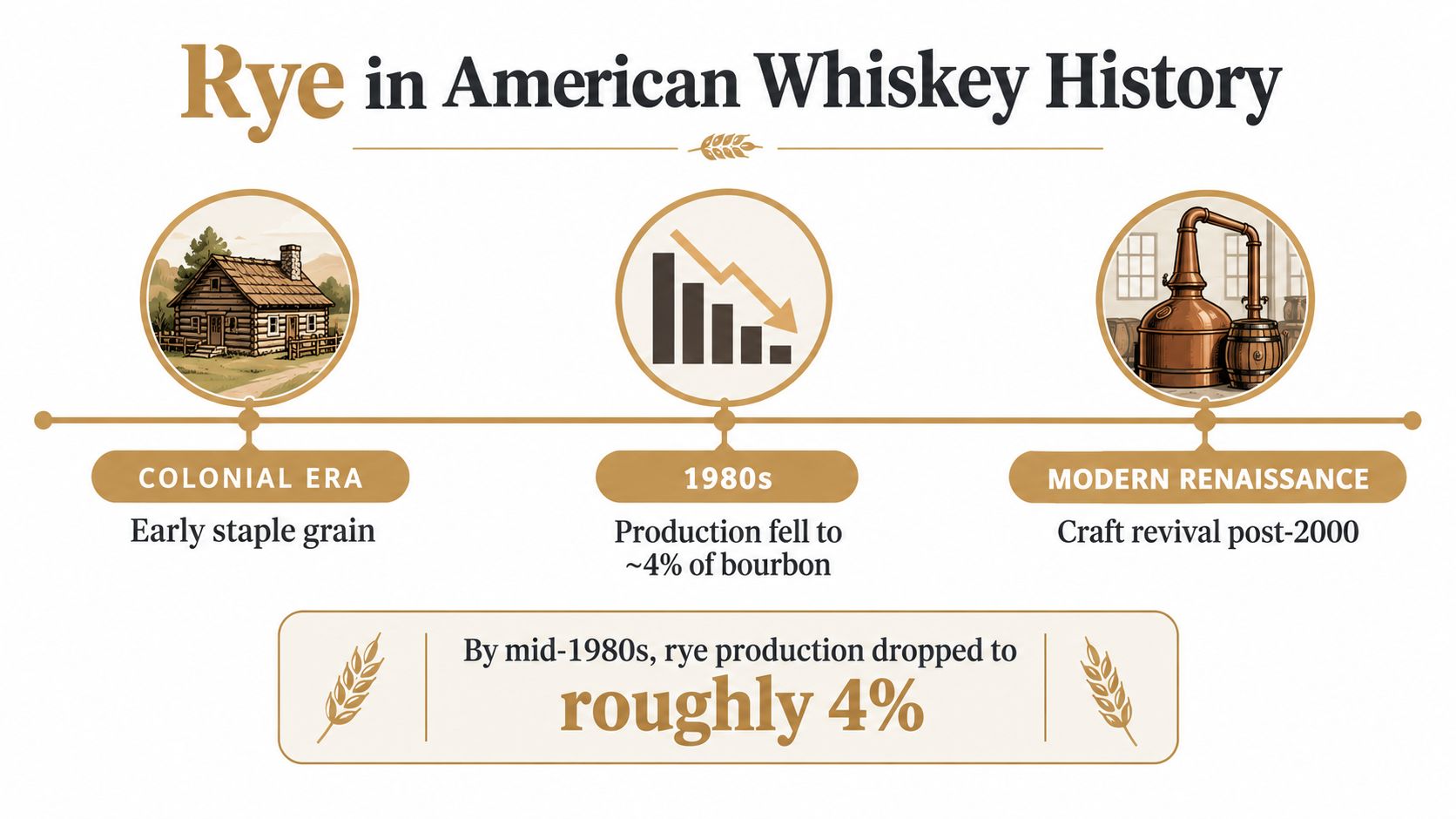
Rye isn't a recent invention created by the modern craft-distilling movement. The grain became especially important in the northeastern United States, including Pennsylvania, New York, and Maryland, where it grew well and supported regional farmer-distiller traditions.
By 1810, Pennsylvania reportedly produced three times as much whiskey as the United States produced bourbon that year, and much of that Pennsylvania whiskey was rye. Rye was described as the principal American whiskey style from the end of the Civil War until Prohibition, which places today's rye-forward bourbon in a much older American grain tradition. The historical milestones, including the later disruption and sales comparison, are summarized in this history of American rye whiskey.
A category disrupted, then rediscovered
National production suffered a severe interruption during Prohibition, which lasted from 1920 to 1933. Rye later became far smaller than bourbon. In 2006, U.S. rye whiskey sales were approximately 150,000 nine-liter cases, compared with 14.7 million nine-liter cases of bourbon.
The revival changed the conversation. Distilled Spirits Council figures cited by industry sources show rye production rising 1,275% between 2009 and 2019. That resurgence gave distillers and drinkers more room to explore grain ratios, regional styles, and bolder flavor profiles.
American craft whiskey now sits inside a broad craft-distilling sector. The American Craft Spirits Association counted 3,069 active U.S. craft distillers as of August 2024, up from 2,753 in August 2023, and recorded approximately 13.5 million nine-liter cases sold in 2023 with $7.8 billion in sales. That scale helps explain why newcomers encounter so many different mash bills, yeast programs, barrel approaches, and regional grain choices.
Rye bourbon belongs to that modern category, but its character reaches further back. Each bottle connects a corn-dominant legal category with rye's long role in American whiskey-making.
What High Rye Bourbon Actually Tastes Like
A high-rye bourbon commonly contains roughly 20% to 35% rye while retaining at least 51% corn. That range is an industry convention, not a legal definition, so one producer's high-rye bourbon may taste noticeably different from another's. The label signals an approach, not a guaranteed intensity setting.
Start at the nose. Look for black pepper, mint, baking spice, clove, and dried herbal notes. You may also notice the sweeter bourbon foundation underneath, especially as caramel-like or light brown sugar impressions. On the palate, rye can create a lively grain warmth, while the finish may feel drier, hotter, and more peppery than a wheat-led bourbon.
Read the finish, not only the first sip
New drinkers often focus on the first burst of alcohol. That can hide the grain. Let the sip move across your palate, then pay attention to what remains after you swallow. A rye-influenced bourbon often leaves a peppery, dry, or herbal snap, while a softer bourbon may leave a rounder sweetness.
Oak and production choices can alter that pattern. More time in oak can add tannin, vanilla, toast, and deeper wood notes. Yeast and fermentation can change the balance of fruit, grain, and floral impressions. Higher-proof whiskey can concentrate every sensation, including rye spice and alcohol heat. These variables are why high-rye whiskey tasting guidance should be treated as a starting point rather than a promise about every bottle.
For a useful blind exercise, compare three distinct formats:
- A standard bourbon with a modest rye presence, where corn sweetness and oak lead.
- A disclosed high-rye bourbon, where pepper, mint, and dryness become easier to identify.
- A rye whiskey, where rye is the majority grain and the grain-forward character should be more central.
You don't need to guess the exact recipe. Your task is to rank the glasses by perceived sweetness, spice, and finish length. If you taste the same bourbon at different strengths, notice whether dilution reveals a softer corn center beneath the initial heat.
A Simple Tasting Method for New Drinkers
A useful tasting doesn't require expensive glassware or a complicated vocabulary. It needs consistent pours, a quiet moment, and controlled dilution. Room-temperature whiskey makes it easier to compare aroma and texture without ice rapidly changing the sample.
Stage one begins with the nose
Pour equal small samples of two bourbon styles into clean glasses. A tulip-shaped glass can concentrate aromas, but any clean glass will work. Smell each pour before sipping, first from a short distance and then closer to the rim.
Write down only what you can identify. Use plain categories such as:
- Sweetness: corn, caramel, brown sugar
- Spice: black pepper, baking spice, clove
- Herbal character: mint or dried herbs
- Oak: char, toast, vanilla-like wood notes
Don't force a note because someone else mentioned it. If all you notice at first is alcohol, move the glass away, take a calm breath, and return to it.
Stage two separates heat from flavor
Taste a small sip neat. Let it rest across your tongue, then notice the finish after swallowing. Add a few drops of room-temperature still water and reassess the same whiskey. Beam Distilling's whiskey tasting notes guide recommends this controlled approach instead of immediately using ice.
For a repeatable measure, one beginner guide recommends 1 to 2 drops of room-temperature, non-chlorinated water per 15 milliliters of whiskey, which is roughly one-eighth teaspoon for a 30-milliliter pour. The guidance from this whiskey tasting method for beginners gives you a small starting point, not a fixed rule. Add gradually if the pour still feels concentrated.
Stage three creates the contrast
Taste a wheated bourbon after the rye-forward samples. You're not trying to declare a winner. You're giving your palate an anchor. The wheated pour may make the high-rye bourbon's pepper and dryness easier to recognize, while the high-rye bourbon may make the wheated bourbon's softer sweetness more obvious.
Repeat the nose, sip, and water comparison. Record three observations for each glass: the strongest aroma, the dominant palate impression, and the character of the finish. That simple record will teach you more than trying to memorize a long list of official tasting terms.
Putting It All Together on Your Next Pour
When you shop, begin with the legal identity. If the bottle says bourbon, corn is the majority grain and the whiskey has to meet the bourbon production standards. If the bottle says rye whiskey, rye is the majority grain. “Rye bourbon” adds a flavor expectation, not a new regulatory class.
Then look for a disclosed mash bill. A higher rye proportion often points toward more pepper, mint, baking spice, and dryness, but no label phrase can guarantee the exact experience. Oak, yeast, distillation choices, proof, and maturation environment can pull the final whiskey in different directions.
A simple flight can make the distinction memorable. Taste a standard bourbon, a high-rye bourbon, and a labeled rye whiskey in the same session. Put the glasses in an order that hides the brands, note sweetness and spice before looking at the labels, and use a few drops of water to see whether alcohol heat was masking the grain.
American craft distillers make this kind of comparison especially interesting. The U.S. craft sector includes thousands of active producers, giving drinkers access to regional grains, distinctive yeast choices, and varied barrel programs. You don't need to identify the producer to learn from the pour. First decide whether the whiskey feels corn-led, rye-led, or balanced between those impressions.
The practical answer to what is a rye bourbon is therefore straightforward: it's bourbon with rye helping design the flavor. The next time a glass tastes spicy enough to seem like rye whiskey, check whether its sweetness and roundness still suggest a corn majority. Your palate can describe the architecture, while the label confirms the category.
Blind Barrels offers quarterly blind whiskey tasting kits with four samples from small American craft distilleries, a tasting table for aroma, palate, and finish notes, and a QR code that reveals the bottles and provides access to full-bottle purchases. Visit Blind Barrels to compare rye-forward bourbon, wheated bourbon, and other American whiskey styles without letting brand or price decide what your palate likes.