

At its core, whiskey is a distilled alcoholic spirit made from a fermented mash of grains. Think of it as a flavorful spirit born from humble ingredients like corn, barley, rye, or wheat. That beautiful amber color and rich, complex taste? That comes from aging the spirit in wooden barrels, a crucial step that transforms the raw liquid into the whiskey we know and love.
Your Essential Introduction to the World of Whiskey
Diving into whiskey can feel a bit overwhelming, but it doesn't have to be. Forget about becoming an expert overnight. The real goal is to start a personal journey of discovery, one sip at a time. This guide is your starting point, giving you the essential knowledge to explore with confidence and curiosity.
Whiskey has captivated drinkers for centuries, and its popularity is soaring. The American market, in particular, is in the middle of a massive boom. Projections show the U.S. whiskey market rocketing from USD 14.1 billion in 2025 to a staggering USD 46.6 billion by 2035. This isn't just about drinking more; it's about drinking better, with a huge shift toward premium and small-batch spirits that tell a unique story. You can dig deeper into this market growth and see what's driving the trend.
For a quick reference, here’s a simple breakdown of what makes whiskey, well, whiskey.
Whiskey at a Glance: Key Characteristics
| Element | Simple Description |
|---|---|
| Base Ingredient | Made from a fermented mix (mash) of grains like corn, rye, barley, or wheat. |
| Process | The fermented grain mash is distilled to concentrate the alcohol and flavor. |
| Aging | Must be aged in wooden barrels (usually oak), which gives it color and complexity. |
| Alcohol Content | Typically bottled at 40% alcohol by volume (ABV) or higher. |
| Origin | A global spirit with distinct styles defined by country of origin and production rules. |
This table covers the fundamentals, but the real magic is in the details that create such a diverse world of flavor.
Embracing the Craft and a New Way of Tasting
At the very heart of this whiskey renaissance are the American craft distilleries. These smaller, independent producers are the rebels and artists of the industry. They’re pushing boundaries, experimenting with local grains, and pouring their passion into every single bottle. Brands like Frey Ranch from Nevada and Westward Whiskey from Oregon are perfect examples, focusing on character and quality over volume. This is where the real excitement is right now.
For anyone new to whiskey, this craft boom is the perfect on-ramp. It offers an incredible variety of styles, from sweet, corn-driven bourbons to spicy, assertive ryes. To truly appreciate what these distillers are doing, you need an honest way to taste—and that's where blind tasting comes in.
Blind tasting is the practice of sampling whiskeys without knowing the brand, price, or age. It removes all preconceived notions and marketing hype, allowing your palate to be the only judge.
This is the ultimate tool for discovering what you genuinely enjoy. You might be shocked to find your favorite sip of the night comes from a tiny, unknown distillery instead of a household name with a multi-million dollar ad budget. It’s a fun, honest approach that puts the focus right back where it belongs: on the taste. Throughout this guide, we'll give you practical tips to start your own tasting journey, helping you build confidence and find your flavor.
Whisky or Whiskey: Understanding the Difference
Walk down any liquor store aisle, and one of the first things you'll notice is the spelling. Is it whiskey with an "e," or whisky without one? This isn't a typo—it’s a clue to the spirit’s story, a single letter that speaks volumes about geography and tradition.
Think of it as a quick field guide. If a spirit comes from Ireland or the United States, you’ll almost always see it spelled whiskey. If it’s from Scotland, Canada, or Japan, it’s whisky. This tradition kicked off in the 19th century when Irish distillers added the 'e' to set their product apart from their Scottish rivals. American distillers, many with Irish roots, largely followed suit.
But the spelling is just the beginning. The real differences are found in the history, ingredients, and production methods that have shaped each style over centuries.
A Tale of Two Traditions
The story of this spirit starts with the Celts. The Gaelic phrase uisce beatha, meaning "water of life," was the original name for the fiery distillate that would one day conquer the world. From there, the tradition split, creating two distinct paths—one in Scotland and the other in Ireland. Both nations still claim to be the spirit's true birthplace, a friendly debate that’s alive and well today.
This heritage crossed the Atlantic with immigrants who brought their distilling know-how to a new world. Here, they found new grains like corn and rye and began adapting their recipes. This spirit of innovation gave birth to a uniquely American whiskey identity, one forged in the fires of rebellion and independence.
The Whiskey Rebellion of the 1790s was a defining moment. When the brand-new U.S. government decided to tax distilled spirits, frontier farmers and distillers revolted. The event solidified whiskey’s place not just as a drink, but as a symbol of American grit and self-reliance.
How Geography Shapes the Spirit
This history isn't just a story; it’s something you can taste in the glass. The rugged, peat-covered landscapes of Scotland produce smoky Scotches, while the lush green fields of Ireland give us smoother, often triple-distilled Irish whiskeys. In the United States, the abundance of corn in states like Kentucky and Tennessee became the backbone of Bourbon and Tennessee Whiskey.
Want to go deeper on this? You can explore our full guide on the difference between whisky and whiskey.
Today, that spirit of place is roaring back to life in the American craft whiskey movement. Small distilleries are tapping into their local terroir, using regional grains and experimenting with aging techniques that reflect their unique environments.
Tips for New Whiskey Drinkers Exploring Different Styles:
- Start with the spelling: Use it as a quick guide on the shelf. "Whiskey" will likely lead you to sweeter American styles, while "whisky" might point you toward smoky Scotch or smooth Canadian options.
- Don't judge by the letter alone: The real story is in the glass. A rye whiskey from a craft distiller in Texas will taste wildly different from one made in Indiana, even though both are spelled the same.
- Connect with the story: Learning about a brand’s history or a region's traditions can add a rich layer of appreciation to your tasting experience. It connects you to the people and places behind the spirit.
From Grain to Glass: How Whiskey Is Made
Every bottle of whiskey, no matter how humble or how rare, starts its life as a simple pile of grain. The path from a farmer’s field to the amber spirit in your glass is a fascinating story of patience, chemistry, and craftsmanship. Once you understand the process, you'll have a whole new appreciation for what you're sipping.
At its core, making whiskey is all about unlocking the sugars hidden inside grains, using yeast to turn those sugars into alcohol, and then concentrating and aging that alcohol to create complex flavors. It’s like a master chef following a time-honored recipe, where every single decision shapes the final dish.
The First Steps: Mashing and Fermentation
It all kicks off with mashing. Grains—think corn, barley, rye, or wheat—are ground into a flour and cooked in hot water. This step is a lot like making a giant, grainy oatmeal. The goal is simple: break down the grain's starches and convert them into fermentable sugars. The result is a sweet, porridge-like liquid called mash or wort.
The specific grains used here are the whiskey's blueprint. This recipe, known as the mash bill, dictates the spirit's fundamental character before it ever sees a barrel. A corn-heavy mash bill will create a sweeter spirit, while a high-rye recipe brings a classic spicy, peppery kick. To learn more about how these ingredients set the stage, you can explore our guide on what whiskey is made from.
Next up is fermentation. That sugary wort is pumped into massive tanks, and yeast is pitched in. This is where the real magic starts. The yeast goes on a feeding frenzy, devouring the sugars and producing two things in return: alcohol and carbon dioxide. This bubbly, beer-like liquid is now called distiller’s beer or wash, and it usually clocks in around 5-10% alcohol by volume (ABV).
Distillation: The Art of Concentration
Now that alcohol has been created, it’s time for distillation. This is the crucial step where the alcohol and desirable flavor compounds are separated from the water and other stuff in the wash.
The wash is heated in a big metal vessel called a still. Since alcohol boils at a lower temperature than water, it turns to vapor first. This vapor rises, gets captured, and is cooled back down, condensing into a much stronger liquid. This raw, clear spirit is called "new make" or, more affectionately, "white dog."
Distillation isn't just about cranking up the proof; it's an art form. The distiller makes "cuts," separating the initial vapor (the "heads") and the final vapor (the "tails") from the pure, desirable "heart" of the spirit. Getting these cuts right is a huge part of what makes a whiskey smooth and flavorful.
This process is typically repeated at least once. Each round of distillation refines the spirit, increases its proof, and purifies its character, getting it ready for the most important step of its life.
This helpful visualization illustrates the journey of the "whiskey" spelling from its origins.
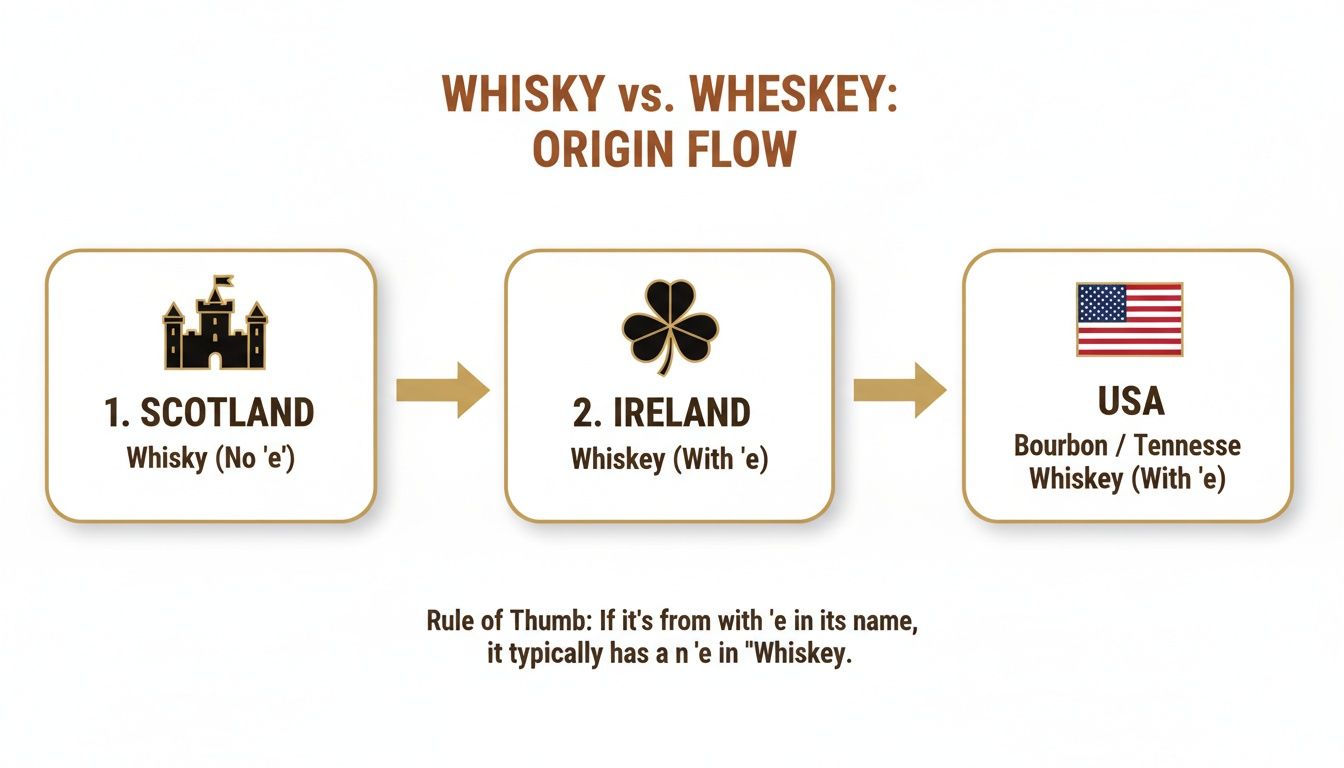
This flow shows how Irish immigrants brought the "whiskey" spelling to the USA, which is why American and Irish styles share the "e."
Aging: The Final Ingredient
That fiery, crystal-clear "new make" spirit isn't officially whiskey yet. It's missing color, depth, and just about all of the complex flavors we love. To earn its title, it has to be aged in wooden barrels—almost always oak. The barrel isn't just a storage container; it’s the final, and arguably most important, ingredient.
Over years of slumbering in the cask, the spirit is completely transformed:
- It gets its color: The clear liquid slowly soaks up pigments from the wood, turning it into beautiful shades of gold, amber, and deep mahogany.
- It develops flavor: The oak imparts its signature notes of vanilla, caramel, coconut, and baking spice. Charring the barrel's interior—a standard for American whiskeys—caramelizes wood sugars and adds layers of toffee and smoke.
- It mellows out: Oak barrels are porous, allowing the whiskey to "breathe." This slow interaction with air, combined with seasonal temperature swings, smooths out the harshness of the young spirit and catalyzes complex chemical reactions that build character.
This maturation can last anywhere from a few years to several decades. Many experts believe that up to 70% of a whiskey's final flavor profile is developed during its time in the barrel.
After its long rest, the whiskey is finally ready for bottling. It might be proofed down with pure water to a desired strength or bottled directly from the barrel as a "cask strength" offering. From there, it makes its way to the shelf and, eventually, to your glass—completing a journey that is truly a testament to time and tradition.
Navigating the Major Styles of Whiskey
Now that you know how whiskey is made, we can get to the good part: tasting what comes out of the barrel. Walking into a well-stocked liquor store can feel like visiting a library where every bottle tells a different story. The best way to start reading is by learning the major categories—think of them as genres—that guide you through the world’s most popular whiskeys.
Each style is defined by a set of rules governing where it's made, what grains are used, and how it's aged. Understanding these core differences is the key to finding a whiskey you’ll love. It's less about memorizing laws and more about getting a feel for the fundamental flavor profiles each style typically offers.
Bourbon: The American Classic
When most people think of American whiskey, their mind immediately goes to Bourbon. To earn that name on the label, a whiskey has to follow a strict set of rules, making it a uniquely American spirit.
- Mash Bill: It must be made from a grain mixture that is at least 51% corn, which is where Bourbon gets its signature sweetness.
- Aging: It must be aged in new, charred oak containers. This is the secret sauce that imparts those deep vanilla, caramel, and toffee notes.
- Origin: While it can technically be made anywhere in the U.S., Bourbon's heart and soul belong to Kentucky.
That corn base makes Bourbon incredibly approachable, often rich with notes of brown sugar and baked goods. It’s a fantastic starting point for anyone new to whiskey. While the big, iconic brands are great, the American craft scene is where some of the most exciting stuff is happening. Distilleries like Stellum Spirits and Frey Ranch are crafting incredible Bourbons that offer a true taste of modern American whiskey.
Rye: The Spicy Contender
If Bourbon is a sweet, warm hug in a glass, Rye whiskey is a firm, spicy handshake. Its popularity has absolutely exploded in recent years, thanks in no small part to the revival of classic cocktails. Rye brings a bolder, more assertive flavor that stands up beautifully in a Manhattan or an Old Fashioned.
The rules for Rye are almost identical to Bourbon's, but with one crucial switch-up:
- Mash Bill: The mash must contain at least 51% rye grain. This is the grain that brings all the pepper, herbal notes, and sometimes even a little fruitiness to the party.
- Flavor Profile: Get ready for flavors of black pepper, baking spices like cinnamon and clove, and a characteristically drier finish than its corn-based cousin.
American craft distillers have jumped on the rye comeback with both feet. Keep an eye out for producers like New Riff Distilling from Kentucky or FEW Spirits from Illinois, who are creating complex and robust ryes that really let the grain's signature spice shine through.
Tennessee Whiskey: A Southern Tradition
Often confused with Bourbon, Tennessee Whiskey is its own distinct style thanks to one extra, non-negotiable step. It follows all the same rules as Bourbon—at least 51% corn, aged in new charred oak—but adds a special filtration process before the spirit ever sees the inside of a barrel.
This defining step is known as the Lincoln County Process. Before aging, the new spirit is slowly dripped through several feet of sugar maple charcoal. This filtering mellows the whiskey, stripping away harsh edges and adding a subtle sweetness and smoothness.
This charcoal filtering is what gives Tennessee Whiskey its famously smooth and easy-drinking character, often layering hints of charcoal and toasted sugar on top of the classic Bourbon notes. It’s a style truly defined by its regional technique.
Scotch Whisky: A World of Flavor from Scotland
Let’s hop across the Atlantic to Scotland, the home of Scotch whisky. Notice the spelling—no "e" here. Scotch is arguably the most diverse and complex whiskey category on the planet. It’s primarily made from malted barley and must be distilled and aged in Scotland for a minimum of three years in oak casks.
The world of Scotch is massive, but it's often broken down by region, with each area known for a signature style:
- Speyside: Famous for elegant, fruity, and often honeyed whiskies.
- Highlands: A huge, diverse region producing everything from robust and rich to floral and light whiskies.
- Islay: Known for its powerfully peaty and smoky whiskies, with distinct notes of brine and seaweed from the sea air. Think campfire on the beach.
- Lowlands: Typically produces lighter, softer, and more delicate whiskies, often with grassy or floral notes.
If you're just dipping your toes in, starting with a non-peated Speyside or Highland Scotch is a great way to experience the category's complexity without getting hit by the intense smoke of an Islay whisky.
Irish Whiskey: The Smooth and Approachable Cousin
Finally, we head to Ireland, the birthplace of Irish whiskey. Known for its exceptionally smooth and light character, Irish whiskey is often triple-distilled. That extra distillation step creates a softer, more refined spirit compared to the typical double distillation used for Scotch. Like its Scottish counterpart, it must be aged for at least three years in wooden casks.
Its approachable nature, with common notes of fruit, vanilla, and light floral hints, makes it another excellent choice for beginners looking for something easy to sip.
This growing global appetite for whiskey is driving incredible expansion. Projections show the worldwide market charging toward a massive USD 345.7 billion by 2035, a huge leap from USD 118.5 billion in 2025. American whiskey is a big piece of that puzzle, with craft distillers constantly pushing boundaries, especially in the booming rye segment. These are the producers making the small-batch releases and unique cask finishes that services like Blind Barrels get so excited to feature. You can discover more insights about these whiskey trends and see how innovation is shaping the industry.
To help you keep all these styles straight, here's a quick side-by-side look.
Major Whiskey Styles Compared
It can be a lot to remember, but this table breaks down the key differences between the major whiskey styles at a glance. Think of it as your cheat sheet for navigating the whiskey aisle.
| Whiskey Style | Primary Grain | Country of Origin | Common Flavor Notes |
|---|---|---|---|
| Bourbon | Corn (51%+) | USA | Caramel, vanilla, oak, baking spices |
| Rye | Rye (51%+) | USA | Black pepper, cinnamon, herbal, dried fruit |
| Tennessee | Corn (51%+) | USA | Smooth, vanilla, charcoal, toasted sugar |
| Scotch | Malted Barley | Scotland | Varies: smoky, fruity, floral, honeyed |
| Irish | Barley | Ireland | Smooth, fruity, vanilla, light floral |
Each one offers a completely different experience, which is what makes exploring the world of whiskey so much fun. The best way to learn is to start tasting
How to Read a Whiskey Label Like an Expert
A whiskey label is more than just branding; it's a roadmap to the liquid inside the bottle. Learning to read this map can completely change your experience, turning a confusing trip down the liquor aisle into a confident hunt for your next favorite bottle.
By understanding a few key terms, you can decode the story of the spirit before you even pop the cork. These aren't just marketing fluff—they're specific descriptions that tell you how the whiskey was made, aged, and bottled, giving you valuable clues about its flavor, intensity, and character.
Decoding Common Whiskey Terms
As you browse the shelves, you'll see a lot of phrases that can feel a bit intimidating. Let's break down some of the most common ones you’ll run into.
-
Single Barrel: This is exactly what it sounds like. Every single drop of whiskey in that bottle came from one, individual barrel. Since no two oak barrels are identical, each single barrel release is a unique, one-of-a-kind snapshot in time, offering a flavor profile that can never be replicated.
-
Small Batch: Now, this one sounds exclusive, but the term has no legal definition. It generally means the whiskey is a blend of a select number of barrels—fewer than a distillery's standard, large-scale release. It implies a more curated product, but the actual "batch" size can be anything from just a few barrels to a few hundred.
This is where American craft distilleries really shine. Their smaller scale often means their standard releases could be considered "small batch" by the big players. This hands-on, artisan approach is a major driver of the American whiskey resurgence. The market has seen explosive growth, with supplier sales jumping from US$1.4 billion in 2004 to an estimated US$5.2 billion in 2024. Discover more insights about American whiskey's growth and see how the craft movement is shaping the entire industry.
Understanding Proof and Filtration
Beyond the batch size, the label also tells you about the whiskey's strength and texture. These terms are huge indicators of the spirit's intensity and mouthfeel.
Cask Strength or Barrel Proof
This is a big one for enthusiasts. It means the whiskey was bottled at the exact same alcoholic strength it was when it came out of the barrel. No water was added to dilute it, resulting in a much higher proof—often 55-65% ABV or even more. Cask strength whiskeys deliver a powerful, concentrated flavor experience, but they can be pretty intense for newcomers.
Tip for New Drinkers: If you're trying a cask strength whiskey, don't be afraid to add a few drops of water. This can help "open up" the aromas and tame the alcoholic heat, making all those complex flavors much more approachable.
Non-Chill Filtered (NCF)
Most big-name whiskeys are chilled and filtered before bottling. This removes certain fatty acids and proteins that can make the liquid look a little cloudy when it gets cold. A non-chill filtered whiskey skips this cosmetic step. Whiskey aficionados often hunt down NCF bottles because they believe keeping those compounds in preserves more of the original oils and esters, resulting in a richer texture and a more robust flavor.
Labels with a Legal Guarantee
Some terms you see on a label aren't just descriptive—they're legally binding guarantees of quality and production standards.
Bottled-in-Bond
This is a U.S. government certification that comes with some very strict rules, all laid out in the Bottled-in-Bond Act of 1897. To earn this seal, a whiskey must be:
- The product of one distiller from a single distillation season (either January-June or July-December).
- Aged for at least four years in a federally bonded warehouse.
- Bottled at exactly 100 proof (50% ABV).
This label is a historic stamp of authenticity. It’s a guarantee that the spirit inside meets a specific, high standard set over a century ago.
Finally, you have the age statement. If a label has a number on it (like "12 Years Old"), it refers to the age of the youngest whiskey in that bottle. A higher number doesn't automatically mean "better," but it does signal a longer conversation between the spirit and the oak barrel, which often leads to deeper, more complex flavors.
A Beginner's Guide to Tasting Whiskey
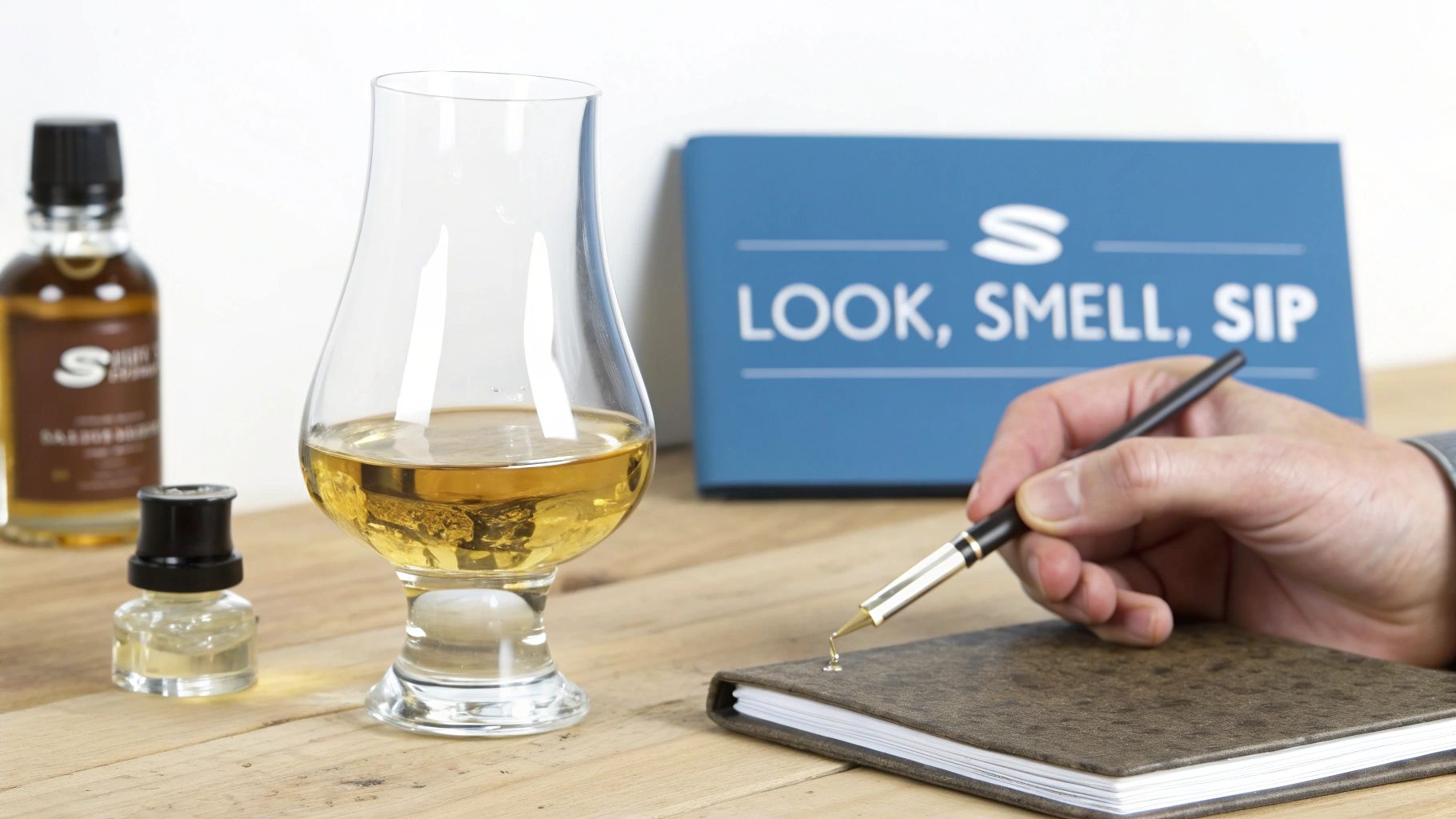
Let's get one thing straight: tasting whiskey isn't a test. There are no right or wrong answers. It's an adventure for your senses, a chance to figure out what you genuinely enjoy. Forget stuffy rules and complicated rituals. The only goal is to pay attention to what's in your glass.
All you really need is a simple framework to guide you. It breaks down into three easy steps: looking, smelling, and sipping. Each stage reveals a different part of the whiskey's story, from its age and proof to its core flavors. This mindful approach helps you appreciate the spirit’s complexity beyond just its alcoholic kick.
The Three-Step Tasting Framework
To get started, pour a small measure into a glass. If you have one with a curved bowl, like a Glencairn, that's ideal because it helps concentrate the aromas right where you want them.
-
Look: Hold the glass up to a light source. Check out the color—it can range from a pale straw to deep mahogany, offering clues about its age and the type of barrel it matured in. Give the whiskey a gentle swirl and watch for the "legs" or "tears" that run down the side of the glass. Thicker, slower-moving legs can suggest a higher proof or a richer texture.
-
Smell: This is arguably the most crucial step in tasting. Bring the glass toward your nose, but don't stick it all the way in and take a huge whiff. Instead, keep your mouth slightly open and take short, gentle sniffs. What are your first impressions? Do you get sweet notes like vanilla, something spicy like cinnamon, fruity hints of apple, or maybe a smoky, campfire aroma?
-
Sip: Finally, take a small sip and let it roll over your entire tongue. Think about the palate (the initial flavors you taste), the mouthfeel (is it thin and light, or rich and oily?), and the finish (the flavors that linger long after you swallow).
A Tip for New Drinkers: Don't be afraid to add a few drops of water. Seriously. It can lower the alcohol's intensity and open up a whole new world of subtle aromas and flavors that were hiding behind the heat.
The Power of Blind Tasting
If you want to fast-track your palate and discover what you truly like, blind tasting is the single best way to do it. When you strip away the brand names, the price tags, and the fancy labels, you remove all the preconceived notions. Your taste buds are the only judge.
This is the whole philosophy behind our Blind Barrels tasting kits. You might be shocked to find that your favorite whiskey of the night comes from a small, unheard-of American craft distillery, not some big, famous brand. It's an honest approach that builds real confidence in your own preferences.
To dive deeper, you can explore our detailed guide on how to taste whiskey and start your own unbiased journey.
Got Questions? We've Got Answers.
Diving into the world of whiskey is a blast, but it's totally normal to have a few questions swirling around. Let's tackle some of the most common ones so you can explore with a bit more confidence.
How Much Should I Spend on a Good Bottle?
This is the big one, right? But honestly, price doesn't always line up with quality. You can find some absolutely killer whiskeys for under $50, especially if you start looking at the American craft scene.
Instead of getting hung up on expensive bottles, your best bet is to explore different styles and find what you actually enjoy. A well-made rye or bourbon from a smaller producer often delivers a much more interesting and memorable experience than a big-name bottle with an even bigger price tag.
Is Older Whiskey Always Better?
Not at all. This is one of the biggest myths in whiskey. An age statement simply tells you how much time the spirit spent inside a barrel—it's not a grade of its quality.
Sure, older whiskeys can develop some deep, complex oak and spice notes, but some can just end up tasting like a woody mess. On the flip side, plenty of younger craft whiskeys, like those coming out of American craft distilleries like Balcones in Texas, are incredibly vibrant and full of character. The "best" whiskey is whatever tastes best to you, regardless of the number on the label.
Tip for New Drinkers: The ultimate goal is to trust your own palate. Blind tasting is the perfect tool for this, as it strips away all the noise—the fancy label, the age, the price—and lets you focus purely on the flavor in the glass.
What Is the Best Way to Drink Whiskey?
Simple: however you enjoy it most. Seriously. Whether that's neat, with a few drops of water, over ice, or in a cocktail, there are no real rules.
For getting to know a new whiskey, starting neat is a great way to experience it just as the distiller made it. From there, try adding just a splash of water. You'll be surprised how it can soften the alcohol's heat and open up a whole new layer of aromas and flavors. It's a great trick, especially when you're just starting out.
Ready to discover your next favorite American craft whiskey without the brand bias? Blind Barrels sends you curated, blind tasting kits every quarter, letting your palate lead the way. Explore the best of small-batch America and find what you truly love. Start your tasting adventure today!