

At its core, rye whiskey is a spirit distilled primarily from rye grain. Think of it as bourbon’s spicier, more assertive sibling. While bourbon is known and loved for its sweet corn foundation, rye whiskey brings a distinctively peppery, complex flavor profile that has been a favorite of drinkers for centuries, especially those from pioneering American craft whiskey brands.
The Defining Rules of Rye Whiskey
So, what exactly makes a rye a rye, at least according to the law? In the United States, the regulations are quite specific, ensuring that any bottle labeled "rye" meets a consistent standard of quality and character. This legal framework is what gives American rye its unmistakable identity.
To earn the title American rye whiskey, a spirit has to follow a strict set of rules. It must be distilled from a grain mixture (or "mash bill") of at least 51% rye and aged in new charred oak barrels. No exceptions, no shortcuts. This combination is what creates its bold, spicy DNA.
In fact, blind tasting panels often rate rye as being 25% spicier than bourbon. A significant 65% of tasters also pick out dominant notes of black pepper, fresh-baked rye bread, and even tobacco. These are the classic calling cards of a great American rye. You can explore more rye whiskey market insights to see how its popularity has grown.
Key American Rye Requirements
For anyone new to whiskey, getting a handle on these rules is the first step to truly appreciating what’s in your glass. Here’s a quick rundown of what makes an American rye official:
- Mash Bill: The recipe has to be at least 51% rye. The remaining 49% is usually a mix of corn and malted barley, which can soften the spice and add other layers of flavor.
- Aging: It must be aged in new, charred oak containers. This step is non-negotiable and is where the whiskey gets its color, aroma, and a huge chunk of its flavor.
- Distillation Proof: It can't be distilled higher than 160 proof (80% alcohol by volume).
- Barrel-Entry Proof: The spirit must go into the barrel for aging at no more than 125 proof (62.5% ABV).
If you see "Straight Rye Whiskey" on the label, that's an extra guarantee of quality. It means the whiskey has been aged for a minimum of two years. Many exceptional American craft whiskey brands, like Pennsylvania's Dad's Hat or Washington's Westland Distillery, often age their ryes for much longer to develop even deeper complexity.
A tip for newcomers: If you find a 100% rye whiskey a bit too intense at first, look for one with a mash bill closer to the 51% minimum. The higher corn content will lend a touch of sweetness to balance the spice, making it a perfect introduction. Many excellent American craft whiskey brands offer this style.
To make things even clearer, let's look at how rye stacks up against its famous cousin, bourbon.
Rye vs Bourbon At a Glance
Here's a simple side-by-side comparison of the key legal and flavor differences between these two iconic American whiskeys. This is a must-know for new whiskey drinkers trying to find their preference.
| Characteristic | American Rye Whiskey | Bourbon Whiskey |
|---|---|---|
| Primary Grain | At least 51% rye | At least 51% corn |
| Primary Flavor | Spicy, peppery, herbal, fruity | Sweet, caramel, vanilla, oaky |
| Typical Finish | Drier, often with a lingering spice | Softer, sweeter, and smoother |
| Cocktail Use | Foundation for classics like the Manhattan & Sazerac | Backbone of the Old Fashioned & Whiskey Sour |
While both are fantastic spirits, the grain at the heart of the recipe makes all the difference in what you experience in the glass.
Canadian Whisky: A Different Story
It’s also important to remember that the rules change once you cross the border. Historically, a lot of Canadian whisky was simply called "rye," even if it contained very little actual rye grain. Over time, the term just became another name for Canadian whisky in general.
While modern Canadian distillers are now producing some phenomenal high-rye whiskies, their legal framework is much more flexible. This allows for a wider range of styles to fall under the "rye" umbrella, so it’s a key distinction to keep in mind as you explore the global landscape of this incredible spirit.
The Rebellious History of American Rye
Long before bourbon was a household name, rye whiskey was the undisputed king of American spirits. Its story is woven right into the fabric of the nation, starting with Scottish and Irish immigrants who put down roots in the Mid-Atlantic colonies. They brought their distilling know-how across the ocean, but their beloved barley just wouldn’t cooperate with the new world's climate.
Rye, on the other hand, was a different beast entirely.
This tough, scrappy grain thrived in the rocky, unforgiving soil of places like Pennsylvania and Maryland, making it the obvious choice for farmers' stills. It wasn't just a crop; for many, it was a form of currency, a go-to medicine, and the backbone of the very first truly American whiskey. The spirit it produced was just like the pioneers who made it: hearty, spicy, and full of character.
This early American spirit quickly became the drink of the people. It flowed freely in taverns and was a staple in homes, far more common than imported rum or other liquors. Its dominance was a testament to its homegrown roots and the sheer resourcefulness of the nation's earliest distillers.
The Whiskey Rebellion
Rye's defiant personality was forged in the fire of actual rebellion. After the Revolutionary War, the brand-new federal government was drowning in debt. In 1791, Treasury Secretary Alexander Hamilton decided to impose the first-ever federal tax on a domestic product: distilled spirits. This tax hit western Pennsylvania farmers—who often distilled their rye into whiskey for easier trade and transport—particularly hard.
Their anger quickly boiled over into a full-blown insurrection. By 1794, the Whiskey Rebellion was raging, with furious farmers marching on Pittsburgh to protest. The situation got so tense that President George Washington himself had to call up 13,000 militiamen to squash the uprising. It was a powerful, and nearly catastrophic, test of federal authority that solidified rye's reputation as a rebel's drink, forever tying it to America's independent streak.
Tip for New Drinkers: When you sip a classic rye, you’re tasting history. Look for brands with deep roots like Old Overholt, or check out modern American craft whiskey brands reviving historic styles, like Pennsylvania's Dad's Hat. They offer a direct connection to this rebellious legacy.
From Popularity to Prohibition and Back Again
For the better part of a century, rye whiskey was on top of the world. It was the essential spirit for classic cocktails like the original Old Fashioned and the Manhattan. Bartenders loved it; its spicy, robust flavor provided the perfect backbone to stand up to other ingredients.
But its golden age came to a screeching halt. The one-two punch of World War I grain rationing and the arrival of Prohibition in 1920 completely decimated the industry. Thousands of distilleries shut their doors for good.
By the time the "noble experiment" was finally repealed in 1933, American tastes had shifted. Lighter spirits and sweeter, corn-based bourbon had stolen rye's spot on the backbar. For decades, rye languished as a niche product, kept alive by only a handful of dedicated producers. It seemed destined to become a historical footnote.
The Modern Rye Revival
Then, something shifted. In the early 2000s, a new generation of bartenders and whiskey lovers started digging into the past. They were looking for rye's signature spice to make more authentic classic cocktails, and in doing so, they introduced its bold character to a whole new audience.
That spark of interest ignited a full-blown comeback.
Today, American craft distilleries are leading the charge, breathing new life into this historic spirit. Distillers like Frey Ranch in Nevada and Southern Star in North Carolina aren't just recreating old styles; they're innovating with new mash bills and aging techniques. These American craft whiskey brands are pushing the boundaries of what rye can be and ensuring that America's first whiskey has a very bright future ahead. To dive deeper into this fascinating journey, check out our article on the history of rye as America's true native spirit.
How Rye Whiskey Gets Its Signature Spice
That signature pepper and spice in a glass of rye whiskey doesn’t just happen by accident. It's the result of a deliberate, time-honored process where distillers carefully guide humble grains through a fascinating transformation of science and art. Each step layers on another dimension of flavor, starting with the recipe itself.
The Foundation: The Mash Bill
At the very core of every rye is its mash bill—the specific recipe of grains that kicks everything off. Think of it like a baker's formula for a perfect loaf of sourdough; the ratio of ingredients determines the final character. For a whiskey to legally be called an American rye, its mash bill must contain at least 51% rye grain.
But it's the other 49% where a distiller's creativity really shines. They'll often add corn for a touch of sweetness or malted barley to provide the natural enzymes needed for fermentation. A high-rye mash bill, sometimes pushing 95% or even 100%, will give you that bold, herbaceous, and intensely spicy character that die-hard rye fans love. On the flip side, a recipe that sticks closer to the 51% minimum will be softer and sweeter—a great starting point if you're just dipping your toes into the world of rye.
From Grain to Spirit
With the recipe locked in, the real magic begins. This is where the grains start their journey to becoming whiskey, and every stage is critical.
- Mashing: First, the grains are ground up and cooked with hot water. This creates a thick, porridge-like substance called "mash" and, more importantly, converts the grain's starches into fermentable sugars.
- Fermentation: After the mash cools, yeast is pitched in. Over the next few days, these tiny organisms go to work, feasting on the sugars and producing alcohol. The result is a funky, sour, beer-like liquid known as "distiller's beer" or "wash."
- Distillation: The wash is then heated in a still. Because alcohol has a lower boiling point than water, it turns to vapor first. This vapor is captured and condensed back into a liquid, creating a crystal-clear, high-proof spirit. At this point, it's called "new make" or, more colloquially, "white dog."
This unaged spirit is the raw, fiery soul of the whiskey. It has all the spicy essence of the rye grain, but its character is still incomplete. The final, crucial transformation happens inside the barrel.
Tip for New Whiskey Drinkers: When you're exploring rye, check the mash bill. Knowing if it's a "barely legal" 51% rye or a bold 95-100% powerhouse gives you a huge clue about the flavor inside. It’s a small detail that can help you find a bottle that hits your personal sweet spot. Many American craft whiskey brands put this info right on the label.
The Magic of the Barrel
The last, and arguably most important, step is maturation. American law dictates that rye whiskey must be aged in new, charred American oak barrels. This is where the clear "white dog" gets its familiar amber hue and develops the bulk of its complex aromas and flavors.
The charred interior of the barrel acts as a natural filter, mellowing out harsh notes while contributing its own delicious character—think vanilla, caramel, toffee, and toasted oak. As the seasons change, the whiskey expands and contracts, pushing into and pulling out of the wood, absorbing these flavors over time. The longer it rests, the more profound the barrel's influence becomes. For a closer look at how this aging process compares to its corn-based cousin, check out our deep dive into rye vs bourbon whiskey.
This timeline gives you a sense of how rye’s long journey through American history has shaped the spirit we know and love today.
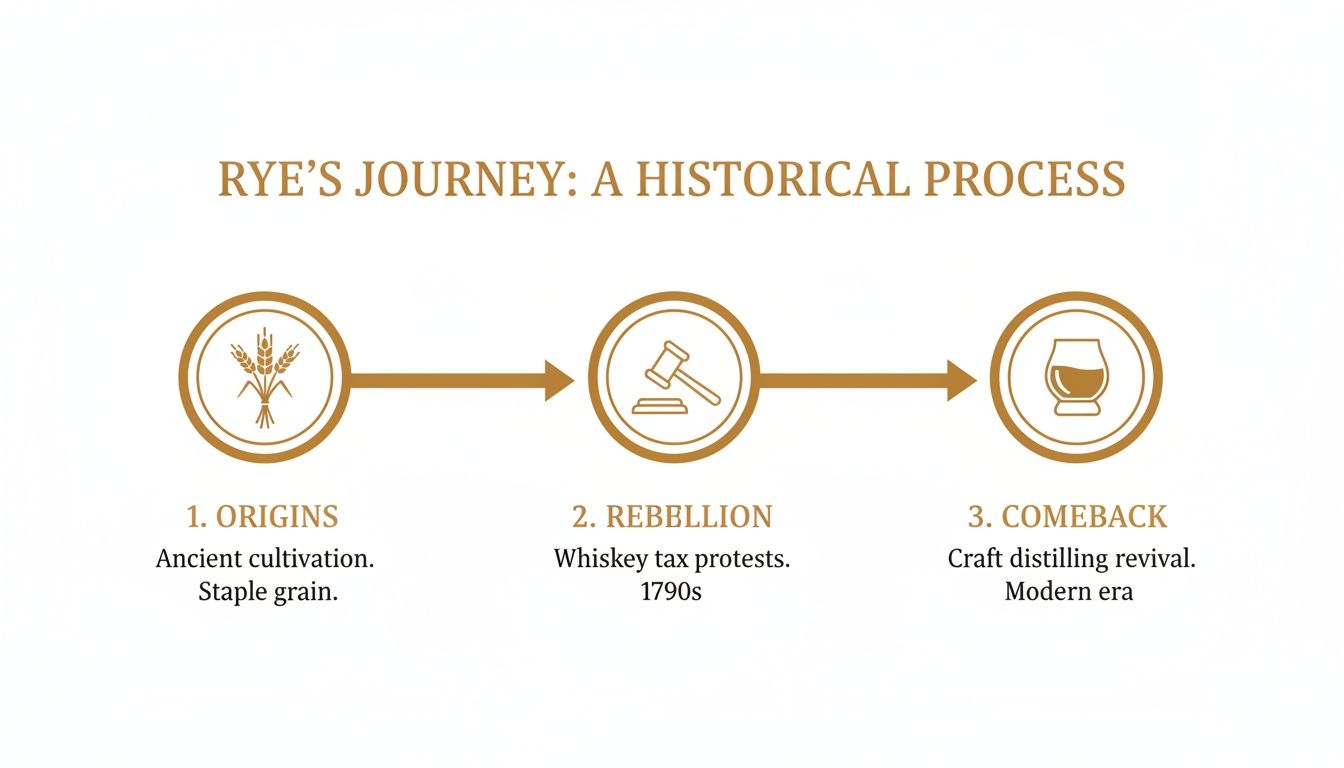
From its roots as a colonial staple to its near-demise after Prohibition and its incredible craft revival, rye has always been a spirit of resilience and innovation.
Today, that spirit is alive and well. American craft distillers are constantly pushing boundaries. Distilleries like High West in Utah have become masters of blending ryes from different sources to create something unique, while others are experimenting with finishing their rye in casks that once held port, rum, or sherry. It’s this constant evolution that makes exploring American craft whiskey brands so rewarding.
Cracking the Code on Rye Whiskey's Flavor
Think of the mash bill as the blueprint for a whiskey, and the flavor profile as the finished building. Learning to taste whiskey is a bit like learning a new language for your senses, and it's an experience that goes way beyond just calling it "spicy." When you can start to pick out the common tasting notes—and understand where they come from—you really begin to appreciate what's in your glass and zero in on what you love.
A pour of good rye whiskey is a full-on sensory journey. Its main personality comes straight from the rye grain itself, which is what gives you those hallmark notes of black pepper, baking spices like cinnamon and clove, and sometimes even a cool, herbal whisper of mint or dill. This spicy backbone is what makes rye so bold and sets it apart from its much sweeter cousin, bourbon.
But the grain is just the opening act. The yeast that fuels fermentation can add all sorts of fruity or floral notes, while the time spent in a charred oak barrel layers in vanilla, caramel, rich toffee, and toasted oak. It’s the constant conversation between these different elements that creates the incredible spectrum of flavors you find in the final bottle.
How to Train Your Palate and Taste Like a Pro
You don't need some kind of "super-palate" to get good at tasting whiskey. All it takes is a simple, repeatable process. Breaking it down into three distinct steps helps you focus your attention and really notice the different layers of aroma and flavor. This method works whether you're a total beginner or have been sipping for years.
-
Nose (Smell): Before you even think about taking a sip, give the whiskey a gentle swirl in your glass. Bring it up to your nose and breathe in softly, keeping your mouth slightly open. This little trick keeps the alcohol vapor from zapping your senses and lets the more delicate aromas shine through. Can you pick out the peppery rye? The sweet vanilla from the barrel?
-
Palate (Taste): Now take a small sip and let it roll across your entire tongue. What hits you first? Is it that spicy pepper, a wave of sweet caramel, or maybe something fruity? As you hold it in your mouth for a moment, other flavors will start to unfold. This is also where you'll get a feel for the texture, or "mouthfeel," of the whiskey.
-
Finish (Aftertaste): After you swallow, pay attention to what's left behind. That lingering sensation is the "finish." Is it long and warm, with a pleasant spicy tingle that seems to last forever? Or is it short, clean, and crisp? The finish is a huge part of the experience and often tells you a lot about a whiskey’s quality and complexity.
A Quick Tip for Newcomers: Don't stress about trying to name every single flavor note right out of the gate. Just start with the big picture: is it spicy, sweet, fruity, or oaky? With a bit of practice, your palate will get sharper, and you'll start picking out those finer details without even trying.
What Makes "High-Rye" Whiskey So Spicy?
The whole idea of a "high-rye" whiskey is the perfect illustration of how the mash bill directly shapes the flavor. While any American whiskey with at least 51% rye in the recipe gets to be called rye, a lot of American craft whiskey brands are pushing that number way, way higher—often to 70%, 95%, or even 100% rye.
As you crank up the percentage of rye grain, the intensity of its signature spice goes right along with it. These high-rye whiskeys are often described as being drier, much bolder, and more herbaceous. For a fantastic real-world example, check out some of the bottles from craft distilleries like Dad's Hat Pennsylvania Rye, which often uses a high-rye mash bill to pay homage to the state's historic style. The result is a seriously robust spirit with a powerful peppery kick that stands up beautifully in a cocktail or sipped on its own. It's this assertive profile that has so many bartenders and whiskey lovers seeking out these high-rye expressions.
Common Tasting Notes in Rye Whiskey
To help you put a name to what you're smelling and tasting, here's a quick guide to some of the most common notes you'll find in rye. Think of it as a cheat sheet for your senses, especially helpful for new whiskey drinkers.
| Flavor Category | Common Notes |
|---|---|
| Grain & Spice | Black Pepper, Cinnamon, Clove, Nutmeg, Rye Bread, Mint, Dill |
| Sweet & Fruity | Caramel, Vanilla, Honey, Dark Fruit (Cherry, Plum), Citrus Peel |
| Oak & Barrel | Toasted Oak, Char, Leather, Tobacco, Toffee |
| Floral & Herbal | Cut Grass, Floral Notes, Anise, Pine |
Use this table as a jumping-off point for your tasting adventures. The next time you pour a glass of rye, see if you can find one or two notes from each category. You'll be amazed at how quickly you start to crack the code on the complex and delicious world of rye whiskey.
How to Drink and Enjoy Rye Whiskey
Alright, you've got the backstory on what goes into a bottle of rye. Now for the best part: actually drinking it. Rye’s bold, spicy character makes it incredibly versatile, shining just as brightly on its own as it does holding down the fort in a classic cocktail.
There’s really no single "right" way to enjoy it. The whole point is to experiment and figure out what works for you. For many people, that journey starts with a well-made cocktail where rye’s assertive flavor refuses to get lost.
Rye's Starring Role in Classic Cocktails
Rye isn’t just another ingredient in the cocktail world—it’s often the star that makes a drink truly unforgettable. Its signature peppery spice provides the perfect counterpoint to sweet vermouth or aromatic bitters, creating a beautifully balanced, complex drink. If you're new to rye, mixing it up is a fantastic way to get acquainted.
- The Manhattan: This is arguably rye’s most famous home. A true Manhattan just sings with rye, sweet vermouth, and a dash of Angostura bitters. The whiskey’s spice slices right through the rich vermouth for a sophisticated and timeless classic.
- The Old Fashioned: While you often see it made with bourbon these days, the original Old Fashioned was a rye cocktail. Using rye lends a drier, spicier edge to the drink that many aficionados swear by.
- The Sazerac: Born in New Orleans, this legendary cocktail demands rye whiskey. The mix of rye, Peychaud's bitters, a touch of sugar, and an absinthe rinse creates a complex, aromatic experience that is genuinely one of a kind.
The modern cocktail renaissance has been huge for rye's comeback. In fact, the Manhattan alone accounts for a staggering 40% of on-premise rye sales and has helped boost demand by 15% in city bars across the globe. We're seeing that trend online, too, where sales are climbing by 25% annually.
Sipping Rye Neat or With a Splash of Water
For those who want to appreciate the spirit in its purest form, sipping rye neat is the ultimate experience. This is where you can really dissect the complex flavors and aromas the distiller worked so hard to create.
The key is to take your time. Pour a small amount into a proper tasting glass, like a Glencairn, which is designed to concentrate the aromas and deliver them right to your nose.
If you find a particular rye a bit too intense—especially a high-proof or cask-strength bottling—don't hesitate to add a few drops of water. This simple trick can be a game-changer.
Tip for new whiskey drinkers: Adding a little water can tame the alcohol "burn" and literally open up the whiskey. It unlocks more subtle aromatic compounds, revealing new layers of flavor that might have been hiding behind the proof. Just start with a drop or two, give it a swirl, and taste again.
Tips for New Whiskey Drinkers
Diving into the world of rye should be fun, not intimidating. The key is to start slow and build your palate. American craft distilleries are putting out a huge range of styles, so there’s a perfect entry point for everyone.
Here are a few tips to get you started on the right foot:
- Start with a Cocktail: Ordering a rye Manhattan or Old Fashioned at a good bar is a low-risk way to experience the grain's signature spice in a balanced, delicious context.
- Look for "Barely Legal" Rye: Try a bottle with a mash bill closer to the 51% rye minimum. These whiskeys have more corn sweetness to balance the spice, making them more approachable. Look for offerings from American craft whiskey brands.
- Don't Fear Lower Proofs: You don’t need to jump straight into the deep end with barrel-proof whiskeys. Start with a bottle in the 80-94 proof range (40-47% ABV) for a gentler introduction.
Ultimately, tasting is a personal journey of discovery. For more guidance on refining your senses, check out our complete guide on how to taste whiskey and learn how to pick out the notes you truly love.
Start Your Own Rye Tasting Adventure
Let's be honest, the best way to really wrap your head around rye whiskey is to get some in a glass and taste it for yourself. You can read about spicy notes and fruit-forward profiles all day, but nothing compares to discovering them firsthand. The real secret to finding what you genuinely love isn't about chasing the most expensive bottles or the big names—it’s about tasting without any preconceived notions.
This is where the magic of blind tasting comes in. When you strip away the fancy label, the price tag, and all the marketing hype, all that’s left is the liquid. It’s just you and the whiskey. It forces you to trust your own palate and lets your senses call the shots. You might just be shocked to discover your favorite of the night is an affordable bottle from a small, unheard-of American craft distillery.
Host a Simple Blind Tasting at Home
Putting together a fun and eye-opening blind tasting is way easier than you might think. You don't need to be a seasoned expert to lead your friends on a whiskey discovery journey. A little bit of prep is all it takes to create a memorable night.
Ready to give it a shot? Here’s a simple guide to get you started:
-
Gather Your Whiskeys: Aim for three to five different rye whiskeys to keep things manageable. Try to grab a variety—maybe one with a “barely legal” 51% rye mash bill, a bold high-rye expression, and one from an innovative American craft whiskey brand like Frey Ranch or Southern Star.
-
Conceal Their Identities: Pour a small sample (about one ounce is perfect) of each into identical glasses for everyone. The whole point is to keep them anonymous. You can use numbered stickers on the bottom of the glasses or have a friend pour them in another room so even you don't know which is which.
-
Taste and Take Notes: Guide your friends through the process—nose, palate, and finish. Encourage everyone to jot down what they smell and taste. Is it spicy, sweet, or fruity? Does it remind them of anything specific, like black pepper, dill, or caramel?
-
The Big Reveal: After everyone has tasted and debated their favorites, reveal the whiskeys one by one. This is always the best part—seeing how everyone’s perceptions line up with what was actually in the bottle.
Tip for New Drinkers: Don’t get hung up on finding the "right" answers. Everyone’s palate is different, and that's the point. The goal is simply to start noticing what you enjoy and figuring out how to describe it. This is the fastest way to build your tasting confidence.
Ultimately, a blind tasting is a call to action. It’s an invitation to trust your own senses and kick off a personal journey of discovery. It’s a chance to celebrate the incredible diversity of American craft whiskey, find what truly speaks to you, and have a blast doing it—one sip at a time.
Your Rye Whiskey Questions, Answered
Alright, let's wrap this up by hitting some of the most common questions that pop up when people first start exploring rye. Think of this as your back-pocket guide for when you're staring at a whiskey menu or a crowded store shelf.
So, Is Rye Whiskey Always Spicy?
Pretty much, yes. That’s the rye grain doing its thing, bringing those signature notes of black pepper, baking spice, and sometimes a hint of dill or mint. But the real question isn't if it's spicy, but how spicy.
A whiskey made with a 100% rye mash bill is going to be a bold, peppery powerhouse. On the flip side, a bottle that just meets the legal minimum of 51% rye will have that spice beautifully softened by the sweetness of corn or the creamy texture of barley. These "barely legal" ryes are a fantastic place to start if you're just dipping your toes in the water.
Does All Rye Whiskey Taste the Same?
Not even close. The mash bill is just the opening chapter of a much longer story. Once that grain recipe is set, a whole world of variables comes into play, creating an incredible spectrum of flavors for you to explore.
A distiller's choice of yeast strain, the specific shape of their still, the char level on the barrel, the local climate where it's aged, and the total time it spends in oak all leave a unique fingerprint on the spirit. It's why a rye from a high-desert American craft whiskey brand like Frey Ranch in Nevada tastes worlds apart from one made by Southern Star in the humidity of North Carolina.
What’s the Best Way to Drink Rye for a Beginner?
There's no single "right" answer here, but my advice is always to start with a classic cocktail. Ordering a well-made Rye Old Fashioned or a Manhattan is the perfect introduction. It lets you appreciate the whiskey's spicy backbone while it's balanced by other ingredients.
When you feel ready to try it neat, look for a bottle with a more approachable proof (somewhere in the 80-94 proof range) and a mash bill closer to that 51% rye mark. It's a much gentler on-ramp than diving headfirst into a high-proof, 100% rye beast. Many American craft whiskey brands specialize in these more balanced expressions.
Is Older Rye Whiskey Always Better?
Not necessarily. Age can add some incredible layers of complexity, smoothness, and deep oak influence, but it's not the only—or even the most important—measure of quality. Sometimes, too much time in the barrel can smother the vibrant grain notes, leaving you with a whiskey that just tastes like wood.
Many younger ryes, especially from innovative American craft distilleries, are absolutely bursting with character and are exceptionally well-made. The "best" rye is just the one that tastes best to you, no matter what the age statement on the label says.
- Younger Rye (2-4 years): Expect a more grain-forward, vibrant, and spicy profile. The raw character of the rye really shines.
- Older Rye (8+ years): This is where you'll find more barrel influence, with deeper notes of caramel, leather, and oak playing alongside the signature rye spice.
Ready to trust your palate and discover your perfect rye without bias? Blind Barrels sends you a quarterly tasting kit with four incredible samples from America's best small-batch distilleries. It's the most exciting way to explore craft whiskey, find what you truly love, and get exclusive discounts on full bottles.