

You're standing in the whiskey aisle with a bottle in each hand, trying to decide whether the sweeter-looking bourbon or the spicier rye is more likely to suit you. A recommendation might help, but it can't tell you what you enjoy. A whiskey sampler set gives you a way to taste before committing to a full bottle, and a blind tasting can help you notice your preferences without a familiar label or price shaping your first impression.
What a Whiskey Sampler Set Gives You
A shopper in that aisle could take home one bottle and hope for the best. Or they could choose a whiskey sampler set, a small, curated group of whiskeys meant to be tasted side by side. Sets often feature American craft whiskey brands, and a typical set contains several small pours, so you can compare styles instead of betting on one full bottle.
Like a tasting flight at a bar, or a box of chocolates: you try a few options, notice what you like, then decide which one you'd choose again. A useful set gives you contrasting pours, a small amount of whiskey in each, and a way to record what you notice. A standard 50 mL sample is about 1.7 U.S. fluid ounces, a manageable pour for comparing aroma and flavor without opening several full-size bottles.
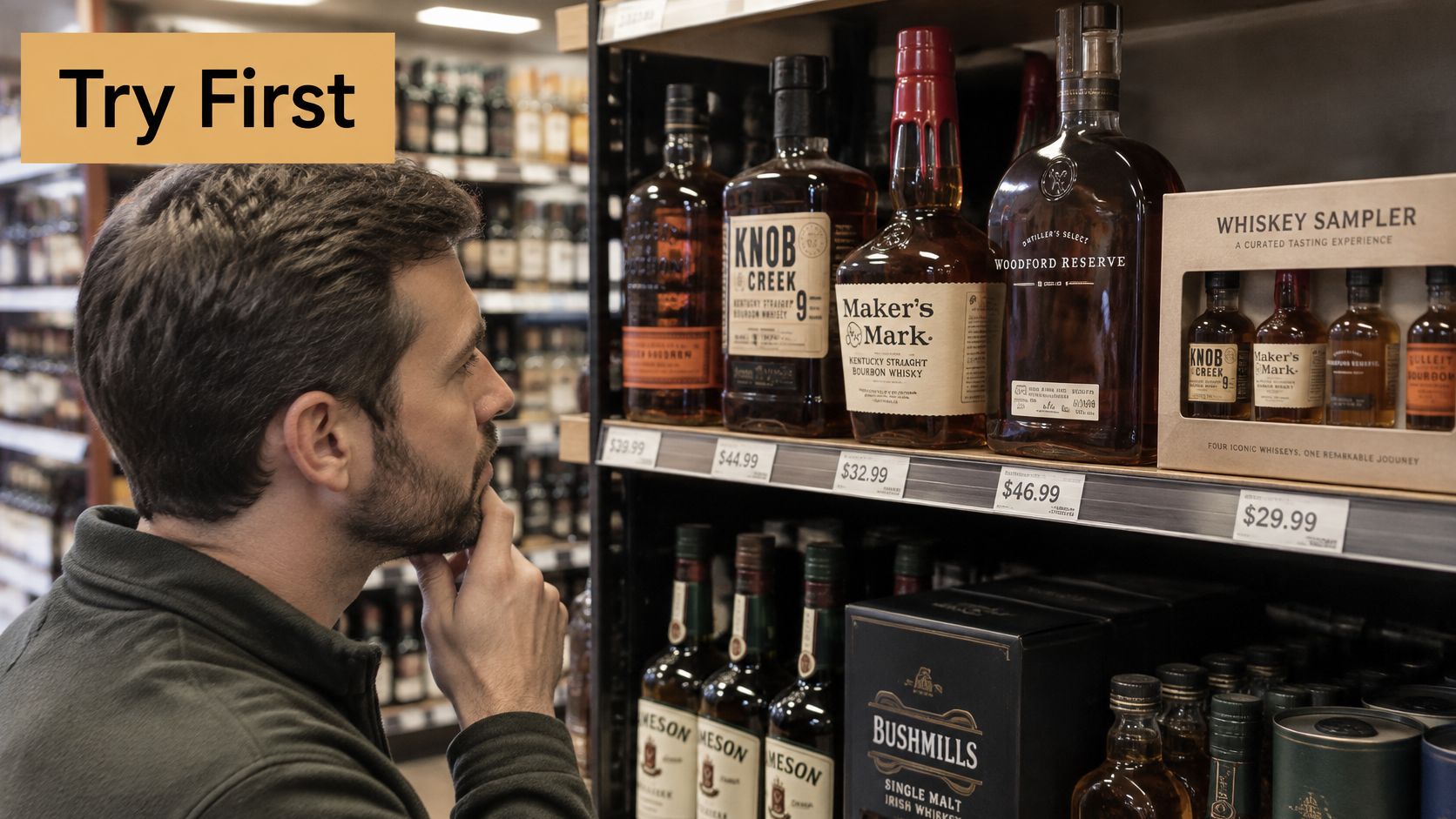
The choice can feel especially hard because the category has grown. In the United States, more than 31 million 9-liter cases of American whiskey were sold in 2023, and sales volume was up 132% compared with 2003, according to the Distilled Spirits Council of the United States' American Whiskey fact sheet. More styles and producers give drinkers more to explore, but they can also make it harder for a beginner to know where to start.
A sampler can also work as a blind-tasting tool. Cover the labels or use samples marked A, B, and C, then write down which pour you prefer before you learn its brand or price. That preference isn't a verdict on which whiskey is objectively best. It's evidence about what you enjoy.
Beginner's self-check: If you can't name the style or proof of the bottle you usually buy, a sampler may teach you more than another full bottle.
Single Bottles, Miniatures and Subscription Kits Compared
Choosing between formats works a bit like standing at a chocolate counter: you can take home one bar you already love, or a tasting box that lets you compare several pieces before committing. Whiskey samplers come in three main formats.
| Format | What You Get | Commitment | Best For |
|---|---|---|---|
| Single bottle | One full-size bottle, usually 750 mL | Full bottle commitment | Drinkers who already know their favorite style |
| Miniature sampler set | Several 50 mL samples in one package | One purchase, low commitment | Beginners comparing styles |
| Subscription kit | A new set of blind samples on a recurring schedule, often with tasting notes | Ongoing, usually quarterly | Ongoing discovery or gifts |
A single bottle makes sense when you already know what you like. You get more of one whiskey, useful when you want to return to that bottle over time, but you get no side-by-side comparison. If the style does not suit you, a full bottle is a lot to work through.
A miniature set trades volume for range. In the United States, the Alcohol and Tobacco Tax and Trade Bureau's distilled spirits guidance lists 50 mL and 100 mL among the smallest approved standards of fill for distilled spirits. Four 50 mL samples total 200 mL, well below a standard 750 mL bottle. The limit is worth naming plainly: a 50 mL pour is enough to compare aroma and flavor across a few glasses and to learn which style you would reach for again, though it rarely stretches to revisiting a favorite many times or testing it in cocktails.
Subscription kits keep the comparison going. Each delivery brings new samples on a recurring schedule, often with tasting notes or a structured guide, so the learning repeats instead of ending with one box. Blind Barrels' quarterly membership, for example, sends four 50 mL samples labeled A through D, and members can order member-discounted full bottles of a whiskey they discovered. For a one-time version of the same idea, the Single Kit ($89.99, shipping included, no subscription) packs four blind tasting bottles with a tasting table and a whiskey game. This guide to the whiskey subscription box explains what recurring kits typically include.
Blind samples give these kits their real value. Covering the label separates preference from reputation, so your notes reflect what you enjoyed rather than what a brand or price told you to expect.
A single purchase lets you try the format and stop. A subscription spreads discovery over time and adds surprise, though it also means continuing spending until you cancel. If you are weighing recurring tasting experiences in other categories, you can explore wine club benefits as a parallel model of planned, ongoing exploration.
Two questions close the decision. How many bottles would you realistically open in a month, and do you want to compare styles once or keep meeting new producers? Whatever the answer, confirm the seller ships spirits to your state before you pay.
How to Choose by Style, Proof, Age and Provenance
| Criterion | What It Changes | Reference Range | Beginner Pick |
|---|---|---|---|
| Style | Grain mix shapes sweetness, spice and cereal notes | At least 51% of the named grain for the listed whiskey types | Bourbon for sweetness, rye for spice |
| Proof | Higher proof can add heat and hide aroma | Compare the proof stated on each label | Choose a lower-proof sample to start |
| Age | Time in oak influences wood-derived flavors | Straight whiskey must mature for at least two years | Choose a set that clearly states age |
| Provenance | Distillery and region show how the whiskey was made | Check for a named distillery and mash bill | Choose producers that publish their mash bill |
Style is the starting point. Bourbon and rye can taste quite different because the grains in the mash bill, the recipe used to make the whiskey, influence its character. U.S. federal standards require bourbon, rye, wheat, and malt whiskey categories to contain at least 51% of the named grain. If you're curious about sweetness, start with bourbon; if you're looking for a spicier impression, try rye. The federal whiskey standards also set requirements for distillation and barrel entry, so the category names describe production rules as well as taste expectations.
Proof is a clue, not a quality score. Higher bottling proof can increase alcohol heat and make delicate aromas harder to pick out. Compare the proof printed on each sample rather than assuming the strongest one is the most complex. If you're new to whiskey, begin with a lower-proof pour, then try a higher-proof one later if you're curious. Adding a little water can help you explore how the whiskey changes.
Age describes time in oak, not a guarantee of excellence. Straight whiskey must mature for at least two years under the federal standards. Time in oak can contribute wood-derived flavors, but older doesn't automatically mean better for your palate. A younger whiskey might have a brighter or less oak-heavy character that you prefer.
Provenance gives the tasting more context. Look for the distillery and mash bill, then consider how a producer's choices could shape the whiskey. The American craft spirits industry includes many small producers: the American Craft Spirits Association's 2024 Craft Spirits Data Project reported 3,069 active U.S. craft distillers as of August 2024. That's a broad pool of producers, though not every craft distiller makes whiskey. A set featuring several small American distilleries can introduce you to different production approaches without asking you to choose a full bottle first.
For a first sampler, pick one sample per style, start with lower-proof options, and favor samples that disclose their age and distillery. That gives you a fairer comparison than trying to guess everything from flavor alone.
Shipping and State Rules Before You Order
A whiskey sampler is small, but its size doesn't remove the rules that apply to shipping spirits. The FedEx alcohol-shipping guidance says individuals can't ship alcohol and that spirits shipments generally require licensee-to-licensee transactions. Direct-to-consumer spirits shipping is allowed only in a limited number of U.S. jurisdictions, with state-specific requirements. For a broader explanation of online alcohol purchases, read this guide to whether it's legal to buy alcohol online.
Before you pay, run these four checks:
- Confirm the destination state is eligible. Check the seller's state eligibility information at checkout, using the recipient's state rather than assuming every address can receive spirits.
- Look for age verification. The seller should explain how it checks that the buyer or recipient meets the legal age requirements. If state eligibility isn't disclosed, don't assume the order can ship.
- Plan for delivery. Expect adult-signature delivery and make sure an adult can be present. Ask the seller whether a spouse or neighbor can accept the package, and check how the seller handles a gift order if the recipient won't be home.
- Compare the cost fairly. Divide the set price by its total liquid volume, then compare that figure with the price per milliliter of a 750 mL bottle. For example, four 50 mL samples contain 200 mL in total, but the per-milliliter comparison won't tell you whether trying several styles is worth more to you than buying one bottle.
The final decision belongs to the state where the package will arrive. Whether you choose a sampler, a single bottle, or a gift set, that destination determines whether the order can go ahead.
How to Taste Your Set Blind and Read the Results
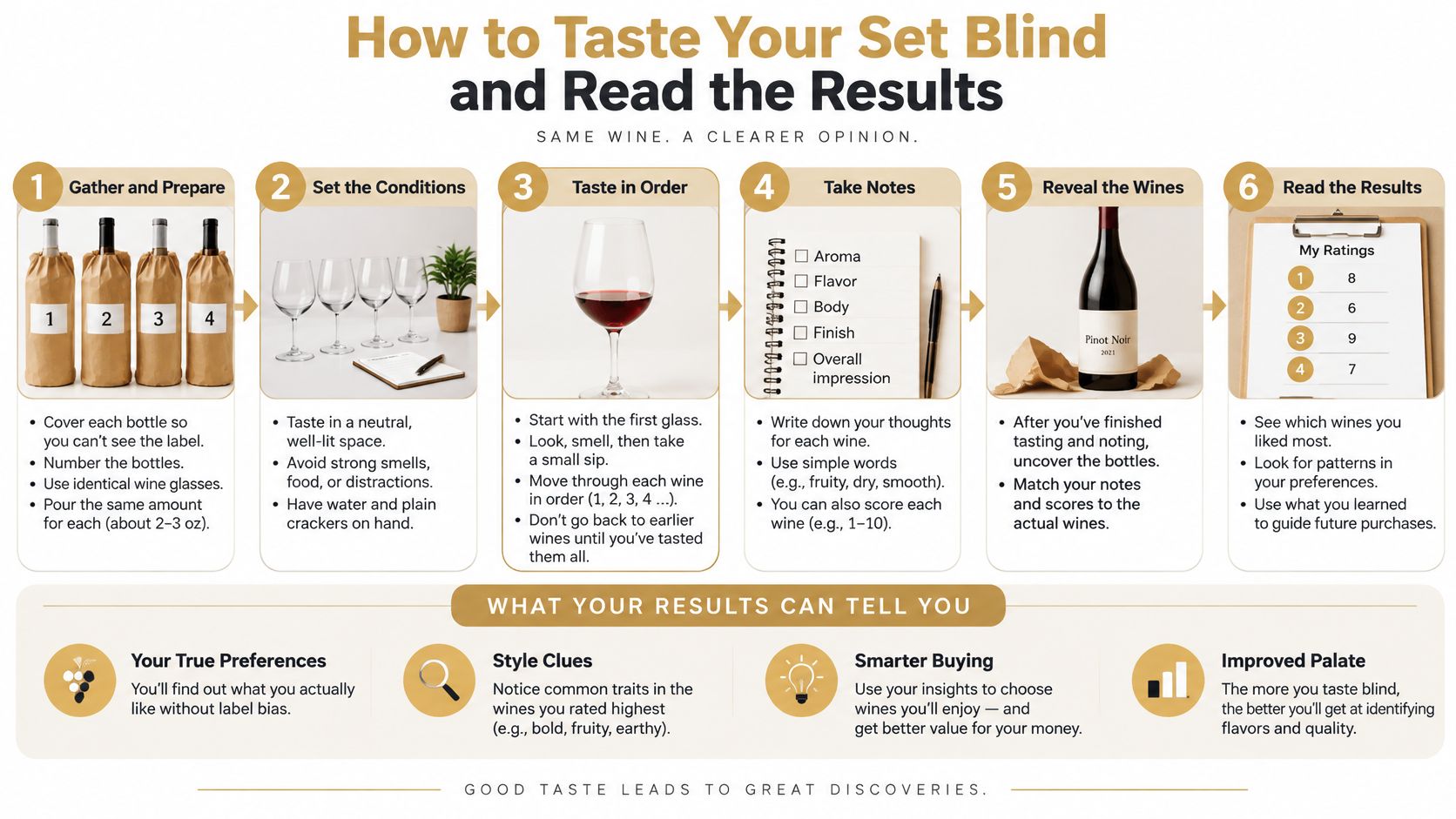
By the time the box is open, the buying questions should be settled: the set can ship to the destination state, an adult can sign for it, and the samples are ready to pour. Now the sampler works like a small tasting flight with the labels covered: same glass, same routine, no brand cues, so each pour is judged on smell and taste rather than reputation.
- Set up a quiet tasting. Pour about 15 mL, or half an ounce, of Sample A into a clean tulip glass and let it rest briefly. A consistent glass and a calm setting make it easier to focus on what you smell and taste.
- Notice the aroma before sipping. Smell the whiskey with short sniffs, first without swirling, then after gently swirling the glass. Write down your impressions before you try to identify the whiskey.
- Taste a small sip. Let it coat your mouth, then record the palate and finish, meaning the flavors that linger after swallowing. The finish may show oak or spice differently from the first moment on your tongue.
- Add water gradually. Try two to five drops of room-temperature water, wait a moment, and taste again. A peer-reviewed whisky sensory study found that dilution changed aroma and that differences among whiskies within the same style became less apparent beyond an 80:20 whisky-to-water ratio. Taste neat first, then add water in small amounts instead of pre-diluting the sample.
- Repeat with each pour. Work through Samples B, C, and D, rinsing with water between pours. A plain cracker can help refresh your palate, but keep the tasting order and routine consistent.
- Record neat and diluted notes separately. Include fields for aroma, palate, finish, and the amount of water you added. A whiskey tasting notes template can help you keep your observations organized. If you like structured sensory exercises in other foods, this step-by-step chocolate tasting method offers a useful parallel.
- Guess before you reveal. Write down your estimate of style, proof, and age, then uncover the labels and compare your guesses with the details. If the samples include a tasting table, use it to capture what stood out and what surprised you.
Blind tasting helps separate what you like from what the label primes you to like. A hidden-label flight works like a box of chocolates with the key covered: a favorite can win because it tastes good to you, while a famous or expensive piece can lose its advantage once the wrapper is gone. If you guess that a fiery sample is older, you may be responding to alcohol heat rather than age. If a soft, sweet pour feels “better,” the preference may be real even when the style is not your usual choice.
A wrong guess is useful information. It shows which cue carried your judgment: vanilla sweetness, rye spice, smoke, tannic oak, or simple proof. A small sample can reveal style, balance, and whether a whiskey deserves a second look; it cannot fully predict how the same whiskey will behave across a whole bottle over several evenings.
The useful result: A blind tasting is strongest at showing which pour you would reach for again. Use that preference as the signal, and treat broad claims about which whiskey is “best” with care.
Choose Your First Sampler Set and Taste It Blind
Start by choosing one format and one goal. If you're new to whiskey, a miniature sampler is a straightforward way to compare styles without taking home a full bottle of each. If you want discovery to continue over time, a blind subscription may suit you better. Either way, choose samples with clear information about the distillery, mash bill, ABV, and age statement so you have something concrete to compare after the reveal.
A QR code in each Blind Barrels membership box links to sample details, including distillery, mash bill, ABV, age statement, aroma and tasting notes, and the distillery's background. The tasting table helps members make sense of aroma and tasting notes for the four samples. That kind of information turns a set from a collection of miniatures into a guided comparison.
Before ordering, check that the seller can ship to the recipient's state and review the delivery requirements. Then set aside a short tasting session: taste each pour neat, add a few drops of water if needed, record your guesses about style, proof, and age, and reveal the labels only at the end. Compare your notes, choose the sample you'd most want to drink again, and use that preference to guide your next full-bottle purchase.
For a gift, a sampler gives someone room to explore without asking them to commit to a full bottle they may not enjoy. Choose a set with clear sample details, schedule one tasting, and let your own notes decide which style to try next.
Blind Barrels offers blind whiskey tasting kits featuring small American craft distilleries, with four samples, a tasting table, and a whiskey game that lets you guess each pour before the reveal. If you're ready to compare your preferences without brand and price cues, visit Blind Barrels and choose a sampler experience that fits your next tasting.