

If a small whiskey pour and a generous-looking glass of wine can contain the same amount of alcohol, what are you really choosing between? Whiskey vs wine is less about which drink is stronger or healthier and more about how each fits your food, attention, and evening.
The useful differences start before either drink reaches the glass. Grapes and grain take different paths through fermentation, maturation, and bottling, and those paths explain why you might crave bright fruit with dinner but prefer vanilla, spice, and oak afterward.
Why Whiskey and Wine Get Compared at All
Whiskey and wine aren't natural rivals. You might enjoy both, yet reach for them in different settings: wine alongside a meal, whiskey in a smaller glass when you want to linger over its aroma.
The question is usually practical. What fits tonight's food? Which bottle suits your budget? Do you want something refreshing, something warming, or an experience that gives everyone at the table something to discuss?
| Consideration | Wine | Whiskey |
|---|---|---|
| Production starting point | Grapes and their harvest conditions | Grain recipe, followed by distillation |
| Main identity clues | Grape, region, and vintage | Whiskey type, proof, and maturation |
| Useful sensory focus | Fruit, acidity, tannin, and texture | Grain, oak, spice, and alcohol integration |
| Serving comparison | Check volume and alcohol strength | Check volume and alcohol strength |
| Choosing for an occasion | Consider the meal and serving conditions | Consider the pour, pace, and tasting format |
Those are starting points, not rules. Whiskey can accompany dinner, and wine can reward quiet, focused tasting without a plate in sight.
Choose the experience before the category
Think about how much attention you want to give the drink. A conversation-filled dinner calls for a different approach than an evening spent comparing aromas and writing tasting notes.
Choose the occasion first. Then choose the drink that belongs in it.
For new whiskey drinkers, that removes unnecessary pressure. You don't need to prefer whiskey neat, identify obscure aromas, or buy an expensive bottle to participate.
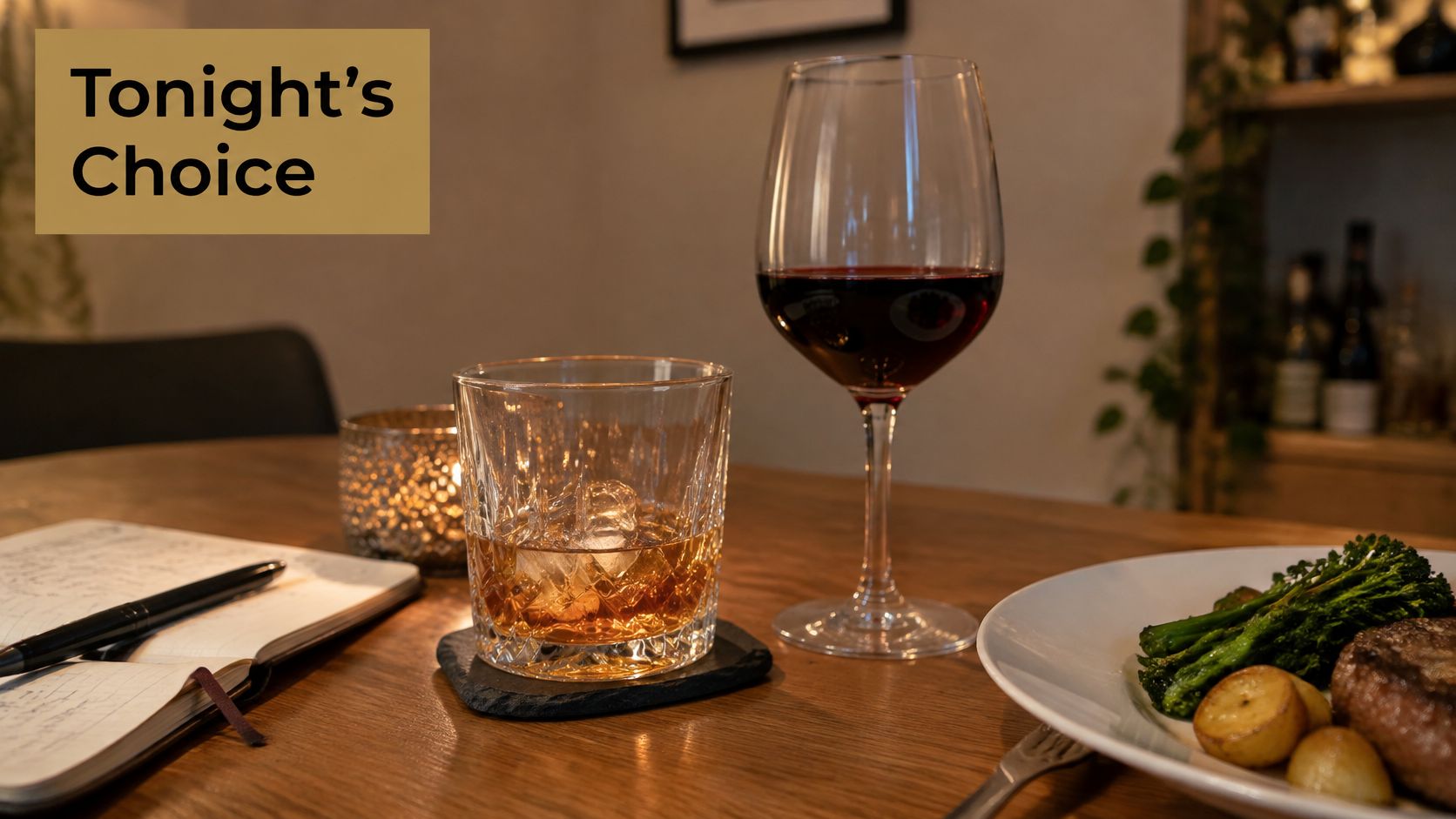
A useful comparison accounts for production, aging, flavor, serving size, storage, and cost. Personal preference is the outcome, not something you need to justify with a label or reputation.
How Production Scale Shapes Each Category
Wine and whiskey statistics can look comparable while measuring quite different things. Wine is commonly counted as total liquid volume; whiskey may be reported in bottles, cases, litres of pure alcohol, or export value.
According to the International Organisation of Vine and Wine's global sector report, estimated wine production reached 225.8 million hectolitres in 2024, down 4.8% from the previous year and the lowest level in more than 60 years, while consumption fell 3.3% to 214.2 million hectolitres.
The Scotch Whisky Association's industry figures describe more than 1.3 billion 70-centilitre bottles shipped annually to over 160 markets, equivalent to roughly 43 bottles exported every second.
Wine and Whiskey by the Numbers
| Measure | Wine | Whiskey |
|---|---|---|
| Common measurement convention | Total beverage volume | Bottles, cases, pure alcohol, or export value |
| Annual scale represented above | Global production and consumption | Scotch export shipments, not all whiskey |
| Main production constraint | Annual grape harvest | Distillation and maturation planning |
| Response to changing conditions | Harvest conditions affect available wine | Mature stocks depend on earlier production decisions |
Scotch exports aren't a proxy for all whiskey production. Comparing those shipments directly with worldwide wine production would mix a regional export measure with a global production measure.
What scale means at your table
Wine's agricultural exposure matters because a vintage begins with a particular harvest. Weather and growing conditions can change what producers have available before fermentation starts.
Whiskey producers face a different planning problem. They must decide what to distill and mature before knowing exactly what customers will want when those casks are ready.
For American craft whiskey brands, that makes a bottle's production choices more useful than broad claims about category size. Ask what grain recipe, barrel treatment, and bottling strength distinguish the release.
Liquid volume alone doesn't establish value. Your purchasing decision should account for the experience you want, the amount you'll serve, and whether the bottle's character appeals to you.
From Grape Harvest to Barrel Maturation
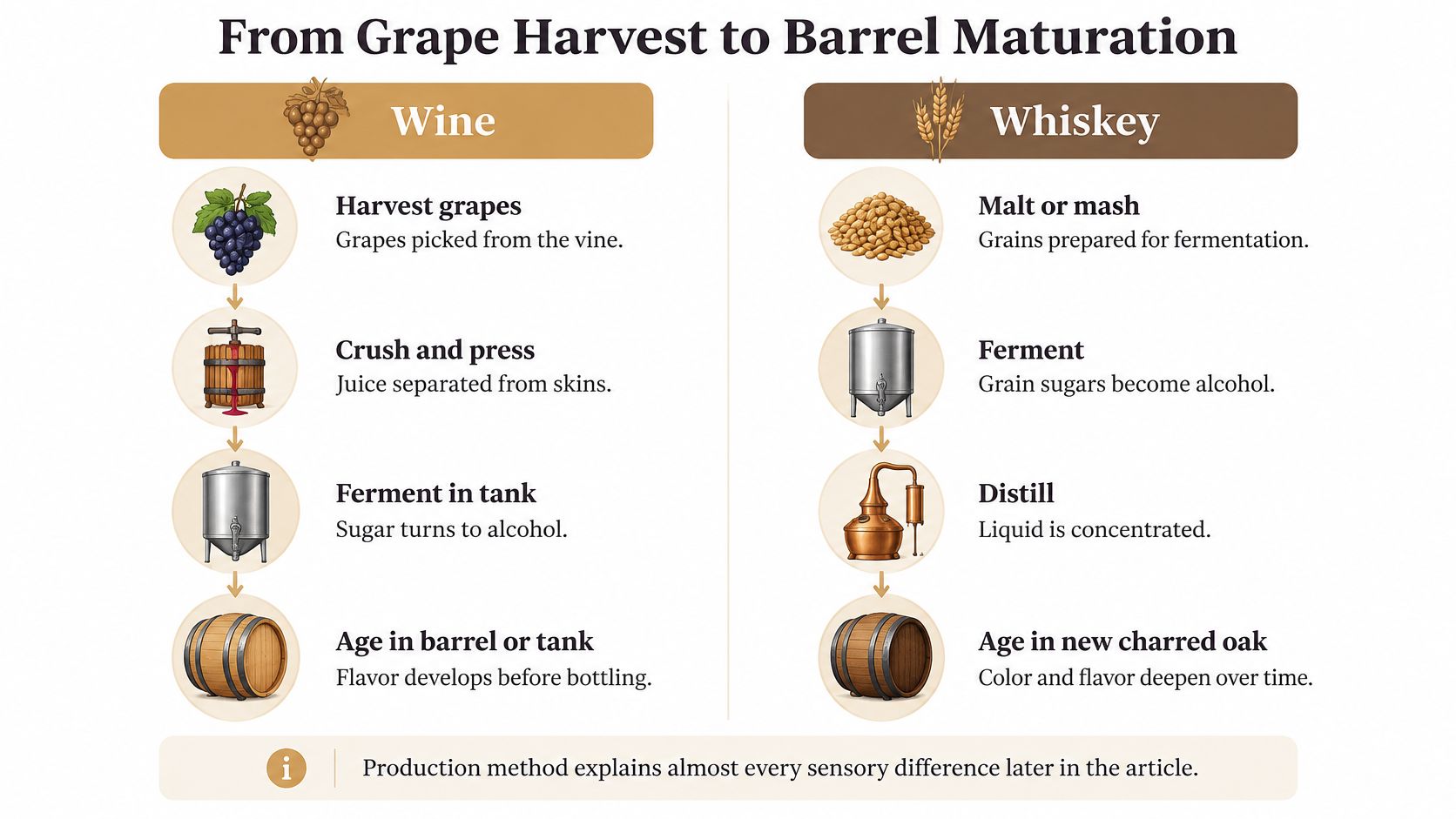
Start with whiskey's grain recipe, often called its mash bill. Producers prepare the grain so its sugars can support fermentation, then distill the fermented liquid to concentrate the alcohol.
Maturation follows. The cask isn't just a waiting room: its wood becomes part of the drink's development, alongside the character created through fermentation and distillation.
Read American whiskey labels precisely
Bourbon is a specific category, not a synonym for American whiskey. Its production framework requires:
- Grain composition: A mash bill containing at least 51% corn.
- Maturation container: Aging in new charred oak containers.
- Distillation strength: No more than 160 proof.
- Barrel-entry strength: No more than 125 proof.
- Bottling strength: A minimum of 80 proof.
Straight bourbon must mature for at least two years, and straight bourbon aged under four years must disclose its actual age on the label.
These requirements apply across producer sizes. An American craft whiskey brand doesn't operate under a separate bourbon definition because its distillery is small.
When browsing names such as Frey Ranch or Southern Star, begin with the particular bottle's category and proof rather than assuming the brand name tells you everything. Compare releases, not an imagined house flavor you haven't tasted.
Follow wine from harvest to bottle
Wine begins with harvested grapes rather than a grain mash. Producers crush or press the fruit, ferment its sugars, and make decisions about skin contact, vessels, oxygen exposure, and maturation.
The sequence varies by style. Don't read a simplified process diagram as a requirement that all grape juice must be separated from skins before fermentation, or that every wine spends time in oak.
Wine can reach the market within months, although some styles mature for years. Whiskey's cask-maturation timeline makes ready-to-bottle supply less responsive to a sudden increase in demand.
That difference gives you useful questions to ask. With wine, investigate grape, region, and vintage; with American craft whiskey, investigate grain recipe, distillation, cask history, proof, and age.
Neither list guarantees quality. Each explains which production decisions you're tasting.
Aroma, Palate, and Finish Side by Side
A wine drinker moving into whiskey already has useful sensory skills. You know how to distinguish a smell from a taste, notice a drying texture, and follow what remains after swallowing.
The adjustment is learning to separate concentrated alcohol sensations from the drink's other characteristics. Warmth is an observation, but it isn't a complete tasting note.
What the barrel changes
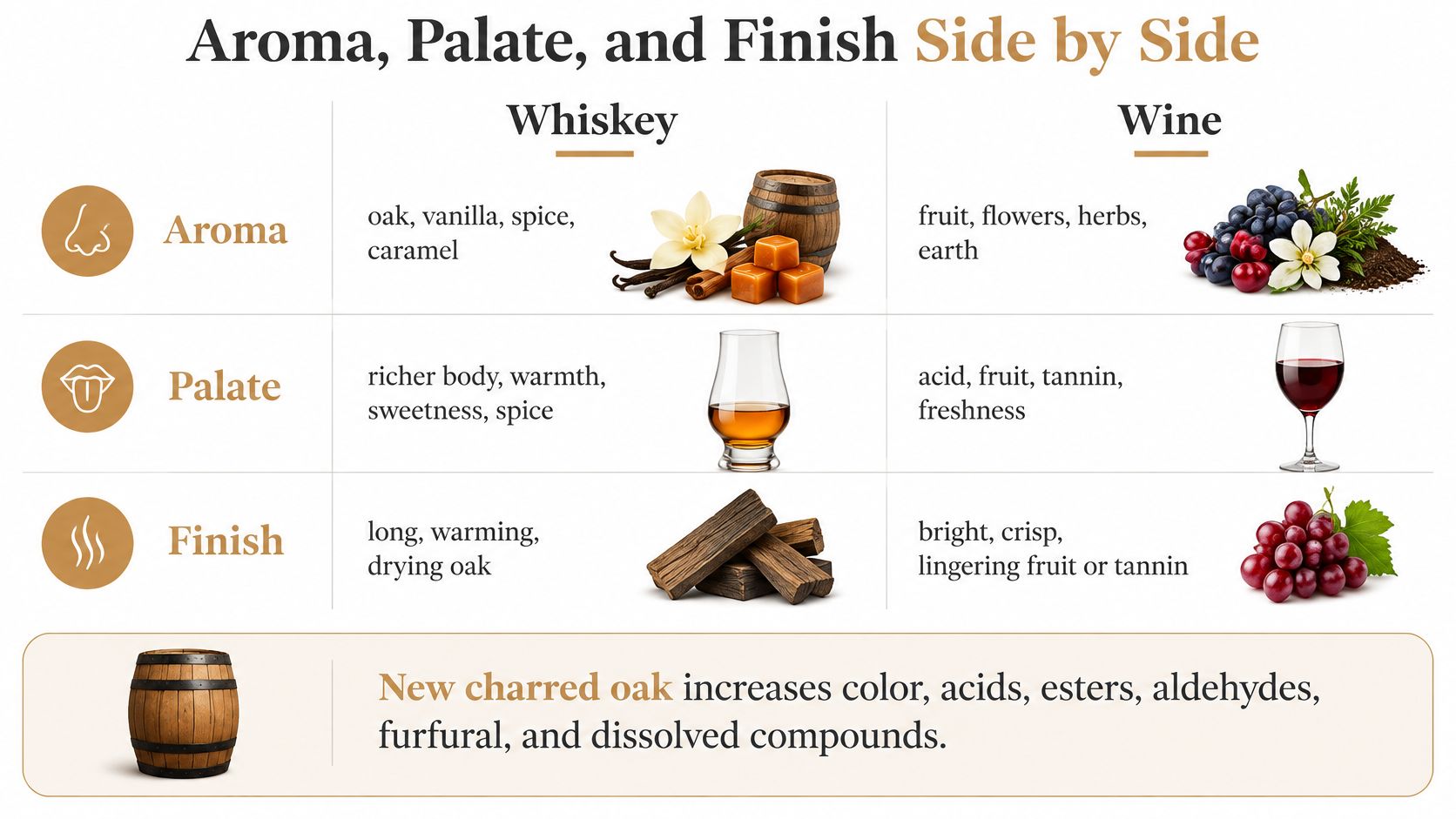
In a controlled study of whiskey mash bills and maturation, researchers found statistically significant differences in 18 of 35 sensory attributes, with wood aging shifting profiles away from vegetal, liquorice, yeasty, and grassy notes toward vanilla, cinnamon, alcohol, and oak; even three months in new charred oak produced clear separation in gas-chromatography and liquid-chromatography profiles.
Contact with that wood increased color, acids, esters, aldehydes, furfural, dissolved solids, and tannins. These findings describe the tested conditions, not a universal timetable for every whiskey.
Wine also develops through fermentation, wood, oxygen exposure, and bottle aging. But the new-charred-oak influence central to bourbon provides a particularly direct explanation for prominent barrel-derived character.
Separate character from intensity
Use a tasting sheet that keeps different impressions apart:
| Observation | What to record |
|---|---|
| Aroma | Fruit, cereal, flowers, herbs, vanilla, or spice you actually notice |
| Palate | Flavor development, texture, sweetness impressions, and alcohol warmth |
| Oak influence | Toast, wood, vanilla, and drying sensations |
| Finish | What remains, how it changes, and whether you enjoy it |
For example, a whiskey might smell invitingly of vanilla but finish with more drying oak than you prefer. Another may offer less obvious barrel character yet hold your interest through fruit and grain notes.
A wine might feel fresh and fruit-led, or more structured and drying. These are possibilities to investigate, not category-wide promises.
Tasting habit: Record what you perceive before deciding whether it signals quality.
For new whiskey drinkers, older doesn't automatically mean better. Look for balance among spirit character, oak, and alcohol rather than rewarding the strongest wood impression.
How to Taste Each Drink Properly
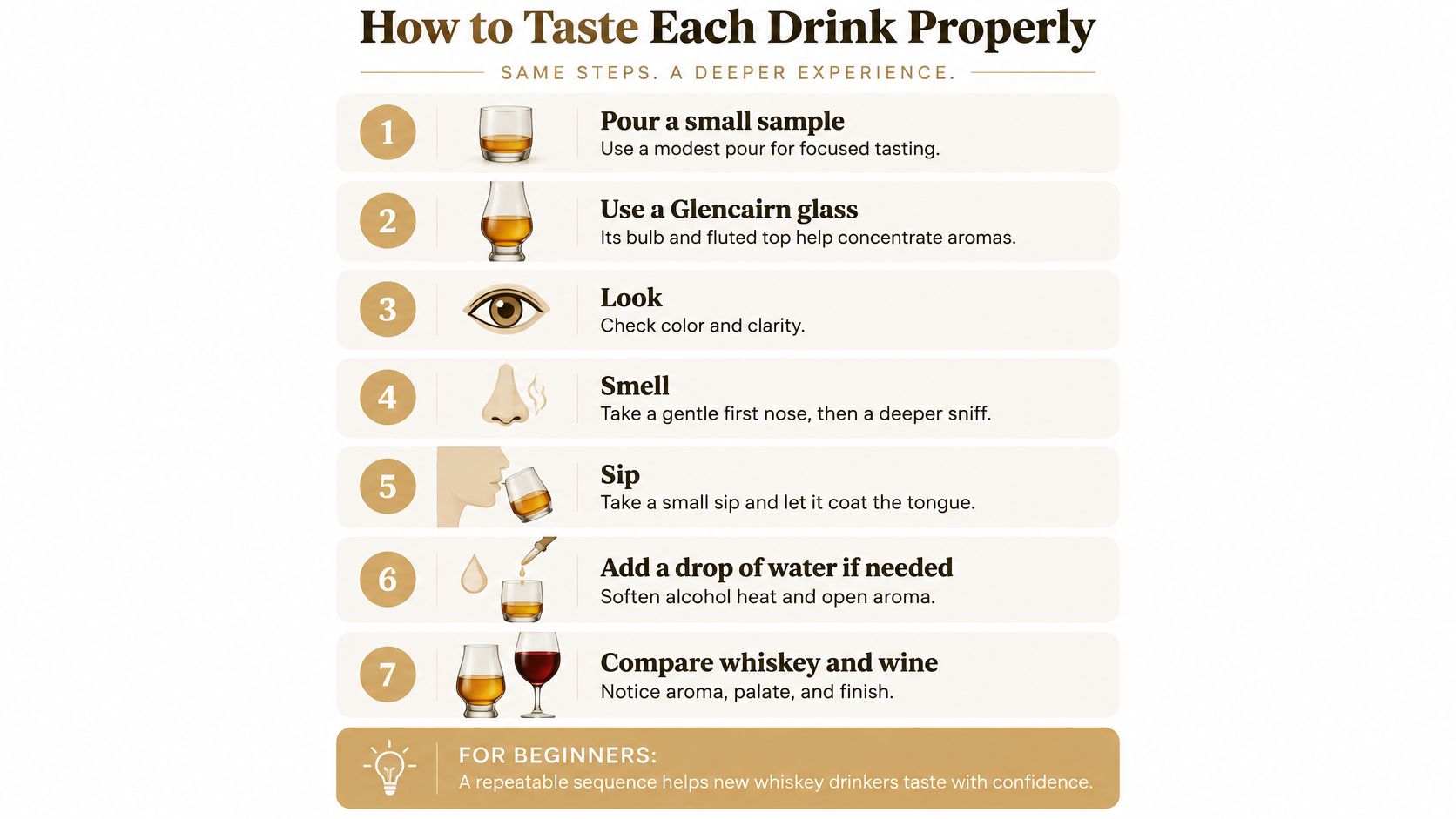
You don't need a large pour to learn something useful. Set out water, a tasting sheet, and suitable glassware, then leave yourself enough time to notice changes without rushing.
For whiskey, a Glencairn glass offers a practical starting point. Its bulb and narrowing upper section help direct aromas toward your nose.
Build a repeatable whiskey routine
The Serious Eats whiskey-glass guide recommends tilting the glass so the whiskey rests in the bulb, rotating it three or four times, and nosing gently near the top edge rather than pushing your nose inside.
Excessive exposure can temporarily dull your sense of smell, commonly called going nose-blind. If all you notice is alcohol, pull back rather than inhaling harder.
- Look first: Check color and clarity, then inspect how the liquid moves against a light source.
- Smell gently: Write down an initial impression in ordinary language. Apple, toast, or baking spice is more useful than a descriptor you don't understand.
- Take a small sip: Hold it near the center of your tongue, move your head slightly side to side, and swallow while breathing out through both nostrils.
- Record the finish: Notice what remains after the initial warmth fades.
Try whiskey at its supplied strength before adding water incrementally and retasting. Don't assume dilution must improve it, and don't add so much immediately that you lose the chance to compare.
Adapt the method for wine
With wine, focus on temperature, glass shape, aeration, and serving volume, rather than table-side dilution. Keep those conditions consistent when comparing samples so you're not judging a warmer, more aerated pour against a freshly opened one.
Use the same aroma, palate, and finish headings for both drinks. The vocabulary will change, but the discipline of observation transfers.
For a wine-focused evening, this guide to hosting a blind wine tasting provides a useful companion format. New whiskey drinkers can borrow that familiar structure without pretending whiskey should behave like wine.
If you're sampling American craft releases, leave room for uncertainty in your notes. “Fruit, perhaps apple” is an honest and useful observation.
Serving Size, Alcohol Content, and Storage
Glass size isn't alcohol dose. A small-looking whiskey measure can contain as much alcohol as a visibly larger wine serving, so appearances make a poor comparison.
The CDC's standard-drink definitions put a U.S. standard drink at 0.6 fluid ounces, or 14 grams, of pure alcohol, approximately 5 fluid ounces of wine at 12% ABV or 1.5 fluid ounces of spirits at 40% ABV.
Measure the pour and check the strength
Those examples depend on both volume and alcohol by volume, or ABV. Change either variable and you change the alcohol exposure.
Cask-strength whiskey may reach roughly 55–60% ABV, putting the familiar spirit-sized pour above the standard-strength example. Check the actual label instead of treating every whiskey as equivalent.
| Check | Why it matters |
|---|---|
| Pour volume | A free-poured glass may not match your intended serving |
| ABV or proof | Similar-looking whiskeys can have different strengths |
| Total tasting volume | Several small samples still contribute to total intake |
| Added water | Dilution changes concentration, not the alcohol already poured |
The practical rule is to normalize by alcohol amount, not glass size. For help interpreting bottle strength, consult this explanation of how much alcohol is in whiskey.
That's particularly useful when an American craft whiskey tasting includes releases bottled at different proofs. Equal sample volumes make a tidy visual comparison, but they don't necessarily provide equal alcohol.
Store for the drink you'll actually finish
Whiskey is comparatively shelf-stable and concentrated. Wine needs closer attention to heat, light, and oxygen, particularly once opened.
Keep storage practical: protect bottles from unsuitable conditions, close them carefully, and consider how quickly you'll use an opened wine. Don't buy more than your household can sensibly enjoy merely because a bottle looks like good value.
Price deserves the same context. Wine's harvest and vintage variation and whiskey's maturation decisions make bottle-price comparisons incomplete.
For your own budget, compare planned occasions and measured servings, not just liquid volume. An expensive bottle you don't enjoy isn't a better purchase because its category carries prestige.
Choosing Between Them by Occasion and Ritual
Choose wine when you want to explore how a drink changes alongside a meal. Choose whiskey when you want to concentrate on a measured sample, compare production choices, or build a cocktail around a particular character.
Neither choice needs to become a permanent identity. A wine enthusiast can enjoy American craft whiskey without abandoning the dinner table, and a whiskey fan can appreciate the structure of a wine-centered evening.
Match the format to the company
For a food-led gathering, start with the dish and the amount of attention guests want to give their drinks. This guide to pairing food with whiskey offers a way to bring whiskey into that conversation rather than reserving it automatically for afterward.
If your curiosity centers on exploring an estate's wines, you can discover this estate wine club from Clos Pegase and consider whether that producer-focused format suits you. That's a different experience from comparing unidentified whiskey samples, and either can fit the right occasion.
Avoid choosing wine because you assume it's the healthy option. A review of beverage-specific health evidence found beverage type generally had only marginal importance after accounting for alcohol quantity, with drinking patterns and context complicating comparisons.
Apparent advantages in observational research don't prove that wine itself protects health. Diet, drinking with meals, social circumstances, and reporting differences can complicate interpretation; alcohol remains associated with cancer risk regardless of beverage type.
The relevant variables are serving size, pace, total ethanol, and context, not the category printed on the label.
Let the palate decide without the packaging
Blind tasting hides brand and price cues until you've committed your observations to paper. It doesn't make your judgment infallible, but it prevents you from knowingly awarding points for a familiar name or expensive-looking bottle.
A quarterly blind-whiskey subscription offers one structured option alongside a home-organized tasting. The publisher's kit contains four blind samples from small American craft distilleries, plus a tasting table for aroma, palate, and finish notes.
A QR code reveals the samples afterward and provides access to discounted full bottles. An accompanying guessing game asks you to identify age, proof, and whiskey type, then scores your palate accuracy.
Treat that score as a learning tool, not a competition over who has better taste. Your most valuable discovery may be that the unidentified sample you preferred wasn't the style you expected.
Frequently Asked Questions for New Drinkers
How should I choose my first American craft whiskey?
Start with the whiskey type and labeled strength, not packaging. When considering Frey Ranch, Southern Star, or another craft name, choose a specific release you can sample and record what you enjoy before buying.
Does craft whiskey automatically taste better?
No. Bourbon's production rules provide a shared framework, while grain, maturation, and bottling decisions allow differences within it. Compare the actual liquids rather than treating producer size as a quality score.
How do I host a fair blind flight?
Use consistent glassware and equal sample volumes within a comparable-strength whiskey lineup. Hide labels, write aroma, palate, and finish notes independently, then reveal and discuss.
How do I compare whiskey and wine fairly?
Use the standard-drink relationship above, adjusted for each bottle's actual strength. Set your total tasting allowance before pouring, and don't feel obliged to finish every sample.
Blind Barrels offers quarterly blind tasting kits featuring small American craft distilleries, with guided notes and sample reveals that turn curiosity into a practical tasting experience. Visit Blind Barrels to explore whiskey beyond the label and discover which flavors deserve a place at your table.