

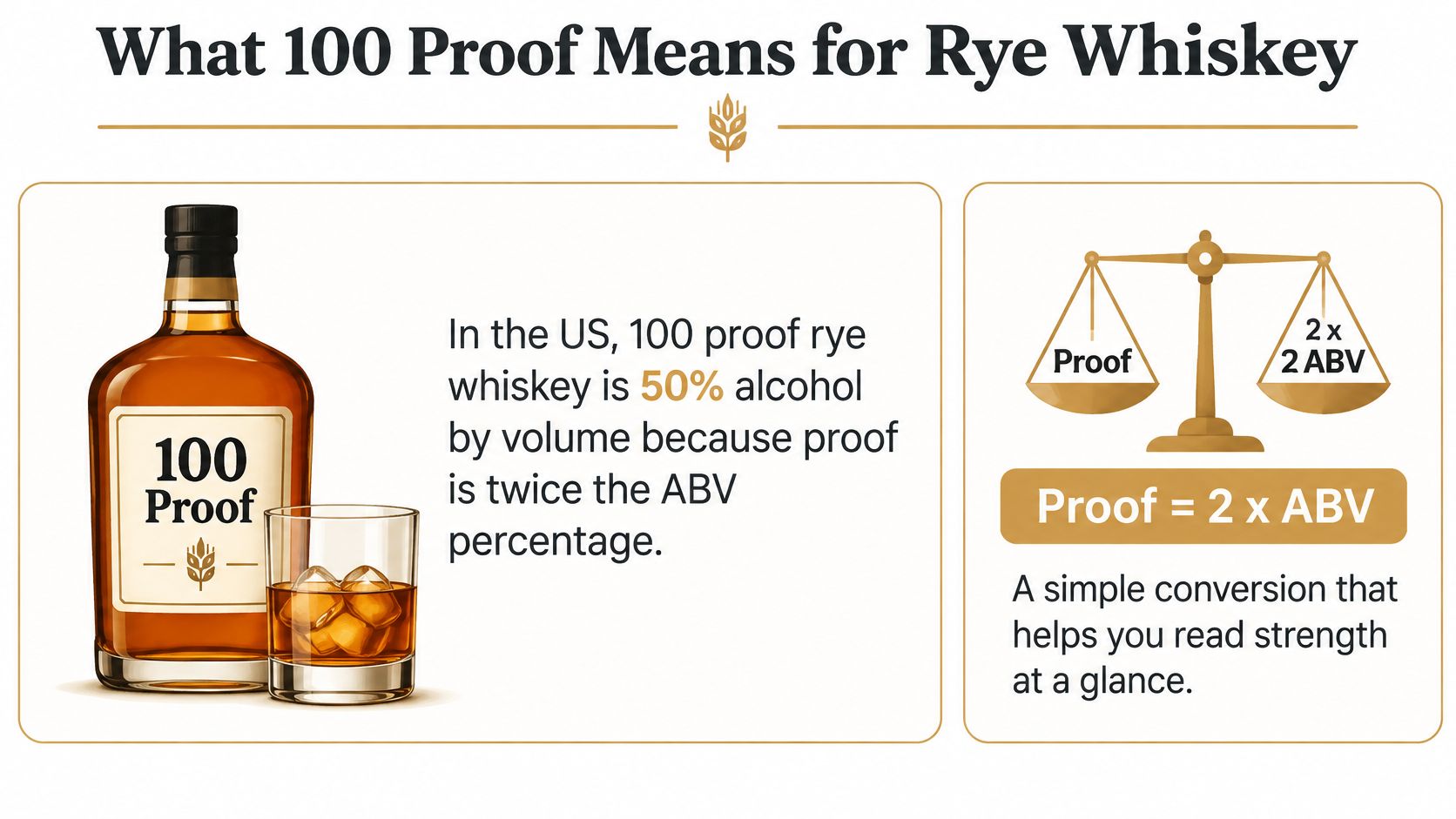
In the US, 100 proof means 50% alcohol by volume because proof is twice the ABV percentage, so a 100 proof rye is 25% stronger than a standard 80 proof bottle. That's a comparison of alcohol concentration, not a promise that it will taste better or feel proportionally hotter.
You've poured a little rye, brought the glass toward your nose, and found more alcohol sting than the caramel or spice you expected. Before you decide the bottle isn't for you, set a glass of water beside it. You can adjust the strength in your glass and discover whether the whiskey becomes fruitier, softer, woodier, or less interesting to you.
What 100 Proof Means for Rye Whiskey
Think of proof like the concentration on a juice label. It tells you how concentrated the drink is, not which ingredients you'll prefer or how carefully someone made it. Proof measures strength, not age, grain recipe, or quality.
The Alcohol and Tobacco Tax and Trade Bureau's alcohol reference establishes that US proof is twice ABV: 100 proof is 50% ABV, compared with 80 proof at 40% ABV, giving the stronger bottle 25% more alcohol by volume. Its rye standards also set a minimum mash content of 51% rye, a maximum distillation strength of 160 proof, and a maximum entry strength into charred new oak of 125 proof.
Proof, ABV and rye thresholds at a glance
| Proof | ABV | What It Means for Rye |
|---|---|---|
| 80 proof | 40% ABV | Standard strength for most whiskey bottles |
| 100 proof | 50% ABV | The subject of this guide and a common bottled-in-bond strength |
| 125 proof | 62.5% ABV | Maximum proof when rye enters charred new oak |
| 160 proof | 80% ABV | Maximum proof at distillation for rye |
These numbers describe different moments in production. Distillation strength concerns the spirit leaving the still, barrel-entry strength concerns the spirit going into wood, and bottle proof tells you what reaches your glass.
The rest of the grain recipe can include corn, malted barley, or other permitted grains. A producer who uses more corn may make a different-tasting whiskey from a producer who leans heavily on rye, even when their bottles show identical proof.
Our guide to what proof means in whiskey helps you read that strength information without confusing it with a flavor rating.
Bottling strength isn't barrel strength
A bottle at this strength isn't necessarily cask strength. The distiller may have added water before bottling, as the TTB's whisky webinar explains through its production and proofing benchmarks.
That distinction matters when shopping American craft whiskey. A dramatic label, small distillery name, or dark liquid doesn't tell you whether the producer bottled the whiskey directly from the barrel.
Use this quick label check:
- Proof: What strength will you pour?
- Rye share: Does the producer disclose the grain recipe?
- Age: Is a maturation period stated, rather than implied by color or packaging?
If the label doesn't disclose a detail, leave it unknown. Your tasting notes can describe the whiskey without turning guesses into production facts.
How Proof Changes Flavor and Mouthfeel
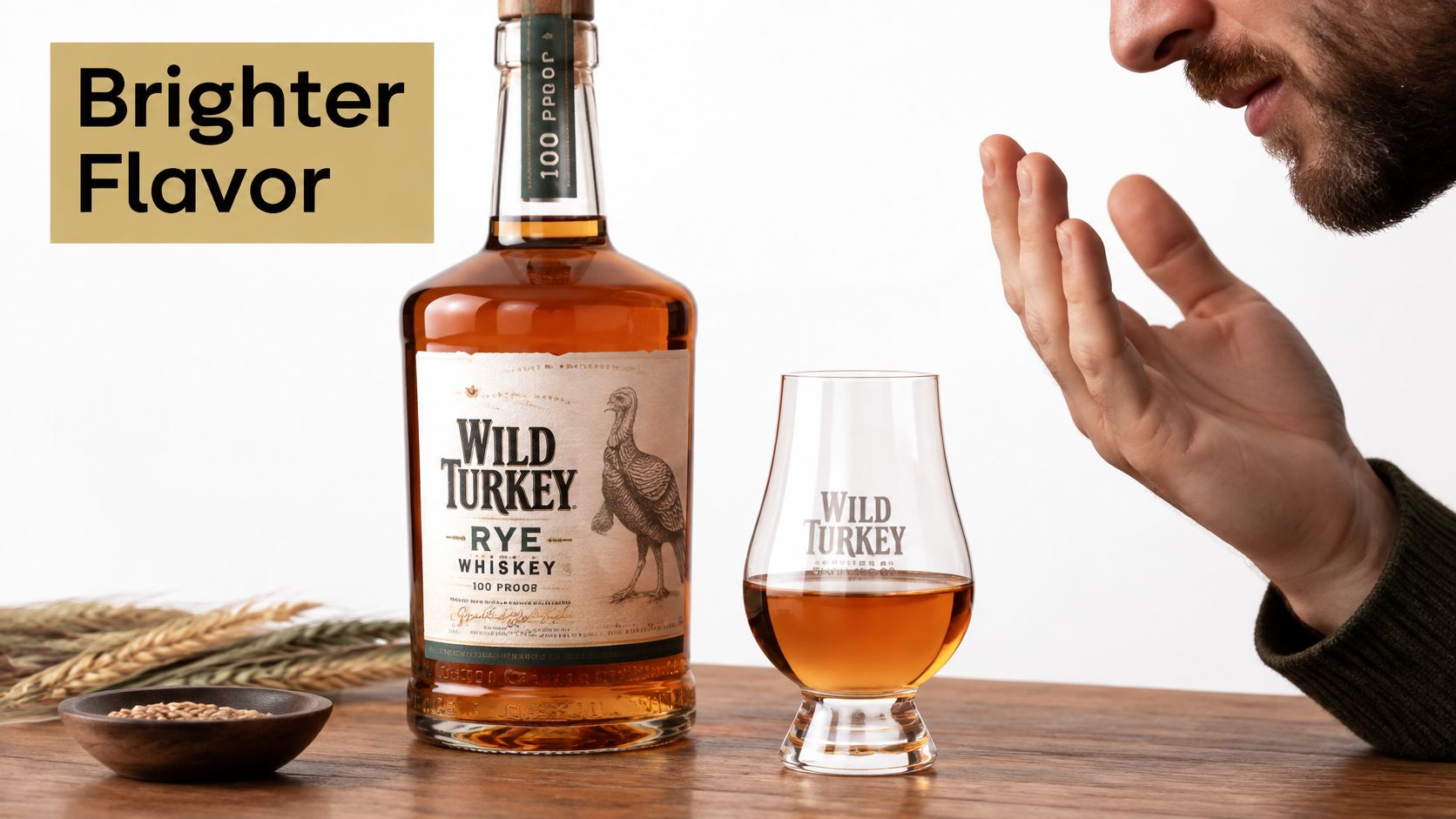
Alcohol works a little like stage lighting. It helps you notice some features, leaves others less visible, and can become uncomfortable when it's too intense. With stronger rye, the first impression can be bright and sharp enough that you miss quieter fruit or vanilla aromas.
Heat comes first for many beginners. A large sip can make your tongue and throat feel warm before you've identified any flavor. That doesn't mean the whiskey has nothing else to offer. It means your first useful adjustment may be a smaller sip, not a different bottle.
Aroma and texture don't change in lockstep
The TTB's distilled-spirits guidance provides the strength framework for this comparison: ethanol can increase perceived heat and suppress some aroma perception, so comparing neat whiskey with a controlled water addition helps separate those effects.
Don't push your nose deep into the glass to compensate. Hold it away, take a gentle sniff, and approach only as far as feels comfortable. You're looking for recognizable impressions, not trying to inhale every aroma at once.
On the palate, a stronger rye may seem fuller, coat your mouth longer, or leave a persistent warming sensation. But strength alone doesn't guarantee a thick texture or long finish. Grain recipe, distillation choices, and maturation all influence those impressions.
Separate what you feel from what you taste. Warmth is a sensation; cinnamon is a flavor association. A dry, gripping feeling along your gums is different again, and may be associated with oak rather than alcohol alone.
A longer burn isn't automatically a longer flavor finish. Notice what remains after the warmth begins to fade.
Water changes the balance
Adding water changes how aroma compounds distribute between the liquid and the air above it. In a peer-reviewed whisky dilution study, relatively water-soluble compounds decreased in that airspace while less water-soluble compounds could become more prominent.
That helps explain why diluted rye doesn't always smell like a quieter version of the neat pour. A previously hidden fruit note might become easier to identify, while another aroma becomes less distinct.
Treat water as an adjustment, not a repair. The useful question isn't whether the whiskey became smoother. Ask whether you can identify more of what you enjoy and whether the mouthfeel still suits you.
Typical Rye Flavor Profiles at 100 Proof
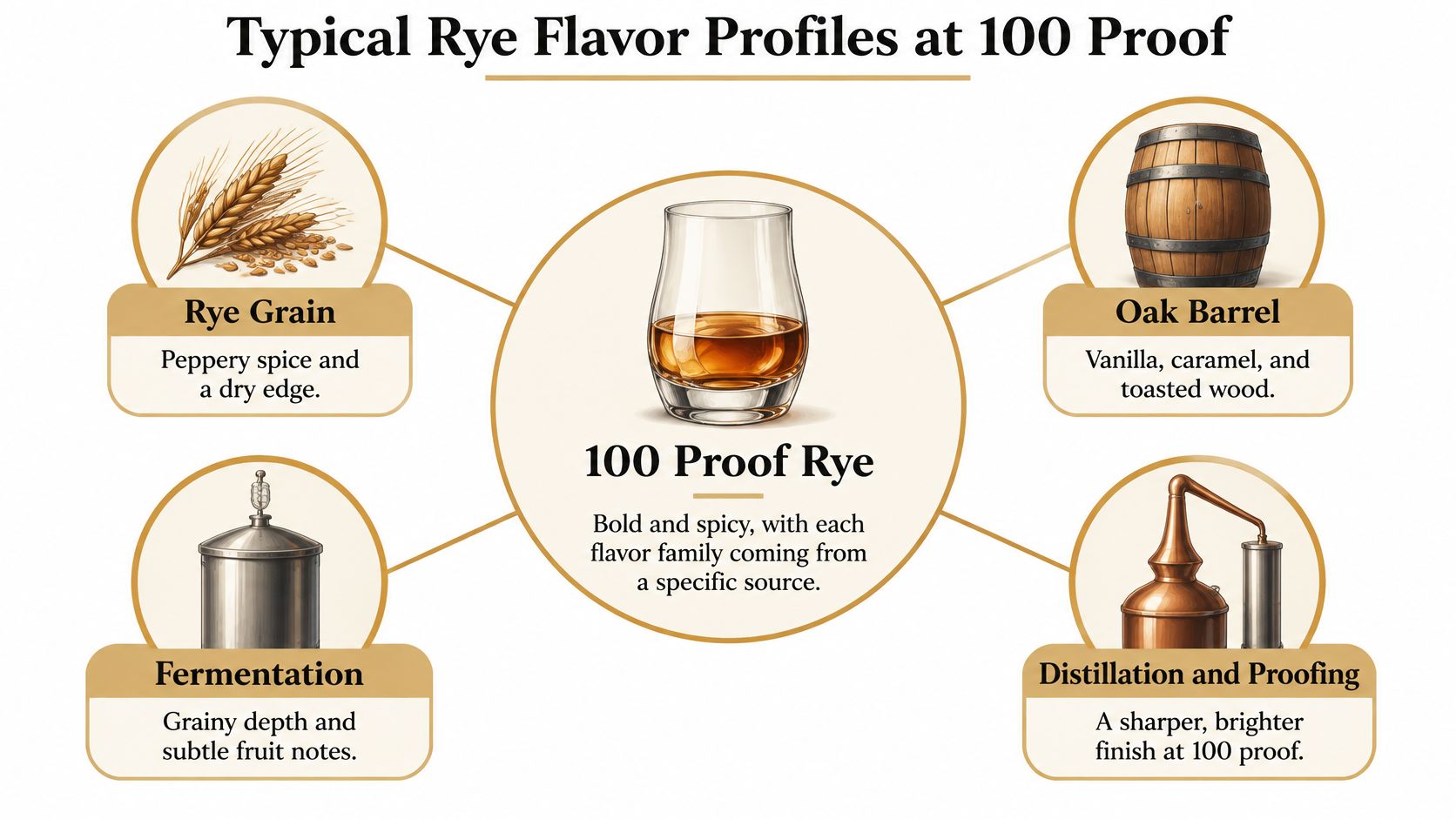
Flavor families in 100 proof rye
| Flavor Family | Typical Notes | Main Source | Usual Intensity at 100 Proof |
|---|---|---|---|
| Spice | Black pepper, clove, cinnamon | Rye grain and new charred oak | High, often read as heat |
| Sweet | Caramel, vanilla, brown sugar | Oak extraction during aging | Medium to high |
| Grain | Rye bread, cocoa, toasted grain | Mash bill and fermentation | Medium |
| Fruit | Dried apricot, orange peel | Fermentation esters and aging | Low to medium |
| Wood | Toasted nut, tobacco, leather | Barrel char and toast | Medium to high |
Use these as tasting prompts, not guaranteed ingredients or laboratory identifications. A whiskey that reminds you of orange peel hasn't necessarily had oranges added, and a caramel aroma doesn't mean someone sweetened it.
Rye grain often contributes a peppery, bread-like, herbal, or dry impression. Fermentation and distillation influence how those grain-derived characteristics develop, so a rye-forward whiskey needn't taste like a mouthful of cracked pepper.
Oak contributes a separate layer. The TTB's Beverage Alcohol Manual distinguishes straight rye's charred-new-oak maturation from the broader rye category's allowance for used oak, an important clue when judging expected wood influence.
Read flavor clues without overreading them
Vanilla, caramel, and toasted wood can become prominent through barrel maturation. Tobacco, leather, nut, and cocoa associations may accompany that development, but no single note proves an age or barrel treatment.
Fermentation can contribute fruit-like aromas that sit beneath the grain and oak. If dried apricot sounds too specific, start with a broader description such as dried fruit. You can refine your vocabulary after repeated comparisons.
A sweet, brown-sugar profile can suggest substantial oak influence. A grassy, sharp profile can suggest a rye-forward recipe or a younger spirit. Neither impression lets you reconstruct the production record from a sip.
Our guide to what rye whiskey tastes like offers more flavor language for making those distinctions. Use familiar food memories rather than searching for impressive terminology.
Practical rule: If pepper remains recognizable after the alcohol sting softens, record it as a flavor rather than calling everything heat.
For your first pour, test these expectations:
- Spice character: Is it peppery, minty, herbal, or closer to baking spice?
- Sweetness impression: Do you notice vanilla and caramel, or mostly dry grain and wood?
- Finish character: After swallowing, does fruit, spice, oak, or warmth remain?
American craft ryes are useful comparisons because producers make different grain and barrel choices. Compare specific expressions, not an assumed craft flavor, and let the glass contradict your expectations.
How to Taste and Evaluate a 100 Proof Rye
Set out a tulip-shaped glass, room-temperature drinking water, a small measuring syringe or pipette, and a notebook. Choose a quiet moment without strong food smells, scented candles, or a recently brushed, minty mouth.
You don't need to finish every sample. Small tastes, pauses, and a spit cup make a comparison easier to manage without increasing how much alcohol you consume.
A controlled tasting routine
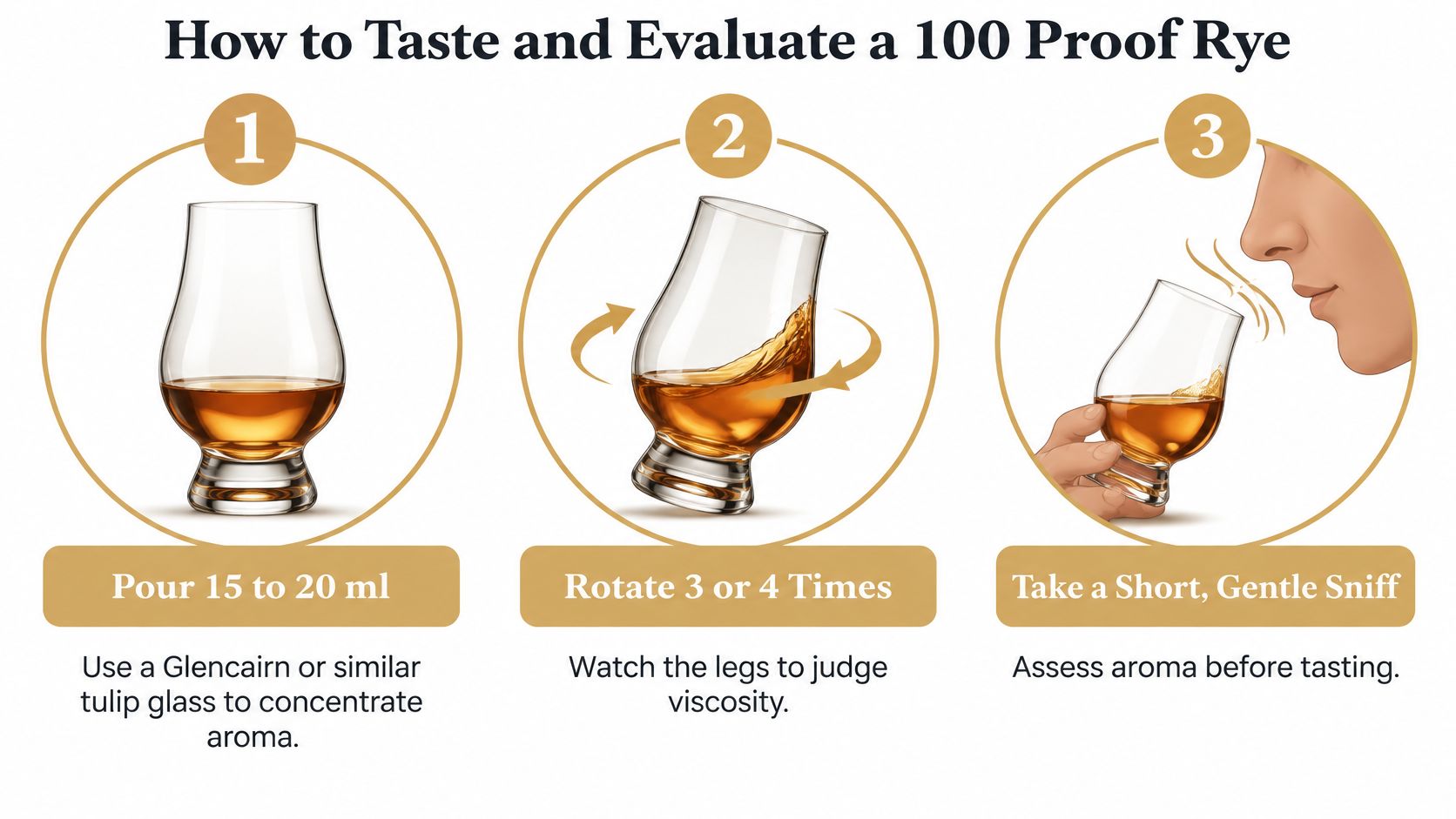
- Pour a small sample. For a practice session, use 15 to 20 mL in a Glencairn or similar tulip glass. Leave plenty of empty space so you can tilt the glass without spilling.
- Look, then rotate gently. Serious Eats' whisky-tasting guide recommends rotating the glass three or four times and observing viscosity. Treat the streaks on the glass as an observation, not proof of age or quality.
- Take a short sniff. Start a few centimeters away with your lips slightly parted, then move closer only if comfortable. A forceful inhale can overwhelm your nose before you identify anything useful.
- Taste slowly. Take a small sip, move it across both sides of your mouth and in front of your teeth, then swallow slowly and breathe gently through your nostrils. Don't take a large mouthful to speed up the process.
- Record impressions before adding water. Use a simple practice scale from 1 to 5 for heat, sweetness, spice, oak, and finish length. These are personal comparison scores, not objective quality grades.
- Measure a diluted comparison. As a worked example, add 2 mL of water to 8 mL of whiskey: the resulting 10 mL mixture contains 20% water and lands near 40% ABV. That water addition is a quarter of the original whiskey volume, not a fifth.
- Rest, then repeat. Let the diluted sample settle for about a minute before smelling and sipping again. For this exercise, stop at an 80:20 whiskey-to-water mixture rather than continuing until the whiskey loses definition.
- Write what changed. Record which aromas became clearer, whether the mouthfeel thinned, and whether the finish retained recognizable flavor. A preference for the neat sample is just as useful as a preference for the diluted one.
Compare at a matched strength
For a fair bottle comparison, use the measured diluted sample beside a lower-strength rye at the same ABV. Keep the glass shape and pour size consistent, and leave the lower-strength whiskey undiluted if it already matches your target.
Differences that remain are better clues to the whiskey's underlying style than differences noticed only at unequal strengths. You might find that a seemingly fierce rye becomes fruitier than its gentler neighbor.
Avoid rushing through several strong whiskeys, tasting with a tired palate, or pouring water freely before recording the neat sample. Take breaks, keep drinking water separate from dilution water, and stop when your notes become repetitive.
Serving 100 Proof Rye Neat, Diluted and in Cocktails
Serving options for 100 proof rye
The quantities below are practical serving examples, not targets you need to finish.
| Serving | Method | Best For | Tip |
|---|---|---|---|
| Neat at room temperature | 25 to 30 mL in a tulip or Glencairn glass | Tasting and comparison | Rest the pour one to two minutes before the first sip |
| Neat with a splash of water | 2 mL water per 8 mL whiskey | Easier sipping and flavor changes | Add water in small increments |
| Over a large ice cube | 30 mL poured over one large cube in a rocks glass | Slow sipping after dinner | A large cube melts slowly and keeps dilution gradual |
| Old Fashioned | Rye stirred with sugar, bitters, and ice, served over fresh ice | Stirred cocktail | Expect more dilution than a neat pour |
| Manhattan | Rye and sweet vermouth stirred with bitters and ice, then strained into a chilled glass | Classic stirred drink | Stir for about 20 to 30 seconds |
Room temperature is a useful starting point when you want to explore aroma. Chilling can make the whiskey feel more restrained, which may suit relaxed sipping even if it makes detailed nosing harder.
Use a tulip glass for concentrated aroma and a rocks glass when you want room for ice. A large cube generally dilutes more gradually than small pieces under comparable conditions, but temperature and how often you move the glass also affect melting.
Pair the whiskey with the occasion
Dark chocolate brings a bitter contrast to caramel-like flavors. Aged cheddar adds richness alongside dry spice, while smoked brisket complements toasted wood. Pecan pie works when you want dessert's sweetness against rye's peppery edge.
For a savory option, Smokey Rebel's whisky glazed chicken wings offer a useful cooking project for a whiskey-themed dinner. Taste the rye before the food as well as alongside it, since a sticky glaze can change your impression of sweetness.
In an Old Fashioned, rye's spice can remain recognizable beside sugar and bitters. In a Manhattan, sweet vermouth adds herbal and fruit-like complexity. Our guide to the best rye whiskey for cocktails helps you choose a bottle around the drink you enjoy making.
Start with less than you think you'll want. You can pour more later, but you can't undo drinking too quickly.
If you're unsure about the strength, pour half your usual amount and keep a glass of water alongside. Let your comfort level determine whether you continue, rather than treating an empty glass as the goal.
Choose Your First 100 Proof Rye by Its Label
Buy a bottle you can use as a benchmark, not the most expensive bottle you can justify. Choose something you can afford to revisit and describe without worrying about whether your opinion matches its reputation.
Read the label as a set of clues
Check these details together:
- Bottling strength: Confirm the proof rather than assuming a familiar brand always uses the same strength.
- Designation: Look for bottled-in-bond or straight rye, and read the complete wording.
- Age statement: Record it when present; don't invent one when absent.
- Grain recipe: Note a disclosed rye share without treating it as a quality score.
- Repeatable price: Choose a cost that makes another comparison realistic.
As The Daily Pour's bottled-in-bond rye explanation describes, the designation requires one distiller at one distillery, a single distilling season, at least four years in a federally bonded warehouse, and bottling at exactly 100 proof. Its straight-rye explanation specifies at least 51% rye, distillation at no more than 160 proof, charred new oak, and at least 24 months of aging.
Proof alone therefore doesn't establish bottled-in-bond status. A rye can meet both designations or carry different labeling, so read rather than infer.
Choose an affordable comparison
Craft describes an industry segment, not guaranteed quality: the American Craft Spirits Association's craft spirits report counted 2,282 active US craft distillers in August 2025, down from 3,069 in August 2024.
For a mainstream price reference, Flask Fine Wines listed Rittenhouse Rye 100 Proof Bottled in Bond at $28.99 for a 750 mL bottle in 2026. For an American craft alternative, our UNBendt Straight Rye Whiskey Bottled-in-Bond has a Member Price of $54.99 and a regular price of $69.99.
Taste your chosen rye neat, then prepare the measured water comparison and record the difference. Repeat with another bottle, keeping the preparation consistent and hiding the labels if possible.
The aim isn't to identify the most prestigious whiskey. It's to learn which grain, oak, texture, and strength combinations you want in your glass.
Blind Barrels offers adults aged 21 and over blind American craft whiskey samples, a tasting table for aroma, taste, and finish notes, and a guessing game that scores palate accuracy. To explore whiskey without brand and price cues, visit Blind Barrels and bring the same careful neat-and-diluted approach to your tasting.