

Welcome to the exciting world of American single malt whiskey, a spirit defined by its incredible innovation and flavor. Think of it as the single-origin coffee or single-varietal wine of the whiskey world—it's the purest expression of one grain from one distillery, offering a taste of place that's uniquely American. This guide is your perfect starting point, especially if you're new to the world of whiskey and curious about what these craft distillers are creating.
Defining the New American Whiskey
When you hear "single malt," your mind probably jumps to the misty glens of Scotland. For decades, they owned the category, and for good reason. But a new movement has been brewing right here at home, one that's taking the classic single malt playbook and ripping out a few pages to write its own story. It's a story driven by passionate American craft whiskey brands.
At its core, American single malt follows a few simple, crucial rules. These aren't meant to stifle creativity; they're the foundation that ensures every bottle shares a common soul, even as they express wildly different personalities.
- 100% Malted Barley: This is the heart of it all. Unlike bourbon's reliance on corn, the only grain allowed is malted barley. This is where you get those delicious biscuity, nutty, and often fruity base flavors.
- One Single Distillery: Every drop of the whiskey, from mashing and distilling to aging, has to happen under one roof at a single U.S. distillery. That’s what the "single" in single malt really means.
- Aged in Oak: The spirit has to spend time maturing in oak casks. But this is where American producers get to have some real fun, with way more freedom than their Scottish counterparts.
A Focus on Craft and Innovation
That freedom is what truly sets American single malt apart. While Scotch production is steeped in centuries of tradition and strict regulations, American craft distillers are free to experiment, question, and explore. This is where the magic really happens for us drinkers.
You might find a distillery like Westland in Seattle using unique local barley strains and aging their whiskey in native Garryana oak barrels, creating flavors you literally can't find anywhere else on the planet. Or you could head over to Virginia Distillery Co. in the Blue Ridge Mountains, where they might finish their whiskey in old cider or port casks, adding incredible layers of fruity complexity.
This flexibility is the hallmark of the category. It allows distillers to create whiskeys that reflect their specific region, climate, and creative vision, making American single malt one of the most dynamic spirits on the shelf today.
Your First Sip of American Single Malt
For newcomers to whiskey, this category is wonderfully welcoming. The flavors are often less aggressive than the heavy char of a big bourbon or the intense peat smoke you find in some Scotches. Instead, you can expect inviting notes of honey, toasted bread, rich chocolate, and sweet dried fruit.
The journey of American single malt from a niche craft experiment to an officially recognized whiskey category is a story of pure passion and grit. This formal recognition has cemented its place on the global stage, inviting curious drinkers to explore a truly homegrown spirit. It’s a category built on flavor, not just rules—the perfect place to start your whiskey adventure.
The Journey to Official Recognition
For years, American single malt was a whiskey without a home. Passionate craft distillers were turning out incredible spirits from 100% malted barley, but they were operating in a sort of no-man's-land. Without a unified, legally protected definition, these groundbreaking whiskeys struggled for a clear identity on shelves and on the world stage, where categories like Scotch and bourbon have long-established rules of the road.
This wasn't just a bureaucratic headache; it was a battle for legitimacy. A core group of producers, including trailblazers like Westland in Seattle and Virginia Distillery Co. in the Blue Ridge Mountains, knew the category needed a flag to rally behind. They banded together to form the American Single Malt Whiskey Commission (ASMWC), a grassroots coalition laser-focused on one thing: getting a formal "standard of identity" on the books.
The ASMWC, which grew to include over 100 distillers, spent years navigating the halls of Washington, educating lawmakers and regulators. They made a powerful case that a clear definition wouldn't just protect consumers from confusion, but would also unleash the full potential of a uniquely American style. Their relentless effort is a perfect snapshot of the collaborative spirit driving the rebirth of American craft whiskey.
The Rules That Define the Spirit
After a long and hard-fought campaign, their work finally paid off. The U.S. Alcohol and Tobacco Tax and Trade Bureau (TTB) officially carved out "American Single Malt Whisky" as its own distinct category, complete with a clear set of production rules. This was a game-changing moment, giving the spirit the respect and clarity it had earned.
Now, every bottle wearing that "American Single Malt" label has to meet a consistent standard. It gives you, the drinker, a clear landmark in the wide world of whiskey.
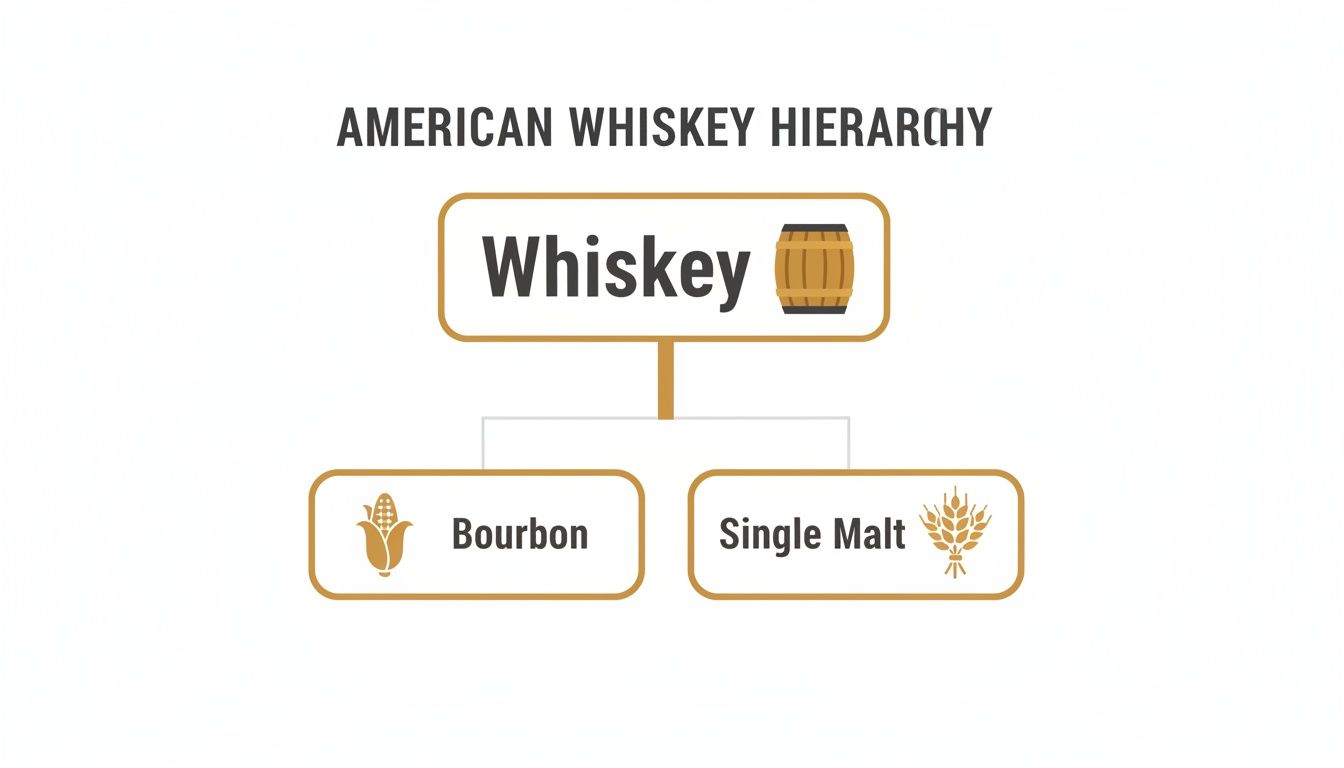
As you can see, American Single Malt now officially stands shoulder-to-shoulder with its corn-based cousin, Bourbon, each defined by its core grain but united under the American whiskey umbrella.
A Landmark Moment for American Whiskey
So, what are the rules? The federal standard defines American single malt as whiskey that is:
- Made from 100% malted barley
- Distilled at a single U.S. distillery
- Mashed, distilled, and matured in the United States
- Distilled to no more than 160 proof (80% ABV)
- Matured in oak casks of no more than 700 liters
The regulations also allow for a "Straight" designation for any whiskey aged at least two years, putting it on equal footing with established standards for bourbon and rye.
This official recognition does more than just define a spirit; it validates a movement. It confirms that American single malt is not a fleeting trend but a legitimate, world-class whiskey category ready to compete with the best.
For anyone just dipping their toes into whiskey, this clarity is huge. When you pick up a bottle, you know exactly what you’re getting: a spirit born from American creativity, crafted with passion, and now—finally—recognized for its unique place in the world. This journey from craft experiment to official category is a true testament to the distillers who saw the future in a glass of American single malt.
Decoding the Flavors of American Single Malt
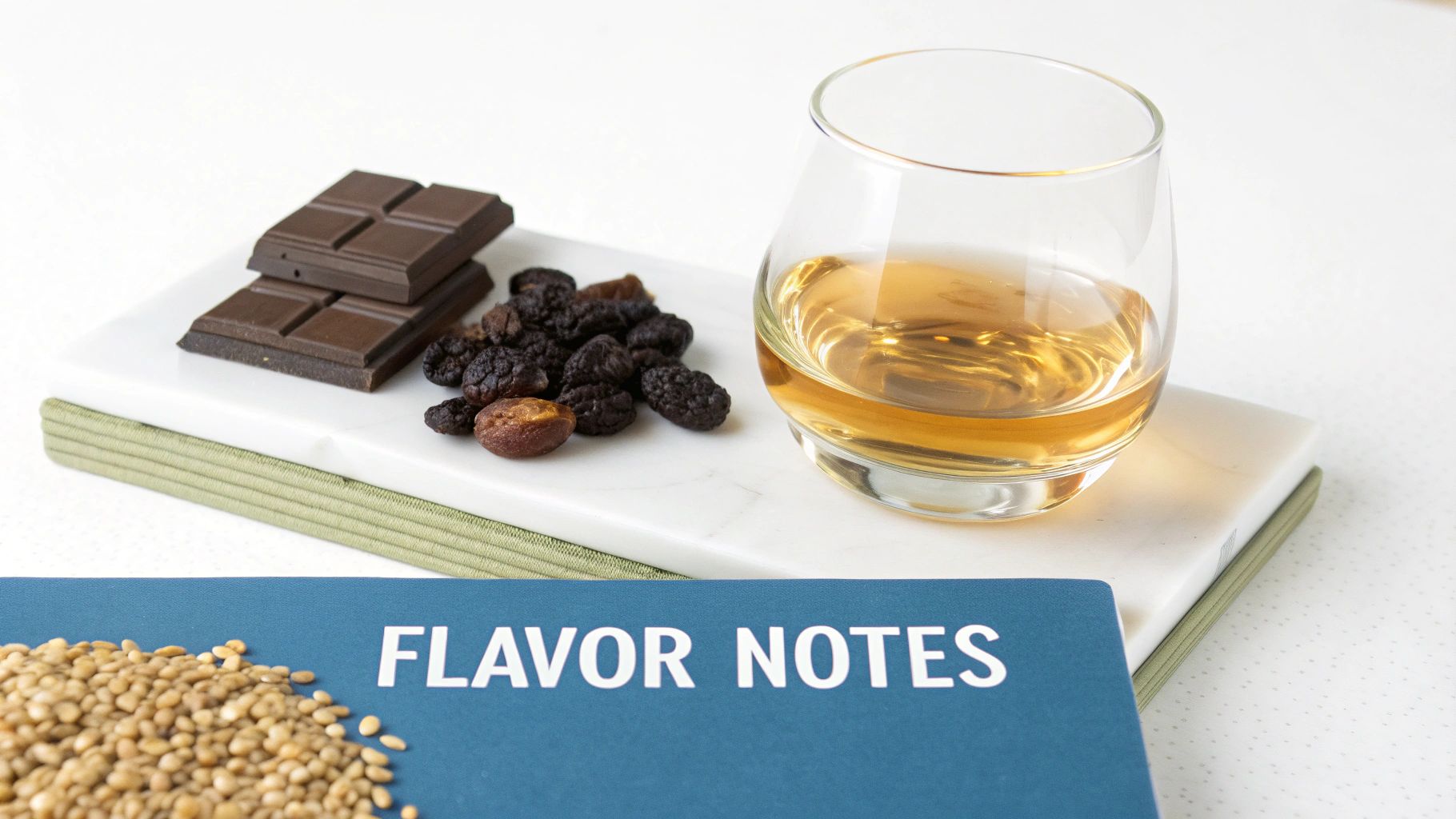
So, what does American single malt actually taste like? While the rules provide a framework, the flavor is where the real story unfolds. This is where American ingenuity transforms a simple grain—malted barley—into a spectrum of tastes as diverse as the country itself.
At its core, the use of 100% malted barley provides a consistent, delicious foundation. Think of it as the canvas upon which distillers paint their masterpiece. This single grain typically imparts foundational notes that are approachable and inviting, especially for those new to whiskey. You can learn more about the crucial role of this ingredient by exploring what malt is in whisky in our detailed guide.
Common foundational flavors you’ll often find include:
- Toasted Cereal: A comforting, bready note reminiscent of biscuit or granola.
- Honey and Toffee: A gentle sweetness that coats the palate without being overwhelming.
- Nutty Undertones: Flavors like almond, walnut, or hazelnut that add depth and complexity.
The Influence of Climate and Place
Unlike the cool, damp environs of Scotland, American distillers operate in a wild variety of climates, and this has a massive impact on flavor. The intense, fluctuating heat of a Texas summer, for example, forces the whiskey to interact more aggressively with the oak barrel. This accelerates maturation and can pull out deep notes of dark chocolate, leather, and spice in a much shorter time. American craft whiskey brands like Balcones in Texas are masters of this climate-driven aging.
In contrast, a distillery in the temperate coastal climate of the Pacific Northwest might see a slower, more graceful aging process. This environment can yield a whiskey with delicate, fruity, and floral notes, showcasing a completely different side of what malted barley can do. It’s this sense of terroir—the taste of a specific place—that makes exploring American single malt so rewarding.
The Art of the Cask
Here is where American distillers truly get to play. While bourbon is legally required to use new charred oak barrels, American single malt producers have the freedom to use almost any type of oak cask they can imagine. This opens up a universe of flavor possibilities.
This cask flexibility is arguably the single most important factor driving the diversity in American single malt. It allows distillers to layer flavors in a way that’s simply not possible in more traditional whiskey categories.
Imagine a whiskey from a craft distillery like Virginia Distillery Co. They might age their spirit in ex-bourbon barrels before finishing it in casks that once held Virginia cider or French Cabernet. This process layers bright apple and rich red fruit notes on top of the whiskey’s malty base.
Other distillers get even more creative, using barrels that previously held:
- Port or Sherry: Adding notes of dried fruit, figs, and rich nuttiness.
- Craft Stout or IPA: Imparting roasty, coffee-like, or hoppy citrus flavors.
- Rum or Tequila: Introducing tropical fruit or earthy, agave-like characteristics.
For a new whiskey drinker, learning to identify these notes is part of the fun. Just as we decode the complex flavor profiles of American Single Malt, similar principles of discerning taste apply to other artisanal beverages. For a different perspective, you might find this guide on understanding flavour notes in beverages insightful. By starting with familiar descriptors like dark chocolate or toasted nuts, you can begin to build a vocabulary that makes tasting less intimidating and far more enjoyable.
A Practical Guide to Tasting Whiskey
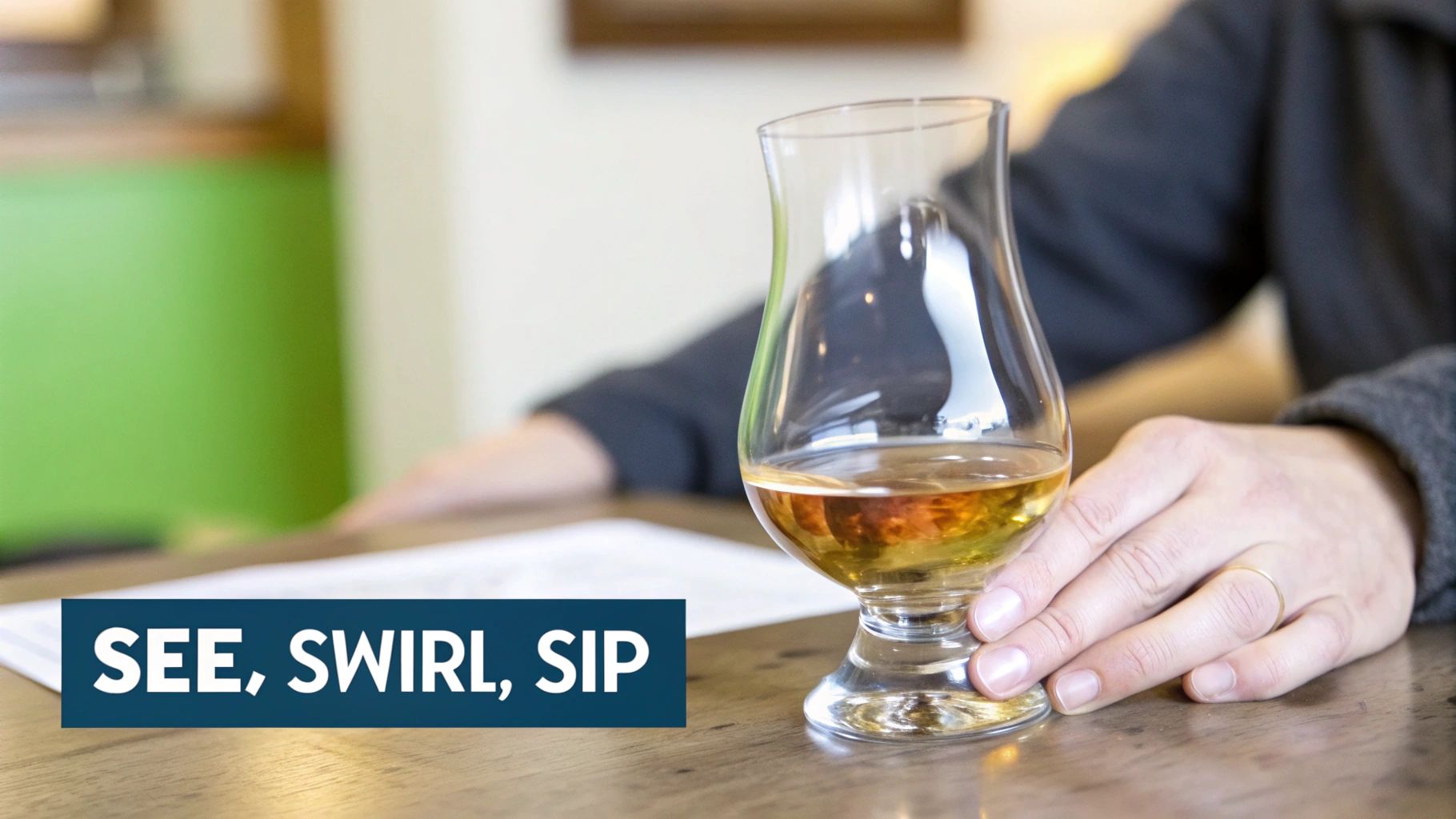
Exploring the world of American single malt is an adventure for your senses. To really get what’s going on inside the glass, though, it helps to have a simple method. Tasting whiskey isn't about some stuffy, complicated rulebook; it’s about paying attention and figuring out what you actually enjoy.
The good news is you don’t need a super-calibrated palate to get started. A simple four-step process—see, swirl, sniff, and sip—is all it takes to unlock the character hiding in any whiskey. This approach helps you shift from just drinking whiskey to truly experiencing it.
Setting the Stage for a Great Tasting
Before you even pour a drop, the right tool can make a world of difference. A standard rocks glass is perfectly fine for a cocktail, but a proper tasting glass like a Glencairn is designed to completely change the game. Its tulip shape is a revelation, especially for new drinkers.
The wide bowl lets you give the whiskey a good swirl, kicking up all those aromatic compounds. Then, the narrow rim concentrates those aromas and funnels them right to your nose. It’s a small detail that makes it way easier to pick out the subtle notes of fruit, spice, or oak that the distiller worked so hard to create.
A Step-by-Step Tasting Method
With your whiskey poured, you’re ready to dive in. This straightforward process will guide you through a more thoughtful tasting. If you want to go even deeper, check out our complete guide on how to taste whiskey, which is packed with more tips and tricks.
-
See: Hold the glass up to a light source. The color alone tells a story about its age and the type of barrel it called home. A lighter, straw-colored whiskey probably matured in used barrels, while a deep amber or mahogany spirit likely spent its time in new oak or sherry casks.
-
Swirl: Gently roll the whiskey around the glass. Watch how the liquid coats the sides and slowly drips back down. These little rivulets are called "legs," and thicker, slower legs can be a clue to a higher proof and a richer texture.
-
Sniff (or 'Nose'): This is probably the most important step. Don’t just shove your nose in the glass—you’ll just get a blast of alcohol burn. Instead, bring the glass slowly toward your nose with your mouth slightly open and take gentle sniffs. Try smelling from different spots around the rim; you’ll be surprised by the different aromas you can pick up.
-
Sip: Take a tiny first sip and let it coat your entire mouth. Think of it as priming your palate for the alcohol. Now, on the second sip, you can start hunting for specific flavors. Is it sweet like honey? Fruity like dried cherries? Is there a spicy kick or more of a toasty, bready vibe?
Tasting Tip for New Drinkers: Don't be afraid to add a few drops of water, especially to a high-proof whiskey. It can dial back the alcohol "burn" and open up entirely new layers of flavor and aroma that were hiding, making the spirit much more approachable.
The Power of Blind Tasting
Once you start getting the hang of it, one of the absolute best ways to find out what you genuinely like is through blind tasting. This just means tasting whiskey without knowing the brand, the price tag, or how old it is. It strips away all the marketing hype and preconceived notions, letting your palate be the only judge.
You’ll be shocked by what you discover. A little-known craft whiskey might blow a big-name brand out of the water, or you might find you prefer a younger, punchier spirit over a super old one.
This unbiased approach is perfect for navigating the diverse landscape of American single malt. By focusing only on what's in the glass, you can pinpoint the flavor profiles you truly connect with—whether it's the rich, wine-cask influence from a producer like Virginia Distillery Co. or the unique regional character of a Pacific Northwest pioneer. Blind tasting empowers you to trust your own taste, and that’s the most important skill any whiskey drinker can develop.
Your Guide to Discovering Great Whiskey
Alright, you’ve got the rules down, you can talk the talk about flavor, and you even know how to taste like a seasoned pro. Now for the best part of diving into American single malt: finding the whiskeys that truly speak to you. The scene is exploding with small, passionate craft distilleries, and every single bottle tells a unique story.
This creative boom isn't just a fluke. The American single malt market is on a tear, currently sitting at around $350 million. Projections show it’s on track to blast past $800 million in the next few years. That growth is fueled by people like you—whiskey drinkers who appreciate true craft and spirits with a local soul. You can dig into more data on this impressive growth and see what it means for the future of whiskey.
What this all means is there's an incredible variety of spirits out there just waiting to be found, many from distilleries you’ve probably never seen on your local store shelf. The big question is, where do you even start?
Finding Your Way Through the Craft Whiskey Maze
Walking up to a wall of whiskey bottles can be intimidating. The big-name brands with their massive marketing budgets tend to suck all the air out of the room, making it tough for the little guys to get noticed. How are you supposed to find those hidden gems—the truly special bottles from American craft whiskey brands that might just become your new go-to?
This is where blind tasting becomes your secret weapon. As we touched on earlier, tasting "blind" cuts through all the noise. It strips away brand bias, flashy labels, and sky-high price tags, forcing you to focus on the only thing that actually matters: what’s in the glass.
When you trust your own palate, you empower yourself to discover what you genuinely enjoy. You might find that an unknown American single malt from a tiny distillery in the Pacific Northwest blows a well-known classic out of the water. It’s a powerful reminder that great whiskey is about flavor, not fame.
For anyone new to whiskey, this is the single best way to build confidence and figure out what you truly like.
A Better Way to Discover
So, how do you make this a regular practice? One of the most effective—and fun—ways to explore the world of American craft whiskey is through a blind tasting subscription. Think of it as having an expert guide who does the legwork, scouring the country for the best small-batch spirits and delivering them right to your door.
This approach turns whiskey tasting from a random guessing game into a guided journey. It’s a structured way to systematically try different distilleries, flavor profiles, and production styles without having to commit to a full bottle every time.
A solid blind tasting kit transforms the experience into a genuine event with a few key ingredients:
- Curated Samples: You get a hand-picked selection of high-quality samples from different American craft distilleries, all presented without any labels.
- Guided Tasting Materials: A tasting mat or journal helps you organize your notes and gives you prompts for what to look for in the aroma, taste, and finish.
- The Big Reveal: After you’ve jotted down your thoughts, you get to uncover the identities of the whiskeys. This is where you learn about the distillery, its unique story, and what makes its process special.
Making Tasting an Experience
This structured "taste and reveal" process is more than just drinking—it’s an interactive adventure. It’s a fantastic way to train your palate, learn what flavor notes you gravitate towards, and build a mental library of what you like and don't like. Imagine sitting down with a few friends, each with a flight of mystery whiskeys. You can compare notes, debate flavors, and even make a game out of guessing the proof or region.
This is exactly the kind of communal and educational experience we've built at Blind Barrels. We specialize in sending our members quarterly kits with four exceptional samples from America's best craft distilleries. Each kit is a complete tasting experience designed to help you discover hidden gems and buy your next bottle with total confidence. For anyone ready to jump headfirst into the exciting world of American single malt, it’s the perfect next step.
Common Questions About American Single Malt
As you dive into the exciting world of American single malt, a few questions are bound to pop up. It’s a dynamic category and still pretty new to a lot of whiskey drinkers, so let's clear up some of the usual suspects. Think of this as your go-to guide for sipping with confidence.
We'll tackle some of the most common questions head-on with clear, straightforward answers. The goal here is to build on what you've learned and give you the practical know-how to keep exploring.
Is American Single Malt the Same as Bourbon?
This is easily the biggest question out there, and the answer is a hard no. While they're both proudly American whiskeys, they are fundamentally different spirits, and it all comes down to the main ingredient.
-
Bourbon's Foundation: At its heart, bourbon must be made from a mash bill of at least 51% corn. That corn is what gives bourbon its signature sweetness, with those classic notes of caramel, vanilla, and oak we all know and love.
-
Single Malt's Soul: American single malt, in stark contrast, must be made from 100% malted barley. This creates an entirely different world of flavor, often leaning into notes of honey, toasted biscuit, chocolate, and a whole spectrum of fruit.
It’s kind of like the difference between cornbread and a loaf of sourdough. Both are fantastic, but the base grain makes for completely unique textures and tastes. It's the exact same principle with these two whiskey styles.
Do I Really Need a Special Glass to Drink Whiskey?
Look, you can absolutely enjoy whiskey from any glass you have on hand. But using a proper tasting glass—like a Glencairn—is a total game-changer, especially when you're just starting out. It’s less about being fancy and more about getting the most out of your whiskey.
A standard rocks glass has a wide mouth, which lets all those delicate aromas fly right out. A Glencairn glass, with its unique tulip shape, is engineered to trap and concentrate those aromas right at the narrow rim. This simple trick makes it so much easier to pick up on the subtle scents the distiller worked so hard to create, helping you train your palate and appreciate every single pour.
What Foods Pair Well with American Single Malt?
One of the best things about American single malts is how incredibly versatile they are with food. The general idea is to match the intensity of the whiskey with the intensity of the food. But honestly, don't be afraid to experiment and see what you like.
Here are a few ideas to get you started:
-
Lighter, Fruity Malts: These brighter expressions are fantastic with lighter dishes. Think smoked salmon, a sharp aged cheddar, or even fresh oysters. They just sing together.
-
Medium-Bodied, Nutty Malts: A whiskey showing off notes of honey and nuts is the perfect partner for a charcuterie board, roasted chicken, or a nice pork tenderloin. The savory and sweet elements play off each other beautifully.
-
Bold, Rich, or Smoky Malts: For the bigger, more powerful single malts—maybe one aged in a sherry or new oak cask—you need food that can stand up to them. These are brilliant with a grilled steak, a rich dark chocolate dessert, or even a good cigar. For example, a complex, sherry-finished single malt from a craft distillery like Virginia Distillery Co. would be an unbelievable pairing for a decadent chocolate torte.
The most important rule of pairing is that there are no rules. Your palate is the final judge, so have fun with it and explore what combinations really click for you.
Ready to put your newfound knowledge to the test and discover your next favorite craft whiskey? With Blind Barrels, you can explore the best of American single malt without brand bias. Our blind tasting kits are the perfect way to train your palate, find hidden gems, and buy your next bottle with complete confidence.