

Let's settle this one right off the bat: all bourbon is whiskey, but not all whiskey is bourbon.
It’s an easy distinction to get hung up on, but the relationship is simpler than you might think. Just picture "whiskey" as the massive, sprawling family tree for all spirits distilled from fermented grains. "Bourbon" is a very specific branch on that tree—an American-born cousin with a strict, legally-defined set of rules it has to live by.
Unpacking the Whiskey and Bourbon Relationship
At the end of the day, what separates bourbon from the rest of the whiskey world comes down to the letter of the law. Bourbon is America’s only native spirit, a title proudly protected by the U.S. government with a non-negotiable checklist for production. Mess with the list, and you can’t call it bourbon. Simple as that.
Whiskey, on the other hand, is a global affair. It’s a category that includes everything from the peaty, smoky scotches of Scotland to the light, triple-distilled spirits coming out of Ireland, and even bold single malts from American craft producers like Balcones Distilling in Texas. This legal framework is precisely what gives bourbon its famously sweet, full-bodied character that so many drinkers, especially those new to the spirit, find incredibly approachable. The rules dictate everything from the grain in the mash to the kind of barrel it sleeps in. If you want to get into the nitty-gritty of the broader category, you can learn more about what makes a whiskey a whiskey in our detailed guide.
Here's the easiest way to lock this in: every square is a rectangle, but not every rectangle is a square. It’s the same logic. Every bourbon is a whiskey, but not every whiskey can be called a bourbon. Grasping this simple concept is your ticket to navigating the spirits aisle like you own the place.
A Quick Comparison
Seeing the requirements side-by-side really makes the distinction click. The specific rules for bourbon create a consistent, reliable foundation for its flavor profile, while the wide-open nature of the whiskey category is what allows for such incredible diversity across the globe.
It's why a craft distillery like Frey Ranch in Nevada can produce both a legally defined Straight Bourbon and an American Single Malt Whiskey right under the same roof. They're both whiskey, but they follow two completely different playbooks.
Let’s break down the main distinctions in a simple table.
Whiskey vs Bourbon At a Glance
Here’s a straightforward look at the key legal and production differences that separate the broad world of whiskey from the specific style of bourbon.
| Attribute | Bourbon (A Specific Type of Whiskey) | Whiskey (The Broad Category) |
|---|---|---|
| Geography | Must be made in the United States. | Can be made anywhere in the world. |
| Ingredients | Mash bill must contain at least 51% corn. | Made from various grains like barley, rye, wheat, or corn. |
| Aging | Must be aged in new, charred oak containers. | Aged in oak barrels, which can be new or used. |
| Distillation | Distilled to no more than 160 proof (80% ABV). | Distillation proof varies widely by country and style. |
| Barrel Entry | Enters the barrel at no more than 125 proof (62.5% ABV). | Barrel entry proof varies depending on regional regulations. |
As you can see, bourbon's rules are tight and specific, ensuring a certain consistency and character. The broader whiskey category, however, offers a world of variety shaped by different traditions, grains, and regulations.
The Legal Guardrails That Define Bourbon
What truly separates bourbon from the sprawling whiskey family tree isn’t some secret recipe, but a strict set of legal rules. For a spirit to earn the name "bourbon," it has to follow a non-negotiable checklist laid out by U.S. law, which is what cements its status as "America's Native Spirit." This legal framework is the very reason bourbon has such a reliably rich and often sweet character.
These aren’t just friendly suggestions; they're the federal standards of identity. If a distiller misses even a single step, they simply cannot put the word "bourbon" on their label. This precision protects the entire category and gives us all confidence in what we're pouring.
This simple decision tree gets to the heart of what separates a general whiskey from a legally defined bourbon.
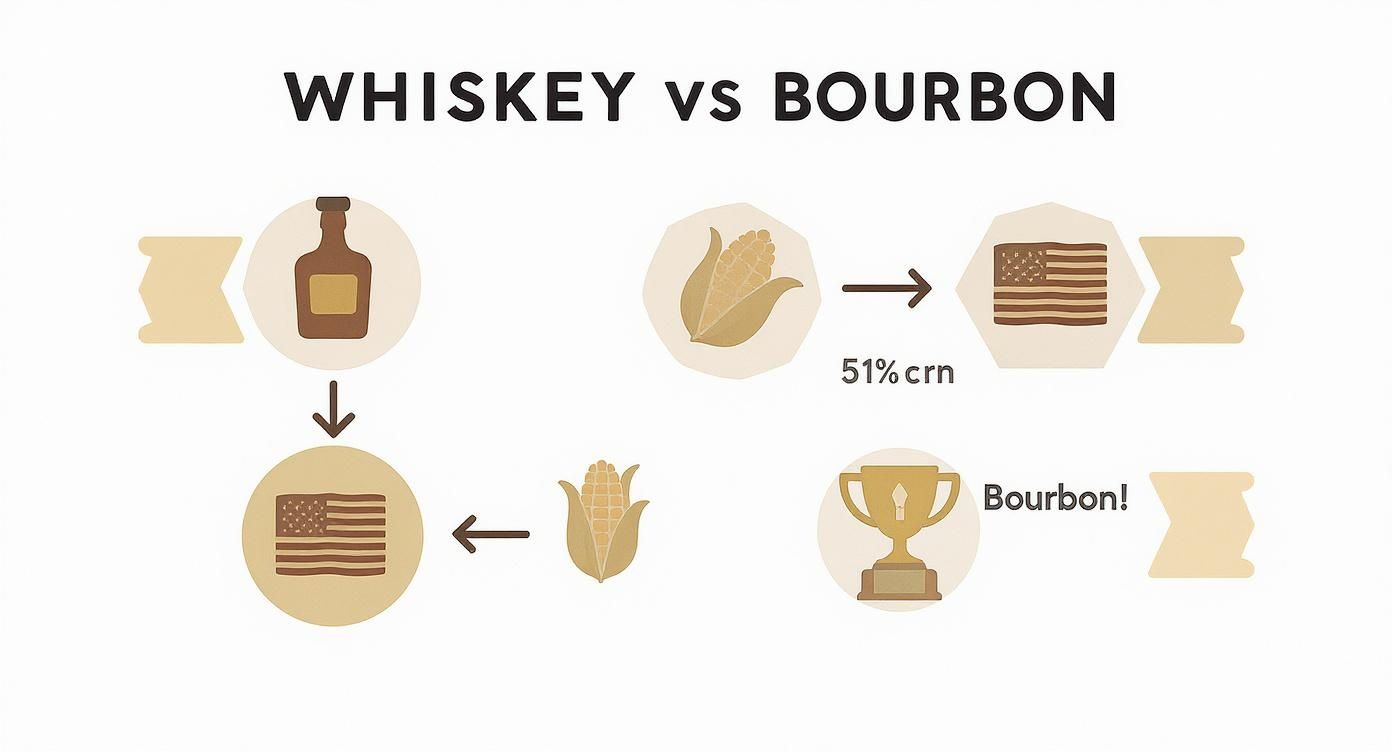
As you can see, being made in the USA and starting with a corn-heavy recipe are the first two gates every bourbon must pass through.
The Corn Foundation
At the heart of every single bourbon is its mash bill—the grain recipe that gets fermented. By law, that recipe must be at least 51% corn. This one rule is almost single-handedly responsible for bourbon's signature sweetness, immediately setting it apart from spicier rye whiskeys or malty Scotch.
The other 49% is where distillers get to play and innovate. It’s common for craft producers to experiment with "wheated" or "high-rye" mash bills to create truly unique flavor profiles. If you want to go deeper on how these secondary grains shape the final spirit, check out our guide to the bourbon grain bill.
Distillation and Aging Mandates
Once fermentation is done, the regulations continue to guide the process with mathematical precision. The spirit can’t be distilled to a strength higher than 160 proof (80% ABV). This rule ensures that all the flavorful character from the grains isn't stripped away, which can easily happen at higher distillation proofs.
Perhaps the most impactful rule is that bourbon must be aged in new, charred oak containers. This is where bourbon gets its classic notes of vanilla, caramel, and spice, not to mention its deep amber color. Unlike Scotch or Irish whiskey, which can reuse old barrels, bourbon barrels can only be used once to age bourbon.
The spirit also has to go into that brand-new barrel at no more than 125 proof (62.5% ABV). This lower entry proof forces a much richer, deeper interaction between the spirit and the wood as it ages.
These strict laws have fueled bourbon's incredible rise; from 1999 to 2022, its production soared by an unprecedented 475%. This growth mirrors a massive surge in global demand, as U.S. whiskey sales climbed from $1.3 billion in 2003 to $5.27 billion in 2023.
Exploring the Diverse World of Whiskey
Now that we’ve pinned down the strict rules that make a bourbon a bourbon, we can really appreciate the incredible variety in the wider world of whiskey. Think of bourbon as a very specific, very delicious chapter in a global story told through different grains, climates, and traditions. Venturing beyond it introduces you to a spectrum of flavors that, frankly, just makes you appreciate America’s native spirit even more.
This exploration isn't about crowning a "better" spirit. It’s about expanding your palate and understanding the context that makes each style unique. Every country with a whiskey tradition has its own rulebook—or sometimes, a deliberate lack of one—that shapes every drop in the bottle.
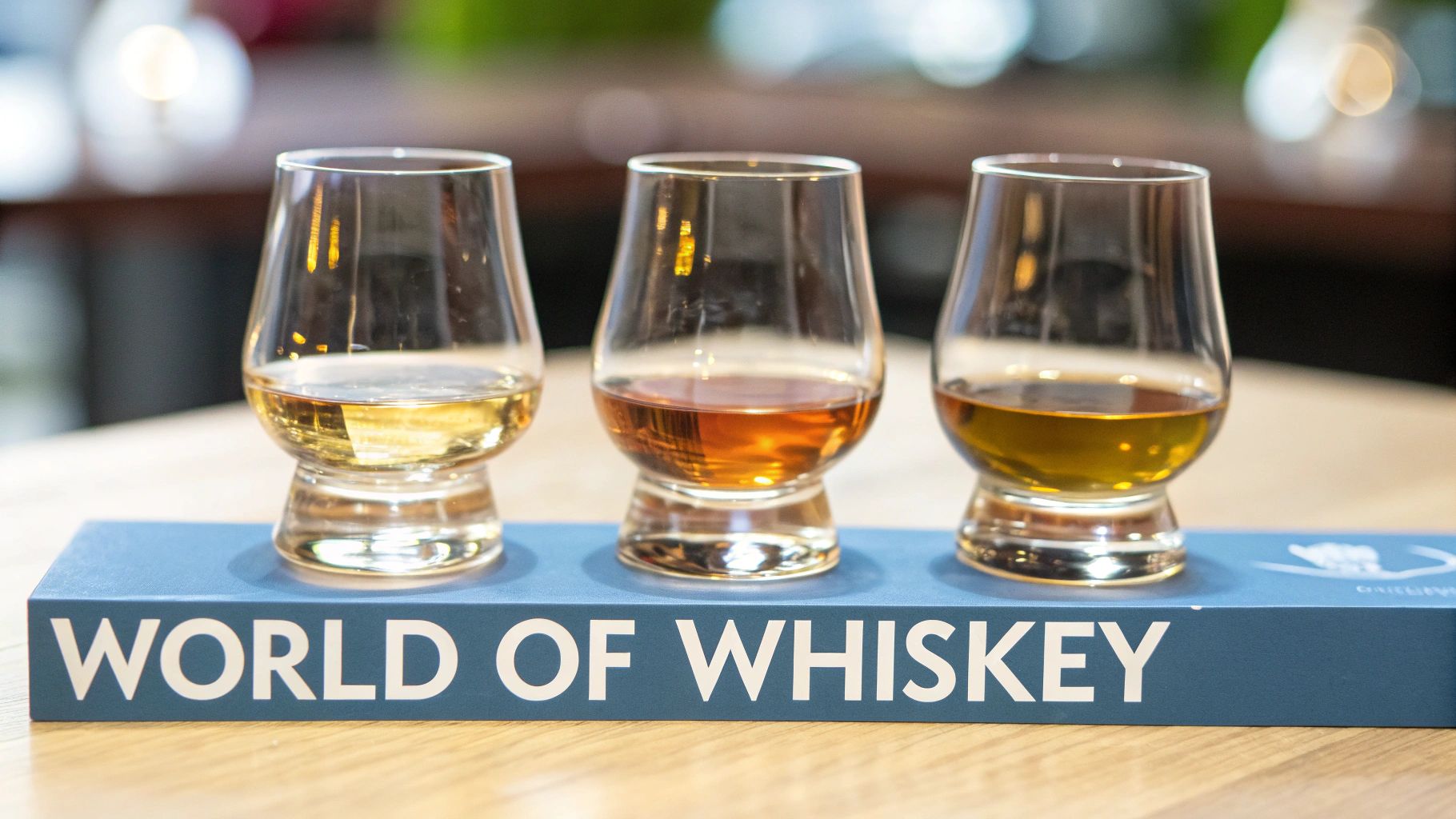
A Global Tour of Whiskey Styles
Let's take a quick trip around the world to see just how much whiskey changes from one place to the next. Each of these major categories offers a stark contrast to bourbon's corn-heavy sweetness and new charred oak maturation.
- Scotch Whisky: Hailing from Scotland and spelled without the "e," this spirit is famously made from malted barley. It’s often dried over a peat fire, which imparts that distinctive smoky flavor you hear about, especially in whiskies from the Islay region.
- Irish Whiskey: Known for its exceptionally smooth and light character, Irish whiskey is often triple-distilled (bourbon is typically only distilled twice). It uses a mix of malted and unmalted barley and is aged in used barrels, giving it a fruitier, less oak-forward profile.
- Japanese Whisky: Inspired by the Scotch tradition, Japanese distillers have perfected the art of blending and finding perfect balance. Their whiskies are celebrated for delicate, nuanced, and complex profiles, often showing subtle floral and sandalwood notes.
- Rye Whiskey: While also an American whiskey, rye is a whole different animal from bourbon. To be called rye, it must contain at least 51% rye grain, which gives it a spicier, peppery, and drier flavor profile that many cocktail lovers swear by.
Why This Diversity Matters for New Drinkers
If you're just getting into whiskey, understanding these different styles is your road map to finding what you actually enjoy. Maybe you find bourbon's signature sweetness isn't for you. In that case, the crisp, spicy bite of a rye whiskey from a craft producer like High West Distillery might be your perfect match. Or perhaps the smooth, easy-going nature of an Irish whiskey is a better place to start.
Tip for New Drinkers: Don't feel pressured to drink whiskey neat (straight from the bottle) right away. Bourbon's sweetness makes it fantastic in simple cocktails like a Whiskey Sour or an Old Fashioned. It's a great way to get used to its flavors without the full force of the alcohol.
This global perspective also puts the sheer scale of the industry in focus. In 2024, the global whiskey market was valued at a staggering $61.51 billion, with projections showing it could grow to $71.85 billion by 2028. That kind of money shows just how many diverse tastes worldwide support this incredible array of styles, far beyond just bourbon. You can dive deeper into whiskey market forecasts and trends at ohbev.com.
Tasting these different global expressions side-by-side is, without a doubt, the best way to train your palate. It sharpens your ability to pinpoint the core difference of whiskey and bourbon, moving you from simply drinking to truly tasting.
How to Taste the Difference in the Glass
Knowing the rules on paper is one thing, but the real magic happens when you can actually taste the difference between whiskey and bourbon in your glass. All those production rules directly translate into what you smell and sip, and learning to pick them apart is easily the most rewarding part of the journey. This is where we leave the textbook behind and start training your palate to recognize the unique signature of each spirit.
The legal requirement for at least 51% corn and aging in new, charred oak is what gives bourbon its classic, inviting flavor profile. Think big, sweet notes of caramel, vanilla, and a solid backbone of toasted oak. It’s a profile that has made bourbon a favorite for newcomers and seasoned drinkers alike.
A Beginner's Guide to Tasting
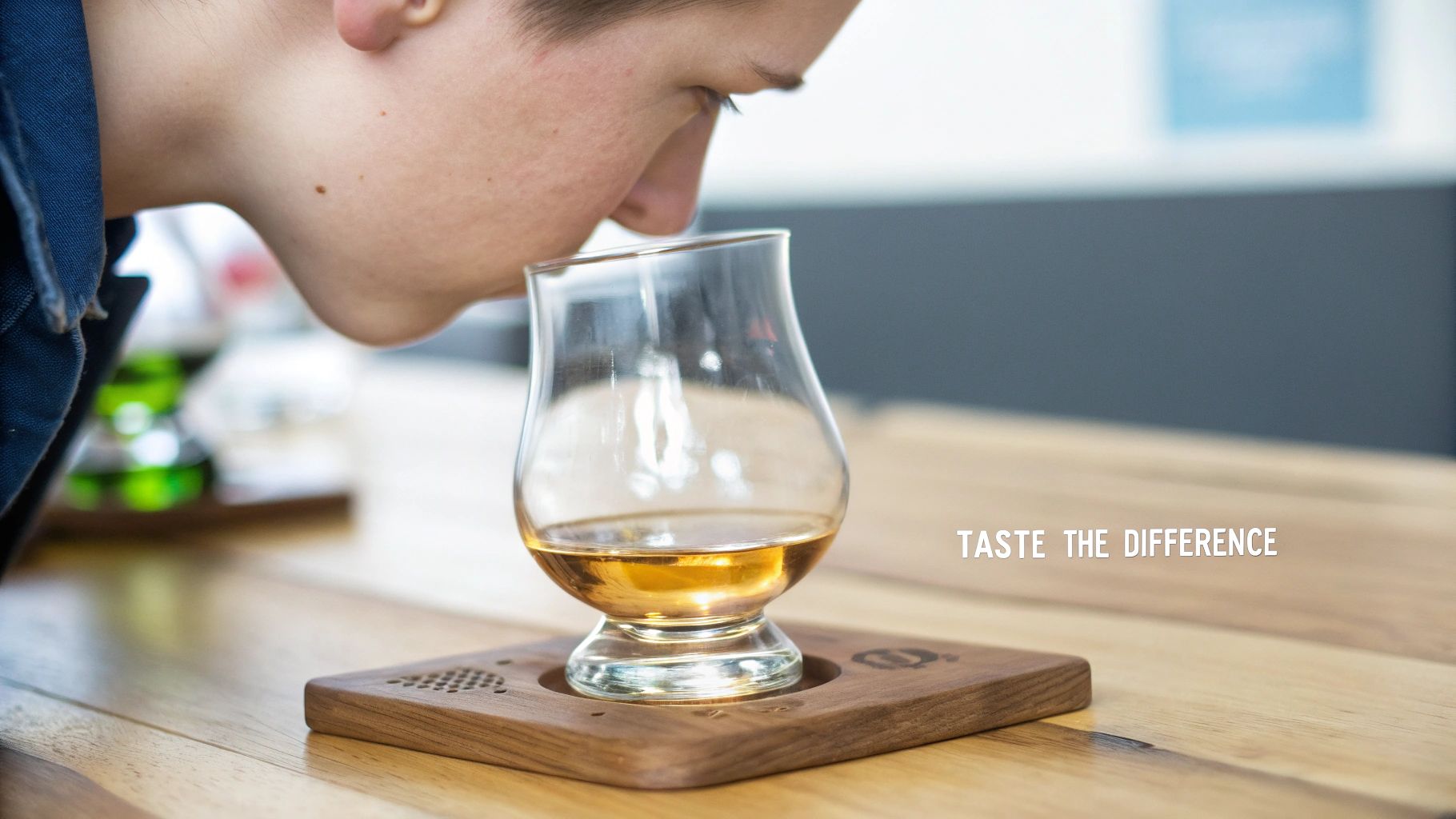
Tasting whiskey boils down to a simple three-step process: look, smell, and taste. Don't worry about getting it "right" on the first try; the whole point is just to observe what you're experiencing. For a deeper dive, you can learn more about how to taste whiskey in our full guide.
- Look at the Color: Pour a little into a glass. The color, which can range from pale straw to deep mahogany, offers clues about its age and the type of barrel it was aged in. Bourbon, because it has to use new charred oak, often shows up with a deeper amber or copper hue.
- Nose the Spirit: Give the whiskey a gentle swirl and bring the glass to your nose, keeping your mouth open just a bit. Take a slow inhale. What do you smell? With bourbon, you'll probably find those sweet notes like caramel, vanilla, or brown sugar. A peated Scotch, on the other hand, might hit you with earthy smoke and salty brine.
- Taste and Savor: Take a small sip and let it coat your entire tongue. Pay attention to the initial flavors (the palate) and what lingers after you swallow (the finish). Is it sweet, spicy, smoky, or fruity? Does the finish disappear quickly or does it stick around with a long, warming sensation?
Putting It into Practice: A Side-by-Side Comparison
The absolute best way to learn is by doing a direct comparison. This simple exercise will highlight the unique character of each spirit in a way that reading about it never could.
Tasting Tip: Grab a classic, easy-to-find bourbon like Buffalo Trace or Maker's Mark and an entry-level peated Scotch like Laphroaig 10 or Ardbeg 10. Pour a small measure of each into separate glasses.
First, nose the bourbon. You’ll get hit with those hallmark sweet corn, vanilla, and caramel notes. Now, switch over and nose the Scotch. The difference will be immediate and striking—instead of that sweetness, you’ll likely find campfire smoke, iodine, and damp earth.
Next, taste the bourbon. Its inherent sweetness and rich oaky character will be front and center. Take a sip of water, then taste the Scotch. The smoky, savory, and sometimes medicinal flavors create a stark contrast that perfectly illustrates how different ingredients and production methods craft entirely different spirits.
Trying whiskeys from American craft distilleries adds another fantastic layer to your exploration. A brand like Frey Ranch out of Nevada, for example, produces a "farm-to-glass" bourbon where that corn sweetness is beautifully balanced by the spice from their estate-grown rye. Tasting it next to a traditional Kentucky bourbon reveals subtle yet fascinating differences even within the same category. This kind of active tasting is, without a doubt, the fastest way to build your palate and discover what you truly enjoy.
Exploring Innovative American Craft Whiskey
While Kentucky's titans rightfully get a lot of airtime, the real buzz in American whiskey these days is happening in the creative corners of craft distilleries. These are the folks pushing the envelope, playing with heirloom grains, and fundamentally redefining what American whiskey can be. If you really want to grasp the modern landscape of American spirits, getting to know these smaller players is non-negotiable.
They just operate on a different wavelength. Many live by a "grain-to-glass" philosophy, giving them total command over their product from field to bottle. This hands-on, almost obsessive approach leads to spirits that aren't just unique—they're deeply personal expressions of a specific place and a distiller's vision. To support them is to invest in the future of American whiskey.
Pioneers of Modern American Whiskey
The best way to stretch your palate beyond the classic profiles is to dive headfirst into the craft scene. These distilleries are offering a completely fresh take on what American spirits can do.
- Balcones Distilling (Waco, Texas): A true Texas original, Balcones put itself on the map by using unconventional ingredients like roasted blue corn. Their flagship "Baby Blue" is a corn whiskey made from this very grain, and it delivers a rich, nutty flavor that’s totally distinct. It will challenge everything you think you know about corn-based spirits.
- Westland Distillery (Seattle, Washington): Flying the flag for the American Single Malt movement, Westland crafts whiskey in the Scottish tradition but with a soul rooted in the Pacific Northwest. They use locally sourced barley and even unique peat sources to create complex, beautifully balanced spirits that can go toe-to-toe with global heavyweights. It’s proof that American whiskey is so much more than just bourbon.
- Frey Ranch Distillery (Fallon, Nevada): As a true farm-to-glass operation, Frey Ranch grows 100% of the grains for their whiskey right there on their own land. Their flagship Straight Bourbon Whiskey is a four-grain masterpiece, hitting a perfect harmony between corn’s sweetness and the kick of rye. It’s a taste profile that is uniquely, undeniably Nevadan.
Exploring craft whiskey isn't just about what's in the glass; it's about uncovering the story behind the spirit. These distilleries are living proof that incredible American whiskey is being made in every corner of the country, each with its own identity.
While Kentucky remains the heartland, the wider American whiskey scene is absolutely booming. The global market is largely driven by U.S. production, with bourbon making up about 70–75% of the total volume of whiskey produced here. In 2022, that translated to roughly 22.7 million 9-liter cases of bourbon, and Kentucky was responsible for a staggering 95% of it. You can read more about the bourbon whiskey market on marketgrowthreports.com. This sheer dominance is exactly what makes the innovation happening outside of Kentucky so exciting to watch—and, of course, to taste.
Finding Your Favorite Way to Drink Whiskey and Bourbon
Look, figuring out the difference between whiskey and bourbon is one thing, but the real fun starts when you find the best way to actually enjoy them. If you’re just starting out, bourbon’s bold, sweet profile is a fantastic entry point. It really shines in classic cocktails that can tame its fiery edges while letting its character sing.
A well-made Old Fashioned or a classic Whiskey Sour with a good bourbon is the perfect handshake. The sugar and citrus play off the spirit’s proof, pulling those signature caramel and vanilla notes to the forefront. It’s a great way to get your palate acquainted with bourbon’s core flavors without getting knocked over by the alcohol.
Tips for New Whiskey Drinkers
As you get more comfortable, you can start branching out. The whole point is to find what you like, not to follow some stuffy rulebook.
- Glassware Really Matters: To sip whiskey neat, grab a Glencairn or a tulip-shaped glass. The design funnels all the aromas right to your nose, helping you pick up on subtle notes you might otherwise miss in a standard rocks glass.
- The Great Ice Debate: If you like your whiskey on the colder side, a single large ice cube or sphere is the way to go. It melts much slower, chilling the drink without diluting it into a watery mess. Stay away from a handful of small, fast-melting ice cubes.
- Just a Drop of Water: This is a game-changer, especially with higher-proof whiskeys. Adding just a few drops of water can completely transform your drink. It dials back the alcohol burn and "opens up" the spirit, unlocking a whole new layer of complex flavors and aromas.
Ordering at a bar shouldn’t be intimidating. Just tell the bartender what you normally drink—even if it's not whiskey—and ask for a recommendation. Saying something like, "I usually go for a rum and coke, but I want to try a simple bourbon cocktail," gives them a perfect place to start.
At the end of the day, bourbon’s robust sweetness makes it a natural for cocktails. Meanwhile, many other whiskeys, like a delicate Japanese single malt or a peat-heavy Scotch, are often at their best savored neat or with just a splash of water to let their unique complexities shine. To really expand your palate, try dipping into American craft whiskeys, like those from Balcones Distilling. Their "Baby Blue" corn whiskey, with its rich, nutty profile, is a perfect next step beyond traditional bourbon.
Answering Your Lingering Whiskey Questions
To wrap things up, let's tackle a few of the most common questions that always seem to surface when people start digging into the world of bourbon and whiskey. Getting these straight will help clear up some popular myths and really lock in your understanding.
So, Is Jack Daniel's a Bourbon?
Here's a fun one that sparks a lot of debate. Technically, Jack Daniel's checks all the legal boxes to be called a bourbon. But, the distillery proudly labels it a Tennessee Whiskey, and for one specific reason: the Lincoln County Process.
Before the new make spirit goes into the barrel, it’s slowly filtered through 10 feet of sugar maple charcoal. This extra step mellows the spirit and gives it a signature smoothness. So while it could be called a bourbon, the folks at Jack Daniel's feel this unique regional process sets it apart.
Does Bourbon Have to Be Made in Kentucky?
This is easily one of the biggest misconceptions out there. It’s true that Kentucky is the heartland of bourbon production, accounting for about 95% of the world's supply, but the only geographic requirement in the rulebook is that it must be made in the United States.
You can find absolutely stellar bourbon from coast to coast. Craft distilleries from Texas to New York are putting their own unique spin on America's native spirit, proving that great bourbon knows no state lines. Just look at a distillery like Frey Ranch in Nevada—they're crafting award-winning, estate-grown bourbon that showcases a completely different terroir.
Beginner's Tip: If you're new to whiskey, a well-balanced bourbon is often the perfect place to start. Its natural sweetness from the corn base is usually more welcoming to a new palate than the smoky punch of a Scotch or the peppery spice of rye.
A great way to ease in is by trying a classic bourbon in a simple cocktail, like a Whiskey Sour or an Old Fashioned. The other ingredients will tame the alcohol's edge while letting the spirit's core caramel and vanilla notes shine through, making for a fantastic first impression.
Ready to discover the incredible diversity of American craft whiskey for yourself? With Blind Barrels, you get a blind tasting kit delivered quarterly, featuring unique whiskeys from the nation's best small-batch distilleries. Taste, learn, and find your next favorite bottle without brand bias. Explore our whiskey tasting subscription.